World Tamil Diaspora Groups Support to Hartal in NORTH & EAST OF SRI LANKA on Tuesday 25 -04- 2023

We, the leading Tamil diaspora organisations, extend our full support for the forthcoming general strike (hartal) that has been scheduled in the traditional homeland of Tamils in the North & East of Sri Lanka on Tuesday – 25th April 2023 and cordially invite all other diaspora organisations to provide support leaving behind their differences aside at this crucial time.

The purposes of the hartal are:

• To reject the Anti-terrorism Bill that is to be submitted in the Sri Lankan parliament for ratification, because it is worse than the current Prevention of Terrorism Act.
• To oppose the racist state’s premediated actions of committing structural genocide and denying the Tamil people of their inalienable right to self-determination by carrying out:
o Land grab.
o Colonisation of the traditional homeland of the Tamil people with Sinhala people from the south
o Destruction of evidence on Tamil heritage.
o Demolition of historical Hindu temples and replacing them with Buddhist viharas, all aimed at distorting and denying the long history of the Tamil people in their traditional homeland in the North-East of the island.

We extend our sincere gratitude and appreciation of all political parties, religious groups, trade unions, university students and other civil society groups who have initiated and are conducting this hartal, and we encourage them to continue with organising similar integrated and coordinated actions in future.

We call upon all Tamil people living in Sri Lanka and the Tamil political parties to unite and participate in this hartal to demonstrate our unified strength to the Sinhala-Buddhist state, Sinhala majority and to the international community.

Thank you.

Posted in Uncategorized

Tamil organizations working with major political parties in Britain support the Hartal

The undersigned Tamil organisations working with the key political parties in the United Kingdom, wish to express our solidarity with the organisers of the general shutdown planned for Tuesday, 25 April 2023 demanding an end to militarisation in the North-Eastern regions and removal of the Prevention of Terrorism Act.

Despite repeated calls from the international community and against numerous commitments it has
made to the United Nations Human Rights Council, Sri Lanka continues its heavy military presence in the Tamil homeland with constant interference by security forces in civil matters and continues to use the draconian Prevention of Terrorism Act to intimidate and subjugate the Tamil People in the island.

We fully support this action by the organisers and call on all political parties, civil society organisations and people in North-East to join the general shutdown and send a strong message to the Sri Lankan government and the international community.

Gallery


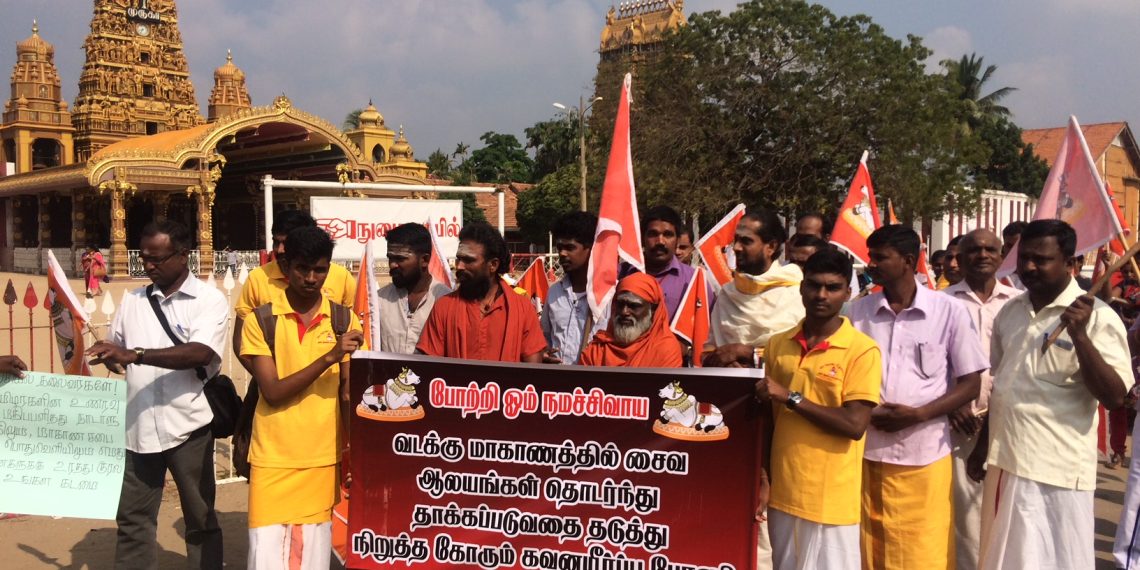
Tamils flag escalating attacks on Hindu temples in northern Sri Lanka

Tamils in Sri Lanka have witnessed an escalation in the attack on Hindu temples in recent weeks, a trend that they note is part of the State’s “ongoing Sinhalisation project” in the island’s north.

In recent weeks, Tamil media reported multiple incidents of vandalism at temples, where Hindu deities were found missing or damaged. In Jaffna, some Tamils have sought to counter the trend by placing a Hindu deity in a public space, prompting police to petition the court seeking its removal. Several Tamil political parties have called for a protest on April 25 against the recent temple attacks, among other issues.

Simultaneously, Tamils also point to an increase in the number of new Buddhist structures and shrines coming up in the Northern Province, where Hindus form the largest religious group, followed by Christians and Muslims, with Buddhists in the fourth place.

The developments come amid heightening activity of Sri Lanka’s Department of Archaeology in the Tamil-majority north and east. Authorities have restricted public access to some temples, citing ongoing “archaeological research” in the historic sites. In one instance, media reported the arrest of a youth who attempted to worship at a temple in Vedukkunarimalai, Vavuniya. A large protest was held in the area last month protesting the vandalism of idols at this temple.

Jaffna legislator and Tamil National People’s Front Leader Gajendrakumar Ponnambalam sees the incidents as part of a larger, persistent assault on Tamils’ rights, including to worship. Ever since the end of the war, consecutive governments have “accelerated the Sinhalization” of the north and east, he said, “as if to catch up with the gap of the 30 years during the war that they missed out on.”

The Aiyanar temple at Kurunthurmalai, Mullaitivu, has remained controversial amid a rapid increase in Buddhist structures on its premises in the last few years. Despite a court order preventing any new religious installations at the spot, a state minister in 2021 led a ceremony to place a Buddhist statue at the site, in the presence of military men and archaeological department officials. Similar contestations on land have also been reported in the east.

“The Rajapaksas spearheaded this [Sinhalisation] project, but that doesn’t mean the attitude of [President] Ranil Wickremesinghe or [Leader of Opposition] Sajith Premadasa is any different,” he told The Hindu. Recalling the manifesto of Mr. Wickremesinghe’s United National Party, ahead of the 2018 local government elections, the MP said: “It stated that their government will rebuild 1,000 Buddhist viharas [temples], a vast majority of them claimed to be in the north and east. Mr. Sajith was the Minister in charge of this project.”

Mr. Ponnambalam said Tamils have been struggling against “this genocidal agenda”, of “erasing the Tamil identity” of the north and east. “It is utter desperation that led [Tamils] to take up arms. Well, now that the Tamil armed struggle was crushed, we are back to business as usual.”

M.A. Sumanthiran, Jaffna legislator for the ITAK and a senior lawyer, is appearing for Hindu religious groups in multiple legal battles where temple land, or access, is being contested by authorities. There is “very clearly, a pattern and an agenda” seen in the escalating instances of attacks and vandalism on Hindu temple deities across the north, he noted.

Mr. Sumanthiran, too, accused authorities of pursuing a project of “Sinhalisation”, targeting places of worship of the Tamils, based on claims that these are archeological sites, implying they have a Sinhala heritage. “To start with, even if these sites had archeological evidence of some Buddhist heritage, it may not necessarily be Sinhalese, because we know that Tamil Buddhists have lived in the north,” he told The Hindu.

Observing that the Sri Lankan Constitution guarantees every citizen the right to worship, or to not worship, he said: “This Sinhalisation project cannot be countered by simply acting in competition, by placing more statues or deities. We need sober ways of putting an end to this practice. It needs regulation of the erection of new statues, across religions. Meanwhile, a citizen’s right to worship, which is an absolute right, ought not to be interfered with, irrespective of which religion one follows,” he said.

Some temple administrators have reportedly approached the Indian High Commission on the issue. Further, amid reports of Hindu religious groups also appealing to their Indian counterparts, some Tamils have voiced scepticism. “There have been calls by Sri Lankan Tamil groups to BJP/Indian Hindu groups to intervene and stop the destruction of Hindu temples & construction of Buddhist temples in their place in North & East. This is dangerous and ignores many socio-political realities. BJP is no progressive force,” said human rights activist Ambika Satkunanathan, in a recent Twitter thread. “BJP’s politics is akin to that of the Rajapaksas-they demonise and dehumanise Muslims, Christians and Dalits, portray them as the enemy and as obstacle to building a Hindu state,” she said.

In Mr. Ponnambalam’s view, seeking help from State or Government of India, or any other country, for “a reasonable and just” request is “totally acceptable”. But he cautioned Sri Lankan groups against seeking the help of organisations that have “a very clear political agenda”, which goes beyond religion, and “sees sections of the Tamil Nation in Sri Lanka that belong to different religions as enemies”.

“Help does not come free. It comes with conditions, and the conditions that some of these Hindu organisations lay will ultimately divide the Tamil Nation here,” he said, adding that Tamil nationalism in Sri Lanka had been a reaction to the Sinhala Buddhist ethnocratic state’s policies. “We have therefore insisted that our liberation has to be on the basis of secularism and equality. That aspect, as far as our organisation is concerned, can never be compromised.”

The Department of Archaeology is yet to respond to The Hindu’s query. When contacted, the Governor of the Northern Province Jeevan Thiagarajah said historical places that are religious in character are interpreted in different ways and that there have been “issues around their history”.

“The Department of Archaeology looks into archaeological matters, but there are other departments tasked with looking into religious concerns and unfortunately, they are not out there on the field doing their job. I will take it up with the Ministry [of Culture],” noted the most powerful central government representative in the Province. The Northern Province, like the island’s eight other provinces, is currently under Governor’s rule, owing to the indefinite postponement of provincial council elections. “Sectarianism is not the way forward…we hope not to go down that path,” he said.

Source:The Hindu

Bill to amend the Provincial Councils Elections Act in Parliament on Tuesday

The bill to amend the Provincial Councils Elections Act, No. 2 of 1988 is scheduled to be tabled in Parliament on the 25th of April.

The Private Member Bill by Parliamentarian MA Sumanthiran was published in government gazette in 2019 as the Provincial Councils Elections (Amendment) Bill.

According to MP Sumanthiran, the first reading of the bill will take place on Tuesday.

If Parliament adopts the bill, the delayed Provincial Council elections can be held under the previous voting system.

The Provincial Councils Elections Amendment Bill was passed by Parliament on the 20th of September 2017 with the support of more than two-thirds of the Members of Parliament.

However, it led to the delay of the Provincial Councils elections for more than five years.

China Merchants, Sri Lanka’s Access to build US$392mn logistics hub

China Merchants Port Holdings said it is teaming up with Sri Lanka’s Access Engineering and Colombo port to set up a 392 million dollar logistics centre as a build operate transfer project.

outh Asia Commercial and Logistics Hub, will be a 50-year build operated transfer project with CM Port holding a 70 percent stake and Access Engineering and Sri Lanka Ports Authority holding 15 percent each.

The statement said the project will “result in an infusion of US$ 126 million in addition to an upfront payment of US$ 26 million after the agreement is signed.”

An 8 storey building with a 530,000 cubic metre capacity will be built in the centre of Colombo port. Construction will begin in the second half of 2023 and is expected to be completed by end 2025.

It will be linked to the Katunayake airport via a port access elevated highway.

If will offer services including multi-country consolidation. Container freight station, general warehousing and value added services.

Colombo port has been declared as a ‘freeport’ by the Government of Sri Lanka.

The “will enjoy the associated Freeport advantages in its operations, such as no customs clearance for transshipment and MCC cargo, resulting in reduced paperwork and associated costs,” the statement said.

“The project also provides an ideal platform for the registration of hub companies – which will enjoy tax concessions in CIT, WHT, VAT, etc.”

Posted in Uncategorized

Govt turned Sri Lanka into ‘land of auctions’ – Sajith

Leader of the Opposition Sajith Premadasa alleges that, although the loss-making state institutions need to be reformed, the government is planning to sell off the profit-making state institutions as well.

Making a special statement regarding the IMF’s Extended Fund Facility (EFF), the Opposition Leader claimed that the government failed to secure the best IMF agreement for the country and its people, by reaching out for the global lender at the last moment.

“It is very much clear that loss-making state institutions should be reformed. A bankrupted country cannot maintain the unprofitable state institutions”, he said.

Premadasa further stressed that as a result of the weak policies of the government, plans are afoot to sell off the state institutions to deceitful capitalists for dirt cheap.

“The country has become a ‘land of auctions’ for capitalists across the world”, he alleged.

Sajith Premadasa also claimed that the government should act to create a suitable model for the country by following the models such as Temasek in Singapore and Kazanah in Malaysia, in order to convert the loss-making state institutions into profit-making institutions and the profit-making ones to make more profit.

Posted in Uncategorized

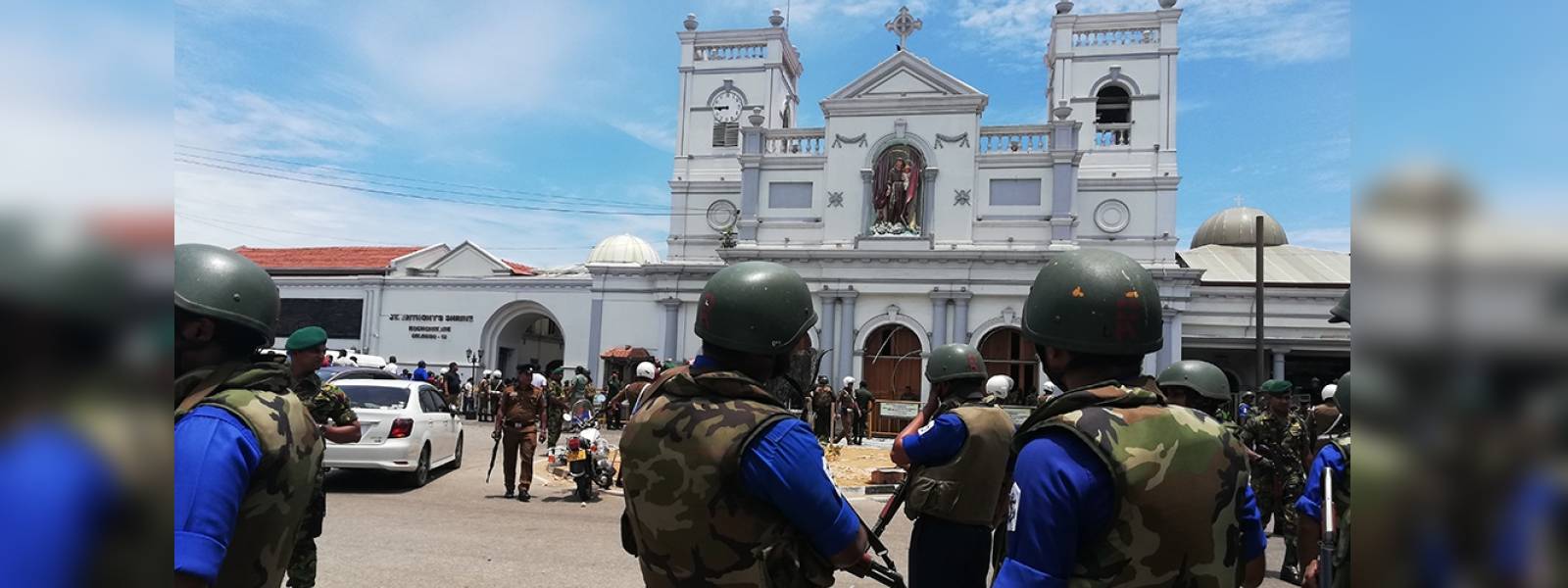
The Smell of Terror -GroundViews

“On land a tiger, in the water a crocodile.” A Bengali proverb

In Sri Lanka terror means Tamil or Muslim. When the J.R. Jayewardene government responded to the ethnic problem not with the promised political reforms but with repression and the PTA was born, the concept of terror (and its prevention) invoked an image. Not of the Tiger chief, for his face was yet to be seared into the collective memory of the Sinhala South, but of the Tamil. Every Tamil symbolised terror, from the politician defending the Eelam demand in parliament to the old woman sweeping the street who knew nothing of a separate state. They were the descendents of South Indian invaders of yore, political heirs of the timeless project of occupying and unmaking this land of Sinhala-Buddhism.

The PTA was thus born and lived most of its 44 year existence as an anti-Tamil law. It was first enacted as a temporary measure when the armed Eelam movement was in its infancy, hardly a movement, just a ragtag band of dreamers and malcontents. Within four years of the PTA’s birth, the fledgling insurgency had turned into a raging war, fed by innumerable political crimes and mistakes, ranging from the burning of the Jaffna library to Black July. Had those atrocities not happened, had a political solution to the ethnic problem been enacted, the Eelam War could have been prevented, with or without the PTA.

So the PTA was a colossal failure. It failed not only to nip the Tamil insurgency in the bud, or to do the same with the JVP insurgency of 1987-89. It also failed to stop the Easter Sunday massacre. The anatomy of that final failure is extensively documented through a number of investigations and inquiries. Revisiting their findings is timely since that tragedy is being used by the administration to push through the potentially more draconian ATA.

The Easter Sunday massacre was preventable. It wasn’t prevented not because the PTA had loopholes but because of “the deplorable want of oversight and inaction…in the conduct of affairs pertaining to security, law and order and intelligence.” That was the Supreme Court in its January 2023 judgement. Information about an impending attack first became available on April 4, 2019, yet the men in charge of ensuring national security and public safety did nothing. That failure happened not because the PTA didn’t confer enough powers on the security establishment but because of their “lack of strategic co-ordination, expertise and preparedness,” as the Supreme Court put it succinctly.

If any one man symbolises this failure, it is Nilantha Jayawardana, the then head of the SIS. He was the first top official to receive concrete information about an impending attack. By April 21, he had in his possession the names of several potential attackers: Mohamed Zaharan, Mohamed Milhan, and Mohamedu Rilwan. If even one of these was arrested, the massacre might not have happened. As the Supreme Court pointed out, “All this shows that there was so much information that was available before Nilantha Jayawardena…but it cannot be said that Nilantha Jayawardena acted with alacrity and promptitude.” The court ruled that disciplinary action must be taken against him within six months, as part of a broader revamping of “security systems and intelligence structures.”

The same point was made by the parliamentary select committee in October 2019. In its final report the committee said that the SIS chief, MOD secretary, IGP, CNI, DMI “failed in their responsibilities. All were informed of the intelligence information prior to the Easter Sunday attacks but failed to take the necessary steps to mitigate or prevent it.” But doing anything about these structural or personnel problems was impossible. Within hours of the attack, the Rajapaksas had blamed the government for permitting it by weakening and demoralising the intelligence agencies. This cry was later taken up by Cardinal Malcolm Ranjith who accused the government of dismantling “The intelligence agencies that were once very strong. This was done to fulfil the needs of international organisations and NGOs.”

Innocents like Hejaaz Hisbullah and Ahnaf Jazim were arrested. The man the Supreme Court singled out for negligence, Nilantha Jayawardana, was made a senior DIG on January 3, 2023. Three and a half months later, he remains in that august position. And the security systems and intelligence structures remain as they were, moving to a beat that has very little to do with national security and public safety. The government is busy pushing the ATA. The opposition and the Cardinal are busy chasing the elusive mastermind. And the Rajapaksas are poised to benefit from both preoccupations.

The Mastermind Syndrome

The idea of a hidden hand, a mysterious mastermind behind the Easter Sunday massacre was birthed and popularised by the Rajapaksa camp. Two days after the massacre, Mahinda Rajapaksa mentioned the possible presence of a foreign hand behind the attack. In the next several weeks, this amorphous foreign hand was given shape and form by his acolytes. Wimal Weerawansa said that the American Ambassador could be behind the attack, with Prime Minister Wickremesinghe’s complicity, to turn us into a Libya or Syria. Udaya Gammanpila informed the parliament that the IS was an American cat’s paw. Americans had Muslims ready, complete with Sinhala names, to attack other Muslims thereby igniting another Black July. Muslim countries would protest and the West would invade in the guise of peacekeeping, he claimed.

These ravings were rendered respectable when Cardinal Malcolm Ranjith joined the bandwagon. In June, at a ceremony to re-consecrate the Katuwapitiya church, he said, “The youth who carried out the bomb attacks were used by the international conspirators…I have seen a report that ISIS leader Abu Bakr al-Bagdhadi is in a military camp which is run by the most powerful country in the world. I won’t mention the name of this country but clearly the ISIS leader is in a military camp which is run by this powerful nation… We question whether this nation knew about the bomb attacks.” The paper was Divina, which was less coy than the cardinal and mentioned the name of the country supposedly hosting the IS chief, the US.

The possible identity of the mastermind changed according to the political climate. At first it was the foreign hand. Later parliamentarian Rishard Bathiudeen became the top contender for the role. Athuraliye Rathana thero began a fast against him. The Catholic Church backed a no-confidence motion by the pro-Rajapaksa opposition against him. He was even arrested during the Gotabaya presidency. Today, for many, the Rajapaksas are the mastermind. Cardinal Malcolm Ranjith even quoted from the parliamentary select committee report to this effect. (The report wondered “whether those with vested interests did not act on intelligence so as to create chaos and instil fear and uncertainty in the country in the lead up to the presidential election.” At that time, the Cardinal didn’t heed the warning.)

The mindless preoccupation with a mastermind is a convenient scapegoat for political and security establishments, as well as for the people. Politicians promise to find the mastermind when in opposition and use the mastermind to evade the difficult task of revamping the security establishment once in power. The security establishment depend on the mastermind to deflect attention from their own culpability. We, the people, need not face how we failed to take a public stand against extremists in our own communities.

When the police came to the Dematagoda house of Ilham Ibrahim, the Shangri La bomber, his pregnant wife detonated a bomb, killing herself, her three children, and unborn baby. What would make a father consent to such a horrendous plan or a mother carry it out? The question, if asked, would compel us to face the dark side of religion, how extreme belief and piety can result in inconceivable horror (this is true of ideological extremisms of the secular variety too). But if we busy ourselves with the forever search for the mastermind, we need not face the role played by Sinhala-Buddhist supremacism and Islamism in preparing the ground for the massacre. We are not guilty for the mastermind did it.

The mastermind obsession also served to discredit the only serious investigation into the massacre carried out by the CID under DIG Ravi Seneviratne and SSP Shani Abeysekara. When President Gotabaya Rajapaksa transferred 700 CID personnel including the members of the investigative teams, hardly anyone protested. The Rajapaksa opposition also boycotted the parliamentary select committee. Both the investigation and the select committee pinpointed how the Rajapaksas’ anti-Muslim campaign played into the hands of Mohamed Zharan and other extremists. As the then acting head of the TID Jagath Vishantha informed the parliamentary select committee, “After the Digana incident they published a lot of posts against Sinhala-Buddhist extremism. And from our Research and Analysis units we could see that they got many comments and likes.” “Zahran started a campaign to radicalise Muslim youth and motivate them to use violence to achieve their ends post March 2018 attacks on Muslims in Digana…” the select committee concluded. “He was able to recruit many by using that incident and the Aluthgama incidents of 2014 to embrace the Islamic State of Syria and Iraq ideology.” The report also highlighted increasing levels of Wahabism and Arabisation in parts of Sri Lanka or rather Saudi-Arabisation.

So without the Rajapaksa’s anti-Muslim campaign, without Aluthgama and Digana, the Easter Sunday massacre could have been prevented just as the long Eelam War could have been avoided if Black July didn’t happen. The key is political, a state and a society that enable moderates of all religions while marginalising extremists of every religion. But those necessary political changes need not even be discussed so long as we can cling to the never ending search for the mastermind. For there will never be a mastermind that can satisfy all the diverse elements who need him.

The problem with the ATA

Shakthika Sathkumara was an award-winning writer and a Sinhala-Buddhist father of three. Fathima Nushara Zarook was a Muslim mother of one who had worked in the Middle East as a housemaid. Mr. Sathkumara was arrested in early April and Ms. Zarook in early May 2019. Both had fallen foul of ICCPR, an international covenant created to protect fundamental rights and was being used to violate them in Sri Lanka.

ICCPR is being wielded against minorities and dissenting Sinhalese via Section 3: “No person shall propagate war or advocate national, racial or religious hatred that contributes incitement to discrimination, hostility or violence.” The proposed ATA includes in its definition of terrorism, “causing destruction or damage to religious or cultural property or heritage.” This clause is ripe for abuse by Sinhala supremacists within and outside the state. For instance, a Muslim woman believed to be wearing a kaftan featuring a dhamma chakka or a Sinhala man writing a story about predation within the Sangha can be deemed guilty of damaging our heritage. Tamils protesting the implanting of a bo sapling in an area without a single Buddhist inhabitant can be accused of damaging cultural property. “Causing serious risk to health and safety of the public or a section thereof’ would be terrorism under ATA. This in a country where Muslims were accused of spreading Covid-19! If passed sans amendments, ATA could create an abusive system like pre-revolutionary Frances’s lettre de cachet. This may not happen under President Wickremesinghe. What about his successors?

The normally fractious opposition is united against the ATA. The Rajapaksas are hedging their bets, waiting to cut the best deal either way. To get the law through the parliament, President Wickremesinghe will need the votes of all SLPPers and not just those backing him. To get that support, he will have to concede whatever pound of flesh the Rajapaksas demand. This is likely to be ministerial posts to Namal Rajapaksa and hardcore acolytes like Johnston Fernando and Rohitha Abeygunawardana, perhaps even premiership for Mahinda Rajapaksa. If the president concedes, that would tarnish his recovering reputation beyond redemption and give a new life to the outdated myth of Ranil Rajapaksa.

The Rajapaksas retain the backing of their devotees, but most of the 6.9 million have long deserted them. Angry at being deceived by the family, burdened by indirect taxes and high rates, they will react with unappeasable anger at any attempt to give cabinet portfolios to men they blame for their condition. This anger may well work against President Wickremesinghe at any future election, especially a presidential poll.

The government’s determination to push the ATA is creating new political fault lines the economy could ill afford. Sri Lanka has avoided Lebanon’s fate and achieved a modicum of stability thanks to President Wickremesinghe’s economic policies. The steady increase in foreign remittances is the latest indication of a country that is on the path to recovery. The focus should be on justice, good governance, and rule of law, specifically preventing incidents like the recent attack on a foreign-owned garment factory by supporters of a Gampaha district state minister. ATA is a diversion from that sensible path. If repressive laws and armed power suffice to maintain status quos, Bastille would still be standing.


US Court orders SL, Hamilton Reserve Bank to submit joint status letter by 12 May

The United States District Court, Southern District of New York last week ordered the Sri Lankan Government and its sovereign bondholder Hamilton Reserve Bank (HRB) to submit a joint status letter by 12 May 2023.

The decision by US District Judge Denise Cote follows a conference held involving the two parties on 20 April.

The Government in early April in its answers to HRB’s Amended Complaint, denied almost all the allegations.

Via its attorneys Clifford Chance US LLP, the Government said the Plaintiff HRB’s claim is barred, in whole or in part, by reason of Sri Lanka’s sovereign immunity. Furthermore the Plaintiff’s claim is barred, in whole or in part, because Plaintiff lacks standing to sue and Plaintiff’s claim is barred, in whole or in part, and/or should be stayed, on the grounds of international comity.

Therefore, Sri Lankan Government respectfully requested the US Court to dismiss HRB’s Amended Complaint with prejudice or, in the alternative, staying proceedings; as well as award Defendant its costs, attorneys’ fees, and such other and further legal and equitable relief as the Court may deem just and proper.

The Daily FT on 10 April exclusively reported (https://www.ft.lk/top-story/SL-s-external-debt-restructuring-bid-suffers-blow/26-747259) United States District Court, Southern District of New York decision to deny Sri Lanka Government’s motion to dismiss the case filed by HRB.

HRB owns over $ 250 million in principal amount of the $ 1 billion worth International Sovereign Bonds (ISBs) issued in 2012. The Bonds matured on 25 July 2022. Hamilton alleged that as a result of Sri Lanka’s default, it is owed $ 250.19 million in principle and $ 7.349 million in accrued interest (before accounting for pre-and post-judgement interest).

HRB, represented by Bleichmar Fonti and Auld LLP and Jenner and Block LLP, initiated this action on 21 June 2022 after which on 21 September Sri Lanka filed a motion to dismiss the complaint.

Sri Lanka in mid-April announced a moratorium on foreign debt repayments including the Bonds and since then has made no payments on the Bonds.

Why did Thowheed Jamath endorse Gotabaya Rajapaksa?

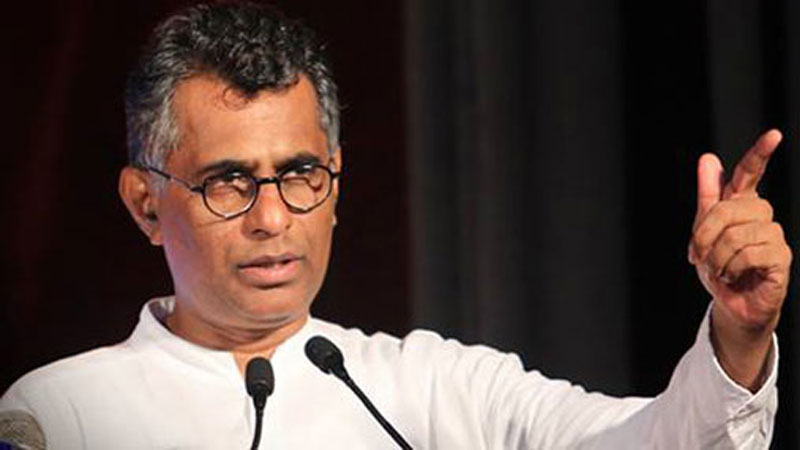
Despite several commissions of inquiry to probe the Easter Sunday attacks of 2019, four unresolved questions remain, MP Patali Champika Ranawaka said.

“There is still no response to the allegations that the Sri Lankan military intelligence fed the Thowheed Jamath organzation.

Why did this organization endorse the election of Gotabaya Rajapaksa?” Ranawaka questioned, adding that he has no confidence that justice will be meted out to the victims of these attacks.

Posted in Uncategorized

Monk appointed as the new SLPP Chairman

The Sri Lanka Podujana Peramuna (SLPP) has appointed a monk as its new Chairman, to replace rebel SLPP MP G.L Peiris.

The Venerable, Professor Uthurawala Dhammarathana Thera was appointed as the SLPP Chairman at the SLPP General Meeting today.

The SLPP had in March sacked party Chairman Prof. G. L. Peiris from his post.

SLPP General Secretary Sagara Kariyawasam said the Executive Committee of the SLPP took a unanimous decision to remove Prof. G. L. Peiris from the post of Chairman.

Kariyawasam said that Prof. G. L. Peiris was invited to attend the meeting but he did not attend.

Prof. G. L. Peiris was Chairman of the SLPP from the day the party was formed.

However, last year Prof. G. L. Peiris and a group of SLPP members crossed over to the opposition benches and sat as Independent MPs in Parliament.