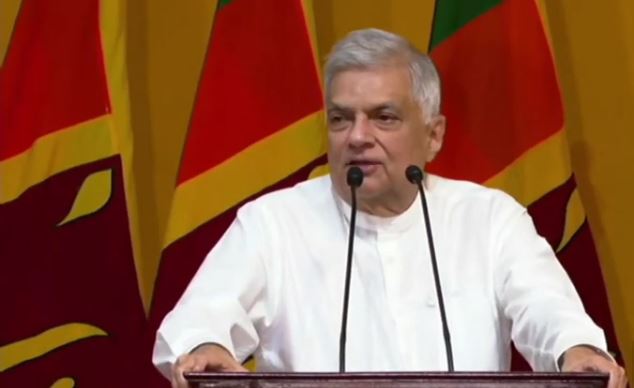
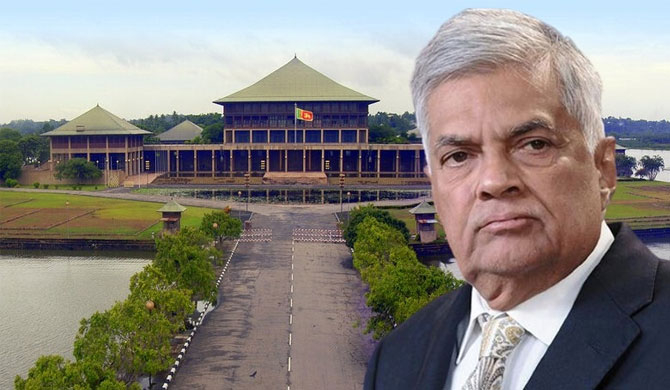
President Ranil Wickremesinghe has emphasized during an interview organized by Harvard University on the 24th, through Zoom technology, that Sri Lanka’s access to the growing Indian and African markets should not be disrupted by any big power rivalry or conflict.
The President also highlighted the rising competition between China and the Quad, which has been further aggravated by the newly formed ‘Aukus’ pact between Australia, the United States, and the United Kingdom. Additionally, he stated that Sri Lanka supports ASEAN’s vision of the Indo-Pacific region and is committed to ensuring the freedom of navigation in the Indian Ocean and the security of undersea cables, as it is essential for the future of the country.
He said that Sri Lanka aims to achieve a significant development goal in the next 25 years by working alongside other countries in the Indian Ocean and South Asia. The government’s 25-year new reformist program will drive the country towards this objective, and the President has invited the entire Sri Lankan youth community, including those living in the diaspora, to actively participate in building a developed Sri Lanka. President Wickremesinghe also stated that Sri Lanka plans to become an upper-middle-income country by 2048, which marks the 100th anniversary of independence from colonial rule, and achieving this goal depends on the country’s commitment to economic reforms.
The President said that as a small country with a strong democratic tradition and an open economy, Sri Lanka has always maintained its political independence and viewed India, its closest neighbor with the longest relations, as the protector of the region. The President also highlighted Sri Lanka’s role in building a new economy by collaborating with the development of the Asian region and India, moving away from the old economy. He suggested that the free trade agreement with India should be elevated to an economic cooperation and technical agreement and expressed his willingness to enter into an agreement with the largest trade group in Asia, the Regional Comprehensive Economic Partnership, which would allow Sri Lanka to continue trading with the largest trade group in the world.
In his discussion on proposed social, economic, and political reforms to create a prosperous and productive Sri Lanka in the next 25 years, the President emphasized the need for equal opportunities and resources to be provided to all ethnic groups, leading to inter-ethnic discussions and mutual understanding to find solutions to the ethnic problem in Sri Lanka. He also stressed that national unity can be strengthened by embracing and celebrating diversity among people.
Following is the full interview of President Ranil Wickremesinghe;
Interviewer
Good morning. My name is Fatima Sumar, and I’m the Executive Director of the Center for International Development (CID) here at Harvard University. On behalf of CID and the Lakshmi Mittal and Family South Asia Institute at Harvard University, I want to welcome you to today’s conversation with President Ranil Wickremesinghe live from Sri Lanka. Mr. President, thank you for being here with us.
The Mittal Institute engages in interdisciplinary research to advance and deepen the understanding of critical issues in South Asia and its relationship with the world. The Center for International Development works across Harvard University and a global network of researchers and practitioners to build, convene and deploy talent to address the world’s pressing challenges. Today’s event originated from a discussion with Harvard students and alumni. As research centers at Harvard who work on complex and difficult issues, we believe robust dialog is critical to understanding all nuances of the current situation in Sri Lanka. We want to acknowledge that people have strong views, emotions and feelings about what is happening in Sri Lanka and of today’s event itself. And what has happened in the country during and after the Civil War is deeply personal to many Sri Lankans, including those who are part of our Harvard community.
Harvard University is committed to open debate and discussion, which are essential to improving public policy and public policy leadership. Harvard acknowledges the rights of our community members to nondisruptive protests and to express dissent as well as the right to access and participate in discussions and events without impediment. We also acknowledge that speakers should have the chance to present their views and to be heard by those who wish to hear them.
We expect speakers to take questions from the audience. And thank you for helping us follow decorum to have the most constructive dialog today. Sri Lanka is at a pivotal moment in its history. The island nation is facing its worst ever economic crisis since it gained independence in 1948. Since 2019, Sri Lankans have faced significant shortages of food, medicine and fuel, as well as skyrocketing inflation.
The economic crisis is estimated to double the poverty rate between 2021 and 2022, increasing the number of poor people by 2.7 million. The news this week of the International Monetary Fund deal raises both hope and questions on the economic trajectory of the country and the reforms ahead. Tough issues remain to be resolved on democratic governance, reconciliation, the postponement of local elections, and the right to peaceful protest among several civil liberties and human rights.
Ranil Wickremesinghe was sworn in as the president of Sri Lanka on the 21st of July 2022. He has been the Prime Minister of Sri Lanka on six occasions. He is the leader of the United National Party, Sri Lanka’s oldest political party founded in 1946, and he has served in all parliaments since 1977. President Wickremesinghe was elected president by parliamentary vote after the People’s Movement Aragalaya or struggle toppled the serving president. Since taking office last year, he has voiced his commitment to restoring economic and political stability to his country. The future of Sri Lanka has important implications, not only for the region but globally as well. In the United States, we are commemorating the 75th anniversary of bilateral relations this year.
Today’s run of show will include a 15 minute address from the president, followed by a discussion with our moderators. Professors Tarun Khanna and Azam Khwaja are both distinguished economists and the respected heads of our centers. They will come to the stage at the 15 minute mark to lead a moderated discussion. Following this dialog and in keeping with Harvard tradition, the President will then welcome questions from the audience.
Mr. President, thank you for joining us here at Harvard today for this important dialog. Let me also acknowledge in our audience the presence of Mahinda Samarasinghe, Sri Lanka’s Ambassador to the United States. Mr. President, the floor is yours. Thank you.
President’s opening speech
Thank you. Distinguished guests and friends. First, I must thank Professor Tarun Khanna and Professor Azam Khwaja for inviting me to join this conversation with you researchers, on Sri Lanka and what’s happening. As you pointed out, the Lakshmi Mittal and Family South Asia Institute has certainly brought South Asia into focus, ably assisted by your Center for International Development.
To save time, let’s start at what happened at the time I took over as president. I became the president of the country amidst the worst economic and political crisis in the 200 years of its modernity. As you said, poverty had doubled to 25% of the population, while 500,000, lost their jobs, the nation’s revenue as a percentage of the GDP fell from 12.5 in 2018 to 8.2 in 2022.
It was insufficient to meet the vital needs of debt servicing, salaries and social protection. The public debt increased to 11% of the GDP. As Sri Lanka moved towards the abyss of economic obliteration, chaos erupted. My predecessor was forced to leave the country and resign. The President’s House the President’s Office, the official residence of the Prime Minister, the Prime Minister’s office, were all occupied by protesters.
My private residence and library was set on fire. Attempt to occupy Parliament and force the Members of Parliament out were prevented by the timely arrival of the army. When I took over, our foreign reserves were down. There was no money in the Treasury. I used to get up every morning going to office and meet with the officials to see where we could find an extra Rs. 100 million, an extra Rs. 200 million. The foreign reserves were such, where there were few days in which we had no foreign reserves. I had $2,000 at home. For once in my life, I was richer than the State. So my first task therefore, was to arrive at a Staff Level Agreement with the IMF. It required price adjustments, a difficult decision to make, but there were no options.
Then came the IMF Extended Fund Facility arrangement approved by the IMF board on 20th March. It’s broadly a four year program of fiscal consolidation from 2023 to 2026. It will also address the twin imbalances of Sri Lanka’s economy, the fiscal deficit and the balance of payments deficit. We agreed on an ambitious program to restore macroeconomic stability and debt restructuring, to achieve economic sustainability.
The program will raise Sri Lanka’s revenue to 15% of the GDP by 2026, improve debt management and control public expenditure. This will make available much needed financial resources for education and healthcare, as well as allowing the expansion of the social safety net and the restoration of price stability. More than the $3 billion that we received from the facility, the value of IMF support is far greater.
The credibility that is attached to the IMF program helps unlock the sources of financing from development partners and the global market in general. Such financing is essential to build Sri Lanka’s foreign reserve. Restoring external financing of our budget will also reduce the need for monetary financing by the Central Bank. Alongside negotiating for the IMF facility, Sri Lanka has embarked on an effort to restructure its debt.
Precise negotiations with creditors on the modalities of restructuring debt will commence now. In reorganizing debt, Sri Lanka will ensure that the stability and integrity of its financial system remain robust and unhindered. All these measures will stabilize the economy by 2026 at the latest. However, this alone is not sufficient. High growth has eluded Sri Lanka in the last few decades.
Unlike the Southeastern nations, we have not been able to seize the opportunity and possibilities arising from the fast changing global economic situation. This program, then, is the defining moment. The current structural reform will release Sri Lanka’s growth potential by enhancing competition, promoting trade liberalization, remove impediments to private investment and implementing climate change programs to put us on a high growth trajectory.
It is my belief that the success and the sustainability of this reform will depend on a new political framework which addresses the requirement of the commitment to reconciliation among the major ethnic groups in the country, leading to a truly collective Sri Lankan identity. Politically settling the bristling issues pertaining to the ethnic groups in the country, is a sine qua non for sustainable and lasting development.
I have been talking with the Tamil Members of Parliament, both in the government and the opposition, to tackle the unresolved issues regarding national reconciliation. The expedition of tracing Tamils missing in action. This is an urgent measure. The issue of Tamil prisoners who were involved in terrorist activities, the release regarding them, operationalizing the National Land Commission under the Constitution, return of the land in the North and East, settling the related issue of the devolution of political power and the implementation of the Presidential Commission report on the violation of human rights, to name a few. In addition, legislation is being prepared for a Truth and Reconciliation Commission alongside a new law to replace the existing Prevention of Terrorism Act.
I will be continuing discussions, this time not only with the Tamil Members of Parliament, but also with other Tamil groups, including the diaspora, and we are setting up a separate Diaspora Office to liaise with the Tamil Diaspora community. We want everyone to be involved in this effort to the commitment to equity, equality, inclusivity, diversity and the genuine empowerment of women.
Sri Lanka is in the process fulfilling its long overdue commitment to the UN Convention on the Elimination of Discrimination Against Women by drafting pieces of legislation, the Gender Equality Act, the Women’s Empowerment Act and the National Commission on Women Act. The Cabinet had already approved the National Policy on Gender Equality and Women’s Empowerment, as well as the Women’s Peace and Security Action Plan.
Third, the youth representation and the Youth Parliament.
The youth have been calling for a genuine, system change. I will be appointing a presidential commission on political parties. We have already made provision for youth representation on the oversight committees of Parliament.
Fourthly, responding to the challenge of climate change and bringing in the climate change legislation and Living Entities Act two take in five areas of Sri Lanka. The protection of the famous Muthurajawela swamp land, and of course, the establishment of a climate change university, the first of its kind to serve the whole Indian Ocean region. And finally, addressing social issues, we are calling for a social contract among all different economic partners, workers, farmers, businessmen, so that we all benefit from the growth agenda. It’s not a question of few benefiting and others losing out.
There’ll also be a social justice commission to inquire into areas which are called remedies by the state. Looking beyond the short- term debt restructuring strategy and imbalances, we need to take this crunch as an opportunity to transform the economy, to face the complex and multifaceted demands of the mid 21st century forged by mass globalization, massive digitalization, high tech, multicity of information, automation, impending artificial intelligence, climate change and ecological response unit. Fresh understanding of plurality, diversity, and inclusivity as well as the instabilities of the postmodern condition.
This requires a new economic model founded on a highly competitive, export oriented economy and environment friendly green and blue economy and a digital economy. Professor Ricardo Hausmann, who is from Harvard, has already been doing work on the competitiveness of the Sri Lankan economy and will be carrying forward that work and I hope that he will be in Sri Lanka very soon.
The restructuring and the regional Sri Lanka economy over the next 25 years is expected to bring about a high growth trajectory in the medium term and to meet the following long term goals economic growth of 7 to 8%. This is possible. We had it once for a short period. Increase international trade by more than 100% of the GDP.
Annual growth of USD 3 billion from new exports going up to the next ten years, and also for the next ten years, annually attracting $3 billion of investment. An internationally competitive workforce with market responsive skills, coming about in the next ten years, which will also require changes in our vocational and university education. And we will build on our natural advantages.
Firstly, the modernization of agriculture and fisheries sector. Then to make Sri Lanka a regional logistics center, we will build up diversity in tourism. Not merely the traditional tourists who come in to Sri Lanka. We will explore Sri Lanka’s potential for green hydrogen and by digitalizing the economy and introducing automation; we aim to leapfrog into industry four for our manufacturing and services.
That’s a ten year span, not a two year span. As I said before, the is an ambitious program for 25 years that will make Sri Lanka a high middle income country when it reaches its century of independence from colonial rule in 2048. This is not impossible. From 1977 in ten years, we carried out a massive land development and reservoir program, which originally was to take 30 years.
We’ve opened up in that period a number of free trade zones. We established a large number of factories for exports. It is a question of the will to repeat this by going in to further economic reforms. Then, if we are to do so, we also have to make use of our location in the region, our strategic location being an advantage; we also have to face two immediate problems. Firstly, the lack of economic integration in South Asia. Apart from a few lukewarm efforts, there has been no sincere political will to amalgamate the region’s economies into a powerful trading bloc. And it is further complicated by the flagging India-Pakistan relations. To move forward then, Sri Lanka needs trade integration with many of its neighboring countries.
Firstly, we will upgrade the free trade agreement with India to an economic cooperation and technical agreement. This is essential. India is going to be the next growth center and it will trigger off growth in South Asia. We are just 22 miles away and we have to work especially to ensure that the synergies of Sri Lanka and Tamil Nadu are brought together.
Secondly, we’d like to come to an agreement with the right to see the Regional Comprehensive Economic Partnership, Asia’s largest trade bloc. But that will bring us to make the largest trade bloc in the world. And finally, as we go along, we would also like to join the comprehensive progressive Trade Agreement. With this, Sri Lanka will be integrated with the three largest trade blocs, India, RCEP and the Comprehensive and Progressive Agreement for Trans-Pacific Partnership (CPTPP).
This exercise will also determine the level of competitiveness and thereby provide the vital push for growth. The other sticky issue that we need to make into account is the smoldering big power rivalry in the Indian Ocean. While our island has always maintained its political independence, India is regarded as the net security provider in the region and is Sri Lanka’s closest neighbour and the country which we have the longest ties with.
Sri Lanka is also a member of the Belt and Road Initiative. However, the presence of the Chinese Sea Fleet ships and the formation of the Quad, the security dialog between Australia, India, Japan and US have complicated peace and security in the Indian Ocean. We have close ties with all the members of the Quad as well as China.
The rising level of competition between China and the Quad has further been aggravated by the newly formed ‘Aukus’, the pact between Australia United States and United Kingdom. Sri Lanka, accepts the ASEAN outlook on the Indo-Pacific territories. We regard the Indo-Pacific as consisting of two distinct oceans. Our country is committed to the freedom of navigation and the security of undersea cables in the Indian Ocean.
Therefore, it is essential for Sri Lanka’s future to ensure that the issues of the Asia Pacific, especially that of Taiwan, does not spill over into the Indian Ocean. Sri Lanka’s access to the growing Indian market as well as the opening of African markets cannot be disrupted and should not be disrupted by big power, rivalry or conflict. So this is a story of a country, a small country, but a country with a strong democratic tradition, with an open economy which has been nonaligned, of arising out of the ashes of its old economy, to build a new economy going hand-in-hand with the developments in the Asian region and India.
So that’s our future. It may be a difficult task, but it is not an impossible task. We have to apply ourselves and we are confident that with the rest of the Indian Ocean countries and South Asia, we will grow in the next 25 years. So I must thank you for having invited me and I hope that I kept the time limit and I was able to complete this before my 15 minutes was up.
Thank you.
Interviewer
Actually, it’s pretty impressive, you are as impressive as the last time I met you. Mr. President, thank you for commenting on your presidency and taking over the presidency and reminding the audience of the circumstances and the difficult time that Sri Lanka found itself in and finds itself in. And for also starting to paint a vision not just for the next few years, but also for all the way up to 2048, which would be the 100th anniversary of the modern Sri Lankan state.
Mr. President, you were part of the past recent administration that some would say borrowed at relatively high rates for projects that sometimes the economists look at it and they wonder about the wisdom of some of the projects. The past administration also rushed through agricultural policy changes in ways that backfired.
So all compromising your beautiful country’s ability to respond to the shocks that, of course, none of us could have foreseen caused by the tragedy in Ukraine having to do with food and fuel prices. Congratulations on the recent IMF deal. But I’ll remind the audience that it’s your seventeenth deal with the IMF. And as you observed or hinted, it stabilizes things for now, but it doesn’t buy enough in itself and position you for growth in the future.
That requires many more very difficult changes. As the audience will recall, GDP last year contracted by 9%. Most observers say that it will contract again by 6%. Inflation has not budged in the last few months. It’s still in excess of 50%. I salute you for taking on this task. But why should your countrymen and countrywomen trust your stewardship in the years to come?
President
I was the only person who said that we still need the help of the IMF.
I said that in 2020, told them to go to the IMF in 2021 and again, I pleaded with the then president, don’t delay, Go to the IMF. That didn’t happen. In 2002 when we had negative growth, as prime minister I ensured that I turned the economy around the next year. In 2015, when we came into power again, we had economic problems.
But from 2016 to 2018, we were able to achieve the main goal of a surplus in the primary budget. Now, these are the achievements, and if we had kept on with that program, we certainly wouldn’t have faced this problem at this time. So I think that people looked at me as being the only person who could resolve the issue.
And I felt I had a duty to the country to come out at that time and take over this job. After all, the president offered it to the opposition. The opposition refused to take the job. There were no takers when I went in, and that’s how I went ahead. And now that I have delivered the results, I think the people will come along with me.
Interviewer
Well, I hope the people support you in this. As you know, there are many tough decisions ahead. And I’m just reflecting on several difficult circumstances that countries that are in the middle of IMF-supported recovery processes, and procedures often find themselves in. I assume you’d have to do something about, for instance, your state-owned enterprises to make sure that they are operating at efficient levels.
Usually, it goes hand in glove with more unemployment potentially, or having to redo something about the workforce. In your comments, you spoke about a need to develop human capital in the future. But the immediacy of change strikes me as being a very difficult pill for Sri Lankans already suffering, to swallow. How will you handle that in the immediate term?
President
The state enterprises are a problem. They are not efficient. And the money we spent in subsidizing some of them, like the Petroleum Corporation, the Electricity Board and our airlines, is more than the total sum we have spent on education and health in the corresponding period. So there are two issues we have. We are tackling one which is that the state will not subsidize state enterprises anymore.
It will be left for the enterprises to ensure efficiency. Secondly, we are of the view that the state must get out of business. So, in many of them, we would like to call for bids to hand them over to the private sector. But the state will stay on in the financial sector. Outside that we are open.
Interviewer
I heard lots of things in your statement which were very encouraging about growth, about green growth, about getting the participation of other sectors, about inclusive growth, and all that. I didn’t hear as much about social protection programs. Can you just walk us through how you were thinking, because behind a lot of the current crises and a lot of the resistance, a lot of the protests is this notion that the poor are being taken care of. What are the big social protection programs you’re including? How do you think they will reach the poor? Do you have a sense of how they will be received by those who are expressing some of the concerns right now?
President
Well, firstly, we stepped into the rice market last year. There wasn’t sufficient rice. And this year we said we will buy paddy at Rs100 a kg. Rice was selling at about Rs 80 to 85 below the cost of production. Today, Rice has been produced at about Rs 100 to 204 a kg. In addition, the government will supply 20 kilograms of rice free to 2.8 million families that are at the lowest end of the income groups.
The social protection net is being restructured. We find that about 30 to 40% of the people on the social protection net system are not entitled to the awards. They are not entitled to receive these benefits, and there is a larger number who should be in it. So there is a reform of the society and the beneficiaries of the social protection net.
Next one needs to ensure that we receive better results on the money we spend for education and for health. So this is what we are working on. We should ensure as far as we are concerned, we have the maximum benefit of every rupee we spend on health and we spend on education. Our focus at this moment is on these issues.
We are talking with the banks of how we can help some of the small and medium industries that have got into financial difficulties and how we can revive employment for a large number of people who lost their jobs. It is not easy and we are living in a difficult time. I admit that. There are families which skip one meal.
At least now they can have two meals. As the people who find it very difficult overnight when the dollar, the exchange rate for the dollar had gone up from 185 to 385. Everyone, all of us found life very difficult. And we have to ensure that the people who are the lowest income earners are protected. The rural areas seem to be picking up.
But what concern me is the urban and the semi-urban areas, especially in the Western Province, where they have no chance of resorting to agriculture.
Interviewer
Mr. President, it was really nice to hear you reference our colleague Ricardo at the Kennedy School. And it suggests that you are open to receiving ideas from outside, and I made the comment about the targeting of the social programs which makes me think about my own country of India, where the targeting of social programs is improved dramatically in the last ten years because of the tech stack and the biometric identity.
Just a note for the audience. I want to switch gears a little bit to our other big neighbor, China. My colleague Assam, who is from Pakistan originally, reminds us that Pakistan is engaged in a number of belt and road deals also that are very similar to the port deal that Sri Lanka signed sometime back when I was last in Colombo, I think it was in January of right before COVID hit.
All my Sri Lankan classmates from this university who were in Colombo and former students were asking, why do the Chinese own the Port? What would you say to that? There are not that many container ships going through it right now either.
President
So what’s the question you want me to answer?
Interviewer
Why do the Chinese own the port?
President
The Chinese don’t own the port. We own the port, but we have given all the operations of the port to China Merchants. This is because we found that the Colombo Port Authority was unable to manage the port, and we were making big losses. There were no takers for the port, except China Merchant. Our other option was to close it.
But the security of the port is controlled by the Government of Sri Lanka, the Southern Command of Sri Lanka’s Navy will be in Hambantota. A number of US and Japanese warships have visited the port. The port has no basic military value. The Chinese will not use it for military purposes. They can’t. We have had regular consultations with the US in regard to this port as well as dealings with the Chinese.
But looking at the arrangement at the ports that the Chinese are building in Africa and somewhere in the Bay of Bengal, this will be certainly a crucial port as far as commercial activities are concerned. I think this will be one of the ports where the goods are assembled and reshipped to other destinations. I can’t see a military use for it and the Chinese haven’t the ability to have a large number of warships in the Indian Ocean any way, to counter India and the US.
Interviewer
Mr. President, moving on to sort of social issues, yet as we think of the crisis Sri Lanka is going through, the past is very much part of the present. There were accusations of massive human rights violations and large-scale violence that the government also took part in during the Civil War, including longtime suppression of Tamil, and Muslim minority rights, and restricting the free press.
There are concerns that this trend is continuing. The day after your inauguration in July, military and police forces were used against protesters in Colombo with more than 50 people, including lawyers and journalists, beaten and injured. The Human Rights Watch has reported that the Prevention of Terrorism Act has been used to detain individuals without charges or due process. Even here today at Harvard, students are peacefully protesting and raising their concerns. Governments often suppress and discredit protesters by labeling them as anti-nationalist and problematic. Alternatively, one can instead view protesters as deeply patriotic and helpful. People who care so much about their country that they are willing to risk so much. Mr. President, can you let us know which of these two contrasting views of protesters does your government have and how do you plan to listen to and act upon their concerns?
President
Firstly, after the war was over, the then president Mahinda Rajapaksa and the then Secretary-General of the UN, Ban Ki-moon, came to an agreement that we have yet to fulfill. And I have committed myself to fulfil those demands. I have already been advocating reconciliation with the Tamils. I have lost elections because I have advocated reconciliation with the Tamils and now I am going through the steps which I have discussed with the Tamil parties and I am willing to discuss with the diaspora.
So I cannot be accused at any stage of dealing with any of these instances. Now, the Human Rights Watch talks up, protesters being beaten up the day after I became president. Not so, that there were protesters, as I mentioned, who are trying to take over parliament. And it was at that stage that the police intervened. My house was burned.
I lost 3000 books that were burnt by some of the protesters, some of whom were very educated people. I am repairing the president’s house, which is costing us about Rs 2 to 3 billion. And some of the historic paintings and others are missing. So amidst the protesters who went in, were also rogues and others. As far as we are concerned, I would not have allowed anyone to come into the house just as much as you are having inquiries in regard to the January 6th riots.
So if you can prevent the capital from being taken over, why is it that you can’t prevent the Sri Lankan parliament from being taken over? Why is it that you are using these double standards? I believe in peaceful protests and that’s one thing that can’t be said against me. As Prime Minister, I brought in legislation that did away with criminal defamation.
We are the only country in South Asia without criminal defamation. I brought in the right to information Act. Three times I brought in the Constitutional Amendment which established independent commissions, including the Human Rights Commissions. Now, why should I go and stop all this? I am the one who has done it. Why should I suppress their rights? But we had a time when the Parliament and the whole system was under threat and that was the time that the army stepped in.
At that time, yes, two people were taken in under the Prevention of Terrorism Act. Isn’t taking over the government offices, taking over the prime minister’s offices, and marching on to parliament, what do you call that? To say that we are going to overthrow the government. But I sorted it out.
Once the period was over and things had cooled off, we let them go. I could have kept them on for months and months. No, I didn’t do that because we want democracy to function. But at the same time, the protests have to be peaceful. Now, the teachers went on strike. The parents also went on strike against the teachers.
So that’s the type of protest that goes on. So what the Human Rights Watch put down here is without inquiry and I am meeting with Amnesty International in the next few days, if I had anything to hide, I will not meet with Amnesty International.
Interviewer
Mr President, I appreciate that. Just one follow-up on that. We talked about the Prevention of Terrorism Act. It’s been used. I’m just curious about your thoughts on the future use of that act, but also what concrete steps are you taking to restore the rights for peaceful protest and release those who were detained without due process?
President
Firstly, the right to peaceful protest is there, and a lot of people are protesting. It happens when there is violence. There are two groups that say that we want to clash with the government. We are going to overthrow the government. That is what you called the Progressive Socialist Front. So What can you do if they come in, clash with the government, and police and if they are not at all peaceful? That’s all that I could tell you. As far as people who were detained, there were three people whom we detained and they have all been released. Before the three-month period was up to extend the detention, they were released as things in the country were peaceful. And I was hoping that they will not go on the rampage again. Unfortunately, they are on a rampage. So what can I do then? The police will appear. I’m certainly not using the detention powers of the president. The rest of the detentions will be by the courts.
Interviewer
Thank you, Mr. President. Just for the record, we are not giving the U.S. a free pass either. There are plenty of contests that can restrict society, as you know. It’s good to hear of your future and continued commitment to human rights.
Questions by the audience
Yes. Thank you, Mr. President. Given that you spoke about the importance of the social contract and Sri Lanka’s democratic tradition, and given that the public has so far not tended to see the formation of your current administration what is the importance you place on the conducting of local government elections and what is your commitment to ensuring that they will take place now that they have rescheduled it?
President’s response
My government has been confirmed by Parliament as required by the Constitution, and the constitution is valid. I don’t think anyone can question it. In our parliament, if the presidency becomes vacant, you have to elect the President. In your system, if the Vice President who becomes the president.
In parliament, I have asked all parties to support me. The government can get legislation through. As far as the local elections are concerned, there was also a call and I also mentioned it, to appoint a delimitation commission to reduce the number of members from 8000 to 4000. They think there are too many politicians at the local level and that also legislation which had been brought to ensure 25% of youth representation in the local authorities.
So when the elections are called before that and also when they asked me, I said the economy won’t be really functioning till about June. In any case, when the elections were called, there were two sets of cases. Elections are called as a result of two parties going to the Supreme Court and asking for elections. We had the election commission agree.
Then two other parties went to Supreme Court and said to stop the elections. Now that case is going on. That’s all that has happened. But once the Supreme Court decides what the cases are, then we will go ahead accordingly. Remember, this is not the first time that the holding of local authority elections has been dragged, to the last moment.
When I was prime minister the opposition and the government and the parliament couldn’t agree on the delimitation. And again, the elections dragged on and were not held for a year and a half. At that stage, the Supreme Court stepped in and said the elections must be held. It has gone on for long enough. If the parties can’t agree now, the same parties who were in that government with me and who had no problem when the elections were postponed by one year are now complaining that elections should be held immediately.
In both instances, the courts had to decide. In earlier instances also the court had to decide. unlike the presidential elections and the parliamentary elections, which dates are fixed by the constitution. So these are issues that have been going to court not once, not twice, even earlier, the holding of local authority elections. And once the court decides, we will go ahead.
If they say yes, you have to hold it. If they say no, then they have to think of another date. That’s all.
Question 1
Thank you, Mr. President. you mentioned it’s a turning point for the country and in building the nation of Sri Lanka. Could you talk specifically about queer rights and protection?
Question 2
My parents are originally from Sri Lanka. We left Jaffna during the Civil War. And so my question is related to that. And I recently sanctioned both Mahinda and Gotabaya Rajapaksa for gross violations of human rights, coupled with credible allegations of economic crimes that forced them from power.
How does Sri Lanka intend to hold the Rajapaksas accountable for violations of domestic and international law.?
Question 3
So Sri Lanka has the world’s second-highest number of UN-registered enforced disappearances. The Office of Missing Persons, which was established in 2017 under a government you’re a part of, has been touted as a sign of progress, despite the fact it has yet to resolve a single case. How does your government plan to tangibly meet Sri Lanka’s international commitments to provide answers on the missing?
President’s response
Okay. On the first question on queer rights, as our law now stands, homosexuality is an offense under the Penal Code, but it has not been enforced for the last five decades to my knowledge. Certainly, the government will or will not enforce that law. But now a group of parliamentarians are discussing, and most probably will take action to bring legislation to repeal this provision of the penal code.
I know the discussions are going on and maybe at some stage they will bring the resolution, the law, to Parliament.
Then comes the next question. You asked me about the missing persons. We’ve had the missing persons office and the missing persons Office started in 217, but some of the work was slow at that time, I admit it. And now they have really appointed a large number of committees to go into the missing persons and they are hoping to clear a few thousand cases this year.
In addition to it, where they feel a person is missing, We are setting up the Truth and Reconciliation Commission. At the moment, two of our ministers are in South Africa holding discussions with the South African government. So, the cases could be referred there.
When we were in government in 2015 to 2019, many allegations of corruption were actually investigated and action was filed against many members, including some in the Rajapaksa family. There was no evidence against the others. So thats what we have done and the courts are still hearing the cases. Some, I think, have been concluded. Others are being heard so we are trying them under our own system.
We do not accept the Canadian jurisdiction on this matter. We feel it is a matter for the Sri Lankan courts. And we are not members of the international Criminal Court. So we will go ahead and whenever there is evidence, we will investigate and take action. I know the sufferings that you all have gone through in Jaffna. I know how much the war affected you all.
I know how much how many people had to leave Jaffna and to leave Sri Lanka. Finally, not only Tamils, but Sinhalese, Muslims have also had to leave the country. I realize the pain that the Tamils have of having to leave their property, of losing their loved ones. I certainly understand that. And that’s why we have set up the Truth and Reconciliation Commission to go into those cases.
But while we find out the truth and decide what to do in those cases, we must also go in for reconciliation. So I would like everyone to join and let’s all work together to ensure that these problems of Sri Lanka are resolved. It’s a terrible experience. I’ve been through it all. I’ve seen so many people killed, both Tamils, Singhalese and Muslims.
I would not like to live through it. And people were killed when the fighting was going on, when they were outside. I know that. I know the pain that you have.
Questions
I’m a Chinese are working India and I’m visiting fellow here. So based on my observation, I find that there is increasing distrust and a vicious, even polarization either in domestic politics or international politics. As a very spirited kind of politician, I think you might have your only observation and thinking. So what’s the deep cause for this kind of increasing distrust and divisions among people, among nations? And what might be the implication for the weaker group or the country and what might be the possible ways for us to get out of this?
Question 2
I’m a fellow at the Kennedy School. My question is about your experience as a legislator for over 40 years and your commitment to re-empowering Parliament and whether before the end of your term as president, you will finally be the President who abolishes the Executive Presidency as many before you have promised.
Question 3
I had a question about Sri Lanka’s relations with its neighbors. And you gave us a rundown about Sri Lanka’s longstanding relationship with India and its projects with China. And now that we’ve seen India and China face off on the border and we see the world dividing. If Sri Lanka was at a crossroads and had to choose between India and China, where do you think that relationship would evolve towards?
Question 4
My question is about the point you were making around reconciliation across all the different ethnic groups in Sri Lanka. And you referenced the presidential commission report and the LLRC. This was drafted in 2011. It hasn’t been implemented and it’s been also considered wholly inadequate. And there have been a lot of challenges that the country has faced since.
What is your new plan to take into account the inadequacies of the LLRC and ensure that there is real national reconciliation overdue?
President
Firstly, one on the nature of politics. Certainly it is becoming more and more confrontational throughout the world and that is unfortunate. The use of television and more of social media has led to this situation in many countries. So politics is now really based on how you divide the numbers so that you can get a majority and cast the minority on your opponent.
So that’s one of the issues that we have here in Sri Lanka. And add to that the ethnic issue that it really is bad that we have we need reconciliation to go ahead.
Secondly, is the question that Asoka asked. Well, at the moment I have only one member of my party in Parliament, so we’ll be first pursuing the issue of electoral reform.
But I’d also like to take and resolve the issue of the Executive Presidency that is not responsible to parliament. A President or a prime minister has to be directly and indirectly responsible to parliament. Yes, but I will have to work toward it. There are two reports that we can work on now. One is the report of the parliamentary committee in the 2015 Parliament, which has gone through many of the items.
And secondly, Romesh de Silva, a constitutional committee report. So we could work on those two reports.
Then comes the third question about Sri Lanka and India and China. So far, I think India and China wants the issue to be bilateral and they have held it. There has been intervention maybe by Russia and others indirectly.
We would like to see that no confrontation breaks out between India and China, India and Pakistan. So far, the situation has held. Though it’s the tensest place in the world with three nuclear powers. None of us want to come to a situation that we had to choose between India and China if there’s a confrontation.
Our job is to ensure that there is no confrontation and the easing of relations. Now, this is going to be a difficult task at the moment when the Quad is operating on one side and China on the other hand, and Ukraine has really raised the level of confrontation between the West, Russia and China though in our part of the world we are not involved in the Ukraine issue and has kept away from taking sides.
But this is why I was worried that the presence of UK in the Indian Ocean and Pacific where they shouldn’t be and there is military power, can make things worse. I think between us in the region we will somehow manage it. So we don’t want the things to become worse and we all like to ensure that we all work with India, China, US, Japan and everyone else.
That’s our aim, not to have big power rivalry in the area.
And Priyanka, yes, there were shortcomings in the LLRC report and other reports. So president, Gotabaya Rajapaksa, appointed a commission headed by Justice Nawaz to look into all these reports and come back with a comprehensive report. They have just handed the report to me and that will cover the what has been said in the earlier reports.
I think that that would resolve most of the issues. But Priyanka, do you come to Sri Lanka anytime?
Answer by Priyanka (from the audience)
Yes, yes.
President
Come next time, let me know. Tell the ambassador, all of you there who wants to know what is happening on the Tamil issue. You can come, you can ask Tarun also, we can invite you to come with the professor. If all of you come down there, we will be more than happy to have the people who are working on it to meet you.
You can meet with the opposition parliamentarians, any other group. We want you to join us because we want young people like Priyanka to tell us what we should do and how we can make Sri Lanka tick again. Are you willing?
Priyanka
Yes, sure.
President
Ambassador, You should get hold of Priyanka and find out when she’s coming and who else wants to come to Sri Lanka.
Priyanka
Mr. President, this is me Priyanka. I am Sri Lankan, and I want to feel at home in my own country and I would be very willing to come back and work as long as the country is also accepting of someone like me who is Tamil and has grown up my whole life there and wants to give back.
But I think that is on you, Mr. President, and your government to make sure that it’s an enabling environment for educated people to come back and join and serve. Because there’s nothing I would love more.
President
I certainly will build an enabling environment. Priyanka But you and your friends must tell me what more has to be done whether its in Colombo or in Jaffna, whether it’s in Nuwara Eliya or Batticaloa? Come and tell me what exactly you think should be done. We will look at what we are going to do and then tell us what else do you feel we should do.
So next time before you come to Sri Lanka, tell the ambassador and I will get all those who are in charge to speak with you and any of your friends. Tamils are a part of Sri Lanka. We are all together, as our national anthem says, we are the children of one mother and our culture is basically intervened.
You can’t remove one. Some of us trace it back to Tamil Nadu, the rest of us Sinhalese trace it back to Kerala. So that that’s the way we are and we have to ensure that the injustices done to the Tamils are remedied.
Interviewer
Mr. President, thank you again for being willing to take and respond to these questions, especially the tougher ones. We fundamentally believe democracy works best when leaders are held accountable to the public. This is true as much in the US as it is in all parts of the world.
I’m just going to end with one sort of which I hope will be a slightly lighter question, perhaps a more contemplative one in cricket parlance.
Mr. President, you have completed a half century in politics. During this time, you have held incredibly important positions. You are now leading your country, as we discussed, in one of its worst crises. There are many challenges ahead, but there are also incredible opportunities. I also understand it’s your birthday today. One’s birthday can often offer a moment of reflection as you reflect, if there is one thing, one thing that’s going to be hard, you would want to be seen as your legacy, to be remembered for by the Sri Lankan people. Both those here and the diaspora. What would that one thing be?
President
Give Sri Lanka a better future. That has been my aim. That is what I have worked for. That is what I have stood for and lost the election because I spoke out openly and that’s what I will do, that the young people here will have a better future than us. And that is why we brought in the 25 year long term vision.