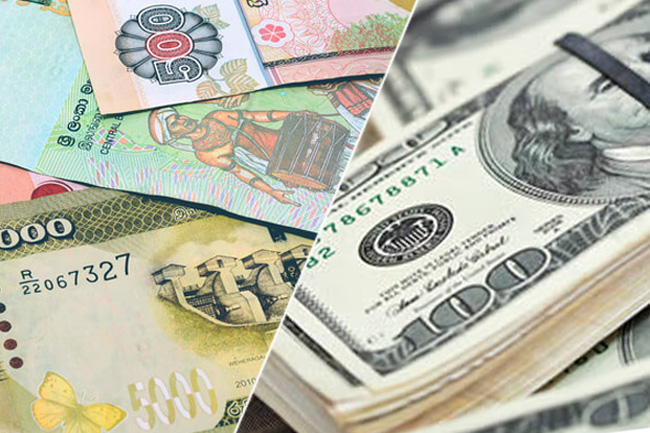
Sri Lanka’s rupee has so far appreciated from around 360 to the US dollar to below 300 to the US dollar in 2023 amid complementary money and exchange policies of the central bank which is creating a virtuous policy cycle.
Currencies of reserve collecting central banks collapse when money and exchange policies conflict and more money than needed is supplied through open market operations, especially after using reserves for imports (sterilizing outflows).
Initial weakness of the soft-peg or a flexible exchange rate, then triggers a loss of confidence and panic, which then snowballs into outflows (flight) and delays in inflows, which requires extra high interest rates to slow domestic credit to match the outflows and reduce domestic investment and consumption.
If policy rates are kept fixed with new injections (reserve sales are sterilized) a vicious cycle of reserves sales and injections take place (contradictory money and exchange policy) until all reserves are lost and a float and a rate hike is forced upon the monetary authority.
Why is the Sri Lanka rupee appreciating now?
The short answer is that the rupee is appreciating, because under Governor Nandalal Weerasinghe, the central bank is not really printing money, credit has been contained with more market determined interest rates, and the currency has been allowed to appreciate by not buying up all the unspent inflows in a given day.
A currency will be under upward pressure if open market or liquidity operations are deflationary (liquidity from dollar purchases is withdrawn from the interbank market) and downward pressure if liquidity operations are inflationary (liquidity is injected through dollar or other asset purchases by the central bank) and the money is used by the domestic credit system and turned into loans.
At the moment domestic credit is weak and some banks, instead of giving loans, have deposited money in the central bank creating what is called a liquidity trap, also known as a private sector sterilization.
The government had also raised taxes and cut spending to reduce the growth of domestic credit. Energy ministry has market priced fuel and electricity. But as seen in 2018, if the central bank continues to print money, the rupee will fall despite hiking taxes and market pricing fuel.
Mostly interest is now being borrowed by the government, which is being rolled over as paper, including within the central bank, which is leading to an expansion of domestic assets of the central bank without any liquidity being released to other banks.
Is the rupee market determined?
No. No good money or stable currency or bad money for that matter, is market determined. That is a common claim made by Mercantilists particularly after the break-up of the Bretton Woods in 1971-73. The mistaken ideas about money originally started to mainstream in the 1920s, which were ideas that were defeated in the earlier century and prevented balance of payments deficits and chronic inflation. A state owned central bank has unlimited powers through open market operations to expand the supply of money, which is usually called ‘monetary policy’. The question of ‘supply’ is therefore a matter of bureaucratic decision. The ability of the central bank officials or economists to create extra money has to be constrained by an anchor, which limits the ability to conduct ‘monetary policy’.
Politicians or legislators have the lawmaking power to control mainstream ‘economists’ through strict laws imposed on the monopoly power given to a central bank of a country to overproduce money, usually through an inflation or exchange rate target. The value of any currency is therefore determined by monetary policy which is constrained by an anchor, not the market.
Before 1971 the anchor was an exchange rate, gold or silver. Gold was a market selected anchor chosen by the people – users of money – in preference to other anchors. Under such a rule, central banks a have an automatic limit to their money printing powers or monetary policy.
How do floating exchange rates work?
Floating exchange rates have targeted either money supply or an inflation index. Inflation targeting has partially failed in the US and EU areas by ‘economists’ trying to create jobs or increase output through liquidity injections. They are now now suffering high inflation due to bad monetary policy and delaying tightening by blaming real economy phenomena like supply chain shocks for inflation. The lower the inflation target, and more transparent the index, the better the stability.
The price or rate of a floating exchange rate is determined purely by monetary policy (interest rate and liquidity operations) with no forex interventions. Clean floating exchange rates backed by appropriate monetary policy have turned out to be very strong and are generally called ‘hard currencies’. Most so-called hard currencies that emerged after the failure of the Bretton Woods soft-pegs are clean floats. The Swiss National Bank is using more complex monetary policy. So is the Singapore Monetary Authority, which is operating on currency board principles.
In other words, the monetary anchor or rule will determine the value of the currency as well as domestic inflation, which are two sides of the same coin. When interest rates are raised and it works through the credit system (transmission mechanism), a floating currency will also appreciate against other currencies (based on their individual credit cycles) as well as real commodities.
Is the rupee a floating exchange rate?
No, the rupee is not a floating exchange rate because the central bank is collecting foreign reserves. It is a soft-peg or flexible exchange rate, which collapses suddenly when extra money is produced through various liquidity windows when credit demand is strong, and appreciates suddenly when liquidity is withdrawn and/or credit demand falls.
In a soft-pegged or flexible exchange rate, where the central bank collects reserves, exchange rate policy (interventions) will influence the value of the currency as well as monetary policy.
These central banks have two anchors, an inflation target (monetary policy) as well as interventions in the forex market (exchange rate policy).
The exchange rate is targeted in a fully discretionary, non-transparent manner, unconstrained by law. The non-transparent, deliberate, discretionary intervention is labelled ‘market determined’.
If the dollar purchase are less than withdrawals of liquidity permitted by a given interest rate regime and domestic credit (monetary policy) the exchange rate will appreciate.
This discretionary power of a money monopoly is sometimes deployed to depreciate a currency to maintain ‘export competitiveness’ based on Mercantilist ideology. The policy triggers inflation, nominal interest rates higher than in countries with floating rates or hard pegs, undermining fiscal metrics, as well as motivating strikes and social unrest, discouraging foreign investment.
So no, the rupee’s value is not market determined. Its value is determined by two anchors. If the two anchors conflict the rupee will fall, if they do not, the rupee will be stable or strengthen.
Are money and exchange rate policies in conflict now?
In recent months, liquidity generated from dollar purchases have disappeared into an overnight liquidity shortage, which has reduced from levels seen at the beginning of the year without being used in the economy. On the other side of the balance sheet of the central bank, the dollars have been loaned to foreign countries as foreign reserves. On December 31, money borrowed (printed) overnight from the central bank was about 561 billion rupees. The volume had fallen to about 120 billion rupees on June 01.
Separately banks have also deposited money in the central bank or kept in their RTGS accounts. The central bank has also bought some Treasury bills outright in partially offsetting amounts.
Conflicting money and exchange policies can be seen as rising domestic assets of a central bank (T-bills holdings) in the red line and falling net foreign assets. As a share of reserve money or the monetary base, net foreign assets decline.
That is what happens in a ‘balance of payments deficit or a currency crisis as seen in the graph. At the moment Treasury bill volumes have not fallen exactly line with foreign assets partly due to interest rollovers.
If interventions are made to build reserves and liquidity is not withdrawn through open market operations, amid weak credit, liquidity will build up until interest rates fall and credit resumes again. Interest rates will fall towards the lower policy corridor. Exchange policy will therefore determine monetary policy in that situation, which comes when an IMF reserve target is met amid weak credit.
Another way of describing a single anchor floating exchange rate is that reserve money will grow in step with domestic assets. In a hard peg reserve money will grow in step with foreign assets. In a soft-peg domestic assets will go up when money and exchange policies conflict in a vicious cycle. Complementary policy – as now will lead to a rise in foreign assets compared to reserve money.
In summary soft-pegs or flexible exchange rates collapse because there are two anchors which conflict in a vicious cycle of exchange interventions followed by liquidity injections to stop rates from going up.
Monetary policy in a country that goes to the IMF frequently, is usually partially constrained by a high inflation target, perhaps double or more of hard currencies, leading to higher inflation and instability than counties with better money.
In a hard peg, where the country has no need to go the IMF, there is only an exchange rate policy and no monetary policy, in other words only one anchor. The exchange rate therefore does not fall.
Are tourism receipts pushing up the currency?
Not really. Higher tourism receipts will widen the trade deficit, in a pegged or floating regime.
Tourism receipts bring inflows and can push up the rupee on the day it is converted only. A part of the receipts is immediately spent by the recipients, like tourism sector workers, directly on imports, say on fuel and foods. A part they may save in banks. The hotel companies will pay for electricity and also repay loans.
If credit demand is strong, these money deposited in banks will be loaned for new investments generating imports and widening the trade deficit. But higher tourism receipts will not create a balance of payment deficit or pressure on the rupee, despite widening the trade deficit.
If the central bank sells a Treasury bill in its portfolio to a bank and takes the deposited cash, or a similar amount of other money, banks will not be able to lend the money to the economy, and there will be a balance of payments surplus and upward pressure on the rupee.
If the central bank buys a Treasury bill and injects money, when credit has recovered, regardless of any tourism receipts, banks will give credit with the new money on top of the tourism receipts. The rupee will be under pressure until interest rates are allowed to go up or reserves are sold to mop up the new money.
So, no. Tourism is not responsible for currency appreciation. The central bank is solely responsible for currency strength. It has the monopoly on creating or destroying money and meeting the real demand for money.
Is the foreign buying of Treasury bills driving up the rupee?
Inflows will only put temporary upward pressure on the day of the conversion if the dollars are sold in the open market. If the central bank buys all the dollars from the foreign investor and creates new money there will be no rupee appreciation. If credit demand is strong, all inflows will eventually be spent by their recipients or loaned by banks and the trade deficit will go up.
If the central bank sells a security and mops up the money from the banking system it created in buying dollars from foreign investors, it will be able to keep the dollars it bought as reserves. If not, the money will be spent by their recipients – the party that sold the Treasury bill to the foreign investor, usually the government.
If the government uses the dollars from Treasury bills to repay foreign loans, the rupee will not appreciate and neither will the trade deficit expand.
Inflows through the financial account will boost imports and widen the trade and current account deficit, but will not create a balance of payments deficit or forex shortage, which is the result of expansionary open market operations or liquidity injections (monetary policy).
Either way it can be seen that monetary policy is the final driver of the exchange rate and foreign reserve changes. That is why large volumes of ‘bridging finance’ last year failed to stabilize the exchange rate or end forex shortages, until rates were raised.
The central bank can also sell a Treasury bill in its portfolio to a foreigner and take the money directly into its reserves without disturbing reserve money or interest rates or domestic credit (a reserve money neutral transaction). IMF loans before budget support loans were done in this manner.
From the foregoing it can be seen that any collecting of reserves and lending to foreign countries involves keeping interest higher than if reserves were not collected.
Are import controls the reason the rupee is appreciating?
Definitely not. Sri Lanka had 3,000 imports under control in 2021 and it eventually led to the biggest reserve losses and imports and eventual default.
At the time the central bank was refusing to roll-over Treasury bills and injecting money and this money was being loaned by banks driving unsustainable credit into permitted areas, for example building material for construction.
Imports of non-essential goods like cars which attract high rates of duty are usually controlled, leading to loss of revenues, more money printing and forex shortages.
Freeing import controls will not lead to a depreciation unless the central bank prints money to keep rates down. If a lot of loans are given to buy cars and the central bank prints money to keep rates down, then the rupee will fall. If not, banks will have to choose between cars and say financing an apartment or some other project, keeping the exchange rate stable.
If banks choose cars which have high tax rates over some other loan, government revenues will go up and interest rates can fall than if a loan was given to a project involving imports of low taxed capital products.
Are IMF loans pushing up the rupee?
No. IMF loans are almost always lower than reserve targets. In addition, IMF loans in the past came directly into the central bank balance sheet and was loaned to the US without disturbing the domestic credit system.
Also IMF gives loans only after the central bank stops the cycle of sterilization and eliminates downward pressure on the rupee through a rate hike and a float. That IMF money drives up the rupee – or any other currency – is media hype.
IMF loans however can give confidence and end or reverse capital flight.
Can an IMF reserve target drive the rupee down?
Yes. Any IMF reserve target, which is not accompanied by a market interest rate to reduce domestic credit can drive the rupee down. Usually in the first year of an IMF program when monetary policy is tight and private credit is weak or negative it is possible to both collect reserves and keep the exchange rate stable. If the central bank can resist the usual Mercantilist demand for a ‘competitive exchange rate’ the currency can appreciate and the economy can recover faster and people will have no ‘pain’.
But in the second year of an IMF program rates are cut when the economy and private credit recovers. Rates are cut because inflation is low under a domestic anchor. The currency then slides if the rate cuts are enforced with domestic assets purchases as money and exchange policies conflict.
When credit demand recovers, and rates are cut, and attempts are made to buy dollars (increase foreign assets of the central bank) without a corresponding decline in domestic assets of the central bank, which is needed to curtail bank credit, the rupee can fall.
Central bank dollar purchases are different from the Treasury purchasing dollars from the market to repay debt, which is similar to the Ceylon Petroleum Corporation buying dollars with rupees already in the system. Central Bank dollar purchases creates new money and expands reserve money. If the dollars are not re-sold when the rupees are used by the former owners of the dollars, or if the cash is not mopped up before use, the currency will fall.
Again, monetary policy is the final driver.
Central bank reserve building is identical to debt repayment. Except that, central bank reserve building is considered ‘below the line’ in BOP calculations. Debt repayment is ‘above the line’ and is part of the capital/financial flows section of the balance of payments. This is one of the reasons why East Asian countries with fixed or semi-fixed exchange rates maintained with deflationary policy, have current account surpluses.
Can a resumption of debt repayments drive the rupee down?
A resumption of debt repayments will be accompanied by a resumption of debt funded foreign aid projects. There are also budget support loans. Resumption of debt repayment can lead to depreciation if the domestic interest rate is insufficient to balance domestic credit at the given ‘flexible’ exchange rate.
This problem is generally explained by what is known as the impossible trinity of monetary policy objectives. In order to maintain a free capital or financial account (free capital flows or debt repayment) at a stable exchange rate, the central bank has to allow interest rates to change accordingly and the necessary changes allowed to take place through the domestic credit system.
That is why in a currency board, or gold standard central bank or in a free banking system when interest rates were market determined, capital flows were free under a fixed exchange rate.
Western central banks started to have balance of payments troubles from the 1920s and the pound Sterling lost its place as the pre-eminent currency in the world and inflation became permanent. J M Keynes thought a current account surplus was required to make external repayments and could not grasp the concept that debt repayments or investments abroad led to an improvement in the current account automatically if interest rates were not manipulated. This false doctrine is known as the ‘transfer problem‘. By the time IMF was created after World War II the false doctrine was fully entrenched in most universities in the UK and US. As a result, when the IMF was created by Keynes and Harry Dexter White, only current transactions were required to be free and capital controls were taken as a given.
West Germany rejected the false doctrine after World War II creating a strong Deutschmark and France after 1960 with the New Franc, under the Reuff-Pinay stabilization plan.
The UK rejected these ideas in 1979 and removed exchange controls. (Colombo/June02/2023 – Updated. Added question on IMF)