Northern Province to produce food to feed the country

The Northern Province is to be transformed into a province that is capable of producing enough food to feed the country, President Ranil Wickremesinghe said.

He also said that steps will be taken to commence the production of animal feed in the North.

“We believe that there will be a surplus of paddy harvest in the ‘Maha Season’. Accordingly, arrangements are being made for the government to purchase a kilo of paddy at a guaranteed price of Rs. 100, the President added.

The President made the remarks while attending the Northern Province harvest ceremony at Paranthan, Jaffna today.

“Many people are currently experiencing financial difficulties. Even if yields increase, there is a segment of the population that lacks the financial means to purchase rice. Therefore, we are implementing a program to provide 10 kilos of rice free of charge to 2 million families during March and April. Then by the Sinhala New Year season, they would have received 20 kilos of rice,” he said.

The President also said that more methods of purchasing and storing paddy will be developed in the future.

Minister of Fisheries Douglas Devananda, President’s Senior Adviser on National Security and Chief of Staff Sagala Ratnayake, President’s Secretary Saman Ekanayake, former Member of Parliament Vijayakala Maheswaran, Chief of Defence Staff General Shavendra Silva, Inspector General of Police C D Wickramaratne and Northern Province Government officials participated at the event.

Posted in Uncategorized

Tamil Nadu BJP president meets CWC leadership for talks

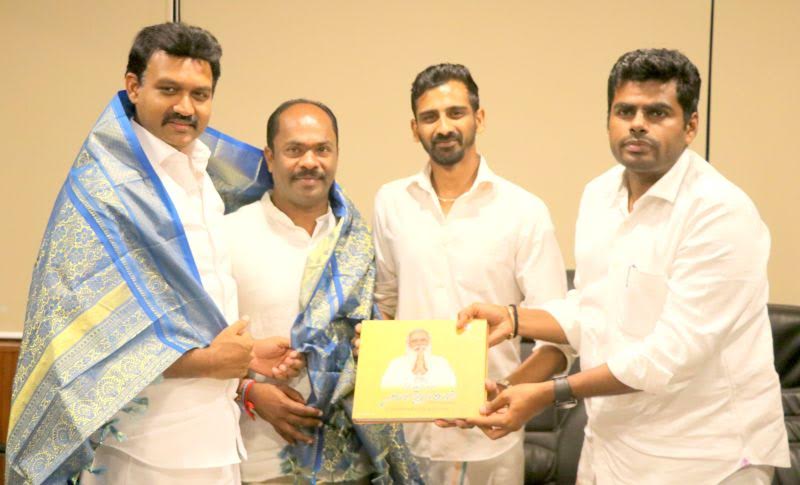
A meeting between the Tamil Nadu president of the Bharatiya Janata Party (BJP) K. Annamalai, who is on a visit to Sri Lanka, and the executive committee of the Ceylon Workers’ Congress (CWC) was held at the headquarters of CWC in Soumya Bhawan.

The Secretary General of CWC and Minister Jeevan Thondaman, President of CWC Senthil Thondaman, Vice President Maruthapandi Rameswaran MP, Vice Presidents Ganapathi Kanagaraj, Anushiya Sivaraja, National Organizer AP Sakthivel, Vice Presidents, Divisional Council Presidents of CWC, and Party dignitaries participated in this meeting, yesterday (11).

Also, a special meeting between the members of the Sri Lankan Indian Community Council and K. Annamalai was held at the Ministry of Water Supply and Estate Infrastructure Development under the leadership of Minister Jeevan Thondaman.

In this meeting, Tamil Nadu State President of the BJP, Annamalai had assured Minister Jeevan Thondaman that he would act as a bridge between the people of the central province and the Central Government of India to provide financial assistance in all possible ways and to speed up the measures to implement the 10,000 houses project in the Central Province.

‘China is our friend and will work with them, Indian interest won’t be undermined’ – Ali Sabry

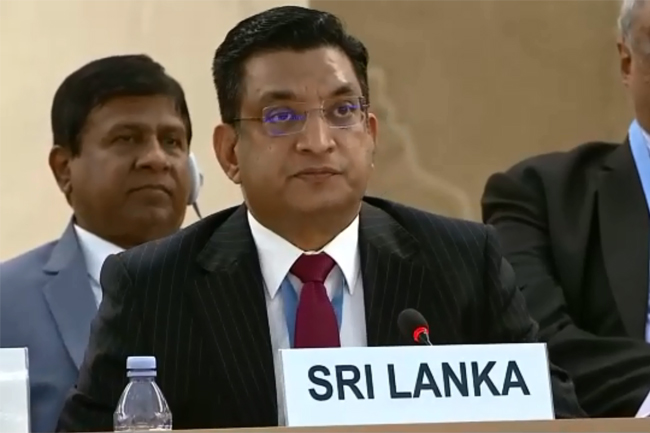
Sri Lankan Minister of Foreign Affairs Ali Sabry on Saturday said that China is a friend of his nation and the two countries will continue to work arm in arm. However, there is no need for India to be concerned as at no point will the island nation let the Indian interests be undermined, Ali Sabry said. Sri Lanka‘s strong relationship is part of its civilization and will not permit any activity that poses a threat to India’s internal security to happen on its soil, he added.

MFA Ali Sabry was speaking to the media in Kerala’s Kochi after attending a private function. His comments come at a time when the Sino-Indian relationship remains tense over conflicts in the Himalayan region.

“India need not worry… The Srilankan relationship with India is very strong, it is a part of civilization. We will not allow anything that will harm India’s internal security in our region. China is also our friend, we need to deal with them and work with them. However, Indian interests will not be undermined. We have made it very clear to the Indian government,” he said.

Ali Sabry further said that the two countries are like a family and when issues arise, they will be sorted out like in a family. “You will always have issues like in a family. We will talk to each other and resolve them. Your honourable fisheries minister is in Colombo right now. Our minister would have met him for dinner yesterday. We will look into it and try to come to a permanent solution. You shouldn’t worry about it,” he said.

The statement can also be read in the context of the Sri Lankan Navy being often accused of assaulting and even arresting Indian fishermen, especially from Tamil Nadu.

Ali Sabry further said that Sri Lanka is happy with the fast-paced development that India is achieving. “It is the entire region that develops along with India. So as neighbours, we are watching India’s progress with great pride and a sense of honour. Sri Lanka is looking forward to India’s growth and will try to be a part of that growth,” the island nation’s MFA added.

Source – Times Now

The 13th Amendment: The Ball Is In The Sinhala Court By A. Jathindra

The 13th Amendment, created 35 years ago, has once again become a flashpoint after President Ranil Wickremesinghe declared its implementation. Anti-devolution forces have begun gnashing their teeth; those who went into hiding because of mass protests and violence over the economic crisis are using it to resurrect and project themselves as the phoenix rising from the ashes to save the Sinhalese again.

The same propaganda game is being played with the old spin that the country is about to be divided. Nothing could be further from the truth: the LTTE, which fought for a separate Tamil state, threw out the amendment and waged a bloody war against the Indian Peace Keeping Forces with the backing of President Ranasinghe Premadasa. How then can the 13th Amendment, much maligned and objected to by the LTTE, lead to the breaking-up of the country? If this point of contention were to be deliberated by the Sinhala South, unnecessary fears can be avoided.

In the south, many need to try to realize the truth. The LTTE chief Prabhakaran was the only one who was adamant on the objective of independent Tamil state (Thamil Eelam). If Prabhakaran had accepted the 13th Amendment and gone along with India, the island’s history would have been on a different trajectory. If Prabhakaran had accepted a federal solution at the Oslo talks and gone along with the peace process, he need not have met his Waterloo in Mullivaikkal.

Given this background, there is no point in debating how the 13th Amendment was introduced in Sri Lanka. The hard truth is that the 13th Amendment remains in the constitution 35 years on, despite efforts to usher in a ‘civilizational constitution’ in the recent past. It is unconstitutional to state that the provisions of the constitution are unenforceable. If this were to be true, one could surmise that the country has governed unconstitutionally for the past 35 years! Why has no one thought along such lines of argument?

Until 1970, no Tamil leader even dreamt of flying overseas for political remedy. Since then, the Tamils had to move towards India due to the south ignoring even the minimal of legitimate political demands of the Tamil moderates. All doors for negotiations were shut by both the United National Party government and the Sri Lanka Freedom Party government that alternately ruled Sri Lanka. The Tamils will inevitably move towards India again if Colombo closes the door.

The south’s view that India imposed the 13th Amendment on Sri Lanka can be challenged. India would not have insisted on a political solution If the Sinhala polity had resolved the Tamil national question within Sri Lanka. Recently, six major Tamil parties joined together and wrote a letter to the Prime Minister of India to intervene in the implementation of the 13th Amendment. It would not have been necessary for the Tamil parties to seek the intervention of the Indian Prime Minister if Colombo had shown progress in implementing the 13th Amendment.

It was against this backdrop that India’s intervention took place. Apart from this, India’s involvement in Sri Lanka is geopolitically inevitable. As an immediate neighbour and regional power, India cannot remain silent while the country burns. The Eelam Tamils have cultural affinities with the eighty million Tamils in Tamil Nadu. On this basis, India had to intervene in the Sri Lankan political issue directly.

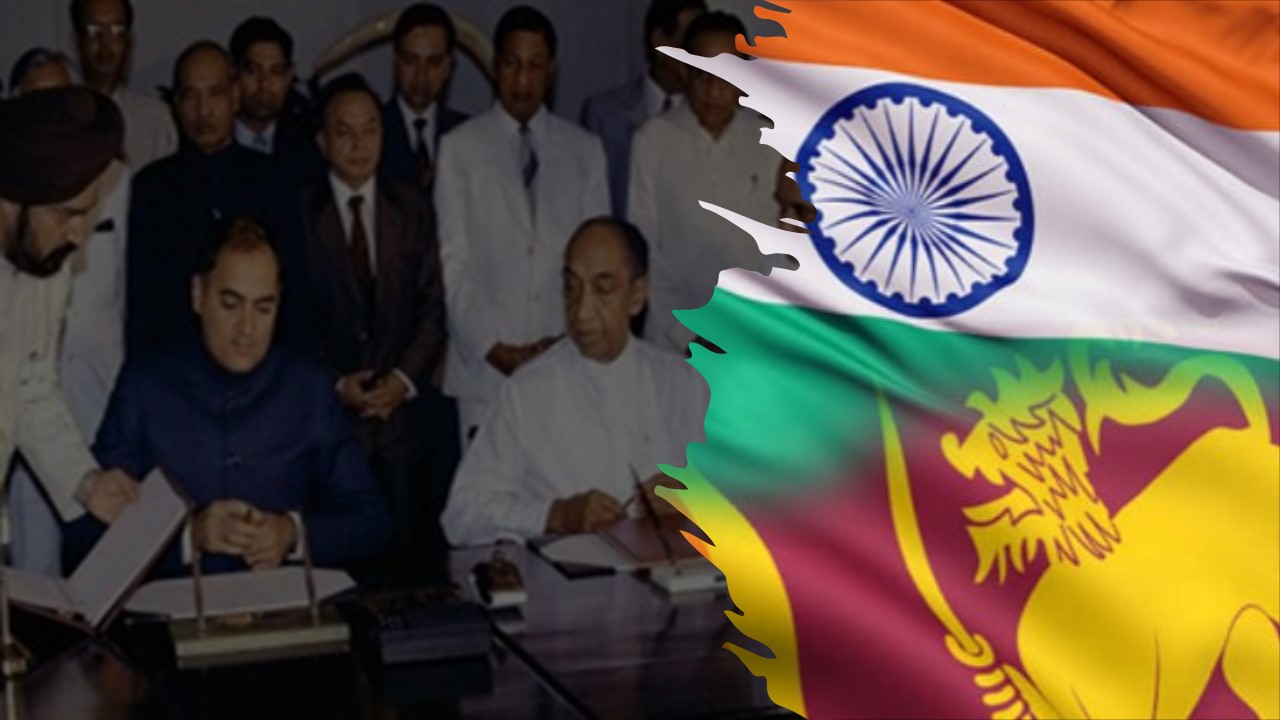
Looking at it another way, the objective of the India-Lanka accord still needs to be fulfilled. One of the main objectives of the Indo-Lanka accord was to conceive a political solution for the Tamil people, who have historically inhabited the North-East. Such a solution is yet to be perfected. Against this backdrop, India is responsible for pushing for the completion of a bilateral agreement. Given this background, the Tamil political parties fighting for the rights of the Tamils have urged India’s mediatory involvement.

The political significance of the amendment has evolved more than before. So far, India has been the only country insisting on it. However, the amendment has now acquired an international dimension. It has been mentioned in the recommendations of the UN Human Rights Council resolution that insists that the Government of Sri Lanka respect local governance, including the holding of elections for provincial councils and ensuring that all provincial councils can operate effectively, in accordance with the thirteenth Amendment to the Constitution of Sri Lanka.

Against this backdrop, the amendment has become central in the post-war reconciliation process. In this context, the ball is now in the Sinhalese court. Because there have been significant changes in the Tamil political environment since the war ended, Tamil nationalist parties have understood the political realities. Most of them understand the practical difficulties in achieving federalism even though they are chanting it for electoral interests. Due to this, demands for implementing the amendment has increased among Tamil parties.

The Sampanthan-Sumanthiran duo believed a new constitution could be brought in during the Ranil-Maithiri regime. It was the last hope of bringing a federal constitution to the island nation. During this period, Sampanthan completely ignored New Delhi. While addressing a meeting held in Colombo, Sampanthan stated that there is no need to talk about 13th Amendment since we have gone beyond it. The failure of this new constitution-making has once again taught a lesson.

It was from this experience that the constituent parties of the Tamil National Alliance (TNA) decided to move away from ignoring the amendment. That later became a letter to the Prime Minister of India. Many in the Tamil intelligentsia had pointed out that engaging in an effort for a new constitution was futile. This author has pointed out in his Tamil writings on various occasions that it is strategically impossible for Tamils to move beyond the 13th Amendment. Sampanthan adamantly refused to realize. Surprisingly, people like Dr Jayampathy Wickramaratne knew the problems; however, they did not try to make Ranil Wickremesinghe and Sampanthan aware of the complex challenges of bringing in a new constitution. The Ranil-Maithri coalition was a great opportunity to take the country forward by implementing the 13th Amendment. President Ranil Wickremesinghe might learn from his experiences.

In any case, Ranil Wickremesinghe has returned and woken up to political realities. The Tamil parties have also returned to the same reality. The opportunity has knocked at the door again. If the amendment is to be abandoned to fulfil the wishes of the fundamentalists in the southern polity, what is next? What is the solution for the Tamil people if the southern polity refuses to implement the constitutional provision?

A small Tamil faction argues that a political solution for the Tamil people can only be found in Sri Lanka with third-party intervention. They completely reject the unitary-based 13th Amendment. Instead, such people argue that a referendum is necessary for Tamil national questions under international monitoring. However, the majority of Tamils want a dignified life in Sri Lanka. If it is denied, then the argument of a minority side will be logically justified. History may answer the question as to what can be expected from those who refuse to give even constitutional provisions to the Tamil people.

Despite international pressure, Colombo did not effort to satisfy Tamil discontent politically in the last thirteen years since the ending of the war. Against this backdrop, the ball is now in the Sinhala court to defend the idea of a united Sri Lanka.

*A. Jathindra, political analyst and head of Centre for Strategic Studies – Trincomalee (CSST)

New departure duty-free shopping opens at Jaffna Int’l airport

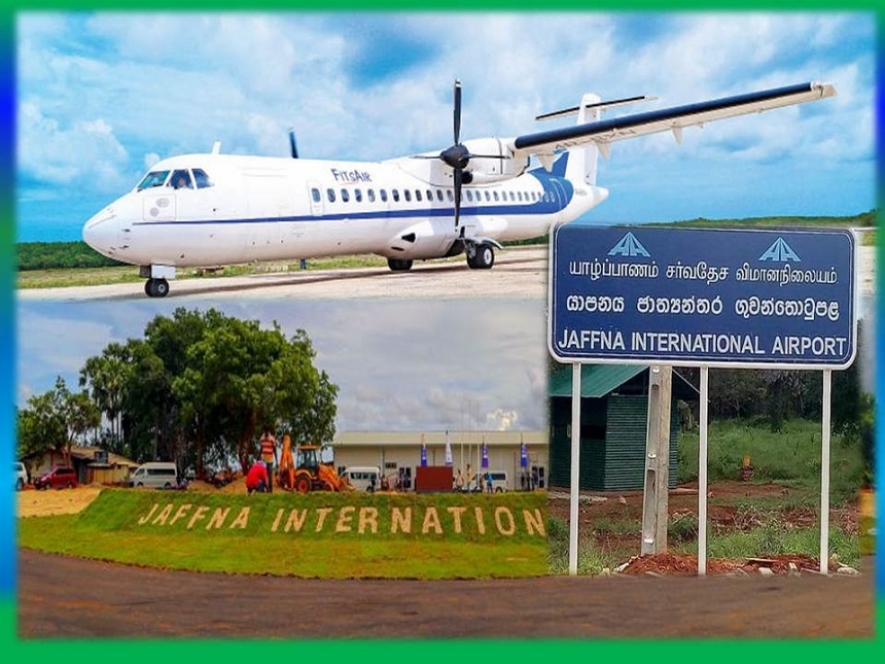
A duty-free shopping facility was declared open for passengers today at the Jaffna International Airport (JIA).

It was opened by the Chairman of Aviation Services (Sri Lanka) (Pvt) Limited (CAASL), Major General (Rtd.) G. A. Chandrasiri with the objective of facilitating the outbound passengers.

CAASL is planning to make the duty-free shopping facility available to inbound passengers in the near future.

Meanwhile, Alliance Air operates four flights a week with full capacity at present and is exploring the possibility of introducing daily flights between Jaffna and Chennai. A total of 67 passengers arrived and 67 passengers left at the same time.

Posted in Uncategorized

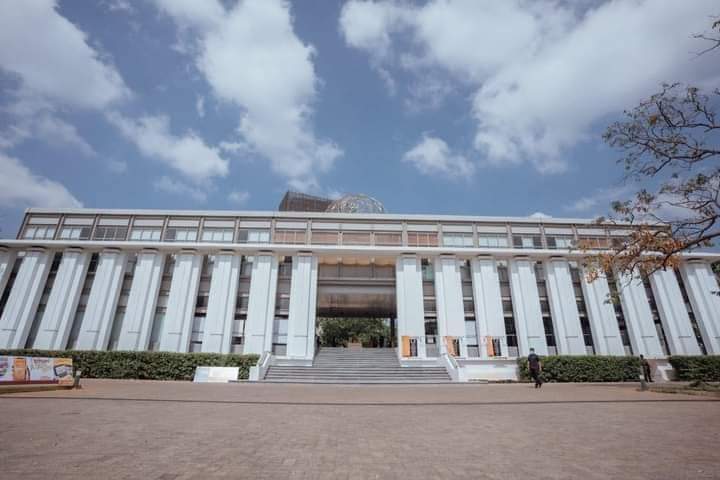
Jaffna Cultural Center: India’s USD 11 million gift to Sri Lanka inaugurated

he Jaffna Cultural Center (JCC), which was built with grant assistance of Government of India (GOI), was dedicated to the people on Saturday by the President of Sri Lanka Ranil Wickremesinghe in the presence of the Indian Minister of State for Fisheries, Animal Husbandry & Dairying and Information & Broadcasting, Dr. L. Murugan.

The High Commissioner of India Gopal Baglay, Douglas Devananda, Minister for Fisheries, Vidura Wickramanayake, Minister for Buddhasasana, Religious and Cultural Affairs, Kadar Masthan, Minister of State for Rural Economy, several Parliamentarians and dignitaries from various walks of life graced the occasion.

A Bharatanatyam performance

The state-of-the-art JCC consists of multiple facilities such as a museum of two floors; an advanced theatre-style auditorium for more than 600 people; an 11-storeyed learning tower; a public square which could also act as an amphitheatre; exhibition galleries (Air conditioned), Open exhibition and a 100-seat Conference facility, among others.

The foundation stone for JCC was laid by Prime Minister Narendra Modi in May 2015 during the first-ever visit by an Indian Prime Minister to Jaffna. Following the construction of JCC, the iconic facility was virtually inaugurated during the visit of External Affairs Minister Dr. S. Jaishankar to Colombo in March 2022.

Describing JCC as a gift from Prime Minister Narendra Modi, President H.E Ranil Wickremesinghe thanked him and GOI for the Center. He thanked India for the support extended to Sri Lanka during the economic challenges. Highlighting cultural similarities between the two countries, he noted that India and Sri Lanka were the two sides of the same coin.

A Sinhalese folk dance

Speaking on the occasion, Minister of State Dr. L Murugan underlined that India’s partnership with Sri Lanka was guided by Prime Minister Narendra Modi’s ‘Neighbourhood First’ policy. He also announced a special financial assistance scheme to 100 students from economically weaker families in the University of Jaffna. He also highlighted that GOI has implemented numerous people-centric projects cutting across sectors in Northern Province.

Ranil Wickremesinghe and Vidura Wickramanayake handed over a special token of gratitude to the Indian Minister Dr. L Murugan for JCC. The wide array of cultural performances showcased the richness and diversity of Sri Lanka’s culture.

The JCC is an outstanding example of GOI’s ongoing commitment to the people of Sri Lanka including in the Northern Province. GOI’s development partnership with Sri Lanka which touches upon all aspects of daily life such as infrastructure development, education, health, housing, livelihood development etc currently stands at USD 5 billion.

Posted in Uncategorized

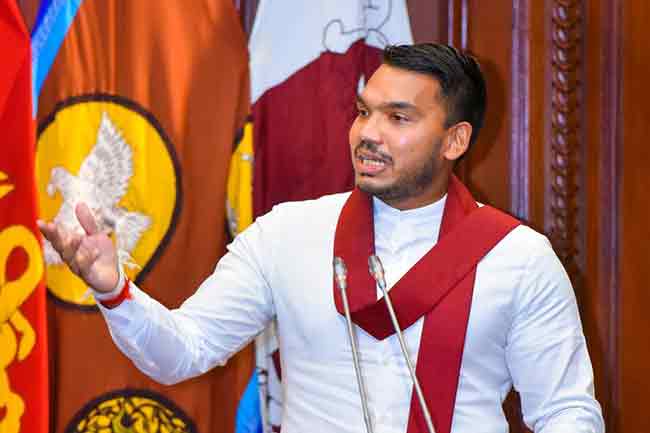
Amid debate on 13A, Namal Rajapaksa plans a 22A

Even as a political debate on with regard to a full enforcement of the 13th amendment to the constitution, SLPP MP Namal Rajapaksa is planning to bring in a 22nd amendment as well, according to party sources.

The MP has told his close associates that he has submitted a related plan to a commission on policies.

At SLPP meetings, Rajapaksa has strongly criticized the president’s statement about fully implementing the 13th amendment, said the sources.

Meanwhile, MP Prof. Charitha Herath, a member of the Dullas Alahapperuma faction, has spoken in support of the president’s suggestion.

He noted that his view was different to that of a majority in his group, who claim the president is without a public mandate to do so.

Herath said the 13th amendment should be implemented and a dialogue initiated together with the Tamil people to develop the country.

He compared it favourably with the development achieved by India through devolving powers amongst its various communities.

Sri Lanka suffering from both moral and economic collapse – Cardinal

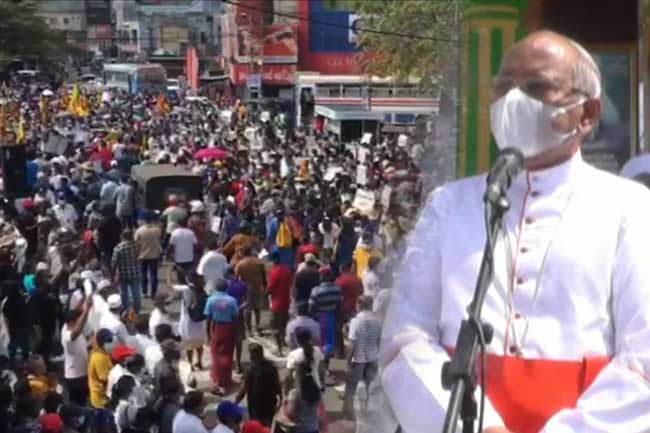
The Archbishop of Colombo, His Eminence Cardinal Malcolm Ranjith says the root cause of the satiation Sri Lanka is facing at present is its moral collapse.

Addressing an event at the BMICH on Friday (Feb 10), the Cardinal stated that Sri Lanka is suffering from moral collapse as well, not just economic collapse.

“Morally we are not able to do what is right and people have lost all sense of justice. They have forgotten what is right.”

Raising concerns about the Independence Day celebration on Feb. 04, the Cardinal said the ceremony with 21 gun salutes, hoisting of the flag, parades on the road and ambassadors and dignitaries had been organized just to show the world that Sri Lanka is a great nation going around with a ‘begging bowl’.

He pointed out that the country reached this critical juncture due to the mistakes it has made historically, especially the introduction of an open economy due to which the country became a largely dependent economy.

18 including an MP arrested in Jaffna

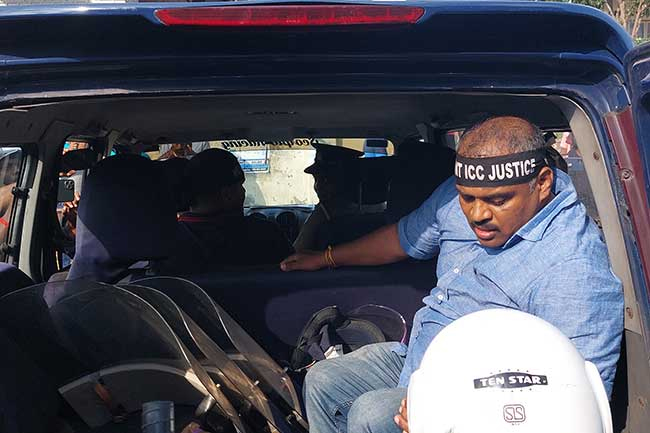
Tamil National People’s Front MP Selvarasa Kajendren and 17 others have been arrested for engaging in a protest violating a court order in Jaffna, Police Spokesman SSP Nihal Thalduwa said.

He said they were arrested for protesting against the visit of President Ranil Wickremesinghe who was in Jaffna to declare open the Jaffna Cultural Centre in Jaffna city.

The spokesman said a court order had been issued to prevent holding the protest in Jaffna today.

Posted in Uncategorized

Chairman of Pakistan’s Joint Chiefs of Staff meets the President

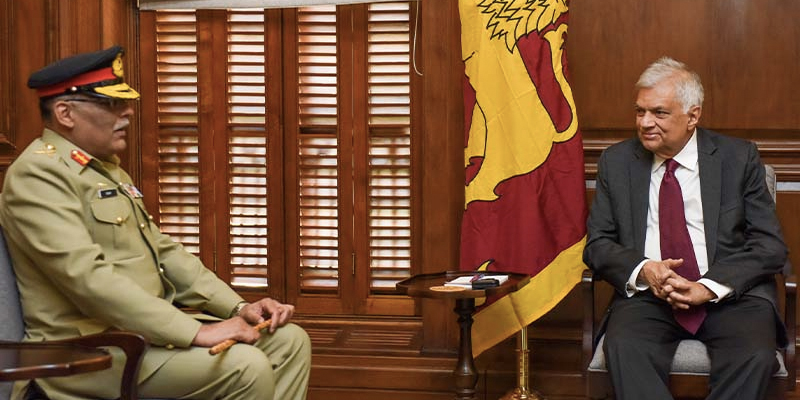
General Sahir Shamshad Mirza, Chairman Joint Chiefs of Staff Committee of Pakistan, met President Ranil Wickremesinghe at the President’s Office this morning (10) during his three-day official visit to Sri Lanka.

The President engaged in discussion with General Sahir Shamshad Mirza and recalled the long-standing close relationship between Sri Lanka and Pakistan as friendly countries.

General Mirza also presented the President with a commemorative memento to mark this meeting.

President’s Secretary Saman Ekanayake, Chief of Defense Staff General Shavendra Silva, and the Pakistan Navy delegation led by Rear Admiral Abdul Basit Butt attended the discussion.