CID records statement from GR over recovery of millions in cash from President’s House

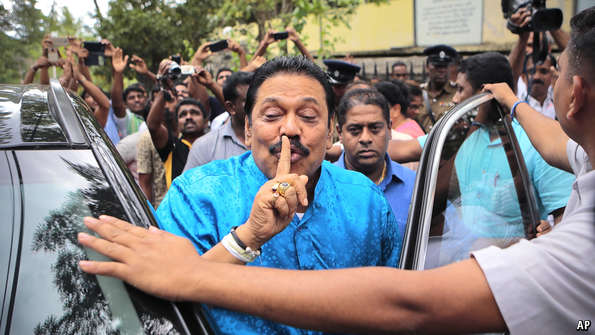
The Criminal Investigations Department (CID) has recorded a statement from former President Gotabaya Rajapaksa over the recovery of Rs.17.85 million from the President’s House on 9th July 2022.

Police Spokesman SSP Nihal Thalduwa said the CID has recorded a nearly three-hour statement from the former President following a court order.

Earlier, the Fort Magistrate’s Court ordered the Police to record a statement from Gotabaya Rajapaksa pertaining to the millions of rupees in cash found at the President’s House during mass protests last year.

The money was found by protesters when they stormed the presidential residence during mass anti-government protests.

SSP Thalduwa said the CID officers visited the former President’s residence on Monday to record a statement in this regard.

Posted in Uncategorized

Sri Lanka bankruptcy to last until 2026: President

Sri Lanka’s President said on Wednesday that the island nation will remain bankrupt for at least three more years as he works to repair battered government finances following an unprecedented economic crisis.

Mr Ranil Wickremesinghe took office in 2022 at the peak of national unrest sparked by months of food, fuel and medicine shortages.

He has since pushed through tax hikes and negotiated with international creditors after a default on Sri Lanka’s foreign debt to clear the way for a sorely needed International Monetary Fund (IMF) bailout.

“If we continue according to this plan, we can rise out of bankruptcy by 2026,” he said during an address to Parliament urging support for economic reforms.

“Introducing new tax policies is a politically unpopular decision. Remember, I’m not here to be popular. I want to rebuild this nation from the crisis it has fallen into.”

He said in January that the economy may have contracted by up to 11 per cent in the last calendar year, when Sri Lanka’s foreign exchange reserves dried up and left traders unable to import vital goods.

But on Wednesday, he said the economy would return to growth by the end of 2023 as new revenue measures boosted government coffers.

Tax increases and the removal of fuel and electricity subsidies have been unpopular with Sri Lanka’s public, already hit hard by the crisis and rampant inflation.

Mr Wickremesinghe’s policy address took place at the same time as a huge trade union strike, with air traffic controllers, doctors and those in several other industries stopping work.

He said Sri Lanka had reached the final stage of IMF discussions to secure a preliminary US$2.9 billion (S$3.8 billion) bailout.

The process has been delayed by protracted debt restructure negotiations with China and other major creditors.

He said Sri Lanka was in direct discussions with China about its outstanding debt but had received “positive responses from all parties” and was working towards a final agreement.

AFP

Swiss government provides funds through UNICEF to support services for children In Sri Lanka

The Government of Switzerland has contributed Swiss Francs (CHF) 500,000 (approximately Rs. 199 million) through UNICEF to meet the urgent needs of children impacted by the economic crisis in Sri Lanka.

With this funding, UNICEF will procure essential medical supplies, including medicines for treatment of illnesses and complications among children and women. In education, the funds will help children in disadvantaged schools continue learning and support catch-up classes to recover learning loss, including by providing transport allowance to teachers and daily snacks to students.

UNICEF will also support case management for children facing violence, neglect and family separation, including children with a disability.

“UNICEF and partners swiftly responded to the needs of the most vulnerable children from the outset of the economic crisis last year, with thanks to the support of donors. This contribution from the Swiss government and people is crucial in sustaining the response and protecting children from the effects of the crisis as it continues”, said Christian Skoog, Representative, UNICEF Sri Lanka.

The Swiss contribution will also be used to support data collection and analysis to assess the impact of the on-going crisis on households’ social and economic well-being and vulnerabilities, to help national and development partners put in place effective response strategies.

“Switzerland has worked closely with many partners, including UNICEF in addressing the needs of communities during crises such as the one that Sri Lanka faces now. This support demonstrates our long-standing cooperation with the people of Sri Lanka”, said Dr. Dominik Furgler, Ambassador of Switzerland to Sri Lanka and the Maldives.

UNICEF has issued an appeal for resources in 2023 to help 2.4 million most vulnerable children receive nutrition support, healthcare, clean drinking water, mental health services and continue learning.

’’Islandwide trade Union action cost Sri Lanka over Rs.1 bn’’ – Economists

The country has lost an estimated revenue of Rs.1 billion due to several crucial sectors launching a protest today, inconveniencing millions of citizens and leading to roads being blocked in the business hub of Colombo, senior economists said today.

Colombo University Department of Economics Professor Priyanga Dunusinghe told Daily Mirror that more than Rs.1 billion of losses had been faced by the country today due to the massive trade union action staged by doctors and several other professionals over the government’s new income tax policy.

Priyanga said this loss at this critical juncture was a blow to Sri Lanka’s development.

Another senior economist who wished to comment off the record said that such protests at a time when Sri Lanka was seeking international assistance for its debt relief sent a wrong signal to its global partners.

He said protests staged by crucial sectors cost the country billions and such losses were not feasible at the moment and also sent wrong signals to its international lenders.

“Opposing taxes is one thing but causing such a loss to the country is another. This sends a wrong message at a time when we are negotiating with our global partners for debt relief,” the economist said.

Over 40 trade unions including the Government Medical Officers’ Association (GMOA), Ceylon Electricity Board (CEB), University Lecturers, Sri Lanka Ports Authority (SLPA), National Water Supply and Drainage Board (NWS&DB), several banks, Sri Lanka Air Traffic Controllers Association (SLATCA) and Ceylon Petroleum Corporation (CPC) staged an island wide trade union action today to oppose the government’s new income tax policy.

The main business hub of Fort came to a standstill in the early hours of today as large groups gathered near the Fort railway station resulting in the military being called in to maintain calm.

The Trade Union Collective Centre (TUCC) told Daily Mirror that the Trade Union action had been a complete success and gave a direct message to the government on how the people would be affected by the new tax policies.

TUCC Operation Board Member Mahinda Jayasinghe said the sudden implementation of a higher PAYE Tax was unfair to the people who earned a higher salary because they had to adjust to maintain their lifestyle accordingly.

Jayasinghe said most of the professionals including doctors would be forced to migrate because of this. “They have come to a situation where they are unable to survive,”he said.

Commissioner General files affidavit and urges SC to facilitate holding LG polls

In an affidavit to the Supreme Court, Commissioner General of Election Saman Sri Ratnayake stated that the Election Commission has faced great difficulty in taking necessary steps to hold the Local Government Election due to the failure of the Secretary to the Treasury and other relevant officials to release required funds for the conduct of the election.

Accordingly, Commissioner General of Election Saman Sri Ratnayake urged the Supreme Court to make appropriate orders on the Secretary to the Ministry of Finance and other officials to facilitate the holding of Local Authorities Election in accordance with the law and in accordance with the undertakings given by the Commission to the Supreme Court.
Saman Sri Ratnayake stated that he is submitting this affidavit in consultation with the Chairman of Elections Commission.

Ratnayake stated that the Chairman of the Ceylon Petroleum Corporation in his letter dated 31/01/2023 and the Chairman of the Ceylon Electricity Board in his letter dated 02/02/2023 have informed the Chairman of the Elections Commission about their difficulties to provide electricity and fuel for the election as requested.

He maintained that the Ceylon Petroleum Corporation and the Ceylon Electricity Board has a duty to ensure the provision of fuel and electricity respectively for the purpose of the election and that any move to deny fuel and the supply of electricity for the election purposes will result in a hindrance to the election process.

Ratnayake informed court that an amount of 10,000 million rupees has been allocated in the annual estimates for the year 2023 for the activities of the Local Authorities Election and this has been approved by Parliament.

Ratnayake further said though he requested the Secretary to the Ministry of Finance, Economic Stabilization and National Policies to release the imprest for the initial arrangements of the election, the said request has not been fulfilled.

He further said by his letter dated 24/01/2023, he requested the Secretary to the Ministry of Finance, Economic Stabilization and National Policies to release 100 million rupees by the last week of January and the remaining imprest to be released in the month of February.

He stated that it is not necessary to arrange the aforementioned amount of 10,000 million rupees all at once to carry out the activities of the election. According to data from previous elections, less than 25% of the total expenditure on elections are incurred before the election.

Posted in Uncategorized

Another request to permit the use of Russia’s Mir cards in Sri Lanka

Ambassador of Sri Lanka to Russia Janitha Liyanage has made another request from the Central Bank to reconsider the possibility of using Russia’s Mir cards in Sri Lanka.

During an interview with RIA Novosti, Ambassador Liyanage has said negotiations on the use of Mir cards are underway.

She said she sent a request to the Central Bank of Sri Lanka and the issue is being discussed at present.

Ambassador to Russia Janita Liyanage said at present the tourists coming to Sri Lanka can use the project of the National Investment and Industrial Bank and the People’s Bank in Sri Lanka.

In order to use the service Russian nations need to create an account with the financial institution and once they land in Sri Lanka they will be issued a local Visa card.

When requested previously, the Central Bank of Sri Lanka said that it could not allow the use of Russian Mir cards in the country due to US sanctions.

Posted in Uncategorized

Sri Lanka invites Russian businesses to invest in the country

Sri Lanka Ambassador to Russia Janitha Liyanage says Sri Lanka is open for investments from Russian businessmen and the government is actively discussing such opportunities, including with representatives of the construction industry.

Speaking to Sputnik Liyanage said, “Sri Lanka is open for investment, and we are discussing with Russian entrepreneurs, and Russian construction companies … There are a lot of opportunities for Russians”.

She said Sri Lanka invited Russian companies to open their branches in the island.

Liyanage said in the near future, Sri Lanka plans to open a trading house in Russia and increase the deliveries of tea, coconut-based products, and spices.

She noted that Minister of Transport Bandula Gunawardana and Minister of Agriculture Mahinda Amaraweera are due to visit Russia in March and April.

Paris Club members agree to negotiate Sri Lanka debt restructure: president’s office

Member states of the Paris Club have expressed their commitment to negotiate debt restructuring with Sri Lanka in accordance with the comparability of treatment principle and with the goal of restoring debt sustainability, President Ranil Wickremesinghe’s office said.

Saudi Arabia and India have also expressed their support and commitment to providing financing assurances, the president’s office said in a statement on Tuesday February 07.

The Paris Club members urged other official bilateral creditors, including China, to do the same in line with the International Monetary Fund (IMF) programme, it added.

Earlier in February, the Paris Club members informed the IMF of their support for Sri Lanka debt restructuring.

An Independence Day fete Ranil may still like to forget By N Sathiya Moorthy

For incumbent Ranil Wickremesinghe, taking the Independence Day as the nation’s President is known to be a dream come true. It should be so for most politicians in the country, especially when they are young, inexperienced and unexposed. It would have been more so for Ranil, as this is not only the first time that he was unfurling the national flag at capital Colombo’s famous Galle Face Green, as his predecessors had done in heir time, but it was also the nation’s landmark 75th Independence Day, which his government spared no effort to celebrate with customary pomp and show, despite criticism and opposition over the high-spending in the midst of unprecedented economic crisis.

Yet, President Wickremesinghe, for all right reasons and wrong, might also want to forget the I-Day honour and the attendant fete. Despite his open appeal and official invitation, most Opposition parties stayed away, citing equally predictable reasons that they called justification. They had also stayed away from the all-party talks called by President Ranil to address the ethnic issue, lest he should take credit for the ‘interim solution’ that was centred on the ‘full implementation’ of the 13th Amendment – if and if alone it succeeded. Thankfully for them, it did not reach that stage, not by Ranil’s self-declared Independence Day deadline.

‘Sole representative’

The reasons are not far to seek. While the southern Sinhala Opposition’s boycott of ethnic talks, though not the Independence Day celebrations, was only to be anticipated, the government possibly was not prepared for the ‘beneficiary’ Tamil polity observing it as a ‘black day’. The list included the vertically-divided Tamil National Alliance (TNA), including the one-time ITAK leader of the coalition, with whose leaders alone the President and the government were holding most of the talks as if they were the ‘sole representative’ of the Tamil community.

In the process, the ITAK itself seem getting divided. Party MPs, M A Sumanthiran and Sanakiyan Rasamanickam, led a rally in eastern Batticaloa (the native district and electorate of the latter). This even as students of the Tamil-majority Jaffna University commenced a North-to-East march on the same theme, but with a different intent and participation.

Protestors at the Batti rally wore typical ‘Gandhi caps’, as if to recall and reassure for the nation, the peaceful path that they have inherited from party founder S J V Chelvanayagam, often referred to ‘Ceylon Gandhi’ or ‘Tamil Gandhi’. It is another matter that that ITAK president Maavai Senathiraja was nowhere to be seen, and the possibility is that he was not ever taken into confidence, making it a two-man show all the way, in the neighbourhood of ailing leader R Sampanthan’s eastern Trincomalee base that too has dwindled over the years.

Loaded statement

Incidentally, it was at Batti, where SJV declared that the just-concluded BC Pact with then Prime Minister S W R D Bandaranaike was only the ‘first step’ (towards a ‘separate state’?). Authors, analysts and international diplomats often fed exclusively on the Tamil information and interpretation of the contemporary ethnic history, seldom mention that SJV’s speech might have been the cause for SWRD tearing up the pact, seeing it as a ‘betrayal’.

Sampanthan, who could not participate in the Independence Day fete (only) owing to overnight hospitalisation for what his family described as a ‘routine check-up’, has since issued what reads like a loaded statement, addressing the Tamils as much as the government and the majority Sinhala polity that is also majoritarian in many parts. He said that if a political solution was not found for the ethnic issue, there was the fear and possibility of the ‘historic Tamil homeland’ being ‘snatched away, step by step’.

There is no denying that despite the controversies surrounding his leadership, Sampanthan might be the last hope for the Tamils, after SJV and LTTE-slain Amirthalingam, and of course, the LTTE and Prabhakaran, too. Tamil critics often see him as too soft on the government and Sinhala polity, always speaking for ‘self-determination within a united Sri Lanka’, and also relying excessively on the ‘international community’ than the domestic constituency and the Diaspora.

Unmet pre-conditions

In this background, Sampanthan was obviously hinting at the real possibility of the government and the Sinhala polity not feeling like having the need to talk to other Tamil leaders after his time – and thus even having the need to address the ‘legitimate aspirations’ of the Tamil people. While they may continue to want hiding their own short-comings or may even be on a denial mode, they all seem to be tired of the Tamils’ way of taking two steps backward after one forward step.

The current situation is a case in point. A year ago, most Tamil parties wrote to Indian Prime Minister Narendra Modi for New Delhi to press/pressure Colombo for the full implementation of 13-A. India’s visiting External Affairs Minister (EAM) S Jaishankar too said as much, and in public, about wanting it that way, and his conveying the Indian message to President Ranil and other government leaders.

However, after the TNA split ahead and over the nation-wide local government elections (LGE), scheduled for 9 March, one after the other, ending with the ITAK, announced their boycott of the Independence Day, and not just the Colombo fete. They introduced pre-conditions for talks, which were not new, and which successive government could have resolved through the stroke of the President’s pen.

Now, Ranil is seen as completing the unfinished task from his long innings as Prime Minister (2015-19). However, there is no knowing why he could not have completed it then and there. After all, issues such as freeing ‘Tamil political prisoners’ and also Tamil private lands in the military’s possession, and even ‘justice for missing persons’ are all issues that needs political will than bureaucratic paper-work.

Rajapaksas too stay away

While in Colombo, India’s Jaishankar also met former President Mahinda Rajapaksa, along with political heir, Namal Rajapaksa, MP, where the subject was believed to have come up for discussion. The Rajapaksas are the real power behind Ranil’s throne, yes, and Jaishankar meeting Mahinda was more than courtesy shown to a former President and ex-Prime Minister. After all, there are three other former Presidents around, and Jaishankar did not meet any of them.

Yet, at the end of the day, all six Rajapaksas in politics, including the non-controversial older brother Chamal (a former Minister and also full-term Parliament Speaker) and his equally invisible son Shasheendra, who is also a state minister in Ranil’s government, stayed away from the official function. According to low-profile, at times delayed reports, Mahinda as also another former President, Maithripala Sirisena, were invited – and both stayed away, unbecoming of the high office they had held, whether or not they were still a part of the government coalition.

It was even more problematic when Ranil’s immediate predecessor Gotabaya Rajapaksa and Chandrika Bandaranaike-Kumaratunga, were reportedly not invited for the I-Day fete. If true, it was odd, especially after the otherwise ‘despised’ Gota was among the guests at the India’s Republic Day reception – as was only proper and protocol-driven – just days earlier. It is anybody’s guess why and how Ranil could expect cooperation from others when his leadership has acted like squabbling school children.

No explanation has been offered as to why the Rajapaksas, stayed away, as Namal is still a parliamentarian, with reported aspirations to be President in his time (though not in the foreseeable future, thanks to uncle Gota’s mis-administration and mal-administration that was thankfully short-lived. Namal is since on record that father Mahinda, though Prime Minister at the time, was not consulted, nor was he involved in Gota’s controversial decisions, one after the other.

It does not explain how Mahinda, because of whom his constituency voted for brother Gota – could abdicate responsibility, and not the position until the Aragalaya protestors made it too late and too difficult. The explanation does not hold for Basi, another of the four brothers, who is no more a parliamentarian only because his national loyalty is still equally divided between Sri Lanka and the U S, which he refuses to give up.

The ‘why’ of Basil choice still remains a mystery, yes, but more than that is the question how the SLPP, going beyond the Rajapaksas’ clannish leadership, could afford to share their secrets with him. It is another matter that Basil is still considered the chief strategist of the party, and also its chief organisers, in reality and otherwise.

Be it as it may, President Ranil’s parliamentary majority tends to become doubtful if there is more to the Rajapaksas’ ‘boycott’ of the Independence Day fete than whatever remains undisclosed. It is not unlikely that they are unhappy with the way the Election Commission desires to go ahead with the local government polls that many predict the SLPP alliance would lose – and very badly so, in the aftermath of last year’s protests and the economic crisis that caused it all.

It could also mean that if not addressed adequately in whatever way, the SLPP may decide to rise questions about Ranil’s approach to economic management, IMF debt-requirements and of course the 13-A. When Ranil raked up the issue in Parliament some months ago, Mahinda went a step further to declare that they were ready to discuss 13-Plus, too.

Some hopes then, but….

(The writer is a policy analyst & political commentator, based in Chennai, India. Email: sathiyam54@nsathiyamoorthy.com)

Posted in Uncategorized

Election Commission to go to court if funds not provided

The Election Commission of Sri Lanka has noted that in the event the relevant authorities fail to comply with their fund request required to cover the basic expenses of the upcoming Local Government (LG) election, the matter will be taken to court.

Accordingly, Chairman of the Commission, Attorney-at-Law Nimal Punchihewa noted that in the event a favourable response is not received pertaining to the sum of Rs. 770 million requested from the Secretary to the Treasury, the matter will be presented before the court on 09 February.

He explained that the funds were requested to cover the basic expenses to be incurred in the month of February, leading up to the 2023 LG election, including the initial payments due to be made to the Department of Government Printing and the Police and Postal departments, in order for them to carry out the preliminary work required to hold the election.

Punchihewa noted, however, that the Secretary to the Treasury is yet to respond to the request which was made earlier this month.

Although the Ministry of Finance had previously handed over nearly Rs. 37 million to the Commission for the upcoming election, the request for Rs. 770 million was made by Punchihewa in writing to the Secretary to the Ministry of Finance, after the Commission noted that an estimated sum of Rs. 4 billion is required for the whole process of holding the upcoming election.

The 2023 LG election is schedule to be held on 09 March.