Namal notes strong bond between TMVP and MR

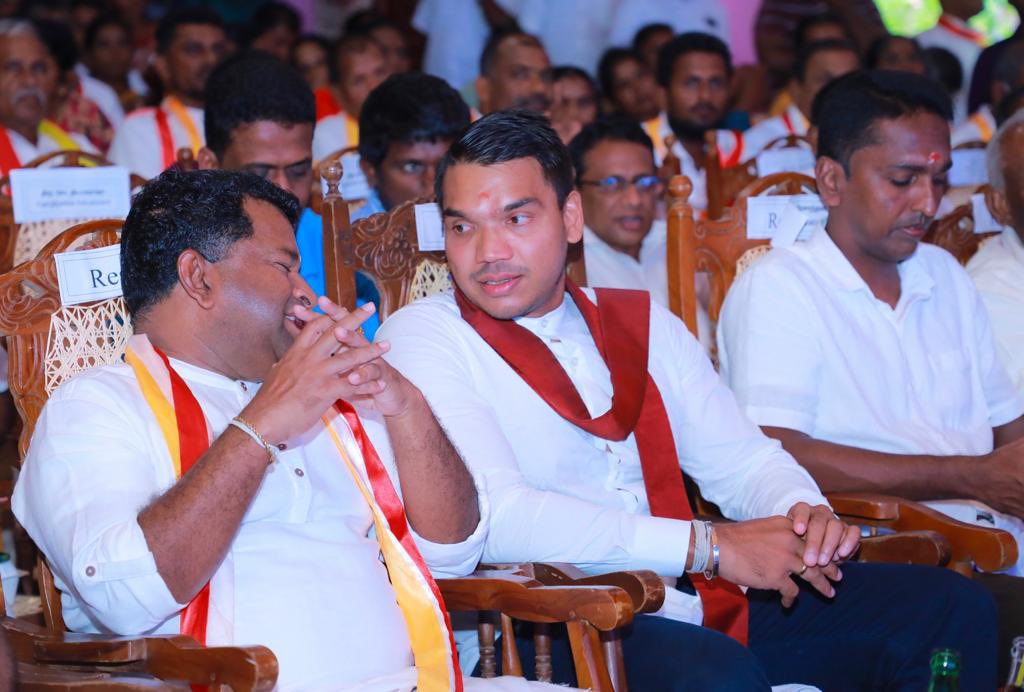
The former Minister tweeted saying that he attended the convention of the party in Batticaloa today.

“Since it’s inception as a political party the TMVP has maintained a strong alliance with all HE @PresRajapaksa led govts. It was an honor to attend the convention of the party earlier in #Batticaloa today on the invitation of Hon. Sivanesathurai Santhirakanthan,” Namal Rajapaksa tweeted.

The TMVP consists of some members who were earlier part of the LTTE.

The TMVP was accused in the past of being involved in human rights abuses.

A former spokesman of the TMVP had also alleged that there were links between the TMVP and the Easter Sunday attacks.

The TMVP has, however, denied the allegations.

Posted in Uncategorized

IMF boss Georgieva comments on Sri Lanka deal

Managing Director of the International Monetary Fund, Kristalina Georgieva has commented on the Funds program with Sri Lanka.

“Very pleased that IMF staff and Sri Lankan government officials have reached a staff-level agreement to support the country’s economic policies with a 48-month Extended Fund Facility of about US$2.9 billion,” she said in a twitter.com message.

“This is an important step forward for Sri Lanka,”

Sri Lanka faces regular currency crises due to operating an intermediate monetary regime (soft-peg) and their frequency has increased in recent year amid more aggressive open market operations to target an output gap.

In December 2019 by policymakers also cut taxes to target a ‘persistent output gap’ followed by even more aggressive liquidity injections leading to steady loss of reserves and default by April 2022.

Paris Club ready to start debt relief for Sri Lanka

The Paris Club said on Friday it is ready to start the debt relief process for Sri Lanka, the President’s Media Division (PMD) says.

It reiterated its willingness to coordinate with non-Paris Club official bilateral creditors to provide the necessary financing assurances in a timely manner, the PMD said citing a statement from the Paris Club.

The Paris Club statement said, “Paris Club members welcome the Staff-Level Agreement (SLA) concluded between Sri Lankan Authorities and IMF staff for a 48-month arrangement under the Extended-Fund Facility (EFF). This agreement represents an important step to restore macroeconomic stability and public debt sustainability.”

Noting the IMF’s assessment for the need for a debt treatment in the context of the IMF program, the Paris club said it is ready to start the debt treatment process and reiterated its willingness to coordinate with non-Paris Club official bilateral creditors to provide the necessary financing assurances in a timely manner and ensure fair burden sharing, as already proposed to the largest other official bilateral creditors.

The statement also assured that, “The Paris Club remains at the disposal of the Sri Lankan authorities and non-Paris Club official bilateral creditors to further discuss the next steps of the debt treatment process.

Follow IMF conditions or risk credibility again: Ali Sabry

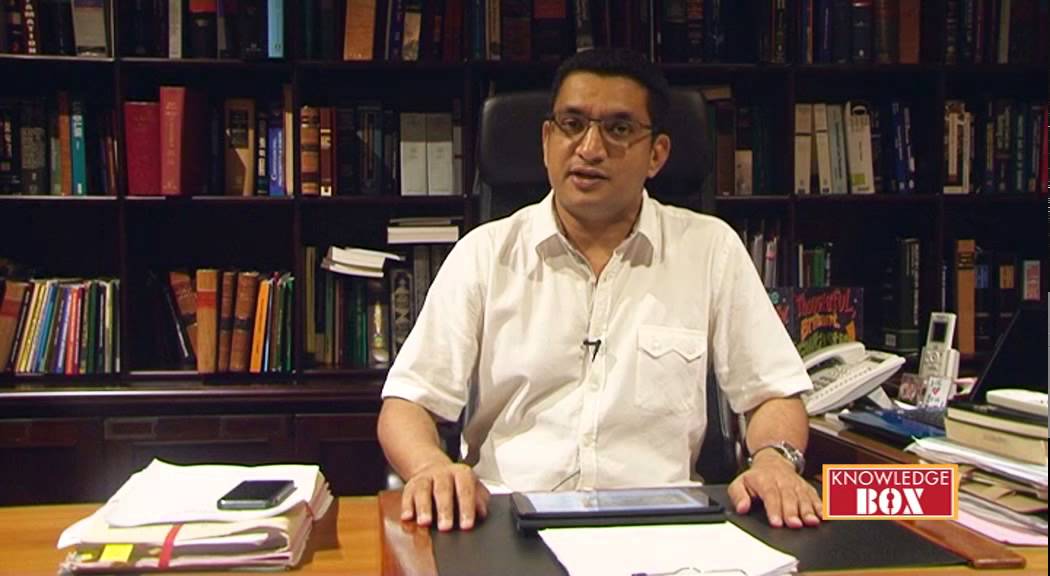
Improving transparency, Sri Lanka’s human rights track record, and securing an International Monetary Fund (IMF) agreement are focus areas for the Government to improve Sri Lanka’s international recognition, says Foreign Affairs Minister Ali Sabry, PC.

According to Sabry, who will be leaving for the UN Human Rights Council (UNHRC) sessions in Geneva next week with Justice Minister Dr. Wijeyadasa Rajapakshe, Sri Lanka has made progress on addressing concerns related to the much-criticised 1978 Prevention of Terrorism Act (PTA), with draft legislation almost ready to be put to the Cabinet of Ministers. He blamed the political instability in Sri Lanka over the past six months for the slow progress in addressing issues related to missing persons and reparations.

Minister Sabry further noted that the Government was not aware of a new resolution on Sri Lanka to be moved at the upcoming UNHRC sessions in Geneva, but said a new resolution may be introduced if the current one was not rolled forward.

In an interview with The Sunday Morning, the Foreign Minister also highlighted the need to review Sri Lanka’s foreign policy and ensure the national diplomatic apparatus is staffed by trained and competent persons as the nation moves towards a recovery phase.

Following are excerpts of the interview:

Sri Lanka is trying to rebuild its credibility in the international arena. What are the key areas the Government is working on to improve Sri Lanka’s international recognition?

Firstly, we need to engage with the international community positively and work to win their confidence in order to quickly reach an IMF agreement. We have already reached the first step of a Staff-Level Agreement (SLA). That is important, because it is central to everything else that we need to gain. It is needed before we move to restore the confidence of others or encourage investors to rethink about Sri Lanka.

Secondly, we also need to improve the transparency of Sri Lanka’s workings. Thirdly, there is the matter of improving the human rights record.

The Geneva human rights sessions are around the corner; has there been tangible progress since last year? On counter terrorism laws, the Government recently spoke about a National Security Act (NSA) – is this a new process?

There is; we told them that we will continue to engage with them. Some important achievements are that we have appointed a committee to look into the cases of people who have been held for a long time under the PTA. The PTA has been amended since then [last sessions] and bail provisions have been granted, so the number of cases and individuals held in custody has come down.

Secondly, we are in the process of establishing the Counter Terrorism Act (CTA) or similar legislation, in line with international best practices. I don’t know what he [spokesman] was talking about. However, what we are looking at is replacing the PTA with an Act that will have a better balance between national security and human rights. It is difficult to give a timeline about the process, but we are in the process of presenting the draft legislation to the Cabinet.

There are reports of moves for a fresh resolution on Sri Lanka at the Geneva sessions; do you have any information on such moves?

No, we are not aware of such a move, practically, because resolution 46/1 is coming up for review. So, unless we agree on that, or there is a roll-over of 46/1, there cannot be a new resolution.

Recently, local law enforcement agencies used the PTA to detain several protesters; isn’t this a misuse of the legislation?

We are open to the opinions and suggestions of people. However, the investigators are of the opinion that there are matters that need to be looked into and allegations that need to be dealt under the PTA and fall within its preview. So I think they have already gone before the courts on the charges and the courts will decide if these cases, these allegations of terrorism, are plausible or not. That is part of the legal process.

Has Sri Lanka made any progress in the other human rights-related areas, such as the Office on Missing Persons (OMP), reparations, and war crime allegations, since the last sessions in Geneva?

I think we have made some progress on the issue of missing persons over the last year but unfortunately, nothing happened over the last six to seven months, since March, due to the situation in the country. We couldn’t show much progress, but we should still work towards that.

The IMF has clearly signalled that Sri Lanka needs to engage China on debt restructuring. A recent report in the press quotes Chinese diplomatic sources stating that ‘the ball is in Sri Lanka’s court’. Has Sri Lanka begun a discussion on debt restructuring with China and how is it progressing?

On the matter of debt restructuring, I think we were concentrating on reaching an SLA with the IMF. Now that we have gained a certain amount of certainty (following the SLA with the IMF), we will begin engaging with all bilateral creditors, particularly China, India, and Japan.

Sri Lanka has sought assistance from Japan to coordinate with its creditors, including China, on debt restructuring. How and when will this process take place? Who will be involved from Sri Lanka?

I think that is a question the Finance Minister and the Finance Ministry are better placed to answer.

A team from the IMF was in Sri Lanka last week to hold staff-level talks with the Central Bank of Sri Lanka (CBSL) and other Government officials, reaching a four-year $ 2.9 billion SLA. How confident are you that Sri Lanka will meet the structural reforms agreed on and address corruption vulnerabilities?

Yes, I think we need to do those. We have no choice; we need to follow up on those conditions. Otherwise, I don’t think we will get those facilities [conditional $ 2.9 billion]. If we don’t do it, we risk losing credibility again.

The recent visit of the Chinese Yuan Wang 5 vessel caused much controversy in the country and in the international sphere. Do you think the incident was properly managed by Sri Lanka and has the controversy strained Indo-Lanka or Sino-Lanka relations?

It was a very difficult situation for us. This difficult issue came at a crucial juncture; Sri Lanka was undergoing tremendous turmoil. When some concerns were raised, we looked into it and consulted all parties. Having consulted all the parties, we tried to manage it as much as possible.

Naturally, there will be some concerns from all sides in matters such as these. However I think, given the complexity and the risks that it entailed, we did manage it well. That’s what I feel.

In a recent interview with the Economist, President Ranil Wickremesinghe stated that ‘we see India as the net security provider in the area and then all other countries can also be present as long as it doesn’t lead to rising tensions or increase the rivalry between states’. Does this indicate a change in Sri Lankan foreign policy, a sign of a closer orbit on security matters with India?

Regional security is paramount for Sri Lanka as an island nation. To ensure regional security, there should be consultation and coordination with the biggest player in the region. It is in that context that the President would have said so. Our aim is to have peace in the region.

The entire Indian Ocean should be a region of peace and Sri Lanka should ensure a good economic climate for trade and safety of maritime routes of communication. Adversity or enmity with anyone should not be promoted in the Indian Ocean.

As the Minister of Foreign Affairs, given Sri Lanka’s vulnerability due to the economic crisis and the dynamic nature of geopolitics, do you think a review of Sri Lanka’s foreign policy is due?

Yes, I think so. Even otherwise, I think we need to review the foreign policy after discussing the pros and cons of such changes, and proceed with changes that benefit Sri Lanka’s national interest. The Ministry is planning to review the foreign policy as soon as possible.

Managing international relations during a crisis requires competent and capable professionals in charge of our diplomatic missions overseas. What action, if any, will you take to depoliticise the Foreign Ministry and the Foreign Service and allow career diplomats to return to the helm of diplomatic relations?

Yes, in terms of numbers, we need to review the deployment of our best personnel. We need to look at that carefully. The backbone of the Foreign Ministry and diplomacy should be the Foreign Service. The Foreign Service has been recruited and trained for that task. Wherever possible, we will try to give Foreign Service officers the maximum priority and make use of them.

We have not recruited to the Foreign Service for the past five years. We need to move quickly to get the next team coming in, otherwise we may have problems filling the ranks of first, second, and third secretaries and senior diplomats at our missions. We are working towards that. Hopefully, it will be done soon; it needs to be done in consultation with the President’s Office. We are making every effort to do it soon.


Posted in Uncategorized

Back in Lanka, Gotabaya struggles to get support -The Newindian express

After seven weeks, former Sri Lankan President Gotabaya Rajapaksa finally returned to Colombo on September 2. He fled on July 13 after the nation witnessed huge protests over country’s worst economic crisis.He will be living in a state bungalow close to Wijerama Mawatha in Colombo while a large security contingency will be appointed to maintain security in the area.

“Former Presidents are accorded security and there are some other entitlements which will be extended to Gotabaya. Nearly all members of SLPP (Sri Lanka Podujana Peramuna) went to the airport to receive him when he returned from Bangkok on a Singapore Airlines flight. His wife, Ioma, too returned with him. He looked visibly happy and relieved,’’ say sources.

The New Indian Express was the first to report on August 22 that Gotabaya would return to Colombo in the first week of September. Meanwhile, the support that Gotabaya received on his arrival at Bandaranaike International Airport indicates that his supporters from SLPP will try and garner support for him. Some sources suggest he might return to politics sometime.

Gotabaya is said to be waiting to get his US Green Card as both his wife and son are US citizens and Gotabaya had to surrender his citizenship when he became President. When he was trying to flee Colombo in July, he was desperate to go to the US but couldn’t as he could not manage a short-term visa.“His stay in Bangkok left him feeling very uneasy as he was confined to stay in the hotel due to security reasons. He was looking forward to returning to Colombo,’’ said sources.

Gotabaya is likely to lie low for some time, before he makes any statement or suggests which way he will head towards. However, his return triggered calls for his arrest. Leaders of the protest campaign that toppled his government said Rajapaksa should now be brought to justice.

Posted in Uncategorized

Tamil activists and politicians call for Sri Lanka to be referred to ICC ahead of UNHRC session

Tamil civil society organisations, activists and politicians have repeated their calls for Sri Lanka to be referred to the International Criminal Court (ICC) in a joint letter to the Core Group on Sri Lanka.

In their letter, they expressed their “concerns of continued failure for accountability for war crimes, crimes against humanity and genocide committed against the Tamil people.”

The letter calls on the Core Group, comprised of Canada, Germany, Malawi, Montenegro, North Macedonia, the UK and the United States, to “clearly urge UN Security Council to refer Sri Lanka to the ICC.”

“We as representatives of Tamil people strongly believe that anything short of calling for the referral to ICC will permanently eliminate any chance of getting justice for the mass atrocities we faced,” the letter added.

The signatories highlighted that successive Sri Lankan government have stalled accountability and “have adopted different tactics to drag the accountability process to hoodwink UNHRC.”

The letter also noted that aside from the lack of progress made by Sri Lanka in achieving justice and accountability, the state has continued it’s oppression of the Tamil nation by continuing to heavily deploy it’s forces in the region. Moreover, the state has continued to take away Tamil lands in an attempt to alter the demographic of those areas.

In last year’s report, outgoing High Commissioner Michelle Bachelet encouraged member states to take steps to refer Sri Lanka to the ICC as well as using their own courts to investigate and prosecute war criminals under universal jurisdiction.

Next month, Sri Lanka will be on the agenda of the 51st session of the UNHRC in Geneva.

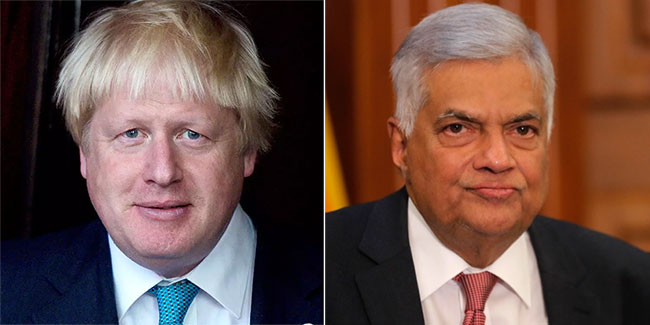
UK PM urges Ranil to change approach on human rights issue

British Prime Minister Boris Johnson has urged President Ranil Wickremesinghe to change Sri Lanka’s approach on the human rights issue.

He said the upcoming 51st Session of the UN Human Rights Council will be a moment for the Sri Lankan Government to demonstrate its human rights credentials with a change of approach.

Johnson commended the efforts of President Ranil Wickremesinghe for establishing an inclusive government which will bring the stability needed to address issues for the Sri Lankan people.

In a congratulatory message to President Wickremesinghe on his appointment as the Head of State, the British Prime Minister said that upholding democratic principles and seeking democratic consensus will be vital to President Ranil Wickremesinghe’s success, the President’s Office said.

Reiterating the British Government’s sincere commitment to Sri Lanka, Prime Minister Boris Johnson said the UK will continue to work with the people of Sri Lanka, especially during the current economic and social challenges.

“I hope that you will be able to make quick and positive progress with the International Monetary Fund. The UK stands ready to engage with our international partners to support Sri Lanka on this issue.”

The British Prime Minister also expressed confidence that the two governments can work together to achieve long-lasting and substantive progress on reconciliation and accountability in Sri Lanka.

“The 51st UN Human Rights Council in September will be a moment for your government to demonstrate your human rights credentials with a change of approach. We and others in the international community want to work with Sri Lanka to make real and tangible progress on these issues.”

He also highlighted the recently announced Developing Countries Trading Scheme. This, he said, will offer Sri Lanka the opportunity to benefit from duty- free access for the vast majority of total goods exported to the UK. “As we continue to strengthen our bilateral relationship, I hope we can find more opportunities to enhance trade and investment. I anticipate that there are strong opportunities for UK support with green finance and renewable energy,” the British PM said, recalling the conversation the two leaders had in May about shared ambitions on climate change.

British Prime Minister Boris Johnson concluded his message by expressing confidence that with Sri Lanka due to celebrate its 75th Anniversary of Independence, UK and Sri Lanka would continue to build an even deeper and stronger partnership. He also appreciated Sri Lanka’s efforts to prioritise UK-Sri Lanka relations and wished President Wickremesinghe the very best in his efforts to restore stability and prosperity in Sri Lanka.

Posted in Uncategorized

Interim-budget for 2022 passed

The interim-budget for 2022 was passed by Parliament today.

The second reading of the budget was passed with 120 MPs voting for it, 5 against and 43 MPs abstaining.

The third reading was passed with amendments, without a vote.

The opposition Samagi Jana Balawegaya (SJB) and the rebel MPs of the Sri Lanka Podujana Peramuna (SLPP) had decided to boycott the vote on the 2022 interim-budget.

The SLPP rebel group consists of 13 MPs who crossed over to the opposition this week.

President Ranil Wickremesinghe presented the interim-budget to Parliament this week which meets the expectations of the International Monetary Fund (IMF).

China says ready to work with other countries to support Sri Lanka

China says it is ready to work together with other countries to support Sri Lanka to recover from the economic crisis.

Chinese Foreign Ministry Spokesperson Zhao Lijian at the regular press conference on Friday said that China has paid close attention to the difficulties and challenges faced by Sri Lanka.

Zhao said China has provided help to Sri Lanka’s socioeconomic development to the best of its capacity.

On Friday, Shunichi Suzuki urged all countries that lent money to Sri Lanka, including China, to discuss the country’s debt restructuring after Sri Lanka reached a loan agreement with the International Monetary Fund.

Responding to a media query about the Japanese Finance Minister’s request, Chinese Foreign Ministry Spokesperson China supports relevant financial institutions in consulting with Sri Lanka for proper solutions.

“We are ready to work with relevant countries and international financial institutions to continue to play a positive role in supporting Sri Lanka’s response to current difficulties and efforts to ease debt burden and realize sustainable development,” Chinese Foreign Ministry Spokesperson Zhao said.