He fled the country and went into hiding. Why has Sri Lanka’s deposed leader come back now? CNN

After more than 50 days, he’s back.

Runaway former Sri Lanka president Gotabaya Rajapaksa returned to Colombo early on Saturday, Sri Lankan airport and security officials confirmed. The move threatens to reignite tensions in the crisis-hit country.

Rajapaksa, who once ruled Sri Lanka with an iron fist, has kept a low profile since fleeing hastily to Maldives on July 13, just days after angry protesters broke into his official residence demanding he resign over his handling of the nation’s worst financial crisis in decades.
He is yet to explain why he traveled to three Asian countries in recent weeks amid economic and political turmoil at home — or why he decided to come back now.

Some activists are now demanding Rajapaksa face criminal charges, but with his allies remaining in power, analysts say any prosecution is unlikely. And it remains unclear if his return to the island nation of 22 million will stir further demonstrations.

After temporary stays in Maldives, Singapore and Thailand, Rajapaksa may have run out of countries willing to let him enter or stay, analysts said.

And according to a source cited by Reuters on August 23, the cost of maintaining his lifestyle overseas — including a private jet, presidential suite and security — had already mounted to hundreds of thousands of dollars.

Rajapaksa’s widespread unpopularity in Sri Lanka is a major reversal from the days when many in the country revered him as a “warrior-king” leader for defeating separatists in a decades-long civil war.

The ousted leader’s downfall “would have been a huge blow to his ego,” said Ambika Satkunanathan, a lawyer and former commissioner of the country’s Human Rights Commission.
“It was very difficult for him to find a permanent or semi-permanent place to stay. It proved more difficult than he imagined,” she said. “This was a politician who was once perceived as a demigod. He’s not used to being held accountable.”

Moving from country to country

Rajapaksa’s first stop was Malé, the Maldivian capital just a 90-minute flight from Colombo.
His plane was initially refused permission to land until former Maldivian President Mohamed Nasheed — now speaker of the Maldivian Parliament — intervened, according to a high-ranking security official.

But Sri Lankans in Male were not happy — many took to the streets to protest his arrival.
“Throw him out here,” read one protesters’ placard. “Dear Maldivian friends, please urge your government not to safeguard criminals,” read another.

Less than 48 hours later, Rajapaksa left the archipelago on a Saudia flight for Singapore.
Singapore’s Foreign Ministry confirmed on July 14 that Rajapaksa was allowed entry to the island city-state on a “private visit.”

“He has not asked for asylum and neither has he been granted any asylum,” the Singapore Foreign Ministry said at the time.

Multiple news organizations reported that Rajapaksa would subsequently travel to Saudi Arabia — but that visit never materialized.

It’s unclear why, though some analysts pointed to a possible reason in a heavily criticized 2020 Rajapaksa policy that required Muslim Covid-19 victims to be cremated.

The practice was “inconsistent with Islamic precepts,” according to a statement that December from the Organisation of Islamic Cooperation (OIC), of which Saudi Arabia is a member. The OIC expressed concern and called “for respect to the burial ritual in the Muslim faith.”

Rajapaksa subsequently reversed the policy, but implemented another controversial rule requiring Muslim victims to be buried at a remote government site, without their families and without conducting final religious rites.

From Singapore, Rajapaksa officially tendered his resignation as Sri Lanka’s leader.
He then found himself on the receiving end of a potential criminal investigation in the city state for alleged human rights abuses while he was defense chief during Sri Lanka’s 26-year civil war — allegations he denies.

On July 23, lawyers from the International Truth and Justice Project (ITJP) filed a criminal complaint with Singapore’s attorney general, requesting Rajapaksa’s immediate arrest.
According to a 2011 United Nations report, Sri Lankan government troops were responsible for abuses including the intentional shelling of civilians, summary executions, rape, and blocking food and medicine from reaching affected communities. The UN report said “a number of credible sources have estimated there could have been as many as 40,000 civilian deaths.”

A spokesperson for the Singapore attorney general’s office confirmed to CNN they received the ITJP’s complaint, but declined to comment further.

ITJP executive director Yasmin Sooka Sooka said filing a claim in Singapore was “incredibly symbolic” as it “demonstrated that once Gotabaya lost his immunity of office, he is an equal before the law.”

On August 11, Rajapaksa left Singapore for Thailand on a private jet.

His diplomatic passport entitled him to enter the country without a visa for up to 90 days, according to a spokesperson for Thailand’s Ministry of Foreign Affairs. The ousted leader’s stay was temporary and he was not seeking political asylum, the spokesperson added.

Thai Prime Minister Prayut Chan-o-cha cited “humanitarian” grounds for allowing Rajapaksa to enter Thailand — but said the former president had been advised to lay low.

“The promise has been made that he will stay here temporarily. No visiting, no meeting and no movement whatsoever,” Prayut told reporters on August 10.

At home in Sri Lanka, pressure was building from the former leader’s supporters on new President Ranil Wickremesinghe — a Rajapaksa ally — to allow him to return safely.

On August 19, Rajapaksa’s brother Basil Rajapaksa, a former finance minister, requested protection to allow his return, according to a statement from the family’s Sri Lanka Podujana Peramuna political party (SLPP), which has an overwhelming majority in parliament.

“The main demand of the SLPP is the safety and security of the former president,” the statement said.

What happens now?

Sri Lanka took a step toward economic stabilization Thursday, reaching a provisional agreement with the International Monetary Fund (IMF) for a $2.9 billion loan.

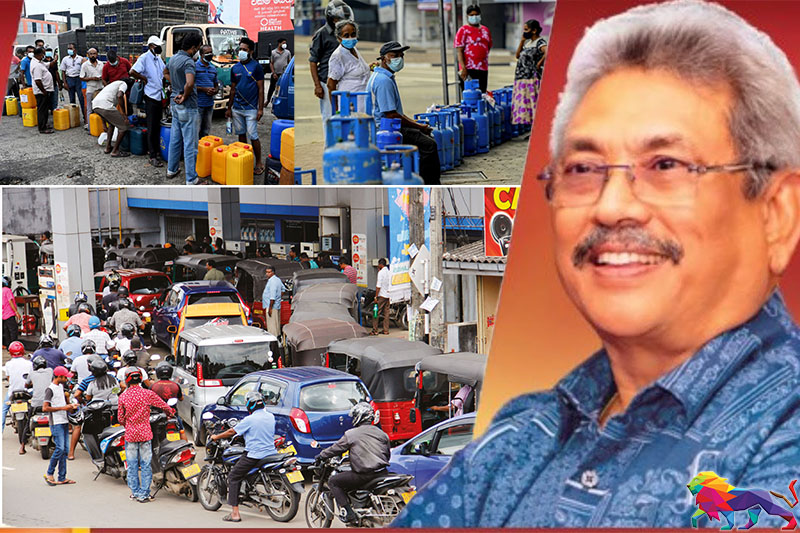
The four-year program would aim to restore stability in a nation that has been plagued by crippling food, fuel and medicine shortages by boosting government revenue and rebuilding foreign reserves.

But with the IMF still yet to approve the loan, Sri Lanka faces a long road to economic recovery and analysts say it is unclear whether Rajapaksa’s arrival will inflame the situation in the country once again.

Since Wickremesinghe was sworn in on July 21, demonstrators have been forcibly removed from protest sites by police and some have been imprisoned for damaging public property, among other alleged offenses — moves condemned by rights groups and opposition politicians.
“There is definitely an element of fear,” said Satkunanathan, the human rights lawyer. “It’s hard to say if there will be further protests. But of course, cost of living remains high and inflation is escalating.”

And while millions in the country are unable to afford food or fuel, Rajapaksa’s comfortable lifestyle upon his return threatens to inflame the situation once again.

“That is what bring my people to the streets. They get so angry over this hypocrisy,” said Satkunanathan.

According to Sooka, from the ITJP, it is also “unlikely” that the former leader will be investigated over war crimes allegations.

“The political class will protect him, and despite him fleeing, the structures and loyalties he relied upon are still intact,” she said, adding the protest movement is “broken, scared, and fragmented from within.”

“There is always hope that an intrepid civil society group would petition the court to open a case against him and that the attorney general and police would support such an action,” she added.

“Impunity should not be tolerated. Dealing with Gota will show the world and Sri Lanka that nobody is above the law.”
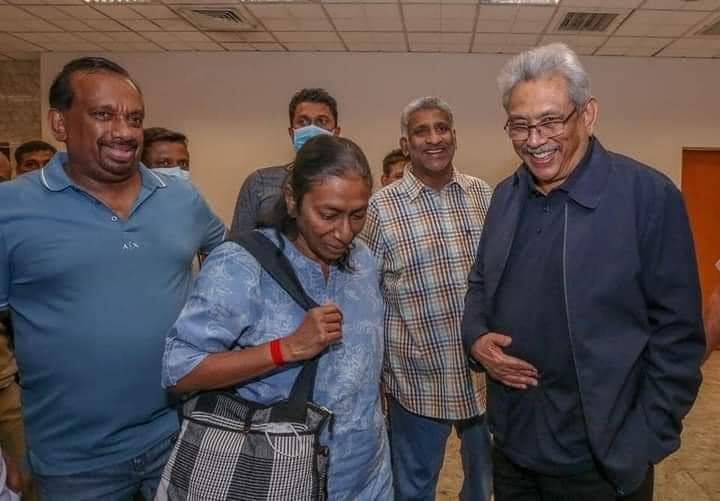
Ousted former President Gotabaya Rajapaksa returns to Sri Lanka

Sri Lanka’s former President Gotabaya Rajapaksa, who fled the country amidst the public uprising, returned to the island from Thailand along with his wife Ayoma Rajapaksa yesterday (02) at midnight.

Several ministers were present at the Katunayake airport to welcome the former president.

After his arrival in the island, the former President arrived at his house located at Malalasekara Mawatha, Colombo 07 at around 12.50 am Saturday.

In the face of unprecedented public protests, former President fled the country on July 13, first to the Maldives and then to Singapore.

Gotabaya Rajapaksa stayed in Singapore from July 14th and was granted visa for 14 days each by the Singapore government on two occasions. When the visa period given to him by the Singaporean authorities expired, he and his wife departed for Thailand

It was reported that the government has arranged to give Mr. Gotabaya Rajapaksa the privileges he is entitled to as a former president.

Japan denies preparations to host debt restructuring conference for SL

The Japanese Minister of Foreign Affairs has denied claims the country’s Government is making preparations to host a debt restructuring conference on behalf of Sri Lanka.

In response to a question posed by a journalist at a press conference held on Tuesday, Japanese Minister of Foreign Affairs Yoshimasa Hayashi said there is no preparation to hold such a conference with Sri Lanka.

“We are having various interactions with Sri Lanka. We are also carefully monitoring the grave economic situation in Sri Lanka. Given the economic crisis situation in the country we are currently implementing plans to provide humanitarian aid in the form of pharmaceutical products and food to the country,” he said.

“We hope the Sri Lankan Government in coordination with the International Monetary Fund (IMF) and the Paris club are trying to implement financial and economic solutions while ensuring transparency. Our country will carefully monitor the situation in Sri Lanka and discuss with Sri Lanka or other international donor organisations,” he added.

However, Japanese Minister of Finance Shunichi Suzuki has in the meantime urged all creditor nations to gather and discuss Sri Lanka’s debt at the same table. Suzuki was quoted as telling reporters that Japan would coordinate with other creditors to resolve Sri Lanka’s deepening financial crisis. Suzuki said Sri Lanka must accelerate talks with the IMF on a bailout and that all bilateral creditors, including China and India, must gather to discuss the issue.

President Ranil Wickremesinghe had told a foreign publication this month that Sri Lanka would ask Japan to invite the main creditor nations to talks on restructuring bilateral debts. He said he would discuss the issue with Prime Minister Fumio Kishida in Tokyo next month.

Posted in Uncategorized

China hopeful Sri Lanka will work out feasible solution expeditiously

China says it has been always encouraging the IMF and other international financial institutions to continue to play a positive role in supporting Sri Lanka’s response to current difficulties and efforts to ease debt burden and realize sustainable development.

“As a traditional friendly neighbour of Sri Lanka and a major shareholder of the International Monetary Fund (IMF), China has been always encouraging the IMF and other international financial institutions to continue to play a positive role in supporting Sri Lanka’s response to current difficulties and efforts to ease debt burden and realize sustainable development,” says the Embassy of China in Colombo.

“As to the bilateral financial cooperation, shortly after the Sri Lankan government announced the suspension of international debt payments in April 2022, Chinese financial institutions reached out to the Sri Lankan side and expressed their readiness to find a proper way to handle the matured debts related to China and help Sri Lanka to overcome the current difficulties,” the embassy said in a statement today.

“We hope Sri Lanka will work actively with China in a similar spirit and work out a feasible solution expeditiously,” it further reads.

SLFP decides to amend party constitution to penalize violators

The Central Committee of the Sri Lanka Freedom Party has agreed on amending its party constitution in a way that empowers the central committee and the party leadership in expelling party members who act in a manner detrimental to the policies and rules of the party.

The Party Secretary Dayasiri Jayasekara stated that this decision was reached during a discussion held at the party headquarters on Thursday (1) evening.

Posted in Uncategorized

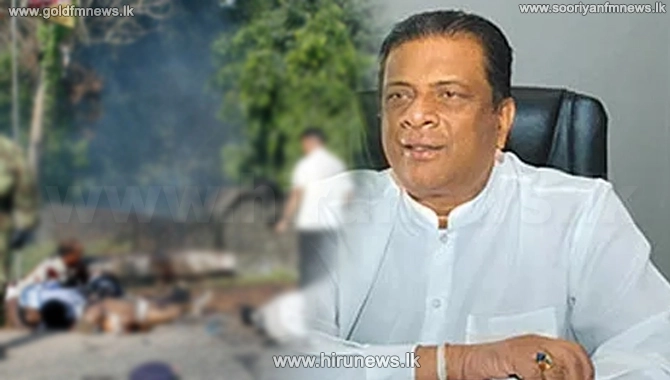
Jeyaraj murder: Former ASP and Ex-LTTE cadre acquitted and released

Former ASP for Gampaha, Lakshman Cooray and Ex-LTTE cadre Selvarajah Piribahakaran aka ‘Morris’ who were in remanded custody over the murder of former Minister Jeyaraj Fernandopulle were acquitted and released by Gampaha High Court Judge Sahan Mapa Bandara today.

They were charged and indicted for the murder of Former Minister the late Jeyaraj Fernandopulle and 15 others in 2008.

Jeyaraj Fernandopulle was killed in a suicide bomb attack, carried out by an LTTE terrorist on 6th April 2008 when he was participating in a New Year festival at Weliweriya.

Posted in Uncategorized

IMF gives Lanka a 4-four year Extended Fund Facility and a US$ 2.9 billion loan

An IMF mission led by Peter Breuer and Masahiro Nozaki visited Colombo from August 24 to September 1, 2022 to continue discussions on IMF support for Sri Lanka and the authorities’ comprehensive economic reform program. At the end of the mission, Messrs. Breuer and Nozaki issued the following statement:

“The Sri Lankan authorities and the IMF team have reached a staff-level agreement to support the authorities’ economic adjustment and reform policies with a new 48-month Extended Fund Facility (EFF) with a requested access of about SDR 2.2 billion (equivalent to US$2.9 billion)”

“The new EFF arrangement will support Sri Lanka’s program to restore macroeconomic stability and debt sustainability, while safeguarding financial stability, reducing corruption vulnerabilities and unlocking Sri Lanka’s growth potential,” the IMF said in a statement.

“The agreement is subject to the approval by IMF management and the Executive Board in the period ahead, contingent on the implementation by the authorities of prior actions, and on receiving financing assurances from Sri Lanka’s official creditors and making a good faith effort to reach a collaborative agreement with private creditors. Debt relief from Sri Lanka’s creditors and additional financing from multilateral partners will be required to help ensure debt sustainability and close financing gaps.”

“Sri Lanka has been facing an acute crisis. Vulnerabilities have grown owing to inadequate external buffers and an unsustainable public debt dynamic. The April debt moratorium led to Sri Lanka defaulting on its external obligations, and a critically low level of foreign reserves has hampered the import of essential goods, including fuel, further impeding economic activity. The economy is expected to contract by 8.7 percent in 2022 and inflation recently exceeded 60 percent. The impact has been disproportionately borne by the poor and vulnerable.”

“Against this backdrop, the authorities’ program, supported by the Fund, would aim to stabilize the economy, protect the livelihoods of the Sri Lankan people, and prepare the ground for economic recovery and promoting sustainable and inclusive growth.”

Key elements of the program are:

Raising fiscal revenue to support fiscal consolidation. Starting from one of the lowest revenue levels in the world, the program will implement major tax reforms. These reforms include making personal income tax more progressive and broadening the tax base for corporate income tax and VAT. The program aims to reach a primary surplus of 2.3 percent of GDP by 2024.

Introducing cost-recovery based pricing for fuel and electricity to minimize fiscal risks arising from state-owned enterprises. The team welcomed the authorities’ already announced substantial revenue measures and energy pricing reforms;

Mitigating the impact of the current crisis on the poor and vulnerable by raising social spending, and improving the coverage and targeting of social safety net programs;

Restoring price stability through data-driven monetary policy action, fiscal consolidation, phasing out monetary financing, and stronger central bank autonomy that allows pursuing a flexible inflation targeting regime. A new Central Bank Act is a cornerstone of this strategy;

Rebuilding foreign reserves through restoring a market-determined and flexible exchange rate, supported by the comprehensive policy package under the program;

Safeguarding financial stability by ensuring a healthy and adequately capitalized banking system, and by upgrading financial sector safety nets and regulatory standards with a revised Banking Act;

and Reducing corruption vulnerabilities through improving fiscal transparency and public financial management, introducing a stronger anti-corruption legal framework, and conducting an in-depth governance diagnostic, supported by IMF technical assistance.

“The IMF team held meetings with President and Finance Minister Ranil Wickremesinghe, Prime Minister Dinesh Gunawardena, Central Bank of Sri Lanka Governor Dr. P. Nandalal Weerasinghe, Secretary to the Treasury K M Mahinda Siriwardana, and other senior government and CBSL officials. It also met with Parliamentarians, representatives from the private sector, civil society organizations and development partners.

“We would like to thank the authorities for their candid approach and warm hospitality and are looking forward to continuing our engagement in support of Sri Lanka and its people.”

Posted in Uncategorized

Sri Lanka invites Saudi Arabia to set up a refinery in the country

Sri Lanka’s Minister of Environment Naseer Ahmed has invited Saudi Arabia to set up an oil refinery in Sri Lanka.

Minister of Environment Naseer Ahmed has made this invitation during his recent visit to Saudi Arabia as the special representative of the President for the bilateral talks between Sri Lanka and the Kingdom.

The Minister has also said that Sri Lanka can provide sufficient oil storage facilities to cover the entire region.

The Environment Minister has said that this invitation was made to provide a modern oil refinery and storage facilities for energy security cooperation by establishing a strong long-term relationship with Saudi Arabia.

In these discussions, attention was focused on the long-term agreements that can be made for Sri Lanka to obtain gas oil, petrol, jet A-1 fuel, crude oil, etc. and the necessary activities to establish long-term economic cooperation.

The Minister also stated that Saudi Arabia, one of the leading economic powers in the Asian region, is playing a major role as a leader in the energy sector and that the “Vision 2030” of Saudi Arabia’s Crown Prince Mohammed bin Salman has attracted the whole world including Sri Lanka.

Posted in Uncategorized

GR to return back to SL on Saturday

Exiled former president Gotabaya Rajapaksa is expected back home from Thailand tomorrow night (02), according to reliable sources.

He will be accompanied by his wife, chief bodyguard Brig. Mahinda Ranasinghe and private secretary Sugeeswara Bandara, the sources say.

Incumbent president Ranil Wickremesinghe has already allotted him a safe stay at Bullers Road in Colombo with maximum security.

The Sri Lanka Podujana Peramuna’s (SLPP) general secretary Sagara Kariyawasam told the media recently that Rajapaksa would be given all facilities due to a former head of state.

Following the country-wide protests on July 09, Rajapaksa fled to the Maldives four days later and then took a Saudi Airlines flight to Singapore on temporary visa.

From there, he tendered his resignation.

After the expiration of Singapore visa, Rajapaksa left for Thailand on August 11.

Rs 20M paid for Sanath Nishantha’s burned home

A sum of Rs 20 million has been provided to SLPP MP Sanath Nishantha as compensation for his home that was torched on 9 May.

The MP stated that he had received the said amount for his losses and the damages caused as he had paid his insurance as a businessman. Nishantha added that as a big-time businessman in the Puttalam District and that having estimated the value of his house and land, a sum of Rs 22 million had been provided to him as compensation.

The MP explained that he has no issues with regard to the said sum as he had received it for his work as a businessman and asserted that the sum does not belong either to the State or it concerns the public.

He charged that his house was not damaged by floods or tornados but set ablaze by protesters and mentioned that he had spent a sum of Rs 100 million to build it. He insisted that by current rates, it would be impossible for it to be even built for Rs 200 million.

Source:Ceylon Today