Presidential Commission’s report on Easter Attacks handed over to CID

The Secretary to the Public Security Ministry has handed over the report of the Presidential Commission to probe the Easter Sunday bomb attacks to the Criminal Investigation Department (CID) for further investigations, under the instructions of the President, Minister of Public Security Ananda Wijepala said.

Meanwhile, on March 30, President Anura Kumara Dissanayake stated that investigations into the Easter Sunday terror attacks are being carried out speedily, and that several of those responsible will be exposed before Easter Sunday this year. He made these remarks while addressing the gathering at a public meeting in Deiyandara.

Further commenting on the matter, the President added, “Investigations into the Easter attacks are being carried out systematically. April 21 once again marks the anniversary of the Easter attacks.”

The President also noted, “The Criminal Investigation Department (CID) is working to expose a significant group responsible for the attacks before April 21.”

Posted in Uncategorized

Easter Sunday bomb attacks: Church believes Maulana could uncover plot

Two days before marking the sixth anniversary of the 2019 Easter Sunday bomb attacks, the Catholic Church has expressed satisfaction with the state of the ongoing investigations.

Speaking to The Sunday Morning yesterday (19), Colombo Archdiocese Communication Director Rev. Father Jude Krishantha said that the authorities had been periodically updating the church on the progress of investigations into the attack.

“We are satisfied with the investigations. They informed us from time to time on how the investigations are progressing,” he said.

He further noted that a number of cases, including the cases of the victims who had filed for compensation, were still ongoing, claiming that there were about 20-25 suspects in custody at the moment.

“Some among those in custody are individuals who possess a lot of information about the attack.”

He expressed that they believe Asad Maulana could be a key to finding out about those who were responsible for the attack.

Maulana, a witness who testified on the attack for a Channel 4 documentary, alleged that there were connections between the intelligence service and local politicians and that these entities were involved in the attack.

“We hope that a lot can be revealed through questioning Asad Maulana who provided information in the Channel 4 documentary,” said Fr. Krishantha.

When asked about the progress of the cases related to the Easter Sunday attacks, Attorney General Parinda Ranasinghe told The Sunday Morning that the cases were being handled by the Police.

“We are not involved in it. You must speak to the Police,” he said.

Speaking to The Sunday Morning, Police Media Spokesperson SSP Buddhika Manatunga said that all those who had been arrested in connection with the attacks were either in remand prison or out on conditional bail.

He added that no suspects remained in Police custody at present.

Meanwhile, a senior official at the Ministry of Public Security and Parliamentary Affairs claimed that the investigations were moving ahead. “The investigations are going well. They are making progress,” he told The Sunday Morning.

Fr. Krishantha further stated that the Catholic community, along with many other Sri Lankans, were awaiting justice for the victims of the attack. He said that they were hopeful that President Anura Kumara Dissanayake would make revelations about the attacks and take the investigations forward.

Commemoration events for the victims of the Easter Sunday terror attacks are planned to be held at the St. Anthony’s Shrine, Kochchikade and St. Sebastian’s Church, Katuwapitiya, marking the sixth anniversary of the attacks tomorrow (21).

Sri Lankan Delegation Heads To U.S. For Tariff Talks

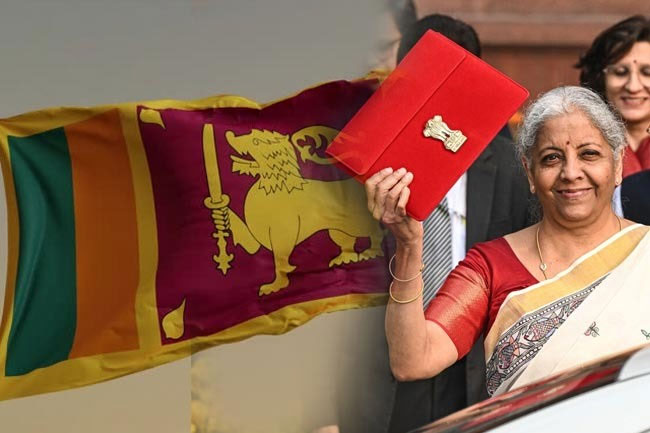
A Sri Lankan delegation has departed for the United States to engage in discussions regarding the recent imposition of reciprocal tariffs on the country.

Deputy Minister of Finance, Professor Anil Jayantha Fernando, stated that the talks are scheduled to take place on April 22.

He said that they will meet with the United States Trade Representative, and the discussions will focus on strengthening investment and trade relations with the U.S.

Pakistan-Sri Lanka Naval exercise scrapped after India’s concern – report

A plan to hold a military exercise between the navies of Pakistan and Sri Lanka in the strategic waters of Trincomalee was shelved a few weeks back, after New Delhi conveyed its concerns to Colombo over the proposed drills, multiple sources have said.

Trincomalee is situated on Sri Lanka’s northeastern coast and is considered a significant hub in the Indian Ocean region, especially for India’s maritime security interests.

The sources said the navies of the two countries had planned to carry out the exercise off Trincomalee, in line with their regular engagements.

The plan did not go through after India apprised its apprehensions over the exercise to the Sri Lankan side, they told PTI.

The joint exercise was planned weeks ahead of Prime Minister Narendra Modi’s visit to Colombo, the sources said.

The navies of Pakistan and Sri Lanka are known to have cordial relations and warships from both countries visit each other’s ports regularly, besides carrying out wargames.

There was no official word on the plan either from Sri Lanka or Pakistan.

Military experts, explaining Trincomalee’s strategic importance for India, said it has the potential to dominate the Bay of Bengal and much of the northeast Indian Ocean, and New Delhi was right in expressing concerns over the proposed exercise.

The Pakistani Navy operates in close cooperation with China’s PLA Navy and New Delhi has reasons to have concerns over any visit by Pakistani warships to Trincomalee, said one of the experts.

The docking of Chinese missile and satellite tracking ship “Yuan Wang” at the Hambantota port in August 2022 had triggered a diplomatic row between India and Sri Lanka.

Another Chinese warship docked at the Colombo port in August 2023 had also triggered some concerns in New Delhi.

In the last few years, India has been focusing on extending assistance to Sri Lanka in developing Trincomalee’s energy infrastructure.

India is especially looking at revitalising the oil tank farms in Trincomalee that has one of the finest natural harbours in the world.

During Modi’s visit to Colombo this month, India, Sri Lanka and the United Arab Emirates (UAE) firmed up an ambitious agreement to develop Trincomalee as an “energy hub”, with a broader aim to help the island nation achieve energy security and fuel its economic growth.

Significantly, India and Sri Lanka also signed a defence pact to institutionalise military cooperation following talks between Modi and Sri Lankan President Anura Kumara Dissanayake.

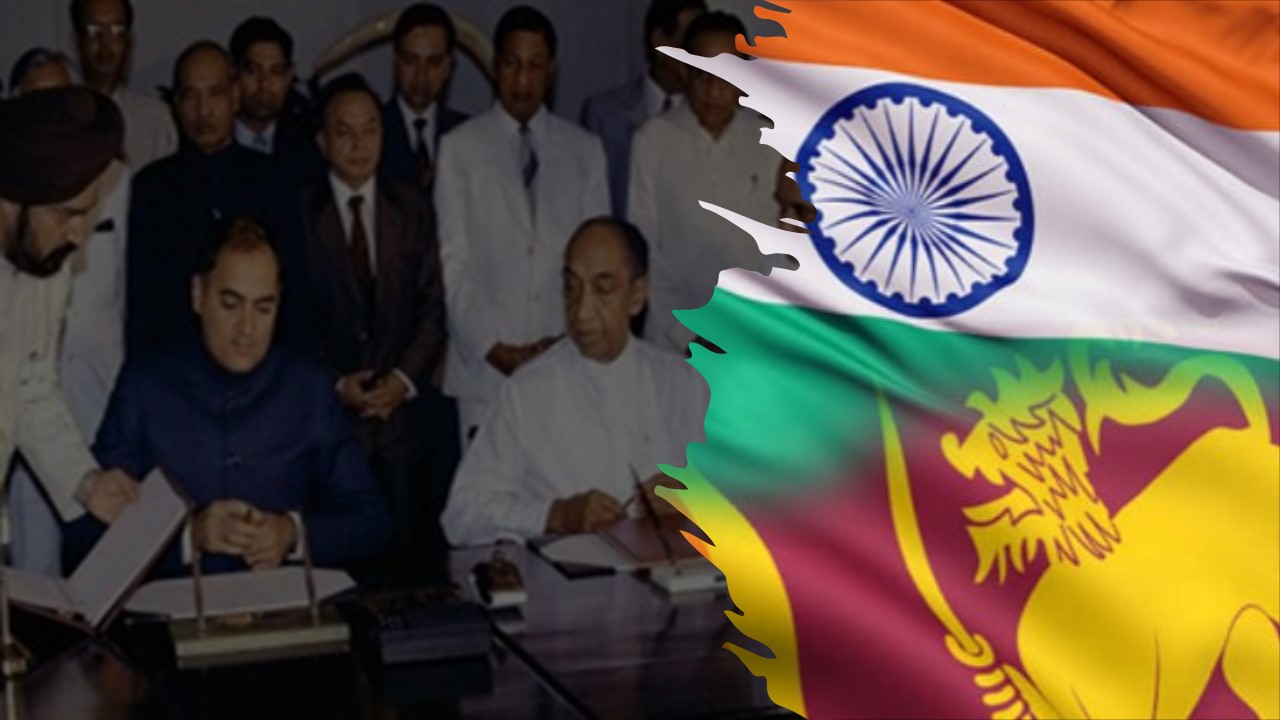
The agreement on defence cooperation signals a major attempt to boost the India-Sri Lanka defence ties, nearly four decades after the Indian Peace Keeping Force’s intervention in the island nation strained the relations.

India has been expanding its overall strategic ties with Sri Lanka amid concerns over China’s attempts to increase influence over the island nation.

Three years back, India handed over a Dornier maritime surveillance aircraft to Sri Lanka.

The aircraft was given to Sri Lanka from the inventory of the Indian Navy to help the country meet its immediate security requirement.

Source: PTI

Posted in Uncategorized

In a bid to secure GSP+ trade concessions: Govt. Fast-Tracks Repeal of PTA By Anuradha Herath

In a decisive shift aimed at securing Sri Lanka’s access to the European Union’s GSP+ trade concessions, the Government is preparing to swiftly repeal the Prevention of Terrorism Act (PTA).

A high-level EU delegation is expected to arrive in Sri Lanka this May, during which trade and investment discussions will be held. Deputy Minister of Economic Development, Anil Jayantha Fernando, said that Sri Lanka will also take this opportunity to discuss export diversification and the continuation of GSP+ benefits with the visiting team.

According to him, the EU expects Sri Lanka to ensure the protection of human rights and maintain a stable environment free from terrorism or unrest. If such conditions are upheld, the EU is likely to support Sri Lanka’s continued access to GSP+.

Taking this into account, the Government has decided to move ahead with repealing the PTA—a law long criticised for being used not only to address terrorism, but also to suppress dissent and serve political interests. The EU has repeatedly voiced strong disapproval over the law’s misuse by successive governments.

Commenting on the matter, Minister of Justice Harshana Nanayakkara confirmed that the Government is ready to repeal the Act without delay. He said public consultations will be held next month to gather opinions from the public, civil society organisations, and other stakeholders.

However, Nanayakkara noted that a substantial amount of feedback has already been collected from a wide range of groups, and as there is little need to start over, the Government is prepared to proceed swiftly.

He added that ahead of repealing the Act, it is vital to establish a legal framework that protects human rights, addresses global terrorism threats, and upholds the rule of law. That process, too, is expected to be carried out without delay.

Posted in Uncategorized

China ready to support SL against economic coercion – Ambassador

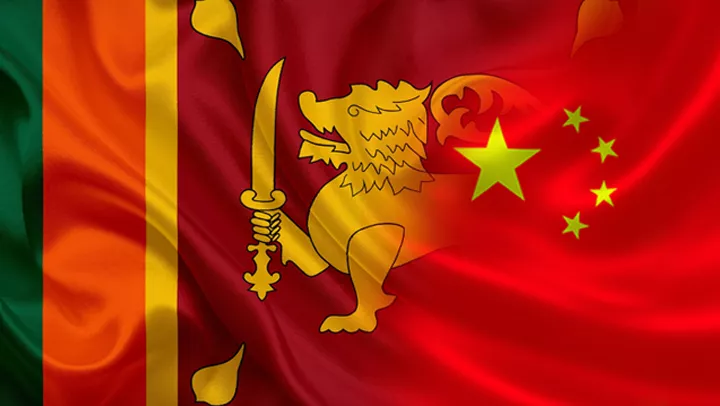
China stands ready to support Sri Lanka’s development and strengthen their longstanding partnership, Chinese Ambassador Qi Zhenhong said in a release, addressing global trade tensions.

Emphasizing the importance of multilateralism and economic cooperation, Qi re-affirmed Beijing’s commitment to working closely with Colombo to resist protectionism and economic coercion.

He described China – Sri Lanka relations as a model of South-South cooperation and said the two nations are well-positioned to build a shared future based on mutual benefit and stability. Qi also criticised the United States tariff policies, warning of their impact on developing nations and the global economy.

Excerpts from the statement:“Recently, the US government, disregarding unanimous opposition from the international community, announced its decision to impose so-called “reciprocal tariffs” on all trading partners including China and Sri Lanka. This move was followed by repeated policy reversals, creating significant chaos and uncertainty on a global scale. Moreover, this uncertainty continues to accumulate, potentially causing broader turmoil and even triggering a global economic recession.

“By recklessly imposing tariffs on other countries, the US defies the fundamental laws of economics and market principles, disregards the balanced outcomes achieved through multilateral trade negotiations, ignores the fact that the US has long benefited substantially from international trade, and weaponizes tariffs to exert maximum pressure for selfish interests.

“As a matter of fact, the US and other Western developed countries have been the architects and long-time leaders of the global free trade system.People in Global South countries, including China and Sri Lanka, have only been able to earn meagre foreign exchange earnings by working really hard to provide high-quality, low-priced commodities to developed countries like the US. Meanwhile, the US, by occupying the high end of the industrial chain, has earned substantial profits by exporting services, high-tech products and equipment. What’s more, many products manufactured by developing countries like China and Sri Lanka and exported to developed countries are essentially products of Western companies.

“Openness and cooperation are the prevailing trends of history and mutual benefit is the shared aspiration of all. For the majority of countries committed to development and revitalization including Sri Lanka, a free and open multilateral trading system is of vital importance. A secure and stable international environment is indispensable, and the more cooperative and reliable economic and trade partners there are, the better.

Looking back at history, the evolution of globalization has always advanced through twists and turns amid turbulence. As the second largest economy, the second largest market for consumer goods, and a firm supporter of the multilateral trading system, China has always believed that cooperation is the only right path to addressing global challenges and multilateralism is the inevitable choice for overcoming the difficulties the world faces.

“Moreover, China will continue to advance high-standard opening up, and implement high-standard policies for trade and investment liberalisation and facilitation, share development opportunities with the world to achieve mutual benefits, win-win outcomes and shared prosperity, and promote a universally beneficial and inclusive economic globalisation.

China and Sri Lanka are good friends, good brothers and good partners from history to present. Our cooperation has become a model of South- South cooperation. Under the new circumstances, China stands ready to work with all countries in the world including Sri Lanka, to firmly uphold multilateralism, oppose economic bullying and trade protectionism, jointly safeguard international fairness and justice, and strive to foster a stable global environment for development. In this process, China will resolutely implement the important consensus reached between President Xi Jinping and President Anura Kumara Dissanayake, bring greater opportunities to Sri Lanka through China’s high-quality development, and work together to jointly build a China-Sri Lanka community with a shared future for greater benefits of the people of the two countries and the region.”

Three ex-governors say president cannot stop funding to any LG body

The president, cabinet nor a provincial governor has discretion whatsoever to deny funds due for any local government body under the control of an opposition party or an independent group, three former governors said in a statement.

Signed by Rajith Keerthi Tennakoon, Maithri Gunaratne and Asath Sally, it refers to remarks by the president twice that he would readily allot funds to NPP-controlled LG bodies, but would closely monitor before funding the others.

What the president said is a politically-forceful statement which is an election fraud, misleading of the public and without any foundation, they stressed.

Whoever voted to power, they should have the freedom in running the LG bodies, said the three ex-governors, adding the president is bound by the constitution and the regulations to fulfil his obligations.

They also refuted a claim in a NPP leaflet the central government funds the LG bodies, noting that a majority of them have so far been receiving allocations to pay salaries only.

LG bodies have their own income generation avenues by way of taxes, stamp duty charges etc, they said.

A writ order can be obtained from courts against anyone blocking the receipt of such income, the three governors added.

Posted in Uncategorized

Postal Ballot Paper Distribution Underway; Voting Dates Revised

The Election Commission says that all postal ballot papers will be distributed by April 21.

Chairman of the Commission R. M. A. L. Ratnayake said that if a court issues any rulings affecting specific local government bodies, postal voting in those areas may be delayed accordingly.

So far, ballot papers for postal voting have been dispatched to 227 local government institutions.

Distribution to the remaining 112 institutions is expected to be completed in the coming days.

In light of the recent legal developments, the Commission has also revised the dates for marking postal ballots.

Postal voting for all state institutions, including the police, tri-services, schools, corporations, and statutory boards, will now take place on April 24, 25, 28, and 29.

Driver of ‘Pillayan’ Sivanesathurai Chandrakanthan Arrested by CID

The Criminal Investigation Department (CID) this evening arrested the driver of former MP Sivanesathurai Chandrakanthan, widely known as ‘Pillayan’, in connection with the 2006 abduction and disappearance of former Eastern University Vice Chancellor, Professor S. Raveendranath.

This latest arrest comes as part of an intensified investigation into the unresolved case that has haunted the academic community for nearly two decades. Prof. Raveendranath went missing under suspicious circumstances in December 2006, shortly after arriving in Colombo to attend official meetings. He was last seen in the vicinity of the BMICH.

Pillayan, a former Chief Minister of the Eastern Province, was himself arrested by the CID in Batticaloa on 8 April and subsequently detained under the Prevention of Terrorism Act (PTA) for 90 days from 12 April.

The Easter Sunday Cover-Up: The Story Of Naufer Maulavi And His Masters In Colombo

Part 1: Who Is Naufer Maulavi Really?
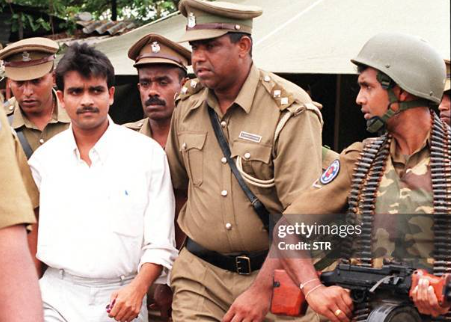
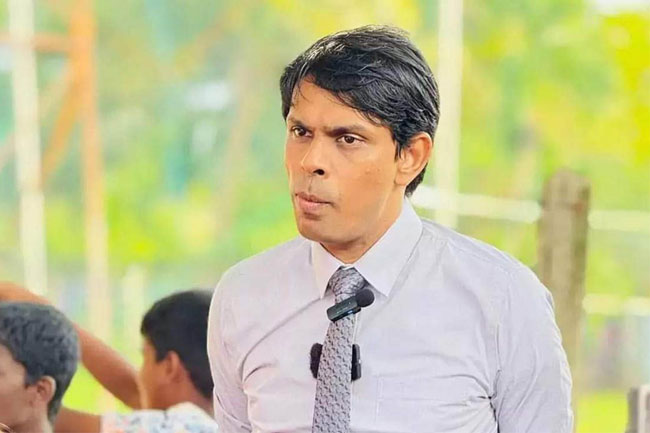
The name Mohammadu Ibrahim Mohamad Naufer, more commonly known by the religious honorific Naufer Maulavi (in Picture), is one that has haunted Sri Lanka since the carnage of April 21, 2019—the devastating Easter Sunday bombings that claimed over 250 innocent lives. Branded as the “mastermind” of the attack by the media, government reports, and even international law enforcement agencies, the truth about Naufer Maulavi has long been buried under layers of misinformation, manipulation, and outright deception.

This investigation seeks to peel back those layers—and to expose the far more sinister actors who lurk in the shadows, far from the mosques of Kattankudy and closer to the marble floors of power in Colombo.

The Man From Khartankodi
Born on 30th November 1978, in the dusty eastern town of Khartankodi near Kattankudy, Naufer’s early life was unremarkable. He attended local Islamic religious schools, and through the years, earned the title Maulavi—a credential that denoted him as a religious teacher, not a warrior or an ideologue. He was known in his community as pious, soft-spoken, and deeply engaged in scholarly debates within Wahhabi circles.

It’s important to note that Wahhabism—though often misunderstood—is a reformist movement focused on purifying Islamic practices. The organizations Naufer initially affiliated with in the Middle East had no proven ties to violent extremism. They were purist, yes—but not militant.

So what happened to Naufer? How did a theological student become the alleged “ISIS agent” and “mastermind” of Sri Lanka’s deadliest terrorist attack?

The Arrest That Almost Didn’t Happen
Just days after the Easter bombings, Naufer Maulavi was arrested—not through elite intelligence work—but by accident. He was holed up at a safe house in Enderamulla, Colombo, at the time of the attack. Fearing imminent police raids, he made a fateful journey back east to his native Kattankudy via Dambulla, traveling with a driver in a rented vehicle.

They checked into a local hotel under false identities—both Muslim names. Suspicious hotel staff tipped off the police. Initially, the Dambulla Police detained him and, after running his documents through Colombo’s Terrorism Investigation Division (TID), found no red flags. He was allowed to leave.

It was only after a secondary TID officer, asking for photographs, spotted him and recognized him from a confidential military dossier, that the order came through: “Arrest him immediately.” He was picked up at the hotel, interrogated, and whisked to Colombo.

But what was in that confidential file? And why did the TID, despite initially green-lighting his release, only react upon visual confirmation? Here’s where the trail begins to darken.

The Military Intelligence Connection
Sources within the intelligence community—both in Colombo and outside—have confirmed that Naufer Maulavi had long been a person of interest to Sri Lanka’s Military Intelligence Corps (MIC). Not because he was a terrorist. But because he was a potential asset.

In the years leading up to 2019, several covert operations were run by a rogue unit of military intelligence, led and mentored by now-infamous figures like Major General Suresh Saleh, then Director of Military Intelligence. The objective? Infiltrate Muslim communities, identify theological influencers, and—where possible—weaponize them.

Naufer, the Maulavi with Gulf ties, a clean academic record, and no criminal past, was perfect. He was approached, monitored, and eventually cultivated—not by radicals from ISIS, but by men in uniform operating under the pretext of “national security.” These operations had full political sanction, specifically from members of the Rajapaksa family, who were then out of power but plotting their grand return.

Zahran Hashim And The False Flag Network
In 2018, Naufer was allegedly instructed by his handlers to build a relationship with Zahran Hashim, the radical preacher from National Thowheeth Jamaath (NTJ). Zahran, too, had been under surveillance, but mysteriously remained untouched by law enforcement despite numerous public threats.

Through intermediaries, including another intelligence-linked operative known only as Khalil, Naufer and Zahran were made to “collaborate.” Reports suggest that Khalil, now in remand over unrelated charges, was the crucial link between military intelligence and the NTJ cell.

The real bombshell? Zahran’s cell was infiltrated, managed, and possibly even directed by Sri Lankan military operatives posing as foreign religious mentors.

This strategy aligns eerily with doctrinal writings of Professor Rohan Gunaratna, a controversial academic whose theories about “Sri Lanka’s ISIS threat” were peddled in government reports, policy white papers, and, eventually, the FBI affidavit that sealed Naufer’s fate as the so-called “mastermind.”

The Gunaratna Doctrine: Creating An Enemy
Professor Gunaratna, a Sri Lankan counter-terrorism scholar with deep ties to both Western intelligence and the Sri Lankan state, was one of the first to publicly label Naufer Maulavi the “mastermind” of Easter Sunday. His reports became the foundation of legal action not just in Colombo, but also in Washington.

The problem? His conclusions were drawn before a full forensic investigation had even been concluded.

It appears that the narrative had been pre-scripted:

ISIS-inspired Islamist radicals,

A network led by Naufer,

Operationalized by Zahran,

Supported ideologically by Middle Eastern contacts.

A perfect case for international sympathy—and an even better excuse to justify the return of the Rajapaksas to power on a platform of national security.

The question now is not whether Naufer was involved. He may very well have had knowledge of the plot. He may have even assisted in logistics. But did he design, fund, and mastermind the entire operation alone? All evidence suggests: Absolutely not.

The FBI’s Hasty Affidavit
The FBI affidavit, used as primary evidence in several international forums to establish the role of ISIS in the attack, now faces serious questions. Why?

Because the FBI never interviewed Naufer Maulavi directly. Their conclusions were based on documents and interviews provided solely by Sri Lankan Military Intelligence and Rohan Gunaratna’s analysis.

Since then, multiple internal reviews—especially after the 2022-2023 international pressure campaign by victims’ families—have called for the affidavit to be revisited. The U.S. Department of Justice is reportedly embarrassed by its reliance on flawed intelligence.

One former senior FBI official, speaking anonymously, stated:
“We were handed a cooked narrative. Our mistake was trusting Sri Lanka’s version without independent verification.”

Plant, Patsy, Or Pawn?
Today, Naufer Maulavi sits in prison, branded as the “father of Sri Lankan Islamic jihadism.” He continues to preach to fellow inmates and has even, bizarrely, taken on the identity of a martyr-scholar.

But privately, he’s begun to talk. Sources close to his legal team suggest that he is ready to reveal everything—the military connections, the handlers, the Zahran connection, and most damningly, how he was set up to take the fall.

As this investigation continues in Part 2, we will explore:

The timeline of military intelligence involvement with NTJ

Why the warnings from Indian intelligence were ignored

The sudden withdrawal of police protection from churches before the attack

How the Easter Sunday bombings conveniently reset the political landscape for the Rajapaksas

One thing is already clear: Naufer Maulavi was not the architect—he was the blueprint. A false flag framed in fire.

(To be continued in Part 2: “Inside the Operation—How Military Intelligence Orchestrated the Perfect Crisis.”)

Source:Lanka Enews -By Investigatice Reporter