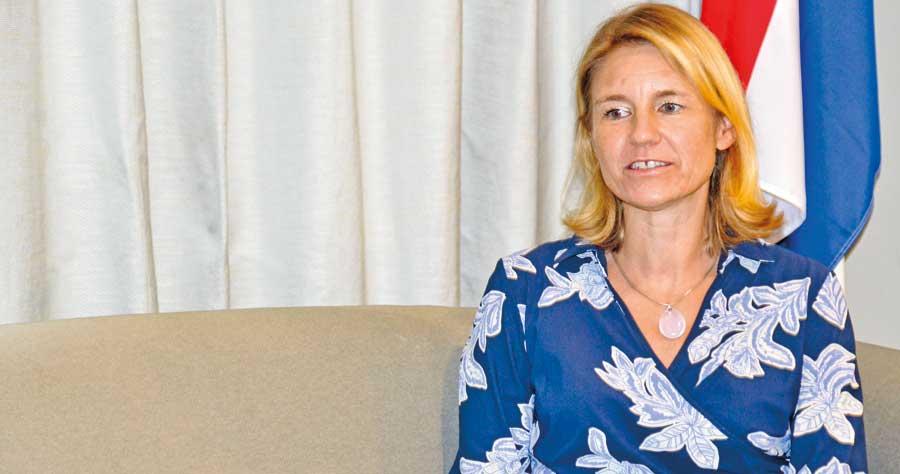
Ambassador of the Netherlands Tanja Gonggrijp, in an interview with Daily Mirror, speaks about bilateral relations between the two countries and rich Dutch heritage in Sri Lanka. She also responds to queries about Sri Lanka’s move for organic agriculture and the UNHRC process.
Excerpts;
Q Sri Lanka–the Netherlands bilateral relations are historical and multifaceted. It has influenced the legal system, architecture, cuisine, culture and lifestyle, as well as various facets of the socio-political system of Sri Lanka. In the event of the two countries celebrating the 70th anniversary of bilateral ties, how do you intend to elevate bilateral ties to the next level?
Indeed, Sri Lanka and the Netherlands celebrate our 70th anniversary of diplomatic relations this year. Two weeks ago, my counterpart in The Hague and I launched the celebrations and we foresee a series of events to mark this historic milestone in our relations. Our countries have known many historic milestones since the starting of trade between our countries around 1600. You mention the Dutch influence which has indeed contributed to the rich culture of Sri Lanka today. However, it is also important to recognise the dark side of the Dutch period in Sri Lanka; its colonial violence, slavery and monopolisation of trade. An important milestone was the ending of Dutch colonial rule in 1796. And another milestone was the start of official diplomatic relations between the two sovereign countries in 1951. Since then, our relationship has widened and deepened during countless forms of cooperation: for example to conserve our shared cultural heritage and to exchange know-how in the agriculture as well as infrastructure sectors and of course facilitating exchange for students and assistance for tourists.
We now focus to grow our relations in future-proof ways: both countries have committed to achieving the Sustainable Development Goals, so we share a vision to achieve them through our bilateral relations as well. We are facing big challenges, notably because of climate change. We view them as complex puzzles: puzzles that can only be solved together sustainably. So we are committed to business opportunities that support a shift to a circular and sustainable economy, climate resilient agriculture and supporting Sri Lanka to become the preferred sustainable choice in the region. Our infrastructure projects in Sri Lanka, the development of hospitals, bridges and water supply systems, also have a strong focus on sustainability, both with regard to the end use and the way the infrastructure is built. And we focus on deepening our cultural collaboration beyond maintaining our shared heritage: we support projects that look into the Dutch period in Sri Lanka critically and innovatively and we support the development of contemporary art in Sri Lanka. As we strongly believe, we should Leave No One Behind, we will continue to work with all sectors in society – government actors, civil society, knowledge institutes and businesses – to contribute to a thriving and inclusive society where human rights
are safeguarded.
Q You find a lot of Dutch history in Sri Lanka. What are the latest measures as far as conservation of places associated with the Dutch rule is concerned?
Sri Lanka is one of the focus countries for the Netherlands in terms of cultural cooperation. We have ongoing projects supporting heritage management and work with the museum sector and national archives to keep the Dutch heritage alive for the next generations. For example, we have recently started a project to produce digital mapping of Dutch fort cities in Sri Lanka. Local youth are involved and are made the future custodian of the shared heritage; they will tell stories about the forts and what they mean to them. We are also co-developing contemporary cultural expressions; for example, we have just started a dance project involving youth from all over Sri Lanka, going beyond boundaries of ethnicity, disability and genders.
Q How can the Netherlands cooperate with Sri Lanka in the development of tourism?
Two important elements that attract a lot of tourists to Sri Lanka are the island’s rich culture and the beautiful and diverse nature. I would like to explore how Sri Lanka could offer a more interactive and edutainment experience for visiting tourists with regard to for instance the Dutch period. This will make Sri Lanka an even more attractive destination for Dutch tourists. I know that the Department of National Museums is working on renovating the Dutch Period Museum in Colombo and we are glad to engage with the Department to contribute to the development of an audience oriented museum. I also see opportunities for more sustainable tourism. Making Sri Lanka a destination for eco-tourism will not only add to its attractiveness, but also contribute to the wellbeing of the Sri Lankan people and protection of the environment.
Q The Netherlands is the second highest export earner of agricultural products in the world despite being a geographically small country. How can Sri Lanka benefit from bilateral ties to develop its agriculture and livestock industries?
Indeed, the Netherlands is a big agricultural exporter: not only of agricultural products, but also of sustainable agricultural knowledge and technology. Since many years, Dutch technology and technical know-how has supported the Sri Lankan agricultural sector to better handle the challenges like the need for productivity, water use inefficiency and climate resiliency. The Embassy has been supporting different Sri Lankan agricultural sectors in these areas by organising missions, exposure tours, capacity building training and fellowships. Right now, we have ongoing projects to support the dairy, poultry and horticulture sectors in Sri Lanka. The focus is on supporting Sri Lanka to develop these sectors in a more future-proof, sustainable way. And I think that in the future, as the Netherlands plays a prominent role in the global agricultural supply chains, Sri Lanka can benefit from having more partnerships with
Dutch companies.
Q Sri Lanka has introduced organic farming in place of chemical farming. As a country advocating environment-friendly agriculture, how does your country observe this?
The Netherlands is not only the second largest exporter of agricultural goods in the world, we are also regarded as a leader in efficient and sustainable agriculture. Nearly 20 years ago, the Netherlands made a commitment to work towards sustainable agriculture by aiming to produce twice as much food using half of the resources. Research and innovation facilitated by partnerships between government, farmers, industry, civil society and knowledge institutions like the University of Wageningen, have brought Dutch agriculture a long way. This has led to a reduction of dependence on water by 90 percent and a considerable reduction of chemical pesticides and fertilisers, even almost eliminated in greenhouses. Today the Netherlands is aiming for circularity in agriculture, energy saving in the greenhouse sector and better animal welfare. I am convinced that sustainable and more organic farming is the only future-proof way of farming in the long run in any country; in the Netherlands, in Sri Lanka, anywhere. However, this transformation takes time and demands more research and innovation and long-term planning and investments. No country can do it alone as supply chains are global. So indeed we aim to continue to improve our policy and support other countries like Sri Lanka on this road too, and work together.
Q In what ways can the Netherlands help Sri Lanka implement organic agriculture?
Dutch experience, inputs and technology could support Sri Lanka with this. We have many private companies that produce inputs and machineries for organic cultivation. Moreover, the Netherlands is the home to many sustainability, fair trade and certification initiatives and organisations, like Solidaridad, Fair Trade and Rainforest Alliance. The expertise and experience of these organisations can also support Sri Lanka to work towards sustainable, organic production based on the latest insights in this area. The embassy is here to identify opportunities and connect the right partners in order to assist Sri Lanka becoming a sustainability frontrunner in the region.
Q What are the measures already taken in this regard?
Working towards more sustainable agricultural practices have been part and parcel of our agricultural collaboration with Sri Lanka for many years now. For example, we have trained around 250 trainers on Integrated Pest Management (IPM) in collaboration with the Department of Agriculture. And we are currently in the process of training another 100 trainers on protected agriculture, again in collaboration with the Department. And last year, we trained 125 dairy stakeholders on sustainable dairy feed and waste management in collaboration with the Sri Lanka Dairy Association. Further, we have organised many training and exposure missions to the Netherlands for the sustainable development of the dairy, horticulture and poultry sectors. Many fellowships have also been awarded for the same cause.
Q Recently, you undertook a visit to the eastern province along with your Norwegian colleague. What have you gathered from the visit for further cooperation?
Our visit to the East was as a part of our ongoing engagement with different stakeholders in Sri Lankan society. Together with my Norwegian colleague, I was able to get firsthand insight in the developments in the Eastern Province by visiting the Batticaloa and Trincomalee districts. We had a series of meetings with members of the government, opposition, civil society and the clergy in the province. We visited some of the projects supported by our respective embassies and – of course – Dutch heritage sites.
The visit was also an opportunity to see one of our infrastructure projects. To date, the Dutch company Janson Bridging has completed almost 700 bridges in Sri Lanka since commencing in 2015. These newly constructed bridges enable rural communities to have easier and quicker access to for instance markets, work, health services and education. The Netherlands Government will continue to support the rural bridges across Sri Lanka under the Development Related Infrastructure Investment Vehicle (DRIVE) programme, where 200 more bridges will be built through Dutch government support and partnership.
Q All the European countries decide as a bloc when it comes to Sri Lanka’s issue at the UNHRC. The Netherlands is collectively bound by this decision. However, as the ambassador, how do you assess Sri Lanka’s ground situation as far as the matters envisaged in the UNHRC resolution are concerned?
The Netherlands always aims to work to achieve the greater good for the global community and supports international efforts by the UN or other international mechanisms towards that goal. So yes, we would like to see a prosperous and stable Sri Lanka. As regularly underlined by the Netherlands, EU and the UN, this is possible only through genuinely addressing accountability issues and fostering true reconciliation. We appreciate progress made by Sri Lanka since the end of war and hope it will honour commitments it made before the international community in a timely manner. The Netherlands stands ready to support Sri Lanka in implementing its commitments to the UNHRC.
Q How does the Netherlands view Colombo Port City as a gateway to South Asia?
Colombo Port City has great potential due to its geographical location in the Indian Ocean. Sri Lanka is situated in one of the busiest sea trade routes on the globe. I can certainly understand Sri Lanka’s desire to develop its infrastructure to tap into those potentials and become a key hub for international maritime trade. Developing infrastructure is therefore important, as is attracting trading partners and investors. To do so, a transparent and predictable business environment is key. This will enhance investment confidence and attract diverse investors. Then I think there would be potential for Dutch companies too; they made Rotterdam harbour the gateway to Europe and could therefore contribute to Colombo’s Port
City ambitions!