Sri Lankans let down by Foreign Ministry’s failure to respond effectively to the UNHRC chief’s charges
Bachelet declares Council has an information and evidence repository of 120,000 items regarding human rights violations
Govt. falls back on former administration’s human rights achievements to show progress
Cardinal alleges PM tries to mislead Pope, but Papal diary shows pontiff was in Hungary and Slovenia
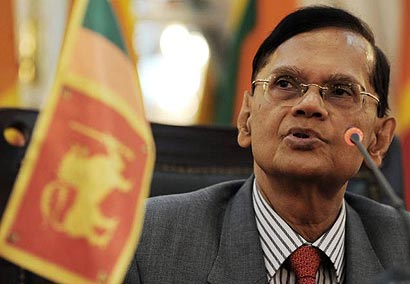
Foreign Minister, Prof. G. L. Peiris had to draw deep from the arsenal left behind by the previous yahapalana government on the “post-war domestic process” to fight the oral report of UN High Human Rights Commissioner Michelle Bachelet on Monday.
She made a string of damning indictments on the Sri Lanka Government at the 48th sessions of the UN Human Rights Council sessions in Geneva.
Other than that, Prof. Peiris rejected “any external initiatives purportedly established by Resolution 46/1 while domestic processes are vigorously addressing the relevant matters.” “Without the co-operation of the country concerned,” he said, they cannot “achieve their stated goals, and will be subject to polarisation.”
That in essence is the position of the Sri Lanka Government. A recorded video explaining it was played out in the halls of Palais de Naciones on Tuesday. Prof. Peiris was then in Bologna in northern Italy accompanying Prime Minister Mahinda Rajapaksa. This was his perceived response to damning remarks High Commissioner Bachelet offered in her oral update on Monday on the human rights situation in Sri Lanka. Thus, the statement did not deal with some strong remarks from the UN High Commissioner, except a few.
Prof. Peiris singled out a few of the foreign policy initiatives of the yahapalana government at the UNHRC, creditably due to the efforts of the late Mangala Samaraweera, the then Foreign Minister. He fell victim to the deadly COVID-19. The “domestic processes,” Prof. Peiris referred to and initiated by the late minister Samaraweera, included the setting up of the Office of the Missing Persons (OMP), the Office for Reparations (OR), the Office of National Unity and Reconciliation (ONUR), the National Human Rights Commission, measures to do away with the Prevention of Terrorism Act (PTA) and a “vigorous engagement” with civil society.
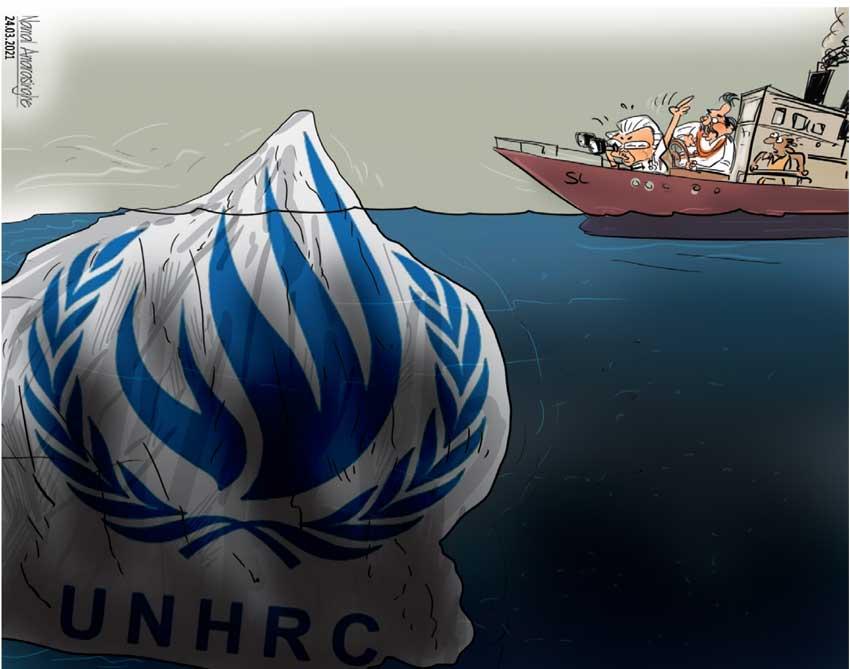
Prof. Peiris’ rejection of “external initiatives” is the Government’s pointed response to High Commissioner Batchelet’s announcement that her Office work to implement the accountability related aspects of Resolution 46/1 (adopted in March this year) had begun, pending recruitment of a start-up team.” Batchlet declared, “We have developed an information and evidence repository with nearly 120,000 individual items already held by the UN, and we will initiate as much information-gathering as possible this year. I urge Member States to ensure the budget process provides the necessary support so that my Office can fully implement this work.”
This is apart from the exercise by the West led by the Core Group to stampede Sri Lanka into the abyss of universal jurisdiction. The stage is being set to move this process during the year ahead. It is therefore incumbent upon the Government of Sri Lanka to arrest the trajectory, as it would be the military personnel who were central to the conduct of the war against separatist terrorism, who would be on the frontline in being prosecuted internationally.
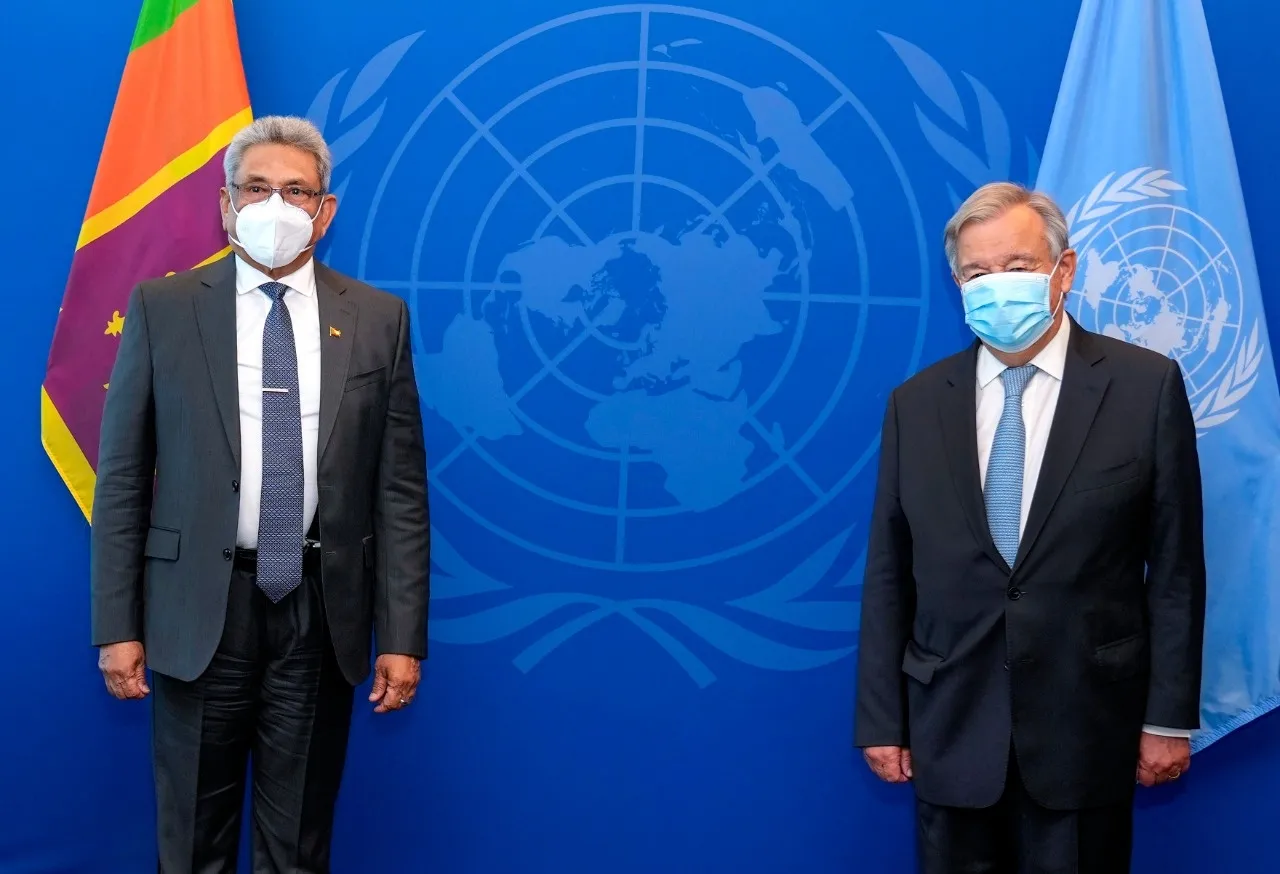
President Gotabaya Rajapaksa, who left for New York last night, is expected to delve into these aspects in his speech to the 76th session of the UN General Assembly. He is accompanied by Foreign Minister Peiris, Senior Advisor Lalith Weeratunga and Foreign Secretary Jayanath Colombage among others. Ahead of his departure, he named parliamentarian Mahinda Samarasinghe, a former Minister, as Sri Lanka’s Ambassador to the United States. Samarasinghe has also served earlier in the Sri Lanka missions in Geneva and in Canberra. His brief, a government source said, was to ensure better relations with the US and draw more foreign investment from there. He will resign from his parliamentary seat after the budget to take up the appointment. Earlier, Dr Lalith Chandradasa, who lives in Los Angeles, was tipped for this position.
Although Prof. Peiris has “rejected any external initiatives,” the question that begs answer is whether this will hold vis-à-vis the Council. Firstly, the Sri Lanka Government has not been able to even ensure a rejection of Resolution 46/1 when it was adopted in March by the Human Rights Council. Thus, the rejection, other than spelling out the Government position, is of little use except with a handful of countries. More importantly, the external mechanism has evolved even against the stated reluctance on the part of Sri Lanka.
On the issue of member states raising the necessary funds for the external initiatives to proceed, there indeed is a revelation from High Commissioner Bachelet. Months earlier, the then Foreign Minister Dinesh Gunawardena publicly declared that such funds had been only partially revised by the Fifth Committee of the United Nations in New York. Bachelet’s remarks indicate that it is not so, and the budgetary requirement submitted originally needs to be met.
Therefore, the question is whether the Government of Sri Lanka will be powerful enough to lobby member countries not to provide the necessary funds. The answer it is clear is a firm no, considering Sri Lanka’s weakness in lobbying countries — and in this case, it needs to obtain a majority support of the 193 member states.
High Commissioner Bachelet’s oral update was generally based on the trends and issues identified in her last report presented at the 46th session in February/March this year. That report set the pace for the envisaged action by the core group in terms of Resolution 46/1 and now provides the basis for the oral update during the current sessions.
Shrinking on democratic space
The Sri Lanka Government for its part has committed to work with the UN to ensure accountability and implement necessary institutional reforms. High Commissioner Bachelet acknowledged it in terms of expecting concrete action to this end, that too in line with the recommendations made in OHCHR (Office of the High Commissioner for Human Rights) Reports and various human rights mechanisms. Hence from the outset, she has established the UN’s involvement in the domestic process of accountability, reconciliation, and reconstruction.
With the accountability issue secured by her last report and the resulting resolution, this oral update’s central feature was the shrinking of civic and democratic space since the 46th session. To this end, expectedly there was reference to “the corrosive impact that militarisation and the lack of accountability continue to have….” that too on fundamental rights, civic space, democratic institutions, etc. The declaration of a new State of Emergency to ensure food security and price controls was observed by the High Commissioner as a move that may further expand the role of the military in civilian functions. This has already come to pass with the new appointment of the Commissioner General of Essential Services being an officer of the Army. Surveillance, intimidation, and judicial harassment of categories of persons were outlined by her, especially excessive use of force and arrest of demonstrators.
The new regulations being drafted on civil society groups were deemed by the High Commissioner as a move to further tighten restrictions on fundamental freedoms. Bachelet expressed concern on the developments in judicial proceedings in several emblematic human rights cases, with a specific reference not to proceed with charges against former Navy Commander, Admiral of the Fleet Wasantha Karannagoda on the enforced disappearances of 11 youths. The recent presidential pardon of former MP Duminda Silva which could risk eroding confidence in the rule of law and judicial process had reference in the oral update. The call by religious leaders for truth and justice on the Easter Sunday attacks also found its way into the oral update. Deep concern was expressed on the deaths in Police custody, reports of torture and ill treatment by law enforcement officials and police encounters with alleged drug criminal gangs.
One wonders on what basis she made the reference to the Government having proscribed or listed over 300 Tamil and Muslim groups and individuals for alleged links to terrorist groups. It is inappropriate for High Commissioner Bachelet to simply make a loose reference to an aspect related to national security of a sovereign nation. Should not there have been some elucidation? The oral report is also damning and has sought to build more allegations on the violations of human rights, which the Government has heaped on itself some through arrogance and the other due to flippancy.
Prof. Peiris’ statement to the UNHRC was also bland and not engaging. This was compounded by the fact that it was recorded rather than delivered live virtually. Much of the progress Prof. Peiris recounted was roll over from the yahapalana times. On the other hand, the Human Rights High Commissioner outlined some details of the delivery of the mandates by each mechanism, while also highlighting shortcomings. She referred to the National Policy of Reparation, being approved last month, with reparation payments and reconciliation programmes being continued. However, she emphasised that reparations programmes must be accompanied by broader truth and justice measures. The continued operation of the Office of the Missing Persons with a sixth regional office operating in Kilinochchi was acknowledged by her.
As for the National Human Rights Commission, Prof. Peiris only noted that “it is carrying out its mandate.” However, High Commissioner Bachelet announced that the Global Alliance of National Human Rights Institutions has initiated a special review of the National Human Rights Commission of Sri Lanka to determine its compliance with the Paris principle. The alliance has indicated its concerns on the appointment process of the Commission and its effectiveness in discharging its human rights mandate. These aspects appear to have flown above the Foreign Minister, judging from his statement.
Prof. Peiris’ touting of the release of 16 Tiger guerrilla cadres convicted of terrorist crimes as progress, was noted by High Commissioner Bachelet as those who were being held under the controversial PTA and were nearing the end of their sentences being pardoned. The Government is now officially faced with an information and evidence repository with nearly 120,000 individual items already held by the UN, following HC Bachelet’s revelation. She has declared that her office has begun its work to implement the accountability related aspects of Resolution 46/1, pending recruitment of a start-up team. This is the sting in the oral update which the Government must take cognisance of.
Prof. Peiris simply rejecting “the proposal for any external initiatives established by Resolution 46/1 while domestic process is vigorously addressing the relevant matters,” is not likely to shelve the action approved by the Council. Yes, as upheld by the Foreign Minister, “external initiatives embarked upon without the co-operation of the country concerned cannot achieve their stated goals……“ but in the UN and Council parlance this amounts to rhetoric, when other coercive measures also could be resorted to by the proponents of the action.
Sri Lanka’s Permanent Representative at the UN in Geneva, C.A. Chandraprema, pointed out that the “UN General Assembly never authorised the UNHRC to assign to any party, or the OHCHR to carry out tasks such as the collection of criminal evidence for use in judicial proceedings.” At the outset, he seemed to have forgotten that the Human Rights Council mandated this aspect through its Resolution 46/1 adopted in March this year. Hence, according to the process, the UN General Assembly will be dealing with the issue during the forthcoming sessions due to third and fifth committee budgetary implications of the Human Rights Council Resolution. The required budget is to facilitate this aspect of the collection of criminal evidence for future judicial proceedings.
High Commissioner Bachelet’s appeal to member states “to ensure the budget process provides the necessary support” to OHCHR “to fully implement the work” is evidence that the required budget has yet to be processed. This mantle falls on the Fifth Committee and the General Assembly in New York. The question is whether any action has been initiated by the Sri Lanka’s Permanent mission in New York.
As stated by Prof. Peiris in his appeal to the member states of the UNHRC that “the resources expended on this initiative are unwarranted, especially when they are urgently needed for humanitarian and other constructive purposes in many parts of the world.” That should resonate far and wide in New York.
A proper strategy to dent the required budget in New York is the need of the hour. The absence of a well-thought-out strategy in Geneva during the 46th session has got Sri Lanka into this present quagmire. For instance, an initiative to have requested a separate vote on operative paragraph 6 in Resolution 46/1 may have been successful in its elimination, considering that many countries do not support external initiatives vis-à-vis a sovereign nation. For instance, this is true of India, which in 2013 held with Sri Lanka on a separate vote of a paragraph based on this very aspect.
In this hour Sri Lanka needs to adopt a strategy of engagement with countries across all hemispheres, basic to which is a time-bound action plan on initiatives covering accountability, reparation, and reconciliation issues. The buy in of Sri Lanka’s closest neighbours on the initiatives is paramount, to go further afield. Both Geneva and New York need to be proactive to ensure Sri Lanka’s betterment and secure its position at international level. The people of this nation cannot be let down due to the misconduct of the country’s foreign policy.
PM’s Italy visit
On the foreign affairs front, the visit by a delegation led by Prime Minister Mahinda Rajapaksa to Bologna in northern Italy also drew flak. This visit ran into controversy. Following Cardinal Malcolm Ranjith’s news briefing where he said that the Catholic church of Sri Lanka would be compelled to present to the international community the issue of legal action yet to be taken by the Government on the incidents of bombing during Easter in 2019. Cabinet spokesperson Dr Ramesh Pathirana was to declare that the Premier while in Italy would meet the Pope and explain the status on the issue.
The upshot of this position was for Cardinal Malcolm Ranjith to deliver a tirade of opposing such a meeting by the Premier as he believed the Holy Father would be misguided. There were some church authorities who were unhappy with what they saw as churlish behaviour. In fact, it was surprising and regrettable that the Cardinal who had served in the Vatican did not deem it fit to first check the Holy Father’s diary which is in the public domain. If he had done it, it would have been evident that the Pope was scheduled to visit Hungary and Slovenia from September 12 to 15. The tirade the Cardinal launched into would have not been necessary, as it only brought into question his own bona fides on this issue.
As regards the purported visit to the Vatican, both the Prime Minister’s Office and the Foreign Ministry scrambled to issue media statements to put the record right. The statement from the Premier’s Office was professional, while that from the Foreign Ministry was simply not in keeping with the standard expected from such an institution. The Foreign Ministry news release categorically stated that the Premier had not requested nor received an invitation to visit the Vatican for an audience with His Holiness the Pope. To defuse the confusion that has arisen from the articulation by the Cabinet spokesperson, the Premier’s Office very correctly spelt out that PM Mahinda Rajapaksa was undertaking a visit to Italy and he delivered the keynote address at the inaugural session of the G20 Inter-Faith Forum 2021. After the event ended Premier Rajapaksa flew to Singapore for medical reasons and returned to Colombo thereafter.
However, the Foreign Ministry announcement of the same occasion was extremely tardy. While it sought to equate the Premier and the Foreign Minister by stating that “the Prime Minister and the Foreign Minister will shortly make a visit to Bologna, Italy, “the purpose of it was merely “to participate in an international event…..” It is basic to make a reference to the details of the visit, rather than simply stating it being an “international event.” Further, the statement dubs the occasion as “international symposium.” There was no reference that the meeting was a G20 forum. The most telling was the last sentence of the statement where it was spelt out “the PM and FM will be leaving Italy, at the conclusion of the event in Bolonga.” Is that a point that needs to be made, as the return of such political hierarchy to their homeland is given.
Much of the lack of professionalism in the Foreign Ministry, as of late, is being demonstrated through the unseemly content of the media statements. The responsibility for such content is in the hands of the Foreign Minister and the Ministry Secretary. After all, the correct usage of language is the bedrock of diplomacy and the mandate of the Foreign Ministry.
One is not wrong in saying that the Premier’s participation in the function in Bologna is a non-event. While it was envisaged for the Premier to have “several high-level diplomatic meetings” as stated in the media release, the absence of photographs and statements in this context, indicates that they did not materialise. This visit was at Italian Prime Minister Mario Draghi’s invitation. It is most regrettable that even the host did not seem to have afforded a brief meeting.
Sadly, the visit to Bologna disturbed a hornet’s nest with the diaspora, particularly in Italy and Germany turning up to protest the issue of the Easter Sunday incidents. Expectedly there were the friendly diaspora elements too who sought to at least get a glimpse of Premier Rajapaksa outside his hotel. Footage doing the rounds in the social media had an unanswerable question over whether some depicted cheer or jeer.
Ratwatte affair
The world marked the International Day of Prisoners on Sunday, a day ahead of the commencement of the Human Rights Council sessions. Providing a grizzly spectacle to the world was Sri Lanka with the Minister of State for Prisons, Lohan Ratwatte, armed with his pistol, walking into the Anuradhapura Prison and ordering two prisoners – Ganeshan Dharshan of Hatton and Mathiarasan Suklakshan from Nelliady (Jaffna) – to kneel before him. He had allegedly threatened to shoot them after pointing the pistol at them. Both prisoners were held under the Prevention of Terrorism Act.
State Minister Ratwatte later sent in his letter of resignation only from the post of Prison Reforms. Dated September 15, the two-paragraph letter said:
“Firstly, I am thankful for having faith in me and giving me the State Ministerial post of Prison Management and Prisoners Rehabilitation Affairs at a time when the Prisons Department was in a crisis.
“Up to now I have successfully carried out the ministerial tasks. For the purpose of avoiding government facing a difficulty regarding the matters published in the media about the ministry, today (September15, 2021) I voluntarily resign from the State Ministry of Prison Management and Prisoners Rehabilitation Affairs. Therefore, with respect I seek your approval to resign.”
However, on Thursday he took up another position – that he had visited the Anuradhapura prison to resolve an issue and declared if he had not gone there, the premises would have been on fire. Tamil National Alliance (TNA) parliamentarian Abraham Sumanthiran called upon the Government to conduct an inquiry into the incident. Jaffna district parliamentarian Gajendrakumar Ponnambalam said that the two prisoners should be transferred to a prison in a “Tamil-speaking area.”
Both President Gotabaya Rajapaksa and Prime Minister Mahinda Rajapaksa have ventured into the field of foreign affairs at a time when the country is facing its worst crisis over economy and the still spreading COVID-19 pandemic. No doubt, Sri Lankans will be called upon to further tighten their belts amidst dwindling foreign reserves, shortage of food items and the fear of the coronavirus.