Vaccination Card will be inspected when visiting Public Places from 15th September

Sri Lankan authorities announced that in order to enter public places, one must be in possession of a vaccination card to prove that one is fully vaccinated.

Army Commander General Shavendra Silva speaking to News 1st said this measure will come into effect from the 15th of September, and people entering public places from that day will be inspected for their vaccination card.

In addition, Inter-ProvinceTravel will be prohibited for a period of two weeks with effect from Friday (13), said the Army Commander.

He said during that period ONLY essential services will be permitted to operate between provinces while permission will be granted for those working in the health sector, ports, airports and agriculture services.

Further, the heads of institutions can decide on the number of employees required to be present at work.

The Army Commander said Inter-Province Public transport is also suspended for a period of two weeks from Friday (13).

Inter-provincial travel ban strictly enforced; inter-province public transport cancelled

The prevailing inter-provincial travel restrictions will be thoroughly implemented from midnight today, Army Commander General Shavendra Silva said.

He said the inter-province public transport would also be suspended from midnight today.

“However, the inter-provincial travel restrictions will not be applicable for banking, tourism, ports, apparel sectors and essential services,” the Army Commander said.

The decisions were taken during the COVID Task Force meeting held this morning at the Presidential Secretariat.

He also said it was utmost essential to operate restaurants and shopping malls under strict adherence to health guidelines.

Posted in Uncategorized

Police training in Sri Lanka halted over abuse fears – The Times UK

Police Scotland has put a controversial scheme to train officers in troubled Sri Lanka on hold amid criticism from global watchdogs.

The New York-based Human Rights Watch last week called on the Scottish national force to “suspend assistance programmes until there is progress on accountability and reform” on the Indian Ocean island.

The global watchdog has reported a surge in police abuses in Sri Lanka during the pandemic, including extrajudicial killings, torture and arbitrary detention.

Its South Asian director, Meenakshi Ganguly, said: “Sri Lanka’s police seem intent on building on their past record of serious abuses, instead of cleaning up their act. The UN, UK and others working with Sri Lankan law enforcement should recognise that without the political will to reform on Sri Lanka’s part, their engagement risks appearing to endorse abusive agencies.”

Police Scotland has long been criticised for its links with Sri Lanka, where it has worked to develop community policing and support the victims of sex crime. The force, however, has always insisted it trains overseas officers under UK government oversight, as part of an effort to improve policing abroad.

The pandemic has effectively stalled such programmes over the past year. However, The Times understands it pressed pause on its programmes as early as May — long before being asked to do so by Human Rights Watch — pending a review of its work it will carry out together with the Foreign Office.

Gary Ritchie, the assistant chief constable, said: “Police Scotland’s values of integrity, fairness, respect and a commitment to upholding human rights are at the heart of everything we do. This includes our work in Sri Lanka, which supports the realisation of the United Nations’ sustainable development goals, particularly gender equality, reduced inequality, peace and justice, strong institutions and partnerships to achieve the goals.

“All UK assistance is subject to robust overseas security and justice assistance [OSJA] assessments to ensure that it supports our values and is consistent with our domestic and international human rights obligations. The OSJA relating to Police Scotland’s current activity in Sri Lanka is currently under review and all our activity is paused for the time being. Officers have not travelled to Sri Lanka since the start of the coronavirus pandemic for public health reasons.”

Early this year The Sunday Post revealed that Police Scotland had renewed its training contract with the Sri Lankan authorities for another two years. It is not known how much this work would be worth, but the force has previously received £700,000. It has sent trainers to the island on about 100 occasions, the paper said.

Sri Lanka rupee 203 non-credible peg to US dollar hanging by a thread

Sri Lanka rupees non-credible peg to the US dollar at 203 has mostly broken, especially for large import payments, market participants said, as banks struggled to find dollars to exchange for printed money from failed bond auctions coming up for redemption in forex markets.

Most Sri Lanka’s bank Treasurers were persuaded to keep rupee at 203 to the US dollar despite the lack of monetary policy to make the peg credible (a floating overnight rate or a wide policy corridor).

Importers say they cannot get dollars at 203 and are begging banks to get dollars at higher prices from exporters to clear import bills before the port charges demurrage on containers.

Some banks have started to pay as much as 211 to exporters to serve customers.

On Friday Standard Chartered Bank told credit card customers that the 2.5 percent premium usually charged will be raised to 7 percent to “reflect the current market rates.”

Most banks are still carrying a rate of 203 for telegraphic transfers on their websites.

State-run Bank of Ceylon has a notice saying for transactions over 7,500 US dollars to contact the Treasury to get a rate.

“These rates are subject to change according to market levels,” a notice said. “Rate quotations for amounts in excess of USD 7500 or equivalent, should be referred to the Dealing Room and shall be decided at the discretion of the Bank.”

This week at the weekly meeting with authorities bank Treasurers explained the difficulties in finding dollars at the 203 rate.

A US money doctor in 1950 set up a Latin America style central bank in then Ceylon, which has since depreciated the currency from 4.70 to over 200 in the worst performance in South Asia.

All South Asian central banks, and those of Mauritius and Seychelles are derived from the Indian rupee which was originally pegged to silver.

Analysts have called for laws to curb the domestic operations of Sri Lanka’s central bank, or its abolition in to a currency board before ‘output gap’ targeting and Modern Monetary Theory led to severe depletion of reserves.

Several central banks set up by the Latin America unit of the Fed before Ceylon, had ended up in market dollarization after severe depreciation.

However last week the central bank raised a ceiling rate on the 12-month bill yield which is serving as a de facto policy rate by 05 basis points.

Posted in Uncategorized

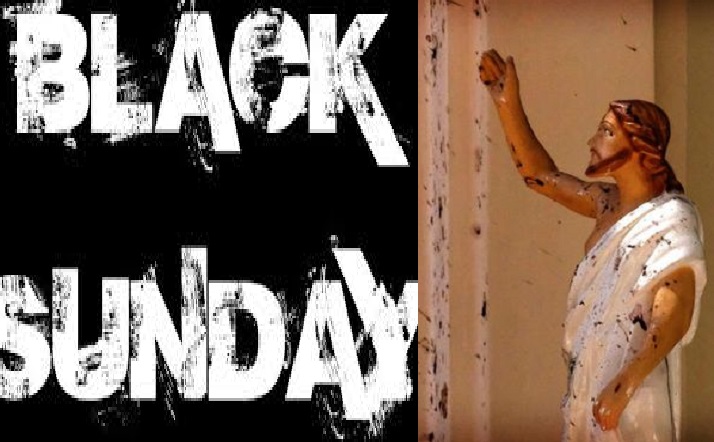
Easter Sunday bombings: Lanka’s Catholic church to hold black flag protest against govt’s inaction

The Catholic church in Sri Lanka will raise black flags on August 21 to express their ‘pain and disgust’ over the government’s handling of the deadly 2019 Easter Sunday attacks that killed over 270 people, including 11 Indians.

Malcolm Cardinal Ranjith, the Archbishop of Colombo, said they will raise black flags on their homes, offices, businesses and vehicles to seek justice for the victims, a statement said on Saturday.

‘It is now clear that the government is not interested in revealing the truth, they want to sweep the whole attack under the carpet and wash off their hands,’ Ranjith said, adding that they were protesting to express their ‘pain and disgust”.

He alleged that the current government, which pledged before the 2019 election to bring to book the culprits, is now indulging in doing politics on the dead bodies of the victims.

Nine suicide bombers, belonging to local Islamist extremist group National Thawheed Jamaat (NTJ) linked to ISIS, carried out a series of blasts that tore through three churches and as many luxury hotels in Sri Lanka, killing over 270 people and injuring more than 500 people on April 21, 2019.

The Catholic church has been demanding that action be taken against former president Maithripala Sirisena and ex-prime minister Ranil Wickremesinghe for their failures to prevent the suicide bombings.

The local Catholic church is demanding justice for the victims, asserting that no action has been taken against Sirisena and Wickremesinghe despite a commission of inquiry finding both of them culpable for their failures to prevent the attack.

The Cardinal expressing unhappiness on the status of the investigation says that politicians have not been able to put a stop to murder, disappearances, political victimisation and abductions. “They appointed various commissions from time to time but people are still to know the truth,” he said.

The government maintains that investigations are proceeding. Early this week, the government announced that 23,270 charges against 35 people have been filed in connection with the attack.

The charges filed under the Prevention of Terrorism Act (PTA) include conspiring to murder, aiding and abetting, collecting arms and ammunition, and attempted murder. The Attorney General’s Department said that the Chief Justice has been asked to appoint a special high court bench to hear the cases speedily.

Sri Lankan police have arrested hundreds of suspects in connection with the suicide bombings.

The Buddhist-majority nation was about to mark a decade since ending a 37-year-long Tamil separatist war in May 2009 when the suicide bombings in 2019 rocked the country.

The attacks caused a political storm as the then government headed by president Sirisena and prime minister Wickremesinghe was blamed for its inability to prevent the deadly attacks despite the prior intelligence made available on the impending terror strikes.

During his tenure, Sirisena formed a presidential panel to probe the attacks.

In its report, the panel said that former president Sirisena and a host of other top defence officials, including former defence secretaries, former IGPs and intelligence chiefs, were guilty of ignoring prior intelligence. The panel report recommended criminal action against them.

Both the then-police chief and the top defence bureaucrat were sacked and arrested for their inaction to prevent the attacks.

Then Prime Minister Wickremesinghe was also blamed for turning a blind eye to the rising Islamic militancy. It was cited as an encouragement to the extremists. Both have denied responsibility.

Source:PTI CORR PMS AKJ PMS PMS

Posted in Uncategorized

We will never give way to the tactics of the government to escape from the international pressure -TELO determined

The government should implement at least thirteen amendment and ensure devolution of power to the Provincial Council permanently and express it’s goodwill.

The government is facing severe pressure at the international level. Resolution 46/1 will be revisited in the September 2021 HRC session and the government will face severe challenges. The Sri Lankan government did not co-sponsor the resolution and completely rejected it. As a result, outside the Human Rights Council, the international community has begun to exert various pressures on the government. The European Union decided to reconsider its GSP tariff. On other hand a resolution at the US Congress is waiting to be adopted. These are just the beginnings.

The Sri Lankan government is considering various ways to relieve itself from these pressures. The president recently told the media that the Government is ready to work with the UN. The international community has condemned the PTA as an aid to state abuse of power. Demands for its removal have been raised. A Presidential Commission has been set up to deal with it as a tactic.
Foreign Minister Dinesh Gunawardena has said that a committee will be set up to look into the release of Tamil lands. He could not say that we would stop the current process of acquiring Tamil lands. Or could not declare that we would not acquire Tamil lands in the future. Because all sorts of plans to discriminate the Tamil people are going to be implemented.

In such a political climate, there are unconfirmed reports stated that the government is ready to negotiate with the Tamil side. No clear comments have been made as to what the government is going to negotiate. At the international level, the government is trying to resort to various tactics to relieve itself at least temporarily of the growing crisis against them. We see all these attempts are part of these tactics. We will never support this initiative of the government. The government’s attempt to escape international pressure at the expense of our Tamil people will never be allowed.
Telo believes that at least implementation of the 13th Amendment to the Constitution in full and the perpetuation of the powers of the provincial councils can pave the way for constructive dialogue. The government can do this on the basis of court rulings and minor amendments to the Constitution. The government today has all the credentials and strength to do so. A simple majority is enough. This requires the government’s commitment.

If the government takes this action as a goodwill gesture, it will create a favourable environment for negotiations. This is nothing new. We demand the fulfilment of our right which is already available in the Constitution.

The government, which passed the new bill to the Port City Commission and handed it over to China, will be able to perpetuate provincial powers through the 13th Amendment, which is already in the constitution. There won’t be any difficulty in implementation. There is no need to be reluctant.

Moreover, we cannot see any political justification in the government’s call for a negotiation while issues such as the release of political prisoners, the operation of offices for missing persons, land grabbing, and the appointment of Sinhala executives to Tamil areas administrations are pending without solution.

The government must express its goodwill and create a conducive environment for negotiation. Even during the last Mahinda Rajapakse regime, an all-party meeting on a political solution was held and no constructive conclusion was reached even after 18 rounds of talks. Similarly, recommendations were made on what constitutional reforms should be made on the part of the TNA to fully implement the 13th Amendment and devolve powers of the Provincial Councils permanently. A committee headed by the current Foreign Minister Dinesh Gunawardena was set up for this purpose. But no constructive steps were taken by this committee.

It is for the government or any other party to assume that the TNA will rush behind a call for talks after we have had so many such deceiving experiences.

Negotiation is necessary. We are not against it. It is the duty of the government to create a conducive environment by expressing goodwill gesture.

We will not allow Tamil people to fall prey or be part to the government’s tactics to use of negotiating with the Tamil side as escape passage to international pressure.

Surenthiran
Media Speaker- TELO
Tamil National Alliance

Posted in Uncategorized

SLFP emphasizes need for a mixed electoral system

Sri Lanka Freedom Party, United People’s Freedom Alliance and People’s United Front handed over their proposals in writing yesterday (11) to the Select Committee of Parliament to identify appropriate reforms of the election laws and the electoral system and to recommend necessary amendments.

Hon. Minister Mahinda Amaraweera, Hon. State Ministers Dayasiri Jayasekara and Lasantha Alagiyawanna handed over the proposals to the hon. Chairman of the Committee, Leader of the House, Minister Dinesh Gunawardena on behalf of their parties.

State Minister Dayasiri Jayasekara speaking on behalf of the Sri Lanka Freedom Party said that the country needs a mixed electoral system at present. He emphasized the need of the executive presidency, and pointed out that proper procedures should be put in place to prevent the appointment of dual citizens to the presidency.

The State Minister said that the possibility of holding the Presidential and General Elections on the same day and the possibility of holding the Provincial Council and Local Government Elections on the same day should be specially looked into. The State Minister also emphasized the need to introduce a district council system in the decentralization of provincial council powers.

Speaking on behalf of the United People’s Freedom Alliance (UPFA), Minister Mahinda Amaraweera said that a system should be set up to hand over the relevant Memorandums of Understanding (MoUs) to the Elections Commission when political parties enter into an alliance. He further stated that every party should have a fair campaign opportunity in the elections.

Speaking on behalf of the People’s United Front, State Minister Lasantha Alagiyawanna said that special attention should be paid towards bringing in new reforms to reduce election campaign expenses. Speaking on behalf of the Lanka Sama Samaja Party, Hon. Member of Parliament Prof. Tissa Vitarana said that there is an urgent need to establish a new electoral system in the country to protect the rights of all communities. He also pointed out the importance of preventing the misuse of state property.

Representatives of the Ceylon Workers’ Congress (CWC) who addressed the committee pointed out that the electoral system should be in place to protect the rights of minorities. It was also emphasized that the representation of the plantation workers should be ensured.

Speaking at the committee meeting, the Democratic Left Front said that it was very important to hold elections on time. They also proposed the complete abolition of the executive presidency and the strengthening of the parliamentary system.

The Communist Party of Sri Lanka, the Democratic United National Front and the Arunalu Janatha Peramuna also presented proposals before the Committee. The Executive Director of the Centre for Policy Alternatives (CPA), Dr. Paikiasothy Saravanamuttu, also presented his proposals to the Committee, saying that new reforms should focus on increasing the representation of women in politics.

Representatives of the Centre for Policy Alternatives (CPA) suggested that many countries in the world have resorted to the method of counting votes electronically and that it should be experimented in Sri Lanka as a pilot project.

Accordingly, the next meeting of the Committee is scheduled to be held on August 18 said the Secretary to the Committee, Chief of Staff and Deputy Secretary General Ms. Kushani Rohanadheera.

Hon. Ministers Nimal Siripala de Silva, Prof. G. L. Peiris, M.U.M Ali Sabry, Hon. State Minister Jeevan Thondaman, Hon. Members of Parliament Madhura Withanage and Sagara Kariyawasam were also present at the Committee Meeting.

Officials from the Election Commission, the Delimitation Commission and the Attorney General’s Department were also present at this committee meeting.

Posted in Uncategorized

Teachers and Principals launch sathyagraha campaign

Teachers ‘and Principals’ Trade Unions, who have withdrawn from online teaching due to salary anomalies, have decided to launch a sathyagraha campaign today.

The sathyagraha campaign is due to be carried out the Independence Square in Colombo today (12).

The Union stated that despite the appointment of a Cabinet sub-committee, no positive solution has been found to their grievences so far, therefore their trade union action will continuine into its 31st consecutive day.

Sri Lanka reports 156 COVID-19 fatalities, highest reported in a day

Sri Lanka has registered 156 more COVID-19 related fatalities confirmed by the Director-General of Health Services on Wednesday (August 11).

This is the highest number of COVID-19 deaths reported in a single day.

This also marks the fourth consecutive day that the daily count of Covid-19 deaths has exceeded 100.

The new development has pushed the official death toll from the virus outbreak in Sri Lanka to 5,620.

According to the data released by the Department of Government Information, the latest victims confirmed today include 87 males and 69 females.

None among the victims are aged below 30 years while 35 victims are aged between 30-59 years and 121 others are aged 60 and above.

Quarantine measures for travellers arriving from overseas revised

The Health Ministry has revised the quarantine measures to be followed by travellers arriving from foreign countries.
According to revised guidelines, all Sri Lankans and their accompanying foreign National spouse, children, Dual Citizens (if using the Sri Lankan passport to arrive) with a travel history (including transit) in the past 14 days to India, do not need to get the prior approval from the Foreign Ministry and Civil Aviation Authority of Sri Lanka (CAASL) to disembark in Sri Lanka.
However, all Foreign Nationals (including valid resident visa holders) and Dual Citizens (If using the foreign passport to arrive) with a travel history (including transit) in the past 14 days to India will be permitted to disembark in Sri Lanka only after getting the permission of Foreign Ministry followed by CAASL.
Besides, fully vaccinated travellers who have not arrived from/ transited at India or a travel restricted country and released from quarantine with an On Arrival (Day One) negative COVID-19 PCR report, do not have to undergo COVID-19 PCR test on Day Seven.
However, unvaccinated children of two years to eighteen years who have been released with the fully vaccinated parents should undergo a COVID-19 PCR test on Day Seven after arriving in Sri Lanka from a Ministry of Health approved Private Sector or State Sector Laboratory. Day Seven PCR test results should be immediately informed to the area Medical Officer of Health (MOH) by telephone or email.
The countries named as Travel Restricted Countries are South American countries and South African countries (South Africa, Angola, Botswana, Lesotho, Mozambiq ue, Namibia, Swazila nd, zambia, Zimbabwe).

Posted in Uncategorized