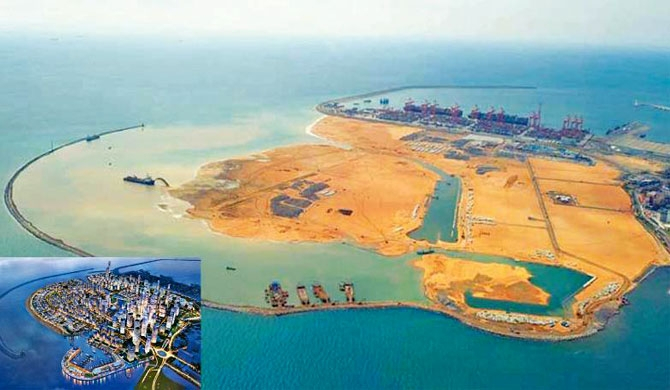
Sri Lanka’s China-backed Colombo Port City, which has attempted to cut through a regulatory morass that is holding back the rest of the country via a fast-track ‘single window’ law is still at risk of delays from incompetent regulators, a top policy specialist has warned.
Rohan Samarajiva, the founder of LIRNEasia, a regional policy research body and former regulator of Sri Lanka’s telecom sector who carried out an extensive de-regulation, says the state ends up regulatory activities of citizens in multiple ways.
“We talk about regulators as some special breed but quite a lot of what the government does is regulations,” Samarajiva said at a seminar organized by Advocata Institute, a Colombo based think tank.
“The difference is that there are entities that do formal explicit regulations, rule-bound; and there are those that can say yes or no therefore regulate but don’t necessarily do in that in a formalized manner.”
Limiting Discretion
Regulations become unclear to investors and the general public and also lead to corruption where there is room or discretion for officials to vary decisions. Delaying decisions also make it difficult to get anything done at all.
“I believe it important to make regulations more efficient and the whole essence of regulations is something called discretion – that is the ability to say yes or no,” Samarajiva said.
“To bound that and to limit that. Of course, you have to say yes or no but to bind it.”
The Port City bill was passed to cut regulatory barriers through a ‘single window’ for investment approvals as the government was called upon to start a state regulator for beauty pageants by people who believe the coercive state with a broken public sector is better at it.
“Why is this concept important? To do any one thing you can ask how many steps you must go through and places you have to go through and any of those places can slow you down due to incompetence,” explained Samarajiva.
“When you talk about the basic concept of greater Colombo Economic Commission law from 1978, the BOI and all the work that was done in the last few years on improvising Sri Lanka’s position in the ease of doing business index; all these hinge on a central concept that is the ‘single window’.
“The whole point of all these activities – I’m not saying it is unique to the Port City bill – but the whole point of all these is the single window concept of simplifying things for the investor.”
Dollarized
The Greater Colombo Economic Commission set up in 1978 (now known as the Board of Investment) came in the wake of a highly regulated ‘closed economy’.
The closed economy triggered by ‘forex shortages from central bank money printing or policy errors, compounded by the collapse of the Bretton Woods system, followed by price controls led to a widespread shortage of goods, rationing and regulation of weddings and menus of restaurants.
Police roadblocks were placed to search vehicles including private cars that transported a few pounds of rice without a license amid draconian import restrictions.
The Port City law was passed as the country was mired in the worst import controls since the 1970s.
The Port City has been spared the central bank policy errors that lead to currency depreciation through dollarization.
Dollarization involves the use of currencies produced by better central banks that are bound by more credible or less discretionary rules such as a low inflation target or a single exchange rate target.
Incompetent Regulation
Samarajiva says the rest of the country is also suffering from incompetent regulation.
“It’s not that I think we shouldn’t simplify things for the citizens, but we are a long-suffering lot and we are here because we want to be here.
But I like this ease of doing concept and improving the ranks because even though it is intended to serve the foreign investors it also has the effect of helping the local business, and entrepreneurs, etc.
The original draft of the bill required that the existing regulators like the central bank were required to give ‘concurrence’ to any decision taken by the Colombo Port City Commission.
This was interpreted as being forced to rubber-stamp decisions.
The commission members were also appointed by the President, which critics fear would lead to the same problem of arbitrary action and incompetence that has dogged the once-independent public service and raised questions over the judiciary since a 1978 constitution started the practice.
Given the past practice of interpreting Sri Lanka’s laws and the constitution, the executive activists feared the worst when ‘concurrence’ was used.
However, Samarajiva says concurrence does not mean automatic approvals in regulatory usage where the minister’s concurrence was needed for many actions. In corrupt countries, Minister’s concurrence requires a payment.
In less corrupt countries, Minister’s concurrence is not required or deemed to be automatically given after a period, such as two weeks.
“What is the meaning of the word concurrence? Samarajiva said. “Now I believed that when it is said ‘I have to get the minister’s concurrence’ that means the minister could give me or not give me. He had the binary option. So if he didn’t give it I couldn’t go any further and I’m done as a regulator.”
In the original Port City bill decisions regarding the banking sector for example required the concurrence of the central bank.
“That means that central bank or some external regulator can say yes or no,” Samarajiva said. “Now the Supreme Court has looked at it and said ‘Why don’t we take the whole word out altogether and say the external regulator will communicate its decision’.
“What this highlights is that the central bank can say yes or no and there is no pre-judging of what that yes or no will be and they can communicate.”
The amendment may delay approvals if the regulators do not respond quickly or do not make clear decisions, Samarajiva said.
When Samarajiva was a telecom regulator, analysts who are familiar with the era say he looked at what innovation was possible for telecom firms to do under the law rather than look at how new things can be blocked, in the way bureaucrats usually act in Sri Lanka and some stagnant European nations.
Balloon Decisions
Samarajiva said when he was last heading Sri Lanka’s ICT Agency he had to write to the telecom regulator regarding government requirement.
“I had to write to my former organization… about an inter-connection matter that affected the government network. And it took them in my opinion too long to respond. And this was an internal government matter.
“I was not very happy about their speed of response and when they responded it was what former Solicitor General KC Kamalasabayson calls “a balloon decision”, which looks like a decision printed on paper. But when you look at it there is nothing there, just words.
“Now this is the kind of situation which we could end up with when everyone says ‘Let’s empower the regulators’ and you have incompetent regulators;
“If regulators have the incentive to kick things down the road, not give decisions, give balloon decisions, delay or obfuscate; I think we got a problem.
Thulci Aluwihare Head of Strategy & Business Development at CHEC Port City Colombo, which reclaimed the land and wants to bring in investors to recover its money, said a Supreme Court decision to requiring eligibility criteria for tax breaks to pre-set will also reduce discretion and bring clarity to investors.
“The broad regulations forming the criteria to be eligible (for tax incentives) are to be placed before the parliament and get it approved,” he said.
“And we are in favour of that because as a foreign investor before they come to the country they would really like to remotely review some of these incentives depending on what their investment is.
“They shouldn’t have to come here and be at discretion, so the discretionary power has been taken away and brought to regulations.”
There had been concerns by critics that an earlier highly discretionary Strategic Development Act has led to auctioning tax incentives under the counter as investors had to negotiate tax breaks individually.
He said the amended law is progressive, though it may be seen as less clear cut than the original draft.
“In my opinion, it can cause issues when you are operationalizing it,” Aluwihare said. “So if you ask me, purely for commercial purposes one apex body would have been ideal.
“I understand we are in a democracy and if it is not in line with the constitution we have to make those amendments.
“The thinking here is that the Commission can still play the single window facilitator role and deal expeditiously with the existing regulators and liaise with the potential business investors who want to set up in the port city.
“But overall, the bill as it is with the amendments is still good enough.”