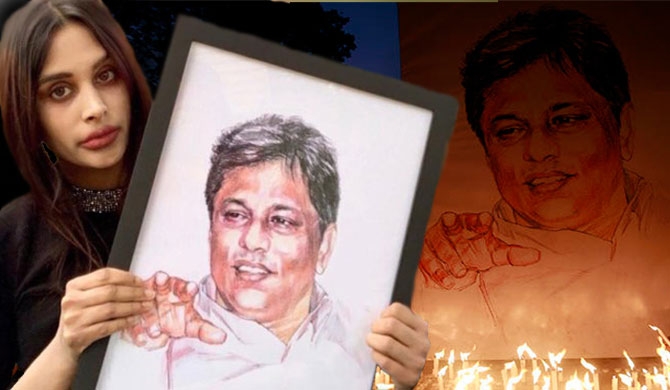
Easter attacks: AG directs probes into 5 suspects including Sara Jasmine

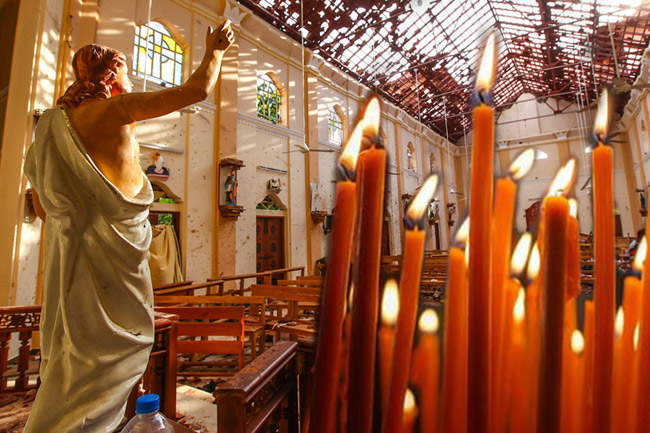
The Attorney General (AG) has directed the Inspector-General of Police to investigate five suspects whose names were disclosed by the report of the Presidential Commission of Inquiry (PCoI) which looked into the Easter Sunday terror attacks.

Accordingly, probes will be carried out into Abu Hind, Lukman Thalib, Lukman Thalib Ahmed alias Abu Abdulla, Rimzan and Mahendran Pulasthini alias Sara Jasmine who were named in the 17th chapter in the report.

In a statement issued today (March 10), AG’s Coordinating Officer State Counsel Nishara Jayaratne said a special team of 12 legal officers of the Attorney General’s Department has been assigned to study the recordings of evidence in the PCoI report.

The Attorney General, on March 08, has called on His Eminence Malcolm Cardinal Ranjith to brief him about the progress of the legal matters and investigations pertaining to the carnage.

During the meeting, the Attorney General has stressed the importance and the need to study all evidence recorded by the Presidential Commission during its proceedings.

Pointing out that the PCoI’s final report was focused on the individuals who failed to prevent the attacks, the Attorney General has noted that it is paramount to study all recordings of evidence as the report does not reveal concrete information about the real ‘masterminds’, conspirators and individuals who directly and indirectly aided and abetted the blasts, the coordinating officer said further.

She assured that all individuals who are accountable for the attacks will be brought to book.

In the meantime, investigations of the Criminal Investigation Department (CID) must be completed and all evidence recorded by the PCoI must be studied by the Attorney General before serving indictments against all those who were responsible for the dastardly act, State Counsel Jayaratne added.

Posted in Uncategorized

Sri Lanka invites foreign minister of Myanmar junta -Daily Mail UK

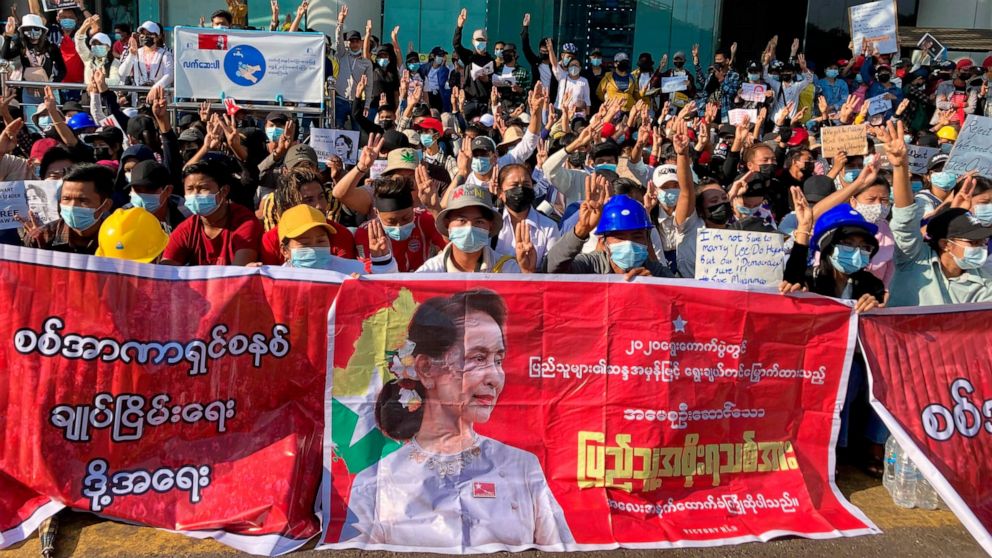
Sri Lanka has invited the new foreign minister of Myanmar’s junta to a regional meeting next month, sparking accusations on social media that Colombo is tacitly endorsing the military coup.

There has been no formal international recognition of the regime which toppled Aung San Suu Kyi on February 1 although Wunna Maung Lwin, the junta’s newly appointed foreign minister, has met virtually and physically with some regional counterparts.

Myanmar’s junta and the envoy sent by its toppled civilian government have also launched contradictory claims over who represents the country at the United Nations.

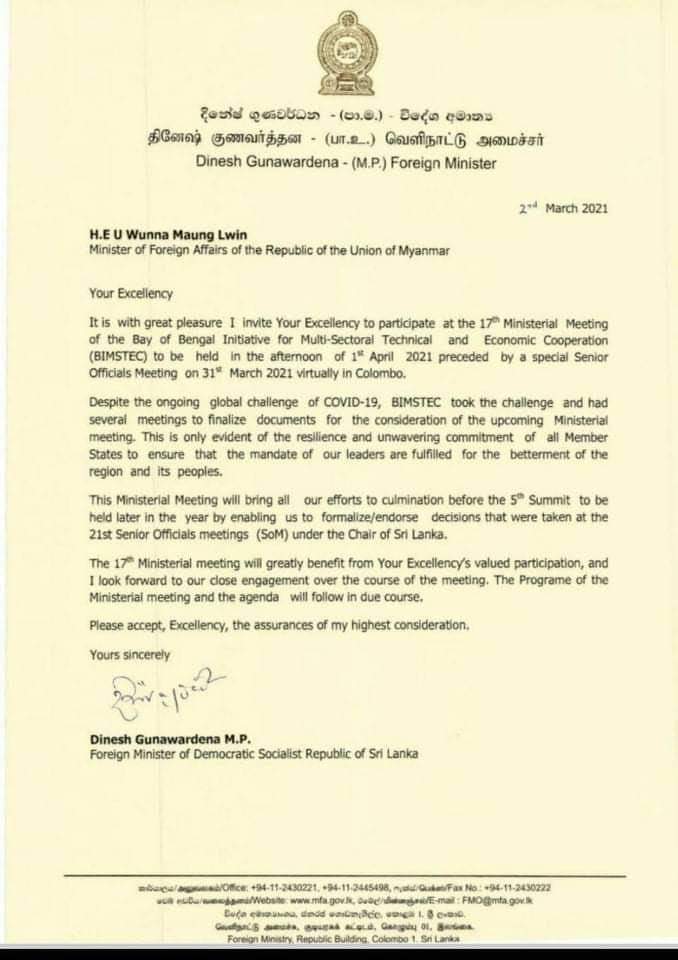
Sri Lanka’s invitation, seen by AFP, is for an April 1 virtual meeting of the foreign ministers of Bangladesh, Bhutan, India, Nepal, Sri Lanka, Myanmar and Thailand under the Bay of Bengal Initiative for Multi-Sectoral Technical and Economic Cooperation (BIMSTEC).

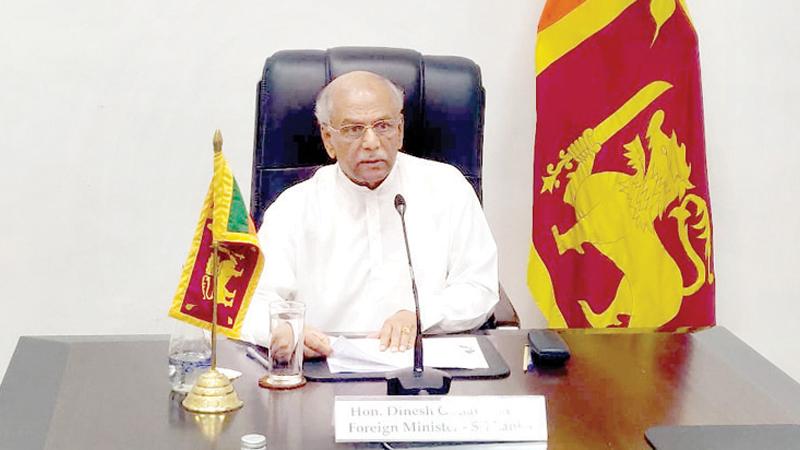
“The 17th ministerial meeting will greatly benefit from your Excellency’s valued participation, and I look forward to our close engagement over the course of the meeting,” Sri Lankan Foreign Minister Dinesh Gunawardena says in the letter.

Several Myanmar activists bombarded the Sri Lankan foreign ministry’s social media platforms to slam the decision.

“Shame on you!!!,” said Twitter user SweZtun.”You invited a member of the Burmese Military Terrorist group to your BIMSTEC meeting…You are shamelessly legitimising Terrorist group…”

“Sri Lanka supporting to terrorist group is the worst shameless behaviour after China,” said another Twitter user identifying as Hein Min Htay.

There was no immediate comment from Sri Lanka’s foreign ministry. The two countries have close religious ties, both following the same branch of Buddhism.

Dozens of Sri Lankan activists meanwhile staged a demonstration outside the Myanmar embassy in Colombo Wednesday denouncing the military coup, in a protest planned before the announcement of the invitation.

“No to the terrorist junta!,” said a banner carried by them. “Prosecute the junta for crimes against humanity and genocide.”

Myanmar has been in turmoil since the military ousted the civilian government last month triggering daily protests demanding a return to democracy.

Close to 2,000 people have been arrested and the death toll has climbed to more than 60, as Myanmar security forces attempt to quash the resistance.

Eight myths about Sri Lanka at the UN Human Rights Council – AI

Eight myths about Sri Lanka at the UN Human Rights Council

Since the beginning of the current session of the UN Human Rights Council (UNHRC) in February 2021, and in the lead up to it, there has been a lot of anxiety and misinformation among the public around what the outcome of the UNHRC sessions would mean for Sri Lanka. This is no doubt the product of years of misinformation deliberately spread domestically by pro-government actors around the consequences of international investigations and accountability for war crimes and crimes against humanity. Eternal bogeymen were made of these processes. Then President Mahinda Rajapaksa who oversaw the end of the war in 2009 even claimed that he would be taken before a war crimes court and executed on an electric chair.[1]It speaks to the astonishing capacity and success of these misinformation campaigns and machinations to be able to continue to spread misinformation in 2021. This is despite significant technological advancement, increased internet penetration in the country and a generation that is far more digitally savvy than the last to be in a better position to do simple fact-checks. Over the past few weeks, I’ve heard the most creative takes on the UNHRC process that are misleading, and sometimes, downright mythical. Allow me to allay some of these fears by busting some common myths around the UNHRC.

Myth 1: Western countries make up the membership of the UNHRC

False. The UNHRC consists of 47 member states elected by the UN General Assembly for a term of three years and are not eligible for immediate re-election after being in the Council for two consecutive terms. The Council’s membership is based on equitable geographic distribution, which means that African States are allocated 13 seats, Asia-Pacific States are also allocated 13 seats, Latin American and Caribbean States have 8 seats, Western Europe and other States have 7 seats and the Eastern European States have 6 seats. Moreover, the group of states leading the resolution is composed of states from Africa (Malawi), Western and Eastern Europe (Germany, the UK, Montenegro and North Macedonia) and North America (Canada).

Myth 2: Trade sanctions will be imposed on Sri Lanka

False. The report of the UN High Commissioner of Human Rights recommended for Member States to explore possible “targeted sanctions such as asset freezes and travel bans against credibly alleged perpetrators of grave human rights violations and abuses.” The recommendation is a far cry from trade sanctions, which are generally accepted as having negative impacts on national economies while disproportionately affecting the livelihoods of some of the most vulnerable people in society.

Myth 3: The atrocities committed by the LTTE are glossed over by the UN and the UNHRC

False. Every UN report based on human rights investigations in Sri Lanka have probed and found allegations of potential serious violations of international humanitarian law and international human rights law by all sides to the conflict. The report of the UN Secretary-General’s Panel of Experts on Accountability in Sri Lanka (2011)[2], known domestically as the Darusman report, found six core categories of potential serious violations by the LTTE associated with the final stages of the war (i. using civilians as human shields; ii. killing civilians attempting to flee LTTE control; iii. using military equipment in proximity to civilians; iv. forced recruitment of children; v. forced labour; and vi. killing of civilians through suicide attacks). The panel found five core categories of potential serious violations by the Sri Lankan government forces (i. killing of civilians through widespread shelling; ii. shelling of hospitals and humanitarian objects; iii. denial of humanitarian assistance; iv. human rights violations suffered by victims and survivors of the conflict, including both IDPs and suspected LTTE cadre; and v. human rights violations outside the conflict zone, including against the media and other critics of the government). The Office of the High Commissioner for Human Rights (OHCHR) investigation on Sri Lanka (2015)[3] also found that there are reasonable grounds to believe that gross violations of international human rights law, serious violations of international humanitarian law and international crimes were committed by all parties during the period under investigation, and urged that these allegations should all be promptly, thoroughly and independently investigated, and those responsible, directly or as commanders or superiors, brought to justice. As such, every resolution at the UNHRC on Sri Lanka has called for accountability for perpetrators from both sides of the conflict to be held to account.

Myth 4: It’s only the Tamil diaspora that is calling for accountability at the UNHRC

False. Victims of human rights violations based in Sri Lanka, including from Sinhala, Muslim and Tamil communities, have called for accountability and supported the UNHRC process after consecutive domestic mechanisms have failed to provide them truth, justice, and reparations for what they have experienced. Families of the disappeared from all communities, and in all parts of the country, have resorted to the UNHRC in efforts to seek truth and redress for their loved ones.

Myth 5: The UNHRC process is against Sri Lanka

False. The UNHRC process seeks to promote reconciliation, accountability, and human rights in Sri Lanka. It is the victims of human rights violations and abuse from all sides to the conflict – whether they be Sinhala, Tamil, or Muslim — that stand to benefit from the process. The process is pro-people, pro-human rights, and is therefore actually, pro-Sri Lanka. It’s a shame that consecutive Sri Lankan governments have failed to promote and protect the rights of all Sri Lankans, and sections of society have been left with no option but to raise their concerns with the UNHRC.

Myth 6: The UN Human Rights High Commissioner’s report on Sri Lanka is based on hearsay and open-source investigations

False. The report is based both on publicly available information and on research and consultations with a range of stakeholders, including Government representatives conducted by OHCHR. The report sets out its methodology and makes it clear that in preparation for the report, the OHCHR had sent a detailed list of questions to the Government of Sri Lanka on 23 November 2020 and received written inputs on 28 December 2020. The OHCHR also held a constructive and substantive meeting with Government representatives in virtual format on 7 January 2021. The Government provided comments on the report, some of which were reportedly reflected in the final text. The Human Rights Commission of Sri Lanka as the National Human Rights Institution has also raised concerns publicly regarding some human issues, which are also reflected in the report. OHCHR has also received direct communications from victims. For e.g., the report states that as of December 2020, over 40 civil society organizations had approached the OHCHR with reports of harassment, surveillance and repeated scrutiny by a range of security services who questioned them about administrative details and activities of the organization, lists of staff, including their personal contact details, donors and funding sources. The report also builds on the findings and recommendations of UN Special Procedures mandate holders. The Special Procedures mandate holders have sent communications regarding complaints they receive to the Sri Lankan government, although the Government has only responded to two out of eight in the past year. The Government has had ample opportunities to engage and provide substantive feedback, to clarify and/or provide an alternative viewpoint to the complaints or the assertions made in the report itself, as the report was sent to the government before being tabled at the UNHRC.

Myth 7: China will veto the resolution on Sri Lanka

False. China is a member of the UNHRC for its 46th session, however it has no veto powers like in the UN Security Council. There are also no permanent members in the UNHRC like in the Security Council. So, while China can call a vote, and vote against, a resolution brought on Sri Lanka, it will not be able to veto any resolution brought to the Council by another Member State. The adoption of the resolution requires the support of a simple majority of UNHRC member states.

Myth 8: The UNHRC has no mandate to act on impending human rights disasters

False. The UNHRC was created by the General Assembly in 2007 through resolution 60/251, which details its mandate. The resolution clearly mandates the UNHRC not only “to address situations of violations of human rights, including gross and systematic violations, and make recommendations thereon,” but also to contribute to “the prevention of human rights violations and respond promptly to human rights emergencies.”

This article first appeared in The Daily FT
By Thyagi Ruwanpathirana, South Asia Researcher

Rajapaksa’s used April Attacks to secure votes; alleged ex-MP

Former JVP Parliamentarian Bimal Ratnayake said the Rajapaksa’s used the 2019 April 21st Attacks as a tool to secure votes at the election.

He said President Gotabaya Rajapaksa has not done anything new with regard to the Presidential Commission of Inquiry appointed by Former President Maithripala Sirisena, adding only 20,000 pages of the 60,000-page report were released.

“The report does not detail the main perpetrators. It only says Zaharan is the main suicide bomber, and that is something everyone knows,” he said.

Several years ago, Former President Mahinda Rajapaksa accepted the fact that intelligence services paid extremist Organizations, said the Former MP adding the Presidential Commission of Inquiry had not questioned these facts from the present Prime Minister or the then Defence Secretary, who is the incumbent President.

Source: News First.lk

New report accuses the government of driving Sinhalese colonization in Tamil areas

As the 46th session of the UNHRC assesses the new resolution on Sri Lanka, a new report from the Oakland Institute, Endless War: The Destroyed Land, Life, and Identity of the Tamils in Sri Lanka, brings forth shocking new evidence on the extent of the continued persecution of the minority Tamil population in the North and East of the country.

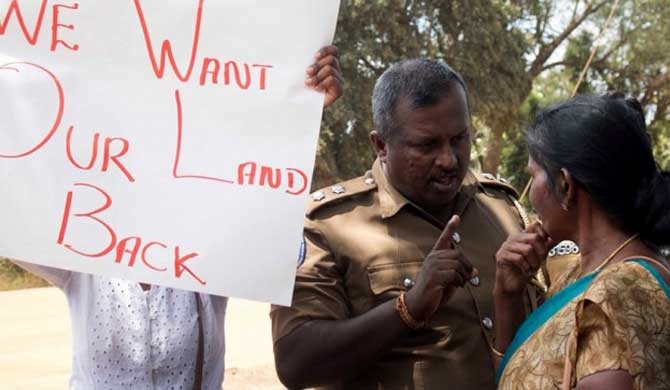
Under the guise of “development projects,” government driven Sinhalese colonization is growing within Tamil areas with the intent to change demographics and deny Tamil communities access to their land.

“Through irrigation schemes, military settlements, archaeological reservations, wildlife sanctuaries, forest reserves and special economic zones — land-grabbing in the North and East has worsened since the regime change two years ago,” said Anuradha Mittal, who coordinated the research for the report.

“Denying Tamils access to their ancestral land, changing the name of villages, replacing churches and Hindu temples by Buddhist viharas, and victory monuments dedicated to the Sinhalese domination, is a concerted effort to erase the Tamil history and culture,” Mittal said, adding that “the government’s strategy is also to geographically fragment the traditional Tamil homeland — the North and the East of the country.”


The report uncovers the use of several government departments — including the Mahaweli Authority, Archaeological Department, Forest Department, and Wildlife Department, in this strategy.

Endless War, the fourth Oakland Institute report on post war Sri Lanka, also provides a timely update on the extent of land grabbing and the impact of widespread militarization on the Tamil population. According to the report, the military occupation is extreme — with roughly one military member for every six civilians.

“The military continues to occupy vast amounts of land. Running 5-star resorts, cafes, construction companies, but also cultivating the land it occupies, the heavy presence of the army severely impacts the livelihoods of the local population,” added Mittal.

Meanwhile, thousands of Tamils, including over 23,000 people in Jaffna alone, remain displaced 12 years after the end of the war, awaiting resettlement with no end in sight.

Mahinda Rajapaksa’s government’s use of the military and various departments to expropriate the lands of Tamil and Muslim populations is geared at expanding the supremacy of the Sinhalese and Buddhist religion across Sri Lanka and should garner the immediate attention of the UNHRC.

The UN High Commissioner for Human Rights, Michelle Bachelet’s January 2021 report on Sri Lanka, stressed the need to not only ensure accountability for past human rights violations, but also called on the international community to stop and prevent possible future violence and conflict.

“The Commissioner’s call for sanctions against top generals and others accused of war crimes and for an International Criminal Court investigation into Sri Lanka’s Tamil separatist conflict are essential to upholding justice and human rights,” added Mittal.

The Zero Draft Resolution, presented by members of the Core-Group on Sri Lanka, however, fails to outline a clear approach for ensuring justice, accountability and lasting peace, the report said.

“It completely deviates from the recommendations made by the UN High Commissioner Bachelet and those made by four former High Commissioners, nine former Special Rapporteurs, and all members of the UNSG’s Panel of Experts on Sri Lanka — to refer the matter to the International Criminal Court. Endless War exposes the reality of the destruction of land, life, and identity of the Tamil people in Sri Lanka and presents a prima facie evidence for collective international action to arrest the worsening human rights situation,” concluded Mittal.

The report reiterated that the UNHRC resolution on Sri Lanka must include these recommendations and emphasize on the immediate cessation of land grabbing and planned settlements, while ensuring immediate demilitarization of the North and East. Failure to do so will be once again a mockery of an international human rights regime.

Posted in Uncategorized

Sri Lanka bond yields down on China swap news, rupee weaker

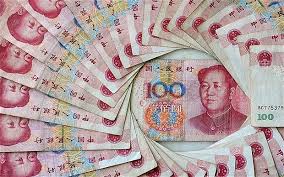
Sri Lanka’s rupee closed weaker at 197.75/198.00 levels to the US dollar in the one-week forward market on Wednesday while bond yields were down, on the confirmation of a central bank swap with China, dealers said.

The rupee last closed in the one- week forward market at 197/197.50 to the US dollar on Tuesday.

In the secondary market bond yields were down on active trade after the State Minister for Capital Markets and Money, Nivard Cabraal announced that People’s Bank of China confirmed a 1.5 billion dollar equivalent swap, dealers said.

He said Sri Lanka could draw down the swap at any time but it will be kept as a buffer.

“We will draw down as and when we need,” he said. “But our main focus is to increase non-debt inflows.”

A bond maturing on 15.06.2024 closed at 6.45/55 per cent, down from 6.60/63 per cent.

A bond maturing on 15.12.2022 closed at 5.75/80 per cent on Wednesday, down from 5.83/88 per cent Tuesday.

A bond maturing on 15.11.2023 closed at 6.20/30 per cent, steady from 6.23/30 per cent Tuesday.

A bond maturing on 01.12.2024 closed at 6.53/57 per cent, down from 6.60/68 per cent.

A bond maturing on 01.05.2025 closed at 6.75/85 per cent on Wednesday, down from 6.70/85 per cent.

A bond maturing on 15.02.2026 closed at 6.97/02 per cent, down from 7.00/10 per cent.

A bond maturing on 15.08.2027 closed at 7.35/50 per cent, down from 7.40/50 per cent.

A bond maturing on 15.05.2030 closed at 8.10/50 per cent, up from 8.00/30 per cent.

Posted in Uncategorized

Protest SriLanka trending in Myanmar over SL Foreign Minister’s letter

Sri Lankan Foreign Minister Dinesh Gunawardena is currently facing severe backlash in Myanmar, with ProtestSriLanka trending on social media.

The backlash has been reported over a recent letter sent by Foreign Minister Dinesh Gunawardena recognizing the Military appointed Foreign Minister in Myanmar, Wunna Muang Lwin.

In a letter addressed to Lwin, Minister Gunawardena is reported to have invited the former to attend the Ministerial Meeting of the Bay of Bengal Initiative of the Multi-Sectoral Technical and Economic Cooperation (BIMSTEC) and a special Senior Officials meeting scheduled to be held in Colombo on 31st march – 1st April, 2021.

Myanmar is currently facing a number of protests due to its recent Military coup.

Social media users in Mynamar have shown their displeasure with Sri Lanka over Foreign Minister Dinesh Gunawardena’s letter.

Source:NewsWire

Robert Minn on Twitter: "The terrorist group(Military) is not our  legitimate government. Sir Lanka must Respect the votes of our people.  Wanna Maung Lwin must not invited @BimstecInDhaka If sir lanka invite

China wants Hambantota Industrial Zone to get off the ground

China wants the proposed Hambantota Industrial Zone to get off the ground.

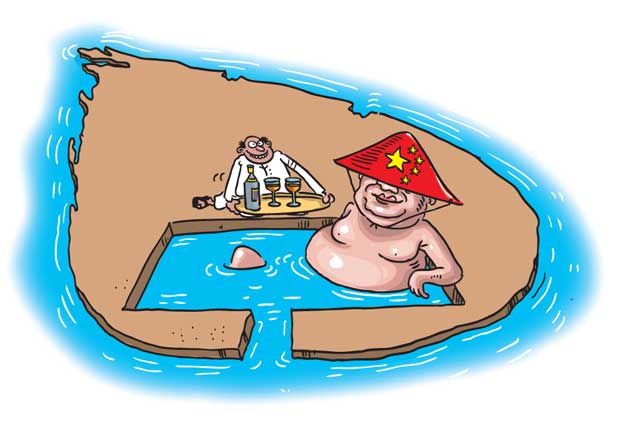
Vice Minister of Foreign Affairs of China Luo Zhaohui said that the Chinese Foreign Ministry will proactively support efforts to increase Chinese tourism to Sri Lanka and more businesses, including SOEs, to invest in the Colombo Port City and the Hambantota Industrial Zone.

The Vice Minister acknowledged that it was time for these two Chinese supported ventures to get off the ground.

He expressed these views when he met Sri Lanka’s Ambassador to China, Dr. Palitha Kohona.

Vice Minister Luo warmly welcomed the Ambassador and stated that the Ministry of Foreign Affairs of China will continue to extend its fullest support to the Ambassador in Beijing and effusively acknowledged his long standing connections with China.

The long discussion that followed included cooperation and mutual support in international fora, in economic matters for post Covid-19 recovery, effective management of the Covid-19 pandemic and future high-level visits. Vice Minister Luo assured of China’s support to Sri Lanka at the UN Human Rights Council (UNHRC) and its continued assistance as Sri Lanka confronts a critical economic challenge.

Both parties agreed that the recommencement of negotiations on the bilateral Free Trade Agreement with the view to concluding it soon would be advantageous to Sri Lanka. Dr. Kohona also raised the issue of non-tariff barriers which are hindering access to the lucrative Chinese market for a range of natural, agricultural and industrial products.

Dr. Kohona commended China for successfully eliminating extreme poverty by 2020 consistent with a key SDG and congratulated the Communist Party of China as it celebrated its 100th year Anniversary. China’s spectacular success could be attributed to the prudent management of the country by the Party.

Lasantha’s daughter questions credibility of NPC

Ahimsa Wickrematunge, daughter of slain journalist Lasantha Wickrematunge, has questioned the credibility of the National Police Commission (NPC).

In a letter to the commission, Ahimsa Wickrematunge accused the commission and the Attorney General of approving the Government’s decision to put the Criminal Investigations Department (CID) in the hands of an officer who tampered with a murder investigation.

Wickrematunge said that in a previous letter to the NPC she drew attention to the fact that it appointed Prasanna J. Alwis as CID Director despite the CID having previously caught him allegedly tampering with evidence in the investigation into her father’s murder.

“I asked the commission to investigate how this happened. You confirm in your letter that evidence with regard to the death of Lasantha Wickrematunge had been suppressed by SSP A.R.P.J. Alwis and that was reported to the Magistrate of Mt. Lavinia on 4 October 2019. You also state that extracts on destroying and suppression of evidence have been handed over to Hon. Attorney General under C.R.01 40/2020. This file was submitted to the Attorney General before Mr. Alwis was appointed to head the CID,” Wickrematunge said.

She says she cannot believe that the commission and Attorney General blessed the regime’s decision to put the CID in the hands of an officer who tampered with a murder investigation.

She notes throwing natural justice to the wind, Alwis was once again allowed to oversee her father’s case and so the Commission must answer for appointing an accused criminal to head the CID.

“Never in the 140-year history of the CID had it ever been headed by an officer with even the slightest disciplinary blemish. That 140-year streak was broken when the NPC appointed a CID Director reported to court for suppressing evidence of Sri Lanka’s most emblematic unsolved murder, in which the state stands accused of killing a journalist for exposing corruption,” she said.

Ahimsa Wickrematunge says by turning a blind eye to the state’s effort to subvert these investigations, the NPC has jeopardised the credibility of the commission, the Police, the Attorney General’s Department and the entire Sri Lankan criminal justice system.

“The NPC well may go down in history as a complicit rubber stamp to an autocratic regime bent on covering up the atrocities of its leaders,” she said.

Ahimsa Wickrematunge called on the NPC to interdict and discipline Alwis, order a full audit of records of her father’s murder investigation and other CID cases including those involving Keith Noyahr and Upali Tennakoon, reveal how the commission was deceived into appointing an officer accused of hushing up a murder to run the CID and re-examine the credentials and disciplinary records of all 100+ officers who were brought into the CID since November 2019.

She notes in the letter that the commission is expected to serve the people and uphold the Constitution.

Posted in Uncategorized

Malaysia’s 1998 playbook helps Sri Lanka shun IMF for China

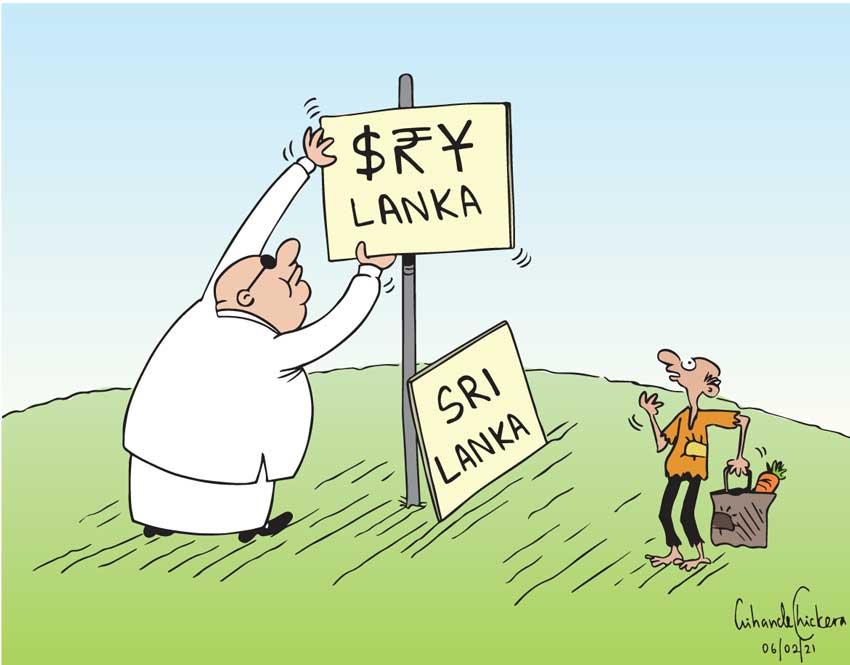
Faced with low foreign-exchange reserves and looming debt repayments, Sri Lanka is borrowing from the contrarian playbook Malaysia used during the days of the Asian crisis in 1998.

The island nation has imposed some form of capital controls and curbs on imports in signs that it’s turning inward, partly to end reliance on the International Monetary Fund before $ 3.7 billion of foreign debt matures this year.

The measures, such as repatriation of export earnings within 180 days from shipment, conversion of some export proceeds into rupees and getting commercial lenders to surrender a portion of their forex receipts to the Central Bank, are aimed at stopping the reserves from bleeding in the absence of loans from the IMF and revenue from tourism amid the pandemic.

That would help the country to rely on its own resources instead of foreign borrowing, the Central Bank of Sri Lanka said in a statement on 23 February. The steps will strengthen Sri Lanka’s credit profile, enhance exchange rate stability, and improve the resilience of the economy, it said.

What these measures also do are to help fend off interference from the IMF, whose aid comes with strict conditions – one of the reasons that prompted Malaysia’s then premier Mahathir Mohamad to shun aid from the lender despite descending into a recession following the Asian currency crisis. The IMF last year prematurely ended a loan program to Sri Lanka after disbursing $ 1.3 billion of an agreed $ 1.5 billion facility, leaving the nation scouting for ways to tide over the pandemic-induced downturn.

Sri Lanka has to repay $3.7 billion to holders of external debt this year, according to Central Bank Governor Weligamage Don Lakshman. The South Asian nation is expecting $ 32 billion from exports of goods and services, remittances and financial inflows, while the outflows are estimated at $ 27.6 billion, leaving a $ 4.4 billion surplus to service the debt, State Minister for Money and Capital Markets Ajith Nivard Cabraal said separately.

“The main thrust is to reduce the government’s reliance on foreign borrowings,” Citigroup Inc. analyst Johanna Chua wrote in a report on 25 February. “The odds of the July 2021 bond being repaid seem rather high given the willingness to pay,” she said.

Sri Lanka’s dollar bonds due in March 2030 are indicated at 59 cents on the dollar, according to prices compiled by Bloomberg. That compares with a high of 84 cents on the dollar in September 2020 before major rating firms downgraded the nation deeper into junk.

Although forex reserves this January fell to $ 4.8 billion from $ 8.9 billion about two years ago, they are enough to cover a little over three months of imports. The island nation is separately negotiating swaps and loans from countries including China and India to build its reserves buffer.

“It is the Government policy to work as much as possible to resolve our foreign exchange policies on a self-reliant basis and to hold discussions with institutions and organisations and countries which are willing to assist on a relatively non-interventionist basis,” Lakshman said in January.

That rules out the IMF, whose prescriptions for assistance included fiscal consolidation and removing caps on borrowing costs. The Government, in its latest budget, proposed increasing spending this year to support the economy, while the Central Bank, for its part, kept interest rates at a record low.

Sri Lanka is close to securing a $ 1.5 billion swap with China’s Central Bank, Cabraal said last month. Besides, discussions are on for loans worth $ 700 million with China Development Bank, Treasury Secretary S.R. Attygalle said.

Sri Lanka is following a market-oriented economy with State guidance, involving some controls and restrictions, according to Governor Lakshman.

“Such a framework would not be successful under an IMF program,” he said.

Source: Bloomberg