Deputy Chief of SIS, DIG Sampath Liyanage prevented Director CID from obtaining a statement from the accused SIS officer
The CID could have easily prevented the Easter attack and save the lives of more than 250
One of the first ‘duties’ of President Gotabaya Rajapaksa was to transfer the CID investigators and hamper the Easter investigations
Head of DMI Nilantha Jayawardena sent four false reports on December 5th, 8th, 14th 2018, and January 3, 2019 to the CID stating that the murders have been committed by the LTTE
Five years after the Easter attack, former Senior DIG, Criminal Investigation Department (CID) Ravi Seneviratne in an exclusive interview with the Daily Mirror, said that he and his most senior officers could have avoided the attack if the State Intelligence Services and Directorate of Military Intelligence provided accurate information to the CID without misleading them.
Seneviratne further said that his team could have concluded the investigations and brought the criminals to book had they were given a few more months before his officers were transferred out of the CID in November 2019.
Seneviratne said how his most senior officer, Director CID SSP Shani Abeysekera was transferred soon after Gotabaya Rajapaksa assumed duties as president in November 2019. Abeysekera was made to take up duties as Personnel Assistant to the DIG Galle District; the move crippled all the high profile investigations and there were no reasons given for the transfer. According to Seneviratne, this transfer was made even before a Prime Minister was appointed in the new government.
“Generally when a new President takes over office, his first duty is to appoint a Prime Minister, cabinet of Ministers and Ministry Secretaries. Other appointments are made later on. But when Gotabaya Rajapaksa assumed duties, his first official duty was to demote SSP Abeysekera. All those who investigated into the Easter attack, politically motivated murders and kidnappings and financial frauds- which involved powerful politicians- were transferred to hamper investigations. Never in the country’s immigration laws, have we ever seen the Department of Immigration and Emigration impose travel bans on the instructions of the CID. Such directives should go through the Judiciary. However, under Gotabaya Rajapaksa’s directive, the newly appointed Director CID, SSP W.Thilakaratne (former personnel security officer to Mahinda Rajapaksa), imposed travel bans on selected 704 CID officers who were directly involved in all the said investigations. This ban is still in force. This is a gross violation of the country’s immigration laws,” he added.
He further said how the CID officers were misled by the State Intelligence Services (SIS) and the Directorate of Military Intelligence (DMI) following the murder of two police constables (PC) at Vavunathivu in Batticaloa on November 30, 2018; which was the turning point of Saharan’s mission that led to the Easter attack five months later.
According to Seneviratne, the intelligence services repeatedly framed former LTTE carders for these murders which prevented the CID probe turning towards Muslim extremists National Thowheed Jamath (NTJ).
According to him, the DMI sent four false reports to the CID on December 5th, 8th, 14th in 2018, and January 3, 2019. All these reports stated that the murders were committed by the Ex-LTTE carders to prevent them from honouring the dead on November 26, 2018. Had the SIS provided the right information to the CID when they were carrying out the Vavunathivu murder investigation and later during the attacks on Buddhist shrines at Mawanella, the CID could have easily prevented the Easter attack and save the lives of more than 250 including foreign nationals and the extensive damages caused to Churches and five star hotels in the country.
Excerpts of the interview:
Q: You claimed that if the SIS and the DMI didn’t mislead the CID your team could have prevented this barbaric attack. On what grounds are you accusing them?
From the very first incident which is believed to be the start of Saharan’s ‘mission’, the SIS and the DMI misled us. Even after the Easter attack, they tried to mislead the CID. I will explain this later during this interview. Your readers can then come to a conclusion why I accused these two intelligence services for misleading the CID.
Q:You further said that if few more months were given, you could have concluded the Easter investigation and brought those who were responsible to book. Why are you saying so because you had nearly seven months to conclude this before Gotabaya Rajapaksa assumed duties as the President in November in 2019?
We were in the process of concluding the investigation when the new President assumed office. By this time we were able to gather the most vital information and had finished the inquiries almost more than ninety percent. One of the first ‘duties’ of President Gotabaya Rajapaksa was to transfer the CID investigators and hamper the Easter investigations. If our team was given a few more months, we would have finished the inquiries and brought the culprits including the big wigs who were directly involved, to books.
Q:What is the connection the Vavunathivu murder of the two PCs had with the Easter attack?
As I said, the Vavunathivu incident was the turning point. On November 30, 2018, the Police Headquarters received a message that two PCs have been murdered at Vavunathivu in Batticaloa. IGP Pujith Jayasundara wanted me to join him with DIG Sarath Peiris of the Special Branch and CI Wijetunge from the CID to visit the scene of crime.
There we met the State, Military and Batticaloa Division Police Intelligence Officers. Before we reached the scene of crime, these intelligence officers had arrived at the conclusion that the murder was carried out by Ajanthan, who was a former rehabilitated LTTE carder because the police sabotaged the ‘Maha Viru’ commemoration on November 26. Not only Ajanthan, but also Sharvanandana- another rehabilitated LTTE carder- has been arrested by the Kilinochchi Police on the information provided by the Batticaloa police for this murder. They had even obtained detention orders for further questioning.
Q:When did the SIS and DMI mislead the CID and how?
Few days after this murder, the DMI and the SIS informed us that this was done by the LTTE. On December 3, Chief of the SIS, SDIG Nilantha Jayawardena informed me that a motorcycle jacket has been found under a culvert in a paddy field closer to the scene of crime and the object can be linked to the murder. SP CID, D.P.D. Jayasinghe was sent there. By the time he reached there, the SIS officers had tampered the backpack that contained the alleged jacket. Although the scents are not traceable for the sniffer dogs after 24 hours, the police dogs picked up the scent from the jacket and had gone to Ajanthan’s house which meant that the jacket has been planted there at least 72 hours after the murder.
Q: What happened next?
When the sniffer dogs went to Ajanthan’s house, his old mother-in-law and his two young children were at home. The mother-in-law had immediately identified the jacket and his two children had said that it was their father’s and had told it was under his bed the previous night.
These wrong information has been fabricated to mislead the investigation team. Later investigations revealed that Ajanthan had no hand in this murders. By the time we realised that the SIS and DMI deliberately misled us to cover up the real culprits – the NTJ, it was too late.
From time to time the Head of DMI sent four false reports to the CID- on December 5th, 8th, 14th 2018, and January 3, 2019 stating that the murders have been committed by the LTTE.
Q: Was the CID carrying out this investigation at the time of the Easter attacks?
Yes. Our officers were fully active, but they could not get any information regarding the LTTE having a link to the murder.
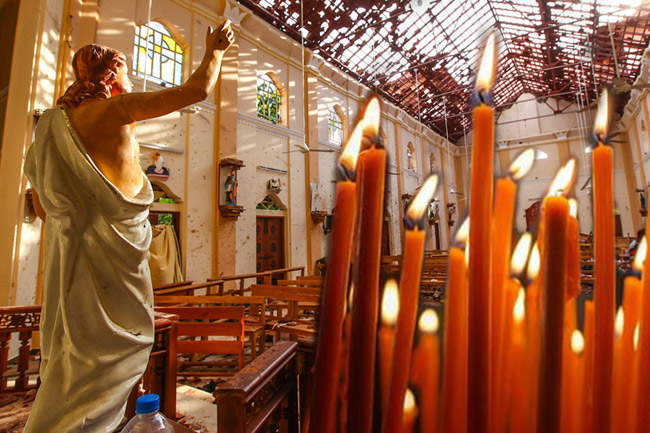
After the bombs started exploding one after another at eight sites- at Kingsbury, Shangri-La and Cinnamon Grand hotels, Katuvapitiya, Kochchikade and Zion churches, Mahavila Garden Dematagoda and Tropical Inn Dehiwela- the IGP, SDIG Nandana Munasinghe, Director CID SSP Shani Abeysekera and myself visited the scene of crime at Kochchikade immediately. The IGP handed over the investigation to the CID. Following this I appointed eight teams to the eight sites each headed by an ASP and an Investigation Officer. SSP Shani Abeysekera was entrusted to oversee all these eight teams. From day one up to three months following this incident, we had early morning conferences daily with all these eight investigation teams and the outcome was reported to the IGP. During this period we were able to arrest many Muslims who were involved with Saharan. During questioning they revealed how they had worked with Saharan and who his other followers were.
Q:How did the CID find that the SIS and DMI was aiding and abetting the suspects at the time of the Easter attack?
With the appointment of a new Director to the Terrorist Investigation Department (TID) SP, J.P.D. Jayasinghe, we received very vital information from him; how the TID and DMI visited the house of the Dehiwela suicide bomber Jameel, before he detonated his bomb at Tropical Inn in Dehiwela.
Jameel had a plan to explode the bomb at Hotel Taj Samudra on April 21 morning. When we came to know about this we checked Taj Samudra CCTV records and saw how Jameel was seated at the Taj lobby and leaving the hotel soon after receiving a call on his mobile.
During further investigations it was revealed how he went to Tropical Inn in Dehiwela, left his bomb laden backpack in his room and went to the nearby mosque. Those who were at the mosque had informed their security guard- who happens to be a retired PC- about Jameel as he was not a familiar visitor to the mosque. This PC, Hadji Marikkar Mohommed Ameer, had questioned Jameel and he had told that he left the house the previous day after an argument with his wife. Jameel had wanted this security guard to talk to his wife, Omar Kaththa, if he does not believe what he says. When the security guard spoke to the wife she had told him that few officers from the DMI and TID had visited their house at Dematagoda to check on Jameel. She has also said that these officers had visited Jameel mother’s house as well at Wellampitiya. During the phone conversation Jameel’s wife had given the phone to one of the DMI officers to talk to the mosque security guard. The DMI officers have requested the security guard to keep Jameel with him, until they come to Dehiwela. This had happened around 12. 30pm on April 21st.
Later Jameel had gone to the Tropical Inn and got the bomb exploded around 1.40pm. Although the then Director TID SSP Waruna Jayasundera knew this ‘operation’, he never informed about this to the CID. After three months, a new Director TID, SP J.P.D. Jayasinghe was appointed and it was he who had informed this to the CID.
When this was informed, we wanted to hold an inquiry on this. By this time the newly appointed Director TID, had recorded statements from TID officers. Although DMI officers too were asked to give statements, they have not turned up until they were told that this will be reported to courts.
When asked why they had visited Jameel’s house before he had exploded the bomb, the DMI officials had revealed that their surveillance team had come to know that Jameel was an Islamic extremists and that was why they went to check his house. Then the CID investigators had asked them, if they had information regarding his links to Islamic extremism, why they were unable to find out that he will be a suicide bomber killing several others in a populated area to which they did not have any answer.
Q: After this incident, what was the response of your fellow officers and were you able to get their assistance to nab those who were involved in this barbaric act?
Few hours after the Easter bombings, the CID was able to establish Saharan’s connection with the attack and within few weeks found out a few names of high ranking officers attached to the SIS, Police and DMI who knew the secret mission and were aiding and abetting the master minders.
After a great effort, the police were able to arrest the Muslim suspects who have worked hand in glove with Saharan. At the questioning, they confirmed their involvement with Saharan and his group in these attacks.
Soon after these explosions, island wide curfew was declared to stop vehicular movements. The same night, I got a message from SDIG Central Province, S.M. Wickremasinghe that Dambulla Police had arrested two Muslim suspects who were stranded there due to the curfew. I sent a team and got them down to Colombo for questioning.
When questioning we found out that they were Saajith and Naufer Maulavi who were planning to flee to Batticaloa. They had asked a three wheeler driver to find a lodge for them to stay overnight. The three wheeler driver who felt suspicious had informed Dambulla police about these two.
During the interrogation, it came to light that Naufer Maulavi is a relative of Saharan and is a follower of his ideology. When further questioning, Maulavi had said that these explosions were carried out by Saharan’s group.
Although Chief of the SIS told me that DMI had informed him that Saharan had fled to India, Maulavi said that Saharan was killed at the Shangri-La blast.
On April 25, 2019, Gafoor Mama, a confidant of Saharan, was arrested in Kalmunai. When questioning, he confessed that the Vavunathivu double murder was carried out by Saharan’s group led by Mihilan, who was in Saudi Arabia at the time of the Easter attack.
We immediately sent a team to bring Mihilan back home, but the Saudi authorities refused to hand him over to us. Subsequently we were able to recover the two revolvers and the uniforms which belonged to the murdered PCs.
After the arrest of Saharan’s wife – Fathima Adhiya, told the CID, that Saharan received several calls from military officers.
Saharan’s wife also said how her husband had received several calls from one Abuhind. According to her, Saharan never allowed anyone to be in the house whenever he received calls from Abuhind as he had secret discussions with him.
We believe that it was Abuhind that had given instructions to Saharan and if the police can find out who this Abuhind is, we can get lot more information about how the Easter attack was planned and who gave them the instructions.
Q:What was the connection those who vandalised the Mawanella Buddhist shrine had with the Saharan group?
A few days after the Easter attack, DIG Kandy, Nalinda Ranaweera, called me and informed that they have arrested two Muslims -Sadiq brothers at Gampola, who were involved in vandalising the Mawanella Buddhist shrine.
I requested Ranaweera to send them to Colombo immediately. But, the DMI had forced Ranaweera to hand him over to them. Without heeding DMI request, Ranaweera had sent the suspects to the CID for questioning
These two suspects accepted the fact that it was they who were with Saharan at Wanathawilluwa safe house when the Mawanella incidents had taken place. Later they were convicted by a Trial at Bar for Mawanella incident as they pleaded guilty.
Then we received information about ‘Podi’ Saharan who was a school leaver from Matale. After he was arrested, at the interrogation, he said he had spoken to a person called ‘Sonic Sonic’ who was later identified as Sub Inspector Bandara of the SIS. Since ‘Podi’ Saharan had contacts with some members of the ISIS Communication Wing at Indonesia, Sonic Sonic (SI Bandara) had asked him, why ISIS still hadn’t accepted their involvement with the Easter attack.
When ‘Podi’ Saharan asked ISIS Communication Wing why they had not acknowledged their involvement in this attack, they had said that if it was carried out by them (ISIS), they would have released a statement with a photograph of the suicide carders along with the pledge.
Within few hours after ‘Podi’ Saharan informed ‘Sonic Sonic’ what the ISIS had told him, a photograph of the suicide bombers giving the pledge was released to the social media along with a press statement. Later it came to light that this photograph had been uploaded from a foreign country to claim that this attack was carried out by the ISIS.
During further investigations, it was revealed that the SIM card used by Sonic Sonic (SI Bandara) was registered under a female City Traffic police officer’s name.
Although the CID was able to record a statement from this female officer, when SSP Shani Abeysekera summoned Bandara to the CID to get a statement recorded, Deputy Chief of SIS, DIG Sampath Liyanage requested CID Director not to record a statement from him.
Q: Did the CID get assistance from foreign counterparts to assist in the investigation process? If so in what way did they help and what was the outcome of their assistance?
Soon after the attack, we requested our foreign counterparts for their assistance. On the request of the Interpol, the Australian Federal Police, the Federal Bureau of Investigations (FBI), Scotland Yard, Israel Mossad, Royal Thai Police and Central Bureau of Investigation (CBI) came to assist us which was a great strength for the investigations.
Since the Saudi Arabian authorities didn’t hand over Mihilan to our police, the FBI, Australian Federal Police and Scotland Yard came forward and made the request to the Saudi Arabian authorities to get down Mihilan back to Sri Lanka.
When being questioned, Mihilan too confessed what Nowfer Maulavi had told about Saharan.
Q:Were you able to get details of Saharan’s contacts for a further breakthrough?
All our attempts to obtain telephone details became unsuccessful as they have used a different app called Thrima to talk to each other where details get erased automatically within few minutes after the call.
After about one month, one of the foreign teams provided us with an Internet Protocol (IP) address and other digital forensic evidence used by one Musilm DMI officer who was a frequent caller to Saharan. We were able to get the International Mobile Equipment Identity (IMEI) number of the phone used by him.
When the CID wanted to summon this DMI officer to record a statement, Director DMI, Chula Kodithuwakku prevented us from questioning him; claiming that this Muslim officer was involved in National Security activities.
Considering the two incidents where Deputy Chief of SIS, DIG Sampath Liyanage and Director DMI, Chula Kodithuwakku prevented the CID from recording statements from the SIS and DMI officers, we felt suspicious why the Deputy Chief of SIS and Director DMI acted in such a manner which became clear that the SIS and DMI had a direct link with Saharan and had the knowledge on the Easter attack.
Considering the sequent of events, what is the purpose of maintaining an intelligence service from the tax payers’ hard earned money, if they cannot provide details into national security and prevent such inhumane attacks which could have easily been prevented?
Q:Despite having conducted a meticulous investigation what was the reason for the former IGP C.D. Wickremaratne to accuse your team of failing to carry out a proper investigation into the Easter attack?
Although the then IGP claimed so, we conducted a thorough investigation into the attack which the Presidential Commission of Inquiry (COI) too agreed upon. It was based on these findings, the Federal Bureau of Investigation (FBI) of the USA, filed legal action against three suspects, Mohamed Naufar, Mohamed Anwar Mohamed Riskan and Ahamed Milhan Hayathu Mohamed (Case N0:m2:20-mj-06014) on November 12, 2020, at the United States District Court, for the Central District of California. Hence I am surprised on what grounds C.D. Wickramaratne levelled allegations against my team.
Although the IGP accused the CID, he himself violated the Police Departmental Orders (DO) for not taking action against the senior-most police officers who visited the Mahanayaka Theras in Kandy and the Chief Prelates in Anuradhapura, to get their intervention to safeguard them from possible legal action against them as their names have been identified in the Presidential Commission of Inquiry report. The Commission has recommended to hold disciplinary inquiry or the Attorney General to take legal action against them for their failure to prevent the Easter attacks. These police officers have not only violated the DO, but has violated the Establishment Code as well by speaking to the media after their meeting with the Prelates.
As the Senior Deputy Inspector General of Police in charge of CID, I briefed the IGP daily on the progress of the investigation and in return he briefed the Security Council on these progresses. Based on these if the IGP said that we hurriedly conducted the investigation and failed to obtain evidence from all connected parties, then he should take the responsibility for not guiding his investigation staff as CID comes directly under his purview.