Sri Lanka rejects UNHRC resolution to extend OHCHR mandate

Sri Lanka has rejected the draft resolution 60/L.1/Rev.1 by the United Nations Human Rights Council, which would extend the mandate of the Office of the High Commissioner for Human Rights (OHCHR), its Ministry of Foreign Affairs said.

The United Nations Human Rights Council adopted the resolution to extend the mandate of the Office of the High Commissioner for Human Rights (OHCHR) on promoting reconciliation, accountability and human rights in Sri Lanka without a vote on Monday.

“The extension of its mandate will only serve the interests of elements with vested interests seeking to create divisions and polarize the communities in Sri Lanka, and will be counterproductive to the Government’s efforts on promoting unity, reconciliation and human rights,” Sri Lanka said in its statement at the UN.

“We do not agree with coercive international action, and we reject resolution 60/L.1/Rev.1 presented to this Council.”

The full statement is reproduced below:

Statement by Sri Lanka as the country concerned during the consideration of draft resolution HRC. 60/L.1/Rev.1 on Sri Lanka at the 60th Session of Human Rights Council

6th October 2025

Mr. President,
Sri Lanka participated in discussions on this resolution in a spirit of open and constructive engagement, that we have demonstrated throughout in our interactions with this Council.

We appreciate the core group’s engagement on language amendments proposed by Sri Lanka. We however regret that we couldn’t find agreement on certain key concerns for us.

While we thank all delegations for their constructive participation on the draft text, Sri Lanka particularly wishes to thank very sincerely, those countries which made positive suggestions during informal consultations and bilateral meetings.

As Sri Lanka had indicated from the beginning to the core group, our fundamental issue with the text is the reference to resolution 51/1 of 2022 denoting the external evidence gathering mechanism on Sri Lanka within the OHCHR, which, in our view is an unprecedented and ad hoc expansion of the Council ́s mandate.

Participating in the Interactive Dialogue on Sri Lanka on 8th September, the Hon. Minister of Foreign Affairs reiterated that Sri Lanka does not accept the external evidence gathering mechanism set up by the OHCHR, which it has labelled as the `Sri Lanka Accountability Project`, at a time when the Government is continuing to strengthen the domestic institutions based on its genuine commitment to reconciliation and human rights in the interests of our own people.

The ongoing domestic processes include strengthening the independent Offices on Missing Persons and Reparations, and the Office for National Unity and Reconciliation, as well as the operationalization of a truth and reconciliation commission, and an independent Public Prosecutor ́s Office.

Sri Lanka, as well as many other countries, have repeatedly questioned the credibility and transparency of how this Project within the OHCHR was set up, its work and the budget allocated to it.

After 4 years of its existence, this Council is yet to see any benefits of this Project for the people of Sri Lanka.

This is clearly evident from the contents of the High Commissioner’s Report as well.

The extension of its mandate will only serve the interests of elements with vested interests seeking to create divisions and polarize the communities in Sri Lanka, and will be counterproductive to the Government’s efforts on promoting unity, reconciliation and human rights.

Mr. President,
We firmly believe that genuine nationally owned processes are best placed to address matters relating to human rights. National processes are rooted in the local context, allow for greater ownership, recognize unique sensitivities, and make implementation of action more efficient and effective.

The High Commissioner for Human Rights who visited Sri Lanka in June this year had the opportunity to experience firsthand the “momentum of change” across all segments of the Sri Lankan society and the “genuine openness of the Government to address issues”.

In his report to this Council too, the High Commissioner highlighted that there is a historic opportunity in Sri Lanka to implement transformative reforms.

As set out by the Hon. Minister of Foreign Affairs in his statement to this Council, within a very short time, the Government has taken a series of tangible and decisive steps on reconciliation and human rights.

Therefore, it is only fair that Sri Lanka be allowed to seize this opportunity to advance the rights of its own people through domestic processes.

For these reasons, we do not agree with coercive international action, and we reject resolution 60/L.1/Rev.1 presented to this Council.

Provincial council election before April next year

The government intends to hold the provincial council election before April next year.

The SJB and other parties are already in the process of selecting their candidates.

The SJB decided to advertise for applications from aspiring candidates.

Deputy minister Ruwan Senarath said the government had no intention of delaying the PC election.

Legal hurdles against holding the election are presently being looked into, he said.

Election commission chief Saman Sri Ratnayake expressed readiness to hold the election once those issues are rectified, since the funds required have already been allotted.

For nearly 10 years, the governors are controlling the all nine dissolved provinces.

Posted in Uncategorized

Land Reforms Commission DG removed

The Director General of the Land Reforms Commission (LRC), Padmasiri Liyanage, has been relieved of his duties following the exposure of major financial and administrative irregularities before the Committee on Public Enterprises (COPE).

Deputy Minister of Lands and Irrigation, Susil Ranasinghe, said that Dineka Jayasuriya has been appointed as the Acting Director General.

A recent audit by the National Audit Office revealed that over 49 acres and 35.64 perches of LRC land had been allocated to 396 of its own officers, in plots of 20 perches each, at a token rate of just Rs. 1,000 per perch.

These allocations were made to staff with five years’ continuous service between 2009 and 2023 under this unusually low valuation scheme.

COPE hearings held on 24 July further uncovered that the LRC had transferred 25 acres of state land to a private real estate company at just Rs. 28.72 per perch, amounting to a total sale price of Rs. 101,109 for the entire parcel.

Members of COPE pressured LRC officials to explain these transactions, raising deep concerns over misuse of state assets and weak institutional oversight.

Posted in Uncategorized

Fitch confirms Sri Lanka CCC+ sovereign rating

Fitch Ratings has confirmed Sri Lanka’s CCC+ sovereign rating saying external finances are stable, and growth is resuming despite US tariffs.

“We expect full-year growth at 4.4 percent, with 3.8 percent in 2026 and 3.6 percent in 2027,” the rating agency said.

“US tariffs will be a growth headwind, but the revised reciprocal tariff rate of 20 percent is now in line with peers, reducing risks to exports.

“We see low average inflation, but to rise gradually to 5 percent in 2027, in line with the CBSL’s inflation target.”

Sri Lanka’s macro-economists created a series of currency crises with its 5 percent inflation target, ousted two elected administrations and triggered a sovereign default using inflationary open market operations and buy-sell swaps to inject money, critics have said.

The resumption of open market operations led to a public outcry in the last quarter of 2024 and the current account slipped into deficit as the central bank was unable collect sufficient reserves.

State Assets in Question as Wijerama House Inventory Goes Missing

The official inventory (assets register) of the Wijerama residence previously occupied by former President Mahinda Rajapaksa has not been properly maintained. As a result, officials are reportedly unable to verify the complete list of movable and immovable items belonging to the state that were present at the premises, Ceylon Today reported.

A senior spokesperson from the Presidential Secretariat confirmed that officials had visited the residence with the inventory records. However, difficulties arose as the team that last occupied the house could not clearly identify or account for the items in their possession.
It is also reported that those who had custody of the residence had asked the officials to separate the state-owned property from their personal belongings, but the officials had refused to do so without proper verification.

The spokesperson noted that, according to procedure, state officials must cross-check all items on site against the official inventory before personal belongings are removed.

When contacted, attorney Manoj Gamage, the media spokesperson for former President Rajapaksa, said that officials from the Presidential Secretariat had already identified the state-owned assets within the residence. He added that if there are any items belonging to other state institutions, their ownership can be confirmed and the house will be formally handed over soon after.

Gamage further emphasised that all items listed in the inventory should be duly and officially returned to the state, warning that failure to do so could lead to renewed controversy over the matter.

(Courtesy: Ceylon Today)

Posted in Uncategorized

Apparel exports brace for volume decline in 2026

Local apparel exporters are anticipating a decline in volumes beginning in early 2026, driven by reduced demand from the US due to reciprocal tariffs and heightened competition in the European market.

Speaking to The Sunday Morning Business, Joint Apparel Association Forum Sri Lanka (JAAFSL) Secretary General Yohan Lawrence stated that despite the challenging external environment, the apparel export industry expected its performance in 2025 to remain on par with the figures recorded in 2024.

However, he revealed that the industry anticipated a decline in volumes beginning in early 2026 as a consequence of reduced demand stemming from the imposition of US reciprocal tariffs, as well as the comparative advantage gained by certain countries under the applicable reciprocal tariff rates.

“Because of the US reciprocal tariffs, we are expecting an impact on demand. Also, there are other countries that have lower tariff rates than Sri Lanka, so there will be a shifting of business away from Sri Lanka,” he stated.

Lawrence further pointed out that their European business was facing increased competition, as the decline in demand in the US had prompted many competitors to shift their focus to the European market.

“This is not a problem unique to Sri Lanka. With the tariffs, there is a reduction of demand in the US and therefore everyone is looking to sell to Europe,” he stated.

Responding to a query on whether the reduction of Sri Lanka’s applicable reciprocal tariff rate from 44% to 20% in August would positively impact the local apparel export industry, he pointed out that reciprocal tariffs across the region had likewise been reduced to around 20%, with the exception of a few countries such as India.

“The tariffs of most countries were reduced to 20%, so there is no comparative advantage for us,” he stated.

Lawrence further pointed out that the abolition of Simplified Value-Added Tax (SVAT) with effect from 1 October would exacerbate the difficulties faced by the industry, as the policy decision was expected to severely hamper liquidity.

“Previously, if you had to buy a raw material locally, you didn’t have to pay VAT at the time of purchasing; instead, it could be claimed later,” he stated.

He also noted that it was too early to comment on the full impact of this decision, given that the new system had only just come into effect.

Posted in Uncategorized

China, U.S. Japan show interest in petroleum refinery in Sri Lanka

Twenty foreign companies, including those from China, the United States (U.S.), and Japan, have expressed interest in investing in the expansion of Sri Lanka’s Sapugaskanda oil refinery, an official said yesterday.

The Ceylon Petroleum Corporation (CPC) recently called for Expressions of Interest (EOIs) from potential investors to expand the facility. The deadline for submissions closed last Friday.

CPC Chairman D.A. Rajakaruna told Daily Mirror that 20 firms from leading countries in the world had applied.

“There are companies from countries such as the U.S., China, Japan, and the United Arab Emirates (UAE) in the list. We are yet to begin evaluation,” he said.

The Sapugaskanda refinery has been a critical asset in Sri Lanka’s energy security for decades, and the expansion plans were considered earlier, followed by feasibility studies in 2010 and 2022, but several challenges delayed progress.

Civil war, the pandemic, economic crises, and political instability prevented any investment.

“With stability improving and regional energy demand growing, now is the most suitable time to re-initiate the project and ensure its long-term success,” he said.

“CPC and the government can manage incremental modifications and maintain profitability,” he said.

This is Sri Lanka’s largest and only petroleum refining business, owned by the government, with a guaranteed local demand and strong potential for expansion into bunkering, jet fuel, lubricants, and chemical markets. The government expects healthy, value-adding proposals that go beyond typical investment models, he said.

The state aims to retain a significant stake, ensuring long-term national benefit while allowing investors to secure competitive advantages. Investors should propose partnership models where the government benefits not just proportionally, but strategically, he said.

Besides, with expansion, Sri Lanka plans to increase its refinery capacity from 50,000 barrels a day to 100,000 barrels a day.

Source:Daily Mirror.lk

Posted in Uncategorized

China Exim loan terms: Cabinet approval granted, awaiting COPF sanction

The $ 500 million loan from China’s Export-Import (Exim) Bank for Section 1 of the Central Expressway Project (CEP-1) is under review by the Committee on Public Finance (COPF), even though the Cabinet has already approved the project.

Deputy Secretary to the Treasury Ajith Abeysekera told The Sunday Morning that the final decision would consider both Cabinet approval and COPF recommendations.

Abeysekera stated: “The entire debt finalisation process is guided by the COPF as a standard procedure. While the Cabinet has already given its approval for the project to proceed, the final decision must reflect both the Cabinet’s considerations and the COPF’s recommendations.”

The $ 500 million loan from China Exim Bank for CEP-1 has become the focus of intense negotiations, as the COPF seeks better terms while the Government moves forward with the project under initial approvals.

Abeysekera’s comment hinted at the position that the Government may consider the proposals of the COPF prior to proceeding to renegotiate the terms.

COPF Chairman Dr. Harsha de Silva, speaking to The Sunday Morning, voiced strong reservations about the proposed changes to the interest rate, describing the new structure as unfavourable to Sri Lanka.

He said: “The proposed loan terms have shifted from a fixed interest rate of 2.5% to a floating rate capped at 3.5%. My main concern is the floor for the floating rate, which is currently set at the present rate.”

Dr. de Silva added: “For a floating rate to be fair and mutually beneficial, the range should be more balanced. The acceptable range should be 1.5–3.5% rather than 2.5–3.5%, so that Sri Lanka can benefit if market interest rates fall.”

“We questioned whether the terms had already been finalised and they responded negatively, so we still have time. The Government should consider renegotiating these terms to make it fair.”

He also emphasised: “As the first major facility under the new Public Debt Management Act, the loan must strictly follow Treasury advice. According to this act, only the Treasury can apply for a public debt, so the Treasury must take strong responsibility to negotiate in the best interests of the country.”

He noted that the Treasury itself had provided three options for managing the revised rate structure, highlighting the importance of careful adherence to the law.

On the timing of renegotiations, Abeysekera clarified: “We have not received the COPF’s formal written recommendation yet. We are waiting for that, so I am not in a position to comment yet.”

Road Development Authority Chairman T. Paskaran explained the role of his organisation, stating: “The RDA does not negotiate the terms of the loan agreement. That is the role of the Treasury. We are only concerned with the civil matters related to the road development work, which have already been settled. The loan negotiation aspect of it is the role of the Treasury”

Deputy Minister of Economic Development Prof. Anil Jayantha Fernando, Treasury Secretary Dr. Harshana Suriyapperuma, and Deputy Minister of Transport and Highways Dr. Prasanna Gunasena were unavailable for comment.

Posted in Uncategorized

Chinese envoy hails ‘multi-faceted’ bilateral exchanges between Sri Lanka and China

Chinese Ambassador to Sri Lanka Qi Zhenhong has reaffirmed their enduring friendship with Sri Lanka, highlighting strong bilateral cooperation in development projects, public welfare initiatives, and crisis response.

The two countries have stood together through challenges such as the Covid-19 pandemic, economic crises, kidney disease, and flood relief efforts, Ambassador Qi Zhenhong said.

Ambassador Qi made these remarks in a statement of commemorating the 76th anniversary of the founding of the People’s Republic of China. He noted that earlier this year, President Anura Kumara Dissanayake’s visit to China resulted in significant understandings with President Xi Jinping, including jointly building a China-Sri Lanka community with a shared future and elevating bilateral relations to a new level.

Ambassador Qi highlighted that cooperation between the two countries spans major infrastructure and livelihood projects from the Colombo Port City and Hambantota Port improvements to the Central Expressway Project, integrated water supply schemes, school donations, free cataract surgeries, and refurbishment of public institutions.

“Our bilateral exchanges are multi-faceted. From daily people-to-people engagement to frequent high-level visits on state governance, from the new progress of the Colombo port city to the improved performance of the Hambantota port, from the full resumption of the Central Expressway Project Section one to the Gampaha, Attanagalla, and Minuwangoda Integrated Water Supply Scheme, from the donation of stationery and fabric for school uniforms to the free cataract surgeries, and from the Out-Patient Department building of the Sri Lankan National Hospital to the refurbishment of the Superior Courts Complex, among many others, these vivid examples of both major and livelihood projects showcase the all-round advancement of our bilateral relations,” he said.

He concluded his statement with a message of goodwill: “We wish China and Sri Lanka greater prosperity and everlasting friendship.”

Wasantha Karannagoda & Gotabaya Rajapaksa: Free For How Long? By S. Ratnajeevan H. Hoole

The Office of the High Commissioner for Human Rights (OHCHR) based on the mandate it received established “OHCHR Investigation on Sri Lanka (OISL).” As a part of this, on 21 July 2025, there was a 15-page report on enforced disappearances in Sri Lanka released. The relevant Mandates werebreceived by 1) The Special Rapporteur on the promotion of truth, justice, reparation and guarantees of non-recurrence; 2) The Working Group on Enforced or Involuntary Disappearances; 3) The Special Rapporteur on extrajudicial, summary or arbitrary executions and 4) The Special Rapporteur on the independence of judges and lawyers.

The report is a good reminder of what the Sri Lankan state does and gets away with. It also reminds us how horrid our state is, and how many important reports like this in the English language tend not to force their attention upon us the public.

The report’s purpose is to “bring to the attention of your Excellency’s Government [I,e., the government of President A.K. Dissanayake [AKD]] “information [the authors of the report] received concerning the prolonged failure to investigate effectively, prosecute and punish those responsible for gross human rights violations, including extra-judicial executions and enforced disappearances, within the context of the Sri Lankan civil war.”

In particular, the report highlights the following high-profile cases: Trinco 5, ACF, Navy 11, White flags, Channel 4, Mullaitivu mass grave and the Chemmani mass graves each of which involves multiple victims.

Wasantha Karannagoda and Gotabaya Rejapaksa: Consistency?

Today under AKD, many are being investigated, charged and jailed for their crimes against the people of Sri Lanka.

Unfortunately, there is no consistency on who is jailed upon conviction. While all who are credibly accused and arrested, like Ranil Wickremesinghe, must face the music, some who are being prosecuted appear to have the system on their side. Gotabaya Rajapaksa seems happily free while Karannagoda has seen feeble efforts against him to bring him to book. Both seem to be heroes among the Sinhalese for the murders they are accused of, as if the accusation of killing Tamils even for the venal purpose of collecting ransom makes one great in Sri Lanka.

To be sure, even these two men who are accused of the brutal murder of Tamils, have been sanctioned by the US and Canada. As a Tamil, I firmly believe that we as a community will never receive justice through investigations under the Sri Lankan state. I have seen obviously planted press stories on the Chemmany massacre claiming that facts leading to conviction will be brought out only when Sinhalese soldiers are in charge of investigations, devoting to such stories far more column-inches well above the norm. The Bar Association condemned Darusman’s 2011 Report to the UN Secretary General on the Mulllaitivu massacre even before it was released, with eminent Tamil lawyers present at the meeting allowing the condemnation to be unanimous!

Sri Lankan justice does not exist for Tamils. Credible justice will come only when foreign participants play a strong and moderating role.

The OISL Report

As seen in the report, “14 individuals including Naval Commander Karannagoda were indicted in 2019. The charges against Karannagoda were dropped in 2021.

In 2023, the Attorney-General decided not to implement the decision of a Commission of Inquiry to drop charges and went ahead with prosecutions. In March 2025, two Supreme Court judges [namely Dilip Nawaz and Priyantha Fernando], recused themselves from a case involving former Sri Lankan Navy Commander Wasantha Karannagoda, citing “personal reasons”. The UNP Protested that Mr. Jaywardene “was Basil Rajapaksa’s [that is Mahinda Rajapaksa’s. brother’s] personal lawyer at the time he was appointed to the Supreme Court in 2014 A newly appointed bench is expected to re-hear the case on 15 September 2025.”

That recusal in March 2025, led to a further six-month delay in a trial already delayed by the AG’s inconsistent and unexplained flipflops. On 15 Sept. when the Supreme Court took up the case, it postponed the hearing to 30 Jan. 2026. Karannagoda seems well-looked after, comfortably ensconsed in impunity.

While the Report cites a Commission of Inquiry for why the AG Charged Karannagoda, no major newspaper seems to have carried it. The Asian Mirror with little known of who owns it, waffles a little (15 Sept. 15) and says that “In 2019, the Attorney General filed indictments before the Colombo Permanent High Court Trial-at-Bar against 14 individuals, including former Navy Commander Wasantha Karannagoda and members of the Navy’s intelligence unit, [and that] during proceedings, the Attorney General decided to drop Karannagoda’s name from the list of accused, despite previously naming him a suspect based on what the petitioners say was sufficient evidence.”

Since when does the AG file charges based on what private individuals say? To frame charges initially the AG must have had evidence against Karannagoda. It stinks of a coverup by the Deep State in collusion with the weaker sections of the press and the judiciary, increasingly being tools of Sinhalese nationalism.

The Commission of Inquiry

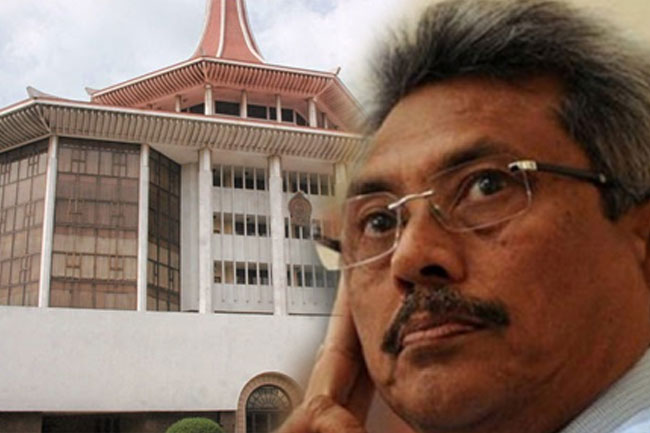
Interestingly, we discern a dirty nexus between Karannagoda and Gotabaya Rajapaksa. The unnamed Commission that made the charges by the Attorney General to be dropped suddenly on grounds of lack of evidence after concluding there was sufficient evidence to charge Karannagoda, was none other than “The Presidential Commission on Political Victimization.” This commission was appointed (that is its members hand-picked) by Gotabaya in January 2020, “to investigate ‘political victimization’ under the previous government.

The irony is that Gotabaya himself is cited by the OISL Report as ordering the army to shoot surrendering LTTE personnel who were indeed shot dead following his orders. He therefore had much at stake in founding this Godforsaken, evil Commission to ensure that he himself is not charged based on the precedent set by Karannagoda’s acquittal!

The Commission’s mandate was used to intervene in ongoing court cases, particularly those involving military officials accused of human rights abuses and corrupt practices in military and aircraft purchases, wrote Human Rights Watch (30 April 2021). The Commission effectively blocked the prosecution against Karannagoda and other military figures.

The three members of the Commission bathed in everlasting ignominy flowing fm their report are Retired Supreme Court Judge Upali Abeyratne (chairman), Retired Court of Appeal Judge Daya Chandrasiri Jayatilleka, and Retired Inspector General of Police (IGP) Chandra Fernando.

That tar brush of shameful ignominy resulted from August 2024 when the Supreme Court nullified the findings of the report. For that cover-up report by the 3 Commissioners, one is reminded of Sir (Saint) Thomas More’s rebuke to his protégé Richard Rich who was made Attorney for Wales for the false witness he provided to Henry VIII against More. Asked More of Rich, “It profits a man nothing to give his soul for the whole world… but for Wales?”

Where are the three commissioners today? What was their Welsh post if any?

It is equally edifying to Sri Lanka as a nation to do a parallel inquiry into why the two supreme court judges recused themselves, keeping in mind that Attorney-at-law Nagananda Kodituwakku has formally charged most SC judges with corruption, and when he demanded that they recuse themselves from his cases, they all refused. A thick judicial skin indeed!

As if in vengeance, Kodituwakku’s ability to practice law has been curtailed, just the way Justices Sarath Silva and Shiranee Tilakawardane suspended the late Elmore Perera citing his rude body language. It is on record that Tilakawardane with N.E. Dissanayake signed “I do” to the vulgar and contemptible “Helping Hambantota” judgement in which Chief Justice Sarath Silva effectively boasted of doing Mahinda Rajapaksa a favour and thereby demeaned the judiciary at the highest levels. As CIABOC goes after bribery and corruption in the judiciary, it has its work cut out or it.

In August 2021, the Attorney General’s Department announced it would not proceed with the charges against Karannagoda, leading to his acquittal.

In 2023, the United States sanctioned Karannagoda for gross human rights violations and prohibited him and his wife from entering the US.

In 2025, the UK also sanctioned Karannagoda for serious human rights violations. Pictured here are Admiral Karannagoda and his protectors, the Rajapaksa brothers. These two also have been sanctioned with travel bans.

Onus on President AK Dissanayake to Put Big Criminals behind Bars

People like Mahindananda Aluthgamage and Nalin Fernando, S.M. Chandrasena , Sathasivam Viyalenderan , Rajitha Senaratne, Shasheendra Rajapaksa, Keheliya Rambukwella , A.H.M. Fowzie et al. have already faced the courts. President

AKD is doing right. Let him proceed.

However, while Arjun Aloysius is being dealt with, prosecuting Ranil Wickremesinghe seems a lukewarm effort when we know little about the Central Bank Scandal and CIBOC’s going after Minister of Finance Ravi Karunanayake seemingly paying for an apartment involving Aloysius. And Arjuna Mahendran?

Charging Ranil, it seems to me is tokenism when there are far bigger crimes to investigate and bigger fish to net.

Everything Fortuitous or Divinely Providential for Karannagoda

AKD needs to explain honestly unlike his sixers about an immediate boat service from Mannar to Talaimannar and a stadium in Jaffna with no funds or water or environmental clearance clearance.The tendency to hit boundaries and sixers, is seen in his hit about the stadium on 1 Sept 2025 just a week before the UNHRC hearings on Sri Lanka – not to mention the prividential date of 15 Sept for Karannagoda’s trial also in the middle of the UNHRC which then again fortuitouly gets postponed to 30 January with no loss to Karannagoda! But AKD himself seems to be pulling wool over our eyes. What is happening to the Central Bank scandal? To his minister of finance and UNP colleague Ravi Karunanayake for a case filed on 17th May 2024 for accepting an apartment from Arjun Aloysius, a director of a primary dealer company.

And the really big fish, the Rajapaksa brothers against whom there seems to be much evidence for those who care to look; not least in diverting an aircraft to carry a puppy, the misuse costing a lot more than what Ranil is accused of misusing on his stop-over in London, however wrong that was. And the OISL report’s contention that Gotabaya ordered surrendering LTTE people to be shot and that they were?

Justice must be blind and its decisions repeatable – not saying enough evidence one day and the opposite the next. Let us get these investigations behind us and move on to building a nation where equality is the most supreme value that we cherish.

Source:ColomboTelegraph