Sri Lanka ruling party MP contradicts poll to claim his party is overtaking president’s

The ruling Sri Lanka Podujana Peramuna (SLPP) is rising from the ashes albeit at a slower than anticipated pace, while President Ranil Wickremesinghe’s United National Party (UNP) still commands only 1-2 percent of the vote, an SLPP legislator said.

MP S B Dissanayake, who is not a member of the cabinet of ministers headed by President Wickremesinghe, told reporters on Thursday December 07 that support for any major political party of the island nation is on a downward trend while the SLPP alone is gaining ground.

An independent poll by the Institute for Health Policy (IHP) however shows that this is decidedly not the case. Polling data for October showed that the leftist National People’s Power (NPP) had enjoyed support from 40 percent of likely voters, having dipped 2 percent from September, while the main opposition the Samagi Jana Balawegaya (SJB) stood at 26 percent, increasing four percent from 22 percent in September. President Ranil Wickremesinghe’s UNP’s support decreased marginally to 11 percent in October from September’s 13 percent. The SLPP also saw a decrease to 5 percent from the previous month’s 8 percent.

“You can’t gamble with elections. The election must be held. We always say electrons must be held. The presidential election must be held next year. There is no alternative,” said Dissanayake.

“Parliamentary elections can be called if needed. But that’s not how it is with the presidential election. Nominations for that will have to be called by September, October next year,” he added.

Asked by a reporter if the SLPP is ready for elections, Dissanayake acknowledged that support for his party had eroded, to nothing.

“We crashed to zero. We were turned to ashes. But we will rise from those ashes. We’re not where we thought we were. The 6.9 million [votes received at the 2019 presidential election] no longer applies. We’re at about half of that. But we’re rising, like this,” he said, gesturing upwards.

“As other major parties go in the opposite direction, we’re rising slowly. But the UNP is not. It’s still on the ground, and still at 1 to 2 percent,” he claimed.

“The SLFP is there too. Those who left us are the same. Even together they cannot form 1 percent. But we’re climbing,” he said.

HRW accuses Sri Lanka of ignoring EU GSP+ requirements

Human Rights Watch (HRW) has accused Sri Lanka of ignoring the European Union’s (EU) GSP Plus requirements.

Issuing a statement today, HRW said that the Sri Lankan authorities had detained nine ethnic Tamils under the country’s abusive counterterrorism law for commemorating those who died in the 1983-2009 civil war, Human Rights Watch said today.

The Sri Lankan Government has repeatedly assured international allies, trading partners, and the United Nations that it would replace the Prevention of Terrorism Act (PTA), which has long been used to arbitrarily detain and torture minority community members and civil society activists. The government should immediately release all those arbitrarily detained under the PTA and place a moratorium on its use until it can be repealed.

“The Sri Lankan authorities’ use of a counterterrorism law against Tamils commemorating those who died in the civil war is cruelly abusive and further marginalizes a community that already faces persistent government discrimination,” said Meenakshi Ganguly, Deputy Asia director at Human Rights Watch. “President Ranil Wickremesinghe speaks of ‘reconciliation,’ but his government’s actions only serve to deepen ethnic divisions.”

The authorities arrested those newly detained under the PTA between November 25 and 27 in Batticaloa, in the Eastern Province, and confiscated decorations and loudspeakers from a commemoration vigil. Since the civil war between the government and the Liberation Tigers of Tamil Eelam (LTTE) ended in 2009 with the separatist armed group’s complete defeat, successive administrations have prevented Tamils from publicly memorializing the war dead.

On December 2, police in Mullaitivu district, in the Northern Province, reportedly shut down an event at a Hindu temple to commemorate the Sri Lankan army’s 1984 massacre of Tamil villagers in Othiyamalai. Preventing ethnic and religious minorities from conducting ceremonies to commemorate the dead violates the rights to freedom of religion, belief, expression, and association, Human Rights Watch said.

Soon after taking office in July 2022, President Wickremesinghe ended a short-lived moratorium on the use of the PTA. A previous administration, in which Wickremesinghe was prime minister, had pledged in 2017 to repeal the law when it rejoined a European Union trading program called the Generalized Scheme of Preferences (GSP+). The GSP+ grants tariff-free access for Sri Lankan exports conditioned on compliance with international human rights conventions. Sri Lankan authorities have repeatedly renewed the pledge but never carried it out.

Many of Sri Lanka’s international partners, including the United States, European Union, and United Kingdom, as well as the United Nations Office of the High Commissioner for Human Rights, criticized the recent PTA detentions.

The administration has also used the PTA to restrict criticism of government management of the economy and other policies. In August 2022, three student activists were detained under the law for protesting the government’s handling of the economic crisis. Other activists say that they fear being arrested under the PTA for speaking out and that the government is constraining civil society organizations’ access to funding, particularly donations from abroad, under the guise of “countering terrorist financing.”

The International Monetary Fund (IMF), which is providing Sri Lanka with a US$3 billion loan, reported in September that civil society’s “oversight and monitoring” of government actions is “restricted … by broad application of counter-terrorism rules.”

In a November report on Sri Lanka’s compliance with its human rights obligations under the GSP+ trading arrangement, the EU found that “the treatment of minorities remains a concern in particular as efforts towards reconciliation are slow, and the 1979 Prevention of Terrorism Act (PTA) continues to be applied including after the protest movements in 2022, causing fear among the population and suffocating dissent. Substantial reform or repeal of the PTA in line with human rights standards remains a priority, just as Sri Lanka’s need to re-commit to reconciliation and accountability.” Despite Sri Lanka’s failure to comply with its six-year-old pledge to reform the PTA, the EU continues to extend GSP+ benefits to the country.

On September 15, the government published the latest version of its proposed replacement counterterrorism legislation. It then withdrew the bill for further revisions after widespread domestic and international criticism that it reproduced many of the abusive provisions of the current law while creating new speech-related offenses that could be used to suppress dissent.

The government recently proposed another law, the Online Safety Bill, that could also be used to restrict freedom of expression by creating a commission, appointed by the president, which would decide whether online statements are false or prohibited. The commission could order the removal of online statements and participate in police investigations and prosecutions of those accused of posting them.

“The Sri Lankan government’s latest misuse of the PTA should be a strong reminder to the EU that its GSP+ requirements are being ignored,” Ganguly said. “The European Union and EU governments need to make their displeasure with this turn of events known.”

Posted in Uncategorized

Three Sri Lankans Ex Army serving in Ukrainian military killed in Russian attack

Three Sri Lankans who were serving in the Ukraine military have been killed in a Russian attack.

Reports from Ukraine, and Russia note that the attack took place on Tuesday (5).

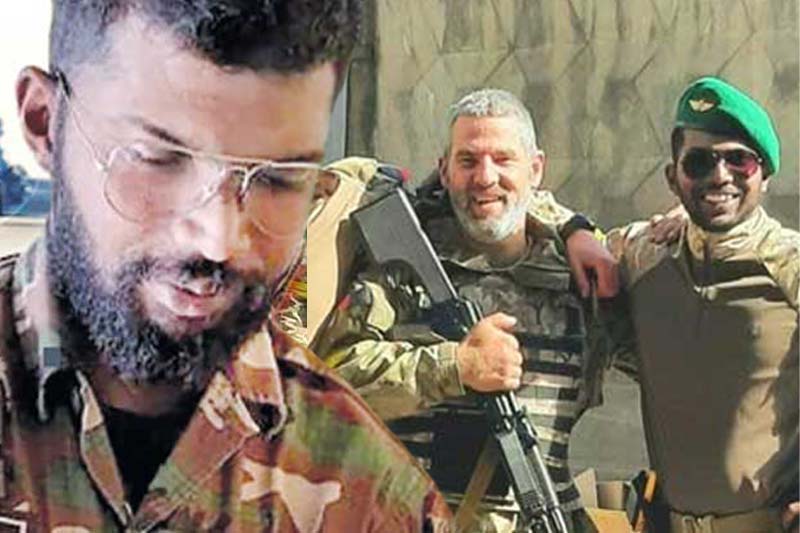
A Telegram channel operation by Russian military personnel revealed this morning that Sri Lankan mercenary Andrew Ranish Hewage with the call sign Dentist from Sri Lanka was killed in a Russian Attack.

It also added that two more Sri Lankan mercenaries that were fight for Ukrainian regime died beside Ranish Hewage.

According to the Telegram channel, the three Sri Lankan mercs were killed in an Russian attack when they attempted to evacuate dead and wounded Ukrainian soldiers.

A comment on a YouTube video said that Andrew Ranish Hewage was killed in Bakhmut, a city in Ukraine.

The comment was made from a YouTube account that goes by the name Lahiru Kavinda.

Translation of the comment:

“Dentist, you breathed your last on my shoulder. You are a hero. I brought you as far as I can. I did everything possible. You made a name, and the name resounds in Ukraine. You deserve an honorable end.”

Who is this ‘Captain Dentist’?

An inquiry from the Sri Lankan Defence Ministry revealed that Andrew Ranish Hewage famous as Captain Dentist in Ukraine was once a member of the Sri Lanka Light Infantry of the Sri Lanka Army.

He had legally left the Sri Lanka Army on the 30th of September 2012, as a lieutenant, and also left the entire military service officially.

Later, he moved to the UAE for employment, and in 2022 decided to join the International Legion for the Defence of Ukraine, where he played an active role.

On February 27, 2022, just two days after the Russian invasion of Ukraine, Ukrainian President Volodymyr Zelensky called for “friends of Ukraine” to volunteer for the Ukrainian Territorial Defense forces, and thus was established the International Legion for the Defence of Ukraine.

According to international media reports, Andrew Ranish Hewage was serving as a Commanding officer on the front lines of the Ukraine – Russia war.

It is also reported that Captain Andrew Ranish Hewage was given a promotion by the Ukrainian President for his bravery in the battlefield.

Unfortunately, details of the two other Sri Lankans killed along with Andrew Ranish Hewage in the Russian attack, were not available.

(NewsFirst)

Sajith wears a Palestinian scarf to parliament as a mark of solidarity for peace

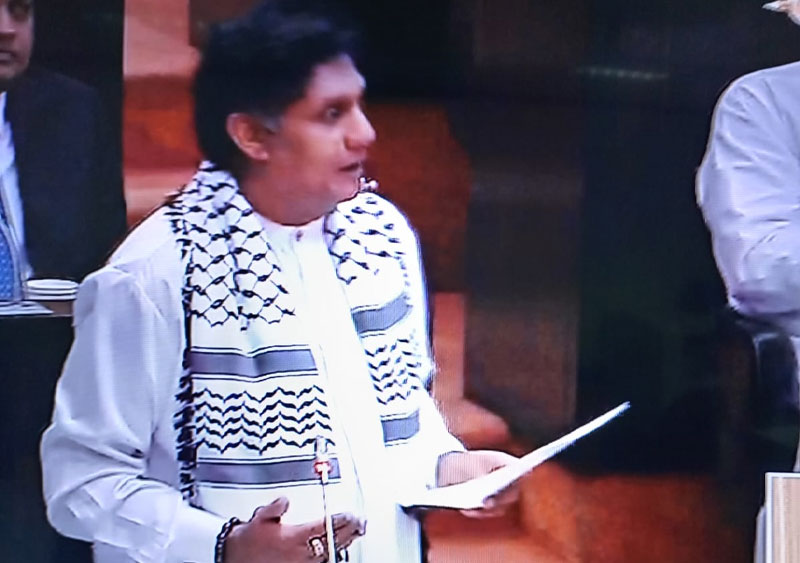
Sri Lankan Opposition Leader Sajith Premadasa attended Thursday’s (7) parliament session wearing the keffiyeh, a black and white scarf, a symbol of Palestinian identity and history, as a mark of solidarity to attain peace in the Middle East and world-wide.

Speaking on the country’s Foreign Policy, the opposition leader said that a foreign policy forms the basic fulcrum of governance.

“A strong, innovative, vibrant, thought-providing, result-oriented foreign policy is of great benefit to our own nation state,” he added in his comments.

He went on to note that Sri Lanka’s track record in terms of abiding by agreements is dismal, adding that abiding by agreements, and credibility is critical for a foreign policy.

“We have been a signatory to protect human rights, civic rights, political rights, economic, social, cultural and religious rights. Unfortunately, in the domestic jurisdiction, the government has embarked on a so-called Online Safety Bill, and an Anti-Terrorism Bill, which destroy the very essence of democracy, freedom of speech, freedom of thought, freedom of affiliation to political parties, expressing one’s vision and wishes,” he said.

He said the Sri Lankan Foreign Policy must walk the talk.

Posted in Uncategorized

SLPP enjoying “great demand” from potential presidential candidates: Namal

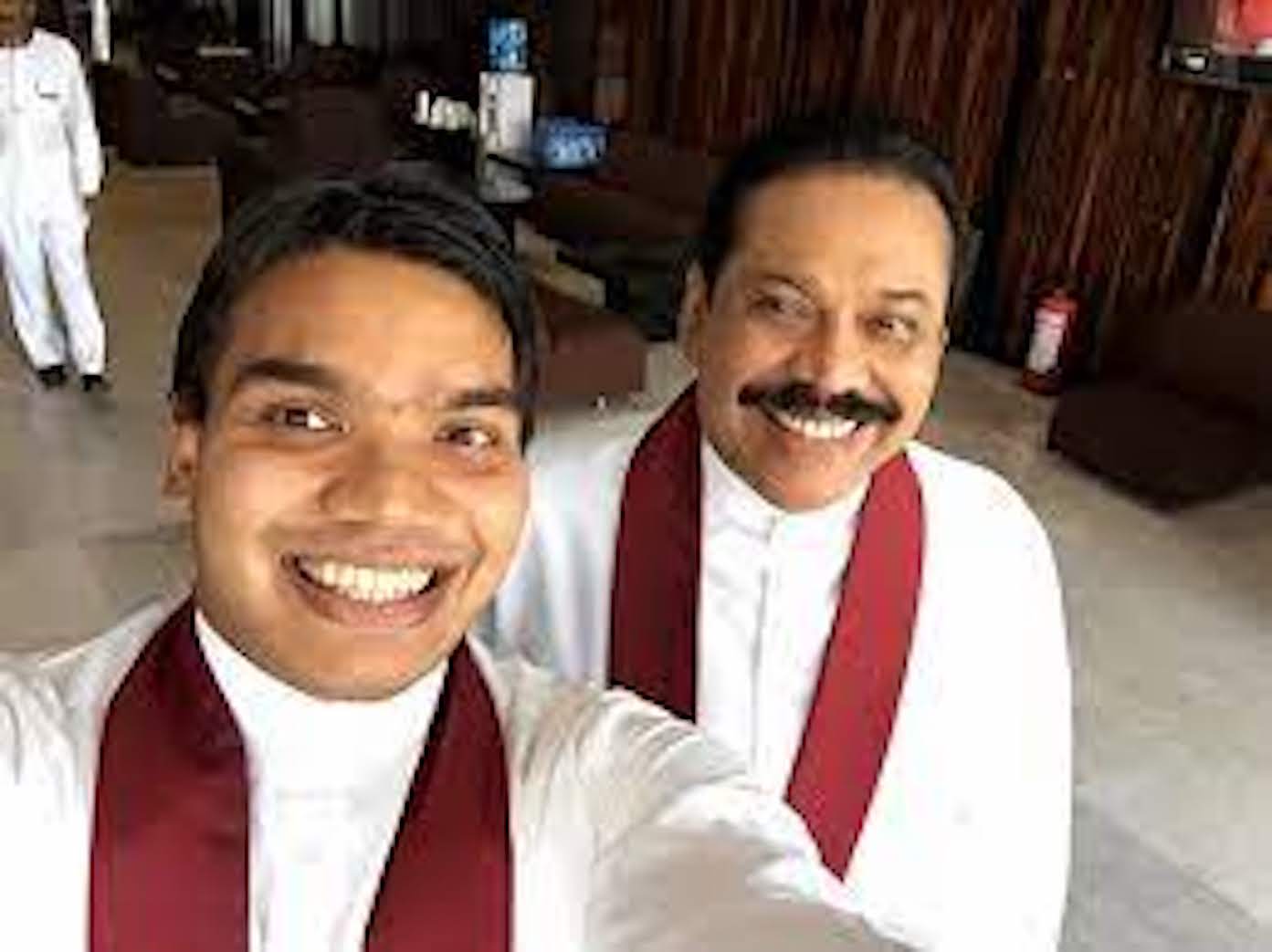
The ruling Sri Lanka Podujana Peramuna (SLPP) enjoys “great demand” from potential presidential candidates, and the party will have to take a call on working with incumbent President Ranil Wickremesinghe, MP Namal Rajapaksa said.

Speaking to reporters on Thursday December 07, Rajapaksa claimed several names have come up concerning the SLPP’s candidate at next year’s presidential election.

“There is great demand: entrepreneurs, businessmen, politicians, are all there. There are presidents too, ready to come forward with our party,” he said.

“Out of all these people, we will put forward on behalf of our party the candidate that can take the country forward while stabilising the economy,” he added.

Commenting on continued support for President Wickremesinghe, Rajapaksa said the while SLPP at present works with the former in the present government, the party will have to decide whether that relationship continues going forward.

“The matter of whether we work with the United National Party (UNP) in the future – this is not a politics dependent on individuals; the SLPP is a party. We will talk as a party with other parties, but no discussions will be held centred around individuals,” he said.

Rajapaksa noted that Wickremesinghe was the only member of parliament representing the UNP at the time of his election by parliament following the resignation of his predecessor Gotabaya Rajapaksa .

“If we are to collaborate with the UNP in the future, we’ll have to discuss that. Once the party has decided on that, we can get a start on those discussions. Today, we work with the president in the present government,” he said.

Last month, when asked to comment on President Wickremesinghe’s 2024 budget, MP Rajapkasa sounded rather sceptical of the president’s ambitions for turning the crisis-hit economy around.

“We must study the budget. He had presented a lot of these proposals in last year’s budget too. They don’t seem to have been implemented,” Namal Rajapaksa said, speaking to reporters after the budget presentation Monday November 13 afternoon.

Rajapaksa’s father and leader of the SLPP former president Mahinda Rajapaksa, however, spoke in favour of Wickremesinghe’s budget.

While not without its shortcomings, the older Rajapaksa said, the 2024 budget is a forward-looking one that aims to ensure fiscal discipline and put Sri Lanka on the path to recovery.

Posted in Uncategorized

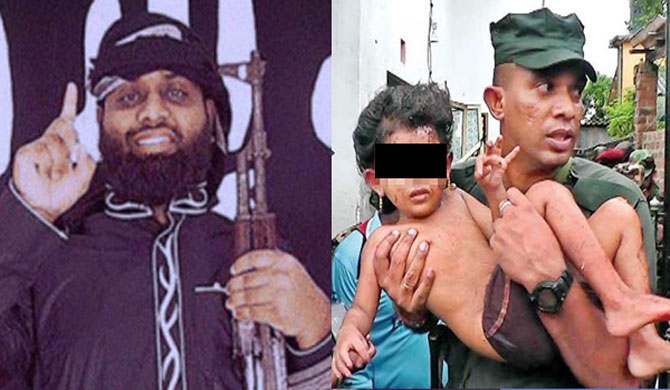
Zahran and group carried out a trial explosion prior to April 21

Senior police officers had been informed of a trial explosion carried out by the group led by Zahran Hashim at Thalankuda on April 16, 2019 prior to the Easter Sunday bombings, Parliament was informed today.

Leader of the House Susil Premajayantha who was responding to an oral question raised by SJB MP Hector Appuhamy in the House said former Director of the Intelligence Service Nilantha Jayawardene had informed the then IGP Pujith Jayasundara and Senior DIG Ravi Senevirathna on the trial explosion carried out by Zahran’s group on April 16, 2019 prior to the Easter Sunday bomb attacks.

This information had been passed on to the then Secretary to the Ministry of Defence.

Both Jayasundara and Senevirathana had also been informed about the area that Zahran was occupying and about their network.

On April 20, 2023 according to the answer provided by the Leader of the House, it had been revealed that action was being taken by the Attorney General and the Ministey of Public Security against those who were responsible for the failure to prevent the Easter Sunday bomb attacks.

Posted in Uncategorized

Controversy surrounds prolonged vacancies in Army’s No. 02, 03 positions

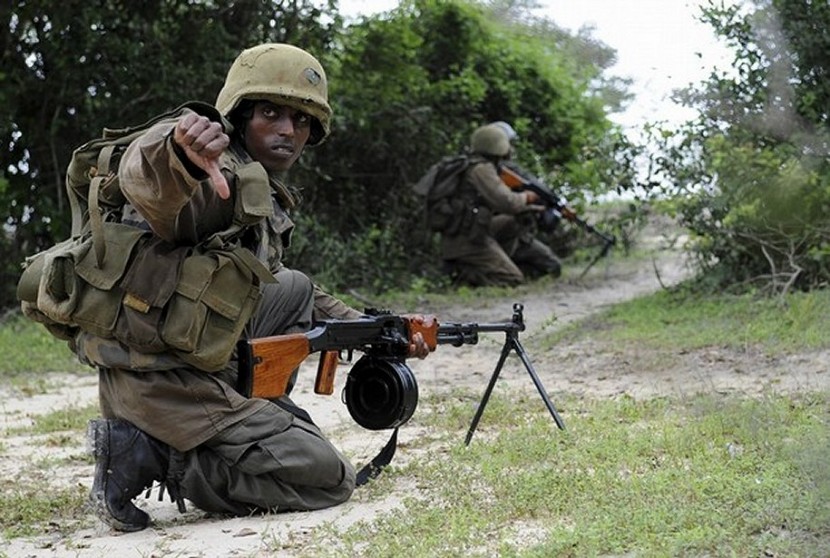
Controversy surrounds the inordinate delay in appointing the Chief of Staff and the Deputy Chief of Staff of the Army against the backdrop of dissident SLPP MP Dullas Alahapperuma’s revelation in Parliament that over 27,000 soldiers had left the Army since January 2022.

The former minister said so while participating in the third reading debate on Budget 2024 under the Defence Ministry expenditure heads. The Matara District MP urged defence authorities to pay attention to the developing situation or be prepared to face the consequences.

Chief of Staff Maj. Gen. W.A.S.S. Wanasinghe and Deputy Chief of Staff Maj. Gen. G.R.R.P. Jayawardena retired on Oct. 13 and Dec 01, respectively. At the time of his retirement, Wanasinghe, son of former Army Commander Gen. Hamilton Wanasinghe, also served as Colonel Commandant of Artillery whereas Jayawardena was Colonel Commandant of the Sinha Regiment.

The Army’s number two slot had never been kept vacant for so long, sources said, pointing out that the Wickremesinghe-Rajapaksa government seemed to have ignored altogether concerns expressed by MP Alahapperuma in Parliament. Sources said that in spite of Wanasinghe widely being tipped to be the next Army chief, he didn’t receive the approval.

The next senior most officer Maj. Gen. Darshana Wijesekara of the Sinha Regiment, currently the Commander of the Volunteer Force, is scheduled to retire on Dec 30, 2023.

The present Army Commander, Lt. Gen. Vikum Liyanage, is on a one-year extension. Ousted President Gotabaya Rajapaksa brought in Liyanage in the wake of the May 2022 violence that destabilized his government. Liyanage succeeded Gen. Shavendra Silva. At the time of President Rajapaksa’s ouster and UNP leader Wickremesinghe’s election (by Parliament) as President in July 2022, Lt. Gen. Liyanage served as the Army Commander. The Gajaba Regiment officer received a one-year extension with effect from Dec 31, 2022. Unless he is granted another extension, Liyanage, too, will retire by the end of this month.

MP Alahapperuma yesterday told The Island that of the 27,000 men, the majority deserted while the rest retired. “Of those who retired, some left after completing 12 years in the service,” the former minister said, claiming that State Defence Minister Pramitha Bandara Tennakoon didn’t properly respond to issues raised by him. “Of course I’m speaking on behalf of the genuine Opposition,” the veteran politician said.

Lawmaker Alahappeuma said that the Army was experiencing a situation very much similar to the crisis in the police. “We do not have anything against former IGP C.D. Wickremaratne. But, can anyone justify him being granted four brief extensions before making an Acting appointment to replace him?” MP Alahapperuma asked. If Senior DIG Deshabandu Tennakoon has been appointed Acting IGP for a three-month period with effect from Nov 29, why did he make courtesy calls on various people? the MP asked.

MP Alahapperuma said that President Wickremesinghe, who is also the Commander-in-Chief in addition to being the Defence Minister, should look into this matter. As the President he couldn’t allow further destabilization of a bankrupt country, MP Alahapperuma said. Wickremesinghe comfortably beat Alahapperuma at the election held in late July in Parliament to elect a president to complete Gotabaya Rajapaksa’s five-year term. In terms of the constitution the next presidential election has to be conducted by/before Oct 2024 and the new president sworn in by Nov.

MP Alahapperuma said that the SLPP should look into this matter without further delay. The failure on the part of the administration to fill the Chief of Staff’s vacancy for nearly two months couldn’t be justified under any circumstances. The ex-minister said that the all-party Sectoral Committee on National Security should look into this matter. For how long the government intended to delay filling vacancies until the desired person could take over command of the war-winning Army, he asked.

The declaration that the Army would be reduced to 100,000 by 2030 should be examined against the sharp increase in the number of desertions over the past two years, the MP said. The top Opposition MP urged the government to take decisions on solid advice of experts and not to be influenced by various interested parties.

Posted in Uncategorized

British MPs to debate Sri Lanka human rights record

The highly controversial and draconian Law-Prevention of Terrorism Act (PTA) has come in for international focus and condemnation once again.

From the UN Human Rights Council to a US Congressman and British MPs along with International organizations and groups, human rights activists have called on the island nation to repeal the law and respect its Human Rights obligations.

Now, the British Parliament will debate on the Sri Lankan Tamils and Human Rights in the Westminster Hall. This debate comes in the backdrop of continuing arrests by the Sri Lankan state security agencies in particular the Counter Terrorism Investigation Department (CTID) dubbed the “Terror Police” in connection with events related to the “Maaveerar Naal” this year, when the Tamils mourn their war-dead every year on 27 November.

As many as 11 have been arrested this week. The event is scheduled for Tuesday (5), from 2.30-4.00 pm, which is 8:00 to 9:30 pm Sri Lanka time. MP’s cutting across parties are expected to participate in the debate.

The debate will be led by Martyn Day MP from the Scottish National Party. A detailed briefing note has been circulated to the MPs. Allegations of war crimes against the oversized army dominated by the majority Sinhalese find a mention in the background paper.

“Sri Lanka’s relationship with the rest of the world has been strongly shaped since then by allegations that the army committed war crimes and crimes against humanity during the final phase of the civil war. A UN Panel of Experts reported in April 2011 that there were ‘credible allegations’ of those crimes by both government and Tamil Tiger forces”.

The Sri Lankan Government in power in the final phase of the war denied many of the accusations of crimes made against the military and civilian Government at the time, and argued Tamil forces had used civilians as “human shields”, says the note circulated to the British Members of Parliament.

Asserting Sri Lanka is one of their priority countries on Human Rights issues, it reminds the MPs of its annual report this year.

“Sri Lanka is one of the UK’s 32 ‘human rights priority countries’ as identified by the Foreign, Commonwealth and Development Office (FCDO). The FCDO’s annual human rights and democracy report published in July 2023, looking back at 2022, highlights the treatment of Tamils and minority religious groups in Sri Lanka as a human rights concern”.

In its report for the current year, the FCDO has detailed the continued state oppression on various fronts and how even fundamental religious rights are being denied to minorities.

“Minority communities faced continued marginalization by state authorities. State-supported land appropriation, so-called ‘land grabs’, sparked concerns over their impact on demographics in the north and east and their impact on the freedom of belief of non-Buddhist denominations. Security forces continued to disrupt Tamil commemorative events for victims of Sri Lanka’s armed conflict, and arbitrarily accused Tamils of links to terrorist organizations”.

In the briefing note compiled by ‘Subject specialist’ John Curtis and circulated by the House of Commons Library, the woes of the families of missing persons and the President’s planned meeting with Tamil political parties.

“Activists and families of the disappeared in the north-east faced surveillance, harassment, and intimidation by security forces. President Wickremesinghe committed to pursue a political solution with Tamil parties in December. Eight proscribed Tamil Diaspora organizations were also delisted, although some Muslim welfare organizations and individuals, including poet Ahnaf Jazeem, remained listed”.

With reference to various news reports as well as reports from international Human Rights bodies including the Office of the Commissioner for Human Rights of the UN, the background paper speaks about the draconian nature of the PTA and its brutal misuse.

“Amnesty International in its 2023 assessment of human rights in Sri Lanka, states that despite amendments to the Prevention of Terrorism Act (PTA), Muslim and Tamil minorities remained disproportionately affected by the use of the PTA”.

The US State Department’s report on human rights in Sri Lanka published in 2023, and looking at the events of 2022, describing how Tamils in the country report systemic discrimination also forms part of the briefing to the MPs.

That report from the US State Department describes how the military monitors Tamil journalists, requesting “copies of photographs, lists of attendees at events, and names of sources for articles”, and intimidated to “refrain from reporting on sensitive events, such as Tamil war commemorations or land occupation protests, as well as on posting anything related to former LTTE leaders”, stating that they “feared repercussions if they did not cooperate”.

“Both local and Indian-origin Tamils maintained that they suffered longstanding, systematic discrimination in university education, government employment, housing, health services, language laws, and procedures for naturalization of noncitizens”, the US report further adds.

US Congressman Raja Krishnamoorthi, representing the 8th Congressional District of Illinois tweeted on Saturday (1) about the misuse of PTA in Sri Lanka. “I am deeply concerned by the recent arrest of Tamils in North-East Sri Lanka during their peaceful commemorations. These arrests under the PTA are the latest in a historical pattern of Sri Lankan Police attempting to prevent Tamil memorialization,” Congressman Krishnamoorthi said.

His comments were echoed by the US Ambassador to Sri Lanka Julie Chung. “It’s vital to ensure freedom of expression and humane treatment of those in custody” she commented on X.

Ambassadors of Canada and Switzerland too have called upon the government to repeal the PTA and ensure Human Rights are protected.


Russia, India JV to operate Mattala Airport?

Sri Lanka has decided to hand over the operations of the Mattala International Airport to a private Russian, Indian joint venture.

Ports and Aviation Services Secretary K. D. S. Ruwanchandra speaking to News 1st said that discussions on the matter on Tuesday (5) were successful.

Accordingly, an agreement will be inked in the near future.

As per the agreement, all operations at the Mattala International Airport will be carried out by the Russian, Indian Private Joint Venture.

The secretary added that this company will also pay the salaries and wages of the airport staff.

He went on to note that a portion of the revenue generated by the private JV in operating the Mattala International Airport will be provided to the state.

The Sri Lankan government currently spends over Rs. 2 Billion to operate and maintain the Mattala International Airport, and with this latest move, such a massive cost can be saved.

Sri Lanka to receive about $600mn ADB funding post-IMF approval

Sri Lanka will get about $600 million, on a staggered basis, from the Asian Development Bank (ADB) after the International Monetary Fund (IMF) releases the second tranche of a $2.9 billion bailout for the crisis-hit country, an official said on Tuesday.

Sri Lanka is inching out of its worst financial crisis in decades, triggered by record-low foreign exchange reserves last year that saw its economy contract 7.8% in 2022.

The island’s economy has been gradually stabilising after locking down a four-year programme with the IMF in March. Its first review is expected to be approved by the global lender next week, which will release a second tranche of about $334 million in funding.

Alongside the IMF programme the Asian Development Bank is likely to provide total budget support of $2 billion over the next four years, said ADB, Sri Lanka Resident Mission, Country Director Takafumi Kadono.

“I would say $500 million to $600 million budget support is what is planned (for 2024) but, again, it is subject to attainment, satisfying the policy actions, so it’s not free money,” Kadono said in an interview with Reuters.

The bulk of the support will likely be extended next year in a combination of policy-based loans and project lending.

The first instalment of $200 million is tabled for ADB Board support on Dec. 8 but will only be given to Sri Lanka after the IMF approves its first review on Dec. 12.

Another $200 million for power sector reforms is expected in 2024, along with $100 million to the water sector and $50-$70 million for the tourism sector.

An additional $100 million is earmarked in ADB support to improve access to financing for small- and medium-sized enterprises, along with another $100 million to improve public finance and debt management.

Sri Lanka has to remain committed to pushing forward reforms pledged under the IMF programme, Kadono said, which include restructuring its loss-making state enterprises, reducing budget deficits and improving governance.

“These are not bandage measures. I think Sri Lanka has done a lot of that in the past so, I think it’s really time to fix the fundamentals of the economy and to address these latent weaknesses in the economy and the institutions,” Kadono said.

Source: Reuters

Posted in Uncategorized