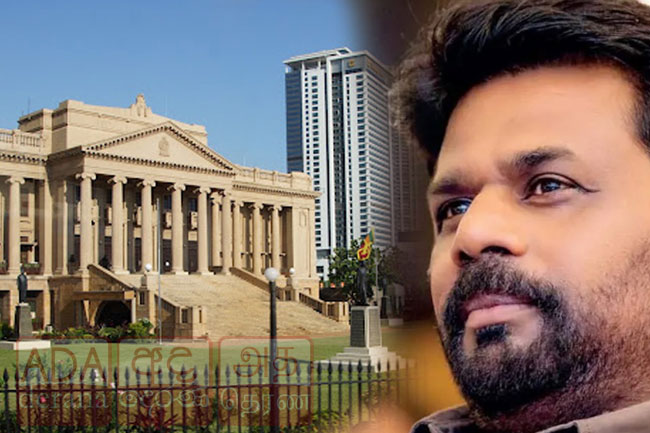
Govt takes responsibility for providing optimal school education for every child – President

President Anura Kumara Dissanayake stated that the proposed education reform is not merely limited to curriculum revision but will simultaneously elevate both the social and economic spheres of the country.

The President requested support for this initiative, emphasising that it is a social objective, not a political one.

He further stressed that no child should leave school without completing 13 years of compulsory education for any reason whatsoever.

President Anura Kumara Dissanayake made these remarks while participating in today’s (24) parliamentary debate on education reforms, according to the President’s Media Division (PMD).

Following is the full speech delivered by President Anura Kumara Dissanayake;

“I intend to present a few points during the debate on education reforms.

No one can be satisfied with the current education system, the young generation it has produced, or the economy it has fostered. Therefore, we urgently need comprehensive education reform.

When discussions about education reform arose, issues such as whether history is included in the curriculum or not became the main topic. However, what is being proposed here is by no means merely a curriculum revision.

Instead, these new education reforms are proposed for a fresh transformation of our entire society, our economic body and our country.

From an economic perspective, our country ranks approximately 38th globally in terms of population density. This means we are a densely populated nation; our population density even exceeds that of China.

Regarding natural resources, we have limited large commercial resources. We lack deposits of oil, gas, gold deposits, iron ore, etc. Therefore, our most valuable asset, the resource that needs to be sharpened and honed to build this nation, is our human capital. Consequently, within our economic strategy, we must focus more on how to advance our nation by developing this human resource.

When we classify those who go abroad for employment, we generally categorise them as domestic workers, unskilled, semi-skilled, skilled, or professional. Looking at professionals, only approximately 3% of our expatriate workforce is engaged in professional occupations. The remaining 97% are in skilled, unskilled, or semi-skilled categories. This shows us that there are two global markets: a goods and services market and a global labour market. We have primarily secured a position in the lower-tier global labour market.

Therefore, from an economic standpoint, we must secure a position in the advanced global labour market. For this, we require a high-quality education system that acquires and disseminates the knowledge emerging in the world at any given moment.

On the social front, our illiteracy and poverty are intertwined. If one is uneducated, they are largely impoverished. If one is impoverished, they are largely uneducated. Therefore, even as a programme to eliminate poverty, education plays a massive role in achieving this. In our villages, it’s commonly said that if one person from a family gets an education, the entire family prospers. Hence, education is extremely crucial for escaping poverty. Furthermore, consider crime in our country. Approximately 80% of those imprisoned have not passed the GCE Ordinary Level examination. Close to 70% of drug addicts have not progressed beyond Year 8.

This indicates a connection between social crime, drug abuse and education. Therefore, if we aspire to a positive transformation of this economic body and this society, then education is the seed, the genesis and the foundation of that transformation. This is why we emphasised the necessity of a broad transformation of education in our policy statement. First and foremost, we must identify the scale of the problems within our education system. Because there’s no point in seeking solutions for problems that don’t exist in the real social fabric. We must seek solutions to the crisis our education is currently facing.

One of the crises we face is our children leaving school prematurely. In 2019, approximately 16,673 children left school, rising to 20,759 in 2022 and 20,755 in 2024. This means they are discontinuing their education while still having further years of schooling available to them. My stance is clear: no child should leave school without completing 13 years of compulsory education.

To elaborate, children born in 2006 would have started school in 2011. In 2011, 358,596 children enrolled in school. These same children would have sat the GCE Ordinary Level examination in 2021. However, only around 311,000 children actually sat the exam. This indicates that nearly 47,000 children had left school. Education reforms are essential to retain these children and ensure they complete their 13 years of compulsory education. Our children must not drop out of school midway; no child should suffer such a fate.

A significant number of factors contribute to children leaving school, including their economic backgrounds, parental conflicts, parents emigrating and unsafe conditions. While developing the education programme, if a child is absent from school for three consecutive days, a state official should conduct a personal investigation into that child’s circumstances. Every child must be retained in school up to 13 years of education. This is included in the proposed programme.

Secondly, discussions in our country often focus on higher education. However, the primary issue we face lies within the school education system. In 2023, there were 98 schools with no new admissions. Furthermore, 115 schools had fewer than 10 students, 406 schools had fewer than 20 students and 752 schools had fewer than 30 students. There were 1,141 schools with fewer than 40 students and 1,506 schools with fewer than 50 students. This means approximately 15% of the entire school system falls into these categories.

Moreover, there are 3,144 schools with fewer than 100 students. This means approximately one-third of all government schools have fewer than 100 students. Is this a healthy situation? In such schools, there are no literary festivals, sports days, excursions, or opportunities for children to interact with their peers. Therefore, we must re-evaluate this school system. We will definitely make that decision.

Some schools need to be closed down, others should be amalgamated and new schools need to be established in certain areas. We must consider relocating schools. Every child should have access to a new society, new experiences and new opportunities. Children should not wither away in the same social conditions, moving only between their village and their school. No child should endure this fate.

Some parents refuse to send their child to the village school and desperately try to send them to a city school. Yet, paradoxically, they also fight to keep the village school functioning. What is the meaning of this? We have had extensive discussions with the Ministry of Education about the necessity of visiting and inspecting schools. We are prepared to meet transport needs. Because even if buildings and human resources are available, if a school only has 10 children, it would be more effective to provide a bus service for those children to travel to a city school.

If we take a closer look at the current challenges within our school system, it becomes evident how significantly human resources are being underutilized. The average teacher-to-student ratio in our country is 1:18. Yet, many districts still face teacher shortages. In schools with fewer than 50 students, the ratio drops drastically to 1:5. For example, a school in Hambantota has just 30 students and 9 teachers this reflects a serious waste of human resources.

In Trincomalee’s Kuchchaveli area, one school has only two students and two teachers. Another school in Haldummulla Education Division, Bandarawela has three students and three teachers, while a separate school in Trincomalee has four students and four teachers. In all these instances, neither the students nor the teachers are achieving meaningful results.

Through our education reform programme, the government is taking responsibility for ensuring that every child receives a high-quality school education. This reform involves rethinking the structure and purpose of our school system, which is a critical undertaking. Every child deserves access to a school equipped with proper facilities, qualified staff and extracurricular activities that enrich the social environment they grow up in. Isn’t that the kind of school we should be striving for?

Our education system has significantly mechanized our children. In many villages today, there isn’t even a volleyball court. After harvesting, children play in the paddy fields or swim in the village tanks. During Vesak, they used to come together to draw pictures and build pandals. But such communal and creative activities have all but disappeared. As a result, we are raising a generation of children who resemble machines, lacking warmth, empathy and a sense of social responsibility.

Sometimes I hear parents say, “Children these days are not like we were.” And they’re right. There ought to be more advanced children at present. Today, tuition starts as early as 4 a.m. They only go to school after finishing extra classes. What kind of life is that for a child? After school, they return to more tuition. Where is their childhood? Do we really want to raise children who don’t enjoy poetry or music? Children who don’t read novels, who grow up without a literary foundation, without social engagement, children who are like machines? A society built on such a foundation cannot move forward.

We must reduce the overwhelming educational burden placed on our children that is our responsibility. Some children are so exhausted that they sleep even after waking up. They sleep in the vehicle and they sleep at school. Don’t we see this? Isn’t it time we changed a system that raises children like robots?

We are now implementing reforms across the entire education system revising subjects, teaching methods and even the volume and weight of the curriculum with the goal of giving children a meaningful and balanced life. Today, the majority of children entering school aspire to become doctors or engineers. But education is not a single, narrow path. It is a wide array of diverse journeys. So what has gone wrong? Our society has placed social value, respect, and professional worth into just two or three fields.

Parents believe that for their child to have a good life, they must become a doctor or an engineer. That is simply not true. A society cannot be built on doctors and engineers alone. A healthy, functioning society depends on a broad spectrum of professions. What we need is professionalism across every field. Every profession deserves dignity, value and recognition.

There are many paths in life and our responsibility is to guide children toward professionalism through these diverse avenues. That is the fundamental aim of our education reforms. Every child needs a path to follow. But what has become of that path today? A child cannot truly understand or choose a direction without meaningful dialogue between teachers and parents. Unfortunately, many paths have been reduced to options ranked by perceived social value.

For example, a student who doesn’t gain admission to the Faculty of Medicine ends up in the Faculty of Agriculture not by choice, but by default. He becomes an agronomist not out of passion, but because he couldn’t become a doctor. At present, there is a significant disconnect between the Ordinary Level and Advanced Level stages. Our reform process aims to address this.

The new education reform programme will begin gradually starting with Grade 6 in 2026, Grade 7 in 2027, Grade 8 in 2028 and Grade 9 in 2029. That means there are still more than three years before the reforms reach Grade 9. Only when we reach that stage in 2029 will we begin the crucial discussions around helping students identify and pursue the right path for their individual talents, interests and aspirations.

There is a path for a child to become a historian someone who studies the evolution of human civilization. Through that path, we nurture citizens with deep knowledge and understanding of religions and cultures. Isn’t that exactly what society needs? While every child receives a foundational education in subjects like geography, sociology, religion and history, we must go further. We need to foster specialized knowledge that builds upon these basics. For that, a clear, well-structured path must be made available.

In many villages, parents believe that completing the Advanced Level examination marks the end of their child’s education. However, Advanced Level should not be seen as the final stage. Beyond that, we must build a robust national university system and establish advanced vocational training centres that align with the demands of a modern economy. Currently, many vocational training institutions are out-dated some resemble little more than carpentry workshops or small-scale factories. Obviously, children are reluctant to enroll in such environments. A census should be conducted to assess how many students who enter government vocational training centres actually complete their studies. The number would likely be alarmingly low.

Many drop out after just three or four months. There remains a stark disparity between the experience of a university student and that of a student in a vocational training centre. This gap must be addressed if we are serious about creating a skilled and future-ready workforce.

Vocational training centres should not be viewed as a fall-back option for those unable to enter university. Our policy is clear: vocational education is not a lesser form of education it is foundational. We aim to establish 40 modern vocational training centres by 2033, integrating both knowledge and technology. Each district will have two such centres, ensuring equal access across the country. Upon completing thirteen years of general education, every child will have the opportunity to enter an open vocational education system. We are committed to ensuring that no child drops out or becomes lost in the education system before completing their thirteen years of schooling.

Traditionally, a child spends thirteen years in school, while a teacher often remains in the system for thirty years. In fact, some of my peers who completed their Advanced Level studies with me are still in the classroom. This raises an important question do our educators possess the updated knowledge and experience required to deliver a modern education? The unfortunate reality is that many do not. Their training and knowledge have not kept pace with the rapidly changing world.

How then can we expect to nurture a modern, forward-thinking generation? To achieve this, we must first build a strong, well-equipped generation of teachers. Today, both students and teachers are constrained by an out-dated system. Neither group enjoys true freedom within our current educational framework. This must change.

Therefore, a qualitative transformation in education must occur every five years. To support this, a comprehensive teacher training programme will also be introduced every five years. This on-going
development requires maintaining a surplus of teachers to ensure flexibility and continuity in the system. We will manage our existing teaching workforce accordingly. Subject selection within the curriculum should not be determined by politicians.

It must be guided by the recommendations of education experts, in line with the evolving needs of society and global standards. Accordingly, we have entrusted this responsibility to professionals with the necessary expertise in educational reform. The role of political leadership is to establish clear timeframes and ensure the successful implementation of structural reforms. While policy direction and reform timelines fall under political authority, the content and direction of education must remain in the hands of those with academic and pedagogical expertise.

Let us engage in a meaningful discussion on the structural transformations needed in education. We must carefully consider the relevant content, subjects and timelines involved. Since we are not experts in every area, it is essential to unite all segments of society and move forward together on this journey. This education reform process is crucial for the strong and sustainable development of Sri Lanka’s economic foundation. Therefore, all political parties should come together to support and implement these reforms. When introducing this new education system in rural areas, it is important not to align with those opposing progress but to actively support positive change.

While some schools have constructed large buildings and theatres, these developments have not translated into tangible educational benefits. To provide optimal education to every child, fundamental reforms of the education system are necessary. Political influence has penetrated provincial schools more deeply than national schools; sometimes they had used teachers from provincial schools for their political activities. As a result, children have become unintended victims of political agendas. There is a prevailing perception among parents that national schools offer better care and quality than provincial schools this perception must be changed. Constructive dialogue is essential to drive new educational reforms.

Sri Lanka currently faces a critical human resource challenge, as there are no competent teams possessing the necessary skills and there is a shortage of officers who demonstrate professionalism. This has led to the weakening of the state’s institutional structure. Therefore, a strong, skilled workforce is urgently needed. This education reform must be pursued decisively not as a political agenda, but as a social imperative to which everyone must contribute.”

–PMD–

Chemmani becomes country’s 3rd biggest mass grave

The mass grave at Sittapandi in Chemmani, Jaffna has become the third biggest of its kind in the country with skeletal remains of 85 persons found there so far.

It surpassed the one found at Tiruketeeswaran in Mannar, from where 82 skeletal remains were found in 2023.

In Chemmani, the 18th day of phase two excavations unearthed five human skulls on 23 July, said lawyer for the victims V.S. Niranjan, adding that 20 skulls have been found within the space last three days.

Of the total skeletal remains found there, 67 have been retrieved by now, he told journalists.

The biggest mass grave in Sri Lanka is the one at the land belonging to the CWE in Mannar, where human remains of 367 persons were unearthed.

It is followed by the Matale mass grave with human remains of 155 found in 2013.

From Kottutuduwai, 52 human remains were unearthed before the site was closed, and no details are yet available from another found at Colombo’s old Secretariat premises in July last year.

All these mass graves were found by chance.

A recent protest in Colombo by trade unions and people’s organisations called for investigations into more than 20 mass graves in the country.

Posted in Uncategorized

Turkish Education Minister Lands in Sri Lanka for Economic Talks

Turkish Minister of National Education Yusuf Tekin arrived in Sri Lanka this morning (24), accompanied by an eight-member delegation aboard a Turkish Airlines flight.

The visiting delegation was received at Bandaranaike International Airport by Sri Lanka’s Deputy Minister of Trade, Commerce, Food Security and Cooperative Development, R.M. Jayawardena, along with Turkish Ambassador to Sri Lanka.

The Turkish officials are in the country to participate in the third session of the Sri Lanka–Turkey Joint Committee on Economic Cooperation, aimed at strengthening bilateral ties in trade, education, and development.

During their visit, Minister Tekin and his delegation are scheduled to meet with President Anura Kumara Dissanayake and Prime Minister Harini Amarasuirya to discuss avenues for enhanced collaboration between the two nations.

Posted in Uncategorized

Pakistan Army’s Top General Meets Sri Lankan Defence Leaders

Lieutenant General Syed Aamer Raza, Chief of General Staff of the Pakistan Army, arrived in Sri Lanka on July 22 for an official visit aimed at enhancing bilateral defence cooperation.

During his visit, Lieutenant General Raza paid courtesy calls on Deputy Minister of Defence, Major General Aruna Jayasekara (Retd) and Defence Secretary, Air Vice Marshal Sampath Thuyacontha (Retd) in separate meetings.

He was accompanied by Colonel Muhammad Farooq, Defence Advisor to the High Commission of Pakistan in Sri Lanka.

The delegation engaged in constructive discussions focused on capacity building, exchange of best practices, and strategic preparedness, particularly in the context of natural disaster response.

Major General Jayasekara (Retd) acknowledged Pakistan’s longstanding support in providing military training opportunities to Sri Lankan personnel, which have significantly contributed to professional development and regional collaboration. He also referenced the Sri Lanka–Pakistan Bilateral Defence Dialogue held in Islamabad in April, emphasizing its role in strengthening multi-domain defence partnerships.

In his meeting with the Defence Secretary, Lieutenant General Raza reaffirmed Pakistan’s commitment to deepening strategic cooperation. Both parties expressed appreciation for the ongoing collaboration between the two nations’ defence establishments and emphasized the importance of sustained high-level engagements to promote regional security and mutual understanding.

Speaker certifies National Minimum Wage for Workers Amendment Bill

Speaker of House Dr. Jagath Wickramaratne on Wednesday (23) endorsed his certification on the three Bills, the Budgetary Relief Allowance of Workers (Amendment) Bill to amend Act No. 36 of 2005, the Budgetary Relief Allowance of Workers (Amendment) Bill to amend Act No. 4 of 2016, and the National Minimum Wage for Workers (Amendment) Bill.

The Second Reading debate on the three Bills was held yesterday (22), and were passed by Parliament.

The three Bills were presented to Parliament for the First Reading on June 03, 2025.

Accordingly, the Budgetary Relief Allowance of Workers (Amendment) Bill (to amend Act No. 36 of 2005) shall come into operation as the Budgetary Relief Allowance of Workers (Amendment) Act, No. 9 of 2025; the Budgetary Relief Allowance of Workers (Amendment) Bill (to amend Act No. 4 of 2016) shall come into operation as the Budgetary Relief Allowance of Workers (Amendment) Act, No. 10 of 2025; and the National Minimum Wage for Workers (Amendment) Bill will come into operation as the National Minimum Wage for Workers (Amendment) Act, No. 11 of 2025.

By the provisions of the Budgetary Relief Allowance of Workers (Amendment) Act, No. 9 of 2025, the payment of the Budgetary Relief Allowance of Workers is deemed to have been discontinued with effect from March 31, 2025 and to have come into operation from April 01, 2025, the Department of Communication of Parliament said in a statement.

Further, by the provisions of the Budgetary Relief Allowance of Workers (Amendment) Act, No. 10 of 2025, the discontinuation of the payment of the Budgetary Relief Allowance, operative from March 31, 2025, is deemed to have come into operation from April 01, 2025.

In addition, the principal amendments introduced by the National Minimum Wage for Workers (Amendment) Act, No. 11 of 2025, are as follows:

1. For the period from April 01, 2025 to December 31, 2025:

National minimum monthly wage: Rs. 27,000 (an increase of Rs. 9,500)
National minimum daily wage: Rs. 1,080 (an increase of Rs. 380)
2. From January 01, 2026 onwards:

National minimum monthly wage: Rs. 30,000 (a further increase of Rs. 3,000)
National minimum daily wage: Rs. 1,200 (a further increase of Rs. 120)
Further, the Budgetary Relief Allowance has been incorporated as a component of the workers’ wage.

The Act is deemed to have come into operation with effect from April 01, 2025, according to the Department of Communication of Parliament.

facebook sharing button Share

Posted in Uncategorized

Sri Lanka to join China-ASEAN Expo in September as special partner

Sri Lanka will join as a Special Partner Country for the 22nd China-ASEAN Expo (CAEXPO) scheduled for Sept. 17-21 in Nanning, capital city of south China’s Guangxi Zhuang Autonomous Region, the expo secretariat confirmed on Wednesday.

A high-level Sri Lankan government delegation led by senior diplomatic officials will attend the event. National key enterprises, including port companies and spice companies, will participate to deepen economic and trade ties with China and ASEAN.

Sri Lanka will hold a national image exhibition, product display and national promotion event during the expo.

Introduced at the 11th CAEXPO, the Special Partner Country mechanism invites Regional Comprehensive Economic Partnership (RCEP) member states or Belt and Road participating countries outside China and ASEAN. This makes the expo a platform to boost exchanges and create business opportunities between China, ASEAN and beyond. Sri Lanka previously held the role at the 13th CAEXPO.

China-Sri Lanka cooperation currently spans infrastructure, energy, port development and other sectors, helping strengthen bilateral economic and cultural ties.

Posted in Uncategorized

More bodies of children among new skeletons uncovered at Chemmani mass grave

Excavations at the Chemmani mass graves in Jaffna have uncovered eight more human skeletal remains, including what is believed to be the remains of a small child, alongside personal items such as an object resembling a child’s feeding bottle.

The discoveries were made during the second phase of forensic excavation at two sites designated by the courts as “Forensic Excavation Site No. 01” and “Forensic Excavation Site No. 02” in Chemmani, Jaffna.

Tuesday marked the 17th day of the court-sanctioned 45-day excavation phase, during which the latest remains were identified. The previous day (Monday), seven skeletal remains were also discovered at the same sites. These are expected to be exhumed on Wednesday, bringing the number of skeletal remains identified in just two days to fifteen.

This phase of excavation work in Chemmani has now spanned 26 days in total and led to the complete exhumation of 65 human remains thus far. The total number of bodies identified so far, stands at 80.

The presence of the suspected child’s remains and associated objects such as the milk bottle and pieces of cloth has raised further concerns over the demographics of those buried at the site, as it points to further involvement of Tamil children among the victims.

The Chemmani mass graves have long been tied to allegations of extrajudicial killings carried out by the Sri Lankan military, particularly in the 1990s following the army’s occupation of the Jaffna peninsula. Survivors, families of the disappeared, and human rights organisations have repeatedly called for independent investigations into these graves, many of which are believed to contain the remains of Tamils who were abducted, detained, or summarily executed.

Monday also saw the arrival of officers from the Criminal Investigation Department (CID), who have now taken over the investigation following an order by the Inspector General of Police. Until now, the Sri Lankan Police in Jaffna had been overseeing the process. The CID’s involvement reportedly sparked disputes at the excavation site, though details remain limited.

As excavations continue, local civil society organisations have urged full transparency and the involvement of international forensic experts to ensure the integrity of the investigation. The latest findings have renewed demands for a credible international mechanism to address mass atrocities committed in the North-East.

Posted in Uncategorized

Pakistan’s Top Army Chief Meets Sri Lankan Army Commander

Lieutenant General Syed Aamer Raza, the Chief of General Staff (CGS) of the Pakistan Army who is currently on an official visit to Sri Lanka, visited the Sri Lanka Army Headquarters on Tuesday (22) accompanied by a high-level military delegation.

Upon arrival, the visiting delegation was welcomed with military honors in accordance with traditional army customs.

Lieutenant General Lasantha Rodrigo, Commander of the Sri Lanka Army, extended a warm reception to his Pakistani counterpart.

During the visit, both parties engaged in discussions focused on strengthening bilateral military cooperation, with emphasis on regional security, stability, and peace-building initiatives. Talks also covered future collaboration in joint military training programs, intelligence sharing, and defense operations.

Posted in Uncategorized

Ranil’s emergency regulations in 2022 violated fundamental rights – SC rules

The Supreme Court, in a majority decision, today ruled Fundamental Rights have been violated through then Acting President Ranil Wickremesinghe’s orders to disperse the ‘Aragalaya’ protestors from Galle Face on 17 July 2022, by resorting to Emergency Regulations under the Public Security Act.

The majority of the judges on the three-member bench held that the Emergency Regulations promulgated by the then Acting President under Section 2 of the Public Security Act were arbitrary, and therefore, invalid.

Chief Justice Murdu Fernando and Justice Yasantha Kodagoda delivered the majority verdict.

However, Justice Arjuna Obeysekara, also a member of the bench, in his separate judgment, stated that the declaration of Emergency Regulations by the Acting President did not constitute a violation of fundamental human rights.

The fundamental rights petitions were filed by the Centre for Policy Alternatives (CPA), former Commissioner of the Human Rights Commission of Sri Lanka (HRCSL) Ambika Satkunanathan, and the Liberal Youth Movement.

Additionally, the Court ordered the government to bear the legal costs incurred by the petitioners.

Committee of Inquiry finds IGP Deshabandhu Tennakoon guilty of all allegations, recommends his removal

The Committee of Inquiry appointed to investigate and report its findings on Inspector General of Police Deshabandhu Tennakoon in respect of acts of gross abuse of power, has found him guilty of all allegations leveled against the IGP.

At the commencement of today’s (22) Parliament proceedings, Speaker of House Dr. Jagath Wickramaratne confirmed that he has received the full report of the Committee of Inquiry which has recommended the removal of Deshabandhu Tennakoon from the post of IGP.

The Speaker announcing the findings noted that the committee has unanimously found guilty of all charges brought against IGP Deshabandhu Tennakoon under section 8(2) of the Removal of Officers (Procedure) Act, No. 5 of 2002.

Speaker Dr. Jagath Wickramaratne also noted that it is a historic occasion, since this is the first time in the constitutional process of Sri Lanka that a Committee of Inquiry of this nature has recommended the removal of an IGP from the post.

The Speaker stated that he is obliged to place the findings of guilt in the form of a resolution in the order paper of Parliament which will be voted by Members of Parliament on a future date.

Speaker Dr. Jagath Wickramaratne also ordered the report be tabled in Parliament.

The Speaker said he intends to release the report of the committee to the general public considering the public interest in the matter and the obligation of the Parliament.

He noted that now it is the duty of the MPs to ratify the findings of the Committee of Inquiry.

The Committee of Inquiry was chaired by Supreme Court Justice P.P. Surasena and consisted of Justice W. M. N. P. Iddawala and E. W. M. Lalith Ekanayake, Chairman, National Police Commission (Ex-officio).

Resolution to appoint a Committee of Inquiry in terms of Section 5 of the Removal of Officers (Procedure) Act, No. 5 of 2002, to remove the Inspector-General of Police Deshabandu Tennakoon from the office of the Inspector-General of Police for misconduct and gross abuse of power of his office in terms of Sections 3(d) and 3(e) read with Section 5 of the said Act was passed in Parliament on April 04, 2025.