Seven million Lankans in need of humanitarian assistance:UNICEF

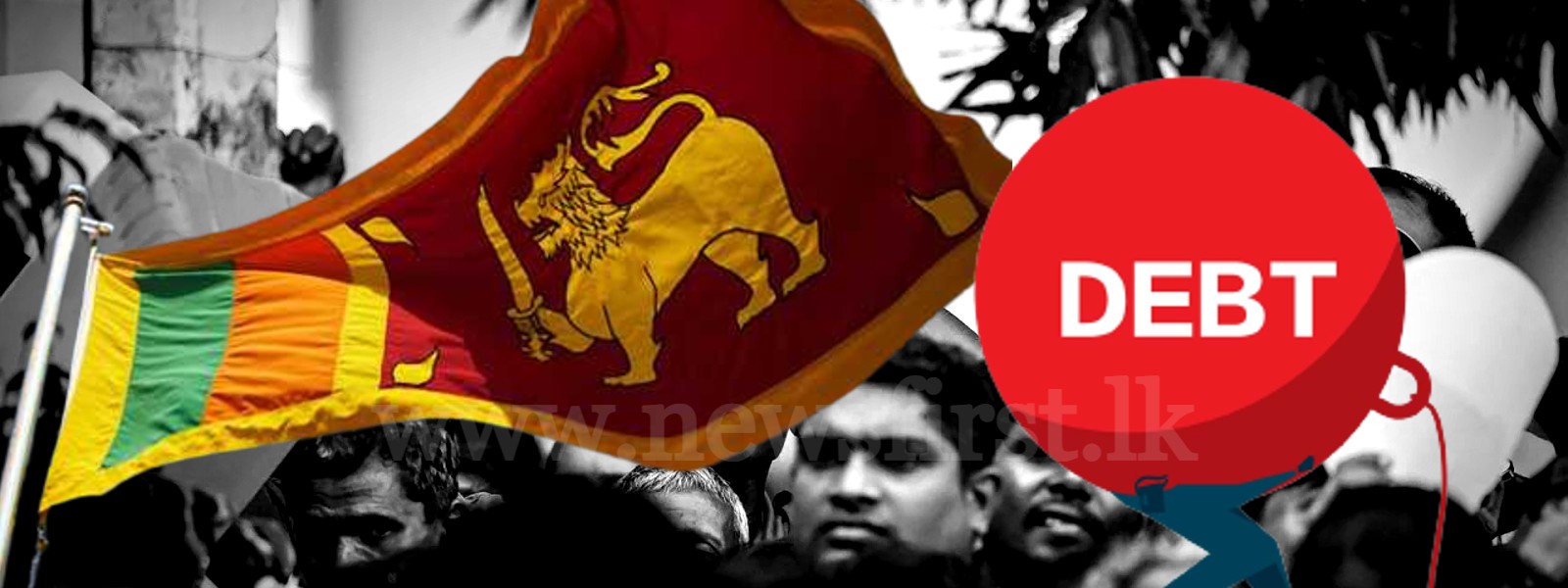
UNICEF has said seven million people in Sri Lanka are in need of humanitarian assistance due to the economic crisis.In its Sri Lanka Humanitarian Situation Report, issued on 02 February, the UN agency said essential services for children such as health, nutrition, and education have been severely impacted by shortages of medicine, food insecurity, lack of fuel and long power cuts.

In 2022, UNICEF reached over 1.3 million people, including 750,000 children with humanitarian assistance through humanitarian interventions.Over 800,000 people in urban areas have access to safe drinking water, 285,403 children in rural and estate areas were provided with educational materials, and 205,000 adolescents benefited from mental health and psychosocial support services in communities and in schools through UNICEF initiatives, the report said.

UNICEF also piloted a humanitarian cash transfers program which reached 3,010 mothers with young children for three months in the Colombo municipal area in 2022.

This is to be further scaled up to reach 110,000 mothers and caregivers in 2023, the report said.It said that in 2022, UNICEF appealed for 25 million U.S. dollars to provide life-saving humanitarian services to nearly 2.8 million Sri Lankans, including 1.7 million children affected by the economic crisis in Sri Lanka.

UNICEF received USD 34 million, however there is uneven distribution of funding received, it said.

UNICEF said: “Some sectors (Education, WASH and Child Protection) remain significantly underfunded, while others (Nutrition and Social Protection) have received almost triple the asked amount. This situation highlights the need for fresh funding into 2023 particularly for the underfunded sectors. In addition, the generous contribution to the cash-based programming was only made available in the fall.

UNICEF Sri Lanka Country Office launched its Humanitarian Action for Children (HAC) on 10 June 2022 aligned with the UN inter-agency Humanitarian Needs and Priorities (HNP) appeal for Sri Lanka. The HAC has been funded thanks to the generous contributions of bilateral, public, and private donors. UNICEF expresses its sincere gratitude to Japan, Australia, New Zealand, Norway, Canada, Switzerland, USAID, the Central Emergency Response Fund, UNICEF USA, Foreign Commonwealth and Development Office (UK) and Global Thematic Humanitarian Funds and many others for their generous contributions, without which UNICEF could not meet the most pressing needs of woman, children, and most vulnerable populations affected by the worst economic crisis the country has experienced since independence. While the HNP expired in December 2022, the need for continued funding to sustain prevailing humanitarian needs post-HNP is critical.”

Posted in Uncategorized

Indian State Foreign Minister to visit Sri Lanka for 75th Independence Day

The Indian Minister of State for External Affairs and Parliamentary Affairs, Shri V. Muraleedharan will be visiting Colombo to participate in the celebrations connected with the 75th Independence Day of Sri Lanka on 4 February 2023.

The Indian Ministry of External Affairs said that his visit will take place at the invitation of the Government of Sri Lanka.

During the visit, the Minister of State will also have separate bilateral interactions with President Ranil Wickremesinghe and the Sri Lankan Foreign Minister, Mr. M.U.M. Ali Sabry on matters of mutual interest.

He will also have an interactive session with prominent members of the Indian Diaspora.

This year also marks the 75th anniversary of the establishment of diplomatic relations between India and Sri Lanka.

Sri Lanka is India’s close neighbhour and friend and occupies a central place in India’s ‘Neighbourhood First’ policy. India, as always is committed to stand with the people of Sri Lanka for their economic recovery, growth and prosperity, said the Indian External Affairs Ministry.

The Sri Lankan government has decided to celebrate the 75th National Independence Day with pride together with the new reformist program for the next 25 years.

During this celebration held with pride under the theme “Namo Namo Matha – A Step towards a Century”, the government will announce its new reformist course for the next 25 years for the implementation of a stable government policy right until the 100th Independence Day celebrations in 2048.

The main ceremony of the National Independence Day Celebrations will be held on the 04th of February at 8.30 am at Galle Face Green under the patronage of President Ranil Wickremesinghe and Prime Minister Dinesh Gunawardena.

The festivities are scheduled to begin after the offering of floral tributes at the statue of Mahamanya D.S. Senanayake at Independence Square and the statue of the war heroes at the Presidential Secretariat.

A Sri Dalada exhibition is to be held at the historic Temple of the Tooth Relic premises in March, an exhibition of Kapila Vastu Buddhist Relics to be held in Colombo in May, the sacred Buddhist relics from China exposition and exhibition to be held in Anuradhapura in June, exhibition of the sacred Buddhist relics from Pakistan is scheduled to be held in the Southern Province in July.

In addition, the special cultural arts festival “LankaraLanka” organized in conjunction with the 75th Independence Day will be held on February 03 at 7.30 pm at Independence Square in Colombo with the participation of 750 artists from the public and private sectors.

The Jaffna Cultural Center will be opened on February 11th morning under the patronage of the President, and the cultural procession will commence opposite the Jaffna Cultural Center and will travel through the streets of Jaffna culminating near the Jaffna Fort (the old bus station site).

On the 19th of February, the Republican Rally is scheduled to parade the streets of Kandy under the full sponsorship of the Sri Dalada Maligawa (Temple of the Tooth Relic) representing all dance traditions of the country.

The Independence Day activities also include a project of 75 urban forests and a project of 1996 houses for low-income families in Colombo and many projects and programs on the National Youth Platform.

In addition, the ‘75th Independence Anniversary Commemoration Medal’ was introduced to the Sri Lankan Tri-Forces recently.

Bondholders Group prepared to engage with Sri Lanka on Debt Restructuring

The Ad Hoc Group of Sri Lanka Bondholders (the “Bondholder Group”) in a letter to the IMF Managing Director has confirmed it is prepared to engage, through its Steering Committee, with the Sri Lankan authorities in restructuring negotiations consistent with the parameters of an IMF Programme and the targets specified therein (the “IMF Programme Targets”).

The Ad Hoc Group of Sri Lanka Bondholders (the “Bondholder Group”) has acknowledges the Sri Lankan authorities’ engagement with their official creditors towards a resolution of the current crisis and restoration of debt sustainability.

The Bondholder Group further acknowledged that such engagement has recently resulted in the Government of India (in its letter to the IMF, dated January 16, 2023 (the “India Letter”)) delivering letters of financing assurances, committing to support Sri Lanka and contribute to its efforts to restore debt sustainability by providing debt relief and financing consistent with the IMF Extended Fund Facility Arrangement (the “IMF Programme”) and the IMF Programme targets indicated in the India Letter.

Similarly, the Bondholder Group through its Steering Committee stands ready to engage quickly and effectively with the Sri Lankan authorities to design and implement restructuring terms that would help Sri Lanka restore debt sustainability and allow the country to re-gain access to the international capital markets during the IMF Programme period.

The Bondholder Group understands that the IMF Programme’s debt sustainability targets are identified as

(i) reducing the ratio of public debt to GDP to 95% by 2032,
(ii) limiting the central government’s annual gross financing needs to GDP ratio to 13% in the period between 2027 and 2032, and central government annual foreign currency debt service at 4.5% of GDP in every year between 2027 and 2032
(iii) closing of the external financing gap.

The Bondholder Group hereby confirmed it is prepared to engage, through its Steering Committee, with the Sri Lankan authorities in restructuring negotiations consistent with the parameters of an IMF Programme and the targets specified therein (the “IMF Programme Targets”), which the Bondholder Group understands to be the targets identified in the India Letter; it being recognized that these negotiations will necessarily be further informed by the receipt of the forthcoming DSA.

The Bondholder Group noted that the finalization of an agreement will also be subject to the satisfaction of the following conditions:

“The central government’s domestic debt – defined as debt governed by local law – is reorganized in a manner that both ensures debt sustainability and safeguards financial stability. Assuming that annual gross financing needs should not exceed 13% of GDP in the period between 2027 and 2032, whilst allowing for central government annual foreign currency debt service to reach 4.5% of GDP in every year between 2027 and 2032, domestic gross financing should therefore be limited at 8.5% of GDP for the period 2027-2032,” the letter added.

“While we recognize that the determination of the economic assumptions underpinning the IMF Programme Targets is ultimately the responsibility of the IMF and that the overall design of the IMF Programme is one that is negotiated between the IMF and Sri Lanka, it is nevertheless important that the Bondholder Group has the opportunity to express its views on both the economic assumptions underpinning these IMF Programme Targets and the adequacy and feasibility of the adjustment efforts contemplated under the IMF Programme. When considering any restructuring proposal that is made to the Bondholder Group, it is the Bondholder Group’s intention to take into consideration the extent to which the economic assumptions and the adjustment efforts are consistent with these views,” it noted.

Recognizing the important commitments made by India in the India Letter, the Sri Lankan authorities will apply the principle of comparable treatment in respect of the debt relief requested and obtained from all their remaining official bilateral creditors, said the Ad Hoc Group of Sri Lanka Bondholders

Postal voting for LG polls on 22, 23, 24 February

Postal voting for the 2023 Local Government election will be held on 22, 23 and 24 February.

Gazette notices have been issued confirming the holding of Local Government (LG) elections in the respective local authorities on 9th March.

The Returning Officers in the respective districts have issued the notice stating that in terms of Sub-section 38(1)(c) of the Local Authorities Elections Ordinance, the elections will be contested in relation to the respective local authorities and the poll for those local authorities will be taken on March 09, 2023 from 7.00 a.m. to 4.00 p.m.

Members for Local Government Institutions need to be appointed by the 20th of March, and for that elections needs to take place before the 10th of March 2023.

The Government has already said that there will be difficulties in funding the elections owing to the economic crisis.

However, the National Election Commission has accepted nominations for the polls and is going ahead with the election, as scheduled.

Posted in Uncategorized

SJB to boycott 75th Independence celebrations

Opposition Leader Sajith Premadasa has decided to boycott Sri Lanka’s 75th Independence anniversary celebrations, due to be held tomorrow (04 Feb.).

Accordingly, the Samagi Jana Balawegaya (SJB) party, as a whole, has decided to boycott tomorrow’s celebration upon a unanimous decision that they will refrain from engaging in such activities in which money is wasted at a time when Sri Lanka is facing one of its worst economic crises.

This decision was reached at a recent party meeting, SJB MP Tissa Attanayake stated.

Posted in Uncategorized

“Police planned to kill me” – Wasantha Mudalige

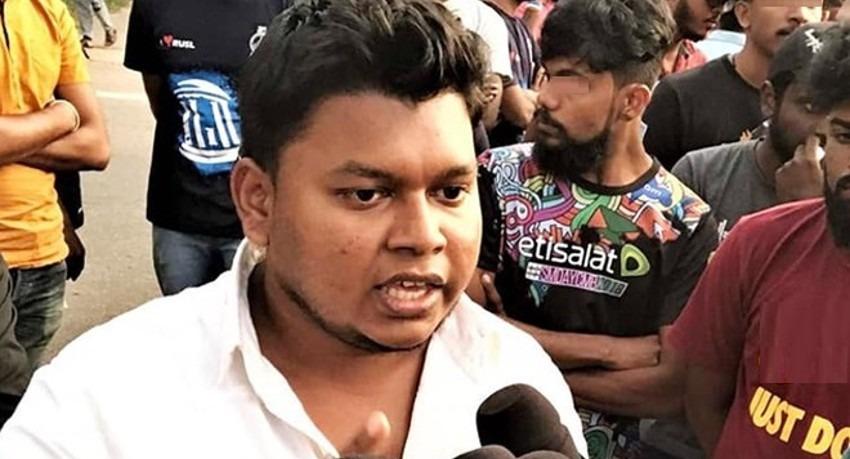
The Inter-University Students Federation (IUSF) Convener Wasantha Mudalige alleged that the police had a plan to kill him while he was in police custody.

He told a news conference that he was taken to a secluded place, blindfolded with a cloth, by the river close to the Nawagamuwa Devalaya. He revealed that one of the officers said over the phone that “Sir, we came to the place. What should we do now?”

He said, having seen a police officer stationed for the security of the Devala, he was taken back in a vehicle.

He said , according to the script, they were not to be released in this manner and said the government wanted to either kill them or imprison them for many years.

108 acres of land in the North to be released to owners

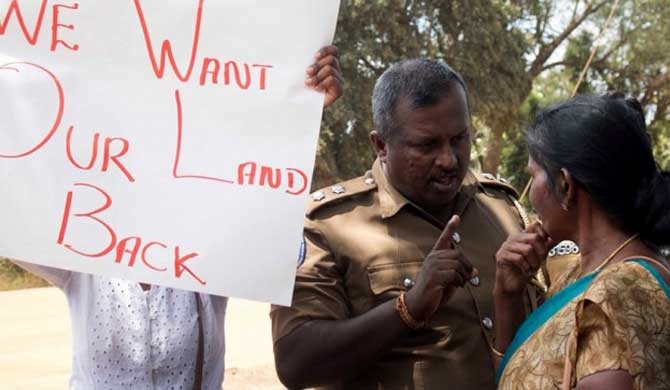
Around 108.893 acres of land in North Valikamam in Jaffna, which was under the custody of security forces during the civil war, will be released and handed over to 197 families on February 03, 2023.

Prior to the 75th Independence Anniversary celebrations on February 4th the relevant land owners were identified through a transparent process for this land release program, which is being implemented under the full supervision of the Security Forces in fulfilment of President Ranil Wickremesinghe’s promise to release the lands in the North and hand them over to their rightful owners prior to the 75th Anniversary of Independence.

Accordingly, five plots occupied by the Sri Lanka Army and another plot occupied by the Sri Lanka Navy are to be handed over to the people.

Of these lands, 13.033 acres of government-owned land in the North Palali area will be distributed among 75 families who were displaced by the war and are still housed in 09 camps at Point Pedro.

Further, the Town Hall building located in the liberated area will be handed over to the Valikamam North Pradeshiya Sabha.

It is also noteworthy that President Ranil Wickramasinghe has instructed the Ministry of Urban Development and Housing which is in charge of the resettlement process to immediately provide resettlement assistance to 197 families to be resettled.

Posted in Uncategorized

Lanka trade its way back to prosperity? BBC

Sri Lanka is, in the words of its own president, “bankrupt”.

The Indian Ocean nation defaulted on its sovereign debt in May 2022, plunging the country into economic and political chaos.

The Colombo government secured a $2.9bn (£2.4bn) International Monetary Fund bailout in principle the following September.

But the cash will not be released to Sri Lanka until its sovereign creditors in China and India first agree to a restructuring of the billions of dollars of bilateral debt they are owed.

Despite optimism over the past month that such an agreement was imminent, a deal has still not materialised – and Sri Lanka’s economic agony, and the suffering of its population, continues.

Yet, even if the bailout cash does start to flow in the coming weeks or months, that will not mark the end of Sri Lanka’s economic rebuilding programme, but merely the beginning.

For it’s widely accepted that Sri Lanka’s economic model needs a fundamental overhaul.

In the years following the savage end of the government’s 25-year war against the separatist Tamil Tigers in 2009, Sri Lanka benefited from something of a financial “peace dividend”.

The government at the time successfully attracted large flows of foreign investment, not only from foreign governments like China, but also private international bondholders.

These financial flows pumped up domestic economic growth, but at the cost of ballooning imbalances.

The domestic economy grew steadily less internationally competitive in these years. And while exports continued to rise from 2000 to 2018, from $6.5bn to $19.4bn, over the same time period they slumped as a share of the economy, from 39% to 23%.

Even before the pandemic hit in 2020, tearing the heart out of the island’s lucrative tourism industry, the Sri Lankan trade deficit – the gap between its imports and exports – was already running at more than 6% of GDP.

That imbalance is one of the reasons the default hit Sri Lanka so hard – it suddenly found itself without the means to generate the foreign currency needed to import vital supplies of food and fuel.

Ranil Wickremesinghe, who took over the presidency after the discredited and reviled Gotabaya Rajapaksa fled the country in July 2022, has been clear that Sri Lanka’s road to recovery will have to involve addressing the imbalance at source, and, in particular, driving up exports.

“We have to transform into a highly competitive export-oriented economy,” he told local business leaders last year.

“There is no other way out. We are a country with 22 million people. We have to find markets outside.”

So the big economic question looming over Sri Lanka is: can this be done? Can the country trade its way back to prosperity?

Traditionally, Sri Lanka’s big exports have been agricultural, starting with cinnamon, which attracted European colonisers in the 16th Century. Today tea is still the biggest export commodity.

But the tea sector is still reeling from a disastrous 2021 ban on imports of fertiliser by the previous government, which cut yields by a fifth.

Looking to the future, increasing agricultural productivity is an obvious avenue for policymakers to explore.

Yet many firms in the tea sector style themselves as “artisan” producers, with leaves still plucked by hand as they were two centuries ago when the plantations were started by the British Empire. And many estates are still using archaic processing equipment.

On top of this, Roshan Rajadurai, the general manager of the Pedro estate in Nuwara Eliya, says that its workers are resistant to new, more efficient methods of picking.

He wants to move to a model in which pickers and their families are given individual sections of plantation to harvest themselves – with them setting their own hours – rather than working in large traditional work teams for fixed daily hours.

It’s a reform Mr Rajadurai says has been proven to increase yields where it has been adopted, but he says the pickers are resisting.

Sri Lanka’s tea farmers struggling to survive
“If we don’t do it I think with the rising cost, and the static prices that we get in the world markets for our product, I don’t think we can be sustainable in the long term,” he warns.

Textiles – manufacturing garments for Western brands – are another major source of exports for Sri Lanka.

But this, even more than tea, relies heavily on imported raw materials and fuel, which have shot up in price in the wake of the pandemic and the Russian invasion of Ukraine.

Those prices should come down this year, yet the reality is that tea and textiles, though they will probably always be important, are unlikely to push Sri Lanka very far up the global export value chain.

So what else could Sri Lanka export?

What’s striking is that speaking to policymakers and analysts in Sri Lanka, as Newsnight did in January, is that there is very little sense of a grand plan.

Unlike other Asian nations such as Malaysia or Vietnam, which saw a major state-led push into electronic manufacturing, there’s no strong sense that one hears of a particular sector where the country can and should gain an advantage.

The closest area to a prospective national champion is probably port services.

The governor of the county’s central bank, Nandalal Weerasinghe, says Sri Lanka’s geographical location, in the centre of Indian Ocean shipping lanes, offers an opportunity to be a major “trans-shipment” hub.

“Ports and logistics are where there is the potential for us to promote exports,” he says.

It is estimated that a third of the world’s bulk cargo, and two-thirds of its oil, is transported across the Indian Ocean.

But perhaps the absence of a clear national plan doesn’t matter as much as getting the economic policymaking basics right.

In the grip of the crisis last year, the government removed a peg on the currency, which resulted in a halving of the value of the rupee against the US dollar. Some think keeping a floating exchange rate will ultimately help boost exports.

“[In the past] we didn’t allow it to depreciate or to adjust according to market forces, which has basically discouraged exports,” says Roshan Perera of the Advocata think tank, and a former central bank director.

Another area for reform identified by the World Bank is, ironically, liberalising imports and dismantling tariffs. These duties make many imported goods and products more expensive, thereby benefiting domestic producers, such as those in the retail and construction sectors.

Global Trade

More from the BBC’s series taking an international perspective on trade.

Sri Lanka is reckoned to be one of the most protected economies in the world in terms of import duties on consumer goods.

The argument is that liberalisation could attract more foreign investment, which will help the country’s industries become more efficient and export more.

The question is whether, despite the change of president last year, there is enough political space for Mr Wickremesinghe to dismantle trade barriers, which will inevitably attract opposition from powerful local vested interests.

The optimistic case is that the shock of the last year will provide an impetus for such painful reforms, and give Sri Lanka at least a fighting chance of trading its way out of its worst ever economic crisis.

Watch BBC Newsnight’s reports from Sri Lanka here.

Paris Club to give Sri Lanka financing assurances amid IMF debt talks

The Paris Club of creditor nations is ready to provide financing assurances to Sri Lanka, a key step needed to unlock a $2.9 billion bailout by the International Monetary Fund (IMF), two sources with direct knowledge of the matter told Reuters.

The informal group of bilateral lenders is set to “soon” announce its support to the crisis-hit nation on a debt overhaul, said one of the people, who asked not to be named because talks are private.

The Asian island nation, which is grappling with soaring inflation, a recession and currency depreciation, entered into a staff level agreement with the IMF last September.

But it needs financing assurances from key bilateral lenders before the fund’s executive board approves the programme.

Sri Lanka’s public debt stood at 122% of GDP, of which 70% is denominated in foreign currency, according to data in a country presentation to investors in November.

China and India, both non-Paris Club members, are the top bilateral lenders. “Paris Club assurance is not reliant on China,” said the source.

Another source said the informal group is currently reaching out to other non-Paris Club besides China on financing assurances, but did not provide any further details.

India previously committed to help ease the debt burden of neighbour Sri Lanka as part of the IMF programme, and China’s Eximbank offered a two-year moratorium in a letter sent to the island nation in January.

While the IMF has not yet provided any guidance on where the lender stands regarding China’s assurances to Sri Lanka, a U.S. official visiting Colombo said on Wednesday that Beijing has not done enough.

“What China has offered so far is not enough. We need to see credible and specific assurances that they will meet the IMF standard of debt relief,” U.S. Under Secretary of State for Political Affairs Victoria Nuland told reporters. The U.S. is the largest IMF member.

Source:Reuters

Posted in Uncategorized

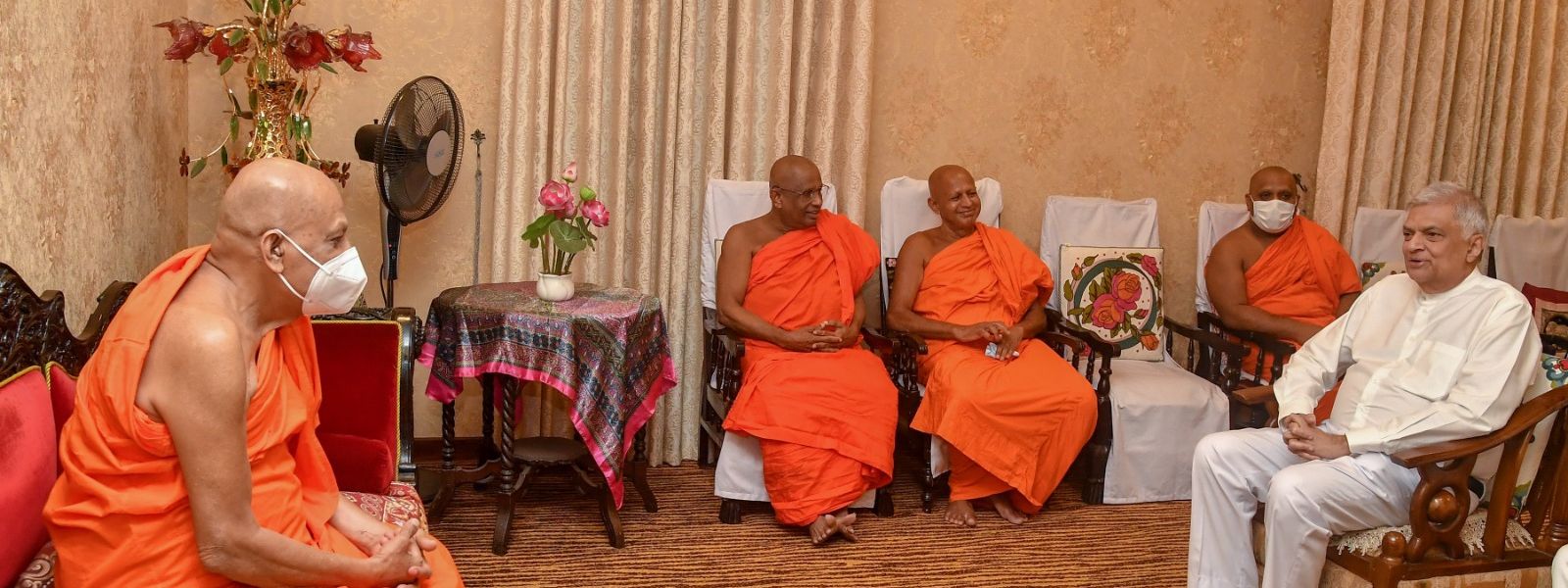
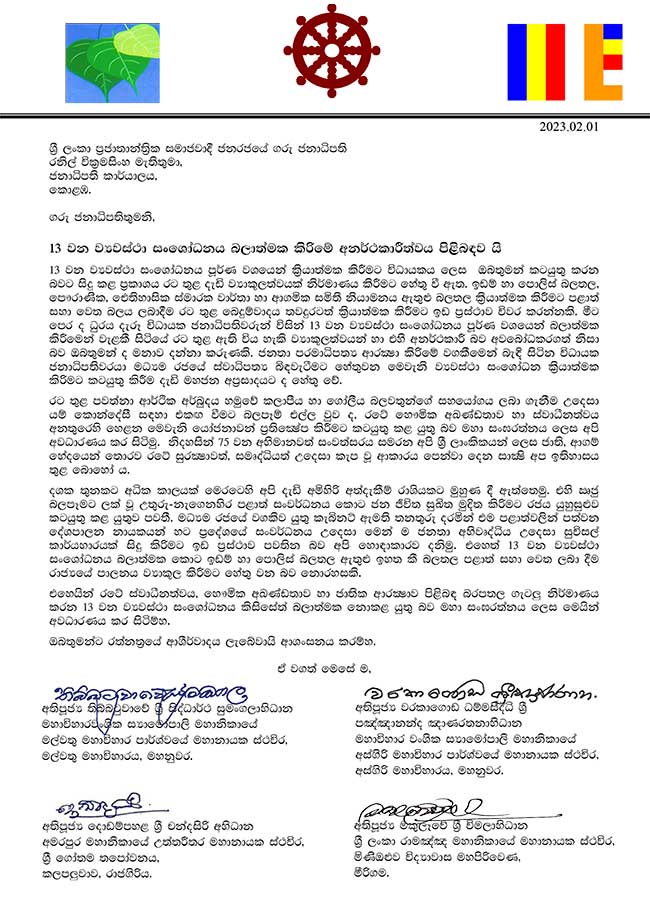
Mahanayake Theras urge President not to implement 13A

The Chief Prelates of the Three Chapters have accused President Ranil Wickremesinghe of confusing the country following his statement on the implementation of the 13th Amendment.

In a letter addressed to the Head of State today (02 Feb.), the religious leaders deemed the 13th Amendment as a piece of legislation that gives rise to serious concerns pertaining to the country’s national security, territorial integrity and its independence.

They further noted that by implementing the 13th Amendment, police and land powers too, will be devolved to Provincial Councils, and thus asserted that the Amendment should not be enforced at all.

Last month, President Wickremesinghe expressed the Cabinet’s willingness pertaining to the full implementation of the 13th Amendment.

Accordingly, he stated that the 13th Amendment will be implemented, in full, unless it is decided by the Party Leaders as to whether or not the Amendment should be abolished.

Attached below is the relevant letter received by Wickremesinghe from the Chief Prelates;