Another meeting next week to discuss the LG election

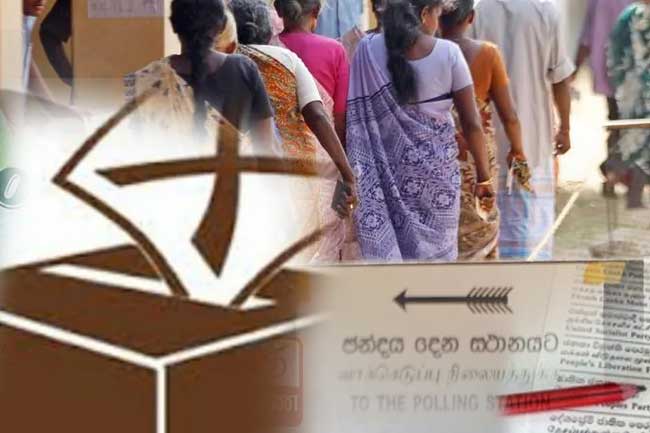
Another decisive meeting is scheduled to be held next week to discuss the impending Local Authorities Election.

A spokesperson of the Election Secretariat informed NewsRadio that several factions are expected to meet on Wednesday to deliberate on the steps needed to conduct the election.

Meanwhile, earlier it was reported the National Election Commission had decided convene a meeting with Secretaries of recognized political parties on the 23rd of March.

Moreover, Postal voting for the 2023 Local Authorities Election is likely to be delayed once again.

According to the Election Secretariat, ballot papers for postal voting are yet to be released to the Election Commission by the Department of Government Printing.

The Election Commission had planned to handover the ballot papers to the Postal Department for distribution to relevant centres on Tuesday.

The Commission had announced that postal voting for the 2023 Local Authorities Election will be held from the 28th to the 31st of March.

Although, the Department of Government Printing had commenced printing documents related to the election and ballot papers, due to lack of funds, the process has been suspended.

The Department has indicated that it has not received the requested funds from the Ministry of Finance thus far.

The Local Authorities Election was scheduled to be held on the 9th of March.

However it was postponed due to the delay in printing ballot papers and owing to lack of funds.

Sri Lanka central government debt rises to 115.2-pct of GDP by end 2022: analysis

Sri Lanka’s central government debt has risen to 115.2 percent of gross domestic product by end 2022 from 104.5 percent a year earlier based on the latest national account estimates by the island’s statistics office.

Sri Lanka’s central bank’s gross debt was about 4.66 percent of gross domestic product. The central bank has also spent special drawing rights, on which it has to pay interest.

However, the central bank holds government rupee Treasury bills which can be sold for dollars to rebuild reserves and repay the external debt as long as domestic credit is moderate and forex problems are not re-started under flexible inflation targeting, as credit recovers.

The government was also responsible for another 5.62 percent of guaranteed debt in state enterprises, taking the total to 125.7 percent of GDP.

Sri Lanka’s nominal GDP exploded 16.8 trillion rupees in 2021 to 24.1 trillion rupees in 2022 in a classic Latin America style ‘inflationary blow off’ boosting nominal tax revenues and reducing the rupee debt to GDP ratio.

Central government rupee debt fell from 66 percent in 2021 to 55 percent in 2022 as a result, in a High Inflation and Financial Repression (IFR) haircut, despite new debt being raised to cover deficits.

Sri Lanka’s domestic interest rates are around 20 to 30 percent amid fears of a domestic debt re-structure as there is no cut-off date for domestic debt re-structure under the IMF debt resolution framework.

Remarkably, domestic creditors are expected to keep financing the government as ‘senior creditors’ despite the threat of default.

Central government foreign debt meanwhile rose from 39 percent to 61 percent of GDP as the rupee fell, despite most new disbursements being halted.

The other so-called senior creditors like the World Bank and ADB, whose debt is not re-structured, redirected approved loans to help urgent and humanitarian needs during 2022.

The US, Japan and several European countries, China and India gave grants which will not add to debt.

Sri Lanka’s rupee appreciated in March 2022 amid a moderation in domestic credit and consumption, but fell back amid an ad hoc peg where central bank purchases appeared to have exceeded the excess dollars available from credit developments.

When year end debt is valued at 337 to the US dollar, the spot market value on March 16, government, government guaranteed debt was 118.7 percent of GDP with central bank’s foreign debt also counted.

Posted in Uncategorized

Sri Lanka counts down to IMF bailout seen as ‘just the beginning’ – NIKKEI

COLOMBO — Sri Lanka is counting the minutes to Monday, when the International Monetary Fund’s executive board is expected to approve a $2.9 billion bailout for the bankrupt island nation.

For the first time in months, many are hopeful that the IMF’s decision will kick-start the country’s recovery from its worst economic crisis since independence from Britain in 1948.

Faced with deepening poverty under high inflation, scarce foreign reserves and dire shortages of essentials, Sri Lanka is on the cusp of the bailout after China offered additional financing “assurances” required by the fund, following months of tough negotiations. Beijing’s apparent hesitance to extend support drew comparisons to a more obliging India. But Sri Lanka’s ambassador to China, Palitha Kohona, strongly defended the country’s key bilateral lender, telling Nikkei Asia, “The Chinese bureaucracy works according to its own rhythm.”

Experts stress just how crucial the final IMF approval is for stabilizing Sri Lanka’s economy, after the turmoil that brought down President Gotabaya Rajapaksa last year.

“Without fresh dollars to import essential goods, an economic turnaround is impossible,” said Sergi Lanau, deputy chief economist at the Washington-based Institute of International Finance. “In the medium term, implementing reforms under the IMF program and successfully restructuring debt should improve Sri Lanka’s outlook.”

In February, the country’s foreign reserves increased to $2.2 billion thanks to various factors such as higher remittances from overseas workers, though the sum is still far from sufficient. Talal Rafi, an economist at the Deloitte Economics Institute, believes that if Sri Lanka receives the IMF loan, it will allow the country to unlock more capital from the World Bank, the Asian Development Bank and bilateral partners.

“IMF approval certifies to the world that Sri Lanka is on the right path,” he said. However, he cautioned, entering an IMF program is “just the beginning.”

The reforms that come next will not be easy. Sri Lanka has gone to the IMF before, completing only nine of 16 such programs. “So, implementing the right reforms is most important, or we would be at the IMF again, like Argentina,” Rafi said.

Dhananath Fernando, chief executive of the independent Advocata Institute policy think tank in Colombo, is skeptical in light of Sri Lanka’s track record. But he is also hopeful because, he said, the severity of the crisis leaves little space to deviate from the program.

“When we went to the IMF during the past 16 times, our debt was sustainable, but this time … our debt is not sustainable,” Fernando said, saying it would be “next to impossible” to deal with those obligations without the IMF. “We need growth and we need to grow out of the crisis, and growth will take place only when we implement economic reforms,” he said.

In focus are Sri Lanka’s state-owned enterprises (SOEs), many of which have racked up huge losses. SriLankan Airlines’ loss in the first half of the 2022-2023 fiscal year came to over 100 billion Sri Lankan rupees ($295 million), more than twice the amount the government spends on support for the most vulnerable citizens.

“Sri Lanka has a bloated public sector, where salaries and pensions took up 86% of government revenue in 2021, and many SOEs are making massive losses and do not even have annual reports for public reference,” Rafi said.

Analysts said that the country needs to redirect more money to the poor, and that SOE reforms are also essential in order to make doing business easier. Sri Lanka is ranked 99th in the World Bank’s index on the ease of doing business.

But Fernando noted that many of Sri Lanka’s leaders have backpedaled away from promised reforms in fear of consequences at the ballot box. “SOEs have been used as a political weapon by most political parties to provide employment for supporters to get more votes,” he said.

While President Ranil Wickremesinghe’s government attempts to put its own house in order, there are lingering questions about the potential geopolitical fallout of the crisis.

India and China, strategic regional competitors and key lenders to Sri Lanka, have been in the spotlight lately. Last week, Sri Lanka asked the State Bank of India and the Indian High Commission in Sri Lanka to extend a $1 billion credit line by half a year beyond the scheduled expiration later this month. Informed sources close to the Indian government told Nikkei Asia that the two sides are discussing the matter.

Last year, India extended around $4 billion worth of support to Colombo. In mid-January, it offered assurances to the IMF that it was willing to support Sri Lanka’s debt restructuring.

China, for its part, was seen as more reluctant to offer a similar pledge. Beijing did send help, but it mostly came in forms other than financial assistance. In 2022, China donated 10,000 tons of rice for more than 1 million students across 7,900 schools, along with 5 billion Sri Lankan rupees’ worth of medicine and health equipment.

But when the Export-Import Bank of China followed India by sending a letter to Sri Lanka’s Finance Ministry in late January, offering a two-year debt moratorium, it was met with disappointment. “China was expected to do more,” Reuters quoted a Sri Lankan source as saying. “This is much less than what is required and expected of them.”

In February, U.S. Treasury Secretary Janet Yellen criticized Beijing’s approach to distressed countries more broadly, saying, “China’s lack of willingness to comprehensively participate and to move in a timely way has really been a roadblock.”

In early March, the Ex-Im Bank sent another letter, promising to expedite debt treatment and finalize the terms in the coming months. This moved Sri Lanka over the line with the IMF.

George I.H. Cooke, a Sri Lankan former diplomat, stressed that India and China had different priorities. He said a continued collapse in Sri Lanka would have been a bigger immediate problem for India, risking a refugee influx.

On the other hand, Cooke noted that China lends to many countries, and that easily granting concessions could have led to “many others tapping on their doors [saying], ‘Give us the same thing you gave Sri Lanka and help us too.'”

Ambassador Kohona insisted that China has always been helpful, from countering terrorism to supplying COVID-19 vaccines. On debt, the envoy acknowledged that obtaining approvals was time-consuming but said, “We had no doubt that China would take its time but would stand by Sri Lanka in its time of dire financial need.”

He added, “Undoubtedly, we are also grateful that, as major bilateral creditors, India and Japan also have provided the requisite assurances.”

Tamils Come Second In IMF Considerations: Navy & Royalist Mafia Party On Tamil Property By S. Ratnajeevan H. Hoole

Our government is totally without support from the people and is sustained in power by the military and police bashing up legitimate protest gatherings. Yet, we are said to be on the threshold of receiving the US$ 2.9 Billion IMF Loan in the next two weeks, reports CNN. God forbid! The IMF gives the loan. It will be spent by those who do not represent us, the people. And we the people would need to pay back when repayment id due. There is no free market in this as preached by the IMF.

The Local Government Elections are up in the air. Even if they are held, they will only indicate the popularity of government while the corrupt MPs who elected the President will continue in office.

It is totally irresponsible for the IMF governors to sit in America and authorize loans that we who need to pay back do not consent to. Yes, the loans will help ease our difficulties but bring no long-term solution. In the meantime, the populist instincts of the government, the cause of most of our problems, remain intact as evidenced in the government loosening all restrictions on foreign transactions using our credit cards while hospitals go without medicine. The elite are looked after. Those of us who have large credit card limits, can buy anything we want and continue to do so by paying the balance on the card in rupees every month to buy again the next month. The government feeds on the Sri Lankan instinct for wanting everything free, and for wanting more.

Lack of Tamil Democracy

The lack of democracy in Sri Lanka must be addressed first and the legitimacy of the government established, before any IMF loan is authorized. That lack of democracy is a national crisis and a particular badly infected sore in the Tamil psyche. Despite all that President Ranil Wickremesinghe promises, nothing is done to resolve our problems. He seems to be a prisoner of the Sinhalese right or in secret league with the Sinhalese right.

I returned this evening (16th) after going to Olumadu and Oonjal-katti on a project to feed the poor. It is a project that started last year March with funding from my children and former students and colleagues.

Olumadu is 10 km from Manal Aaru (taken-over from Tamils and made into the Sinhalese Weli Oya). The take-over of Tamil lands is obvious as one goes from Olumadu to Manal Aaru. In-between, Tamil schools like in Kovil-pulyan-kulam, and Vedi-vaitha-kallu have had their Tamil populations driven out through selective killings. Schools are closed. The populations have run away to Vavuniya and are presently absentee landlords cultivating their paddy fields – once called Ithaya Poomi by the LTTE because of the large harvest. Soon they will not be able to sustain their paddy cultivation and the Weli Oya People will move in is what locals expect.

We Tamils desperately need that 13th Amendment to safeguard our way of life. An example is the Aathi Lingeswarar Temple in Olumadu. Prof. Pushparatnam of Jaffna University has certified it as a long-standing Saivite site as obvious from the term Lingam. Recently Wimal Weerawansa had gone with his thugs claiming it to be “our Buddhist site” and forbidden any Hindu worship or building steps leading up to the Lingam. Mr. Poopalasingham, one of the early settlers from 1976, got Prabha Ganeshan (allied with the Rajapaksas) to build some steps so when Weerawnsa ordered Poopalasingham to remove the steps, Poopalasingham referred Weerawansa to Prabaha Ganeshan and has persuaded Saivites to continue their worship. That tension persists and is a time-bomb waiting to go off.

If ours is a legitimate government, how can these things happen? Ours is an illegitimate government in whose hands the IMF plans to place the billions of dollars which we would be answerable to.

For our safety and well-being, we Tamils desperately need the Thirteenth Amendment and attendant with it the release of private lands acquired by the Archaeological and Forestry Departments. With the amendment come badly needed police powers. Mr. Poopalasingham’s elder son Uthayakumar was killed in 2000 fighting for the LTTE while their youngest, Vijeyakumaran who was a science teacher, was disappeared in 2009 before witnesses. After ignoring all his appeals and entreaties for 12 years, recently a CID Team visited Poopalasingham who responded, “Why did you come? To tell UNHRC because of the ongoing review to show that you are doing something? Or is it to pull the wool over IMF eyes to beg shamelessly for money?”

That encapsulates the respect we Tamils have for our police. The only way to restore the police to legitimacy is to give their management to the Provincial Councils as already enacted.

National Security and Royal College Mafia

An important anecdote shows who runs the country. It is the military and not civilian authorities. The President has promised to dismantle large sections of the military but there are no signs of anything happening, He has also promised to release lands taken over by the military. Any release has been token.

My brother-in-law Dr. Indran Asirwatham acquired a few acres of land in Keerimalai. His land was acquired in Mahinda Rajapaksa’s time on grounds of national security but in reality to feed his ego and take a swipe at Tamils. A Presidential Palace with a swimming pool was erected. The Hindu buildings in the area were almost completely destroyed to build the Palace. Now that Rajapaksa is gone, the navy has taken it over as the residence of the Northern Province Naval Commander (believed to be Admiral Aruna Tennakoon). A very large ground-staff of Sinhalese navy men are employed at the palace – a part of the Sinhalese disease that made Sri Lanka broke by giving jobs to everyone when there is no work.

Indran, despite coming to Jaffna and making several requests and sending several letters to see his own land, even with the support of the District Secretary, could not enter the area. National security, he was told!

Now he finds that for some time Royal College students having no military or government positions have access to the Palace to come on their vacations with their families and use the swimming pool. He is advised that it is unlikely he will get his land back as they have invested much. However, it is common sense that one cannot develop another person’s property and claim ownership, especially when its use is for the Royal College Mafia. The President, another Royalist Mafioso, also stays there often when he visits Jaffna. It is all part of the Sinhalese penchant for having everything free especially at Tamil expense with no sense of shame.

That is our national security, to give luxury accommodation and throw swimming parties to cronies.

One Sri Lanka

If the Sinhalese are sold on one Sri Lanka, they should stop oppressing minorities and provide for a devolved government where all communities can have room for cultural and religious self-expression and development. The Sinhalese must develop a sense of shame that would stop them from taking over things that belong to minorities. The IMF discipline will hopefully give pause to those Sinhalese who want everything free – like free state services without paying taxes.

The rule of law minimally requires implementing the laws that are in the books like the 13th amendment. It also means curbing the acquisitive and even violent proclivities of the Maha Sangha and people like Gnanasara Thero and Wimal Weerawansa.

The President should stop saying one thing to the Sinhalese and another to the Tamils. If there is no forked tongue when he preaches economic reform, he should ensure that Tamil people’s right to private property is not abrogated so as to entertain the Royalist Mafiosi on Tamil Property at Tamil expense. Minimally I expect the President to have a sense of shame when he stays on property bought with hard earned Tamil cash. It looks like he too believes in having everything free. That attitude must go if he wants to solve our problems. He should never stay in that illegitimate Palace and must learn to go to a Jaffna hotel and pay for his room with government cash to the Tamil owners.

Importantly, the IMF should not give funds to a corrupt government unless that government can prove its legitimacy through the endorsement of its people through elections.

Posted in Uncategorized

A presidential election in early 2024!

The government has decided against holding any election until a presidential poll early next year, government sources said.

President Ranil Wickremesinghe has instructed the government hierarchy to prepare for a presidential election in one year’s time.

He has repeated this call at meetings of the government parliamentary group and of the UNP, according to the sources.

However, he has made no mention of not holding the local government polls, while speaking about difficulties in running LG bodies with 8,000 members.

Meanwhile, SLPP national organizer Basil Rajapaksa has rejected calls by some to appoint incumbent chairmen as commissioners of LG bodies, if the membership is to be reduced.

(Source: mawbima.lk)

Posted in Uncategorized

Hope Sri Lanka Parliament will ‘reconsider’ appropriateness of questioning Supreme Court judges – Bar Council of England and Wales

The Bar Council of England and Wales in a press release stated that it hopes “parliamentary authorities in Sri Lanka will reconsider most carefully the appropriateness of questioning Supreme Court Judges before a parliamentary committee, and we similarly hope that the Sri Lankan government will consider most carefully whether it can be ever be right to encourage disobedience to court orders.”

The release refers recent statements made by State Minister of Finance Shehan Semasinghe and Premnath Dolawatte MP, referring to an ongoing case in the Supreme Court pertaining to the Local Authorities elections.

The release, quoting the Chair of the Bar Council of England and Wales, Nick Vineall KC, said: “An independent judiciary is an essential and integral part of the rule of law. So too is the principle that governments comply with court orders.”

The UN Basic Principles on the Independence of the Judiciary state that “it is the duty of all governmental and other institutions to respect and observe the independence of the judiciary” and “there shall not be any inappropriate or unwarranted interference with the judicial process, nor shall judicial decisions by the courts be subject to revision”, the release added.

FULL STATEMENT: https://www.barcouncil.org.uk/resource/bar-council-statement-on-judicial-independence-in-sri-lanka.html

Posted in Uncategorized

Printing Dept refuses to hand over postal voting ballots without receiving payments

The Government Printer insists that the already-printed ballot papers of the postal voting in 2023 Local Government Election cannot be handed over to the Election Commission until the required payments are made.

According to Government Printer Gangani Kalpana Liyanage, the Printing Department has spent more than Rs. 200 million thus far to print ballot papers, despite receiving an initial payment of just Rs. 40 million.

Printing of ballot papers for 17 electoral districts is completed and they need to be proofread under the police security, Liyanage explained, noting that the Printing Department is yet to receive the remaining payments for the election-related work it has done so far.

In light of this matter, Liyanage said the Printing Department would not be able to hand over the postal voting ballot papers to the Election Commission on Monday (March 20) as planned.

Meanwhile, election chief Attorney-at-Law Nimal G. Punchihewa said the Local Government Election can be held on the scheduled date if the election body receives the ballot papers over the next few days.

The 2023 Local Government Election, which was initially planned to be held on March 09, was later rescheduled for April 25.

Meanwhile, as the term of office of 340 local government bodies expires at midnight tomorrow (March 19), the mayors and the Pradeshiya Sabha chairs of these institutions have been asked to return the official vehicles given to them without delay.

The allowances given to the members of these local government bodies would be paid only until March 19, the Ministry of Public Administration, Home Affairs & Provincial Councils & Local Government mentioned.

Posted in Uncategorized

SJB to take legal action against Finance Secretary

The General Secretary of the Samagi Jana Balawegaya (SJB) Ranjith Madduma Bandara has vowed to take legal action against the Secretary to the Ministry of Finance for acting against the court’s orders.

Accordingly, Bandara accused the Finance Secretary of disrespecting the orders of the court by failing to abide by the court order issued pertaining to the release of funds for the upcoming Local Government (LG election).

On 03 March, the Supreme Court issued an order preventing the Secretary to the Finance Ministry from withholding the funds allocated for election purposes through the 2023 Budget.

Thus, he stated that the Secretary to the Ministry of Finance ought to be punished under Article 105 of the Constitution, for not abiding by this court order.

The Finance Secretary was informed of the legal action due to be taken against him in this regard by way of a letter sent to him through a lawyer, the SJB General Secretary said.

India continues to support debt-ridden Sri Lanka

India says under its ‘Neighbourhood First’ policy it has always come forward to help debt-ridden Sri Lanka, and in the latest instance New Delhi has distributed rations in Kalmunai.

Taking to Twitter, the High Commission of India in Colombo said, “Support by @IndiainSL to needy sections continues!! Glimpses of ration distribution in Kalmunai.”

The cash-strapped country in April declared its first-ever debt default in its history as the economic crisis since independence from Britain in 1948 triggered by forex shortages sparked public protests. The island-nation plunged into a financial crisis after the Covid-19 pandemic affected tourism, which is considered the country’s economic backbone, and remittances from citizens working abroad fell.

The war in Ukraine escalated the crisis as prices for imports, particularly fuel, rose sharply due to soaring inflation. And in such a situation, India offered its help to the debt-ridden country. The Executive Board of the IMF is scheduled to meet on March 20 to consider Sri Lanka’s request for a bailout, and if approved, the first tranche of the facility would be released shortly.

Meanwhile, Sri Lankan President Ranil Wickremesinghe has assured the country’s official bilateral creditors of transparency, equal treatment of all creditors, and equitable burden-sharing of all restructured debt in resolving the country’s economic crisis.

The new legislation will prioritise controlling inflation and introduce an inflation target, Weerasinghe said, adding that the finance minister and the central bank would together agree on what that target should be.

Sri Lanka will also eventually set up a separate entity to raise funds to settle its sovereign debt, removing that responsibility from the central bank, once the new legislation is passed, Weerasinghe said.

ECSL issues warning to political parties

The Election Commission of Sri Lanka (ECSL) has called on all political parties that have not submitted their audited accounts for 2021 to do so before 29 March or risk being removed from the list of registered political parties. The ECSL said all parties that have not submitted the accounts have been issued reminders on several occasions and therefore they will be removed from the list of registered political parties if they do not heed this final warning.

Meanwhile, the ECSL has also decided to call for a key meeting with the secretaries of accepted political parties at 10 a.m. on 23 March. The ECSL said the decision to hold a discussion with all political parties was taken at yesterday’s Commission meeting. While it was expected that the ECSL would make an announcement on postal voting and the Local Government election due to the prevailing uncertainty, no such announcement was made following the meeting.

Posted in Uncategorized