The geo-politics that Prabakaran failed to understand By M.S.M Ayub

Although six convicts of the Rajiv Gandhi assassination case were released by the Indian Supreme Court on November 12, four of them have been again detained as they are Sri Lankans who had entered India without proper travel documents. They are being lodged in a special camp in Tiruchi, Tamil Nadu.

Some media reports indicate that the Indian authorities are in a quandary as to what action could be taken regarding them as they do not have documents to prove their country of origin. Yet, some of their details proven during the proceedings of the case might be used as proof of their country of origin, if they intend to deport them, according to some observers.

Rajiv Gandhi assassination, that took place during an Congress Party election rally in Sriprumbuthur in Tamil Nadu on May 21, 1991, is a turning point in the Sri Lanka’s separatist war and there by in the recent Sri Lankan history as well. It is a result of the dynamics of the geo-politics in the South Asian region and it had a considerable bearing on the same dynamics which in turn paved the way for deep changes in the politics in both India and Sri Lanka. It also changed the relationship between India and Sri Lanka which had been severely soured in the context of an extension of the effects of the Cold War into the region, to a positive level.

Thus, the LTTE killed former Indian Prime Minister Rajive Gandhi, former Sri Lankan President Ranasinghe Premadasa, TULF leader A. Amirthalingam and many others. They miserably failed to change the suppressive attitudes of the Indian and Sri Lankan governments towards them by killing Rajiv Gandhi and Premadasa

The initial years of the separatist war in Sri Lanka, the Tamil armed groups seemed to be ideologically slanted towards left with some groups such as the EPRLF openly displaying pictures and quotations of Karl Marx, Engels and Lenin in their offices and propaganda materials. However, they, especially the LTTE openly dared to breach Lenin’s edict on individual terrorism. They killed leaders of rival armed groups, State officials and politicians. Even JVP, which stands for Marxism, unsuccessfully followed this method to the change course of the State oppression which they termed as State terrorism.

Thus, the LTTE killed former Indian Prime Minister Rajive Gandhi, former Sri Lankan President Ranasinghe Premadasa, TULF leader A. Amirthalingam and many others. They miserably failed to change the suppressive attitudes of the Indian and Sri Lankan governments towards them by killing Rajiv Gandhi and Premadasa. Yet, they, by these acts made a tremendous impact on the disgruntled or rebel groups in many countries. For instance, an armed Madhesi group in Nepal with which the Nepalese Government signed a peace deal in 2010 had named themselves Liberation Tigers of Terai Eelam, so that the initials of the name, LTTE becomes identical as that of the Liberation Tigers of Tamil Eelam. (Interestingly, the word Eelam which means in Tamil “Lanka” had been borrowed from the Sri Lankan rebels)

The failure on the part of some of the Sri Lankan leaders as well as the Tamil armed groups, especially the LTTE to realise the geo-politics in the region cost the country and primarily the Tamils in the north and the east dearly. President J.R.Jayewardene, even being a seasoned and shrewd politician, chose to take the side of the Western powers during the peak of the Cold War provoking the wrath of India which was then a close ally of the USSR. And the then Indian Prime Minister Indira Gandhi provided the Sri Lankan Tamil armed groups with funds, weapons and training in early 1980s to fight against the Sri Lankan armed forces. In brief, as Zelensky of Ukraine did, JR, as he was commonly known, took the beating at the hands of the neighbour by supporting the latter’s enemy.

Dynamics of geo-politics was alien to the perceptions of Velupillai Prabakaran as well. Even after all other Tamil armed groups renounced the armed struggle for a separate State within Sri Lankan territory in 1987, he fought not only with the Sri Lankan armed forces, but also with that of India. Besides, he antagonised Tamil intelligentsia, Sinhalese leftists who initially supported his separatist cause and Muslims who were the majority in the Eastern Province.

Despite India providing assistance to the Tamil armed groups, it in fact did not want an independent Tamil State adjacent to its Southernmost State of Tamil Nadu which was then home to 50 million Tamils. Indian leaders knew that such an independent Tamil State would result in separatist trends in Tamil Nadu as well while becoming a launching pad for secessionist movements that might so emerge in that State. Besides, it was a State where a separatist movement was active before it was outlawed by Jawaharlal Nehru in 1960s.

India successfully convinced President Jayewardene’s government to accept the concept of devolution of power by diplomatically pressurising him using the senior officials of its Foreign Office such as G. Parthasarathy and Romesh Bandari by 1987. Also Prime Minister Rajiv Gandhi used coercive means as well to implement the concept. He once, on June 3, 1987, sent a flotilla of ships to trespass into the Sri Lankan waters in the guise of sending food to people entrapped by the war in the Jaffna peninsula. On the next day 5 Indian planes escorted by two Mirage jets airdropped relief supplies in various places in the Peninsula.

Once it tamed Sri Lankan leaders, India no longer wanted to support the separatist cause of Tamil groups and hence thrust an agreement, Indo-Sri Lanka Peace Accord on both the belligerent parties in the neighbouring country, the government as well as the Tamil rebels in 1987. During the 4th SAARC summit in December, 1988 in Islamabad the then Indian Foreign Secretary S.K.Singh informed India’s official stance on the war in Sri Lanka to the media by categorically ruling out the possibility of carving out of a Tamil State in the island. Had Prabakaran realised, at least then what was in store for his struggle, tens of thousands of lives could have been saved in the next two decades.

Apart from the fears of separatism seeping into Tamil Nadu India was compelled to take military action against the LTTE as the outfit started to attack its forces, the “Indian Peace Keeping Force” (IPKF) stationed in the island, subsequent to the signing of the Indo-Sri Lanka Accord. Yet, the Indian leaders were in a quandary when anti-India feelings began to mount in its Tamil State due to the sufferings of Sri Lankan Tamils at the hands of the so-called IPKF. Hence, it wanted to leave the matter to the Sri Lankans to settle among them. It was further facilitated by an unceremonious call by President Premadasa for the de-induction of the IPKF which was completed in March1991.

Nevertheless, Prabakaran’s ignorance on the dynamics of geo-politics prompted him to assassinate Rajiv Gandhi two months after that, as a measure of revenge, pushing the Indian authorities to actively support the Sri Lankan government in its effort to eliminate the Tamil rebels.

The geo-political compulsion exerted on India to finger into Sri Lankan affairs was largely taken off by the end of the Cold War with the collapse of the Soviet Union and the socialism in the Eastern Europe in 1991 itself. Subsequently, India became closer to the West than J.R’s Sri Lanka. Hence, Indian leaders occasionally and ritualistically call on the Sri Lankan leaders to implement a comprehensive programme of devolution of power in the island which they can exploit in Tamil Nadu during elections. The call is now also used as a leverage to exploit economic gains as well.

Posted in Uncategorized

Sri Lanka targets one million Chinese tourists

The Sri Lanka Embassy in Beijing, consistent with its efforts to continuously promote Sri Lankan tourism in the Chinese market, is targeting one million Chinese tourists to visit Sri Lanka after the China travel restrictions are relaxed, a statement from the mission said.

Ambassador Dr. Palitha Kohona met with the General Manager of Beijing Spring Travel Service Co., Ltd, Mr.Yang Yang, on November 16, 2022, in order to further bilateral cooperation in the tourism industry.

The Ambassador Dr. Kohona said that the Embassy is also exploring all possible ways to position Sri Lanka as a preferred destination in the Chinese Market including a formal request to the authorities.
General Manager Mr. Yang said that Beijing Spring Travel Service Co., Ltd is among the top 10 Travel companies in Beijing and Shanghai and has been accorded award certificates many times by the Chinese Government and the travel trade. The annual business turnover of Spring Travel in 2019 was 24.5 billion RMB (3.5 billion USD). Spring Airlines is valued at 50 billion RMB.

The company is already well established in the Sri Lanka travel trade and connected with local travel companies. They have organised a series of group visits to Sri Lanka before the pandemic. The company owns Spring Airlines with 110 aircraft (A320). The Ambassador has already spoken with the airlines of Chongqing, Shanghai, Shandong and Sichuan. The Ambassador and Mr.Yang also discussed the possibility of Spring Airlines establishing air connectivity with Colombo from Chongqing, Chengdu, and Kunming.

Posted in Uncategorized

Sri Lanka in talks for USD 1 Bn “debt-for-nature” swap deal: report

Sri Lanka is in talks for a “debt-for-nature” swap deal of up to USD 1 billion in climate-focused finance, a kind of agreement discussed at the United Nations COP27 summit in Egypt, Reuters reported citing people familiar with the matter.

According to the news report, such agreements are part of efforts to address an intractable quandary facing world leaders as to who would pay the bill for the global fight against biodiversity loss and climate change.

Sri Lanka is among several other countries including Ecuador and Cape Verde exploring the possibility of striking debt-for-nature swap deals to ease the debt problems.

A debt-for-nature swap deal is a bilateral agreement, which involves purchasing foreign debt, converting that debt into local currency and using the proceeds to fund conservation activities. The key to the transaction lies in the willingness of commercial banks (or governments) to sell debt at less than the full value of the original loan.

Reuters reported that Ecuador – a serial defaulter and its sovereign bonds are again trading at “distressed” levels, or a deep discount to their face value – is now n talks with banks and a nonprofit group in an attempt to teach a deal that would see about USD 800 million of its debt refinanced more cheaply, freeing up the savings conservation efforts.

At that level, it would be the biggest debt-for-nature swap struck to date, yet it could eventually be trumped by others, including Sri Lanka, which has been discussing a deal of up to $1 billion according to people familiar with those talks, the news agency said further.

Cape Verde, an archipelago nation off West Africa, is meanwhile close to a nature swap that could be worth up to USD 200 million, said Jean-Paul Adam, a former Seychelles government official who now works for the U.N. Economic Commission for Africa (UNECA), providing financing advice to governments.

Reuters stated that Ecuadorian, Sri Lankan and Cape Verde governments did not respond to requests for comment for this story, although Ecuadorian President Guillermo Lasso said in an local newspaper on Oct. 12 that its Galapagos swap deal could be wrapped up in four or five weeks.

The potential deals for Ecuador, Sri Lanka and Cape Verde, reported here in detail for the first time, point to a jump in interest for this form of financial alchemy, which was conceived decades ago but has remained something of a niche area until recently.

Only three of over 140 or so swaps struck over the past 35 years – the first in 1987 – had a value of more than a quarter of a billion dollars, according to global data published by the African Development Bank. The average size was $26.6 million.

The combined value of swap deals to date is $3.7 billion, according to the data. That’s a fraction of the $400 billion of emerging market sovereign debt analysts at Capital Economics recently estimated had fallen to distressed levels.

Advocates say that those current debt problems, combined with the growing political will and the recent successful swap deals in the Seychelles, Belize and Barbados, mean a swathe of other countries are now exploring the model.

-with inputs from Reuters

Lankan Defense Secretary heads delegation at Pakistan-Sri Lanka Armed Forces Defence Dialogue

Third Round of Pakistan-Sri Lanka Armed Forces Defence Dialogue (AFDD) was held in Expo Centre Karachi from 16-17 November 2022. Pakistan delegation was led by Lt. Gen. (Retd) Hamood uz Zaman Khan, Secretary of Defence. The Sri Lankan delegation was headed by Gen. (Retd) Kamal Gunaratne, Secretary of Defence.

During the Dialogue, Pakistan and Sri Lanka reviewed the existing scope of bilateral military relations and expressed satisfaction on the progress achieved under the umbrella of AFDD. Both leaders exchanged views on regional security and upcoming challenges. It was agreed that Pakistan and Sri Lanka will continue to support each other at all regional and international fora. The cooperation in the field of defence industry, military training, joint exercises high level visits will continue.

In the end, it was agreed that next meeting of AFDD will be convened in Sri Lanka on mutually agreed dates in 2023.

The delegation also visited the Defense Expo IDEAS-22 which is being held at Karachi and held discussions with various stakeholders. The high-level defence delegation also called on the Minister of Defence Production, Secretary of Defence Production, Secretary of Defence and Chairman Joint Chiefs of Staff Committee during their visit to Pakistan. H.E Maj. Gen. (R) Umar Farooq Burki HI (M) High Commissioner of Pakistan in Sri Lanka ensured to facilitate and make this a successful high-level Sri Lankan defence visit to Pakistan.

Police fire tear gas near Nelum Pokuna

The Police fired tear gas and water cannons on protesters near the Nelum Pokuna theatre and Horton Place.

The Police had also earlier fired tear gas on protesters who had gathered near the Prime Minister’s Office at Flower Road in Colombo.

The protest was led by the Inter University Student’s Federation (IUSF) to demand the release of IUSF Convenor Wasantha Mudalige and Inter University Bhikku Federation (IUBF) Convenor Ven. Galwewa Siridhamma Thero.

Protesters converged on Colombo from multiple areas today to mark 90 days since the arrest and detention of Mudalige and Siridhamma Thero under the Prevention of Terrorism Act (PTA).

Protesters had gathered near the Terrorism Investigations Division (TID) office in Narahenpita, near the UN compound in Thummulla and at Flower Road and other areas.

The Colombo Additional Magistrate had this week ordered to remand Mudalige and Ven. Galwewa Siridhamma Thera.

The Magistrate ordered to remand them until the Attorney General’s instructions are received.

Wasantha Mudalige and the Ven.Galwewa Siridhamma Thera were detained under the Prevention of Terrorism Act for 90-days.

Posted in Uncategorized

Sri Lanka’s Wickremesinghe likely to go for presidential poll first – sources

Sri Lanka leader Ranil Wickremesinghe is likely to hold presidential election before any other polls after November 16 2023, three sources close to him said, as he seeks a $2.9 billion IMF loan to consolidate the economy which is on a slow recovery path from a crisis.

Wickremesinghe was elected as the president in the 225-member parliament on July 19, days after former president Gotabaya Rajapaksa fled the country fearing for his life following tens of thousands of protesters stormed into the presidential palace, demanding his resignation after his failed economic policies. He quit after reaching Singapore.

Sri Lanka’s opposition parties and many protestors who led the ousting of Rajapaksa are now demanding both local government and parliamentary polls citing that the current government has no mandate to be in power as its failed economic policies have forced the people to oust them.

Presidency of Wickremesinghe, a six-time prime minister, has been criticized by the opposition and protestors as he was not elected by the public.

Wickremesinghe became the president when he entered the parliament through a national list after his center-right United National Party (UNP) failed to win a single parliament seat in the 2020 parliamentary polls.

“The president is considering the presidential poll first and it will give him a legitimate mandate to push for reforms that are now formulated,” a source close to Wickremesinghe told EconomyNext.

“He can be the president for two more years. But the reforms need more time to see the country economically recovered and is on a strong foot.”

Another source close to Wickremesinghe said there could be division among the current parliament composition if he goes for any other elections other than presidential.

“We see a slight recovery though the worst is yet to come after the implementation of tax policies and IMF reforms. Doing party politics in the next one year will reverse all the reforms,” the second source said.

Focus is on crisis

The President’s office did not comment on a possible presidential poll before both local government and parliamentary elections. However, an official at the president’s office said Wickremesinghe has not been focusing on “any election” now.

“Election is not his priority right now. He has never said anything in any election so far. He is busy with the economic policies to get the country out of the current mess,” the source, a senior official at the presidential secretariat told EconomyNext.

“He has categorically told internal officials that the country’s private sector, civil society organizations, all political parties, and the people should get together to face the current crisis and if we don’t unite, there won’t be a country to do politics after one year.”

The island nation’s political parties are now gearing up for an election. The former ruling center-left nationalist Sri Lanka Podujana Peramuna (SLPP), main opposition Samagi Jana Balawegaya (SJB), and Marxist opposition Janatha Vimukthi Peremuna have already started campaigns at village level.

The parliament election should be held after August 5, 2025, five years after it was held. But President Wickremesinghe can dissolve the parliament and call for an early election after February 2023,

The tenure of the current presidency ends in November 2024. However, the incumbent president can call for an early election if the leader wants. This means Wickremesinghe can call for early election after November 16, 2023.

Posted in Uncategorized

World Bank eyes huge offshore wind potential in Sri Lanka

Sri Lanka’s offshore wind resource far exceeds the South Asian nation’s energy demand, and its development could help the country’s economic recovery by displacing costly fuel imports, according to the World Bank.

The World Bank has completed a draft offshore wind development roadmap for Sri Lanka designed to evaluate the potential opportunities. There is an estimated fixed-bottom potential of 22GW and 17GW floating. The resource is based on areas without environmental restrictions and exclusion zones.

Indeed, the World Bank reckons there is huge potential, and it could supply more energy than the country needs – offering an opportunity to produce other fuels, such as hydrogen and ammonia.

The country’s offshore wind resource is good and in areas suited to the development of large-scale projects, noted the World Bank. There is also the potential for collaboration with the Indian offshore wind market and a possible interconnector.

However, there are numerous challenges to developing the sector. Sri Lanka currently does not have a sufficient supply chain to execute the construction of an offshore wind farm with a significant proportion of local content. This provides an opportunity for investment in local content and education of local resources, added the World Bank.

Moreover, the regulatory framework does not currently support the implementation of industrial-scale offshore wind power. The World Bank notes that this does not preclude the construction of a demonstration/first project.

Sri Lanka’s current grid infrastructure will also require upgrades and expansions to support industrial scale offshore wind.

The Offshore Wind Roadmap for Sri Lanka is being finalised and due to be published in early 2023.

Sri Lanka had been forging ahead with plans to import liquefied natural gas (LNG) in the next few years, but a global supply crunch that has sent prices of the fuel soaring is likely to have dampened enthusiasm for LNG.

EV (Source)

Basil to return to SL on Saturday, will aim for 2/3rd for the budget

Former Finance Minister Basil Rajapaksa who resigned from his parliamentary seat during the recent political crisis will return to Sri Lanka on Saturday after leaving for the United States in September and will now initiate discussions to gain a 2/3rd majority for the budget, the Daily Mirror learns.

Political sources said that Rajapaksa left the USA last night and will arrive in Sri Lanka on Saturday and will also begin to restructure the SLPP as he did prior to the Presidential Election in November.

However, his immediate task will include initiating discussions with parliamentarians seeking their vote for the budget which will be taken up in Parliament in December for the final vote.

The aim of the government is to secure a 2/3rd majority for the budget so that the government can continue to function without any hiccups till a decision is taken to go in for fresh elections after next year.

Basil will also restructure the SLPP and begin ground-level campaigning in order to regain the party’s popularity at the grass root level. Several changes are expected in the party upon Basil’s return.

All aspects in place to attract foreign investments-Chinese envoy

President of the Chinese Peoples’ Association for Friendship with Foreign Countries (CPAFFC) Lin Songtiyan says Sri Lanka’s infrastructure facilities, human resources, and other required facilities are in place and what is needed now is to attract foreign investments and to enact necessary legal reforms.

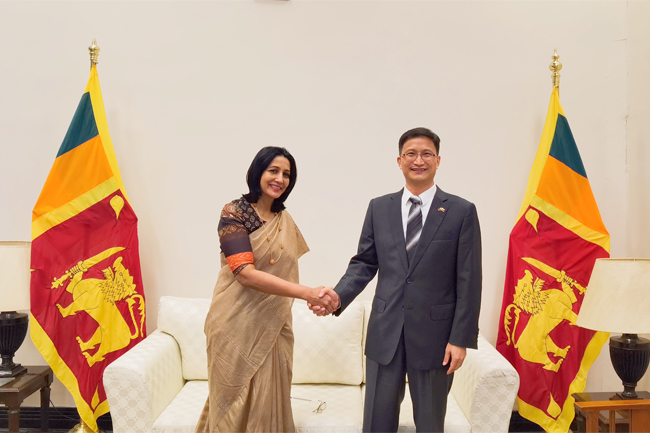
Songtiyan, called on Speaker Mahinda Yapa Abeywardene along with the Chinese Ambassador to Sri Lanka Qi Zhenhong in Parliament recently (15).

The visiting official said Hambanthota and other economic zones as well as the Colombo Port City could attract global investors, if necessary reforms are enacted and an investor-friendly atmosphere is established.

He said China will provide the highest possible support to Sri Lanka for investments.

Appreciating China’s support as a long-term friend of Sri Lanka, the Speaker said he expects to strengthen bilateral relations between the two countries in the future.

Subsequently, the President of the Chinese Association for Friendship with Foreign Countries engaged in a special meeting of the Sri Lanka – China Parliamentary Friendship Association.

While addressing the Parliamentary Friendship Association Songtiyan said the country has all the ingredients such as a strategic location in the centre of the Indian Ocean, highways, ports and also skilled youth resources to leap forward in industrial and agricultural development.

Chairman of the Sri Lanka China Parliamentary Friendship Association MP Namal Rajapaksa said the two countries are looking forward to further enhance bilateral relations through parliamentary friendship associations.

Songtian also engaged in a cordial discussion with MPs.

Posted in Uncategorized

Govt owns 420 institutions including 29 Ministries, 99 Departments

A document presented to the Sri Lankan parliament for the very first time has revealed that there are 1,283 institutions that come under the government, including 420 institutions that are owned by the state.

This includes 29 ministries and 99 departments.

State Finance Minister Ranjith Siyambalapitiya produced a document listing all the government institutions to the Sri Lanka Parliament on Thursday (17).

This is the first time in Sri Lankan history that such a document was disclosed to the house.

According to the Ministry of Finance, Economic Stabilization, and National Policies, this document was presented as per a promise made by President Ranil Wickremesinghe during his recent budget speech.

The government also operates 25 District Secretariats, 9 provincial councils, 341 Divisional Secretariats and 341 local government bodies.