Rajapaksa’s used April Attacks to secure votes; alleged ex-MP

Former JVP Parliamentarian Bimal Ratnayake said the Rajapaksa’s used the 2019 April 21st Attacks as a tool to secure votes at the election.

He said President Gotabaya Rajapaksa has not done anything new with regard to the Presidential Commission of Inquiry appointed by Former President Maithripala Sirisena, adding only 20,000 pages of the 60,000-page report were released.

“The report does not detail the main perpetrators. It only says Zaharan is the main suicide bomber, and that is something everyone knows,” he said.

Several years ago, Former President Mahinda Rajapaksa accepted the fact that intelligence services paid extremist Organizations, said the Former MP adding the Presidential Commission of Inquiry had not questioned these facts from the present Prime Minister or the then Defence Secretary, who is the incumbent President.

Source: News First.lk

Posted in Uncategorized

New report accuses the government of driving Sinhalese colonization in Tamil areas

As the 46th session of the UNHRC assesses the new resolution on Sri Lanka, a new report from the Oakland Institute, Endless War: The Destroyed Land, Life, and Identity of the Tamils in Sri Lanka, brings forth shocking new evidence on the extent of the continued persecution of the minority Tamil population in the North and East of the country.

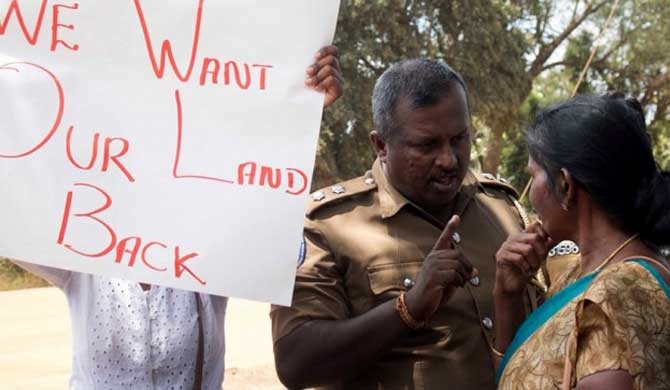
Under the guise of “development projects,” government driven Sinhalese colonization is growing within Tamil areas with the intent to change demographics and deny Tamil communities access to their land.

“Through irrigation schemes, military settlements, archaeological reservations, wildlife sanctuaries, forest reserves and special economic zones — land-grabbing in the North and East has worsened since the regime change two years ago,” said Anuradha Mittal, who coordinated the research for the report.

“Denying Tamils access to their ancestral land, changing the name of villages, replacing churches and Hindu temples by Buddhist viharas, and victory monuments dedicated to the Sinhalese domination, is a concerted effort to erase the Tamil history and culture,” Mittal said, adding that “the government’s strategy is also to geographically fragment the traditional Tamil homeland — the North and the East of the country.”


The report uncovers the use of several government departments — including the Mahaweli Authority, Archaeological Department, Forest Department, and Wildlife Department, in this strategy.

Endless War, the fourth Oakland Institute report on post war Sri Lanka, also provides a timely update on the extent of land grabbing and the impact of widespread militarization on the Tamil population. According to the report, the military occupation is extreme — with roughly one military member for every six civilians.

“The military continues to occupy vast amounts of land. Running 5-star resorts, cafes, construction companies, but also cultivating the land it occupies, the heavy presence of the army severely impacts the livelihoods of the local population,” added Mittal.

Meanwhile, thousands of Tamils, including over 23,000 people in Jaffna alone, remain displaced 12 years after the end of the war, awaiting resettlement with no end in sight.

Mahinda Rajapaksa’s government’s use of the military and various departments to expropriate the lands of Tamil and Muslim populations is geared at expanding the supremacy of the Sinhalese and Buddhist religion across Sri Lanka and should garner the immediate attention of the UNHRC.

The UN High Commissioner for Human Rights, Michelle Bachelet’s January 2021 report on Sri Lanka, stressed the need to not only ensure accountability for past human rights violations, but also called on the international community to stop and prevent possible future violence and conflict.

“The Commissioner’s call for sanctions against top generals and others accused of war crimes and for an International Criminal Court investigation into Sri Lanka’s Tamil separatist conflict are essential to upholding justice and human rights,” added Mittal.

The Zero Draft Resolution, presented by members of the Core-Group on Sri Lanka, however, fails to outline a clear approach for ensuring justice, accountability and lasting peace, the report said.

“It completely deviates from the recommendations made by the UN High Commissioner Bachelet and those made by four former High Commissioners, nine former Special Rapporteurs, and all members of the UNSG’s Panel of Experts on Sri Lanka — to refer the matter to the International Criminal Court. Endless War exposes the reality of the destruction of land, life, and identity of the Tamil people in Sri Lanka and presents a prima facie evidence for collective international action to arrest the worsening human rights situation,” concluded Mittal.

The report reiterated that the UNHRC resolution on Sri Lanka must include these recommendations and emphasize on the immediate cessation of land grabbing and planned settlements, while ensuring immediate demilitarization of the North and East. Failure to do so will be once again a mockery of an international human rights regime.


Sri Lanka bond yields down on China swap news, rupee weaker

Sri Lanka’s rupee closed weaker at 197.75/198.00 levels to the US dollar in the one-week forward market on Wednesday while bond yields were down, on the confirmation of a central bank swap with China, dealers said.

The rupee last closed in the one- week forward market at 197/197.50 to the US dollar on Tuesday.

In the secondary market bond yields were down on active trade after the State Minister for Capital Markets and Money, Nivard Cabraal announced that People’s Bank of China confirmed a 1.5 billion dollar equivalent swap, dealers said.

He said Sri Lanka could draw down the swap at any time but it will be kept as a buffer.

“We will draw down as and when we need,” he said. “But our main focus is to increase non-debt inflows.”

A bond maturing on 15.06.2024 closed at 6.45/55 per cent, down from 6.60/63 per cent.

A bond maturing on 15.12.2022 closed at 5.75/80 per cent on Wednesday, down from 5.83/88 per cent Tuesday.

A bond maturing on 15.11.2023 closed at 6.20/30 per cent, steady from 6.23/30 per cent Tuesday.

A bond maturing on 01.12.2024 closed at 6.53/57 per cent, down from 6.60/68 per cent.

A bond maturing on 01.05.2025 closed at 6.75/85 per cent on Wednesday, down from 6.70/85 per cent.

A bond maturing on 15.02.2026 closed at 6.97/02 per cent, down from 7.00/10 per cent.

A bond maturing on 15.08.2027 closed at 7.35/50 per cent, down from 7.40/50 per cent.

A bond maturing on 15.05.2030 closed at 8.10/50 per cent, up from 8.00/30 per cent.

Posted in Uncategorized

Protest SriLanka trending in Myanmar over SL Foreign Minister’s letter

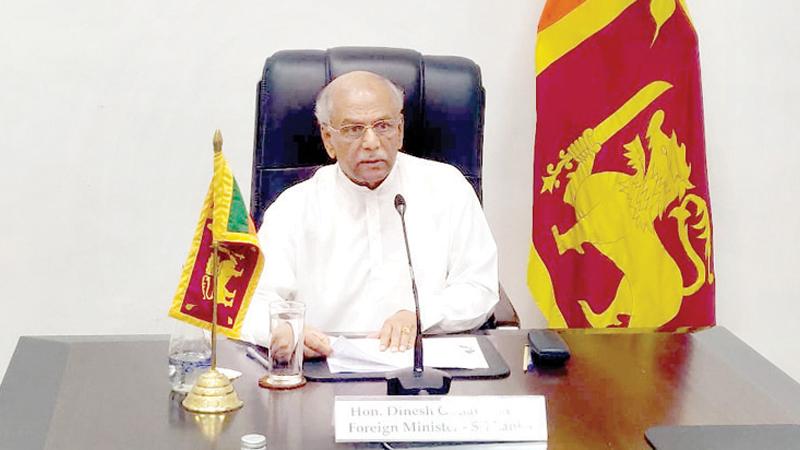
Sri Lankan Foreign Minister Dinesh Gunawardena is currently facing severe backlash in Myanmar, with ProtestSriLanka trending on social media.

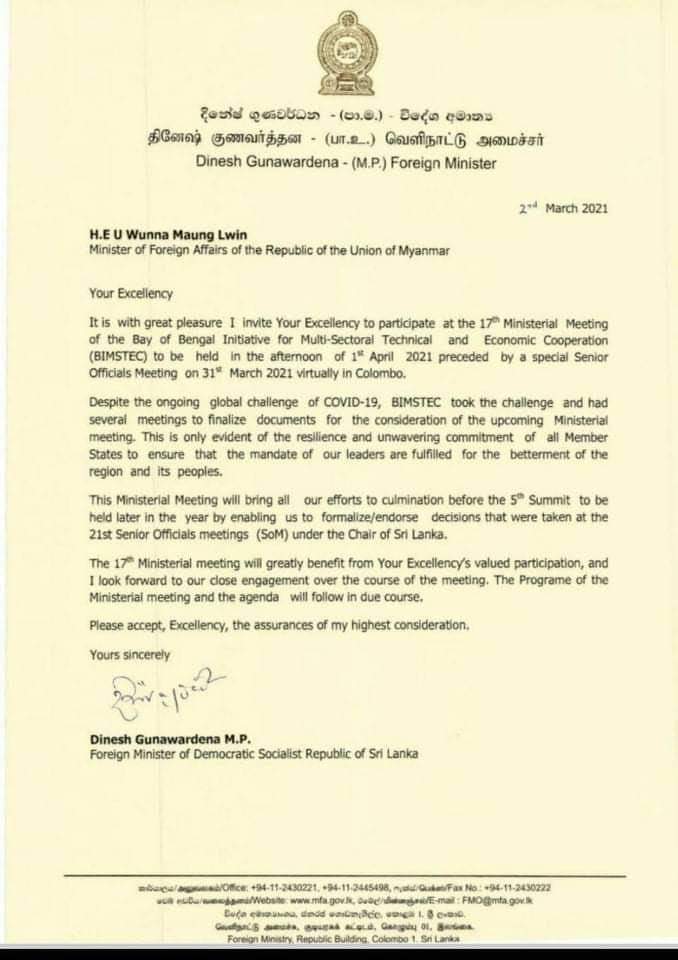
The backlash has been reported over a recent letter sent by Foreign Minister Dinesh Gunawardena recognizing the Military appointed Foreign Minister in Myanmar, Wunna Muang Lwin.

In a letter addressed to Lwin, Minister Gunawardena is reported to have invited the former to attend the Ministerial Meeting of the Bay of Bengal Initiative of the Multi-Sectoral Technical and Economic Cooperation (BIMSTEC) and a special Senior Officials meeting scheduled to be held in Colombo on 31st march – 1st April, 2021.

Myanmar is currently facing a number of protests due to its recent Military coup.

Social media users in Mynamar have shown their displeasure with Sri Lanka over Foreign Minister Dinesh Gunawardena’s letter.

Source:NewsWire

Robert Minn on Twitter: "The terrorist group(Military) is not our  legitimate government. Sir Lanka must Respect the votes of our people.  Wanna Maung Lwin must not invited @BimstecInDhaka If sir lanka invite

Posted in Uncategorized

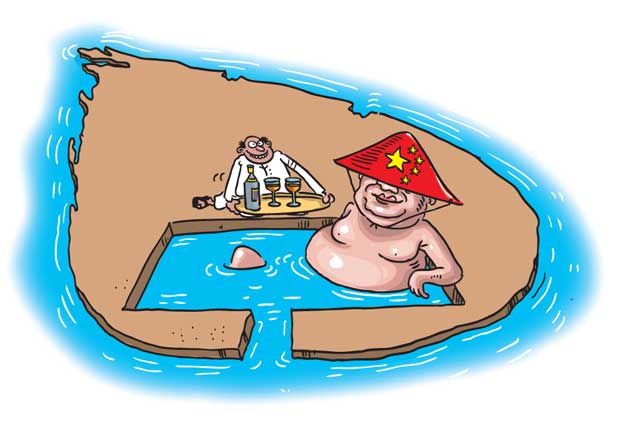
China wants Hambantota Industrial Zone to get off the ground

China wants the proposed Hambantota Industrial Zone to get off the ground.

Vice Minister of Foreign Affairs of China Luo Zhaohui said that the Chinese Foreign Ministry will proactively support efforts to increase Chinese tourism to Sri Lanka and more businesses, including SOEs, to invest in the Colombo Port City and the Hambantota Industrial Zone.

The Vice Minister acknowledged that it was time for these two Chinese supported ventures to get off the ground.

He expressed these views when he met Sri Lanka’s Ambassador to China, Dr. Palitha Kohona.

Vice Minister Luo warmly welcomed the Ambassador and stated that the Ministry of Foreign Affairs of China will continue to extend its fullest support to the Ambassador in Beijing and effusively acknowledged his long standing connections with China.

The long discussion that followed included cooperation and mutual support in international fora, in economic matters for post Covid-19 recovery, effective management of the Covid-19 pandemic and future high-level visits. Vice Minister Luo assured of China’s support to Sri Lanka at the UN Human Rights Council (UNHRC) and its continued assistance as Sri Lanka confronts a critical economic challenge.

Both parties agreed that the recommencement of negotiations on the bilateral Free Trade Agreement with the view to concluding it soon would be advantageous to Sri Lanka. Dr. Kohona also raised the issue of non-tariff barriers which are hindering access to the lucrative Chinese market for a range of natural, agricultural and industrial products.

Dr. Kohona commended China for successfully eliminating extreme poverty by 2020 consistent with a key SDG and congratulated the Communist Party of China as it celebrated its 100th year Anniversary. China’s spectacular success could be attributed to the prudent management of the country by the Party.

Posted in Uncategorized

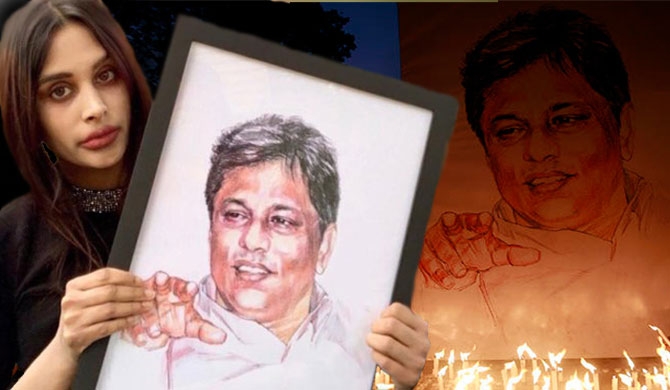
Lasantha’s daughter questions credibility of NPC

Ahimsa Wickrematunge, daughter of slain journalist Lasantha Wickrematunge, has questioned the credibility of the National Police Commission (NPC).

In a letter to the commission, Ahimsa Wickrematunge accused the commission and the Attorney General of approving the Government’s decision to put the Criminal Investigations Department (CID) in the hands of an officer who tampered with a murder investigation.

Wickrematunge said that in a previous letter to the NPC she drew attention to the fact that it appointed Prasanna J. Alwis as CID Director despite the CID having previously caught him allegedly tampering with evidence in the investigation into her father’s murder.

“I asked the commission to investigate how this happened. You confirm in your letter that evidence with regard to the death of Lasantha Wickrematunge had been suppressed by SSP A.R.P.J. Alwis and that was reported to the Magistrate of Mt. Lavinia on 4 October 2019. You also state that extracts on destroying and suppression of evidence have been handed over to Hon. Attorney General under C.R.01 40/2020. This file was submitted to the Attorney General before Mr. Alwis was appointed to head the CID,” Wickrematunge said.

She says she cannot believe that the commission and Attorney General blessed the regime’s decision to put the CID in the hands of an officer who tampered with a murder investigation.

She notes throwing natural justice to the wind, Alwis was once again allowed to oversee her father’s case and so the Commission must answer for appointing an accused criminal to head the CID.

“Never in the 140-year history of the CID had it ever been headed by an officer with even the slightest disciplinary blemish. That 140-year streak was broken when the NPC appointed a CID Director reported to court for suppressing evidence of Sri Lanka’s most emblematic unsolved murder, in which the state stands accused of killing a journalist for exposing corruption,” she said.

Ahimsa Wickrematunge says by turning a blind eye to the state’s effort to subvert these investigations, the NPC has jeopardised the credibility of the commission, the Police, the Attorney General’s Department and the entire Sri Lankan criminal justice system.

“The NPC well may go down in history as a complicit rubber stamp to an autocratic regime bent on covering up the atrocities of its leaders,” she said.

Ahimsa Wickrematunge called on the NPC to interdict and discipline Alwis, order a full audit of records of her father’s murder investigation and other CID cases including those involving Keith Noyahr and Upali Tennakoon, reveal how the commission was deceived into appointing an officer accused of hushing up a murder to run the CID and re-examine the credentials and disciplinary records of all 100+ officers who were brought into the CID since November 2019.

She notes in the letter that the commission is expected to serve the people and uphold the Constitution.

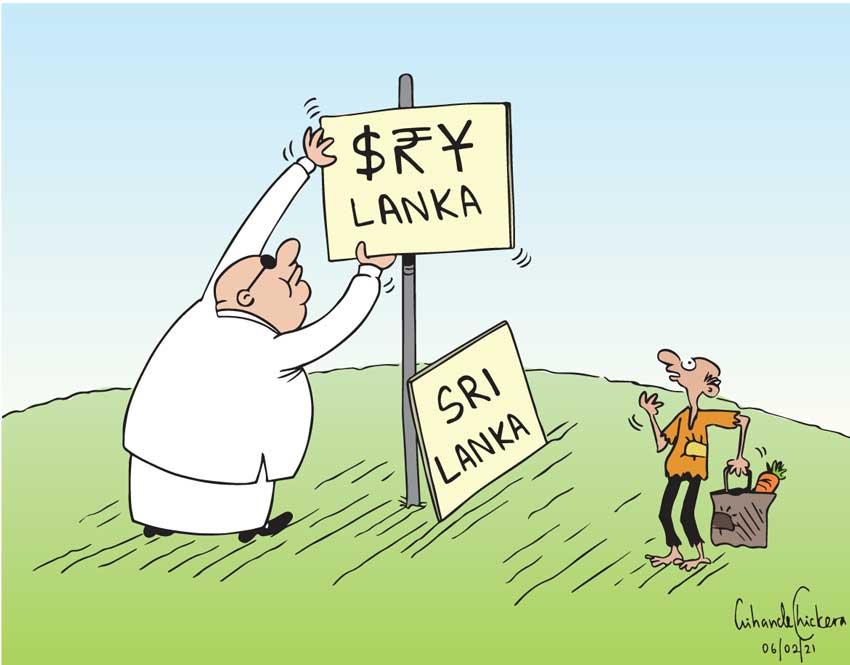
Malaysia’s 1998 playbook helps Sri Lanka shun IMF for China

Faced with low foreign-exchange reserves and looming debt repayments, Sri Lanka is borrowing from the contrarian playbook Malaysia used during the days of the Asian crisis in 1998.

The island nation has imposed some form of capital controls and curbs on imports in signs that it’s turning inward, partly to end reliance on the International Monetary Fund before $ 3.7 billion of foreign debt matures this year.

The measures, such as repatriation of export earnings within 180 days from shipment, conversion of some export proceeds into rupees and getting commercial lenders to surrender a portion of their forex receipts to the Central Bank, are aimed at stopping the reserves from bleeding in the absence of loans from the IMF and revenue from tourism amid the pandemic.

That would help the country to rely on its own resources instead of foreign borrowing, the Central Bank of Sri Lanka said in a statement on 23 February. The steps will strengthen Sri Lanka’s credit profile, enhance exchange rate stability, and improve the resilience of the economy, it said.

What these measures also do are to help fend off interference from the IMF, whose aid comes with strict conditions – one of the reasons that prompted Malaysia’s then premier Mahathir Mohamad to shun aid from the lender despite descending into a recession following the Asian currency crisis. The IMF last year prematurely ended a loan program to Sri Lanka after disbursing $ 1.3 billion of an agreed $ 1.5 billion facility, leaving the nation scouting for ways to tide over the pandemic-induced downturn.

Sri Lanka has to repay $3.7 billion to holders of external debt this year, according to Central Bank Governor Weligamage Don Lakshman. The South Asian nation is expecting $ 32 billion from exports of goods and services, remittances and financial inflows, while the outflows are estimated at $ 27.6 billion, leaving a $ 4.4 billion surplus to service the debt, State Minister for Money and Capital Markets Ajith Nivard Cabraal said separately.

“The main thrust is to reduce the government’s reliance on foreign borrowings,” Citigroup Inc. analyst Johanna Chua wrote in a report on 25 February. “The odds of the July 2021 bond being repaid seem rather high given the willingness to pay,” she said.

Sri Lanka’s dollar bonds due in March 2030 are indicated at 59 cents on the dollar, according to prices compiled by Bloomberg. That compares with a high of 84 cents on the dollar in September 2020 before major rating firms downgraded the nation deeper into junk.

Although forex reserves this January fell to $ 4.8 billion from $ 8.9 billion about two years ago, they are enough to cover a little over three months of imports. The island nation is separately negotiating swaps and loans from countries including China and India to build its reserves buffer.

“It is the Government policy to work as much as possible to resolve our foreign exchange policies on a self-reliant basis and to hold discussions with institutions and organisations and countries which are willing to assist on a relatively non-interventionist basis,” Lakshman said in January.

That rules out the IMF, whose prescriptions for assistance included fiscal consolidation and removing caps on borrowing costs. The Government, in its latest budget, proposed increasing spending this year to support the economy, while the Central Bank, for its part, kept interest rates at a record low.

Sri Lanka is close to securing a $ 1.5 billion swap with China’s Central Bank, Cabraal said last month. Besides, discussions are on for loans worth $ 700 million with China Development Bank, Treasury Secretary S.R. Attygalle said.

Sri Lanka is following a market-oriented economy with State guidance, involving some controls and restrictions, according to Governor Lakshman.

“Such a framework would not be successful under an IMF program,” he said.

Source: Bloomberg

Posted in Uncategorized

UNP leader says Govt. is printing money like newspapers

The leader of the United National Party and former Prime Minister Ranil Wickremesinghe has said that the government is printing money in the manner of printing Sunday newspapers.

He made these remarks at a meeting held in Borella with the youth of the Green Blood organisation affiliated to the party on Sunday afternoon, regarding the current situation in the country

Responding to the questions posed by the youth members, Wickremesinghe said managing the economy was not an easy task and that it would take a decade for the Sri Lankan economy to bounce back. He pointed out that this government had printed three times the amount of money printed in the past ten years, which included the tenure of President Mahinda Rajapaksa in 2010 and of the Yahapalanaya Government in 2015.

He said that managing the economy was not an easy task and regretted the collapse of the program he had started in 2015 to stabilise the economy and repay foreign loans.

The former Prime Minister pointed out that the government had reduced taxes and reduced the country’s income by giving concessions to companies and big businesses, and that the general public did not get the benefit of such tax cuts. “In that way the income of the country decreased even before the arrival of COVID,” he said.

“The government prints money like printing newspapers because it has no revenue. We saved $ 7.5 billion as reserves. Now it is down to $ 4.5 billion. We built the economy although we were blamed. We allocated for money for healthcare. They opposed when we were going to give tabs to students. If tabs were given, now the problems of education would be solved.”

The former Prime Minister said that no development is taking place in the country and that investors are leaving the country, adding that the loan of $ 2 billion the Government has requested from India and China would not be received. He pointed out that the increase in prices was just the beginning and that the stars would start appearing by the end of this year.

The former Premier added that it will take an average government more than a decade to fix this economic situation.

“By then the youth age is over. The confidence of the youth who voted has been broken. The future of the youth is lost. When we talk about economic issues, the freedom of the youth is restricted.”

Final version of resolution on SL after Wednesday

The core group of countries working on Sri Lanka’s issue at the United Nations Human Rights Council (UNHRC) will be ready with the final version of the resolution after another session of informal consultations with the states interested in the issue, an official said yesterday.

During the past week, such sessions were conducted on the resolution which Sri Lanka has already rejected. The United Kingdom which leads the core group called for these sessions.

The western countries, particularly those in the Scandinavian region, asked for strong wording of the resolution amidst objections by the member states that back

Sri Lanka. China, Russia, Cuba and Pakistan are among the countries that lead support for Sri Lanka. Sri Lanka has made engagements with India to woo its support, but there was no commitment even yesterday.

Indian Government refuses to be part of talks on WCT

The Indian Government has refused to be part of talks between Sri Lanka and a private Indian company to develop the West Container Terminal (WCT) of the Colombo Port.

Cabinet co-spokesman Minister Udaya Gammanpila told reporters today that the Indian Government has officially informed the Sri Lankan Government that it will not be involved in the discussions underway between the private Indian company on the WCT development joint venture.

Responding to questions raised by journalists over the Indian Government’s withdrawal from the discussion, Minister Gammanpila explained that the Indian Government had nominated Adani Group of Companies to invest in the East Container Terminal (ECT) of the Colombo Port.

Thereafter, the Sri Lankan Government had made a policy decision to develop the ECT through the Sri Lanka Ports Authority. It was later decided to develop the WCT of the Port as a joint venture between Sri Lanka, India, and Japan, he said.

Minister Gammanpila said at a time when the Sri Lankan Government had made a decision with regard to the WCT, the Indian Government had nominated the Adani Group as the investor for the ECT.

He explained as it was the same investment but a change of location, the Government of Sri Lanka had assumed that India would go through with the nominated investor and had continued discussions with the Adani Group of Companies for the development of the WCT.

The Sri Lankan Government had assumed that the Indian Government would continue with the same nominated investor for the WCT development and had hence continued the discussions with the Indian company, Minister Gammanpila said.

The cabinet co-spokesman said however, the Indian Government has announced it will officially withdraw from the ongoing discussions.

He said despite this announcement, the Sri Lankan Government will continue discussions with the Adani Group of Companies on the joint venture to develop the West Container Terminal of the Colombo Port.

When inquired if Sri Lanka was comfortable with conducting discussions with a private Indian company without the involvement of the Indian Government, Minister Gammanpila said the Government of Sri Lanka has already commenced discussions on the joint venture.

When pointed out that the Adani Group operates several ports in India at present, the Minister said the WCT is not a strategic Port, as that of the ECT.

He said the ECT is strategically positioned and is capable of conducting back to back operations, due to which it cannot be jointly developed with foreign nations.

Minister Gammanpila said Ports officials and the forces believe due to the strategic positioning of the ECT, joint ventures could pose security threats to Sri Lanka.

He said however, as the WCT is not strategically positioned, developing it under a joint venture with Adani Group of Companies which also operates several ports in India, is not a conflict of interest.

Clarifying the two statements made by India and Sri Lanka on the joint venture, the Minister explained that the Indian Government had not made a nomination for the Wester Container Terminal, but had only nominated Adani Group of Companies for the East Container Terminal.

He said due to a policy change on the ECT, the Sri Lankan Government has decided to continue with the Indian Government’s nominee for the ECT, as the investor for the joint venture on the WCT.

When inquired if the Japanese Government had nominated an investor for the joint venture, Minister Udaya Gammanpila said the Sri Lanka Ports Authority has requested for a nominee, and he is yet to receive details on the progress in this regard.