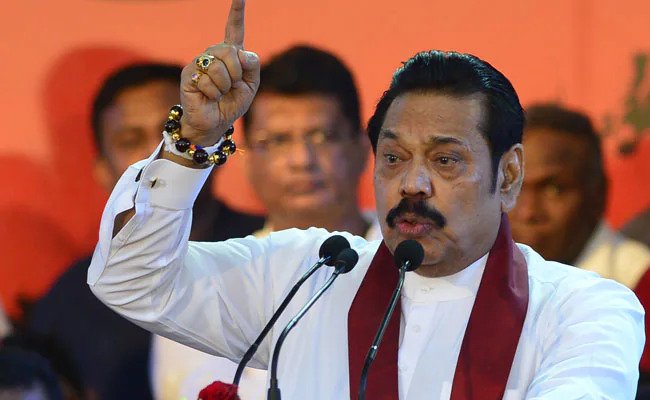
Tiran reorganizes United People’s Party

Minister Tiran Alles has begun reorganizing the United People’s Party (UPP), of which the public security minister is the general secretary.

Several new politburo members were appointed recently. Accordingly, the party’s political and media secretary is tuition master Hemapriya Kaviratne, who was the convener of Black Cap Movement during the ‘Aragalaya’ period.

Attorney Wajira Ranasinghe is the legal and administrative secretary, while retired senior policeman Ranjith Dassanayake is the national organizer with Sumith Ratnamalala as his deputy.

Sameera Manahara is the youth affairs secretary.

Belgian traveller scammed in Kalutara

Tim Tense, a Belgian traveller exploring Sri Lanka, recently shared a troubling encounter from his visit to Kalutara.

According to Tim, he fell victim to a scam at a local restaurant, where he was charged an exorbitant Rs. 1,000 for a single Ulundu Vadai and a cup of plain tea.

In his YouTube video titled “Avoid this man in Kalutara, Sri Lanka,” Tim recounted his experience.

He traversed Kalutara on his own three-wheeler, soaking in the sights.

Upon parking, he was approached by a Sri Lankan individual who offered to take him to a place called ‘Wadani Villas Saivar Kade’ for an authentic Sri Lankan food experience.

The friendly local guided Tim to the restaurant, where he was served an Ulundu Vadai and plain tea, despite not planning to dine initially.

As Tim enjoyed his meal, the host suggested tourist spots, which Tim politely declined, opting to explore independently.

The shocking moment came when Tim inquired about the bill, only to be quoted Rs. 1,000.

Sensing something was amiss, he questioned the price, resulting in a reduction to Rs. 800.

Later, while editing his video, Tim noticed that the advertised price on the wall was significantly lower, no more than Rs. 80.

Despite his reservations, Tim paid Rs. 1,000 and received Rs. 200 in change.

As he left, he expressed his dissatisfaction with the inflated prices to the cashier and the host.

However, they justified it by claiming they charged more for tourists.

Tim denounced the host’s dishonesty in his video, emphasising the importance of integrity over profit.

Fortunately, two local women informed Tim that the fair price for his meal was Rs. 150, leading the host to refund him Rs. 200.

Reflecting on the incident, Tim asserted that the host prioritised money over honesty, tarnishing the reputation of Kalutara.

Despite the financial loss, Tim emphasised the principle of fairness, expressing his disdain for being taken advantage of.

Concerned about potential repercussions, Tim hastily departed on his three-wheeler, fearing the host might follow him.

In conclusion, Tim expressed his disappointment, hoping not everyone in Kalutara shared the same scammy behaviour.

The video relating to the incident was published on April 10 on the channel ‘Tim Tense’.

Posted in Uncategorized

After PM’s Chinese visit, US NSA talks to Sri Lanka President’s advisor on peace, security

The United States National Security Advisor (NSA) Jake Sullivan held talks with Sri Lanka President’s Senior Advisor on National Security Sagala Ratnayaka focusing on regional security issues this week.

The conversation between the two comes days after Sri Lanka Prime Minister Dinesh Gunawardena ended an official visit to China in which he met President Xi Jinping and his counterpart Li Qiang in Beijing amid discussions over further investments in Sri Lanka and concerns over banning Chinese research ships.

The United States along with India is highly concerned over increasing Chinese influence in Sri Lanka, which is located in a strategic location in the Asia.

China already owns a port and a proclaimed land next to the main Colombo port in Sri Lanka and analysts say the Beijing’s ownership of assets has raised doubts if China is planning to use Sri Lanka as a military base. China has denied this and said its relationship with Sri Lanka is only based on commercial aspects.

The discussion between Sullivan and Ratnayaka focused on a range of crucial topics aimed at bolstering bilateral relations between the two nations, the President’s Media Division (PMD) said.

“Central to their discussion was the unwavering U.S. commitment to supporting Sri Lanka’s security and sovereignty,” the PMD said in a statement.

“Acknowledging Sri Lanka’s ongoing endeavours, Sullivan emphasized the importance of completing the fiscal, monetary, and governance aspects of the IMF program.”

The US along with India has raised possible threats of increasing Chinese influence in Sri Lanka, government officials have said. Both countries see China as a security threat to the Indian Ocean region, they say.

“The conversation also delved into future prospects for collaboration between the two countries, exploring avenues for enhanced cooperation in various spheres,” the PMD said.

“Sullivan conveyed his keen interest in fostering continued engagement with Sri Lanka, underscoring the mutual objective of advancing peace and security in the region.”

“This dialogue marks a pivotal moment in U.S.-Sri Lanka relations, demonstrating a shared commitment to promoting stability and prosperity in the Indo-Pacific region.”

Posted in Uncategorized

Arms manufacturers show Indian capability to Sri Lankan military

Indian arm manufacturing firms showed the Delhi’s capability in arm manufacturing to Sri Lankan military at a seminar on Wednesday which the island nation expects to open the door for future joint collaboration in manufacturing and services.

Indian High Commission in Colombo High Commission organised the seminar titled “Identifying New Opportunities and Forging New Bonds” to promote Indian Made Defence equipment and explore avenues for collaboration in defence production.

India’s privately owned defence companies demonstrated the capability they have developed in manufacturing arms and other products including unmanned aerial vehicles (UAVs), latest drones, and latest earth movers used in war zones.

The delegation comprised representatives from Indian Defence companies including Hindustan Aeronautics Limited, Bharat Electronics Limited, Zen Technologies, SSS Defence, Bharat Forge, Big Bang Boom Solutions, AWEL, AVNL, Mahindra Defence, Sager Defence and TATA Advances System Ltd.

They presented their manufacturing capabilities and the advantages of using them in a modern war.

From the Sri Lankan side, Chief of Defence Staff, Commander of Sri Lanka Navy, Commander of Sri Lanka Air Force and other senior officers from Sri Lankan Armed Forces, Police and Special Task Force attended the event along with representatives of leading Sri Lankan business conglomerates.

Santosh Jha, the Indian High Commissioner to Sri Lanka underlined the increasing diversification of India-Sri Lanka bilateral cooperation across domains, including in security and defence matters.

“He emphasised that because of geography, the security of India and Sri Lanka is interlinked and intertwined,” Indian High Commission of Sri Lanka said in a statement.

“India’s defence exports today stand at nearly 2.6 billion US Dollars, a ten-fold increase over the past five years. High Commissioner stated that the seminar was another platform to explore ways of extending India’s increasing capabilities in the defence sector to Sri Lanka.”

TOUGH PAST

Sri Lanka military had been in desperate situations for modern arms when they were fighting a civil war against Tamil Tiger rebels popularly known as Liberation Tigers of Tamil Eelam (LTTE) who demanded an independent state in the island nation’s resourceful North and East.

The military, however, ended the 26-year war in 2009 annihilating all LTTE leaders including its supreme leader Velupillai Prabhakaran.

India, which strongly backed LTTE by providing arms and training in the early stage of the war, took a complete U-turn and helped Sri Lanka military in the final stage of the war.

The LTTE killed Indian Prime Minister Rajiv Gandhi in 1991 after his government sent Indian Peace Keeping Force (IPKF) to stop the violence in the North as per a deal signed between the two neighbours.

India, along with China, Pakistan, and the United States helped Sri Lanka to end the war amid strong concerns over war crimes and human rights violation by the Sri Lankan armed forces.

Since the end of the war, India has been increasingly involved with Sri Lanka armed forces, providing trainings and conducting joint military exercises with a special focus on maritime security after China increased its footprint in Sri Lanka.

China has owned Sri Lanka’s largest port in the country’s deep southern district of Hambantota where the world’s second largest economy is in the process of building a $4.5 billion refinery and establishing an investment zone.

USING INDIAN WEAPONS

A similar Defence Seminar and Exhibition has been conducted in June last year, the Indian High Commission said.

“Sri Lanka Armed forces have been successfully operating a range of Indian defence equipment like L-70 guns, Indra Radar, Offshore Patrol Vessels and Army training simulators,” it said.

“More recently the GoI (government of India) has committed supply of Floating Dock, Maritime Rescue Coordination Centre and Dornier aircraft which would ensure capacity building of Sri Lanka Armed Forces.”

Shri Anurag Bajpai, Indian Defence Ministry’s Additional Secretary (Defence Production) reassured that India stands committed towards ensuring capacity and capability building of Sri Lanka Armed Forces as part of Prime Minister Narendra Modi’s vision of SAGAR (Security & And Growth for All in the Region).

“He highlighted the common security challenges faced in the Indian Ocean Region and called for enhanced collaboration to create a safer environment,” the Indian High Commission said in a statement.

“He shared Aatma Nirbhar Bharat’s, self-reliant India’s upward trajectory in establishing robust R&D (research and development) and indigenous manufacturing ecosystems, while fostering innovation and entrepreneurship”.

“NEW AREAS OF ECONOMIC REVIVAL”

Sri Lanka has been looking for collaboration to earn foreign exchange in all sectors including military since an unprecedented economic crisis in 2022 which forced the country to default sovereign debts.

Since then, the island nation has yet to pay its private and bilateral external creditors.

“This could hopefully open the door to future joint collaboration in manufacturing and services as well as joint research and development, thereby identifying new areas for economic revival whilst ensuring capacity building of the Sri Lankan Armed Forces,” State Minister of Defence Premitha Bandara Tennakoon told the participants at the seminar.

“…as we embrace the era of fourth industrial revolution technologies, we must adapt to the changing landscape of warfare,” he said.

“Innovations in artificial intelligence, cyber security, unmanned systems, and space technologies have revolutionized the way we perceive defence and security.”

“It is essential for us to remain at the forefront of these developments, continuously modernizing our armed forces to counter emerging threats effectively. I believe this seminar is therefore taking us in this future direction.”

Posted in Uncategorized

The hidden but real issue in the row over Kachchativu By P. K. Balachandran

There is hullabaloo in India over the tiny and uninhabited Kachchativu island in the Palk Strait. It was triggered earlier this month by Indian Prime Minister Narendra Modi, who is also the supremo of the ruling Bharatiya Janata Party (BJP).

To everyone’s surprise, Modi accused the opposition Congress party of giving the island away to Sri Lanka “callously” in 1974.

This was followed by External Affairs Minister S. Jaishankar’s utterances blaming India’s first Prime Minister Jawaharlal Nehru and the Dravida Munnetra Kazhagam (DMK), an ally of the Congress in the forthcoming parliamentary elections in Tamil Nadu.

Referring to an official report, secured through the Right to Information Act by a Tamil Nadu BJP leader, Modi said that it was the Congress Prime Minister Indira Gandhi who had handed over Kachchativu to Sri Lanka.

It was “eye-opening and startling,” Modi said and accused India’s grand old party of weakening the country’s integrity continually.

“We can’t ever trust Congress. Weakening India’s unity, integrity, and interests has been Congress’s way of working for 75 years and counting,” Modi wrote on X.

Addressing a press conference in New Delhi, External Affairs Minister and former diplomat, S. Jaishankar said: “Today, it is important for the public to know and the people to judge. This issue has been hidden too long from the gaze of the public. We are talking about 1958 and 1960. The main people in the case wanted to make sure that at least we should get the fishing rights. The island was given away in 1974 and the fishing rights were given away in 1976. One, the most basic recurring aspect is the indifference shown by the then Central government and the PMs about the territory of India. The fact is they simply did not care.

“In an observation given by the then PM Jawaharlal Nehru in May 1961, he wrote: ‘I attach no importance at all to this little island and I would have no hesitation in giving up our claim to it. I do not like matters like this pending indefinitely and being raised again and again in parliament.’ So, to Pandit Nehru, this was a little island, it had no importance, he saw it as a nuisance. For him, the sooner you give it away, the better. This view continued on to Indira Gandhi as well.

“Indira Gandhi is said to have remarked in the AICC meeting that this is a little rock. I am reminded of those days when Pandit Nehru called our northern boundary as a place where not a blade of grass grew. I would like to remind them that after this historic statement by PM Nehru, he never regained the confidence of the country. The same was going to happen to Indira Gandhi when she said that this is only a little rock. So, this is not just one PM. This dismissive attitude was the historic Congress attitude towards Kachchativu.”

In another interaction, the External Affairs Minister said that the Dravida Munnetra Kazhagam (DMK), which was then in power in Tamil Nadu, was kept informed about the government’s stand on Kachchativu and therefore the DMK too was complicit.

Modi’s and Jaishankar’s utterance have not caused ripples in Sri Lanka. Sri Lankan Foreign Minister Ali Sabry told a TV channel on April 3: “This is a problem discussed and resolved 50 years ago and there is no necessity to have further discussions on this.”

A Colombo-based official source told The Hindu that the Sri Lankan government refrained from commenting on the development as it was a clash between two political parties in the run-up to Indian parliamentary elections.

“The comments are about who was responsible for giving up the island to Sri Lanka, not about whose territory it is part of now. So, there is nothing for Sri Lanka to comment on, really,” the official said, requesting anonymity owing to the “sensitivity” of the issue.

No Indian Threat

In fact, neither Modi nor Jaishankar said that they would try to reclaim Kachchativu from Sri Lanka. In fact, when the matter came up in the Supreme Court, the Attorney General of the Modi government Mukul Rohatgi had himself said that the island could not be taken back except by waging war.

It has also been India’s consistent stand that Kachchativu was a “disputed territory” and that the dispute was settled in favour of Sri Lanka in 1974 and 1976 through long and arduous negotiations since 1921. Kachchativu was not a part of India. If it were so, it could not have been alienated without a constitutional amendment. And there was no constitutional amendment when Sri Lanka’s sovereignty was recognized.

Real Issue: Dispute over Fishing Rights

At any rate, the real issue is the fishing rights of the Tamil Nadu fishermen on the Sri Lankan side of the International Maritime Boundary which passes near Kachchativu.

Tamil Nadu fishermen have been making the unreasonable demand that they be allowed to fish in the Palk Strait, the Palk Bay and even off the North Eastern Jaffna shores because they had been fishing there for centuries. For them, the International Maritime Boundary drawn up in 1974 and 1976 are of no relevance. Sri Lanka cannot be expected to agree to this.

Though the retrieval of Kachchativu from Sri Lanka is portrayed as a solution to the problem, it is not a solution at all. Even if it is handed over to India, the Tamil Nadu fishermen will continue to intrude into Sri Lankan waters. Using trawlers that scrape the bottom of the shallow sea denuding it of not just fish but all forms of marine life, these fishermen had over-fished in the sea next to the Indian shores. They had then taken to poaching in Sri Lankan waters right up to the Sri Lankan shores.

They brazenly exploit the relative weakness of the North Sri Lankan Tamil fishermen.

When arrested, the story the Tamil Nadu fishermen narrate to the outside world is that they did not cross Kachchativu and that the Sri Lankan navy had seized them in Indian waters. If this were true, the Indian Coast Guard, which has bases on the Indian side, would have intercepted the Sri Lankan navy. But there has not been a single case of confrontation between the Indian and Lankan naval personnel.

Since the arrest of the fishermen triggers a hue and cry in Tamil Nadu Indian diplomats get them released promptly. But the boats come back again.

During the ethnic conflict, the Lankan navy used to open fire and even kill the intruders. But since the end of the conflict in 2009, they don’t even fire warning shots. The intruding vessels are boarded, the crew are taken prisoner, and their boats are seized. But diplomacy intervenes and the men are set free. But they come back.

Bottom Trawling

Sri Lanka had banned bottom trawlers in 2017. But Indian trawlers come unchallenged. Lankan Fisheries Minister Douglas Devananda told parliament that at least 5,000 bottom trawlers from Pondicherry, Karaikal, Rameshwaram and Nagapattinam enter Sri Lankan waters week after week to engage in bottom trawling at the expense of the livelihoods of local fishermen.

“After the 1976 agreement, the Indian mechanised trawlers which were 36 feet long with 120 horsepower capacity at that time, turned out to be 50-60 foot long massive vessels with 350-550 horsepower engines after 2000,” Devananda said.

In the past, the Northern Tamil shores had the reputation of being one of the most productive regions in terms of export-quality seafood. But over time, shrimps, blue swimming crab and cuttlefish became the main targets of Indian bottom trawling, resulting in a loss of about USD 750 million annually to Sri Lanka. About 50,000 fisher families were affected.

A study quoted in a research paper submitted to the Sir John Kotelawala Defence University revealed that in 2016, around 1000-1500 mechanized trawlers were coming to Palk Strait, Palk Bay and Gulf of Mannar three days in a week. They had harvested approximately 1900 tons of shrimps and 4000 tons of demersal fish.

The Northern Lankan Tamil fishermen were earning just LKR 600 – 800 LKR per day, which was a third of the income they used to earn before the Indian trawler invasion.

With big Indian boats on the prowl, the North Lankan Tamil fishermen do not get enough catch. “There are days when we return home empty-handed, not even enough fish for our own consumption,” Rasenthiram Mathiyalahan, secretary of Aadhikovilady Fishermen Union in Point Pedro, told Sunday Times.

Local fishermen are appalled by a proposal to issue permits to Indian fishermen to fish in Lankan waters. “We will never allow such proposals to be implemented,” Varnakulasingham, a fisher leader said.

There is an India-Sri Lanka Joint Working Group on Fisheries. India makes a case for treating the fishermen “humanely” and release them. The Sri Lankan side obliges. But the poaching goes on unhindered and the demand for retrieving Kachchativu is raised in Tamil Nadu, obscuring the real issue.

(P. K. Balachandran is a freelance journalist based in Colombo writing on South Asian affairs for various news websites and dailies for a number of years. He has reported from Colombo and Chennai for Hindustan Times, New Indian Express and Economist. He has a weekly column in Daily Mirror and Ceylon Today in Sri Lanka)

Factum is an Asia Pacific-focused think tank on International Relations, Tech Cooperation, and Strategic Communications accessible via www.factum.lk. The views expressed here are the author’s own and do not necessarily reflect the organization’s.

Posted in Uncategorized

Mahinda mandated to pick Pohottuwa Presidential candidate

Sri Lanka Podujana Peramuna (SLPP) MP Rohitha Abeygunaw-ardane yesterday confirmed that the party’s presidential candidate will be determined by its leader, Mahinda Rajapaksa shortly.

The MP said the decision was reached during the party’s politburo meeting held yesterday. Addressing the media following the meeting, Abeygunawardane clarified that the party’s politburo had determined that the party’s candidate and the declaration of candidacy would solely be made by party leader Mahinda Rajapaksa.

“The politburo decided to delegate the pertinent responsibilities to the party leader,” he noted. The MP said individual MPs will not present their personal views on the matter going forward.

“At an opportune moment, leader Mahinda Rajapaksa will make the announcement regarding our presidential candidate as agreed on by the party and its politburo,” he said.

“Some may persistently inquire about our presidential candidate. However, it will only be announced when we are fully prepared. Until then, speculation is premature,” he added.

Abeygunawardane emphasised that the party membership remains under the stewardship of Mahinda Rajapaksa, highlighting that his opinions hold significant value for both the party and the nation. “There is no division in the party despite the various claims,” he affirmed.

At the previous politburo meeting held on 27 March, party members were directed by Rajapaksa to abstain from expressing their personal opinions regarding the party’s presidential candidacy and potential candidates after MPs presented varying views to the media.

Posted in Uncategorized

‘Reveal solutions to Tamils’ issues to int’l community’

Thamil Makkal Thesiya Kuttani Leader and Opposition Parliamentarian C.V. Wigneswaran called on the majority community-based Presidential candidates to clearly outline their solutions to the Tamil community’s issues in the presence of foreign diplomats, if they (candidates) seek the Tamil community’s support.

Speaking to The Daily Morning, he said that the majority community-based Presidential candidates should be able to come forward and explain what they would do to resolve the Tamil people’s issues, if they seek the Tamil community’s support.

“If anyone has the guts to say that this is what they are going to do when they come to power, we will consider supporting such a candidate. However, since they may say anything on stages to get votes, this promise has to be made in writing, and in the presence of foreign diplomats including those of powerful countries such as the United States, the United Kingdom and India,” he said.

Despite various promises made by majority based Presidential candidates, he claimed that none of them had provided any progressive solution to the Tamil people’s issues. He however praised the attempt made by former President Chandrika Bandaranaike Kumaratunga to find a solution by introducing the package of constitutional amendments in 2000. “They say that they will do this and that, but they do nothing in the end. Even when one majority community based leader is going to give something to the Tamils, the others are working against it. They would do everything to sabotage it,” he went on to say.

Commenting on their demands, Wigneswaran, who was also a former Chief Minister of the Northern Province, said: “We are not asking for much. Even now, when someone is passing Anuradhapura and going towards Vavuniya, the people there speak in Tamil. Those are areas where there are Tamil speaking people. If someone is going towards Batticaloa by passing Poonewa, the people in those areas also speak in Tamil. What we ask for is only to recognise those areas as Tamil speaking areas, so that the people there will have a right to self-determination.”

The frequent issues faced by the Tamil community include the lack of infrastructure facilities, the occupation of their lands by the military forces and State Departments, and the non-implementation of the 13th Amendment to the Constitution in full. Tamil community based politicians have been charging that the majority community based politicians, including Heads of State, are not interested in resolving such issues.

Posted in Uncategorized

Five million undecided voters waiting to hear economic policies of presidential candidates: Charitha Herath

Five million undecided voters are waiting to hear the economic policies of the presidential candidates who will be running for President in October 2024, Member of Parliament Dr. Charitha Herath of Nidahas Janatha Sabawa (Freedom People’s Congress) told the media yesterday.

Presidential elections are scheduled to be held in Sri Lanka sometime between September and October 2024 according to the Constitution of Sri Lanka where voters will elect a President for a term of five years. Incumbent President Ranil Wickremesinghe is eligible to run for re-election although he himself has not announced that he would be running. However, Samagi Jana Balawegaya (SJB) and Jathika Jana Balawegaya (JJB), representing the Opposition have already become the two front runners in the contest.

In this backdrop, MP Dr. Charitha Herath, who has had a background in university teaching and multiple academic disciplines whose stock in trade is more logic than rhetoric said that there are millions of voters who are keen to weigh on the economic policies of all presidential candidates.

“We know that the government and Pohottuwa (Sri Lanka Podu Jana Peramuna) are very closely related like the two sides of the same coin. We don’t agree with their economic policies. The SJB has an economic programme. The JJB is still going out announcing various concepts but they have still not publicised a proper economic programme of their own.

The leftist political parties are in discussions to come up with their economic policies, and if they announce one, there will be four optional economic programmes for the people to consider. We know the economic programme agreed between President Ranil Wickremesinghe and Pohottuwa. Freedom People’s Congress doesn’t agree with that, and we want to discuss further on other economic policies once they are formally announced. Our party has not closed negotiations with anyone. What we can say right now is; five million voters still remain undecided and they are waiting to hear from all candidates about their economic policies before they decide to cast their votes,” he said.

As per the constitutional election laws, Sri Lankans are to witness the swearing-in of their new president in exactly 174 days.

Meanwhile, according to SJB MP Nalin Bandara, the much expected debate between SJB and JJB on their economic policies should take place in not more than three weeks if they work out the modalities to make it a reality instead of an illusion.

A number of television stations have already expressed their willingness to telecast this debate as it is tipped to be the most sought after political television braodcast.

SLPP MPs barred from going public on their support for presidential candidates

In the wake of SLPP (Sri Lanka Podujana Peramuna) MPS airing contrasting views over the upcoming elections, the party hierarchy has barred all MPS from making comments on their support to any presidential candidate until a formal decision is taken, a party official said yesterday.

The party’s executive committee took this decision at its meeting held last Tuesday.

The SLPP is currently divided on its support, with those holding positions in the government openly supporting the proposed candidacy of President Ranil Wickremesinghe.among them are ministers Susil Premajayantha, Prasanna Ranatunga and Ali Sabry.

Another faction insists on fielding its own candidate. Also, the party has decided to take stern disciplinary action against those who sided with other parties, violating the party constitution.

For Sri Lanka and India, cooperation is the only option: High Commissioner

Sri Lanka’s and India’s shared past, common heritage and strong cultural connect create ‘a natural warmth’ in dealing with each other, High Commissioner of India Santosh Jha has said.

“For us, as close and proximate neighbours, cooperation is the only option. It is not driven by choice and opportunity alone,” Jha said speaking at the India-Sri Lanka Defence Seminar held in Colombo on Wednesday.

“Our approach to Sri Lanka is guided by our neighbourhood-first policy and our SAGAR vision. This entails that we share with our closest neighbours all that we can based on their needs and aspirations. It also entails that our approach remains generous and non-reciprocal.”

India looked forward to working with Sri Lanka to take forward our common endeavour to deepen and further strengthen our defence cooperation, the high commissioner said. 

Bilateral cooperation between the countries is expanding and diversifying, “We now cooperate in wider range of areas including infrastructure and connectivity, deeper economic engagement, trade and investment, culture and education, tourism and people to people ties.”

Indian High Commissioner’s full speech:

Ayubowan, Namaskaar, Good Morning

It is my pleasure to welcome you to the Second Seminar on India-Sri Lanka Defence Cooperation that we are organizing in Colombo. I thank you all for attending. My deep appreciation to the Hon. State Minister Mr. Tennekoon for his presence here today.

I must also thank the Chief of Defence Staff of Sri Lanka and the Commanders of the Air Force and Navy for their gracious presence. We value the support extended by the Ministry of Defence of Sri Lanka. We look forward to working with our Sri Lankan friends to take forward our common endeavour to deepen and further strengthen our defence cooperation. 

I am also grateful for the presence of Indian delegation led by Additional Secretary from Ministry of Defence. He is leading a large and very diverse delegation from the Indian defence-industry, including some leading Indian Defence Public Sector entities and wide range of industry players from the private sector.

Distinguished Guests
Relations between India and Sri Lanka are uniquely fraternal. They are very special and unlike any other we have with other countries.

Our shared civilizational past, common heritage and strong cultural connect create a natural warmth and comfort in dealing with each other. For us, as close and proximate neighbours, cooperation is the only option.

It is not driven by choice and opportunity alone. Our approach to Sri Lanka is guided by our neighbourhood-first policy and our SAGAR vision. This entails that we share with our closest neighbours all that we can based on their needs and aspirations. It also entails that our approach remains generous and non-reciprocal.

Our support in recent years to Sri Lanka, during the Covid pandemic and the economic crisis,were driven by our sense of responsibility and obligation for our closest friend and neighbour. We stood shoulder to shoulder with our civilizational twin, when it was needed most, and without any hesitation. Many of you will agree that India is and will remain Sri Lanka’s most reliable friend and a trusted and dependable partner.

Our bilateral cooperation is expanding and diversifying. It is buttressed by India’s growing national capabilities.

We now cooperate in wider range of areas including infrastructure and connectivity, deeper economic engagement, trade and investment, culture and education, tourism and people to people ties.

Like in other areas, we are cooperating closely on security and defence matters. Because of our geography, our security is interlinked and intertwined. And when we speak of security, we must remember that it has acquired a wider meaning than we have traditionally associated with it.

After the covid pandemic and impact of Russia-Ukraine conflict, it has come to include energy, health,food and even economic security. This is because technology now permeates all aspects of our lives, and looking at security through a narrow and segmented lens is no longer possible. Our response, therefore, must keep this wider definition in mind. We must also act accordingly to address security in its entirety keeping the complex inter-linkages in mind.

Friends,
In recent years, the vision of Atmanirbhar Bharat, which means self-reliant India, has led to significant capability development within the Indian defence industry. The Government of India has promoted this vision through enabling policies and frameworks, initiatives such as establishment of defence industry corridors, and supporting and handholding different stakeholders.We have also promoted collaborations between private and government owned enterprises.

We have invested in research and development and promoted the use of innovation and new age technologies to build capabilities that are future-ready.

Our efforts are showing rich dividends in the last one decade. The Indian defence industry today rolls out state-of-the-art systems, advanced technologies and world class equipment. To name a few, this ranges from fighter aircrafts and helicopters to naval vessels, from electronic warfare systems to cyber security solutions and from small arms to large caliber precision long range artillery systems.


Not only are we producing for our own national requirements, but we have been willing to make these capabilities available to our friendly partner countries like Sri Lanka. In fact, our defence exports today stand at nearly 2.6 billion US Dollars. This is a ten-fold increase over the past five years. We export defence hardware and software to more than 85 countries with more than 100 indigenous firms active in this field.

In this effort, we have relied upon our 16 defence public sector undertakings, which have been the backbone of our defence industrial complex, and supplemented their efforts with a growing private sector participation. Our Innovations for Defence Excellence or iDEX initiative also help us building capabilities in critical and strategic technologies to bridge the gap between the expectations and requirements of the modern Armed Forces by fostering a vibrant defence innovation ecosystem.

Today, India can offer high quality, low cost,and reliable technology in defence with an assured supply chain for long term maintenance support.

As in other sectors, our endeavour has been that our growing capabilities must also benefit our neighbours, including Sri Lanka. We are committed to supporting the needs and requirements of the Sri Lankan Armed Forces.
I am therefore happy that the Seminar today will focus on our security and defence cooperation and help identify our shared priorities in this regard. That this Seminar is being held in Sri Lanka for the second time in the last two years underscores the value we attach to our defence partnership with Sri Lanka.

The large defence industry delegation from India further underlines our strong commitment to building industrial cooperation in the defence sector in Sri Lanka. We would also be showcasing the various advanced platforms and equipment to enable the Sri Lankan armed forces to familiarize themselves with various capabilities that have been developed indigenously in India. We are confident that these can also become viable, affordable and modern solutions for the Sri Lankan military.


I once again thank all of you for participating in this exercise. I wish the seminar and its participants all success. With your close cooperation, we are confident that we will see important and meaningful outcomes.
Thank you.

Posted in Uncategorized