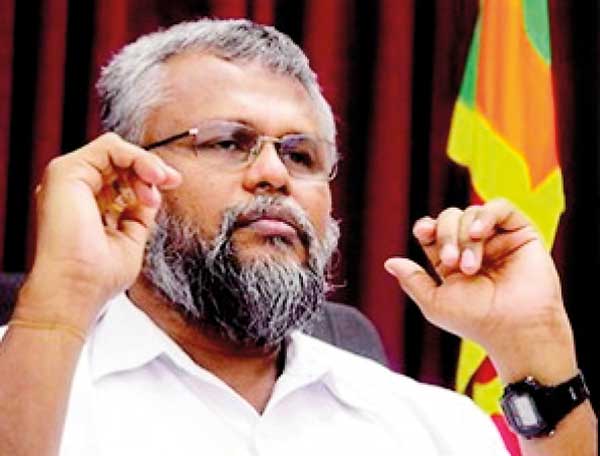
Eelam People’s Democratic Party (EPDP) Chief and Secretary-General, Douglas Devananda became the latest political leader to be arrested in Sri Lanka. The former Jaffna district MP and ex-cabinet minister was arrested by the Police on December 26 (Friday) in Colombo. The ex-minister was initially detained under the Prevention of Terrorism Act (PTA) by the CID and on Sunday he was remanded until January 9, 2026, by the Gampaha Magistrate.
The acting Police Media Spokesman, ASP Minura Senarath told this newspapers that the arrest was connected to an on-going investigation into the alleged transfer of a firearm to an organised gang criminal. It is alleged that a pistol issued to Devananda had later been found in the possession of underworld gang leader and drug lord ‘Makandure Madush’.
Devananda was summoned by the Police Criminal Investigation department (CID) to record a statement concerning details of firearms issued to him by the Defence Ministry for his protection during the years of war between the Sri Lankan Armed forces and the Liberation Tigers of Tamil Eelam (LTTE). Devananda was supportive of the Government and the EPDP under his leadership cooperated with the armed forces in a para-military capacity. The LTTE then branded Devananda as a traitor and made several attempts to kill him.
According to informed Tamil sources Devananda had been asked to present himself on December 26 to record a statement concerning firearms issued to him years ago. The ex-minister travelled down to Colombo from Jaffna and presented himself to the CID on Friday. He didn’t suspect that he would be arrested.
Weliweriya
Devananda was quizzed by Police officers attached to the Homicide and Organized Crime Investigation unit of the CID. He was told that a 9 mm handgun had been recovered in a shrub jungle area near a culvert in the Weliweriya area of Gampaha district in the year 2019. The Police had found the concealed weapon due to information supplied by drug kingpin Makandure Madush who was later killed in 2020 under suspicious circumstances.Some months ago the Police launched an intensive, wide-ranging investigation into organised crime and the narcotics trade. It is well known that President Anura Kumara Dissanayake has declared war on the use and trade of narcotics. The JVP led NPP Government headed by the president is fully committed to the elimination of the drug menace.
When the files concerning slain drug lord Madush were re-activated in this regard, it was discovered that the firearm found in Weliweriya bore the serial number of a handgun given to Douglas Devananda in 2001 by the Defence Ministry. Police had then wanted to find out how a gun given officially to Devananda in 2001 went into the “possession” of the drug kingpin Makandure Madush.
Devananda was summoned to record a statement clarifying how the weapon given to him had got into the hands of Madush. Devananda however hadn’t been able to provide a satisfactory explanation when being questioned, according to the Police. As a result, the CID arrested him and detained him for 72 hours under a PTA order. He is likely to be produced in courts on Tuesday (Dec 30).
Firearms
According to informed Tamil circles close to Devananda, the EPDP leader had received the 9mm pistol in July 2000 and not 2001. It was part of a mini-arsenal provided to the EPDP for protection against the LTTE. The cache consisted of thirteen T-56 assault rifles and six 9 mm pistols. Subsequently the EPDP had been asked to hand over the firearms issued to them twice.
The first occasion was after the 2002 ceasefire facilitated by Norway. The EPDP reportedly returned their firearms to the Defence ministry. As a result several unarmed EPDP cadres were gunned down by the LTTE during the ceasefire period. The EPDP got firearms after the ceasefire ended and war erupted again.
The second occasion was after the war ended conclusively following the military defeat of the LTTE in May 2009. The EPDP had returned the arms on a staggered basis to the defence ministry. The firearm in question had also been returned to the Defence Ministry. If the gun was really in Madush’s possession, then it was more likely that the “lapse” was by the “defence sector” and not the EPDP opined informed Tamil sources.
Tamil Statement
According to these Tamil circles close to the EPDP, former minister Devananda had clearly furnished details of the various arms given to the EPDP by the Defence Ministry. Devananda however had insisted during the interrogation that his statement should be recorded in Tamil. He had pointed out that Tamil was his mother tongue and also an official language. Therefore he was entitled to have his statement recorded in Tamil as his Constitutional right. The CID officers who quizzed Devananda were unable to record the statement in Tamil. It is expected that the 72-hour detention order would enable the statement to be recorded in Tamil.
Makandure Madush
Samarasingha Arachchige Madush Lakshitha alias Makandure Madush was an underworld gangster and drug lord who was very powerful and politically influential. He relocated to Dubai in 2006 and operated his drug network from there. He was arrested in February 2019 for a drug offence and was deported to Sri Lanka in May 2019. Madush allegedly provided much information regarding his illegal activities and connections to the Police. He is said to have implicated over 80 persons in this regard including top politicians, senior Govt officials and high-ranking Police officers.
In October 2020, Madush was reportedly taken by the Police to a housing scheme in Maligawatte to uncover stashed heroin. According to the ‘official’ version released by the Police, Madush was fired upon by two unknown persons. There was a fire fight when Police retaliated. Madush was allegedly caught in the crossfire and killed. This Police story was disbelieved by many.
It is indeed strange that the Police reactivating inquiries into Madush’s activities should probe the pistol given to Devananda instead of so many other grave matters concerning Madush and possibly incriminate people in powerful positions. Compared to the scale and scope of the drug lord’s illegal activities, the ‘Devananda pistol matter’ seems rather insignificant.
Tigerish elements
The arrest and detention of Devananda has been welcomed by people supportive or sympathetic to the LTTE. Tigerish elements and fellow travellers are flooding social media with anti-Douglas posts and comments. Some You Tubers seem confident that this is the end of Douglas and that the EPDP chief would be behind bars for a long time. Tiger and pro-tiger elements hate Douglas Devananda because he defied the LTTE and fought against them alongside the armed forces. Hence they are agog with joy over Devananda’s present predicament. They are delighted that people like Pillaiyaan and Devananda who fought with the Army against the LTTE are now being arrested and detained.Who then is Devananda and what is the role he played in Sri Lanka’s recent history? I have written about him before and will try to answer the question raised with the aid of earlier writings.
Defiance of Tigers
Kathiravelu Nythiananda Douglas Devananda is in a sense a very unique personality. Douglas displayed a high degree of consistency in opposing the LTTE in the past. In those days the LTTE claimed to be the sole representative of the Sri Lankan Tamils and Devananda tried to counter that claim by projecting the EPDP as the sole alternative in defiance of the tigers.
Douglas had to pay a high price for his bold stance; the LTTE killed numerous comrades and cadres, including his own brother. Furthermore multiple attempts were made on his life. Devananda is the only person who has survived several different assassination attempts by the LTTE. Among these are a full-scale attack with SMGs, grenades and RPGs on his former residence in Colombo 5, a brutal assault by LTTE prisoners in Kalutara jail and two attempts by women suicide bombers at his former ministry in Colombo 3.
“Athiaddyk Kuthiyan”
Devananda’s rise to power and office is a fascinating tale. His family hailed originally from Chunnakam, but later moved to Athiaddy in Jaffna town. The LTTE’s “poet laureate” Puthuvai Ratnadurai referred to Douglas in his poems as “Athiaddy Kuthiyan” (hunk of Athiaddy) Devananda’s father Kathiravelu was a Clerk at the Inland Revenue Department and later became a Staff Officer of the Petroleum Corporation. His mother Maheswary taught at Jaffna Central College.
Devananda’s paternal uncle was the well-known trade unionist and activist K.C. Nythiananda. Devananda spent many years with Nythiananda at 17 Frances Road in Colombo 6. The bachelor Nythiananda virtually adopted Devananda who studied at Colombo Hindu College then. Earlier he was at Jaffna Central College. Devananda was no academic bright light, but learned rudimentary politics from his uncle. Devananda went on to include both Nythiananda’s name and his nom de guerre in the militant movement, “Douglas,” as part of his official name later.
The seventies of the 20th Century was a period of political ferment for the Tamils. The old left lost its lustre because of its political cohabitation with the Sri Lanka Freedom Party (SLFP). Leftist stalwarts like Nythiananda metamorphosed into Tamil nationalists. The Tamil youth too were getting radicalised. Secession and armed struggle to achieve it was the credo of the youth.
EPRLF
Devananda also was not immune to these currents. He joined the Eelam Revolutionary Organization of Students(EROS) and, thanks to his erstwhile Trotskyite mentor, Eliathamby Ratnasabapathy, went to Lebanon and obtained military training with the Palestinians. Devananda acquired the nom de guerre Douglas then. After returning from the Middle East, Devananda along with K. Pathmanabha and others broke away from the EROS and formed its off-shoot the General Union of Students (GUES) followed by the Eelam People’s Revolutionary Liberation Front (EPRLF).
Devananda’s indulgence in pre-1983 militancy was short-lived. He led a not-so-successful robbery of the Thirukkovil Bank in the Amparai District, but was caught in Akkaraippattru when fleeing. Jailed at Welikada, Devananda like Panagoda Maheswaran and others fought tooth and nail to escape death at the hands of Sinhala convicts in July 1983.
PLA Commander
Transferred to Batticaloa, Devananda played a crucial role in engineering the breakout from within. Escaping to India, he underwent Indian arms training too and then formed the Military Wing of the EPRLF the People’s Liberation Army (PLA). Douglas was the first PLA Commander.
The PLA’s military track record wasn’t very impressive and its most ambitious project, the 1985 attack under Douglas’s command on the Navy installation at Karainagar, was a disaster. Douglas lost his sister Madhivadani alias Shobha (the first woman cadre to die in combat) as well as his second-in-command Sinnavan among other casualties in the abortive attempt.
Soon sharp differences arose between Devananda the Military Chief and Pathmanabha the Political Commissar of the EPRLF. The movement in practical terms was vertically split. The EPRLF politburo removed Devananda from his post and appointed Gaffoor as Military Commander.
Choolaimedhu
This resulted in Devananda travelling in late 1986 to Chennai (then Madras) to meet Pathmanabha and resolve matters. While Douglas was staying at Choolaimedhu in Chennai, there arose an unsavoury incident where a mob was instigated by interested parties into attacking the EPRLF-backed office, the Eelam People’s Information Centre (EPIC). The EPRLF fired at the mob and an Indian Tamil lawyer was killed. Though not directly involved, Devananda was arrested. Under these circumstances the EPRLF rupture became permanent.
ENDLF
After his release on bail, Devananda’s faction and a PLOTE dissident faction led by Thangarajah alias Paranthan Rajan came together and formed the Eelam National Democratic Liberation Front (ENDLF). The Indo-Lanka accord and its aftermath led to this front collapsing. Devananda took up a firm Tamil nationalist stance and condemned New Delhi. Devananda’s position on the Indo-Lanka Accord was very much akin to that of the LTTE then. This assertion of Independence cost Devananda greatly as the pro-Indian Paranthan Rajan ingratiated himself with New Delhi at Devananda’s expense. A friendless Devananda and cadres were left to fend for their own.
EPDP
This phase was perhaps the nadir of Devananda’s politico-military fortunes. He formed the Eelam People’s Democratic Party (EPDP) in Madras, but found himself pathetically short of funds. The EPDP situation then was pitiful. The desperate EPDP was compelled to engage in extortion and kidnapping of Sri Lankan Tamils in Madras to extract money. Devananda was arrested on a kidnapping charge and tasted prison life again. This episode earned him the negative sobriquet ‘Pillaipidikaran’ (Kidnapper) among Tamil circles. After securing a temporary release from prison, Devananda jumped bail and returned to Sri Lanka where he soon dialogued with intelligence officials and struck a deal with Ranjan Wijeratne.
Ranjan Wijeratne
Devananda met with Ranjan Wijeratne, then Deputy Defence Minister under President Ranasinghe Premadasa, for a confidential discussion. Devananda made an offer that the unconventionally dynamic Wijeratne could not refuse. Devananda was prepared to place at the Government’s command the full cooperation and unstinted support of his newly-formed organisation in return for protection and support.
The offer was path-breaking at that time as no Tamil militant organisation had until then come forward to help the main ‘enemy’ directly. An uneasy truce between the Sri Lankan Government and the Liberation Tigers of Tamil Eelam (LTTE) was in force then. Devananda however could prove useful if war broke out in the future. It was advantageous to Colombo then to procure the services of Devananda.
Preliminary arrangements were made. The agreement arrived at with the Government then was like manna from heaven to Devananda. It was only some weeks before that he had arrived in Colombo with two comrades from Chennai (then Madras). His political fortunes were at a low ebb. The offer to help the Government was born through desperation. The bold gamble worked and then bloomed successfully after war broke out with the Tigers.
Over 300 cadres
With war erupting in June 1990 between the Government and the Tigers. Devananda was in business. EPDP cadres scattered in several parts of India and Sri Lanka began to converge in Colombo. Devananda also went in for new recruits and dissidents from other groups. Soon he had more than 300 cadres at his disposal. Apart from outright block grants of money by the State, arrangements were also made to pay monthly allowances per cadre. The EPDP also engaged in propaganda for the State in both the print and electronic media.
Devananda was criticised severely then for betraying the Tamil cause and openly collaborating with the enemy. Devananda however maintained some form of independence and autonomous action from the start. It is to Devananda’s credit that he did not let the EPDP deteriorate- devoid of political content- into a stark mercenary outfit alone.
As war progressed, the LTTE withdrew from the islands off the northern peninsula. This was Devananda’s opportunity. Devananda and his boys arrived with food and provisions by sea and set foot after many years in the north. The islands were entrusted to the EPDP’s care by the then UNP Government. This helped the EPDP to establish a strong presence in areas coming under the Kayts constituency.
Life thereafter was on the ascendant for Devananda. Utilising the control he had over the offshore islands, Devananda began transporting seafood to Colombo. A lucrative trade in dried fish was established. The transport of goods to and from the islands were another source of revenue.
Entered Parliament
He next moved into the Parliamentary arena, fielding an Independent list of EPDP and UNP candidates in 1994. The captive voters of the offshore islands ‘cast’ their votes overwhelmingly for Devananda. Since the bulk of Jaffna voters were under LTTE control and therefore could not vote, the EPDP list with about 10,000 votes went on to gain nine seats. Devananda entered Parliament. Thereafter he was elected MP from Jaffna in every election until 2024. He switched sides from the UNP to the SLFP and then to the SLPP.
Devananda has represented Jaffna for 30 years at a stretch in Parliament from 1994 to 2024. He also served as a cabinet minister for 18 years in the years 2000 -2002, 2004-2010, 2010- 2015 and 2019-2024. No Sri Lankan Tamil politician possesses such a record. The unexpected victory of the JVP led NPP in the north in 2024 resulted in Devananda becoming a political casualty. Now he has been arrested and detained. What next for Devananda?
(D.B.S.Jeyaraj can be reached at dbsjeyaraj@yahoo.com)