US expresses concerns over Sri Lanka’s Online Safety Bill, calls for transparency

The United States remains concerned about the potential impact of Sri Lanka’s newly passed Online Safety Bill, Ambassador Julie Chung said on Thursday (Jan.25).

Taking to X (formerly Twitter), the US envoy in Colombo expressed dismay at passing the legislation in the parliament by majority vote without incorporating important input from key stakeholders, including civil society and tech companies.

The new law has come under fire for the problematic aspects of several clauses of the Bill, which threaten the freedom of expression, innovation and privacy.

Chung emphasized that the ‘vague and overly restrictive’ Online Safety Bill can hinder investment and development of a digital economy, undermining Sri Lanka’s much-needed economic growth.

On that account, the United States has urged the Sri Lankan authorities to prioritize transparency and ensure any legislation does not stifle the voices of its people.

In her post on X, the US ambassador said: “The United States remains concerned about the potential impact of Sri Lanka’s Online Safety Bill, which passed yesterday without incorporating important input from key stakeholders, including civil society and tech companies who say that this legislation threatens freedom of expression, innovation, and privacy.

“In addition to jeopardizing democratic values, vague and overly restrictive legislation can hinder investment and the development of a digital economy, undermining the economic growth that Sri Lanka needs. The U.S. urges Sri Lanka to prioritize transparency and ensure any legislation does not stifle the voices of its people.”

State Minister Sanath Nishantha killed in accident

State Minister Sanath Nishantha and another person have reportedly died in a tragic accident that took place on the Colombo – Katunayake expressway in the early hours of the day.

According to the police, the state minister’s vehicle had crashed against the roadside barrier before rear-ending a moving container truck around 2:00 a.m. (25 Jan.).

Following the fatal collision, three persons including State Minister Nishantha were rushed to the Colombo North Teaching Hospital in Ragama with critical wounds.

Hospital sources later confirmed that two persons – the lawmaker and his security guard, a police constable named Jayakody – had succumbed to their injuries. The driver of the vehicle is currently receiving medical attention at the hospital.

According to reports, the group had been returning from a wedding ceremony held at a hotel in Bandarawatta, Chilaw last night at the time of the accident.

Kandana Police is conducting further investigations into the accident.

Born on 03 May 1975, Nishantha embarked on his political career in 1997. He was elected to the parliament from Puttalam District at the general elections held in 2015 and 2020.

Nishantha is survived by his wife Attorney-at-Law Chamari Perera, three daughters and a son.

Posted in Uncategorized

‘Major blow to human rights’: Amnesty International slams newly passed Online Safety Bill

Amnesty International says the Online Safety Bill, freshly passed in Sri Lanka parliament on Wednesday (Jan.24), is a ‘major blow’ to human rights in the country.

Commenting in this regard, Thyagi Ruwanpathirana, Regional Researcher for South Asia at the international rights organisation said this legislation is the ‘newest weapon in the government’s arsenal of tools’ that could be used to undermine freedom of expression and suppress dissent.

She urged the Sri Lankan authorities to immediately withdraw the Online Safety Bill and ensure respect for the human rights of everyone in the country.

The Online Safety Bill, which seeks to regulate online content, received the parliamentary majority on Wednesday evening, amidst objections from opposition politicians and activists who raised alarm that the new law would muzzle free speech.

The Second Reading of the Online Safety Bill was also passed in Parliament by a majority of 46 votes. A total of 108 MPs had voted in favour, while 62 had voted against the Bill. The division was followed by a committee stage debate, during which a contentious situation ensued as opposition MPs objected to certain amendments brought by the ruling party, accusing them of being unconstitutional and in violation of the Supreme Court determination.

The Online Safety Bill proposes jail terms for content that a five-member commission considers illegal and makes social media platforms such as Google, Facebook and X (formerly known as Twitter), liable for those posted on their platforms.

Dismissing the accusations, the government has defended the Bill, saying that it is aimed at battling cybercrimes including child abuse, data theft and online fraud.

Yet, many rights organizations, activists and civil society members, including the Asian Internet Coalition (AIC), International Commission of Jurists (ICJ), Bar Association of Sri Lanka (BASL), and Human Rights Commission of Sri Lanka (HRCSL) have voiced deep concerns about the problematic aspects of certain provisions of the Bill.

Commenting further on the passing of the new law to regulate online content, Ruwanpathirana said many parts of the Bill do not meet international human rights standards including overbroad provisions that would restrict the enjoyment of the rights to freedom of expression and privacy online, and vaguely worded, subjective offences such as ‘prohibited statements’ as determined and declared by a powerful ‘Online Safety Commission’.

“As people grapple with and voice their concerns amid hardships during Sri Lanka’s economic crisis and the impact of government’s austerity measures, this legislation will be ripe for misuse by authorities and will be used to further restrict civic space, and crackdown on critics and opposition.

“In a year of elections, with a long history of cracking down on protests, the Sri Lankan authorities must demonstrate the political will to uphold their international human rights obligations and commitments by guaranteeing and ensuring respect for human rights before, during and after elections,” Ruwanpathirana added.

Posted in Uncategorized

Big win for Trump in winning Republican Presidential candidacy

Donald Trump is one step closer to an election rematch against United States Democratic President Joe Biden, as the former president secured a decisive victory in New Hampshire’s first-in-the-nation primary on Tuesday.

Within minutes of the state’s polling stations closing, US media announced Trump had beaten his Republican rival Nikki Haley by a substantial margin, dealing a powerful blow to her campaign.

The final results have not yet been announced, but projections showed Trump with a double-digit lead with about half of the votes counted.

The ex-president’s resounding victory follows a similarly strong showing in the Iowa caucuses last week, cementing his lead in the race for the Republican presidential nomination ahead of November’s general election.

No presidential candidate has ever won the first two contests on the presidential race calendar – as Trump has now done – and not emerged as their party’s nominee.

Though she readily acknowledged her defeat in the New Hampshire primary, she also took aim at Trump’s fitness for office and his chances against Biden.

“With Donald Trump, Republicans have lost almost every competitive election,” she said. “The worst kept secret in politics is how badly the Democrats want to run against Donald Trump.”

Trump responded with a fiery speech of his own later in the evening, at his campaign headquarters in Nashua, New Hampshire.

The former president accused Haley of claiming a win even in defeat. “Who the hell was the impostor who went up on the stage before and claimed a victory?” Trump asked.

While most of the attention was focused on Tuesday’s Republican primary results, President Biden also secured a resounding victory in his party’s primary race, despite not appearing on the ballot.

Biden did not participate in the New Hampshire contest due to a scheduling spat between state Democrats and the Democratic National Committee, but his supporters launched a successful campaign to urge voters to write the president’s name on the ballot anyway.
(Al Jazeera)

Posted in Uncategorized

How Sri Lanka and Maldives tackle India’s objections to visits by Chinese research vessels

Maldives and Sri Lanka are in the unenviable position of meeting the contradictory demands of India and China on the visits of Chinese naval research vessels.

While India and China have competing strategic interests in the Indian Ocean around the Maldivian archipelago and Sri Lanka, the Maldives and Sri Lanka have the sovereign right to take decisions on such matters based on their national interest.

Both the Maldives and Sri Lanka have taken temporary decisions. While, Sri Lanka has declared a one-year moratorium on visits by all foreign research vessels, to enable it to formulate an agreed Standard Operating Procedure (SOP) that would be applicable to all, the Maldives has allowed a visit by the Chinese vessel Xiang Yang Hong 3 for “rotation of personnel and replenishment” only and not for any survey or research.

The Maldivian Ministry of Foreign Affairs stated on Tuesday that the Chinese had made a “diplomatic request” for Xiang Yang Hong 3.

Justifying the decision to allow the vessel to dock in Male, the Foreign Ministry said in a statement: “The Maldives has always been a welcoming destination for vessels of friendly countries, and continues to host both civilian and military vessels making port calls for peaceful purposes. Such port calls not only enhance bilateral ties between the Maldives and its partner countries, but also demonstrate the centuries old tradition of the Maldivian people welcoming vessels from friendly countries.”

The Maldivian decision could not have been an easy one as it has been taken when (a) it is in the midst of a bitter standoff with India on the latter’s military presence in the island and (b) during high profile visits from the US and China.

US Admiral’s Visit

Last week, the Commander of the US Indo-Pacific fleet, Adm. John Aquilino, met President Mohamad Muizzu in Male. The Admiral underscored USINDOPACOM’s unwavering commitment to fostering cooperation and enhancing the partnership between the two nations. The discussions were on mutual initiatives for bolstering national and regional security and sovereignty.

Adm. Aquilino also engaged with Minister of Defence Ghassan Maumoon and Chief of Defence Lt. Gen. Abdul Raheem, emphasizing joint efforts in countering trans-national threats and expanding domestic maritime security.

On January 21, Adm. Aquilino presented a package of U.S. grant-funded equipment to Maldives Chief of Defence Forces Lt. Gen. Abdul Raheem. The equipment is designed to enhance the safety and capabilities of Maldives’ Special Forces personnel during maritime security and counterterrorism operations.

The transfer between the two countries “demonstrates USINDOPACOM’s steadfast commitment to a sovereign, secure, and democratic Maldives,” the US Fleet’s statement on the visit said.

“USINDOPACOM remains resolute in its dedication to fortify the US-Maldives relationship as we offer steadfast support in critical requirement areas. Our commitment underscores the shared vision for a secure, rules-based, and open Indo-Pacific region,” the statement added.

Chinese official’s Visit

Meanwhile, the Maldives intensified its relations with China, a move underscored by the ongoing visit of Ms. Sun Haiyan, the Vice Minister of the International Department of the Chinese Communist Party (CCP).

In her meeting with President Muizzu, Vice Minister Sun focused on expediting the implementation of agreements signed during Muizzu’s recent state visit to China. She articulated China’s interest in bolstering strategic bilateral relations and offering training opportunities for Maldivians in various fields.

President Muizzu’s recent foreign policy decisions indicate a preference for ties with China. He has also requested that India withdraw its troops stationed in the Maldives. But India has said that it has not committed itself to withdrawing the personnel and that the matter is being discussed at a high level core committee.

Sri Lanka Had Defied India Earlier

Except for the cancellation of the visit of Xiang Yang Hong 3 now, Sri Lanka had not cancelled any Chinese vessel visit since 2022, just on India’s asking.

In October 2023, the Chinese ship, Shi Yan 6 docked at the Colombo port. Sri Lanka had only delayed granting permission for the arrival of the vessel due to concerns raised by India.

“Clearance was granted to carry out marine scientific research on 30 and 31 October,” a spokesman for the Colombo Foreign Ministry said at that time.

Scientists from the Sri Lankan National Aquatic Research Agency (NARA), personnel from the Navy and the University of Ruhuna were given clearance to go on board, he added.

Shi Yan 6 was said to be China’s first scientific research vessel focusing on geophysical exploration. NARA said samples of different seawater levels would also be tested.

Significantly, Shi Yan 6’s visit followed President Ranil Wickremesinghe’s visit to China a week earlier.

At that time, the US had also expressed its concern to Sri Lanka about the visit of the Chinese ship. US Under Secretary Victoria Nuland, who met Sri Lankan Foreign Minister Ali Sabry in New York on the side lines of the UN General Assembly session, had reportedly raised concerns about the visit.

In August 2023, again, India raised concerns over the visit of the Chinese People’s Liberation Army Navy warship Hai Yang 24. In August 2022 Yuan Wang 5′ docked amidst Indian protests. It was a Chinese satellite tracking ship. Sri Lanka allowed the ship to dock at the southern port of Hambantota.

Humabtota port is under a 99-year lease to the Chinese company that built it after Colombo was unable to service a U$1.4 billion loan taken for the project.

Cash-Strapped Sri Lanka and Maldives

Cash-strapped Sri Lanka considers both India and China equally important partners in its task of restructuring its US$ 50 billion external debt. China is one of the top lenders to Sri Lanka. Sri Lanka owes USD 7.1 billion to bilateral creditors, including USD 3 billion to China. India had extended a credit of US$ 4.5 billion to help Sri Lanka tide over the crisis.

It is difficult for Maldives also to say no to China and India as it is heavily indebted to both. In addition, India is the regional power which neither the Maldives nor Sri Lanka can ignore.

If India has a natural strategic interest in the Indian Ocean, China has developed an interest as a result of its tremendous economic growth in recent years. Additionally, 80% of China’s enormous energy needs are carried over the Indian Ocean. This sea lane has to be protected. China has only in one base in the Indian Ocean at Djibouti and therefore it needs ports to dock for rest, recreation and replenishment, at the very least.

Since India has to assert its natural right over the Indian Ocean, and is also a growing economic and military power, it has to fortify itself against external challenges. Hence its sensitivity to China’s acitvities in the Indian Ocean.

Posted in Uncategorized

Rulers trying to curb freedom of online speech, after bankrupting Sri Lanka: opposition

Sri Lanka’s rulers are trying to curb the freedom of speech of people after bankrupting the country, opposition chief whip Lakshman Kiriella told parliament in a debate over a controversial law to control online speech.

“We agree that regulation is needed, but this Bill should be postponed and get suggestions from the opposition about our doubts and fears (se-ka san-ka) on this,” Kiriella said.

The UN and several international companies have opposed this Bill, Kiriella said. “The international community will be against us if we bring this law.”

“Lajjayi (shame), instead of going home you are trying to bring this law.”

Ruling party legislator Ajith Rajapakse said there were people who mis-used social media.

The opposition has pledged to repeal the law if they come to power.

Posted in Uncategorized

Sri Lanka’s proposed Online Safety Bill threatens upcoming elections – Human Rights Watch

The Human Rights Watch (HRW) states that Sri Lanka’s proposed Online Safety Bill will create broad and vague new speech-related offences punishable by lengthy prison terms, while critically threatening the right to freedom of expression.

“A repressive new internet law that Sri Lankan President Ranil Wickremesinghe is trying to rush through parliament this week would create broad and vague new speech-related offences punishable by lengthy prison terms. The law would seriously threaten the right to freedom of expression as Sri Lanka prepares for parliamentary and presidential elections later this year”, it said in a statement.

The proposed law, the Online Safety Bill, purportedly provides protections against online harassment, abuse, and fraud, the statement mentioned, highlighting that instead, it is mostly concerned with creating a new “Online Safety Commission,” appointed by the president, that can decide what online speech is “false” or “harmful,” remove content, restrict and prohibit internet access, and prosecute individuals and organizations.

Furthermore, the international non-governmental organization also states that the commission-appointed “experts” would be empowered to enter and search suspects’ premises. Offences under the law carry hefty fines and prison sentences up to five years. The United Nations Human Rights Office said the law “could potentially criminalize nearly all forms of legitimate expression, creating an environment that has a chilling effect on freedom of expression.”

The Asia Internet Coalition, an industry body including tech giants such as Google, Apple, and Meta, has called the bill a “draconian system to stifle dissent” and warned it “could undermine the potential growth of Sri Lanka’s digital economy”, it added.

“Sri Lanka is still reeling from an economic crisis partly caused by misgovernment and failures of accountability. In 2022, months-long protests demanding reform toppled the prime minister and president. Since coming to power that year, President Wickremesinghe has moved to stifle dissent.”

“Other repressive legislation before parliament includes a new broadcasting law, which the UN experts say could be used to ‘suppress dissenting voices,’ and a counterterrorism law that ‘grants wide powers to the police – and to the military – to stop, question and search, and to arrest and detain people, with inadequate judicial oversight’”, the statement mentioned.

Meanwhile, it has also expressed that according to the International Monetary Fund, which is supporting Sri Lanka’s economy, restrictions on civil society, including the “broad application of counter-terrorism rules,” already limit “oversight and monitoring of government actions,” contributing to “severe governance weaknesses and corruption vulnerabilities.”

Sri Lanka’s repressive laws have facilitated widespread human rights violations for decades and contributed to economic and political crises, the Human Rights Watch stressed, adding that passing the Online Safety Bill would be a ‘disastrous setback’.

Posted in Uncategorized

Online Safety Bill passed in Parliament

Sri Lanka’s Online Safety Bill, which seeks to regulate online content, was passed in Parliament with amendments on Wednesday (24), amidst objectios from opposition politicians and activists who allege the new law will muzzle free speech.

Accordingly, the Speaker of Parliament Mahinda Yapa Abeywardena informed the House that the Online Safety Bill was passed in the Committee Stage with amendments.

The Online Safety Bill proposes jail terms for content that a five-member commission considers illegal and makes social media platforms such as Google, Facebook and X, formerly known as Twitter, liable for those posted on their platforms.

The government says the Bill is aimed at battling cybercrimes including child abuse, data theft and online fraud.

The Second Reading of the Online Safety Bill was also passed in Parliament this evening (Jan. 24) with a majority of 46 votes. A total of 108 MPs had voted in favour, while 62 had voted against the Bill.

The division was followed by a committee stage debate, during which a heated situation ensued as opposition MPs objected to certain amendments brought by the ruling party, accusing them of being unconstitutional and in violation of the Supreme Court determination.

The Sectoral Oversight Committee on Media, Youth, Heritage and New Citizen had recently approved the Online Safety Bill, subject to the amendments determined by the Supreme Court.

The bill was approved when the Sectoral Oversight Committee met in Parliament on Monday (22) under the chairmanship of the MP Lalith Warankumara. Thus, the bill, which was tabled in Parliament by Minister of Public Security Tiran Alles was taken for the second reading debate on Tuesday (23) and Wednesday (24).

The Online Safety Bill, published in the government gazette on September 18, aims to ban online communication of certain statements in the country, prevent the use of online accounts – both authentic and inauthentic – for the use of prohibited purposes, to suppress the financing and other support of communication of false statements and other related matters.

However, the Bill has come under fire for some of its problematic aspects, with the AIC, the International Commission of Jurists (ICJ), the Bar Association of Sri Lanka (BASL), and the Human Rights Commission of Sri Lanka (HRCSL) voicing concerns.

The Asian Internet Coalition (AIC), which has Apple, Amazon, Google and Yahoo as members, warned Sri Lanka that the Bill could impact investments in the country’s information technology industry and called for extensive amendments to it.

Meanwhile, the collective of Information Technology (IT) and Business Process Management (BPM) industry stakeholders in Sri Lanka have also raised key concerns regarding the controversial Bill.

The Sri Lanka Association of Software and Service Companies (SLASSCOM), Federation of Information Technology Industry Sri Lanka (FITIS), the Computer Society of Sri Lanka (CSSL) and the British Computer Society (BCS) have also raised concerns pertaining to the Online Safety Bill, issuing a joint statement today (24).

A total of 45 petitions had been put forward by Cardinal Malcolm Ranjith, Samagi Jana Balawegaya (SJB), National People’s Power (NPP), journalist Tharindu Uduwaragedara and many other parties, alleging that the relevant bill is in violation of the fundamental rights of freedom of speech and expression guaranteed by the Constitution.

Later, the Supreme Court, after concluding the deliberation of petitions, communicated its determination on the constitutionality of the Bill and its provisions to President Ranil Wickremesinghe and Speaker of Parliament, emphasizing that pursuant to Article 84(2) of the Constitution, Clauses 3, 5, 7, 9, 11,12, 13, 14, 15, 16, 17, 18, 19, 20, 21, 22, 23, 25, 26, 27, 28, 29, 30, 31, 32, 36, 37, 42, 45, 53, and 56 should be passed by a special majority in the parliament.

However, if these clauses are amended during the Committee Stage, the Online Safety Bill can be passed by a simple majority in the parliament, the Supreme Court’s determination had further stated.

Sri Lankan Tamil leaders seek Indian intervention in implementation of 13A

A group of Sri Lankan Tamil legislators has sought India’s intervention to ensure that Colombo fully implements the New Delhi-mooted 13th Amendment, which provides for the devolution of power to the minority community, PTI reported quoting sources.

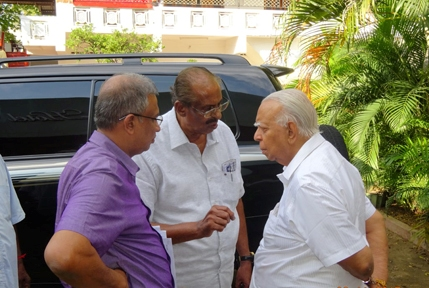
The group led by the veteran politician and former TNA Leader R Sampanthan met India’s new High Commissioner to Sri Lanka, Santosh Jha, on Monday, said the source from the Tamil National Alliance (TNA), which represents Sri Lanka’s Tamil minority.

The two-hour-long talks were centred on the 13 Amendment, which created the provincial councils system for the island nation’s nine provinces.

The Tamil parties pointed out the need for India’s intervention in the current Sri Lankan political context for the meaningful devolution of power, the source said.

They also highlighted the issue of the Tamil political prisoners and the Tamil land grabbing by the state.

India has been pressing Sri Lanka to implement the 13th Amendment brought in after the Indo-Sri Lankan agreement of 1987. The 13A provides for the devolution of power to the Tamil community.

The 13A became a part of Sri Lanka’s constitution in 1987 through the direct intervention of the then-Indian government led by Prime Minister Rajiv Gandhi as part of the Indo-Lanka Accord.

The current Tamil political parties are sceptical of the political will of the majority Sinhala to fully implement the 13A, the PTI report said.

Meanwhile, the Indian High Commission in Colombo reports that the new Indian High Commissioner had met with Tamil leaders of Northern and Eastern Provinces, and discussed the issues concerning political, economic and social development of the region.

“Reiterating India’s longstanding position on reconciliation and full implementation of the Thirteenth Amendment, High Commissioner reaffirmed India’s continuous commitment to work for the well-being of the people of this region”, the High Commission said in a tweet.

Protest in Batticaloa against anti-terrorism and online safety bills laws

A protest took place near Gandhi Park in Batticaloa yesterday (22) against two draft laws presented by the government.

Civil society activists held the agitation over the anti-terrorism and online safety bills.

Carrying placards, they marched from Kallady Bridge with calls to the government to safeguard fundamental rights, right to expression and assembly, and to respect human rights.

Among the protestors was former state minister Ali Zahir Moulana.

Police banned a one-day hunger strike planned after the protest.

The two proposed laws are coming under local and international condemnation.

Posted in Uncategorized