Rathana Thera tight-lipped over leader’s murder

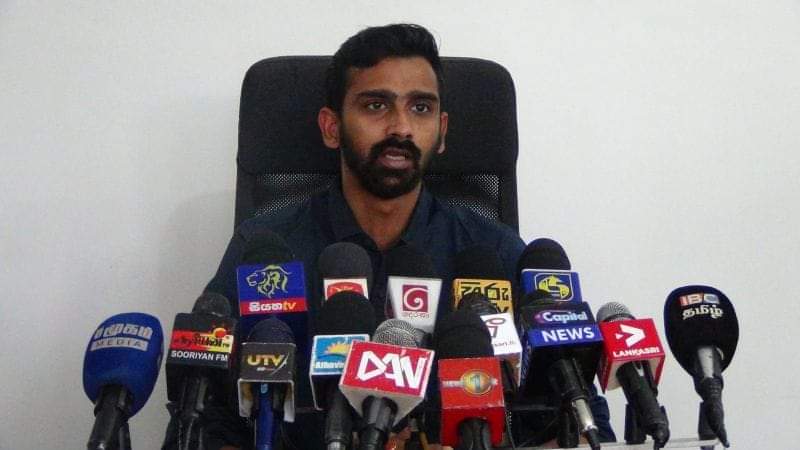
MP Ven. Athuraliye Rathana Thera has declined to comment on the murder of his party’s leader.

Chief of Apey Janabala Party Saman Perera was among the five persons gunned down in Beliatta yesterday morning (22).

Rathana Thera has been elected to parliament on the party’s national list.

Meanwhile, the Colombo chief magistrate’s court issued notice yesterday on Perera to appear before the court on 04 June.

That is related to a case in connection with death threats alleged to have been received by Rathana Thera over the phone.

The court had not been informed about Perera’s murder.

Posted in Uncategorized

India, first country to back Sri Lanka’s IMF relief programme – IHC Santosh Jha

In overcoming the worst crisis in Sri Lanka’ s history, the country’s neighbor, India, became the leading backer of the International Monetary Fund (IMF) relief programme, India’s High Commissioner to Sri Lanka Santosh Jha said.

“Our desire to work closely with the government and the people of Sri Lanka manifested most visibly during the Covid-19 pandemic and the economic crisis in Sri Lanka in 2022. Our response was driven by our neighbourhood-first policy, which is based on a strong sense of solidarity and an outcome based, non- reciprocal and generous approach, H.C. Jha said at a recent forum held at the Cinnamon Grand, Colombo titled, ‘Colombo Leadership Retreat: Aspire, Achieve, Inspire: Women in Leadership Roles’.

H.C. Jha added: ‘India stood shoulder- to- shoulder with the people of Sri Lanka as a trusted and reliable friend. We provided foreign exchange support as well as helped to source essential items like fuel, food and medicines from India. Overall, we deployed concessional loans and credit facility of around USD 4 billion.

‘I congratulated the All India Management Association (AIMA) for organizing the event to promote dialogue about and between the women leaders of India and Sri Lanka.

‘I am confident that such events will not only bring the peoples of our two countries together and forge deeper economic, social and intellectual exchanges but will help in promoting greater access for women to leadership roles in all sectors and organizations.

‘I am delighted that AIMA has gathered some top business leaders from India and Sri Lanka to address this exclusive event over the next three days. The presence of leaders of the industry such as Mr Pai and Mr Shivakumar here today attest to the importance and seriousness attached to this event.

‘The visit of President Ranil Wickremesinghe to India in July 2023 had created further momentum to the multifaceted partnership. During the visit, our countries adopted a vision document for strengthening India-Sri Lanka ties, centred on enhanced connectivity and promoting a deeper economic partnership. Our governments are closely working together to transform this vision into reality.

‘We are exploring synergies in new areas to achieve our economic and developmental aspirations jointly.

‘India strongly advocated international support for Sri Lanka at various fora. We were the first country to provide financing assurances to the IMF for the Extended Fund Facility programme to Sri Lanka. We co-chaired an Official Creditors Committee with Sri Lanka’s other bilateral creditors to hold discussions on debt restructuring.

`As in other neighbouring countries, development partnership is one of the strongest pillars of our bilateral relationship with Sri Lanka. We are undertaking projects through concessional lines of credit and grant assistance. Our support is to the tune of USD 5 million. We are involved in rehabilitation and modernization of Sri Lanka Railways; construction of houses for the poor; solar electrification of religious places; port development, renewable energy and connectivity, among others. One of the principal vehicles for project implementation has been the high impact community development project. This is particularly useful as it enables us to implement a larger number of relatively smaller projects with high community impact. It also enables us to cover all the different provinces of Sri Lanka, including remote locations and underprivileged sections.

‘Apart from this, India’s private sector is also contributing to infrastructure development in Sri Lanka. The newest addition to Sri Lanka’s skyline, ITC, is built with an investment of about USD 500 million.

`The West Container Terminal at Colombo Port and renewable energy projects in the North are some other shining examples of recent Indian investments in Sri Lanka. These projects are a symbol of the trust that Indian companies repose in the Sri Lankan economy and its people.

‘We are advancing multiple energy connectivity initiatives. These include the power grid connectivity, eventually to enable Sri Lanka to export power to India; the multiproduct pipeline to Trincomalee, which will help advance the Trincomalee Tank Farms and Harbour interests; and we are also working to set up a virtual LNG pipeline from Kochi to Colombo. These are in addition to the power projects that I have mentioned earlier, which along with the NTPC solar power project at Sampur promises to transform the Sri Lankan energy mix and profile.

‘It is well known that India is Sri Lanka’s largest trading partner. In 2022, bilateral merchandise trade between India and Sri Lanka stood at USD 6 billion.

`Our governments have recently resumed discussions on the Economic and Technology Cooperation Agreement, which seeks to further advance our trade and economic partnership beyond the Free Trade Agreement, which came into force in 2000. Once signed, it will help in achieving the true potential of the India-Sri Lanka trade partnership. If we go by the FTA experience, it will enable Sri Lanka to significantly expand its exports both in goods and services to India. This is also our objective in keeping with our Neighbourhood-First policy.

‘India has also been the largest source of investments to Sri Lanka in the past four years. We continue to work to generate greater interest among Indian industries to maintain this trend. Investments in infrastructure, energy, renewable energy, transport and telecommunications, among others, are likely to assist us in this regard.

`In the last 10 years we have emerged from being the 10th largest economy to becoming the 5th largest in the world. We are confident that by 2027-2028, we should emerge as the 3rd largest economy. Riding on economic reforms and various government programmes, such as the production linked incentive scheme, we seem to be on the cusp of a big manufacturing boom in India. However, the biggest stories are from the ongoing digital and green transition in India.

‘Not many in Sri Lanka may be aware that India is the only G20 country that is on track to implement and even exceed its Paris Climate commitments. The Climate Change Performance Index, rates India 10 places above the European Union, which is traditionally perceived as the climate leader. Our national electricity authority projections for 2032, predict that 68.4% of our energy capacity will come from non-fossil sources. We are promoting renewables at a breathtaking speed and also implementing ambitious targets for green hydrogen. Existing investment commitments and ongoing project implementation would confirm that green energy growth in India will maintain its current leadership of the climate agenda. There are of course also India-led initiatives, such as the International Solar Alliance, the Coalition for Disaster Resilient Infrastructure and the Life Initiative that are existing manifestations of our climate leadership.’

Introductory remarks at the forum were made by Rekha Sethi, Director General, AIMA. Welcoming remarks were by T V Mohandas Pai, chairman, Aarin Capital Partners and concluding remarks were by Shiv Shivakumar, Operating Partner at Advent International Private Equity and former chairman, PepsiCo India.

Google, Facebook could close up operations in Sri Lanka after OSB: Opposition MP

Sri Lanka might lose access to international platforms such as Google and Meta (formerly Facebook) with the introduction of the Online Safety Bill, Member of Parliament Eran Wickremeratne said in parliament.

“Once this law is introduced, they will review the offences they would be accused of and most likely close up its access to users in Sri Lanka. Further, if the Sri Lankan government requests for certain information from Google, they will most likely not comply anymore as it may be self incriminating,” Wickremeratne said on Tuesday (22) when the bill was being debated.

He was responding to the opening statement to the bill presented by Minister of Public Security Tiran Alles.

“The minister spoke about intermediaries, and that they were in agreement [with the bill]. But, it should be said that they are not in favour of the bill, of which they will express their displeasure through their own social media platforms,” the minister said, referring to representatives of information technology platforms.

In September 2023 the Asia Internet Coalition released a statement saying that it had concerns over the government’s push for the Online Safety Bill “without undertaking any stakeholder consultation”.

Notable members co-signing the statement were Google, Meta, X, LinkedIn, Apple, Spotify and Bookings.com.

“While our member companies take seriously the online safety of those who use their services, legislation should not dampen innovation by restricting public debate and the exchange of ideas that can consequently impact the digital economy.”

“We strongly urge the Government to work closely with industry stakeholders to develop regulations that are proportionate, reasonable, consistent with international best practices, and most importantly, support the growth of Sri Lanka’s nascent digital economy.”

Sri Lanka’s Supreme Court said in November that the controversial bill was eligible to be passed in parliament, once subject to amendments to 31 of its provisions.

Among the offences listed in the draft bill were the communication of false statements on incidents within Sri Lanka, false statements causing defamation, disturbing religious assembly through false statements, communication of false statements with the sole intention of hurting religious emotions, communication of false statements with the sole intention for the abomination of religious emotions.

In addition to the online truths, the bullet points also included criminal activities such as fraud, cheating and child abuse, as part of ‘Online Safety’.

The MP said that he had received the bill in its full form from the legal draftsman’s office only yesterday.

“Yesterday we went to the Sectoral Oversight Comittee, that was the first time we received the legal draftsman’s department’s copy. Other parliamentary ministers are likely to have never seen this.”

The MP said that the bill, which is meant to stringently regulate online platform use, will create a great risk for locals and foreigners.

“We shouldn’t just dwell on whether this is constitutional or not. We have to go beyond that… We as participants in a global digital economy, abide by international conventions such as the ICCPR.”

The minister said that creating avenues for dollar revenues through the technological and internet based sector is key. “That is why we should introduce laws that do not hinder the economy.”

UN experts call on Sri Lanka to immediately suspend and review ‘Yukthiya’ anti-drug operation

UN experts on Monday expressed alarm at the heavy security-driven approach of Sri Lanka’s drug response. They called on authorities to immediately suspend and review so-called Operation ‘Yukthiya’ and to focus on policies based on health and human rights.

“Drug users have human rights,” the experts said. “They deserve to live a life with dignity without facing further discrimination and stigmatisation.”

They deplored reported cases of arbitrary arrests of thousands of drug offenders from marginalised socio-economic groups, and the detention of hundreds in compulsory military-run rehabilitation centres. Torture and ill-treatment were also reported during the security operation known as ‘Yukthiya’.

“The current context of severe repression against suspected drug offenders is deeply worrying,” the experts said.

They stressed that rehabilitation must be conducted from a harm reduction perspective, respecting the autonomy and informed consent of drug users, including the right to refuse medication.

“Compulsory rehabilitation centres should be closed immediately and replaced by voluntary, evidence-based, rights-based and community-based social services,” said the experts, who stand ready to provide technical cooperation.

They urged Sri Lankan authorities to investigate thoroughly and impartially any allegations of torture, ill-treatment and denial of due process and fair trial rights.

“Irregularities in the judicial process of sending people to rehabilitations centres should also be investigated,” the experts said.

They called on the Government to review its current legislation on drug offences and to end the involvement of armed forces in drug control and treatment activities, in line with international human rights law and standards.

The experts raised concerns about Sri Lanka’s legislation on the treatment of suspected drug offenders in a letter sent to the Government in 2023.

The UN experts include Priya Gopalan (Chair-Rapporteur), Matthew Gillett (Vice-Chair on Communications), Miriam Estrada-Castillo, and Mumba Malila, Working Group on arbitrary detention; Margaret Satterthwaite, Special Rapporteur on the Independence of Judges and Lawyers and Tlaleng Mofokeng, Special Rapporteur on the right of everyone to the enjoyment of the highest attainable standard of physical and mental health.

Government likely to carry out feasibility study for 23-km sea bridge between India, Lanka

Will the government accelerate the proposal for construction of a sea bridge linking India’s Dhanushkodi— believed to be the place where Lord Ram had ordered Hanumana to build a bridge to carry his army across to Sri Lanka—with Talaimannar? Sources said the government is likely to carry out a feasibility study soon for building the 23-km bridge.

India and Sri Lanka had agreed to examine the viability for developing land access to the ports of Trincomalee and Colombo during Sri Lankan President Ranil Wickremesinghe’s visit to Delhi last July. Following this, the external affairs ministry (MEA) had held a meeting with other ministries and government agencies on this issue. Sources said the MEA officials had informed the meeting about its plan to carry out the feasibility study for the bridge before preparing a detailed plan.

“A host of issues pertaining to other sectors including dairy, oil, power and shipping which came up during Wickremesinghe’s visit were also discussed at the meeting. The long sea bridge would require huge funds, but it will prove to be a boon for bilateral trade. But for that, the government has to evaluate technical, economic, and environmental aspects to see whether it’s viable,” a source said.

The need for this sea bridge has been part of discussions for more than a decade. In December 2015, Union road transport minister Nitin Gadkari had spoken about the plan to build a road-cum rail bridge following his meeting with Wickremesinghe.

Posted in Uncategorized

Sri Lanka’s main opposition files petition against anti-terrorism bill

Sri Lanka’s main opposition party the Samagi Jana Balawegaya (SJB) has filed a petition against a proposed Anti-Terrorism bill which the party claims is being introduced in an election year to repress opposition parties.

The petition was filed by SJB general secretary Ranjith Madduma Bandara Monday January 22 morning at the Supreme Court.

Speaking to reporters, the MP said the proposed bill is a threat to Sri Lanka’s opposition parties and to democracy itself.

“This bill is being presented not at a time of terrorism prevailing in the country but during an election period. The bill has not defined nor analysed what a terrorist is. Anyone can be arrested,” he said.

“We think this is being done in the face of an election to repress political parties and stifle democracy of this country. That is why we filed a case against this, for democracy,” he added.

The MP said both the anti-terrorism bill and the controversial Online Safety Bill are being introduced in an election year to quell democracy.

Sri Lanka’s proposed new counter-terror law as well as the Online Safety Bill has drawn criticism from various quarters including opposition parties and civil society. Most recently, the Centre for Policy Alternatives (CPA) said in early January that the introduction of the two bills and other measures are some examples where Sri Lanka’s space for dissent is “fast shrinking with fears of increasing authoritarian and militarised trends that erode the rule of law and threaten Sri Lanka’s fragile peace.”

“In such a context, CPA urges the government to withdraw these bills and initiate a process at genuine confidence building measures and reform that addresses the multiple challenges confronting Sri Lanka,” it said.

Human rights activists both local and international have repeatedly called for the repeal of the island nation’s existing Prevention of Terrorism Act (PTA), which critics have called draconian. The proposed new Anti Terrorism Act which was supposed to replace the PTA has also been the target of much criticism both locally and internationally.

The Human Rights Watch (HRW) said in April 2023 that the act, if passed, would empower the authorities to systematically violate fundamental human rights.

The Anti-Terrorism Bill, which was published on March 22, 2023, is intended to replace the “notorious” PTA, HRW said in its statement, which led to “widespread torture and arbitrary detentions since its introduction in 1979”.

Posted in Uncategorized

Fate of the 13th amendment hangs in the balance By Veeragathy Thanabalasingham

The present Sri Lankan constitution, in place for more than four and a half decades, has seen 21 Amendments. Most of them were brought by incumbent Presidents to suit their political interests and were fundamentally anti-democratic.

But the 13th Amendment, which has a relatively democratic dimension in comparison, has long been the subject of intense political controversy. This write has already discussed several times the controversies surrounding it. It was brought in to create Provincial Councils after the July 1987 India-Sri Lanka Accord, has been a part of the Constitution for three and a half decades.

The author is induced to write about it again by a statement issued this week by former minister and High Commissioner in India Milinda Moragoda.

Moragoda, the founder of the ‘Pathfinder Foundation’, has insisted that the parties should give priority to the abolition of the Provincial Council system in their manifestos for the upcoming national elections.

This is not the first time that he has demanded the abolition of the Provincial Council system. Ahead of the 2020 general elections, he had asked political parties to express their position in manifestoes regarding the repeal of the 13th amendment and the abolition of the provincial council system. But no party did.

Moragoda did not speak much about the abolition of Provincial Councils during his more than two years’ tenure as Sri Lanka’s High Commissioner to India. But after coming back from India, he has started talking about it.

A statement issued by his office reiterated his earlier position that provincial Councils should be abolished and their powers given to reorganized Local Councils.

“Local councils are in a better position to address and solve community-level problems as they work closer to the citizens. A small country of 22 million people does not require another unnecessary layer of administration,” he said.

“Abolition of Provincial Councils should be part of an overall strategy to restructure and modernize Sri Lanka’s governance and economy. Provincial Councils can be replaced by a district-level framework which would consist of relevant Members of Parliament, existing key local government office – bearers and other key stakeholders.”.

” The original intent of the 13th amendment, enacted in 1987, was to create more provincial autonomy to help solve Sri Lanka’ s ethnic problem. Instead this structure has proven to be superfluous, expensive, divisive and fraught with inefficiency.

” Rather than having an unnecessary layer of expensive administration, an empowered Senate / Upper House be set up to address issues concerning ethnic, religious and regional diversity. A representative and properly composed forum of this nature would be best positioned to identify solutions for many of the complex issues facing our nation today ” the statement said.

Despite Moragoda’s arguments, none of the main candidates in the Presidential election is likely to express any position on the 13th Amendment in the manifestoes. To get 50% percent plus one vote in the first round, parties will be concerned about securing additional votes from minority communities. So it can be hoped that they will not listen to Moragoda’s request and not take any position that could damage their chances.

At the same time, we can expect them to focus on a stand that does not alienate the majority Sinhalese community or the minority communities.

President Ranil Wickremesinghe, who met Tamil parliamentarians including veteran leader R Sampanthan last December, said that the parliament to be elected in the next general election will take forward efforts for a political solution through a new constitution.

There is no doubt that he made the announcement with the tactful intention of ensuring that the issue of a political solution does not become a key talking point in the next Presidential election.

Wickremesinghe, who announced early last year that the government would fully implement the 13th Amendment step by step over two years, stopped talking about it following protests in the Sinhala South.

The President said that the 13th Amendment, which is a part of the Constitution, should be implemented or it should be abolished. He also suggested that any member of Parliament could bring a new constitutional amendment as a private member bill to abolish the Amendment. But even members of parliament who are strong Sinhalese nationalists are not willing to do so.

There is an allegation that Wickremesinghe pavde the way for more protests against the 13th Amendment in the South than before by way of his haphazard handling of the issue.

He said at one point that it was up to Parliament to decide on the implementation of the 13th Amendment without police powers, but then decided that nothing could be done through the current Parliament and has now handed over the responsibility to the next Parliament.

During his four-visit to the Northern Province earlier this month, the President, at a dinner with professionals, urged the provinces to utilize the powers granted by 13th amendment for economic development asserting that devolution should not merely be a political concept but an economic reality. He did not mention anything about the ethnic problem or a political solution.

But, it is astonishing to note that hardline Sinhala politicians like Wimal Weerawansa interpreted the President’s comments as an attempt to implement 13 Plus!

The Tamil political parties, who have been saying that the 13th Amendment is not a basis for a lasting political solution to the ethnic problem, have now requested the government to fully implement the amendment and hold Provincial Council elections as an interim measure. This is the latest position of the Tamil parties regarding the amendment.

A suspicion has long been lingering in the people’s minds that someday a Sri Lankan government may do away with the existing devolution arrangement in the form of the 13th Amendment in an attempt to bring in a new constitution. But there is also a belief among Tamil people and Tamil parties that India will never allow it.

One day a question will arise as to why India has to keep insisting on the implementation of an amendment that doesn’t have the support of Tamils and Sinhalese. Another question is how much India will care to prevent the abolition of the devolution arrangement in the midst of changing geopolitical conditions.

New Delhi is well aware that Colombo no longer wants to involve it in issues related to the Tamil problem in bilateral relations.

There is a huge difference between the international political situation that prevailed in the 1980s when India directly intervened in the Sri Lankan ethnic conflict and the situation today. But Tamil parties feel that they have no choice but to appeal to New Delhi. They do not seem to have a proper understanding of India’s current level of concern in the Sri Lankan ethnic problem after a bitter experience of several decades. Still, Sampanthan often says that India would never abandon the Tamils.

The 13th Amendment is the only devolution arrangement in the Sri Lankan Constitution. No one needs to be a political expert to understand that it would never have been possible had it not been for India’s direct intervention. If one day a Sri Lankan government does away with the 13th amendment, can such an arrangement be brought back through the domestic process given the fiercely anti devolution mood in the South?

The Tamil people (not Tamil politicians), cannot help thinking about this question. Interpreting this question as one in favour of the 13th Amendment or not would surely be nothing more than a contrarian approach to the issue that will not bear fruit. There should be a conscious concern for the plight of the Tamils on the part of the Tamils themselves.

Posted in Uncategorized

Cardinal Ranjith Calls for Leaders Aligned with Updated Laws

Cardinal Malcolm Ranjith asserted that Sri Lanka’s issues cannot be solved with outdated laws and leaders who ignore the country’s unique context.

Speaking during the feast at the St. John the Baptist’s Church in Mutwal on Sunday (21) morning, he emphasized the need for leaders with an attitude “that fits the culture and suits the country” to effectively address the nation’s problems.

The Cardinal challenged the notion that simply following the agendas of other parties will bring solutions. He stressed the importance of realistic, locally-tailored approaches.

He argued that societal change is not achieved through strict laws and burdening the people.

He argued that societal change is not achieved through strict laws and burdening the people. He pointed to the current Parliament’s new legislation, citing the Ceylon Electricity Board Act as a prime example. “No one knows the details of the Act,” the Cardinal said, questioning its utility for the people.

He questioned how it serves the people and stressed that the country needs a political framework that allows the people to have meals.

The Archbishop of Colombo said the judiciary should not be interfered with as it affects the respect towards the law, and stressed that leaders have no right to interfere with the law.

Sri Lanka seeks UN help for Vesak celebrations

The government is in discussions to get financial aid from the United Nations for its 2024 State Vesak festival, Minister of Religious and Cultural Affairs Vidura Wickramanayake has said.

The Chinese Cultural Promotion, Buddhist Culture and Art Association had agreed to the minister’s request to facilitate support from the United Nations for the State Vesak festival, Wickramanayake who is in China, was quoted as saying in a statement by the Department of Government Information.

A delegation from the Association will visit Sri Lanka to discuss this further, the statement said.

Wickramanayake had also requested the Association to provide an opportunity for Buddhist monks from Sri Lanka to visit China and study Mahayana Buddhism.

Vesak, a Buddhist religious holiday which marks the birth, enlightenment and death of Lord Buddha is celebrated in Sri Lanka with much fanfare; the construction of pandals and the display of lanterns attract large crowds at night over a few days.

The government generally closes liquor stores during the Vesak week. Last year, this resulted in a tax revenue loss of around one billion rupees for the government, the Department of Excise said at the time.

Posted in Uncategorized

Grave concerns raised over Ranil’s attempt to enforce dictatorship

A number of media rights groups, civil society and trade unions have raised concerns over President Ranil Wickremesinghe’s alleged attempt to take the country into a dictatorship by bringing repressive laws.

Issuing a joint statement, the Media, Civil Society and Trade Union Collective said the new laws will restrict the public’s right to expression, right to organize and space for civil activities quite contrary to the basic values of the democracy.

The joint statement said:

We, as citizens who are expecting a good and profound change in the socio-political system, express our grave concern about the attempts by the government led by President Ranil Wickremesinghe to take the country into a dictatorship by bringing repressive laws restricting the public’s right to expression, right to organize and space for civil activities quite contrary to the basic values of the democracy.

Planning to pass the Online Safety Bill next week, tabling the Anti Terrorism Bill in Parliament and other repressive laws show us that attempts are being made to suppress the public’s right to expression as a narrow effort with the aim of winning the upcoming elections at any cost.

We, as signatories to this statement as citizens, civil activists and trade unionists that hold the sovereignty of the country firmly believe a President who was not elected through a public mandate and a parliament consisting of rejected public representatives does not have a moral right to pass repressive legislation and impose new laws.

The forthcoming election is crucial for the country as it’s going to be held following the people’s struggle, which was triggered due to unbearable pressure mounted on the public, to demand a system change and democratic governance that is not corrupt and people-friendly. It is essential to ensure that the next election is free and fair, providing a public platform for debate and discussion without any censorship to access to information that is accurate, balanced, impartial and non-partisan. All opportunities should be guaranteed for the ruling party as well as for the opposition parties to inform their ideas and policies to the public.

Laws that are silencing and terrifying citizens are causing harm to the people’s friendly environment and democracy. A country which has been brought to the brink of destruction by some politicians and corrupt officials for a long time no longer needs dictatorial rulers sitting above the law. Therefore, as a citizens’ collective force, we urge the President and the government, opposition and all political parties representing the parliament to create a democratic environment.

The Online Safety Bill presented by the government was challenged before the Supreme Court by 45 petitioners. At the outset of the hearing, the Attorney General’s Department submitted over 32 amendments to the bill. Following the hearing, the Supreme Court determined that 31 clauses needed to be amended.

The Asian Internet Coalition, consisting of world-renowned companies pointed out to the subject minister in two long letters; one before the Supreme Court determination and another followed by, that the principles of international regulation had been violated by the bill. The validity of the bill was completely annulled following the Supreme Court ruling. A civilized government should have thrown it into the dustbin. However, the government led by the President has made a shameful attempt to pass the bill with amendments by presenting it to the parliament again on 23 January.

The Attorney General’s Department was disgraced on the first day itself as the Attorney General had to propose amendments to the bill when it was challenged before the Supreme Court. It indicated that the AG had cleared and presented the draft bill, prepared by someone else without doing a proper study of it. In our opinion as a collective, it is that the Attorney General should be resigned in order to compensate for the disgrace caused to the department. Our stand is that the government should immediately withdraw this defect bill without causing further disgrace to the country internationally.

We believe that there is no requirement for a draft bill to control the internet as the country has enough legislation in place to counter crimes occurring on the internet.

Legal experts have pointed out that the amendments recommended by the Supreme Court to the Online Safety Bill were not taken appropriately by the Public Security Minister for the second reading of the bill in the parliament. They are of the view that it’s a serious situation. We urge the government to immediately withdraw the bill without being presented for second reading. If the government still wants a bill, it can be decided upon through a lengthy consultation with stakeholders as requested by the Asian Internet Coalition, embassies and the United Nations.

Acting Inspector General of Police Deshabandu Tennakoon was convicted by the Supreme Court for torture and cruel treatment. However, the President and the government continue to keep him in the position of ignoring and undermining the judiciary, a basic pillar of sovereignty. This shows the government’s desire to move towards a dictatorship. Meanwhile, the government is also attempting to bring a single act named the Employment Bill replacing 13 acts including the Trade Unions Ordinance, Industry Dispute Act and Wages Council Ordinance affecting over 3.6 million private sector employees and without reaching an agreement with trade unions.

We recognize it as another sign of the dictatorship through the various repressive actions by the government against trade unions and civil society against their right to organize and the bill on Non-Governmental Organizations. We demand the government to withdraw all these bills immediately and enter a consultation process with stakeholders.

If the government still attempts to present the bills by ignoring all these factors, we respectfully urge the progressive MPs of the ruling party as well as all MPs in the opposition to defeat them at the second reading. We emphasize as a citizens’ collective; we won’t hesitate to take all measures through democratic means to defeat all the MPs who will vote in favor of the bills without responding to people’s voice.

We condemn the president’s attempt to become a dictator using executive powers amidst all these developments. We urge all political parties and also propose all public representatives to commit to building a democratic country where all citizens can live with respect and dignity by abolishing the executive presidential system before the next election or in a very short period of time.

A list of persons and organization signed the above statement representing the media, civil society, and trade unions are mentioned below.

Free Media Movement

Sri Lanka Working Journalists’ Association

Young Journalists’ Association of Sri Lanka

Media Law Forum

Law and Society Trust

National Cooperative Development Fund

Hashtag Generation

Association of Health Professionals

Sri Lanka Postal and Telecommunication Service Union

All Ceylon Management Service Officers’ Union

South Asia Free Media Association

Ceylon Teachers’ Union

Ceylon Trade Union Federation

United Postal Trade Union Front

Savisthri National Women’s Moment

Uva Wellassa Women’s Organization

Movement for the Defence of Democratic Rights (MDDR)

Free Media Movement Tarde Union (FMMTU)

Ceylon Teachers’ Union

Moment for Land and Agriculture Reform (MONLAR)

National Fisheries Solidarity Movement (NAFSO)

Shramabhimani Center

Dabidu Collective

Women’s Action for Social Justice (WASJ)

United Federation of Labour (UFL)

Federation of Media Employees Trade Unions (FMETU)

Muslim Media Forum

Jaffna Press Club

Tamil Women Journalists Association

Tamil Media Alliance

Transparency International Sri Lanka

Free Trade Zone Union

South Asian Women in Media Network- Sri Lanka

Ceylon Bank Employees Union (CBEU)

South Asian Free Media Association

People’s Commission of Women in Sri Lanka

The Voice of Truth

Stand Up Movement in Sri Lanka

Trade Union to Upliftment of Sri Lanka Railway

Freedom Trade Union Center (FTUC)

Prabha Abhilasha Network

People’s Alliance for Right to Land (PARL)

Voice of the plantation people organization (VoPP)

Sri Lanka All Telecommunication Employees’ Union

Unite – Trade Union and Mass Organization Collective

Media.LK

RED Organization

Nature Foundation

Media Pro-Tech

PEN Sri Lanka

National Movement for Social Justice

Standup Workers Union

Asian Media and Cultural Association

Women Center Sri Lanka

Protect Union

Human Rights Documentation Center (INFORM)

Father Sarath Iddamalgoda

Prof Arjuna Pararkarama

Prof Liyanage Amarakeerthi

Prof Nirmal Ranjith Dewasiri

Prof Vijaya Jayathilaka

Dr Ravindra kariyawasam

Dr Rathna Sri Wijesinghe

Dr Kalpa Rajapaksa

Senior Lecturer Anuruddha Pradeep Karnasuriya

Thusitha Siriwardena, Attorney at Law

D M Dissanayake, Attorney at Law

Journalist Seetha Ranjanee

Journalist Hana Ibrahim

Journalist Upali Kolambage

Journalist Ananda Dharmapriya Jayasekara

Journalist Thimbiriyagama Bandara

Journalist Saroj Pathirana

Journalist T M G Chandrasekara

Senior researcher Sarath Kellapatha

Journalist Tharindu Iranga Jayawardena

Journalist Sujeewa Senarath

Littérateur S Nandalal

Social Activist Jayani Abeysekara

Journalist Jayasiri Jayasekara

Journalist Prasad Poornimal

Journalist Shalika Wimalasena

Civil and Human Rights Activist Cyril Pathirage

Creativist Nandasiri Dhrmaratne

Dramatist and Civil Activist Roy Rodrigo

Journalist Indika Roshan Garusinghe

Journalist Chamara Sampath

Civil and Human Rights Activist Suranga Rupasinghe

Journalist Priyan R Wijebandara

Environmentalist Hemantha Withanage

Environmentalist Sajeewa Chamikara

Trade Unionist Chinthaka Bandara

Dramatist Ranasinghe Adhikari

Lyricist Sudath Gamini Bandara

Social Activist Thamara Dayani Heetimullage

Shrinath Perera, Attorney at Law

Journalist Nayanajeewa Bandara

K.W. Janaranjana, Attorney at Law

Journalist K. Sanjeewa

Journalist Lasantha Ruhunage

Journalist Sunil Jayasekara

Journalists Sakeef

Marine Engineer Kamal Wanniarachchi

Social Activist Manjula Gajanayake

Journalist Manjula Wediwardhana

Social Activist Udaya Kalupathirana

Economist Umesh Moramudali

Social Activist Sandaya Eknaligoda

Journalist Poddala Jayantha

Journalist Thushara Weerarathna

Journalist Jini Jayasekara

Journalist R. Yasiharan

Social Activist Saman Senevirathna