India to develop all-round cooperation with Sri Lanka

India has noted its abiding commitment to develop an even stronger all-round cooperation with Sri Lanka in line with India’s Neighbourhood First policy, with people being at the centre of this cooperation.

The High Commissioner of India to Sri Lanka Santosh Jha visited the prominent Gangaramaya Temple in Colombo to pray to the Lord Buddha for health, peace and prosperity of the people of Sri Lanka and India and the longstanding friendship between the two countries. The High Commissioner’s spouse, Mrs. Tanuja Jha also accompanied him for the visit.

At the Temple, the High Commissioner was welcomed by Venerable Dr. Kirinde Assaji Thero, the Deputy Incumbent of the temple. Venerable Dr. Kirinde Assaji Thero warmly recalled Prime Minister Modi’s visit to the temple in 2017, wherein he had inaugurated the International Vesak Day Celebrations.

Venerable Assaji Thero also shared his learnings from the times he studied in India, the land of Lord Buddha’s enlightenment, and underlined the importance of the civilisational ties between the two countries. He blessed High Commissioner Jha and Mrs. Jha by tying pirith noola on their hands after conducting the special Puja at the temple.

The High Commissioner stressed on the commitment of India’s leadership to strengthen multifaceted ties, especially the deep civilisational, historical, religious and cultural bonds. He also discussed with the Venerable Thero the current engagement of the High Commission of India in offering scholarships for the monks for their higher studies in India along with other developmental projects carried out to strengthen the Buddhist ties between both countries, including the recently signed MoU for solar electrification of religious temples under USD 10 mn Indian grant.

The High Commissioner reiterated India’s abiding commitment to develop an even stronger all-round cooperation with Sri Lanka in line with India’s Neighbourhood First policy, with people being at the centre of this cooperation.

Posted in Uncategorized

Japan wants Sri Lanka to repay due for LRT cancellation to resume stalled projects

Japan has informed that in order to commence the stalled projects, Sri Lanka must repay due for the cancellation of Colombo Light Rail Transit Project (LRT).

The Japanese Finance Minister Suzuki Shunichi, who was on a two-day official visit to the island-nation has reportedly emphasized this, when he met President Ranil Wickremesinghe and the Opposition Leader Sajith Premadasa.

In March 2019, the Japanese government agreed to grant loan assistance of USD 1,800 million for the LRT system project which was to be implemented that year and completed by 2026, as a solution for the traffic congestion in the city of Colombo and its suburbs.

Japan International Cooperation Agency (JICA) had agreed to provide financial facilities under concessionary credit conditions while the Oriental Consultants Global Company of Japan had agreed to provide consultancy services in collaboration with several other companies.

On March 11, 2019, Japan and Sri Lanka signed the loan agreement and exchanged notes pertaining to the project, which had been designed to construct a 17km-long elevated rail track including 16 stations to cover important and major intersections from Malabe to Colombo Fort.

Under the project, it had been proposed to deploy 25 trains for the service and each unit was supposed to comprise four air-conditioned passenger compartments to accommodate 800 passengers.

The total estimated cost of the project was Japanese Yen 246,641 million, and JICA was to provide JPY 200,415 million (approximately USD 1,800 million) as a concessionary loan. The company had provided the facility of paying the said loan over a period of 40 years including a grace period of 12 years and the annual interest rate thereon was 0.1 percent.

However, in September 2020, the then-Cabinet of Ministers gave the nod to terminate the project citing heavy operating costs, and environmental damage among other reasons.

A report compiled by the National Audit Office in December 2022 revealed that Sri Lanka incurred a loss of Rs. 5,978 million after former President Gotabaya Rajapaksa-led government unilaterally terminated the LRT project.

In May 2023, the current Cabinet of Ministers decided to green-light the revival of the project days before President Wickremesinghe departed for Japan for an official visit. The decision was taken in a bid to restore Sri Lanka’s credibility with the international community.

Posted in Uncategorized

13 A: Prez accused of abusing GR’s mandate

Dissident SLPP National List MP Gevindu Cumaratunga has accused President Ranil Wickremesinghe of blatantly abusing ousted predecessor Gotabaya Rajapaksa’s mandate.The lawmaker questioned UNP leader Wickremesinghe’s recent declaration in Jaffna regarding the 13th Amendment to the Constitution, enacted in 1988, at the behest of India.

MP Cumaratunga yesterday (12) told The Island that he raised the issue in Parliament early this week, close on the heels of President Wickremesinghe’s high profile visit to Jaffna.

The MP, with an impeccable patriotic pedigree, said that those who voted for Gotabaya Rajapaksa at the Nov 2019 presidential election and gave the SLPP a nearly 2/3 majority at the parliamentary election, the following year, endorsed the country’s unitary status. The Parliament elected Wickremesinghe to complete the remainder of Gotabaya Rajapaksa’s five-year term, Cumaratunga said.

Addressing a gathering in Jaffna, President Wickremesinghe urged all provinces to utilize the powers within the 13th Amendment to achieve development. President Wickremesinghe declared that time was opportune to utilize the 13th Amendment.

Referring to a recent statement made by the Director General of the Office for National Unity and Reconciliation (ONUR) Deepthi Lamahewa, MP Cumaratunga said that the official who had been always supportive of devolution of power to the regions criticized the Provincial Councils for hindering post-war national reconciliation process.

MP Cumaratunga, in his address to Parliament, quoted Lamahewa as having said that Provincial Councils were an obstacle to reconciliation process.

At the onset, lawmaker Cumaratunga pointed out that seven lawmakers, representing the Tamil National Alliance (TNA) and All Ceylon Tamil Congress (ACTC), voted against the ONUR Bill on January 09 even though the new law was meant to appease the Tamil speaking community. Parliament passed the Bill with 48 MPs (SLPP 45+SLPP dissidents 2 +SJB dissident 1) whereas seven opposed and 169 skipped the vote.

Commending Justice Minister Dr. Wijeyadasa Rajapakse, PC, for the spearheading role he played in enacting new laws, ONUR and new Hydrography Bills, MP Cumaratunga said that they owed an explanation why the Tamil voted against the Bill at its Second Reading.

MP Cumaratunga said that if Tamil parties felt that particular Bill required amendments, they could have followed proper procedure to do so at the Committee Stage. Instead, they voted against the Bill.

TMVP leader Sivanesathurai Chandrakanthan aka Pilleyan (Batticaloa District), formerly of the LTTE, voted for the Bill. Lawmaker Cumaratunga was not present in Parliament at the time of voting.

Ahead of the Committee Stage, lawmaker Cumaratunga told Parliament that when the Sectoral Oversight Committee (SOC) on Reconciliation and National Unity examined the ONUR Bill on January 02, 2024, he proposed that the appointment of members to the ONUR office should be subjected to the approval of the Constitutional Council. MP Cumaratunga proposed that those who had been proposed by the Justice Minister and appointed by the President should be subjected to CC’s approval.

However, the Chairman of the SOC on Reconciliation and National Unity MP Dilan Perera hadn’t presented his colleague’s proposal at the Committee Stage, therefore, it was not accommodated. MP Cumaratunga said that when he inquired from the Secretary to the SOC about the status of his proposal he was told the Secretary to the Justice Ministry had been duly informed in this regard.

MP Cumaratunga appreciated President Wickremesinghe, during his recent visit to Jaffna, giving ear to Jaffna-based civil society activist Arun Siddharthan, who wants to unite the races to fight the country’s problems, Lawmaker Cumaratunga, who is also the leader of the Yuthukama civil society group, flayed the Northern and Eastern Provincial Councils for failing to re-open at least one of the Sinhala schools that had been closed down during the war. The MP said that their failure to do so, 15 years after the end of the conflict, couldn’t be justified under any circumstances.

AG tells COPF that Port City Commission cannot formulate duty-free rules for malls there

The Attorney General has informed the Committee on Public Finance (COPF) that the Port City Commission is not empowered to formulate duty-free rules for duty-free malls at the Colombo Port City.

This was revealed at a recent meeting of the COPF.The officials from the Port City Commission, who were present, owned up to the error and assured that the rules would be revoked by the end of this week.

However, the Port City Commission has already entered agreements with four investors based on these rules.

No official stepped forward to take responsibility.Given lack of clarity and accountability, the Committee was of the opinion that the aforesaid regulations had to be revoked forthwith.

The Committee directed the Ministry of Investment Promotion to identify the responsible party and asked them to outline measures to prevent similar errors in the future.

Such action was deemed essential to safeguard against potential discouragement of future investments, the committee said.

Furthermore, the Committee on Public Finance considered Gazette Extraordinary No. 2334/39, as per Section 24 of the Board of Investment (BOI) of Sri Lanka Law, No. 4 of 1978.

State Minister (Dr.) Suren Raghavan and Members of Parliament Patali Champika Ranawaka, Chandima Weerakkody, (Dr.) Nalaka Godahewa, Hon. Nimal Lanza, Premnath C. Dolawatte, Madhura Withanage, Mayantha Dissanayake, Rauff Hakeem, M. W. D. Sahan Pradeep, (Dr.) Major Pradeep Undugoda, Isuru Dodangoda were present at the Committee meeting held.

Posted in Uncategorized

Sri Lanka Faces Higher Educational Crisis as 900 University Lecturers Emigrate in 2023

In a concerning trend for Sri Lanka’s higher education sector, approximately 900 university lecturers left the country in 2023, with expectations of more departures in 2024, as reported by the Federation of University Teachers’ Associations (FUTA). This brain drain poses a significant challenge for Sri Lankan universities, which currently face a staggering 50% vacancy rate among lecturers.

The shortage is particularly acute as Sri Lankan universities require around 13,000 academics to operate optimally, considering the student population of approximately 155,000. However, with only 6,500 lecturers currently employed in public universities, the education system is grappling with a severe deficit.

Multiple factors contribute to this exodus, with the country undergoing its worst economic crisis and deepest recession since gaining independence from Britain in 1948. The economic downturn is reflected in a Central Bank of Sri Lanka report, indicating negative growth of -7.4% in 2022 and -3.8% in 2023.

Posted in Uncategorized

AKD Blasts Sri Lankan President’s Spending, Calls for Financial Discipline

In a scathing critique of the government’s financial priorities, Anura Kumara Dissanayake, Leader of the Jathika Jana Balavegaya, today lambasted President Ranil Wickremesinghe’s spending habits and called for stricter financial discipline.

Dissanayake zeroed in on two specific allocations: Rs. 1.3 billion for Sri Lanka Telecom (SLT) restructuring and Rs. 200 million for the President’s overseas travel, fuel, vehicle maintenance, and arrears.

He questioned the logic of allocating hefty sums for SLT privatization while the nation grapples with economic hardship. Regarding the President’s expenses, he asserted that “the President should be the first person to comply with financial discipline” and condemned the additional funds allocated after an already inflated budget for travel and vehicles.

Dissanayake further scrutinized the President’s frequent overseas travels, highlighting 14 trips in 14 months, including four UK visits, two Japan trips, and an upcoming “longest tour” of nearly two weeks. He contrasted this with previous presidents and questioned the necessity of attending summits where other world leaders were absent.

Dissanayake also drew attention to the irony of the President’s travel expenses while basic necessities like rice, milk powder, diesel, and medical supplies are subject to Value Added Tax (VAT).

He then turned his focus to the Rajapaksa family, questioning the continued use of state residences by former President Mahinda Rajapaksa and his son, Namal Rajapaksa, and other Rajapaksa family members.

The Leader of the Jathika Jana Balavegaya also cast doubt on the purpose of a recent nighttime vessel tour undertaken by the Former President, questioning his ability to participate meaningfully given his health limitations.

HRW accuses Sri Lanka of regressive policies

Regressive government policies and inadequate social protection left many Sri Lankans at risk from the worst effects of the country’s economic crisis, Human Rights Watch said in its World Report 2024.

The Government of President Ranil Wickremesinghe continued to repress freedoms of expression and association, and pursue policies that discriminate against minority communities.

“Millions of Sri Lankans are struggling to survive an economic crisis that partly originated in corrupt, unaccountable governance,” said Meenakshi Ganguly, Deputy Asia Director at Human Rights Watch. “The current administration is responding with policies that weigh heaviest on those who have least, while suppressing voices that are essential for accountable, democratic decision-making.”

In the 740-page World Report 2024, its 34th edition, Human Rights Watch reviews human rights practices in more than 100 countries. In her introductory essay, Executive Director Tirana Hassan says that 2023 was a consequential year not only for human rights suppression and wartime atrocities but also for selective government outrage and transactional diplomacy that carried profound costs for the rights of those not in on the deal. But she says there were also signs of hope, showing the possibility of a different path, and calls on governments to consistently uphold their human rights obligations.

The Sri Lankan government and International Monetary Fund’s (IMF) response to the economic situation undermined human rights in the country. More than 17 percent of the population are moderately or acutely food insecure and in need of humanitarian assistance, and 31 percent of children aged under 5 are malnourished, according to the United Nations. The IMF program focused on raising government revenues, and emphasized tackling corruption and improving social protection, but as structured it shifted the burden of recovery principally onto people with low incomes.

The Government raised electricity tariffs, doubled value-added taxes, and phased out fuel subsidies. The reform program included a “social spending floor” set at 0.6 percent of GDP, less than half developing countries’ average. The government’s plan of targeted social protection benefits led to the exclusion of many who do not have an adequate standard of living. In an attempt to manage its domestic debts, the government reduced the value of state-run pension funds in which ordinary people hold their savings.

The families of victims of enforced disappearance and human rights defenders in the north and east, faced government surveillance and intimidation. Government agencies pursued a policy of “land grabbing” that targeted the property of Tamil and Muslim communities, including religious sites.

President Wickremesinghe sought to suppress dissent, ending a moratorium on the use of the draconian Prevention of Terrorism Act. A proposed new counterterrorism law, which was withdrawn for further revision, would grant authorities sweeping powers and create new speech-related offenses. The proposed Online Safety Bill would further restrict speech by creating a commission, appointed by the president, that could decide whether online statements were false or prohibited, order their removal, and participate in police investigations and prosecutions.

Posted in Uncategorized

CWC opposes move to privatise State plantations

Vice President of the Ceylon Workers’ Congress (CWC) and Head of the Plantation Manpower Institute Bharat Arulsamy, has vehemently opposed the potential privatisation of key Sri Lankan State-owned plantation entities, namely the Sri Lanka State Plantation Corporation (SLSPC), Janata Estate Development Board (JEDB) and Elkaduwa Plantations.

The Government has already announced that loss-making State-owned enterprises would be privatised and these three entities are on the list.

Following State Minister of Finance Ranjith Siyambalpitiya’s announcement in Parliament about the intended privatisation yesterday (10), confusion has gripped the workers in these State-owned sectors, Arulsamy said.

He emphasised that the CWC stands firm against this move, ensuring that workers’ dues, including land rights, are duly honoured to prevent injustice to those who have dedicated decades to these estates.

Arulsamy raised this concern, highlighting that the matter was brought to the attention of Estate Infrastructure Development Minister Jeevan Thondaman, expressing strong opposition to the privatisation of these State plantations.

He stressed that should the Government proceed with its privatisation plans, adequate compensation in the form of EPF and ETF, along with service allowances, must be ensured for the affected workers.

Further, the demand for rightful ownership transfer of the houses and lands presently occupied by the workers. He emphasised the need for a just solution, suggesting the allocation of one acre of land per worker to enable them to become small-scale tea growers, thereby providing a sustainable solution for their livelihoods.

SJB asks whether govt. decided to do away with LG elections

Former Samagi Jana Balawegaya (SJB) parliamentarian Mujibur Rahuman yesterday (10) asked whether the Wickremesinghe-Rajapaksa government had decided to do away with Local Government (LG) polls.

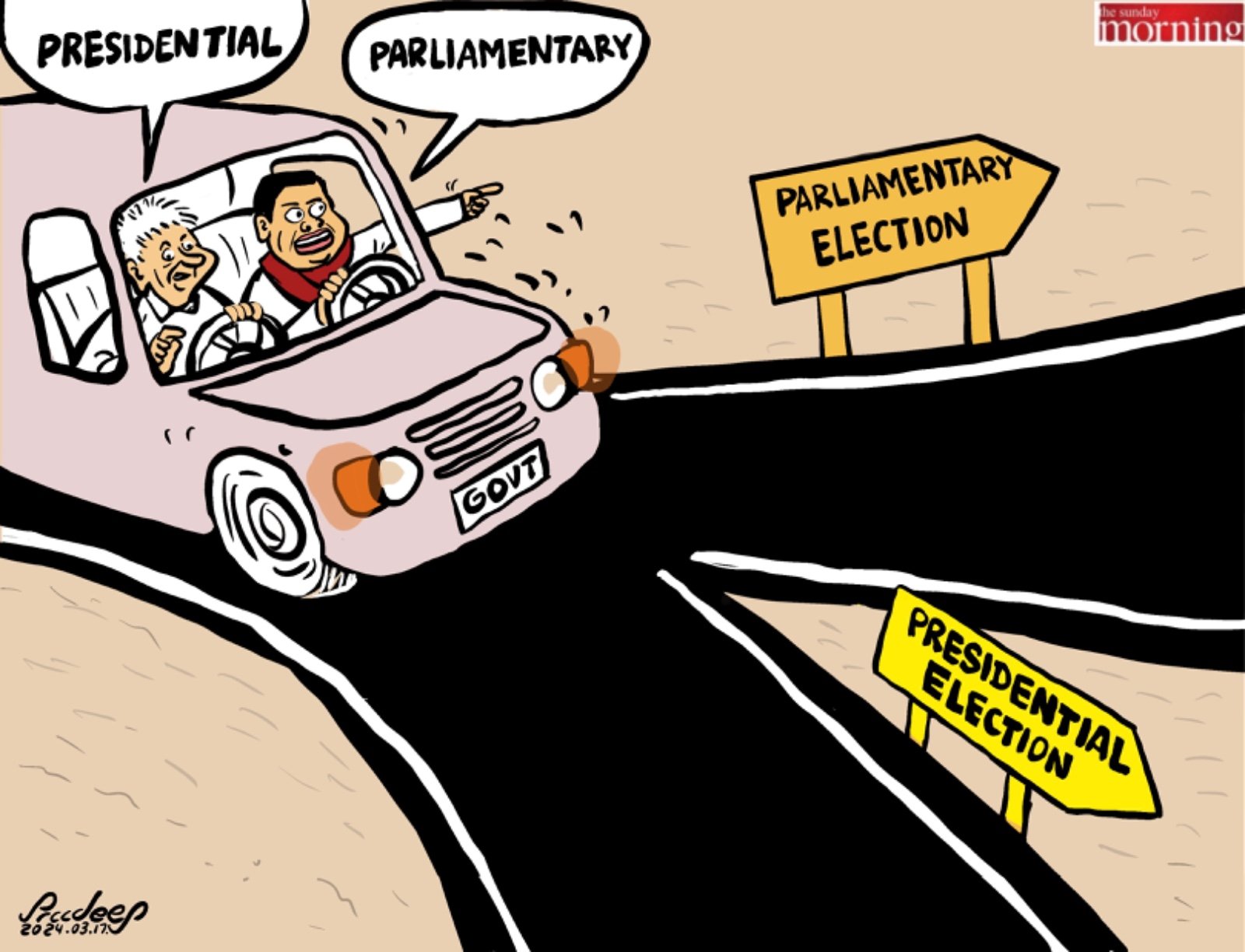
The SJB Mayoral candidate for the Colombo Municipal Council at the indefinitely postponed LG polls said that the so-called UNP Management Committee Tuesday (09) evening had declared that presidential election would be held in September this year, followed by parliamentary election and Provincial Councils in January and March, 2025, respectively.

Rahuman, who first entered Parliament in 2015, as a UNP member, contested the 2020 general election on the SJB ticket. He resigned his parliamentary seat on January 21, 2023 to join the fray as the SJB’s Mayoral candidate at the LG poll in Colombo.

The UNP Management Committee consists of Assistant Leader and ex-MP Akila Viraj Kariyawasam, MP Vajira Abeywardena (National List), Minister Harin Fernando (SJB), Minister Manusha Nanayakkara (SJB), ex-MP Dr. Karunasena Kodituwakku, ex-MP Ravi Karunanayaka, ex-MP Ruwan Wijewardene, Lasantha Gunawardena and Shamal Senarath.

Responding to The Island queries, Rahuman pointed out that having declared presidential, parliamentary and Provincial Council polls that could cost as much as Rs 30 bn, within a space of seven months, the government couldn’t claim it lacked funds to conduct the LG poll.

The ex-Colombo District MP said that the Election Commission should take up this matter with President Wickremesinghe.

President Wickremesinghe yesterday appointed Prof. Lakshman Dissanayake as the fifth member of the EC, headed by R.M.A.L. Ratnayake.

The other members are M.A.P.C. Perera, Ameer Mohammed Faiz and Anusuya Shanmuganathan. Saman Sri Ratnayake functions as the EC Director General.

SJB spokesman Rahuman said that the incumbent government deferred the LG poll, which was to be conducted before the end of March 2023, claiming it couldn’t allocate funds due to the economic crisis. In spite of that, the Supreme Court directed that the funds allocated through the budget for the conducting of election be made available, the ex-MP said, adding that he, too, subsequently moved the Supreme Court in that regard.

Alleging that the SLPP and UNP feared to face the electorate, against the backdrop of Aragalaya, hence the decision to put off LG polls, the former lawmaker said that Gotabaya Rajapakas’s government, in Dec 2021, announced its decision to put off the LG poll to March 2023, blaming it on the COVID-19 pandemic.

Rahuman said that the EC should also be concerned about the inordinate delay in holding the Provincial Council polls. Political parties seemed to have quite conveniently forgotten that all nine Provincial Councils were dissolved, with effect from Oct 08, 2019. The last PC dissolved was the Uva council.

The terms of the Northern Provincial Council came to an end on Oct 25, 2018, the Central Province on Oct 8, 2018, North Western Province on Oct 10, 2018, Sabaragamuwa on Sept 26, 2018, Eastern Province on Sept 30, 2018, North Central Province on Oct 1, 2018, Southern Province on April 10, 2019 and Western Province on April 21, 2019.

Referring to President Wickremesinghe’s repeated assurances regarding devolution of powers in terms of the 13th Amendment and the declarations made in Jaffna during his recently concluded visit, the ex-parliamentarian said that the government should explain why PC polls couldn’t be held for well over four years.

The Parliament, as the supreme institution tasked with enactment of laws and ensuring financial discipline, should be held accountable, the ex-MP said, pointing out the failure on the part of political parties to vigorously pursue the issue.

Rahuman said that those among the international community concerned over the developments here couldn’t remain silent over the postponement of the PC and LG polls. The sudden announcement on presidential, general and PC polls could be in line with the UNP strategy, the former MP said.

EC Director General Saman Sri Ratnayaka said that though they initially estimated the LG poll, if conducted in March 2023, could have cost as much as Rs 10 bn, he was now confident of spending a much lower amount. “We spent about Rs 1 bn on that poll by the time the postponement was declared,” the forthright official said, adding that the EC could have managed with Rs 6 bn. However, against the backdrop of all round tax increase effected this year, expenditure was going to be high, the official said.

In late Nov 2023, State Finance Minister Ranjith Siyambalapitiya, addressing the media at the Presidential Media Centre, declared that Rs 10 bn had been allocated through the 2024 Budget for the EC.

Stung by Indian calls to boycott Maldives, Muizzu appeals to China to send more tourists

Maldivian President Mohamed Muizzu has appealed for increased efforts to have China reclaim its spot as the top source market for tourist arrivals to the Maldives.

He made the appeal in his address at the Invest Maldives Forum at the Fuzhou Strait International Convention and Exhibition Centre in Fuzhou, China, on Tuesday morning.

In his address, President Muizzu noted that China had been the top source market for tourist arrivals to the Maldives before the Covid-19 pandemic.

“China was our number one market pre-COVID, and it is my request that we intensify efforts for China to regain this position,” he said.

President Muizzu said his administration is focused on diversifying Maldives’ economic base and ensuring economic security, while continuing to strengthen and drive the tourism industry and boost visitor numbers.

“The government has plans to diversify the tourism product and offer new experiences. Initiatives include a top-tier school of hospitality and exploring sports, medical and cultural tourism,” he said.

President Muizzu said his administration’s development plan targets revolutionizing the Maldivian economy and doubling its GDP from the current USD 6 billion to USD 12 billion by 2028.

While China had dominated tourist arrivals to Maldives pre-pandemic, the top spot is currently claimed by India. Other top source markets include Russia, Germany and the UK.

FTA with China

Muizzu says his administration is committed to the quick implementation of the Free Trade Agreement signed with China, describing it as a symbol of the close commercial ties between the two countries.

Muizzu said the FTA between Maldives and China is the first comprehensive FTA between China and a South Asian country.

“The FTA’s aim to boost bilateral trade and investments, especially increasing our export of fish products to China is a key priority for us through the FTA,” he said.

“My government is committed to ensure quick implementation of the agreement.”

He added that other initiatives spearheaded by China, such as the Global Development Initiative and the Asian Infrastructure Investment Bank, have also been crucial in accelerating the implementation of Maldives’ developmental projects.

Maldives and China signed the FTA after two years of negotiations in December 2014 – during President Abdulla Yameen Abdul Gayoom’s administration. The agreement wasn’t approved by the Parliament until November 2017.

However, President Ibrahim Mohamed Solih’s administration – which replaced Yameen’s – did not implement the agreement.

Opposition Leaders’ Condemnation

Top Maldivian opposition leaders have condemned the uncharitable remarks made by three Junior Ministers against Indian Prime Minister Narendra Modi X formerly called Twitter.

“We, the Democrats, are dedicated to upholding the stability of the nation’s foreign policy and preventing isolation of any neighbouring country. Are you willing to take all necessary steps to remove (President) Mohamed Muizzu from power? Is Maldivian Democratic Party (MDP) prepared to initiate a vote of no confidence?” MP, Azim Ali said in a post on X.

Former deputy speaker Eva Abdullah told news agency ANI that the comments made by the now ousted ministers were ‘racist’. “I think it is important that the Government of Maldives issue a formal apology to the Indian people. The remarks by the minister are simply shameful, racist and intolerable. The minister’s words are in no way a reflection of the opinion of the people of Maldives. We’re very aware of how dependent we have been on India, and that India has always been the first responders whenever we are in need,” Abdullah said.

“I condemn the use of hateful language against India by Maldivian government officials on social media. India has always been a good friend to Maldives and we must not allow such callous remarks to negatively impact the age-old friendship between our two countries,” former Maldivian president Ibrahim Solih said.

“Derogatory remarks made by two deputy Ministers of the current Maldives government and a member of a political party in the ruling coalition, towards Prime Minister Narendra Modi and the people of India on social media is reprehensible and odious,” former Maldivian foreign minister Abdullah Shahid said.

“We should respond with strong action so that this is not repeated,” former vice-president of Maldives Ahmed Adeeb told news agency ANI.

“India has been our 911 call, whenever we need it, we give a call and you all come to our rescue. That kind of a friend. When you see such disparaging remarks about friends like this, it is sad for everyone concerned,” former Maldivian defence minister Mariya Didi said.