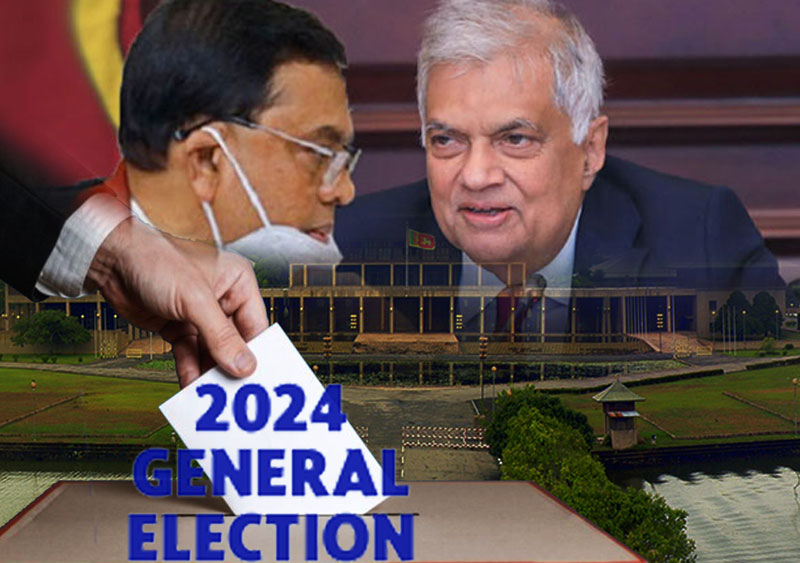
President Ranil Wickremesinghe and Basil Rajapaksa, founder, and strategist of the Sri Lanka Podujana Peramuna (SLPP) discussed a key political issue—the contours of the next national election during a near-45-minute meeting on Thursday night.
They met at the President’s former official residence at Mahagam Sekera Mawatha (former Paget Road). The President drove in there after attending the discussion on Economic Development and Modernisation with Lessons from Japan at the Granbell Hotel in Kollupitiya.
As is now known, President Wickremesinghe is working towards a presidential election though he has not formally declared his candidature. He has tasked seniors in his United National Party (UNP) to prepare for the polls. This week he met nearly 200 members at a meeting at the Presidential Secretariat. His Campaign Manager Ronald Perera said discussions focused on improving party activity at the grassroots level. Participants offered different views on using social media in a bigger way during the campaign. “All this will be in vain if you do not make sure people go to vote on polls day. There should be a mechanism to ensure this,” said one participant.
On the other hand, Basil Rajapaksa, soon after his return from the United States, declared that in his personal view, parliamentary elections should be conducted first. He expressed this view to the Sunday Times. Later he had a meeting with a cross-section of his party seniors on the matter. They endorsed his thinking.
Rajapaksa made a formal request from President Wickremesinghe to consider the SLPP’s official request for the parliamentary elections to be held first. He agreed to study the matter. Rajapaksa had drawn an analogy to back his claim. He has said that it was like obtaining comprehensive insurance for a vehicle. Such a cover was being obtained as a matter of preparedness. Similarly, the request for early parliamentary elections was being made. Such a request was coming from the main partner in the government.
Since the machinery for the conduct of a presidential poll has been set in motion, it is highly unlikely President Wickremesinghe will change his mind. On the other hand, nor will SLPP insist on such a move.
Then came the discussion on an important issue—the mode of support from the SLPP. The Sunday Times learns that Rajapaksa told President Wickremesinghe that he could, if he so wished, seek the individual support of some SLPP members. In fact, some of them have voiced support to President Wickremesinghe. In such an event, it would naturally be devoid of the party’s support. On the other hand, if it was the party’s support the President was seeking, it was available, and the required modalities could be worked out. President Wickremesinghe had readily agreed to accept the SLPP support. That way, even the MPs who are with the SLPP will be happy with the arrangement. There is also a much bigger advantage for the SLPP leadership. Their members will have to eventually look to their leaders even at a parliamentary election. It was only that way they would ensure their nominations.
The SLPP issued a brief four-point statement on the Thursday night meeting. It said:” Summary of the discussion between President Ranil Wickremesinghe and Basil Rajapaksa
1. Regarding the issue whether the Parliamentary election or the Presidential elections should be held first, Basil Rajapaksa said, that as a party, they are inclined towards a Parliamentary election. However, he was in no hurry to obtain a final answer to the issue at this discussion itself. He said a decision should be taken considering the benefits for democracy and the will of the people.
2. Rajapaksa also pointed out that there has been some doubt created about the postponement of the parliamentary elections by opening a new dialogue about electoral reforms and that was not healthy. The President had responded saying elections will not be delayed due to the reforms.
3. Rajapaksa pointed out the issues which have arisen due to the postponement of the Local Government elections. One of them was the injustice to the rights of the voters, the other was the issue created by conducting the functions of the local government institutions without the political representatives and the personal and social issues faced by the former local council members.
4. Rajapaksa also pointed out that there needs to be a proper open dialogue with the Buddhist monks and trade union-led nationalist organisations about the economic reforms taking place, about state enterprises, and economic platforms. The President had agreed to this proposal.
Senior UNPers, who do not wish to be named, say that President Wickremesinghe will announce his presidential candidature during their campaign in April. Should he join the fray, he will be an independent candidate. That is to ensure a broader base of political parties extend their support to him. As previously revealed, the presidential election, in terms of the Constitution, will have to be held between September 18 and October 18.
Other than the national elections, the one-on-one between President Wickremesinghe and Basil Rajapaksa, the Sunday Times learns, also covered several other areas. One, a matter of serious concern to the SLPP, was the move by Justice and Constitutional Reforms Minister Wijeyadasa Rajapakshe to introduce electoral reforms. He had forwarded a recommendation to the cabinet of ministers to effect these reforms. A highlight is to elect 160 MPs on a first-past-the-post basis and 65 on a Proportional Representative basis. This proposal was originally made late last year. Rajapaksa pointed out that the move had already led to apprehensions that the government was doing so to put off elections. This position was not only causing concern for the SLPP. Other political parties too have expressed scepticism over it. President Wickremesinghe, it was pointed out, had assured that he would take serious note of the matter raised and not rush through such reforms. It is likely that Minister Rajapakshe’s move will be put on hold. However, Rajapakshe has also made clear that the electoral reforms will not apply for the current elections
This is the second meeting of the SLPP with President Wickremesinghe. The first was when both Mahinda Rajapaksa and Basil Rajapaksa met him to discuss a variety of issues other than the elections. They related to privatisation of state enterprises and the role of their key members in the districts. At Thursday’s meeting too, the issue of some ministers not granting appointments to trade union leaders was discussed.
This week, Basil Rajapaksa addressed the government parliamentary group as well as the trade unions coming under the party. The main purpose was to advise them to bring in crowds for the SLPP May Day rally at Campbell Park in Borella. Already, As reported earlier, the UNP will hold its May Day rally at Independence Square in Torrington. That each side will try a large crowd turnout to demonstrate its political strength is not in doubt.
The SLPP is also preparing itself for a national election campaign. A team of youth are being sent to India. They will visit the BJP headquarters to learn of how the India’s ruling party is running its election campaigns. Two private homes in the vicinity of the SLPP office at Nelum Mawatha in Battaramulla have been commissioned as offices for this purpose. The SLPP recently carried out a survey of its own in the Hambantota district. That, a party official said, included visits from house to house. He claimed that the party found itself strong in most areas though there were shortcomings in some. One of the recorded revelations in the survey—complaints in Hambantota that the voters were unable to meet their parliamentarian Namal Rajapaksa. This, it was pointed out, was in marked contrast to his father, Mahinda Rajapaksa. Even during the time of the separatist war, he was available for meetings, it was pointed out. Namal Rajapaksa was in Dubai earlier this week.
The Third Front
In other developments, breakaway groups from the SLPP are planning to form what they called a “third front” by teaming up with the like-minded. The move is being spearheaded by the Uttara Lanka Sabhagaya which is marking its second anniversary with events at the National Youth Centre in Maharagama. Besides leaders of constituent parties of the alliance, also speaking yesterday were Dullas Allahapperuma, Roshan Ranasinghe and Dayasiri Jayasekera. The new front is to be launched on April 5.
NPP focus on youth
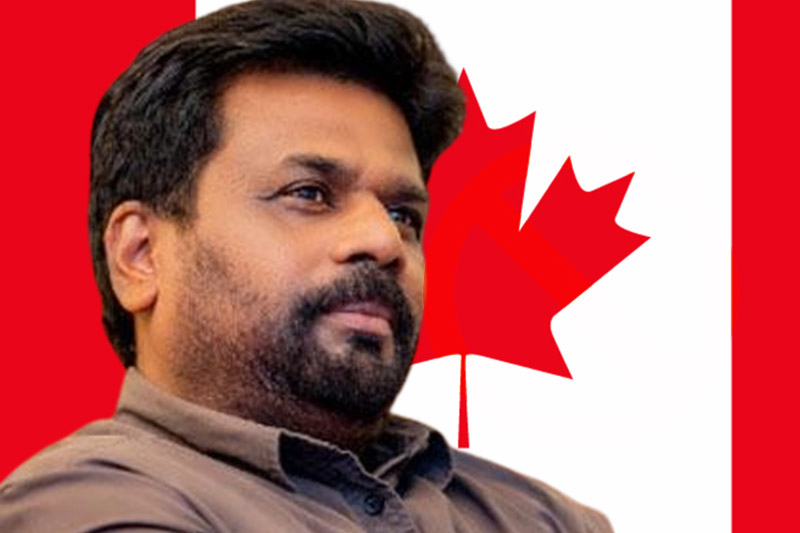
In another development, the Janatha Vimukthi Peramuna (JVP)-led National People’s Power leader, Anura Kumara Dissanayake, is in Canada this week. He addressed Sri Lankans at a meeting in Toronto yesterday. At that meeting, he slammed Minister Nimal Siripala de Silva for a speech he made calling upon all parties to join hands against a ‘common enemy.’ “For three decades he has remained a minister. All he has achieved are accusations of wrong doings,” said Dissanayake. A similar meeting is set in Vancouver tomorrow. Such meetings, however, will not bring in votes for the NPP. There is still no legal provision. Before his departure, he addressed a youth rally in Matara. Some highlights of his speech spelt out by the NPP. It makes clear that the party has not made any offer of a concrete programme for the youth in terms of their future.
“There is no doubt that the work started in Matara to gather the youth for the political transformation will become the biggest youth awakening in Sri Lanka. The young generation of our country thought that politics is not their business. It is like work belonging to parents and several families. The young generation was dreaming and planning how to make their lives successful. Today, the dreams they created are being destroyed in front of their eyes. There are several youth groups in our society.
There is a group that has a certain amount of assets with higher education, is proficient in languages, and has knowledge that can cope with the international community to secure their lives, they have made Australia, Canada, England, and New Zealand, which are considered developed countries in the world, the goal of their journey. There is another group, the burden of parents fell on themselves. There is a group whose future dreams and hopes have collapsed. They are trying to escape to Israel, Korea, Middle East to fulfill their hopes. Yet another group had to stop their schooling in the middle and had to do some work to make ends meet during school. They have no life, no purpose, no goal. Many people are joining that group today. That group has become Deshbandhu’s target. They are a generation of insecure, wandering youth who have no value for life. Jagath Manuvarna’s movie “Kodigaha Yata” showed the life of that young generation.
“This country should be transformed into a very safe country. The young generation of this country should be made into a young generation full of expectations for their future. The tragedy unfolding in front of our eyes today forces us to take the lead in changing this. Where do we change this? This can be changed only by transforming the current political path in a new direction. The first struggle to be done is to liberate this country from this tragedy inherited by the politics of mother and father to the country, the people and you. Our country needs such a political transformation.
“Who has written the politics of this country? To his son Matara Wijesekera. Sirisena to his son. Mahinda Rajapaksa’s nephews. This politics is spinning in the hands of a few families. Those few have been named as the saviours of the youth from the lower class. If a son is born to the president, they think that the presidency is engraved on that child’s forehead. Premadasa’s son, Mahinda Rajapaksa’s son, Wijesekera’s son, they think that the presidency and ministership were sealed by Mahabamba at birth. The politics of our country is divided between several families nationally and regionally. The doors of politics have been closed to our young generation who have the ability and desire.
“None of these people came here with politics engraved on their foreheads. They are not the ones who took political responsibilities with Mahabamba tattooed on their foreheads. Why do we enter this politics? There is an unjust and unfair society before our eyes. The lives of our young generations are being destroyed. We all chose this politics to intervene, lead and join in this social transformation. There is a purpose to change this. There is a need for courage for that. What kind of politics does this country want? The young men and women were kept in line, tall and short, and told, “Height is security. A short worker.” This country needs a politics that divides jobs! That is the politics that the young generation has inherited. How many forms did you fill in to get a job at Hambantota Port during the elections? How many applications did skilled warriors fill out? Those guys sit on top and give us labour jobs. Whether they have a brain or not, they have the presidency and ministership engraved on their foreheads. To change this, let’s achieve a new political transformation.
“I entered politics during my school days. The whole youth of many people, including myself, laboured for this new transformation; fought. In the face of various defeats, when death was happening in front of his eyes, I did not give up and chose this politics for a political transformation. We have been faced with various difficulties and insults, and today we have seen the victory. We can win this. By the end of October this year, a new government, a new rule. This government is entrusted with a major task. This society should undergo a complete transformation. It can be done only with the active involvement of the people. A government should be formed and necessary work should be done to fulfill the expectations. In the ‘X’ generation, we become someone who lives with a secure job, a bank account with savings, an organised social corporation, something within the existing society. In Generation Z, you expect transparency. You are going for an interview for a government job. You fall, someone else understands. Our generation accepts that it is so. People of ‘Z’ generation are asking how it happened. He went to the struggle and asked, “How did you get medicine for the hospital?” Transparency is necessary. How were these people chosen for this job? How did you choose the contractor? How many marks did you get for the paper you wrote? These are being questioned today. Generation Z expects transparency. It is characteristic of your generation. We are creating a government of the National People’s Power that will protect the transparency that today’s youth is looking for.
“This ‘Z’ generation expects creativity. It is not a generation confined to one place. You want to quickly express the creativity that is building within you. Our generation is following the path that was made for us. This generation travels in many byways. There are many people who have come up economically and socially. It came from other big roads. But is our society a society that can absorb your creativity? Our leaders are working in the mindset of the pre-Christian era, old social concepts. When they got on the stage, they had five Navaratna rings on their five fingers. Hands tied with threads given by each temple. Basil Rajapakse goes to a temple to escape a case. The case has been closed. These failed tribal leaders have locked down your creativity. A government of the National People’s Power will build the socio-economic structures necessary to advance the creativity of these children.
“Independence is a hallmark of Generation Z. Our youth should have followed the path created by teachers and parents in a framework. Had to live as dutiful citizens. The new generation does not like traditional jobs, no longer willing to do the job in the same way, subject to a master. You demand independence. Our economic model is designed to target the small and medium scale entrepreneurs. They have become the engine of our economy. Acquiring a share of the world market through IT has become our economic vision. We have developed the necessary vision to transform the tourism industry from a hotel industry into a tourism business. The right to engage in independent employment with autonomy has been confirmed. You are a fast-growing generation. Although you are growing fast, the country’s economy is coming behind you. What do they say? They say there is no suitable job for you. The problem here is that they have failed to build an economy that matches your knowledge. The economy stagnates. You become useless to yourself and the country. If your rapid growth does not catch up with socio-economic transformations at an equally rapid rate, then this society will become an unsuitable society for you. We will create an economy that is as fast as your growth……”
IMF agreement
Another significant development this week is the announcement by the International Monetary Fund (IMF) delegation that Sri Lanka will receive Special Drawing Rights up to 254 million (about US$337 million), the second tranche. The President’s Media Division said, “This agreement, reached after constructive talks in Colombo, underscores the commitment to economic reform and stability. Once approved by the IMF Management and completed by the IMF Executive Board, Sri Lanka stands to gain access to SDR 254 million (about US$337 million) in financing, further bolstering the nation’s economic resilience.
“The IMF stated that key reforms in macroeconomic policies are showing promising results, with initial signs of growth and positive outcomes in areas such as disinflation and reserve accumulation. However, sustaining this momentum and addressing governance weaknesses and corruption vulnerabilities remain pivotal for fostering lasting recovery and ensuring stable and inclusive growth.
The completion of the review by the IMF’s Executive Board hinges on the implementation of prior actions by authorities and the successful completion of financing assurances review, which includes confirming multilateral partners’ financing contributions and making adequate progress with debt restructuring.
“Mr. Peter Breuer, IMF Senior Mission Chief, and Ms. Katsiaryna Svirydzenka, Deputy Mission Chief, issued a statement commending Sri Lanka’s progress under the EFF. They emphasised the importance of maintaining the reform trajectory to navigate challenges and foster economic resilience.
“The IMF mission team, comprising senior officials, engaged with various stakeholders, including government officials, parliamentarians, private sector representatives, and civil society organisations, underscoring the collaborative approach to economic revitalisation…..”
Party leaders have decided that Parliament will meet on Monday April 1 and Tuesday April 2 for government business. A three-day debate on a vote of no confidence against Speaker Mahinda Yapa Abeywardena, as expected, was defeated in Parliament.
This week’s developments come as further proof that election-related activity is on the increase. The May Day rallies of the main political parties are set to show their strength and we are bound to see an escalation.