Sri Lankan democracy: No legal barrier to hold Prez polls before LG: EC

There is no barrier to hold another election before the indefinitely postponed Local Government (LG) Elections, the Election Commission (EC) said yesterday (7).

However, in the event that the Presidential Election is held without holding the LG Elections, citizens may question as to how provisions that cannot be made for the latter elections would be made for the former, the EC’s Chairman opined.

While the LG Elections, which were scheduled to be held in March 2023, have been postponed indefinitely due to the Finance Ministry and Treasury not releasing the required funds, President and Finance, Economic Stabilisation, and National Policies Minister Ranil Wickremesinghe recently said that both Presidential and Parliamentary Elections would be held this year (2024).

The Daily Morning contacted EC Chairman R.M.A.L. Rathnayake on whether they could hold the presidential or any other election without holding the LG elections, and he said that there was no issue in holding the Presidential Election until the required funds are received for the LG elections. “The LG elections have been postponed as we have not received funds. If we receive it, we can hold it. However, the Presidential Election must be held this year. The necessary funds for it have been allocated through the budget. So we can hold it.”

The EC has requested funds for the said two elections separately, he said, adding that the Presidential or LG Elections would therefore be held upon the receipt of the funds. “In case the Presidential Election is held and LG Elections remain postponed, the people will question how funds can be released for one election and not for the other. That is a different story, but there is no legal barrier to holding any other election until funds for the LG elections are received.”

Rathnayake recently said that the Presidential Elections must be held before 16 October 2024, and expressed his confidence in receiving the relevant financial provisions.

HRCSL concerned over alleged human rights abuses in ’Yukthiya’ Operation

The Human Rights Commission of Sri Lanka (HRCSL) has expressed deep concern over alleged human rights abuses in the recent ‘Yukthiya’ Operation conducted by the Sri Lanka Police and the Ministry of Public Security.

In a release, it said the Commission is particularly disturbed by reports of cruel, inhuman, or degrading treatment during search operations, prompting an immediate inquiry into these claims.

The statement is as follows;

The ‘Yukthiya’ Operation, launched with the objective of combating drug trafficking and organized crime, has reportedly led to the arrest of over 20,000 suspects in just a two-week span from December 17 to December 31, 2023. While acknowledging the importance of addressing organized crime and narcotics trafficking, the Human Rights Commission has received numerous complaints of torture, inhumane treatment, arbitrary arrests, and detentions associated with the operation.

The Bar Association of Sri Lanka has also expressed serious concerns about the operation, and the Commission notes that the operation’s association with reports of widespread injustice contradicts its very title, ‘Yukthiya,’ meaning ‘justice’ in Sinhala.

The Commission emphasizes that every person in Sri Lanka has a fundamental right to be free from torture, cruel, inhuman, or degrading treatment or punishment under Article 11 of the Sri Lankan Constitution. This right is considered absolute and inalienable, and police officers are expected to uphold this right by treating suspects with dignity at all times.

The backdrop of these reports is a broader context where the Human Rights Commission has received over 200 complaints of torture in 2023 alone. Complicating matters, individuals accused of torture continue to hold office despite recent Supreme Court pronouncements finding them responsible and ordering compensation for victims.

On December 21, 2023, the Human Rights Commission wrote to the Honorable Attorney-General urging the prosecution of these officers. In response, dated December 28, 2023, the Attorney-General assured the Commission that “necessary steps have been taken by [the Attorney-General’s] Department” in cases where the Supreme Court directed action against those responsible for acts of torture.

Sri Lanka’s Japanese firms hit most badly by fuel shortages, currency depreciation: survey

Sri Lanka based Japanese firms were most badly hit by fuel shortages and currency depreciation, following an economic crisis, according to an annual survey by the Japan External Trade Organization.

About 80 percent of the firms said operations had been adversely affected (up 13.3 percent from 2022), while 13.3 percent said they had not been affected, in a survey conducted between August and September 2023.

“The impact of the economic crisis on Japanese companies in Sri Lanka was more serious than initially assumed,” JETRO said in a statement.

Top blows came from ‘petrol/fuel shortages’ (82.6 percent) followed by ‘currency depreciation’ (60.9 percent).

Central bankers and the IMF generally advocate both depreciation and currency volatility (flexible exchange rate), but businesses and their customers dislike it as it makes planning difficult (businesses).

The third biggest hit came from ‘electricity shortages/power cuts’ (60.9 percent) and ‘income tax and other tax increases’ (60.9 percent).

Businesses were now seeing a gradual recovery from the crisis.

Among the surveyed companies, 33.3 percent said their business had ‘improved’ from last year, 50 percent said it had remained unchanged and 16.7% said it had ‘worsened’.

Specific factors contributing to the improvement included the ending of petrol and fuel shortages (75.0 percent), ‘power cuts have been eliminated’ (75.0 percent), ‘logistics problems have been resolved’ (37.5 percent) and ‘price increases have settled’ (37.5 percent).

“It should be noted, however, that few respondents answered an improvement in ‘exchange rate recovery’ (12.5 percent) or ‘financial settlement’ (0.0%).

Though the rupee appreciated from 360 to 330 the currency had been volatile under the unstable ‘flexible exchange rate’ moving from 322 to close to 330 within a few weeks, busting confidence.

Meanwhile customers are impoverished, triggering social unrest.

Japanese firms were still willing to stay in the country, despite the problems.

“With regard to business development plan over the next 1-2 years, no companies responded that they would relocate to a third country or withdraw,” the statemen aid.

About 28.1 percent (+ 2.5-ct from 2022) had said they were planning an ‘expansion’ and 65.6 percent (+ 11.8 percent from 2022) said they were ‘remaining the same’.

Only 6.3% (- 20.1 % from 2022) responded saying they planned a ‘reduction’.

Sri Lanka was pushed in the worst currency crisis in the history of the central bank in 2022, after the central bank aggressively targeted ‘potential output’ with rate cut, on the back of two currency crises in 2015/16 and 2018 as well as 2012, which pushed up foreign borrowings.

At the time printing money for potential output targeting was illegal. Several economic bureaucrats including two central bank governors as well as key politicians have been faulted by courts for their part in triggering the crisis.

Printing money for growth has been legalized in a new IMF backed monetary law.

The central bank has also been given a license by political authority to create up to 7 percent of inflation with no questions asked.

Posted in Uncategorized

Sri Lanka begins railway line upgradation with India’s assistance

Minister of Transport, Highways and Mass Media Bandula Gunawardena and High Commissioner of India to Sri Lanka Santosh Jha ceremonially launched track rehabilitation work at Galgamuwa Railway Station commencing upgradation of railway line including ancillary works from Maho to Anuradhapura on Sunday (Jan. 07).

The upgradation of the from Maho to Anuradhapura on the mainline is the second phase of a Line of Credit project for track rehabilitation from Maho- Omanthai (128Km) which was undertaken by an Indian Public Sector company, IRCON, under an Indian Line of Credit (LOC) of USD 318 million, the Indian High Commission in Colombo said in a statement.

The cost of the entire project is USD 91.27 million of which the second phase of rehabilitation from Maho-Anuradhapura is scheduled to be completed in a period of six months, it mentioned.

State Minister of Mass Media Shantha Bandara and senior officials from the Sri Lankan Ministry of Transport were also present at the event, according to the Indian High Commission in Sri Lanka.

Speaking during the event, Minister of Transport Bandula Gunawardena expressed gratitude to India for the support extended to Sri Lanka, especially in the transport sector. Appreciating the work carried out by IRCON in Sri Lanka in the past few years, he also called for greater Railway cooperation between the two countries.

The High Commissioner expressed happiness that as a long-standing development partner of Sri Lanka, India had executed projects for development and rehabilitation of Sri Lanka’s Northern and Southern Railway line over the past several years, in line with the priorities and requirements of the Government of Sri Lanka. He underscored the importance of modernization of Railways in enhancing mobility of goods and services in Sri Lanka thereby boosting economic activity.

Railways has been one of the priority sectors for Government of India’s assistance to Sri Lanka, the statement said, adding that till date, India has executed projects of over USD 1 billion in the Railways sector under 5 Indian LOCs.

India’s public sector company, IRCON, started its operations in Sri Lanka in March 2009 and has contributed towards modernization of Sri Lanka Railways by reconstructing the entire railway line network in Northern Province (253 Km) and upgradation of Southern line (115 km). It has also contributed to ensuring safety and reliability through a modern signaling & telecommunication system on 330 km stretch of Railway line, it added.

Furthermore, the Indian High Commission in Colombo mentioned it is notable that India’s support to Sri Lanka under its various LOCs has continued despite the debt standstill announced by the Government of Sri Lanka in April 2022.

In September 2023, the Ministry of Transport and Highways of Sri Lanka and IRCON International signed a new Contract for design, installation, testing, and commissioning of a Signalling system for Sri Lanka Railways, from Maho to Anuradhapura at a cost of USD 14.90 million under an Indian LOC, it added

SriLankan continues to face flight delays

National carrier SriLankan Airlines is in dire need of expanding its Airbus fleet to avoid flight delays, a top SriLankan Airlines official told The Sunday Morning.

The official revealed that the daily operations of the airline were currently being conducted by only around 17 Airbus aircraft, resulting in several flight delays being recorded each month.

According to the official, the airline must have a minimum of 24 aircraft to ensure smooth operations without delays.

Speaking to The Sunday Morning, a SriLankan Airlines passenger shared a recent experience: “I had a crazy flight delay on my way here… they only announced at 8.30 p.m. when I was leaving for the airport that the midnight flight to Melbourne had been delayed by three-and-a-half hours. Tourists and locals were complaining at a rate and the flight was full. Just like me, so many were saying that this would be the last time that they would fly UL (SriLankan). The interesting part is, it’s not a one-off thing but a recurring thing. They just lie and act like it’s a rare occurrence.”

Responding to the complaint, SriLankan Airlines CEO/Chairman Ashok Pathirage told The Sunday Morning that the situation was currently under control while admitting to delays in the recent past.

“We have leased two aircraft and gradually the fleet is improving, so are the issues related to the lack of the required number of aircraft,” he said.

Prior to Covid-19, SriLankan Airlines had an all-Airbus fleet of 24 modern aircraft, which included 12 A330 (long-haul) and 12 A320/A321 aircraft (medium-haul). The airline operated a total of around 3,600 flights per month. However, at present, as per statistics, the airline operates nearly 2,400 flights per month with an average of 17 aircraft.

“This is a very complicated subject. We must have the required number of aircraft for smooth operation. All previous governments considered selling off this national asset. Nobody wanted to develop the national carrier, and, as a result, the infrastructure facilities of the airline saw a drastic decline, but now the situation is improving,” Sri Lanka Nidahas Sevaka Sangamaya (SLNSS) SriLankan Airlines Branch General Secretary Janaka Pathirathna said.

He told The Sunday Morning that it was difficult to manage the flights with the available aircraft as it was complicated to prioritise the operations over cancellations.

“As an example, earlier we had two flights to London, but it has now been reduced to one. When there is a shortage of aircraft, the flights to India get cancelled most of the time. But when such a flight is cancelled, then the number of transit passengers from India to Melbourne is reduced.

“Long-distance flights such as Melbourne are important as we earn good revenue from those flights. But in managing the aircraft shortage and minimising delays, cancelling short-distance flights to India won’t help, as due to such cancellations, the aircraft will only be available for one to three hours. This is a very serious and complicated situation,” Pathirathna explained, adding that another aircraft would be leased by the airline in the coming months.

Posted in Uncategorized

CBK – Sirisena patch-up in SLFP’s interest?

Former President Chandrika Kumaratunga has given her consent to join the SLFP again, party sources told the Sunday Island on Friday.She gave her consent to re-join the party when several SLFP stalwarts met her last week, party sources said. Signifying her rejoining, the former President is scheduled to attend SWRD Bandaranaike commemoration scheduled to be held at the Bandaranaike statue in Galle Face tomorrow (8), party sources said.

Kumaratunga was offered the party leadership but she insisted that she must be the party’s chairperson, a position more powerful than the party leadership according to its constitution, sources said.

Incumbent party President and Leader former President Maithripala Sirisena has agreed to give powers to Kumaratunga to appoint members to the party’s Central Committee. However, Kumaratunga has not yet responded to that offer, party sources said, adding that bringing in Chandrika Kumaratunga back to the party is one of the main moves for the party’s reforms program in view of upcoming elections.

The SLFP executive committee and the central committee are scheduled to meet on Monday (8) at the party headquarters in Darley Road where a final decision would be made on the post and powers to be given to former President Kumaratunga, sources said. The committees are also tasked with discussing the ways and means of facing upcoming elections.

Sources said that as of now the incumbent party leadership and top brass have come to an agreement that the party would face any upcoming election in alliance with other like-minded parties.

CBK played a major role in anointing Maithripala Sirisena as the common opposition candidate at the presidential election of 2019 when Sirisena defeated Mahinda Rajapaksa. But she and the president soon became distanced from each other and have not for many years appeared together at Bandaranaike commemoration events.

Posted in Uncategorized

Jallikattu goes global, Tamils in Sri Lanka tame bulls

Experts in the field from Tamil Nadu and members of the Jallikattu Protection Committee helped the organisers conduct the event in Sri Lanka, while the Animal Husbandry department ensured the bulls were fit for participation.

Pongal, the harvest festival celebrated by Tamils across the globe, came a week early this year for the people of Sri Lanka’s Eastern Province, which scripted history on Saturday by organising the first-ever Jallikattu, a bull taming sport, outside Tamil Nadu.

The event, which was organised by Eastern Province Governor Senthil Tondaman and the Tourism Bureau, saw the participation of over 200 bulls and 100 bull tamers. Hundreds of people queued up at the Sambur public playground in Trincomalee, the capital of Sri Lanka’s Eastern Province, as early as 7 am to catch a glimpse of jallikattu for the first time in person.

Thondaman flagged off the event after which a temple bull was the first to be released via the vaadivaasal into the playground as tens of young men jostled with each other to tame the bull.

Over 200 bulls decorated with flowers, including at least half a dozen raised by Tondaman’s family, were released into the ground one by one with winners returned home with plenty of prices like mixer grinders, rice cookers, and ceiling fans among other household appliances and items.

Vaadivaasal is a narrow passage from where the bulls are let into the ground to be tamed by men. Though ethnic Tamils and plantation Tamils, whose forefathers were taken from several parts of Tamil Nadu to work in coffee and tea plantations in Sri Lanka by the British, celebrate Pongal every year but jallikattu was never part of the harvest festival.

“This is the first time that the sport was conducted in Sri Lanka. Over 5,000 people participated in the jallikattu event held on Saturday,” A P Mathan, Chairman, Eastern Province Tourism Bureau, told DH over the phone.

Experts in the field from Tamil Nadu and members of the Jallikattu Protection Committee helped the organisers conduct the event in Sri Lanka, while the Animal Husbandry department ensured the bulls were fit for participation.

Jallikattu is celebrated with much fervour in several parts of Tamil Nadu, especially in Madurai, Sivaganga, and Pudukkottai districts, during the Tamil month of Thai (mid-January to mid-February).

Referred to as eru thazhuvuthal (embracing the bull) in Sangam Literature, jallikattu is deep-rooted in Tamil culture and a symbol of Tamil pride and valour. Jallikattu is derived from Tamil words salli kaasu (coins) and kattu (a package). It means those who tame the bull will get the package (prize money) that is tied to the animal’s horns.

Kalithogai, a rich Sangam Era Tamil literature dating back to 200 BCE, calls eru thazhuvuthal (embracing the bull) as a sport played in Mullai (forest) land. Historians say eru thazhuvuthal was a sport of the masses and it has a deep-rooted cultural identity.

Posted in Uncategorized

Sri Lankan Tamil parties are in sixes and sevens over Presidential election By Veeragathy Thanabalasingham

Sri Lanka has seen eight Presidential elections after the introduction of Executive Presidency in 1978. But no previous election has been hyped like the upcoming Presidential election months before it is due to be held.

President Ranil Wickremesinghe, who was elected by Parliament for the remainder of the term of President Gotabaya Rajapaksa, after he resigned under a cloud in July 2022, can only remain in office until November 18 this year.

According to the constitution, the next Presidential election should be held within a period of not less than one month and not more than two months before the end of the term of office of the President.

Therefore, the next Presidential election should be held between September 18 and October 18 this year. The date for the election will be determined by the National Election Commission.

There was a stage when there was a serious suspicion that President Wickremesinghe, who postponed the local government elections indefinitely citing the economic crisis, might try to delay the national elections as well. However, he announced several times in recent months that the Presidential elections will be held later this year, followed by parliamentary elections.

Even after his announcement, there is widespread doubt in political circles as to which election will be held first. The President had the power to dissolve the current parliament at any time after February 20, 2023.

Many political observers had commented that Wickramasinghe might dissolve Parliament and go for the general election by the coming March to facilitate the creation of a favourable political situation for him to face the presidential elections.

However, the main opposition political parties have started preparing themselves for the Presidential election since the middle of last year.

A few months ago, United People’s Power (Samagi Jana Balavegaya- SJB) announced that opposition leader Sajith Premadasa was their Presidential candidate and National People’s Power Anura Kumara Dissanayake as their candidate. Both the parties have already started their election campaigns by holding meetings.

Although United National Party politicians say that Wickremesinghe will contest the Presidential election, he is yet to publicly announce his decision. The President says he will decide whether to run for office only after stabilizing the battered economy. But he has been making efforts to build a broad coalition to support him. It is not known how far these efforts have progressed. Some ministers from Rajapaksas’ Sri Lanka Podujana Peramuna (SLPP) have already expressed their willingness to support the President.

The SLPP, which recently held its second national convention in Colombo, has shown dubious signs of fielding billionaire businessman and casino owner Dhammika Perera as its Presidential candidate. Maithripala Sirisena has also announced that he will contest.

A wide range of candidates are likely to contest. The lowest number of candidates contesting in Presidential elections so far was the December 1988 election which was held during the JVP’s second armed insurgency. Former President Ranasinghe Premadasa contested as the candidate of the United National Party, former Prime Minister Sirima Bandaranaike was the candidate of the Sri Lanka Freedom Party and Ossie Abeygunasekara as the candidate of the Sri Lanka Mahajana Party.

35 candidates contested the November 2019 Presidential election. It was the election with the largest number of candidates in the fray. It would not be surprising if even more candidates contest this time.

If the incumbent President is powerful, it is customary for opposition parties to field a common candidate against him. However, this time, it seems that there is no need for the southern political parties to consider fielding a common candidate as President Wickremesinghe doesn’t have much support among the people. His United National Party is in a very weak position without proper grassroots vote base.

And there is no possibility that he will win the hearts and minds of the people in the coming days amidst the steep rise in prices as a result of the tax hikes. It is also doubtful if he will come forward to contest the election if he does not get the support of many other parties.

But this time, in a strange turn of events, some Tamil national political parties have started talking about fielding a common candidate in the Presidential election. Such an idea has never arisen in Tamil politics before.

Tamil candidates have contested Presidential elections before. In the first election held in October 1982, Kumar Ponnambalam, leader of the All Ceylon Tamil Congress, contested. But he got only 173,934 votes.

Even in Jaffna district, Ponnambalam got only about 10,000 more votes than Hector Kobbekaduwa, who contested against the then President J.R. Jayawardene as the candidate of the Sri Lanka Freedom Party. Kobbekaduwa got more than 10 thousand votes than Ponnambalam in Vanni district. But votes for him in the electoral districts of Eastern Province were negligible.

MK Sivajilingam of TELO was the other candidate from a Tamil political party who contested the Presidential election. He contested the 2010 January and 2019 November Presidential elections. No need to talk about the votes he got. A maverick, he once contested the parliamentary election from Kurunegala district.

One Sundaram Mahendran of the NSSP and Subramaniam Gunarathnam of Our National Front contested the 2015 January Presidential Election and the 2019 Presidential Election respectively. Though ethnically Tamils, they could not be considered as having stood for a Tamil cause as they belonged to Leftist parties.

It seems that some of those who are currently talking about a common Tamil candidate are confident that the votes of Tamils, especially North East Tamils, will play a decisive role in electing the next President. There are those who are of the opinion that a common Tamil candidate can use his votes as bargaining power to try to get assurances from the main Presidential candidates on the Tamil question.

There was a time when the votes of ethnic minorities determined the winner of the Presidential elections. That situation, which existed until the latter part of the last century, has largely changed. At the same time, Tamils have invariably been voting on the basis of who “should not” become President, not to “elect” someone as president.

An exception to this was when minority communities’ votes helped Maithripala Sirisena defeat Mahinda Rajapaksa in the 2015 Presidential election. But in the next Presidential election, Gotabaya Rajapaksa won a landslide victory by receiving the overwhelming majority of Sinhalese votes. He openly declared that it was the majority community which elected him as the leader of the country. The votes of the ethnic minorities did not have any influence in that election.

Meanwhile, in today’s political context, no major candidate in the coming Presidential poll is going to give any guarantee to the Tamils regarding a solution of the ethnic problem as naively expected by some Tamil politicians in the north.

In such a situation, there will be no chance for a common Tamil candidate to negotiate with the main candidates. President Wickremesinghe told Tamil parliamentarians who met him last week that the Parliament elected after the next general election will deal with the issue of a political settlement through a new constitution with a view to ensuring that the political solution to the ethnic problem does not become a major issue in the next Presidential election.

There is a section among Tamil polity that suggests that the Presidential election should be used to get a mandate from the Tamils to show the world what kind of political solution they stand for 0in the aftermath of the of the civil war that came to an end almost 15 years ago.

They should think for a moment about the fate of the mandate given to the Tamil United Liberation Front (TULF ) by the Northern and Eastern Tamils in the July 1977 parliamentary elections after more than a year after the famous Vattukkoddai resolution. The tragedy that happened to the politics of the Tamil leaders of those days who claimed that the Tamil people gave them that mandate to carry out a non-violent struggle to achieve Tamil Ealam should be a lesson for today’s Tamil politicians who are unable to launch even a small human chain campaign successfully.

Above all, can the leaders of today’s Tamil political parties, who cannot even come together to deal with the immediate issues facing the Tamil people, be expected to come to a consensus on selecting a common candidate? Is there a Tamil leader today who commands wide acceptance among the Tamil people in both the Northern and Eastern provinces?

Leaders of the Tamil political parties who do not know how to effectively move the struggle for the rights of the Tamil people to the next level in a meaningful will be well advised to allow the Tamil people to vote the way they want without getting into the perverse political act of boosting their egos. It is unfortunate that Sri Lankan Tamil politics is increasingly becoming a laughing stock.

Posted in Uncategorized

Two northern Tamil activists arrested as they tried to meet president

Two Tamil women activists were taken into custody yesterday (05) as they attempted to meet president Ranil Wickremesinghe who is now touring the north.

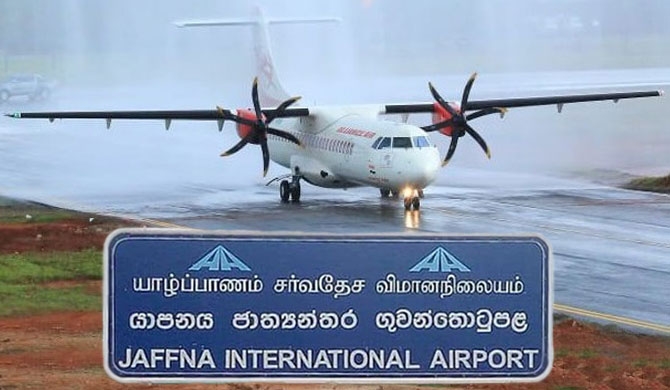
The president travelled by air on a four-day visit there and was participating in a district coordinating committee meeting at the town hall when the arrests were made.

Police prevented protesting members of the association of missing persons from entering the premises.

Secretary of its Vavuniya branch Sivanandan Jenita and Meera Jesmine were then arrested and dragged into a bus, video footage by the media showed.

Police claimed to have obtained a court order against Jenita that prevents her from holding protests.

Families of missing persons are on a campaign for more than 2,500 days to demand justice for their loved ones.

BASL demands end to rule by force, upholding law and justice

The Bar Association of Sri Lanka (BASL) has expressed deep concern over a recent rise in arbitrary arrests, police raids without proper warrants, and extrajudicial killings.

In a statement, the BASL underscored the importance of due process and the rule of law, urging authorities to promptly rectify these issues and restore public trust in the justice system.

The statement said, “The police raids, including the demolition of property carried out without valid search warrants and/or valid search orders, whilst flagrantly violating established legal protocols, render them unlawful. Such actions not only undermine the bedrock principles of justice, but also erode public confidence in the integrity of law enforcement agencies.”

The statement strongly condemned the prospect of extrajudicial killings, emphasizing that even convicted criminals have a right to due process and life as per Article 13(4) of the Sri Lankan Constitution.

The BASL also noted a disturbing trend of arbitrary arrests without proper investigation or legal procedure.

The BASL expressed deep concern over recent statements by the Public Security Minister implicating certain lawyers as conspirators with drug offenders.

The Association highlighted the need for police accountability and transparency in legal proceedings. Unchecked impunity creates an environment where no individual feels secure, regardless of their involvement.

The statement stressed the importance of steadfastly upholding the rule of law and due process for building a just and equitable society for all Sri Lankans.