Amarapura Nikaya rejects Himalaya declaration

The Amarapura Nikaya has rejected the Himalaya declaration unveiled last month.

However, instrumental in its compilation was Anu Nayake of that same Nikaya’s Ambagahapitiya chapter Dr. Madampagama Assaji Thera, together with the Global Tamil Forum.

It was handed over to president Ranil Wickremesinghe on 08 December.

The President’s Media Division said at the time the declaration promotes a pluralistic Sri Lanka that prioritizes the well-being of the community.

It also encourages learning from historical mistakes and stresses the importance of accountability measures, said the PMD.

Now, assistant registrar of Amarapura Nikaya’s Maha Sangha Sabha, Ven. Ambalangoda Sumedananda Thera said in a statement that the declaration did not have their consent.

It contains the personal opinions of a few Buddhist monks only, said the statement.

‘Joint Himalayan Declaration’ is Wickremesinghe’s Plan-B – (Kusal Perera)

“That in the opinion of this House, the Ceylon [constitution] Order-in-Council be amended forthwith to provide for the Sinhalese and Tamil languages to be state languages of Ceylon with parity of status throughout the Island……. Mr Speaker, I want in the first instance to ask this question: What are we aiming at? What is the objective we have in mind for this Country? Do we want a united, strong and an integrated Nation or not?…. If democracy is to be treated as an arithmetical concept that whatever majority decides it must be accepted merely because they have got superiority in members, that is not democracy….. The test of a democratic decision is the morality of the law…. There is no reason why they should separate unless we force them to separate by making Tamil a regional language confirmed to the Northern and Eastern provinces. That is what we are driving them to, that is what people who are advocating Sinhalese as the only official language do not seem to realize.” – (Dr. N.M Perera moving a motion on language in House of Representatives – October 19, 1955)

What’s all this present hype about six (06) sentences called the “Joint Himalayan Declaration”? A supposed “declaration” signed almost 08 months ago on 27 April in Nagarkot, Nepal. Signed between a few lesser representative Buddhist Sangha chapters or “nikayas” and the “Global Tamil Forum” (GTF). A depleted organisation that no more represents the Tamil Diaspora as it did a decade and a half ago at its founding.

Far more serious and in-depth discussions than what is bluffed in this declaration have taken place since the Bandaranayake – Chelvanayakam Pact signed in 1957, backtracked by PM Bandaranayake with the UNP galvanizing Sinhala protests and Buddhist monks threatening a sit-in at the private residence of PM Bandaranayake. The next compromise worked out as the Dudley – Chelvanayakam Pact in 1965 was abrogated again in 1968 due to street protests by SLFP, LSSP and CP that led to the unfortunate death of young novice monk Dambarawe Rathanasara thero from police shooting. Past 50 plus years would have seen over a dozen direct and mediated peace initiatives, all stalled due to ethno-racial opposition in Southern politics.

In January 1984 President Jayawardene chaired an All Party Conference (APC) held in Colombo with political parties in Sinhala South and democratic Tamil political parties participating. At this first APC, leader of the TULF Appapillai Amirthalingam presented a written statement that traversed the long history of Sri Lanka’s National Conflict.

In his written statement Amirthalingam says, “They (Sinhala racists) seem to forget that 5th June 1956 marked the first mob violence against Tamils.” An organised mob attacked the “Sathyagraha” organised by ITAK at Galle face green against the Sinhala Only Act with sticks, poles and stone throwing. The most saddening quote from Amirthalingam’s statement is, “….and when I walked into Parliament with a handkerchief tied round my head and my clothes soaked in blood, the then Prime Minister (Bandaranayake) quipped ‘honourable wounds of war’….” Bandaranayake thus implied that thuggery against a peaceful protest had his blessings. Amirthalingam then goes on to ask, “Can anyone who values truth say that this was the result of the Tamils resorting to violence? Or because the Tamils demanded a separate state?” There was no LTTE nor armed Tamil politics then in 1956 nor a demand for a “separate” Tamil State. But as Dr. N.M. Perera said in 1955, The Sinhala racists were pushing them for “separatism”.

Thereafter bi-lateral discussions in Thimpu, Bhutan were held in 1985 July with all armed groups attending. Thimpu discussions established the concept of the “Tamil Homeland” as North and East and as a non-negotiable demand in any future negotiation.

Elected president in December 1988, Premadasa initiated direct negotiations with the LTTE in Colombo as the sole representative of Tamil people beginning April 1989 that continued in staggered form till June 1990 and an APC with LTTE as an observer at BMICH in August 1989 attended by mainstream political parties in Sinhala South. The SLFP participated in the first two meetings and withdrew thereafter. In 1994 October President Chandrika Kumaratunge initiated direct talks with the LTTE that carried extremely high hopes for peace but ended as a hopeless event, with Chandrika not taking the LTTE seriously to negotiate with.

Thereafter, with Norwegian facilitation, negotiations with the LTTE began in 2002 August. At the third session in Oslo on 05 December both parties agreed on a federal system of power sharing. The Norwegian government thus issued a statement that announced “…. the parties have agreed to explore a political solution founded on the principle of internal self-determination in areas of historical habitation of the Tamil speaking peoples, based on a federal structure within a united Sri Lanka.”

What is this 2023 “Joint Himalayan Declaration” about? This GTF initiated declaration is as old as the Indo-Lanka Accord of 1987 July that led to the 13 Amendment. Thus, the GTF manipulated Joint Himalayan Declaration will once again reduce negotiations to 13 A “Plus” with “faithful” implementation of provisions of present constitution proposed as “temporary” with no timeframe proposed

Surprisingly, Tamil Diaspora groups have not raised the Oslo Declaration as binding on the GoSL. The Oslo Declaration is not a legal agreement between the GoSL and the LTTE. It is a political pledge by the GoSL to provide Tamil people with the Constitutional right to govern themselves within a federal system in a unitary, undivided country. Democratic Tamil leadership since the defeat of the LTTE has principally stood for a “federal solution” within a “united, undivided and an indivisible Sri Lanka” as Sampanthan has been always saying. The irony is no political leadership in the North and South campaign for a federal system of government as the democratic answer to the unresolved conflict.

What kept this national issue unresolved and festering? GoSL agreed to enact 13 A in July 1987 and established PCs. Agreed for a federal system in 2002 December in front of international media. Why does the conflict still remain unresolved? Simple reason is, these were not political positions governments came to, on their own political understanding and convictions. They were positions governments were pushed into by other external factors with geo-political interests within a global economy.

With all negotiated settlements sabotaged since 1957 by Sinhala-Buddhist racism, every new round of negotiations demanded more authority for Tamil areas to make certain they would not be robbed of power. Therefore, from the Regional Councils agreed upon with the B-C Pact of 1957, through PCs within a Unitary State in 1987, the GoSL in 2002 had to agree for a federal system of governance.

Yet no government and no Southern political leadership engaged people in discussing these proposals to have their consent for implementation. Gradually reducing themselves to be Southern Sinhala political parties, they feared they would lose their Sinhala-Buddhist vote base if the proposed devolution for North-East. In the South, all political parties have been competing to be more “Sinhala nationalist” than the other to gain Sinhala-Buddhist votes. Therefore, with a dominant Sinhala-Buddhist social psyche established, close-door negotiations and open politics are two different and contradicting approaches in the South, except when political leaderships feel divisions in the South require some additional votes from North-East to go beyond what South could deliver to form a government. There again its mere manipulations to retain the Sinhala-Buddhist image as large as possible.

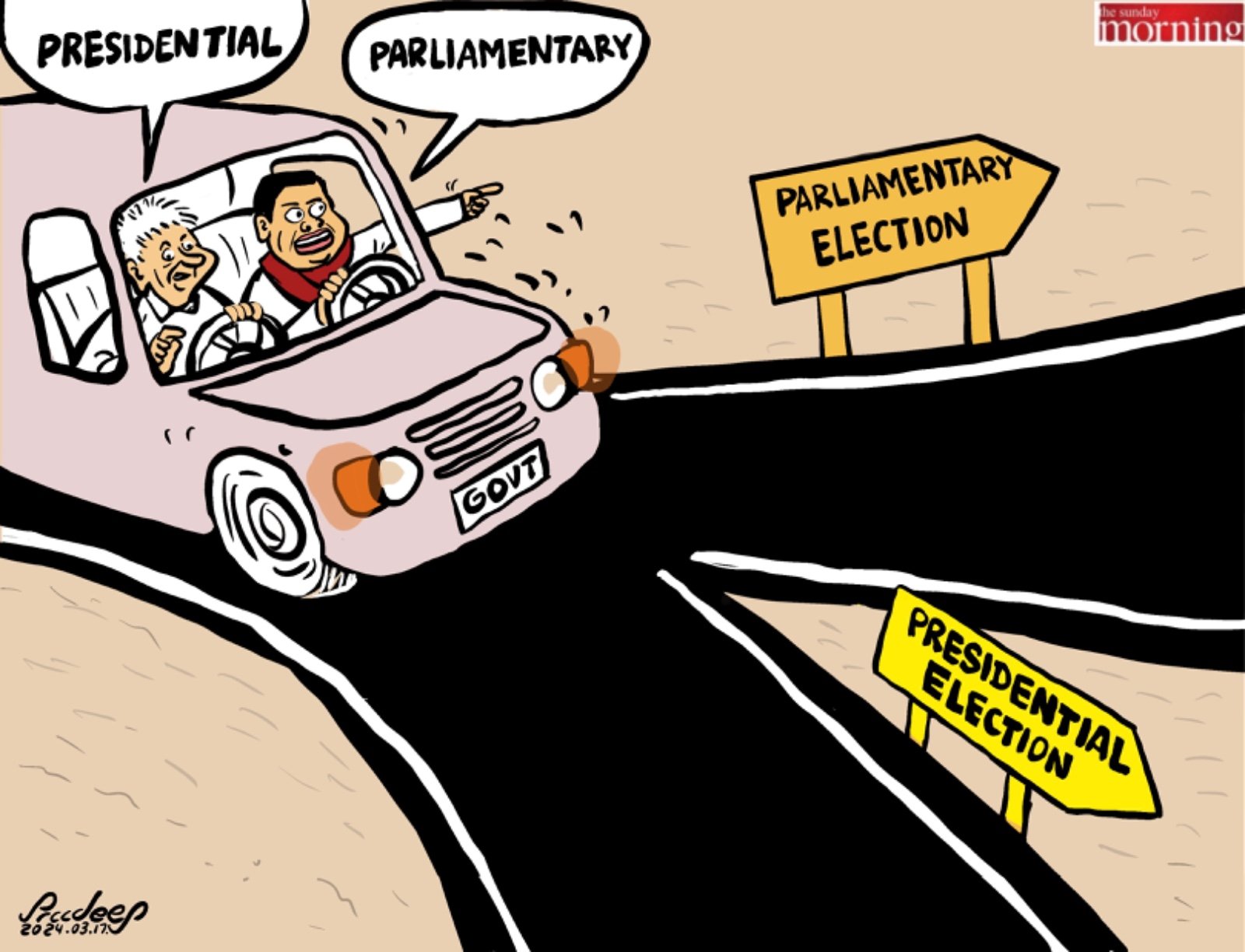
Classic case is the present interest President Wickremesinghe shows in settling the Tamil National issue. With the Southern mainstream political parties gearing up for elections, President Wickremesinghe knows he needs traction in the North-East to remain a decisive factor in post-election politics. His Plan-A was to initiate discussions with Tamil political parties. He spoke about improving PCs with more powers provided and closing the chapter of conflict and animosity. His rhetoric could not hold Tamil leaders in dialogue. They withdrew saying President Wickremesinghe is not serious and sincere and nothing more than “strengthening PCs” is offered.

Wickremesinghe therefore needed a Pan-B that comes with a vague declaration the GTF offers as the Joint Himalayan Declaration in collaboration with few Buddhist monks. The “Joint Himalayan Declaration” was presented to President Wickremesinghe and was discussed with the Speaker and members of parliament. It is being played out with subtle tact, GTF leader Suren Surendiran promising the Sinhala audience they do not stand for “a separate Tamil State”. This out in the clouds initiative is being carried to elite Sinhala-Buddhist representations for publicity.

Meanwhile President Wickremesinghe as the Finance Minister used the budget speech to project himself as a convinced Buddhist. He told parliament his budget 2024 is based on the Buddhist concept of “Samjeewikatha” and set aside allocations for a Buddhist University and a Buddhist Library for Anuradhapura and a Buddhist heritage museum to Kandy. He also promised a new opening for cultural tourism based on Buddhist heritage. He perhaps believes he could build on his Southern vote with that Sinhala rhetoric and have the GTF initiative for power devolution to collect more votes from the North-East.

Riding two horses all at the same time in two different directions, one in the North-East and the other in the South definitely proves its plain foxy politics, deceptive in every way. Fact remains they are not seriously and politically challenged by any in the public domain. They have to be challenged on Southern ground with extremely serious proposals with logical answers to both the post war issues and to the issue of power sharing. If the Tamil leadership is serious in driving for lasting answers, which is also doubtful, there are two extremely well drafted comprehensive documents idling since 2010 that should be brought for social discussions.

First is the LLRC Report that addresses the most important issue of de-militarising the North-East and establishing an effective civil administration which is now valid for the South as well. It also accepts, power sharing is democratising society that should be positively adopted nationally. The second is Prof. Tissa Vitharana chaired APRC Final Report. That provides for a novel restructuring of the State for provincial autonomy within a “united, undivided and indivisible Sri Lanka.” Most importantly this APRC Final Report is the only proposal yet for serious power sharing that has consensus from most extreme Sinhala-Buddhist campaigners in the South.

Now who would say Mahinda Rajapaksa is anti-Sinhala-Buddhist to have them compiled so comprehensively? Together, they provide the best alternative the Tamil leaders should demand immediate implementation. Himalayan Declaration in fact is mere crap compared to what these two documents offer as redress and as a political solution.

Truth, Unity, and Reconciliation Comm. Bill gazetted

The Bill to establish the Commission for Truth, Unity, and Reconciliation, the proposed truth seeking mechanism, has been gazetted.

The Commission shall consist of no less than seven members and not more than 21 members, all of whom shall be Sri Lankan citizens. The composition of the Commission shall reflect the pluralistic nature of Sri Lanka, including gender, and all members shall be persons of integrity and credibility, appointed on the basis of their knowledge and practical experience in the disciplines relating to the law, human rights, and humanitarian law, history, the social sciences, psychology, investigations, post-conflict studies and reconciliation. The members of the Commission shall be appointed by the President on the recommendation of the Constitutional Council.

The Commission shall investigate, inquire, and make recommendations in respect of complaints or allegations or reports relating to the damage or harm caused to persons or property, the loss of life or the alleged violation of human rights anywhere in Sri Lanka, which were caused in the course of, or reasonably connected to, or consequent to the conflict which took place in the Northern and Eastern Provinces during the period from 1983 to 2009, or its aftermath.

The mandate of the Commission includes the following: Establishing a truthful, accurate, impartial, and complete record of the above; to investigate and make recommendations in respect of the causes of the above; to help restore the dignity of aggrieved persons by providing an opportunity for them to give an account of the above; providing the people with a platform and opportunity for truth telling and relating their narratives; recommending the ways and means of effective remedies for aggrieved persons and diverse reparation measures in respect of them, including by the referral of matters to the Office for Reparations; making recommendations with regard to institutional, administrative and legislative policy and resource allocation measures that should be taken or introduced to prevent, and ensure the non-recurrence of the above; investigating and making recommendations in respect of the above allegations including acts or omissions that resulted in the arbitrary deprivation of human life or any attempt thereto, extrajudicial killings, assassinations and mass murders, acts of torture, cruel, inhumane and degrading treatment, sexual violence, and the abuse and exploitation of persons, abduction, hostage taking, and enforced disappearances, arbitrary or unlawful arrests or detentions, fact finding in respect of the alleged corruption and the intentional misuse of equipment and financial resources in relation to the conflict which took place in the Northern and Eastern Provinces that contributed to the loss of life or the grave risk of the loss of life of persons, fact finding in respect of the incidence of the recruitment of children into armed groups connected with the conflict which took place in the Northern and Eastern Provinces or its aftermath, fact finding in respect of the allegations of the forcible transfer or displacement of persons or populations within Sri Lanka, fact finding in respect of the allegations of the arbitrary or unlawful deprivation of property, whether temporary or permanent, inquiry into the existence, if any, of practices that have led to discriminatory treatment or the violations of individual rights based on religion, ethnicity, gender, place of origin, political opinion, language or caste, inquiry into whether any of the alleged violations and abuses referred to above were committed as a part of systemic crimes, and making findings in regard to those responsible for the commission of the alleged violations and abuses referred to above including those who advised, planned, directed, commanded or ordered such atrocities, making recommendations regarding schemes to empower affected communities by providing peace building and conflict transformation and livelihood training opportunities by those qualified to do so, and making recommendations regarding the non-recurrence of, and addressing the root causes.

The Commission’s recommendations shall not be deemed to be a determination of the civil or criminal liability of any person. Notwithstanding anything to the contrary in the Code of Criminal Procedure Act, No. 15 of 1979 or any other law, it shall be lawful for the Attorney General to institute criminal proceedings in a designated court of law in respect of any offence based on the material collected in the course of an investigation or inquiry or both, as the case may be, by the Commission established under this Act. The Parliament may take cognisance of the recommendations of the Commission and pass such a resolution it may consider necessary to promote national unity and reconciliation.

Provisions for victims and witnesses including reparations, and medical and psycho-social support have also been included.

Within one month from the date of publication of the first interim report or the making of the interim recommendations by the Commission, the President shall establish a monitoring committee to monitor and facilitate the implementation of the recommendations of the Commission.

Posted in Uncategorized

Investor sought for Trinco oil tanks development

A proposal to select a prospective investor for the first phase of the development of 61 fuel storage tanks in the Upper Tank area of the China Bay Harbour in Trincomalee was approved at the meeting of the Cabinet of Ministers held on Monday (1).

Accordingly, the Cabinet approved the relevant procurement process tabled by Minister of Power and Energy Kanchana Wijesekera.

The Cabinet meeting held on 3 January 2022 marked a significant decision as the Sri Lankan Government granted approval to lease 61 fuel container tanks in the Upper Tank area of the China Bay Harbour, Trincomalee. The lease, spanning 50 years, is aimed at facilitating the strategic development of these fuel tanks. Following the decision, Trinco Petroleum Terminal (Private) Limited is set to undertake the lease, initiating the project with a comprehensive feasibility study.

The proposed development plan outlines a phased approach, spanning 16 years and seven phases. Under the initial phase, nine productive tanks will undergo renovation, a pipeline extending approximately 1.75 kilometres will be laid, and essential supporting facilities will be constructed.

The entire project is structured under a build-operate-transfer model, allowing for efficient implementation.

Upcoming elections will be ‘do or die game’: AKD

The upcoming elections in the country would create the most intense battle ever in the Sri Lankan political arena which would be a do-or-die game for the National People’s Power (NPP), its leader Anura Kumara Dissanayake said yesterday.

Speaking at a seminar in Colombo, he said the political camps that are in the offing and political divisions which are created are not ordinary in nature.

Dissanayake said if the NPP lost the political battle this time, it would lead the country and the people into further misery and the NPP’s victory would direct the country into a path with new aspirations.

He said the government was making plans to expedite the process of selling off state property while the NPP was discussing the ideology of creating a new economic journey against the failed economic and political policies adopted for a long time by the governments so far.

He said NPP was also discussing about making plans to combat social crimes and change political culture which is full of corruption thereby creating a new political culture in the country.

Posted in Uncategorized

Ranil is certain to contest, says Range Bandara

Incumbent Ranil Wickremesinghe is certain to contest at the next presidential election, said UNP general secretary Palitha Range Bandara.

Speaking to journalists at Sirikotha yesterday (01), Range Bandara said Wickremesinghe, among the country’s leaders, is the internationally-acclaimed, experienced leader who takes decisions without fear or suspicion.

His decisions have enabled the national economy to record a higher revenue after 25 years, claimed the UNP general secretary.

That will enable granting relief for the people, he said.

Range Bandara charged that certain power-hungry persons were now trying to mislead the public after evading their responsibility when people were suffering in queues.

Posted in Uncategorized

Lanza’s alliance announces support for Ranil

A newly-formed political alliance led by Nimal Lanza has announced that it would support incumbent Ranil Wickremesinghe at the next presidential election.

The grouping made its launch at its head office at Rajagiriya yesterday (01) with its key figures Lanza, operations leader Anura Priyadarshana Yapa and Priyankara Jayaratne present among others.

“From today, the new alliance is actively starting its political operations. We will work as a strong, extensive group to support the president at the presidential election,” MP Lanza said.

He expected president Wickremesinghe to hold presidential polls first, followed by parliamentary, provincial council and local government elections.

He went onto say that they have initiated a dialogue with 71 MPs presently functioning as independents to form the new alliance.

“We will be able to form the broadest alliance with the highest number of MPs and parties,” he claimed.

Lanza made it clear that his alliance will not stand together with the SLPP.

Operations leader of the alliance Yapa told the gathering that they were at a decisive juncture and stressed the need for a look back to fulfill their political ideology.

“We will not be able to do it as it had been then. But, we have to think how to do something new for the people by bringing both the present and the future together,” he said.

Posted in Uncategorized

GL, Dilan to join SJB-led alliance in newest political somersault

Two MPs who recently parted ways with the SLPP government along with the group led by MP Dullas Alahapperuma- Professor G. L. Peiris and Dilan Perera- convened at the opposition leader’s office and declared their move to form a grand political alliance in view of the Presidential Elections.

The trio of MPs affirmed their dedication to building a cohesive opposition alliance under the leadership of Sajith Premadasa who is the Leader of the Opposition. Professor Peiris underscored the urgency of this alliance, citing the prevailing national crisis marked by concerns over the public’s financial strain due to tax and price hikes, notably the recent surge in fuel prices.

While expressing their commitment to collaborate with the SJB, the MPs clarified that they have not officially joined the party. Instead, they emphasized their decision to work with the SJB while preserving their distinct political identity.

MP Dilan Perera acknowledged that their leader, Dullas Alahapperuma, is yet to decide on joining the broader opposition alliance. He highlighted the unanimous consensus among them to collaborate with the SJB, acknowledging a minor disagreement regarding the timing of their collective move. Emphasizing the need for a swift formation of a unified opposition alliance in preparation for potential upcoming elections, Perera stated, “The cake has to be iced as soon as possible.”

SLFP MP Shan Wijayalal, at the opposition leader’s office, formally acquired SJB membership from Mr. Premadasa. Wijayalal explained his decision to align with the SJB, citing it as the most potent force within the opposition.

Posted in Uncategorized

Dayasiri, Gammanpila discuss alliance

The United People’s Freedom Alliance (UPFA) and Pivithuru Hela Urumaya are holding talks to form a common alliance.

Top figures of the two sides have met for a preliminary discussion.

For the UPFA, participants were general secretary Thilanga Sumathipala, Dayasiri Jayasekara and former Kotte mayor Janaka Ranawaka.

Leader Udaya Gammanpila, national organizer Dhammika Ratmale, acting general secretary Nalaka Perera, Prasanna Amaratunga, Thilina Peiris, Bhupati Kahatuduwa, Shirantha Jayalath and Anjana Udara represented the PHU.

Leaders of the two parties stressed that they would discuss forming an extensive alliance against the repressive policies of the present regime.

Registrations for the 2024 electoral register commences

The registration of voters for the 2024 electoral register commences on Monday (01).

Chairman of the National Election Commission R.M.A.L. Rathnayake said the relevant instructions have been issued.

Earlier, plans were in place to commence registrations for the 2024 electoral register from February 1.

However, the Election Chief said a decision was reached to expedite the process as a Presidential Election will be held in 2024.

Accordingly, the 2024 electoral register will be displayed soon.