The Ilankai Tamil Arasu Kachchi (ITAK) known in English as the Federal Party (FP) is in the eye of a legal storm. The premier political party representing the Sri Lankan Tamils of the Northern and Eastern provinces is currently undergoing an internal crisis mainly due to recently held inner-party elections. Issues relating to the intra-party elections have brought about a clearly visible divide within the ITAK.
This in turn has led to an unprecedented situation where two members of the ITAK have sought legal recourse against allegedly illegal action by party authorities. Enjoining orders were obtained. Party Leaders were restrained from conducting its postponed National Convention on 19 February.
ITAK leaders were also restrained from implementing decisions made by the Party’s General Council on 21 and 27 January 2024. The General Council known as “Podhuchabhai” comprises members of the Central Working Committee and representatives elected by the party’s district branches. The stay order was issued on 15 February for 2 weeks until 29 February.
As a result of the court orders, the ITAK National Convention did not take place as planned on 19 February. Furthermore, courts have also restrained ITAK Party Leaders from implementing decisions reached at the party General Council meetings on Jan 21 and 27. The decisions reached on the two days were the election of a new party President on January 21, and the election of other office bearers on 27 January. Hence all the new party office bearers including the new President, Sivagnanam Shritharan are debarred temporarily from functioning in their posts.
As is the case with most democratic political parties, the ITAK too has several internal divisions. The fault lines within the ITAK came to the fore when the party’s General Council elected a new President, Secretary and other key office bearers in Trincomalee on 21 and 27 January 2024. These elections and their implications have been discussed by this writer in two articles published in our sister newspaper (Daily FT) on 24 January and 9 February 2024 respectively.
The new office bearers for the years 2024-26 were to be ceremonially announced at the party convention earlier scheduled for January 28. However the “old” ITAK President, Maavai Senathirajah in a controversial move unilaterally announced that the convention was being postponed indefinitely due to differences of opinion within the party. This had the tacit support of the “new” ITAK president Sivagnanam Shritharan. After some days it was announced that the party convention would be held in Trincomalee on February 19.
What happened next was that some party members sought legal intervention on 15 February to prevent the party convention from being held on February 19, on the basis that the number which voted at the elections was in excess of the numbers allocated to the General Council in terms of the ITAK party constitution. They also challenged the legality of the elections of office bearers on the basis that procedures set out in the party constitution were not followed.
Consequentially, the District Courts of Trincomalee and Jaffna issued Enjoining Orders staying the ITAK from holding its party convention or General Council meeting on February 19. This resulted in the party convention not being held on February 19. The Trincomalee Courts have also effectively stayed the functioning of the newly elected office bearers.
Trincomalee
Trincomalee was the venue of the ITAK General Council conclaves. The National Convention was also to be held there. In Trincomalee the complaint was filed by lawyer, Aishwarya Sivakumar on behalf of Para Chandrasekaram, the owner of “Para Hotel” and a resident of Konesapuri in Saambaltheevu. He is a member of the ITAK in the Trincomalee District. When the case was heard by Trincomalee District Judge, Manickavasagam Ganesharajah on 15 February, Geoffrey Alagaratnam PC along with Attorney-at-Law, Purantharan appeared for the petitioner.
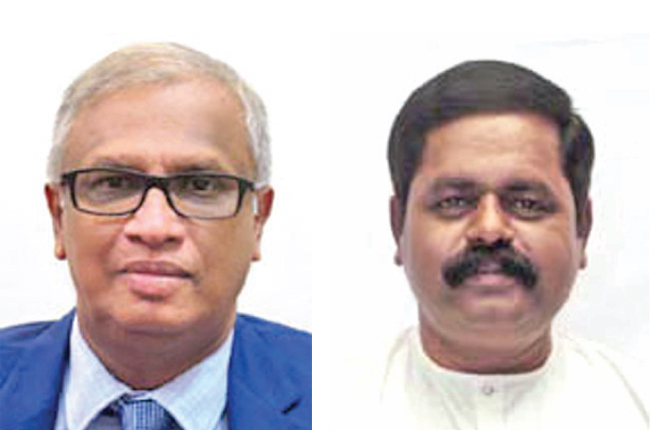
Seven ITAK leaders were named as respondents. They were Somasundaram Senathirajah, Sivagnanam Shritharan, M.A. Sumanthiran, Shanmugam Kugathasan, Pathmanathan Sathialingam, Seenithamby Yogeswaran and Xavier Kulanayagam.
Of these, Senathirajah known as “Maavai” was the ITAK President from 2014 to 2024. He remained as President officially on 21 January, when 321 members of the ITAK General Council voted to elect a new President. Shritharan was elected as the new ITAK President, with a 47 majority on January 21. Sumanthiran was a candidate at the party Presidential poll. He obtained 137 votes. The winner Shritharan got 184. Both Shritharan and Sumanthiran are Jaffna district MPs. “Maavai” is a former Jaffna MP.
Shanmugam Kugathasan is the ITAK Trincomalee District Chairman. He was elected as the new General Secretary of the ITAK on 27 January. Pathmanathan Sathialingam, a medical doctor was functioning as the Acting General Secretary of the ITAK until a new secretary was elected on the 27th. He is a former Northern Provincial Council Minister.
Seenithamby Yogeswaran is a former Batticaloa District MP. He was also a candidate for the ITAK Presidency, but withdrew in favour of Shritharan. Xavier Kulanayagam was elected as the ITAK’s new Deputy General Secretary on January 27. He was earlier the party’s Administrative Secretary.
Enjoining Orders
After hearing submissions praying for an Interim Injunction on behalf of Petitioner Para Chandrasekaram, Trincomalee District Judge, Manickavasagar Ganesharajah issued two Enjoining Orders valid for 14 days until 29 February when the next hearing is scheduled.
One enjoining order restrained the seven defendants namely, Messrs Senathirajah, Shritharan, Sumanthiran, Kugathasan, Sathialingam, Yogeswaran and Kulanayagam from holding/conducting the purported National Convention on 19 February 2024 until the hearing and determination of the application for an injunction.
The other Enjoining Order restrained the seven defendants, Senathirajah, Shritharan, Sumanthiran, Kugathasan, Sathialingam, Yogeswaran and Kulanayagam from implementing any of the purported decisions taken at the purported General Council meetings held on 21 and 27 January 2024 until the hearing and determination of the application for an injunction.
The Trincomalee Court’s Enjoining Order has restrained the party from implementing decisions taken by the General Council on January 21 and 27. What this meant was that the party Presidential election on January 21 and the election of other office bearers on January 27 cannot be followed through. None of those elected can function in their posts until the Courts make their final decision. The stay order is likely to be extended further unless an amicable agreement is reached.
The new office bearers elected are as follows – President – Sivagnanam Shritharan. Senior Vice President – CVK Sivagnanam. Vice Presidents – Charles Nirmalanathan, T. Kalaiarasan, P. Ariyanendran, P. Sathialingam and KV Thavarasa; General Secretary – Shanmugam Kugathasan. Deputy General Secretary – Xavier Kulanayagam. Assistant Secretaries – Shanthi Sriskandarajah, Ranjani Kanagarajah, Krishnapillai Seyon, T. Krukularajah, E. Saravanabavan and C Sivamohan. Joint Treasurers – P. Kanagasabapathy and Gnanamuthu Sreenesan.
Currently, none of these persons can function in the posts they were elected to.
Jaffna
The ITAK party headquarters is located at Martin Road in Jaffna. Peter Ilanchezhiyan, a member of the ITAK Central Working Committee petitioned the Jaffna District Court seeking an injunction against the postponed ITAK National Convention being held in Trincomalee on 19 February. Ilanchezhiyan is the son of former Northern Provincial Council Deputy Chairman, Anton Jeyanathan and the nephew of ITAK Deputy General Secretary, Xavier Kulanayagam. When the ITAK General Council meeting was in progress on January 27, Ilanchezhiyan had openly declared that he would go to Courts if the party constitution was not adhered to.
Ilanchezhiyan’s application was heard by Jaffna District Judge, Sinnathurai Sathiswaran. Lawyer Kumaravadivel Guruparan appeared on behalf of Peter Ilanchezhiyan. Five Persons were named as respondents. They were Somasundaram Senathirajah, Sivagnanam Shritharan, Shanmugam Kugathasan, Pathmanathan Sathialingam and Xavier Kulanayagam. Senathirajah and Shritharan are the old and new party Presidents, respectively. Kugathasan and Kulanayagam are the new General Secretary and Deputy General Secretary. Sathiyalingam is the former Deputy General Secretary cum Acting General Secretary.
In his submissions, Guruparan stated that the party constitution had been violated in constituting the General Council. Persons far in excess of the numbers eligible had attended the General Council meeting and voted at the election. Procedures set out in the party constitution were not followed. Some of the posts had been filled unlawfully.
Counsel Guruparan further stated that the holding of the party convention was improper because the party constitution stipulated that 21 days notice should be given in the media before the convention was held. This had not been done. An injunction against the National Convention being held on February 19 was sought. After hearing the submissions, the Courts issued an Enjoining Order. The convention was not held on the February 19.
Maavai Senathirajah
Several acts of commission and omission by ITAK leaders over the years have culminated in the current crisis. The main share of the blame should be borne by Maavai Senathirajah who functioned as party President for 10 years from 2014 to 2024. Senathirajah was the immediate cause for the present problem too. It was he who arbitrarily postponed the ITAK convention indefinitely. Otherwise it would have been held without any hitch on January 28.
Senathirajah postponed the convention unilaterally and illegitimately on the pretext that a group of persons from Batticaloa were objecting to the election of Shanmugam Kugathasan of Trincomalee as the new ITAK General Secretary. They were demanding that the post should be given to Gnanamuthu Srinesan a former Batticaloa district MP. Though Ex-President Senathirajah was not empowered to do so, he announced a postponement of the party convention until the issue was solved by electing a new General Secretary.
Shritharan and Sumanthiran met Senathirajah. In that meeting Sumanthiran emphasised that the election of Kugathasan as General Secretary was valid in fact and law. The Central Working Committee had endorsed it unanimously. The General Council had accepted it unanimously. Thereafter, it had been put to the vote also and carried forward with 112 voting in favour and 104 against. Therefore, it was not correct for Senathirajah to have postponed the convention on the basis that a new Secretary had to be elected.
Senathirajah disagreed. He said that he was going to Singapore for his son’s wedding and would be back in Sri Lanka on 10 February. He would re-convene a General Council meeting after his return and resolve the issue. Shritharan was amenable to Maavai’s suggestion. Srinesan and the Batticaloa group were Shritharan’s supporters. Kugathasan was perceived as being in the Sumanthiran camp.
Sumanthiran then said that Senathirajah’s suggestion was contrary to the ITAK party constitution. Senathirajah then retorted, “We don’t have to always work according to the party constitution.” Sumanthiran responded that violating the party constitution was unacceptable and could have legal consequences. Senathirajah, with tacit support from Shritharan, disregarded Sumanthiran’s legal advice and went off to Singapore.
Gentleman’s Agreement
After Senathirajah returned, an unofficial meeting was held in which an arrangement was arrived at. A gentleman’s agreement was reached where Kugathasan would function as General Secretary for one year. Thereafter, he would resign and Srinesan would function as General Secretary for a year. Thus the two year term of office was to be divided as one year each. This was followed by another announcement that the party convention would be held on 19 February 2024.
Subsequently, it was announced that the ITAK General Council too would be re-convened and a “mini –election” held. It was said that in terms of the ITAK constitution, it was the Deputy General Secretary who would automatically become General Secretary if the latter resigned. As such, it would be Deputy General Secretary, Kulanayagam who would become General Secretary, if Kugathasan resigned. Srinesan who had been elected joint Treasurer could not replace Kugathasan
Hence it was said that the General Council would be convened to hold two elections. Srinesan would become Deputy General Secretary, and Kulanayagam, Joint Treasurer. This was followed by a meeting between veteran ITAK Trincomalee MP, Rajavarothayam Sampanthan and Shritharan who was accompanied by ITAK Wanni MP, Charles Nirmalanathan. Tamil newspapers reported that Sampanthan had declared at the meeting that conspiracies should be thwarted and fresh elections to all posts in the ITAK should be held.
This caused a major upset in the ITAK circles. The party grapevine began humming that the idea of convening the General Council was not to have a mini-election but to have a major poll in which fresh elections were to be held for all the office bearers elected on January 27. It was strongly believed that people suspected of being Sumanthiran loyalists were going to be replaced by Shritharan supporters. Financial incentives provided by Tamil Diaspora elements were going to play a role as in the case of the party Presidential election of January 21. Rules, norms and procedures laid out in the ITAK Constitution were going to be brazenly flouted.
Constitutionalism Fought Back
It was then that the ITAK constitution or “Constitutionalism” fought back! The legal action initiated in Trincomalee and Jaffna was on the basis that the party constitution was not being adhered to. An Interim Injunction was sought. After ex parte proceedings, the courts have issued enjoining orders.
The crucial question that arises is what the ITAK leaders propose to do. It is blatantly obvious that the ITAK constitution has been flagrantly violated. Protracted legal proceedings may tie up the party in knots. There is also the danger of potential intervention by the Elections Commission. The party runs the risk of losing its registration and popular “House” symbol.
Crux of the Matter
This writer consulted some members of the legal fraternity over the ITAK legal wrangle. According to these legal eagles, the crux of the matter is the composition of the ITAK General Council and the decisions taken by this body on the 21st and 27th of January 2024.
The problem arose when Shritharan’s supporters disputed the decisions taken on the 27th of January and made attempts to change them. The legal challenges seem to be a defensive response to those perceived attempts.
If Shritharan and his supporters provide an assurance that no changes will be made to those decisions and that the newly elected office bearers including the General Secretary and Deputy General Secretary will be allowed to function in their posts, there are chances of persuading the two plaintiffs to withdraw the cases. If this is not done, the cases will drag on and even the position of Shritharan who was elected President on January 21st could be challenged.
Saner Counsel
As stated earlier, the ITAK is in the eye of a legal storm. Unless and until saner counsel prevails within the upper echelons of the ITAK, the party seems headed for protracted legal proceedings.
D.B.S. Jeyaraj can be reached at dbsjeyaraj@yahoo.com