SC concludes hearing of petitions against bill to revoke privileges of former Presidents

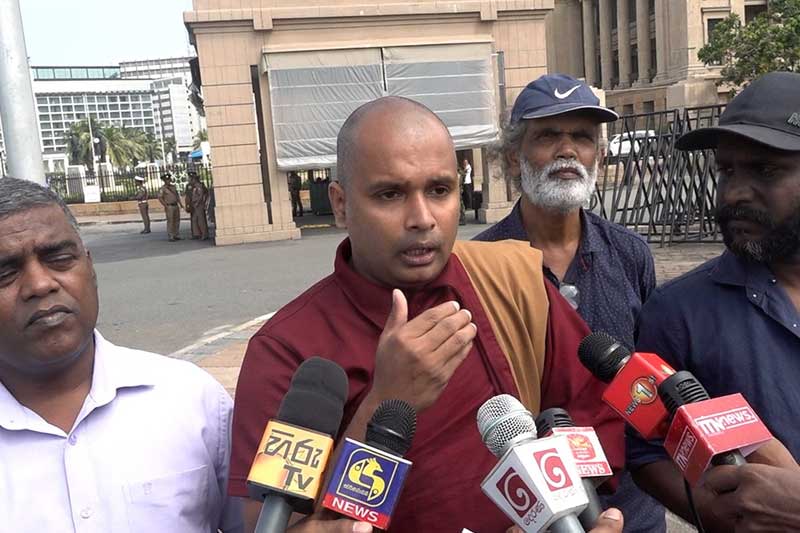
The Supreme Court today (25) announced that it will submit its confidential determination on the constitutionality of the bill presented by the government to remove privileges of retired presidents to the Speaker of House.

After an extensive hearing, a three-judge bench comprising Chief Justice Preethi Padman Surasena and Justices Achala Wengappuli, and Sampath Abeykoon issued the order concluding the hearing of petitions filed against the Presidents’ Entitlements (Repeal) Bill.

At the commencement of today’s hearing, President’s Counsel Ali Sabry, appearing on behalf of former Chief of Staff of the Navy S.M. Wijewickrama, who had filed a petition, argued before court that, under Section 3 of the Presidential Entitlements Act No. 4 of 1986, retired presidents or their widows are entitled to housing, pensions, staff facilities, and transportation.

The Act further states that if a residence is not provided, one-third of the pension amount must be paid by the government as a housing allowance.

Ali Sabry further noted that Articles 36(2) and 36(4) of the Constitution safeguard the rights and privileges of former presidents.

He emphasized that former presidents or their widows are constitutionally entitled to any benefits decided by Parliament, and while these benefits can be increased, they cannot be reduced, as clearly stated in the Constitution.

Sabry argued:

“Your Lordships… The privileges of a president are tied to the Constitution. Therefore, any amendment requires not only a special majority in Parliament but also approval from the people through a referendum, as previously established by the Supreme Court. For instance, in 2015, then-President Maithripala Sirisena voluntarily attempted to reduce certain powers through the 19th Amendment. However, the Court ruled that such powers could only be removed with public approval, since those powers belong not to Maithripala Sirisena personally, but to the Executive Presidency itself.”

He further noted:

“After former U.S. President Barack Obama retired, he requested to waive his pension, but the U.S. Congress rejected it, stating that the privileges are not for the person, but for the dignity of the office. Hence, they cannot be waived.”

Sabry argued that such privileges ensure individuals of high calibre are encouraged to accept high office, and are especially important for ensuring the post-retirement security of presidents who made critical decisions while in office—such as during the final stages of the war in 2009.

“At that time, immense international pressure, especially from Western countries like France and the United Kingdom, was exerted on the Sri Lankan President to stop the war. Yet, the President resisted this and made a very dangerous but bold decision to continue. This is why the Presidential Entitlements Act remains important even today,” he said.

Sabry concluded that since Executive Presidents are elected by the people, Parliament alone cannot remove their post-retirement privileges without a referendum.

Attorney Ashok Baran, appearing for Sri Lanka Podujana Peramuna Administrative Secretary Renuka Perera, told the bench that Parliament attempting to curtail presidential powers contradicts the doctrine of separation of powers enshrined in the Constitution.

He argued that the proposed bill undermines constitutional guarantees afforded to former presidents and thus cannot proceed without public approval.

President’s Counsel Eraj de Silva, representing another party, also emphasized that provisions in the proposed bill violate the principle of separation of powers and constitute an attempt by the legislature to undermine the executive, thereby violating people’s sovereignty.

He warned that this amounts to a serious constitutional breach, as it effectively suspends Article 36, removing the president’s independence and affecting national sovereignty.

Attorney Saman Galappaththi, appearing for former President Mahinda Rajapaksa’s media spokesperson Manoj Gamage and Professor Mahinda Pathirana, argued that the privileges of former presidents were granted by the people, and therefore, any reduction must go to a referendum.

Solicitor General Viraj Dayaratne, appearing for the government, responded by referencing the 1970 parliamentary election, where Sirimavo Bandaranaike’s government won with a two-thirds majority and introduced the 1972 Constitution, transitioning Sri Lanka into a republic. He noted that J.R. Jayewardene, the first Executive President, was not elected by the public, but appointed through a constitutional amendment.

In 1977, Jayewardene campaigned promising a new Constitution with an Executive Presidency, which was later introduced as the 1978 Constitution following a decisive election victory.

He stated:

“The current government too made a campaign promise to remove the privileges of former presidents. This bill is a step in fulfilling that promise. This is not a constitutional amendment, but simply a repeal of the Presidential Entitlements Act No. 4 of 1986. It does not affect presidential pensions or any fundamental rights enshrined in the Constitution.”

Therefore, he argued, there is no requirement for a referendum, and the bill can be passed with a simple majority in Parliament.

He added:

“This is a policy decision by the government. The bill does not touch the constitutional pension rights of former presidents. Repealing the 1986 Act is within Parliament’s power and does not violate any constitutional principles.”

After reviewing submissions from both sides, the Supreme Court bench directed the parties to submit any written submissions by noon on Thursday (28), after which the Court will submit its confidential ruling to the Speaker of House.

No plans to arrest MR: Government

Amid speculation over a possible arrest of former President Mahinda Rajapaksa (MR) following former President Ranil Wickremesinghe’s detention, the Government has denied any such plans, insisting investigations into alleged past crimes are impartial and handled by independent bodies.

Responding to questions about whether the Government intended to arrest former President Rajapaksa and other senior figures, Public Security Minister Ananda Wijepala stated: “There are no attempts to arrest anyone. That is not our motive.”

He maintained that the Government was simply investigating crimes that had been committed in the past that were otherwise ignored.

The Minister stressed that the investigations were being conducted impartially by independent bodies such as the Criminal Investigation Department (CID), Financial Crimes Investigation Department (FCID), cybercrime units, and the Commission to Investigate Allegations of Bribery or Corruption (CIABOC) without interference of the Government.

“It really does not matter whether the person is a former president, minister, deputy minister, MP, or an ordinary person. If a crime has been committed, then they will have to answer,” he said. “We hold no bias even if they are from our own party.”

To underscore this point, Wijepala specifically addressed recent allegations against Energy Minister Kumara Jayakody, a member of the current Government. “If there are allegations against him, they will be investigated,” Wijepala affirmed.

He noted that the decision on whether to arrest someone was the prerogative of the court and that the CIABOC was an independent body that did not fall under the purview of any ministry.

The Minister asserted that the Government did not engage in “vindictive politics” and was committed to strengthening the rule of law. “Nobody is above the law, and our Government does not care for caste or class or power, so any person, no matter which side they are on, will have to be arrested if they are in the wrong.”

The arrest of Wickremesinghe and the ongoing investigations against other prominent figures have drawn contrasting views from both sides of the political spectrum.

Former President Mahinda Rajapaksa’s Spokesperson Ravindra Manoj Gamage has also labelled the arrest of former President Wickremesinghe as an act of “political vengeance”. He stated that the Government had targeted the members of opposing factions and past governments and was antagonising the former leaders to its maximum capability.

He claimed that the Government had particularly targeted the Rajapaksa family. “Arresting Mahinda Rajapaksa will be a near-impossible task for the Government, but you can observe that they are targeting his other family members, Namal and Yoshitha Rajapaksa included.”

“Namal Rajapaksa is definitely a high-profile target for arrest,” Gamage added.

Meanwhile, Police Spokesperson ASP Fredrick Wootler also upheld the official stance, stating that the Police did not comment on specific ongoing cases.

He confirmed that any complaint reported to a Police station or the CID would be investigated and referred to a court of law if warranted. He also claimed that investigations were ongoing in several cases, and if the Police suspected that an arrest was warranted, such an arrest would be made in compliance with the laws and permission of the courts.

The Truth About the Easter Attacks Must Be Told

In April 2019, Sri Lanka was shaken to its core. The Easter Sunday bombings killed over 250 people, many of them attending church services or enjoying a family holiday. It was one of the darkest days in the island’s modern history, leaving a permanent scar on survivors, on the Catholic community, and on the entire nation. Six years on, justice remains elusive.

This week, former President Maithripala Sirisena, who was Head of State and Commander-in-Chief when the tragedy occurred, made a series of startling remarks at the Sri Lanka Foundation Institute. He insisted that governments, militaries, and intelligence agencies worldwide are aware of who the “mastermind” of the attacks was. He further admitted that he has told the Criminal Investigation Department “everything,” but that none of it can be revealed.

Such statements are not only irresponsible; they are an affront to justice and to the memory of those who died. For years, families of victims Sri Lankan and foreign alike have pleaded for clarity, accountability, and transparency. Instead, what they continue to receive are riddles, contradictions, and political grandstanding. When a former President, who bore ultimate responsibility for national security at the time, now declares that he knows the truth but cannot or will not disclose it, the insult could not be greater.

The Easter Sunday attacks were not merely a lapse of intelligence or a failure of security. They were the culmination of systemic negligence and political dysfunction. Inquiries, commissions, and court cases have come and gone, yet the core question remains unanswered: who truly masterminded the atrocity? Each time an opportunity arises to move closer to the truth, it is buried under layers of political self-preservation and evasion.

What Sirisena has now said adds a new dimension of frustration. If he does indeed know the identity and location of the architect behind the attacks, withholding that knowledge is a betrayal of the very people he once swore to protect. To claim that “everyone knows” but that Sri Lanka cannot act is not leadership; it is abdication of responsibility. Worse, it reduces one of the nation’s gravest tragedies to a soundbite; fodder for political speeches and newspaper headlines.

The victims deserve far more. Their families deserve answers, not vague pronouncements. For many, wounds have not healed; for some, they never will. Parents lost children, children lost parents, whole families were torn apart in an instant. Foreign visitors who perished in the blasts had their lives stolen on what was meant to be a holiday. For all of them, six years of delay and obfuscation represent not just bureaucratic inertia, but an ongoing injustice.

The time has come for honesty. If Sirisena truly has information, he must reveal it fully, under oath, and before the appropriate authorities. If not, he should refrain from making pronouncements that only reopen old wounds without offering solutions. Silence is preferable to half-truths that erode faith in justice further.

It is also time for the current government and opposition alike to stop weaponising this tragedy for political mileage. Each camp has, at different times, sought to blame the other, to absolve itself of responsibility, or to point fingers abroad. Meanwhile, ordinary citizens are left bewildered, cynical, and exhausted by the constant drip of speculation. The Easter Sunday attacks are not a political pawn. They were a massacre. They demand accountability, not posturing.

International observers are also watching. When a former Head of State admits that he knows the identity of the mastermind yet does nothing, the credibility of Sri Lanka’s justice system is once again undermined in the eyes of the world. That damage is not easily repaired. A country that cannot deliver justice for an atrocity of this magnitude will struggle to claim legitimacy in the fight against terrorism and extremism.

“Enough is enough” must become the rallying cry. Enough of commissions that lead nowhere. Enough of shifting blame. Enough of leaders making sensational claims only to retreat into silence when pressed. Above all, enough of the cruel neglect of those still mourning loved ones.

Justice delayed is justice denied. The Easter Sunday victims and their families have been denied long enough. They do not need cryptic statements; they need the truth. And the nation needs closure—not through empty speeches, but through real accountability. Until that happens, Sri Lanka will remain haunted by 2019, unable to heal, unable to move forward.

Source:Ceylon Today

Posted in Uncategorized

PTA will be abolished from September – Minister

The Prevention of Terrorism Act (PTA) will be repealed by the beginning of September 2025 and will be replaced with new legislation to ensure national security, pending a final committee report as promised by the National People’s Power (NPP) policy statement and not because of any external pressures to do so.

Foreign Affairs, Foreign Employment and Tourism Minister Vijitha Herath said this while addressing the Parliament yesterday during the adjournment debate on the Human Rights issues faced by Tamils and Muslims in the North and East since independence.

The Minister said that the Gazette notification in this regard will be issued from September 2025.

Minister Herath said that within a short period after assuming power, the Government appointed a committee under President’s Counsel Rienzie Arsakularatne to study and make recommendations on the PTA.

He said that this committee has convened on multiple occasions and has started making relevant amendments to the PTA which will be completed by the end of August and soon after the committee report is submitted, a Gazette notification on abolishing the PTA will be issued in the beginning of September.

The Minister pointed out that National unity in Sri Lanka among the Sinhala, Tamil, Muslim, Burgher and Malay communities is the most vital factor to build the economy of the country as they are all the citizens of this country and children of one mother.

“We must all join together as one nation and one people to restore and develop this country and our Government has commenced its work based on this stance. A clear message was conveyed after the Presidential Election in 2024 by President Anura Kumara Dissanayake that the entire Lankan people are ready to hold hands with the new President and the present Government and move forward on a new journey which is why the people in the North and East, Muslim, Malay, Tamil people in the country for the first time in its history gave a massive mandate due to the trust.

For the first time in history, the highest number of votes from the people in the North and East and the Estate sector was received by one single political party the National People’s Power (NPP) to build national unity and through national reconciliation to take the economy of this country into a strong position. The Government has placed a firm foundation in building the economy of the country having identified this strong mandate given by the people of the entire country.

The Government is working to develop the country based on its three-prong policies of eradicating poverty of the people, digitalizing the systems and making Sri Lanka clean. The war situations arose from time to time in the country, especially in the North due to the instability, inequality and unfairness of the country’s economy. The uproars arose in the North against these reasons which extended into a war. The NPP Government has understood this foundational reason why the people in the North and East rose up against the then governments and are working towards addressing them to bring healing and national reconciliation among the people affected in the North and East, Estate sector and the rest of the country.

Our Government has been able to establish true democracy that all nationalities living in the country wanted within a very short period of time. The Government is taking all decisions based on the Constitution to ensure the protection of the territorial integrity and sovereignty of Sri Lanka without going under any external influences.

All elections that could not be held before due to the prevention by the Delimitation Report will be conducted according to the Constitution after clearing these legal obstacles by our Government in order to protect the democratic right of the people. A new Constitution addressing the needs of all nationalities living in the country is on its way of being created which will be passed by our Government after a referendum held as all the previous Constitutions in the countries were passed without the participation and approval of the people in this country and were forced upon them.

We have taken many steps to protect the human rights of all the people in the country. We have no interest in violating a person’s human rights based on their religion or nationality. Our Government has a five-year national reconciliation plan in place that we will implement that has been already approved by the Cabinet of Ministers with the support of the United Nations to bring reconciliation among the people in the North, East, South and West.

“We don’t need the intervention of other countries to have accountability in running the country democratically. The Judicial system has been made totally independent to take accountable decisions without political influence. There’s no political influence taking place for the Sri Lanka Police to conduct its services free and fair as our Government has made the Police independent in making decisions which is why the ex-IGP who was fully corrupt was able to be removed without any political intervention to restore public security in the country. We have established an accountable process within a local mechanism that is trustworthy and acceptable by the international community that has surfaced and combats all criminal activities including controversial murders of prominent figures in the country, bribery and corruption, Easter Sunday bomb attacks that had been hidden by the previous regimes.”

“We are also working towards implementing women’s rights across the entire country based on the United Nations Conventions to protect their human rights,” the Minister added.

Former President Ranil admitted to Prison Hospital

Former President Ranil Wickremesinghe, who was arrested and remanded in custody on Friday over allegations he misused state funds while in office, has been admitted to the Prisons Hospital on the advice of doctors, according to the Prisons Spokesman.

Wickremesinghe became the most senior opposition figure to be hauled up in an anti-corruption crackdown by the new government as he was ordered remanded until August 26 by the Fort Magistrate’s Court.

“The suspect (Wickremesinghe) will be held in custody till Tuesday, but considering his medical condition he could be admitted to the prison hospital or another hospital,” Magistrate Nilupuli Lankapura said ordering his remand.

Wickremesinghe, whose lawyers said was suffering from heart disease and diabetes, was charged under the Public Property Act and two counts of the penal code – “dishonest misappropriation of property” and “criminal breach of trust.”

Wickremesinghe, 76, was taken into custody after being questioned about a September 2023 visit to London to attend a ceremony for his wife at a British university.

Wickremesinghe had stopped in London in 2023 on his way back from Havana, where he attended a G77 summit, and the UN General Assembly in New York.

The brief UK visit was to participate in the conferring of an honorary professorship on his wife Maithree by the University of Wolverhampton.

His office had previously denied that he abused his position to visit Britain. Three of his then senior aides were questioned this month by the Criminal Investigation Department (CID).

Wickremesinghe had maintained that his wife’s travel expenses were met by her and that no state funds were used.

However, the CID alleged that Wickremesinghe used 16.6 million rupees of government money for his travel on a private visit with a delegation of 10 people, including bodyguards.

Wickremesinghe, who was ordered to be remanded in custody, was taken to the Welikada Prison. The former President was seen being brought to the Welikada Prison in a prison bus amid tight security.

Posted in Uncategorized

UK and Sri Lanka finalise debt restructuring deal worth nearly US $ 90mn

The governments of Sri Lanka and the United Kingdom have officially entered into a bilateral agreement to restructure a portion of Sri Lanka’s external debt, a deal valued at nearly US $ 90 million. The agreement, described as a “significant milestone” in the nation’s economic recovery efforts, was formalised at the Finance Ministry, on August 22, 2025.

This agreement is a critical component of Sri Lanka’s broader effort to emerge from its most severe economic crisis since gaining independence. In April 2022, the island nation defaulted on its foreign debt for the first time in its history, amid soaring inflation and critical shortages of essential goods.

Securing agreements with bilateral creditors like the United Kingdom is a key prerequisite for the continuation of a nearly US $ 3 billion bailout programme from the International Monetary Fund, which is vital for stabilising the country’s finances.

The total rescheduled debt under the UK agreement consists of US $ 86,068,439.80 and JPY 582,940,944.31. According to the Finance Ministry, this accord is the result of discussions that followed a memorandum of understanding with the Official Creditor Committee (OCC). The OCC, co-chaired by India, Japan and France, was formed to coordinate debt treatment plans among Sri Lanka’s various bilateral lenders.

Sri Lankan government emphasised the deal is a testament to its commitment to finalising the restructuring process swiftly to restore debt sustainability.

The diplomatic notes formalising the agreement were exchanged between Sri Lanka’s Finance, Planning and Economic Development Ministry Secretary Dr. Harshana Suriyapperuma and British High Commissioner to Sri Lanka Andrew Patrick.

Officials expressed that the agreement is expected to further strengthen the “deep and long-standing bilateral relationships” between the two nations.

Posted in Uncategorized

Sri Lanka government does not print money, it is under central bank: Minister

Sri Lanka government does not print money, and the entire matter is under the control of the central bank, Deputy Economic Development Minister Anil Jayantha Fernando said in response to concerns raised about recent monetary expansion.

“Under the current environment the government has no ability to ‘print’ money,” Minister Fernando told parliament.

“So we have not done that. There is no legal room to do that.”

Minister Fernando was responding to concerns raised that the expansion of broad money over the past year.

“What is generally called reserve money is completely under the control of the central bank,” Minister Fernando said.

“Based on that, broad money or M2b can expand. All those activities are under the control of the central. The government has not increased money supply.”

Reserve money is a stock of cash that can be measured in real time. Broad money is mostly a paper trail left by reserve money as it goes through the banking system changing from one hand to the next and people put their savings in banks and take out loans.

However excessive growth of credit can also create problems, analysts say.

Sri Lanka’s central bank, like many other state-owned central banks since the Fed Treasury Accord of 1951 have been considered, ‘independent’ or turned into or de jure since the 1990s.

However, when central bank’s print money and trigger forex shortages, inflation far above zero and eventual sovereign default elected politicians are held responsible or accountable by the members of the public.

No Inflationary Budgeting

The current NPP administration has taken a political hit by introducing additional taxes to reduce the budget deficit including on bank deposits and freelancers, though the central bank is trying to push up the cost of living to 5 percent a year, which is more than 20 percent in a 4 -year term of a government.

When introducing the budget for 2025, Minister Fernando said the government had expected zero inflationary financing.

“We have not moved to fill this gap with inflationary ways or money printing,” Minister Jayantha told parliament on February 2025.

“We are planning to raise 2,125 domestically through non-inflationary means. Foreign financing is 75 million dollars.

Central banks deny monetary stability to the people through beliefs held by macro-economists using statistics (econometrics) especially since the 1960s that inflation is good (inflation-employment trade-off), unlike classical economists who said that stability brings long term growth.

Inflation Bias

In Sri Lanka the central bank has won for itself a mandate to create 5 to 7 percent inflation which critics had pointed out does not amount a credible anchor, and has led to serial currency crises since the end of the war and eventual sovereign default.

The relentless pursuit of inflation by macroeconomists, regardless of the impact on the balance of payments or the poor, is referred to as the ‘inflation bias’ of modern independent state-owned central banks.

As countries are democracies, the public naturally holds elected politicians accountable for the rise in cost of living, and not the central bank, which has complete control of reserve money.

In Sri Lanka, questions have also been raised about the way the central bank calculates reserve money, leaving out some excess liquidity.

Excess rupee reserves are money which is not demanded by the public for precautionary purposes or for day-to-day activities (real money demand) but they can be used for final clearing of transactions.

Excess reserves therefore is therefore used for credit, and is the prime cause of forex trouble and reserve losses.

There was public outrage in the last quarter 2024, as the central bank injected money through open market operations as private credit picked up, losing the ability to collect reserves in the last quarter.

Signalling and Pressure

The central bank is currently not printing money through open market operations, but has injected money by borrowing dollars from banks through buy-sell swaps, which analysts have pointed out eventually leads net reserve losses, by mis-targeting rates even if gross reserves appear to be stable.

Rates have been also held down through ‘signalling’ and some moral suasion.

Concerns have also been raised about a so-called fiscal ‘buffer’ which tends to turn paper roll-overs of debt (which does not alter reserve money) into cashflow which has to be financed either by drawdowns of excess liquidity (if there is any) or through reserve shorts or window borrowings, instead of allowing current credit trends to determine market interest rates.

The central bank which had control of raising money for the government, until the public debt management office was set up, could squeeze the supply of cash to the government by keeping bill and bond rates artificially low and discouraging banks and the public from buying them and print money and blame the government for deficits.

Analysts have pointed out that the central bank usually discouraged the public from rolling over past debt and not necessarily current year deficits.

The first time the central bank created the problem was in 1952, leading to a ‘hartal’ in 1953 which led to the deaths of several people. The Prime Minister resigned.

In the old days bad central banks were automatically eliminated by a return to gold to a foreign money analysts say, solving forex problems and domestic monetary instability in one go, analysts say.

But under the IMF, economies are contracted through a stabilization crisis to restore the lost confidence in the money monopoly (local currency), and the central bank with a flawed operating framework gets a new life to create a fresh crisis.

The government in the inflation crisis is kicked out by the electorate and the government that hikes taxes under the stabilization crisis is also kicked out by the electorate as SMEs also collapse and bad loans mount, especially if its term is less that four years and cannot show a recovery.

Sell-Buys vs Buy-Sells

Sri Lanka has exchange controls which were intensified from 1952, after suppressing rates. But in 1951 they were relaxed as it ran deflationary policy amid a bubble created by the Federal Reserve.

Though Sri Lanka until 1950 had a currency board and large reserves and did not need forex controls, due to Cambridge economists running the Bank of England, UK had restrictions which were extended to the island under the so-called ‘Sterling Area’. The Sterling also collapsed in 1949.

In 1951, the central bank ran deflationary policy, told banks not to convert dollars, and was considering appreciating the currency as the Fed printed money (also buying World War I Liberty Bonds as the US government ran budget surpluses hiking taxes for the Korean war), unlike the warnings on buy-sell swaps being made analysts in 2025.

ECONOMYNEXT – Sri Lanka government does not print money, and the entire matter is under the control of the central bank, Deputy Economic Development Minister Anil Jayantha Fernando said in response to concerns raised about recent monetary expansion.

“Under the current environment the government has no ability to ‘print’ money,” Minister Fernando told parliament.

“So we have not done that. There is no legal room to do that.”

Minister Fernando was responding to concerns raised that the expansion of broad money over the past year.

“What is generally called reserve money is completely under the control of the central bank,” Minister Fernando said.

“Based on that, broad money or M2b can expand. All those activities are under the control of the central. The government has not increased money supply.”

Reserve money is a stock of cash that can be measured in real time. Broad money is mostly a paper trail left by reserve money as it goes through the banking system changing from one hand to the next and people put their savings in banks and take out loans.

However excessive growth of credit can also create problems, analysts say.

Sri Lanka’s central bank, like many other state-owned central banks since the Fed Treasury Accord of 1951 have been considered, ‘independent’ or turned into or de jure since the 1990s.

However, when central bank’s print money and trigger forex shortages, inflation far above zero and eventual sovereign default elected politicians are held responsible or accountable by the members of the public.

No Inflationary Budgeting

The current NPP administration has taken a political hit by introducing additional taxes to reduce the budget deficit including on bank deposits and freelancers, though the central bank is trying to push up the cost of living to 5 percent a year, which is more than 20 percent in a 4 -year term of a government.

When introducing the budget for 2025, Minister Fernando said the government had expected zero inflationary financing.

“We have not moved to fill this gap with inflationary ways or money printing,” Minister Jayantha told parliament on February 2025.

“We are planning to raise 2,125 domestically through non-inflationary means. Foreign financing is 75 million dollars.

Central banks deny monetary stability to the people through beliefs held by macro-economists using statistics (econometrics) especially since the 1960s that inflation is good (inflation-employment trade-off), unlike classical economists who said that stability brings long term growth.

Inflation Bias

In Sri Lanka the central bank has won for itself a mandate to create 5 to 7 percent inflation which critics had pointed out does not amount a credible anchor, and has led to serial currency crises since the end of the war and eventual sovereign default.

The relentless pursuit of inflation by macroeconomists, regardless of the impact on the balance of payments or the poor, is referred to as the ‘inflation bias’ of modern independent state-owned central banks.

As countries are democracies, the public naturally holds elected politicians accountable for the rise in cost of living, and not the central bank, which has complete control of reserve money.

In Sri Lanka, questions have also been raised about the way the central bank calculates reserve money, leaving out some excess liquidity.

Excess rupee reserves are money which is not demanded by the public for precautionary purposes or for day-to-day activities (real money demand) but they can be used for final clearing of transactions.

Excess reserves therefore is therefore used for credit, and is the prime cause of forex trouble and reserve losses.

There was public outrage in the last quarter 2024, as the central bank injected money through open market operations as private credit picked up, losing the ability to collect reserves in the last quarter.

Signalling and Pressure

The central bank is currently not printing money through open market operations, but has injected money by borrowing dollars from banks through buy-sell swaps, which analysts have pointed out eventually leads net reserve losses, by mis-targeting rates even if gross reserves appear to be stable.

Rates have been also held down through ‘signalling’ and some moral suasion.

Concerns have also been raised about a so-called fiscal ‘buffer’ which tends to turn paper roll-overs of debt (which does not alter reserve money) into cashflow which has to be financed either by drawdowns of excess liquidity (if there is any) or through reserve shorts or window borrowings, instead of allowing current credit trends to determine market interest rates.

The central bank which had control of raising money for the government, until the public debt management office was set up, could squeeze the supply of cash to the government by keeping bill and bond rates artificially low and discouraging banks and the public from buying them and print money and blame the government for deficits.

Analysts have pointed out that the central bank usually discouraged the public from rolling over past debt and not necessarily current year deficits.

The first time the central bank created the problem was in 1952, leading to a ‘hartal’ in 1953 which led to the deaths of several people. The Prime Minister resigned.

In the old days bad central banks were automatically eliminated by a return to gold to a foreign money analysts say, solving forex problems and domestic monetary instability in one go, analysts say.

But under the IMF, economies are contracted through a stabilization crisis to restore the lost confidence in the money monopoly (local currency), and the central bank with a flawed operating framework gets a new life to create a fresh crisis.

The government in the inflation crisis is kicked out by the electorate and the government that hikes taxes under the stabilization crisis is also kicked out by the electorate as SMEs also collapse and bad loans mount, especially if its term is less that four years and cannot show a recovery.

Sell-Buys vs Buy-Sells

Sri Lanka has exchange controls which were intensified from 1952, after suppressing rates. But in 1951 they were relaxed as it ran deflationary policy amid a bubble created by the Federal Reserve.

Though Sri Lanka until 1950 had a currency board and large reserves and did not need forex controls, due to Cambridge economists running the Bank of England, UK had restrictions which were extended to the island under the so-called ‘Sterling Area’. The Sterling also collapsed in 1949.

In 1951, the central bank ran deflationary policy, told banks not to convert dollars, and was considering appreciating the currency as the Fed printed money (also buying World War I Liberty Bonds as the US government ran budget surpluses hiking taxes for the Korean war), unlike the warnings on buy-sell swaps being made analysts in 2025.

East Asian monetary authorities on the other hand conduct deflationary swaps.

Singapore monetary authority now appreciates its currency routinely as the Fed prints money, a practice it started in the 1970 in the Great Inflation period. Singapore does not have a policy rate and operates money on currency board principles.

For decades during its meteoric economic growth in the past, the three month swap offer rate (SOR) set the benchmark for interest rates. (Colombo/Aug20/2025 – Update IV)

Source: EconomyNext

Posted in Uncategorized

President Meets with Cardinal and Catholic Bishops

A high-level meeting took place Wednesday morning (20) at the Presidential Secretariat between President Anura Kumara Dissanayake and His Eminence Malcolm Cardinal Ranjith, Archbishop of Colombo, along with members of the Catholic Bishops’ Conference of Sri Lanka (CBCSL).

During the discussion, the Cardinal briefed the President on key matters deliberated at the tri-annual meeting of the Catholic Bishops. The delegation also shared the Church’s current perspectives and proposals on national and social issues.

The Archbishop was accompanied by CBCSL President Bishop Harold Anthony Perera and other senior members of the Conference, said the President’s Media Division.

Posted in Uncategorized

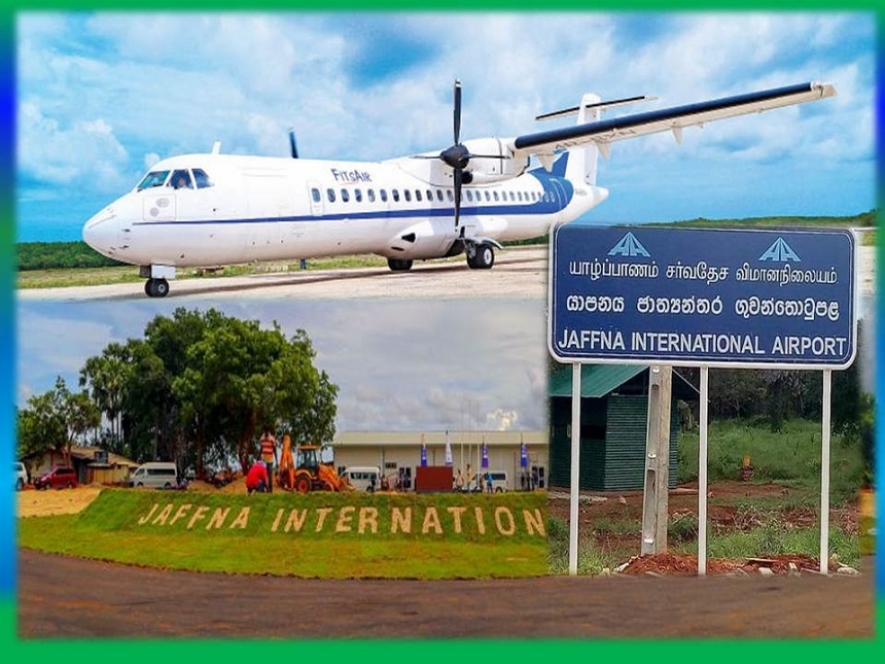
We want Jaffna Airport to be a success story unlike Mattala: Bimal

The Jaffna International Airport will be gradually upgraded with a business plan, Minister of Transport, Highways, Ports and Civil Aviation Bimal Rathnayaka assured in Parliament today (20).

In response to a question raised by Ilankai Tamil Arasu Kachchi (ITAK) Member of Parliament S. Shritharan, Minister Rathnayaka said they are hoping to extend the airport runway before the middle of next year but ruled out major expansion due to financial constraints.

He said they are hoping to expand the runway in a bid to facilitate the landing of aircraft that can carry around 130 passengers.

The Minister noted they cannot expand the airport to cater large wide-body aircraft like at the Mattala International Airport as it will not be feasible.

He stressed that they are determined to make the Jaffna Airport a success story unlike the Mattala Airport which is using large sums of funds, mostly generated by the Bandaranaike International Airport (BIA).

The Minister noted that the government will also consider further reducing the embarkation fee to attract airlines to the Jaffna Airport in future.

NPP politicians attend remembrances for Sencholai massacre victims

Remembrances have taken place in Jaffna and the Wanni to remember victims of aerial bombings on a children’s home at Vallipunam in Mullaitivu 19 years ago that claimed the lives of 61 Tamils, including 54 schoolgirls.

Regional leaders of the NPP too, attended the events.

The attack that has come to be known as the Sencholai massacre on 14 August 2006 also left more than 150 injured, some disabled for life.

A remembrance event took place at the site, where relatives offered floral tributes and lit lamps and candles to victims’ photographs.

ITAK MP Thurairaja Raviharan was among those present.

Parallel events took place at the University and also the Municipal Council in Jaffna, where NPP MPs stood up as lamps were lit for the dead.

TNPF leader Gajendrakumar Ponnambalam and others held a remembrance at Vallipunam.

The Air Force bombing of the facility occurred as a first aid and disaster workshop was taking place for the girls.

The then government spokesman Keheliya Rambukwella defended the attack by saying the place had been identified as an LTTE training camp. Ceasefire monitors, UN and relief agencies that visited the scene later confirmed no military training had taken place there.