Mood of the Nation: Approval of government falls to 9% in October – Verité Research

The approval rating of the government fell to 9% in October 2023 from 21% in June 2023, according to the latest round of the Gallup style ‘Mood of the Nation’ poll of Verité Research.
The survey showed that satisfaction with the state of the nation also dropped by half to 6%, from 12% in June 2023. The economic confidence score also fell from negative (-) 44 in June to negative (-) 62.

The Mood of the Nation poll is conducted three times a year and is based on an island-wide, nationally representative sample of responses. The survey sample and methodology are designed to limit the maximum error margin to under 3% at a 95% confidence level.

Government approval: To the question “Do you approve or disapprove of the way the current government is working?”, 9% said they approve (with an error margin of ± 1.93%). Further, 7% said that they do not have an opinion. The present approval rating is close to the 10% that it was in January and October 2022, and February 2023.

Sri Lanka satisfaction: To the question, “In general, are you satisfied or dissatisfied with the way things are going in Sri Lanka?”, only 6% said they were satisfied (with an error margin of ± 1.66%). This rating was as low as 4% in February 2023.

Economic confidence

The economic confidence score worsened to negative (-) 62 in October from negative (-) 44 in June. However, this was better than 2022 levels, when the economic confidence score ranged between negative (-) 96 and negative (-) 78.

Multiple choice questions on the condition and trajectory of the economy are used to generate the economic confidence score. The score can range from negative (-) 100 to positive (+) 100.
A score above zero means more people see the economic conditions positively rather than negatively. If everyone thinks that the economy is in poor condition (instead of good or excellent), and everyone also thinks it is getting worse (rather than better), then the score will be a (-) 100.

Survey implementation

The Mood of the Nation survey is designed to assess the approval, satisfaction, and confidence of the nation in relation to the government, the country, and the economy. The poll is based on an island wide nationally representative sample of responses from 1,029 Sri Lankan adults, conducted from 21 to 29 October 2023.

The poll is conducted as a part of the syndicated survey instrument of Verité Research with the polling partner Vanguard Survey (Pvt) Ltd. This instrument also provides other organisations the opportunity to survey the sentiments of Sri Lanka.

Posted in Uncategorized

How Sri Lankan hurdles can hamper connectivity projects to India By N Sathiya Moorthy

By seeking to escalate the long-term fishers’ issue at a time the two nations are resuming the forgotten ferry service after four decades, Sri Lanka’s Fisheries Minister Douglas Devananada may be torpedoing the larger connectivity project of his President, Ranil Wickremesinghe.

The minister’s reiteration of an earlier demand for an UN intervention to ‘prevent the large Indian fishing fleet from poaching in Sri Lankan waters’ at a second such meeting in the past months, with the UN Resident Coordinator Marc-André Franche in Colombo has the potential for non-Establishment Indian stake-holders to challenge the 1974 ‘Katchchativu Accord’, at the ICJ or such other fora, whatever their locus standi. Equally important is the potential for Minister Devananda’s initiative to torpedo the multi-nation Colombo Security Conclave (CSC) on Indian Ocean security, starting with non-traditional security in these waters, where the two nations have a lot to share between themselves and with other signatory-nations in the region.

Considering that it is an international initiative, it is unclear if Devananda had Cabinet clearance and/or the President’s approval for approaching the UN directly, over the head of the Foreign Ministry, which alone is known to handle such matters all along. All along the Foreign Ministry has been handling the issue, and at the bilateral level. Yes, the Fisheries Ministry has been the ‘line ministry’ in the matter, but then it had not acted unilaterally. As such, any deviation from the known and/or approved course will have larger bilateral consequences.

Alternatively, it has to be assumed that the Cabinet and/or the President have/has given approval for Minister Devananda to rake up the issue at the ‘international level’. This has an entirely different set of interpretations and consequences at multiple levels. It is again unclear if it is so, and if so, the decision-makers have taken a closer look at issues.

What more the current ministerial initiative seeking extra-stake-holder intervention, even if by the UN, comes at a time when Sri Lanka has named former Foreign Secretary Kshenuka Seveniratne as the next High Commissioner to India at New Delhi. Until recently, Sri Lanka’s Permanent Representative (PR) at the UN Headquarters, Amb Seneviratne is well-versed with the fisheries’ issue, she having headed governmental delegations for talks with India, when she was Additional Secretary in the Foreign Ministry.

Reviving a dream

The ferry service – this one, between Nagapattinam in southern coastal Tamil Nadu Kankesanthurai (KKS) in Sri Lanka’s Northern Province — has had a chequered career before being shut down at the commencement of the ethnic war in Sri Lanka. It had begun as the prestigious Boat-Mail train-cum-boat service between the Tamil Nadu capital of Chennai, then Madras and Colombo, the capital of Sri Lanka, then Ceylon. Both nations were then separate colonies of the British Crown, though issues involving the ownership of the tiny Katchchativu Islet had remained.

The boat-link between Danushkodi in Rameswaram further down Nagapattinam, and Talaimannar in northern Ceylon was lost when the 1964 ‘Rameswaram Cyclone’ washed away Danushkodi Island and also the rail assets in the vicinity. Though reviving the ferry service, this time with higher-speed vessels had captured the imagination of leaders in both Colombo and Delhi since the conclusion of the ethnic war in Sri Lanka, it has been an article of faith for President Ranil Wickremesinghe, as a part of his ‘Connectivity Projects’ between the two South Asian neighbours.

Thus, when he mooted the idea of a land-bridge between the two countries when he was Prime Minister in 2004 Wickremesinghe had visualised as an agency for connecting Sri Lanka, its people and businesses not just with the south Indian State of Tamil Nadu, but the southern Indian region as a whole. In a larger perspective, his connectivity dream extended all the way up to the entire Eurasian land-mass, though he did acknowledge that political issues on either land-wings of India would require time to resolve, for the full potential to be achieved.

Not many people in the two countries remember it, but during an official visit to Delhi as Prime Minister, Wickremesinghe had signed an MoU with Indian counterpart Atal Behari Vajpayee, for undertaking technical studies on a land-bridge. If it could not be pursued, it owed to objections from Tamil Nadu’s then AIADMK chief minister Jayalalithaa, who saw the land-bridge as a ‘security risk’ when the LTTE was still around, even if not as active during those years of cease-fire agreement (CFA) with the Sri Lankan Government (2002-06).

Way with waywardness

The larger idea of greater connectivity between the two countries got a new and urgent fillip during President Wickremesinghe’s delayed yet maiden Delhi visit earlier this year, when the two governments signed a series of agreements to increase flight-frequency, resume the ferry service and revive the hopes of a land-bridge. Though academic doubts do exist about the economic viability of such a massive boost to bilateral connectivity on multilateral spheres, the current Sri Lankan dispensation especially is more hopeful than most.

Inside Sri Lanka especially, there has been unconvincing opposition to the land-bridge especially, with some stray voices claiming that it would lead to the nation becoming yet another State of the Indian Union. Such motivated and at times unreasonable critics of the projects seldom look at the prospects of India having to face multi-strata criticism from across present-day Sri Lanka to any such proposal for ‘unification’, which has never ever happened in history, including when the common British colonial power was lording over both countries, as if they were independent nation-States.

These critics are almost always short on facts. They do not want to acknowledge that if India had designs on Sri Lanka, it would not have to ‘give away’ Kachchativu without contesting Colombo’s claims, which were at best contestable. They seldom remember that even the ‘Kachchativu controversy’ has had its origins when the two nations were under the same colonial master but could resolve it, that too in smaller Sri Lanka’s favour, close to a quarter century both had acquired Independence. They often refer to the IPKF operations as a part of the failed Indo-Sri Lanka Accord, aimed at ending Sri Lanka’s ethnic war early on, as New Delhi’s attempt to have Indian boots on the island-nation, but again forget very many facts in the matter.

One, the IPKF came to Sri Lanka at the written request of wily President J R Jayewardene, who made Indian soldiers fight the LTTE as if by proxy, and give up their lives for a cause that was exclusively Sri Lanka’s, if not of the Sinhala majority, better still ‘majoritarians’ in the country. They do not want to remember that the IPKF left the country, bag and baggage, when Ranasinghe Premadasa as JRJ’s elected successor, wanted them out.

Whether or not the IPKF had a premonition that Premadasa would fall prey to the LTTE’s bicycle-bound suicide-bomber, but they most definitely knew that his leadership was diverting previous war-material meant for his own armed forces, yes, to the LTTE, of all. Unfortunately, no successor government or even the leadership of the armed forces has ordered a probe into the murky dealings of those days, which made not just Premadasa the man and leader, but also the nation’s armed forces, sitting-ducks for the LTTE, for a lot more time to come.

And long after the IPKF’s disastrous relations with the Sri Lankan government (but not their own counterparts), India continued to send in its forces, this time exclusively on a humanitarian mission, post-tsunami, end-2005. The alacrity and pace with which India handled what was Sri Lanka’s situation, that too when coastal south India and the Andaman Islands, including the tri-forces command HQ, too, were badly hit by the tsunami, should have spoken volumes even to lesser mortals. Once again, Indian troops left once the immediate rescue and relief operations were over. Yet, the Sinhala-Buddhist majoritarians have a way, even with their waywardness…

Joint vision

Mr. Wickremesinghe said hailed it an important step in improving connectivity between the two nations, and recalled how people of both countries have travelled across the Palk Strait for many years. Indian PM Modi, again in a video-message, reiterated his statement after the meeting with President Wickremesinghe in Delhi, and said that the ferry service will help strengthen cultural, commercial, and civilisational ties between the two nations. Connectivity is the central theme of the ‘joint vision’ of the India-Sri Lanka economic partnership, he said adding that India will take steps to resume the Rameswaram-Talaimannar ferry service as well. In his video message, India’s External Affairs Minister (EAM) S Jaishankar called it a “truly big step for people-to-people contacts between India and Sri Lanka…. And it was so recognised by Prime Minister Modi and President Ranil Wickremesinghe,” Jaishankar said.

Though the initial plan was to revive the original Rameswaram-Talaimannar route, but it would have meant a further delay as civil works needed to be taken up at both ends. Various alternatives were considered in India, like Karaikal and Puducherry, but Nagapattinam was found to be fast and feasible. Because it was all done in a hurry, as the two governments wanted to launch the service before the cyclone-prone north-east monsoon sets in this month (October), there was not much preparation or pre-launch publicity or guarantee for regularity.
The up-and-down daily trips thus have since been reduced to alternate days until 23 October, the last day before monsoon holiday, after which the ferry service would reopen in January in a full-fledged manner. The current run, where there were only a few passengers on board – but included some excited western tourists – would help the authorities to fix operational problems, if any, before the full commercial launch. By the time, there is also the hope of a better, larger vessel being pressed into service, as for what could now be called the ‘trial run’, India had temporarily diverted Hindustan Shipping Corporation’s ‘HSC Cheriyapani’, which was one of the three speed boats doing the inter-island routes in the Lakshadweep group.

Addressing India’s federal Shipping and Ports Minister Sarbananda Sonowal, who was present at the launch-function, Tamil Nadu’s Ports Minister E V Velu wanted the one-way ticket price to be reduced from the current INR 7,670 (LKR 30,000 appx). That way, Sri Lanka’s Transport, Shipping and Ports Minister, Nimal Siripala de Silva was on hand at Kankesanthurai, to receive the first batch of travellers.

Cause for concern

It is in the overall background, ill-advised initiatives like Minister Devananda’s, that too coinciding with the ferry re-launch, becomes a greater cause for concern than meeting the eye. It is to be noted that every Government in New Delhi since the signing of the ‘Katchchativu Accord’ in 1974 and a modified IMBL Accord in 1976, has conceded that Indian fishers, especially from southern Tamil Nadu and Karaikal enclave of the Puducherry Union Territory, were violating the IMBL on occasions.

Despite the continuing all-round opposition in Tamil Nadu, where it is a sensitive political issue, New Delhi has repeatedly proclaimed that Kachchativu remained a part of Sri Lanka, as outlined in the 1974 Accord. It has also been underscoring the fact that the livelihood of fishers in both nations cannot be interfered with.

It is Indian fishers in the case of their Tamil brethren from northern Sri Lanka, and by the Sri Lanka Navy and lately, Sri Lankan Tamil fishers, in the case of the other. In recent weeks and months especially, there have been constant reports of local fishers from Sri Lanka’s North independently raiding the Indian fishers’ vessels and looting their catch and gears, just as they have all along been complaining about bottom-trawlers from across the Palk Strait destroying theirs all along. Then, of course, there are continual reports of the Sri Lanka Navy (SLN), in the name of curbing poaching by Indian fishers, arresting them and their vessels, under relatively new laws in that country, and freeing only the former after governmental intervention but letting the boats and gears to rot under the open sky.

Greater sensitivity

Bilateral cordiality being what it is now, and the national governments’ joint desire is to fast-track all connectivity projects so that Sri Lanka would not have to risk another economic melt-down as happened last year, there is need for greater sensitivity in both nations towards the ferry service on the one hand and the land-bridge and other projects on the other. Yes, the connecting waters of the Palk Strait cannot be made murky where they are not, and murkier where they already are.

This is because the safety of ferry travellers initially and also pleasure and adventure tourists, not to mention Buddhist, Hindu, Muslim and Christian pilgrims using the cheaper ferry service, compared to air travel, would be compromised if the fishing waters are to be troubled more than already – and continues to be so in the weeks and months after resumption in January.
In between, the heightened fishers’ issue in the region, including the frequent harassment and subsequent arrest of fishers from Nagapattinam region especially (but not exclusively so) in Sri Lankan waters could have consequences for the ferry service, which when resumed full-scale. With the ferry service on, and connecting train services too facilitated in due course, it can interest southern Sri Lanka tour-operators to use the route for aged pilgrims visiting Buddhist religious centres like Bodh Gaya and Saranath in north India.

This is not to leave out Hindu, Muslim and Christian pilgrims from both sides to travel to the other – and also small-time traders in Sri Lanka’s North and the East especially to use the ‘free luggage’ quota to buy products in Tamil Nadu, which they have been lugging by flight, paying higher transport costs. The same, of course, goes for normal tourists from one country to the other, who are keen as much on shopping as seeing places and people.

(The writer is a policy analyst & political commentator, based in Chennai, India. Email: sathiyam54@nsathiyamoorthy.com)

Ousted President Gotabhaya Makes Appearance at SLPP Headquarters During Pirith Ceremony

Former President Gotabaya Rajapaksa and former Prime Minister Mahinda Rajapaksa made a notable appearance at the Sri Lanka Podujana Peramuna (SLPP) headquarters in Battaramulla.

The occasion was the celebration of the 7th anniversary of the party’s founding.

This public gathering marked one of Gotabaya Rajapaksa’s rare appearances since his removal from power amidst a wave of public protests.

The pirith ceremony was organized under the oversight of prominent party officials, including Basil Rajapaksa and Sagara Kariyawasam.

SLPP reaping what it sowed BY M.S.M Ayub

The SLPP leaders are unlikely to accept this challenge as it is very clear to anybody conversant with the relevant Constitutional provisions that defeating the budget would be counterproductive to the SLPP

President Ranil Wickremesinghe has been attempting or pretending to be attempting to fully implement the 13th Amendment to the Constitution, apparently keeping the Tamil votes in mind

While speaking to the media on Monday, Transport, Highways and Mass Media Minister Dr Bandula Gunawardena who is also an economist ruled out any possibility of meeting the trade union demand, unless taxes are further imposed or increased

Are we witnessing another Yahapalana Government, not in its literal sense, but in its political sense? One would recollect that the Yahapalana Government was a cart pulled back and forth by two horses.
President Maithripala Sirisena ran one government while Prime Minister Ranil Wickremesinghe was running another. Ultimately, one sacked the other in 2018, but the Supreme Court saved the latter.
However, there is a difference between then and now; the two leaders of the Yahapalana Government were digging each other’s graves whereas leaders of the two parties of the current government do not seem to go to that extent, they are just each other’s throat, really or ostensibly.

President Ranil Wickremesinghe has been attempting or pretending to be attempting to fully implement the 13th Amendment to the Constitution, apparently keeping the Tamil votes in mind.
However, the Sri Lanka Podujana Peramuna (SLPP), the real political strength of the President within the government is not in favour of it. Some of its leaders have been agitating against the idea arguing that Wickremesinghe has been appointed just to run the office for the remaining period of the term of President Gotabaya Rajapaksa who did not have any mandate to fully implement the 13th Amendment.

After the President made various promises from resolving the ethnic problem before the 75th Independence Day to fully implementing the 13 A within two years and convening all-party conferences and negotiations with the Tamil political parties since November last year, the ethnic problem now seems to have been put on the backburner again.

Now the government is attempting to shift the attention of the people from the ethnic problem to electoral reforms, though it had come to the fore intermittently after Gotabaya Rajapaksa assumed office as President in 2019. In the latest move in this regard, President Wickremesinghe has appointed a nine-member commission under the chairmanship of former Chief Justice Priyasath Dep on
October 16.

However, our sister paper The Sunday Times reported that Prime Minister Dinesh Gunawardena had got to know about the Commission only while he was presiding over a discussion two days later with Opposition political parties for the same purpose.

Interestingly, the same paper had also reported that Justice Minister Wijeyadasa Rajapakshe at the time had submitted a concept paper to the Cabinet on amending the Parliamentary Election Law in order to elect 160 members under the First-Past-the-Post system while appointing another 65 members as per the district and national proportion of votes each political party gets.
Things seem to be not planned in one place and thus haphazardly handled.

The divisive approach of the two groups within the government, the Sri Lanka Podujana Peramuna (SLPP) and the United National Party (UNP) towards important issues concerning governance is manifested again in their response to the agitations by the public sector trade unions for Rs 20,000 salary hike.

While speaking to the media on Monday, Transport, Highways and Mass Media Minister Dr Bandula Gunawardena who is also an economist ruled out any possibility of meeting the trade union demand, unless taxes are further imposed or increased.

State Minister for Finance Ranjith Siyambalapitiya also on the same day had stated that a huge amount of money would be needed if the government is to increase the salaries of 1.4 million State workers and payments for 600,000 pensioners, at least by Rs 100.

Both the Minister and the State Minister, particularly the Mass Media Minister who is supposed to inform the masses of the government’s plans, mainly those that were politically gainful to the ruling parties must have been flabbergasted later in the same day evening when President Ranil Wickremesinghe told the Cabinet that government workers’ salaries would be increased through the
upcoming budget.

The Mass Media Minister who previously argued against a pay hike had to inform the people about the President’s announcement the next day. What an irony!

These differences between the President and the ruling party turned into an open conflict as the President in a surprising move made a mini-Cabinet reshuffle involving only three Ministers and a State Minister on October 23.

The health portfolio was removed from Minister Keheliya Rambukwella who faced a no-confidence motion in Parliament last month over allegations of corruption, mismanagement and deaths of patients purportedly caused by substandard drugs and offered to Dr. Ramesh Pathirana in addition to the industries portfolio he has been holding.

The responsibility of plantation industries which was under Dr. Pathirana was given to Mahinda Amaraweera who would also retain the Agriculture Ministry that was already under him. State Minister for Finance Ranjith Siyambalapitiya was appointed as non-Cabinet minister of Plantation Enterprises in addition to what he had been earlier.

Despite the removal of the Health Ministry from Rambukwella being the issue that drew the interest of most of the people, the ruling Sri Lanka Podujana Peramuna (SLPP) was concerned most about Amaraweera being entrusted with the plantation industries portfolio.

They do not see the appropriateness of two similar subjects – Agriculture and plantation industries – coming under the purview of one minister but angrily protesting against a subject that was under a member of their party being assigned to a Sri Lanka Freedom Party (SLFP) member.
Some of the infuriated SLPP leaders, such as its General Secretary Sagara Kariyawasam and Namal Rajapaksa had gone to the extent of making veiled threats to defeat the budget that is to be passed next month.

Some young SLPP leaders had questioned the President’s knowledge about coalition politics. The mini-cabinet reshuffle might have irked the SLPP leaders for another reason as well. The President had ignored their demand to include more of their members in the Cabinet for the past year. They seem to be of the view that their demand should have been met at least to some extent with this latest Cabinet reshuffle.

A group of SLPP dissidents are organizing themselves as separate faction under the leadership of Nimal Lanza MP who is maintaining a close relationship with the President.

The group, it was rumoured was functioning from the Presidential Secretariat, until they found a separate office outside. It is natural for the SLPP leaders to consider this as the President encouraging dissidence within their party.

Adding fuel to the fire, Lanza, on October 26 threw a challenge at Kariyawasam and Namal Rajapaksa to defeat the budget, if they can. In fact, the SLPP leaders are unlikely to accept this challenge as it is very clear to anybody conversant with the relevant Constitutional provisions that defeating the budget would be counterproductive to the SLPP.

The Constitution provides for the President to appoint a new Prime Minister and a Cabinet if a budget is defeated. A hostile President is likely to offer more room for the SLPP dissidents in the Cabinet in such an event, while repeated defeats of the budget by the SLPP at a time when the country is reeling under an unprecedented economic crisis would also politically serve the President.

The current situation may be somewhat humiliating for the SLPP, but it would continue to offer them – at least a section of them – opportunities for corruption and protection as well as perks and privileges as a ruling party until at least the next Presidential election is held in 2024. After all, it was the SLPP that voted Wickremesinghe into power.

Anti-Terrorism Bill: Concerns continue with calls for further review

Sri Lanka’s proposed Anti-Terrorism Bill, which was recently revised, has come under scrutiny from the Human Rights Commission of Sri Lanka (HRCSL), raising concerns over its potential infringement on fundamental rights.

The commission has submitted observations and recommendations to Minister of Justice Dr. Wijeyadasa Rajapakshe, calling for further revisions to ensure compatibility with Sri Lanka’s Constitution and international human rights obligations.

The key points of concern revolve around the definition of ‘terrorism’ in the bill. Clause 3(1) outlines intentions that can transform ordinary offences into ‘terrorism’. These include intimidating the public, compelling the Government to act or abstain from action, and propagating war.

The commission raises a red flag over the vague nature of some of these intentions, especially the one related to compelling the Government, which could potentially encompass public protests, demonstrations, strikes, and civil disobedience.

“We note that intention ‘(b),’ i.e. ‘wrongfully or unlawfully compelling the Government of Sri Lanka… to do or abstain from doing any act’ may include public protests and demonstrations, strike action, and acts of civil disobedience, which are integral to the fundamental rights of all citizens to the freedoms of expression, association, and peaceful assembly.”

Another contentious issue arises from Clause 3(2)(e), which categorises acts causing serious damage to public places or infrastructure as ‘terrorism’ when carried out with specific intentions.

While such acts might constitute criminal offences under existing laws, the commission is concerned about labelling them as ‘terrorism’. This designation would subject suspects to a separate legal regime under the proposed bill, potentially allowing for detention without the possibility of bail.

“For example, public protests against a particular Governmental policy may escalate to the point where serious damage to a place of public use may occur. While perpetrators of such damage may be dealt with under ordinary criminal law, the characterisation of such acts as an ‘offence of terrorism’ is unreasonable and disproportionate, particularly given that such suspects would be subjected to a separate procedural regime under the proposed bill. For example, by virtue of being a suspect with respect to the offence of ‘terrorism’ as opposed to under the ordinary criminal law, a suspect would be liable to be detained under a detention order without prospect for bail.”

The broader implications of these concerns are highlighted in Clause 10(1)(a), where the bill criminalises the publication of statements, words, or visible representations that could be seen as encouraging or inducing terrorism. In this context, even encouraging a public protest, which might escalate into acts causing damage to public places, could be deemed a separate offence under the bill.

“The effects of the overbroad definition of the ‘offence of terrorism’ are compounded by other provisions of the bill. For example, under Clause 10(1)(a) of the bill, a person who ‘publishes or causes to be published a statement, or speaks any word or words, or makes signs or visible representations which are likely to be understood by some or all of the members of the public as a direct or indirect encouragement or inducement for them to commit, prepare or instigate the offence of terrorism’ also commits an offence.”

The Human Rights Commission’s recommendations to address these issues include a substantial revision of the ‘terrorism’ definition to narrow its scope, the introduction of judicial oversight for detention orders, ensuring judges have the authority to grant bail, guaranteeing suspects prompt and meaningful access to legal counsel, and refraining from granting Police powers to restrict fundamental rights.

“Our main observation is that the definition of terrorism must be changed. It is too broad in nature and must be limited. We also highlighted the fact that the DIG signature is not adequate and that the minister’s signature must be sought like in the current Prevention of Terrorism Act,” Human Rights Commission of Sri Lanka member Nimal Punchihewa told The Sunday Morning.

Meanwhile, the Ministry of Justice said that it would table the bill in Parliament and await any objections raised with the Supreme Court and its subsequent verdict.

“We will not revise it again at this point. It will be tabled in Parliament and then we will see what happens once it is put before the Supreme Court,” Ministry of Justice Secretary Wasantha Perera told The Sunday Morning.

As Sri Lanka continues to grapple with security challenges, this debate over the Anti-Terrorism Bill’s provisions is likely to shape the country’s legal framework and its impact on citizens’ lives. The bill’s future will depend on how policymakers navigate this delicate balance between security and the protection of fundamental rights.

Posted in Uncategorized

India will send Teacher Trainers to improve education among upcountry Tamils – Indian FM

India will send Teacher Trainers to improve the education standards and meet growing needs and aspirations of Sri Lanka’s up country Tamil students, visiting Indian Finance Minister Nirmala Sitharaman said on Thursday.

Sitharaman is on a three-day official visit to Sri Lanka and was the keynote speaker at “Naam 200” event to mark 200 years of arrival of the Indian – origin Tamil (IOT) community to Sri Lanka.

She emphasized the importance of education and pledged support to the IOT.

“Education transforms, empowers, and enhances your social mobility. It is for this reason; (the) Government of India has given special focus on educational support to you as part of its developmental partnership over decades,” she told the event held in Sugathadasa.

“Taking this forward, as part of our special package to IOTs, I am delighted to announce that we will soon send Teacher Trainers who will work with local Teachers and abreast them with latest developments in teaching field and enhance their teaching skills to meet growing needs and aspirations of students from Malayaha (upcountry) Tamils.”

“I am sure this Teacher Training programme along with other projects under the package will provide a holistic developmental framework for Malayaha Community and make an impact on their livelihood.”

She also pledged the Indian dedication to upgrade a vocational training centre in the central town of Hatton to assist the IOTs in enhancing skill requirements.

During her visit, Sitharaman virtually launched phase – 4 of the flagship Indian Housing Project for the construction of 10,000 houses in plantation areas of Sri Lanka along with Sri Lankan President Ranil Wickremesinghe and virtually inaugurated the upgraded Thondaman Vocational Training Center in Hatton, built with Indian government grant assistance.

Posted in Uncategorized

Sri Lanka leader hits at US, West for double standards on human rights after Gaza failure

Sri Lanka President Ranil Wickremesinghe in a public speech hit hard on the double standards of the United States-led West over human rights citing what they have done to the South Asian Island nation and Palestine where over 10,000 civilians including children have already been brutally murdered.

Since an October 7 surprise attack by Palestine militant group Hamas, Israel military has been bombing the Gaza strip where tens of thousands of native Palestinians are cornered following gradual encroachment by Israelis in the past seven decades.

The critical comments by Wickremesinghe, who has been seen as a pro-Western leader, comes as the Western nation led by the U.S., Canada, and the United Kingdom have been raising concerns over Sri Lanka’s human rights and accountability.

The United States last month vetoed a United Nations Security Council resolution that would have called for humanitarian pauses in the conflict between Israel and Palestinian Hamas militants to allow humanitarian aid access to the Gaza Strip.

Since then, thousands of Palestinians have been killed by Israel aerial’s indiscriminate bombing including hospitals.

“Why is it that they are acting in this manner? Because, last year in October, at the Human Rights Council, they all got together and passed a resolution against Sri Lanka,” President Wickremesinghe said while addressing a gathering at the opening of the Courts complex in central town of Welimada on Friday (3)

“The country that moved it was Canada who, also at this time, moved the amendment to the ceasefire resolution. Canada has now become the henchman for moving these resolutions. The resolution has been moved against and passed by them. And we all have to follow it.”

Western nations like the United States, Canada, and the United Kingdom have consistently put pressure on successive Sri Lankan governments to address past human rights violations, demanded to uphold minority rights, and backed a series of resolutions to probe alleged war crimes in the final phase of a 26-year war that ended in 2009.

“What applies to us must also apply in Gaza. What the US has told us, they must also ensure it is enforced in Gaza. Now we are having two different systems,” the president questioned.

“So, what you are being asked here, in Gaza, is to address the concerns of the Muslim population. If the Sri Lankan government must address it, why is there another rule?”

The Palestinians are all Muslims and they have all been marginalized in their own place. So, I ask them, why is it that the US applies this to us but not in Gaza?

Following is the address delivered by President Ranil Wickremesinghe declaring open the modern courts complex in Welimada;

“The administration of justice we have is about the oldest in Asia coming from the Dutch and the British and we are the oldest as far as the rule of law is concerned. It was applied here before it was applied anywhere else. Not even in India not in Japan, so that is the history we have and we have upheld this rule of law. Now the rule of law, though at that time confined to a few countries, have now become universal and it is also enshrined in the Universal Declaration of Human Rights, which we have all to follow.

And that is the Universal Declaration of Human Rights which we have all respected and will continue to respect. But it requires every country to adhere to it. Today, there are major issues that have arisen with regard to the declaration of human rights and the course of normal international affairs. I only must refer to the war that is taking place in Gaza. When Hamas attacked Israel, on the 07th of October the Government of Sri Lanka condemned it. I said though Sri Lanka stands by the principle of Palestine in statehood, we cannot condone this act. We can’t condone terrorism and it also left the government with the right of retaliation within the laws and rules available in the international community.

But, that in my view does not in any way justify the killing of over 10,000 people in the Gaza strip. This is not figures that I have, these are figures that are being quoted by the UN agencies. Now, this raises another issue. Are you entitled to declare war to one area of your own country. Can you go to war against it? Now we have gone through this question. And can countries condone it? Because, when we brought a motion for the ceasefire, many of our countries, all of us voted for it, USA opposed it and some other countries also opposed it.

Now, this is the question. Why is it that they are acting in this manner? Because, last year in October, at the Human Rights Council, they all got together and passed a resolution against Sri Lanka. The country that moved it was Canada who, also at this time, moved the amendment to the ceasefire resolution. Canada has now become the

henchman for moving these resolutions. The resolution has been moved against and passed by them. And we all have to follow it.

So I only want to point out, now what is this difference? We have been asked in this, underscoring the importance of addressing the underlying governance factors and root causes that have contributed to that crisis including deepening militarization, lack of accountability in governments and impunity of human rights violations abolished and abuses. Now if this is good for Sri Lanka, it must also apply to Palestine. After all what is taking place in West Bank and the bringing in of settlers is a big issue.

Then why is it one rule applies to us, and another rule applies to them. This is the question I have and reaffirming also that all measures taken to combat terrorism must comply fully with states obligation under international law. In particular, international human rights law and as applicable, international refugee law and international human rights law. So, what applies to us must also apply in the Gaza. What US has told us, they must also ensure is enforced in the Gaza. Now we are having two different systems.

Then, express concerns that the human rights impact of the economic crisis, including as a result of increased food insecurity, severe shortages in fuel, shortage in essential medicine and reductions in household incomes. As what they said of Sri Lanka last year, it is much worse in Gaza today. I stress the importance of the protection of human rights and fundamental freedoms, the grievances and demands of the Tamil and Muslim population.

So, what you are being asked here, in Gaza, is to address the concerns of the Muslim population. If the Sri Lankan government must address it, why is there another rule?

To take measures to address the marginalization and discrimination against persons from the Muslim community. The Palestinians are all Muslims and they have all been marginalized in their own place. So, I ask them, why is it that the US applies this to us but not in Gaza?

They in fact, tell us that there is no need for a ceasefire, only what is called a humanitarian pause. Now, this is the issue we are faced with. Now, my problem is, ok let’s say the US is handling the Gaza issue, when we go next year, to the UN Human Rights Council, we will be judged by this.

There is one law for us, one standard for the others.

So that’s why I am now thinking of that rule which all of you apply in courts That you must come to courts with clean hands. That is in the domestic jurisdictions. Sometimes in international tribunals they have also said that you must come to courts with clean hands. So why shouldn’t it then apply here also? Next September come with clean

hands and we will also answer you. If you haven’t got clean hands, why should we answer you?

That’s the question I have. So, I thought I’ll ask the Minister of Justice and the Minister of ForeignAffairs together with Attorney General and our permanent representative of the UN to consult international legal opinions on this application that you must come

to court in clean hands, why shouldn’t it apply to the Human Rights Council? Can you ask a country which as condoned so much of violations then to come and say that we shouldn’t do it. So, this is what we must study and go ahead. It’s a matter in which we will require the advice of our BAR Association of our other legal practitioners and even the Chief Justice and theSupreme Court.

The advisory power or the president can ask for the advice of the Supreme Court. I think we must make this arule you can’t have one law for us and another law for some one else, am against it. If it applies to all I will stand by it. Sri Lanka will stand by it. If it doesn’t apply to all why on earth should we do it? But when we go there, we must remember that our hands must also be clean from today to that day. That’s why I say the agreement reached between President Rajapaksa and Ban ki Moonmust be implemented and we must not have any incidents based on race or religion in the country. We had an unfortunate incident about a week back in Batticaloa, but law and order must be enforced. Let’s enforce the law and order, uphold it and take this up.

I think we are in a position this time, to canvass a lot of support in this case from the global south and part of the global north. Let’s take the principle up here. Youhave taken it up against us, we will take it up against you. We are all, as the United States says, for the rules-based order.

We want a rules-based order, but then the rules must apply to everyone. It can’t apply to some and not to others. So, in that sense what we have to test next year with the support of many other countries in the United Nations. I thought I’ll share this thought with you because we could get your views also informulating the principles, let’s take it forward.

Like any lawyer will do. And let’s see where we do. I’m sure we will succeed.”

Posted in Uncategorized

China’s secret “Blue Dragon” strategy: Can US containment policy succeed from Taiwan to Sri Lanka?

China’s “Blue Dragon” strategy seeks to upend Washington’s containment policy and breakout of strategic bottlenecks through leveraging national defence and development across four separate geographic frontiers. For Washington, addressing the China challenge must begin by rethinking policies no longer suitable to the challenge at hand.

To compete strategically with the United States (US) and undermine Washington’s Indo-Pacific policy, China has quietly been advancing its stealthy divide and conquer foreign policy agenda on four different but connected frontiers. The core of this comprehensive plan can be described as China’s “Blue Dragon” strategy, which is primarily anchored between two “unsinkable aircraft carriers,” Sri Lanka and Taiwan. The plan targets three bodies of water in the Indo-Pacific region and the major river systems in Southeast and South Asia originating from the Himalayas.

Despite Washington’s public denial of “containment” of China, the US has continued its “global spy operations” and increased its defensive military posture in the Indo-Pacific. The Biden administration’s recent reengagement of relations with Beijing emerges from the tense diplomatic hiatus following the Sino-Russian “no limits” pact in February 2022 and the US Airforce fighter jets downing of a suspected Chinese spy balloon in February 2023.

One question still remains: can a traditional containment policy prove effective in countering China’s ambitious Blue Dragon strategy?

An emerging global power

The first frontier in China’s Blue Dragon foreign policy strategy is related to territorial disputes over Taiwan and the Senkaku Islands (as known in Japan) in the East China Sea (ECS) and the Western Pacific Ocean. While continuing its operational air and sea activities encircling Taiwan and the cross-Strait region, China has been penetrating the ECS and beyond into the Western Pacific. The increasingly militaristic China has clearly been demonstrating its show of force to Taiwan, while simultaneously sending a purpose-driven message to the United States and Japan.

Armed with two aircraft carriers—the Liaoning and the Shandong—and a fleet of modern ships and aircraft, China’s unyielding pressure on Taiwan is closely tied to President Xi Jinping’s dedication to the “reunification” of the “breakaway province.” The Chinese government has explicitly stated that the “national reunification is the only way to avoid the risk of Taiwan being invaded and occupied again by foreign countries [and] to foil the attempts of external forces [i.e., the US] to contain China.”

The constant Chinese People’s Liberation Army’s (PLA) Navy and Airforce exercises mark an escalation of Beijing’s “gray zone warfare” in the Taiwan Strait, the Senkaku Islands, and even in the vicinity of US military bases in Okinawa and Guam. China’s Blue Dragon strategy includes “normalising” Beijing’s territorial claims.

The maps, ships, and artificial islands

Beijing’s second frontier is linked to its militarised artificial islands in the South China Sea (SCS). With the release of the “new standard” map of China in August 2023, Beijing has claimed a vast swath of contested waters and reefs, reinforcing its “nine-dash line” in the SCS. China’s neighbouring countries—including India, the Philippines, and Vietnam—were infuriated by the new map.

In 2016, the Permanent Court of Arbitration in The Hague ruled in favour of the Philippines, rebuking China’s territorial claims, stating Beijing has “no legal basis” for “expansive claim to sovereignty over the waters.” The United States, the Philippines, and the global community at the time hoped that the landmark ruling would force Beijing to reconsider its claims and honour international law.

Since the ruling, China has continued its aggressive territorial claims with the publication of new maps, construction of artificial islands, and militarisation of the SCS. China’s escalating assertiveness has compelled the US to thwart Beijing’s expansion efforts. While the US has failed to ratify the 1982 UN Convention on the Law of the Sea, Washington continues in practice to operationalise its principles, maintaining that “all States [should] enjoy the freedoms of navigation . . . [and] lawful uses of the sea,” according to UN Articles 58 and 87.

Sri Lanka: the crown jewel of the “Western Ocean”

China’s third Blue Dragon frontier is associated with Sri Lanka, India, and the Indian Ocean—i.e., China’s “Western Ocean.” Beijing also continues to claim Aksai Chin and Arunachal Pradesh as Chinese territory. These claims are carefully devised to keep India perpetually restless and drain its military and financial resources rather than finding a permanent solution to the border conflict.

The northern encirclement of India is also strategically linked to China’s “Buddhist diplomacy” with Sri Lanka and its surrounding Indian Ocean. Beijing’s goal is to transform the Indian Ocean into the “Western Ocean”—the name that can be traced back to ancient Chinese literature and poetry. This tale of China’s “peaceful rise” and historical relationships is showcased in Sri Lanka, China’s other “unsinkable aircraft carrier.” Sri Lanka is the “crown jewel” of the Belt and Road Initiative, as evidenced by Beijing’s construction of the Hambantota Port, the Colombo Lotus Tower, and other massive infrastructures with loans to the island.

Sri Lanka continues to play a pivotal role between China, India, and America (CIA). When Sri Lanka was declared bankrupt upon the default of its international loans and other financial obligations in May 2022, it was India that provided the needed loan of US$3.8 billion. Out of concern for disclosing China’s “art of war” in secret dealings, Beijing has advocated a bilateral Sino-Sri Lanka solution and declined to involve a multilateral framework aimed at achieving a sustainable debt restructuring scheme.

Instead, China has announced the sending of the Shi Yan 6 PLA Navy ship to Sri Lanka in late October 2023, causing “concerns” in both New Delhi and Washington. In August 2022, India and the United States also expressed security concerns over Yuan Wang 5 ship’s berthing at the Hambantota Port, which is widely considered the next Chinese military base. US Senator Chris Van Hollen recently reiterated in Colombo that Washington is committed to protecting Sri Lanka’s sovereignty “whether it comes to a free and open Indo-Pacific or debt restructuring” by providing IMF assistance and supporting the Sri Lanka Navy to safeguard the island’s territorial waters. Thus, the “CIA” competition over Sri Lanka continues.

The Himalayas: From Mekong to Brahmaputra

Beijing’s fourth frontier is related to the “geopolitics of water” in the Brahmaputra River basin in India and Bangladesh and the mighty Mekong River in the Southeast Asia.

China has been using the rivers in east, south, and southeast Asia, derived from their tributaries in the Tibetan Plateau, to produce hydroelectric power through a vast network of river dams. However, the control over the sources of transboundary rivers, like Brahmaputra and Mekong, has also given Beijing significant geopolitical and geo-economic leverage against the downstream countries. With the expansion of its dam system, China has manipulated the water level of cross-border rivers, disrupting agriculture, farming methods, and transportation networks throughout Asia.

Beijing might keep using the powerful “water card” of manipulation against downstream countries, forcing them into various compromises and concessions. In other words, China possesses a “water blackmail” tool to pressure lower riparian countries and “punish” them for policies and actions which do not correspond with Beijing’s will.

Washington’s dilemma: to contain or not to contain?

China’s philosophy to win a war without fighting a battle is illustrated by a range of carefully designed tactics from Taiwan to Sri Lanka. The United States’ traditional containment methods stemming from the Cold War cannot be used in the context of an increasingly more versatile and powerful China. Today’s world is more closely interconnected by political and corporate lobbying as well as technology and trade than it was during the Cold War period. Thus, it is nearly impossible to divide the world into pro-American and pro-China camps, especially when the US-Sino trade regimes are inexplicably intertwined and expanding.

Washington needs to keep ahead of China’s scientific and technological advancements and maintain US security guarantees to its allies and like-minded democratic countries in the Indo-Pacific. However, American military cooperation—in the forms of Quad and AUKUS, or bilateral defence treaties with the Philippines and Vietnam—is not a panacea. The United States should treat its “small” allies and friends as partners in both military and economic realms. The Biden White House has now begun a “charm offensive” by courting the 18-nation Pacific Islands Forum aimed at curbing Chinese inroads in the South Pacific.

With its growing centralised power and autocratic mindset, Beijing might miscalculate by overestimating its military might and economic capacities with its ambitious plans augmented by “wolf warrior” diplomats. After all, while America’s containment policy contributed in part to the downfall of the Soviet Union, the autocratic empire in Moscow collapsed under the weight of its own miscalculations and weaknesses of the centralised system.

Unlike democratic governing systems that have naturally embedded self-correcting mechanisms—such as regular elections, multi-party platforms, and the freedom of expression—autocratic and centralised systems tend to erupt from the top, sideways, and the bottom like a volcano. In this worldview, perhaps, China might be “its own worst enemy.” The United States would be wise to sustain a highly agile containment policy through active partnerships with friends and allies while allowing Beijing to make its own mistakes and miscalculations.

(Dr. Patrick Mendis, a former American diplomat and military professor in the NATO and Indo-Pacific Commands during the Clinton, Bush, and Obama administrations, is a distinguished visiting professor of transatlantic relations at the University of Warsaw in Poland. Dr. Antonina Luszczykiewicz, a former Fulbright senior scholar at Indiana University in Bloomington, is an assistant professor at the Jagiellonian University in Krakow, Poland.)

(This article is published under a Creative Commons License and may be republished with attribution: Courtesy of Australian Outlook. https://www.internationalaffairs.org.au/australianoutlook/chinas-secret-blue-dragon-strategy-can-the-us-containment-policy-succeed/.)

Easter attacks case : New court order against Maithripala

Taking up the petition filed on the 2019 Easter Sunday terror attacks, the Supreme Court of Sri Lanka today ordered several former state officials, including former President Maithripala Sirisena, to produce their assets and liabilities.

Former Defence Secretary Hemasiri Fernando, former Inspector General of Police (IGP) Pujith Jayasundara, and former State Intelligence Service (SIS) Chief Nilantha Jayawardena have also been ordered to produce their assets and liabilities.

The Supreme Court instructed the former state officials to produce their assets and liabilities through affidavits before December 30, 2023.

The order has been issued as the former state officials have failed to pay compensation in full to the victims and relatives of victims of the Easter attacks.

In January 2023, the Supreme Court ordered the group of former government officials to pay compensation for the victims of the 2019 Easter Sunday attacks.

The order was issued by the Court as it announced the verdict concerning the case filed against Sirisena and several others over failing to prevent the Easter attacks despite having prior intelligence information.

The Supreme Court ordered former President Sirisena to pay Rs. 100 million, and former Secretary of Defence Hemasiri Fernando to pay Rs. 50 million in compensation to the victims of the Easter attacks.

The court also ordered former SIS Director Nilantha Jayawardena and former Inspector General of Police Pujith Jayasundara to pay Rs. 75 million each, and National Intelligence Chief Sisira Mendis is to pay Rs. 10 million as compensation to the victims.

The verdict was issued after 12 petitions filed by the Bar Association of Sri Lanka, the families of the victims of the attacks, Catholic priests and several others were heard before a seven-member bench headed by Chief Justice Jayantha Jayasuriya.

Posted in Uncategorized

India and China jostle for investments in Sri Lanka By P.K.Balachandran

With the Sri Lankan economy slowly recovering from the dumps it has been in since defaulting on its international loans in April 2022, India and China are jostling to secure investment opportunities in the island nation.

On its part, the Ranil Wickremesinghe government is trying to accommodate both the regional powers through a delicate and challenging balancing act amidst opposition criticism over non-transparency in its dealings with India.

Earlier this week, the Lankan government said that it would shortly enter into an investment agreement with the Chinese oil major Sinopec, to build a US$ 3.85 billion refinery at the Chinese-built Hambantota port.

Earlier in 2019, the project was given to a Singapore-based Indian-family owned company, Silver Park International, but that company had failed to implement the contract, the Lankan Energy Minister Kanchana Wijeskekara said.

The government terminated the contract in August when Silver Park International failed to start construction. It also retrieved the 485 hectares of land allocated for the refinery.

It has now given the project to the Chinese state-owned Sinopec.

Among the various international and domestic bidders, Sinopec was the only one that had stayed in the field.

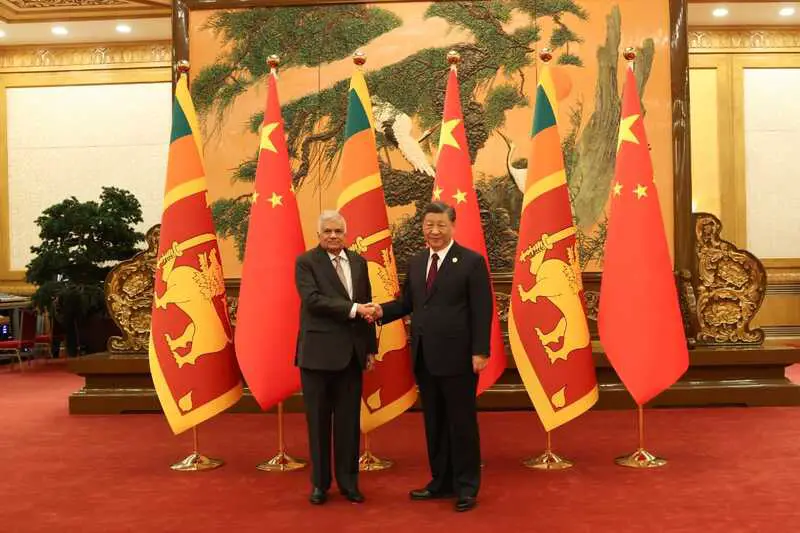
During his recent visit to China, Lankan President Wickremesinghe held talks with the Sinopec Group Chairman Ma Yongsheng. Sinopec has agreed to make an initial investment of USS$ 1.5 billion in the refinery.

Sinopec has already entered Sri Lanka’s retail fuel distribution market. The Lanka IOC and the Lankan State-owned CEYPETCO are the other players in this field.

The operations of two other foreign fuel distribution companies –the United States-based RM Parks and United Petroleum Australia—will be delayed. RM-Parks has deposited the performance bond.

“We have placed a condition that they cannot remit their profits from fuel trading technically for two years after the arrival of each shipment. Therefore, it becomes a huge initial investment for them. Therefore, they need time,” the media quoted an official as saying.

China owns 52% of Sri Lanka’s bilateral debt, and Beijing’s approval is crucial for any efforts by Colombo to restructure its outstanding loans.

India Not to Let Go

Meanwhile, India is trying hard to retain its foothold in Sri Lanka which it had gained substantially in 2022 when it extended US$ 4.5 billion to rescue Sri Lanka from the dire straits it was in after the default in April 2022.

Indian Finance Minister Nirmala Sitharaman arrived in Colombo on Wednesday for a three-day visit, during which, she will attend a grand ceremony to mark the 200th., year of the arrival of Indian plantation workers in Sri Lanka and also discuss with the Sri Lankan President the role India can play in the economic recovery of Sri Lanka.

Sitharaman is expected to discuss the resumption of talks to enhance the existing FTA to an Economic and Technology Cooperation Agreement (ECTA) after a five-year hiatus.

The two sides held the 12th round of negotiations on the ETCA in Sri Lanka from 30 October and 1 November but no agreement could be reached.

A Business Summit on the theme “Enhancing Connectivity: Partnering for Prosperity,” is a highlight of her current visit. A high-power Indian business delegation of 30 persons, cutting across several industries, is in Colombo to participate in the discussions. The delegation includes the Confederation of Indian Industry (CII) and the Federation of Indian Chambers of Commerce and Industry (FICCI).

India has reiterated on several occasions that it is committed to the economic recovery process in Sri Lanka and has highlighted the vital role of investments in this endeavour.

India is currently the largest source of investments in Sri Lanka and the largest source of tourists too. It is also Sri Lanka’s largest trading partner.

Separately, Finance Minister Sitharaman has informed the Chief Prelate of the premier Buddhist institution, the Asgiriya Chapter of the Maha Sangha, the Venerable Warakagoda Sri Gnanarthana Thera, that she will witness the exchange of MOU on solar electrification of religious places across Sri Lanka.

This is the first project under the USD 15 million grant announced by Prime Minister Narendra Modi for the promotion of Buddhist ties between the two countries.

The Sri Lankan media have acknowledged that Sitharaman was instrumental in fast-tracking the multi-pronged assistance of U$$ 4.5 billion to Sri Lanka in 2022. She had also advocated strongly for Sri Lanka at the IMF for a special package, during the economic and financial crisis.

India was also the first bilateral creditor to provide a written assurance of financial support which paved the way for the IMF package, the media said.

Opposition Objects to IOC Deal

However, the main Sri Lankan opposition party, the Samagi Jana Balawegaya (SJB) has opposed the government’s decision to extend the license given to the Lanka Indian Oil Corporation (LIOC) for another 20 years.

The LIOC has about 150 petrol sheds in the island nation.

On October 29, the SJB Deputy General Secretary Mujibur Rahman told the media that the 2001 agreement with Lanka IOC had granted the entity hefty tax concessions and a 20-year licence to operate in Sri Lanka in exchange for an investment of U$ 70 million.

“The agreement was struck without a competitive tender process and lacked transparency,” he charged.

According to Rahman, over the years, Lanka IOC has made a net profit of US$ 3 billion from its operations in Sri Lanka.

“Once again, there has been no competitive tender process or transparency. Are we obligated to grant this deal to the IOC? Was this agreement secretly negotiated between President Ranil Wickremesinghe and Indian Prime Minister Narendra Modi?” he asked.

He raised concerns about whether the cabinet had thoroughly examined Lanka IOC’s two-decade presence in Sri Lanka before consenting to the renewal.

Rahman also criticised the Energy Minister for not presenting a comprehensive review and the particulars of the deal in parliament.

He complained that LIOC did not address the fuel shortage during Sri Lanka’s most severe crisis nor did it provide better prices to the public.

“The public deserves to know the rationale behind this renewal. Instead, the government has secretly extended their licence once again,” he alleged.