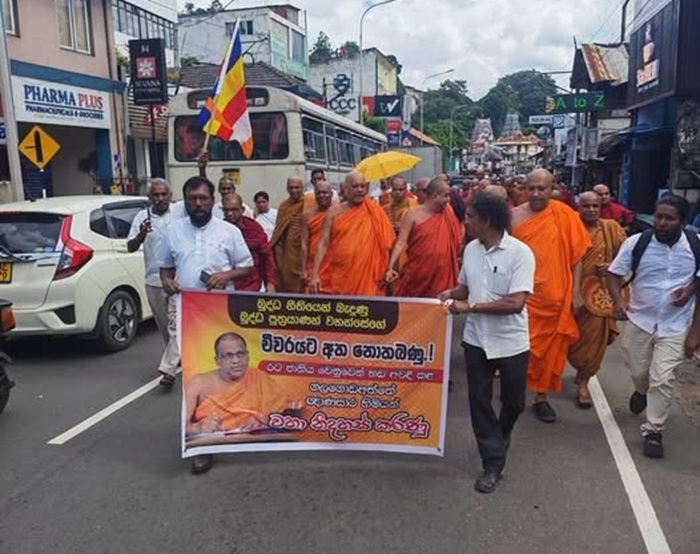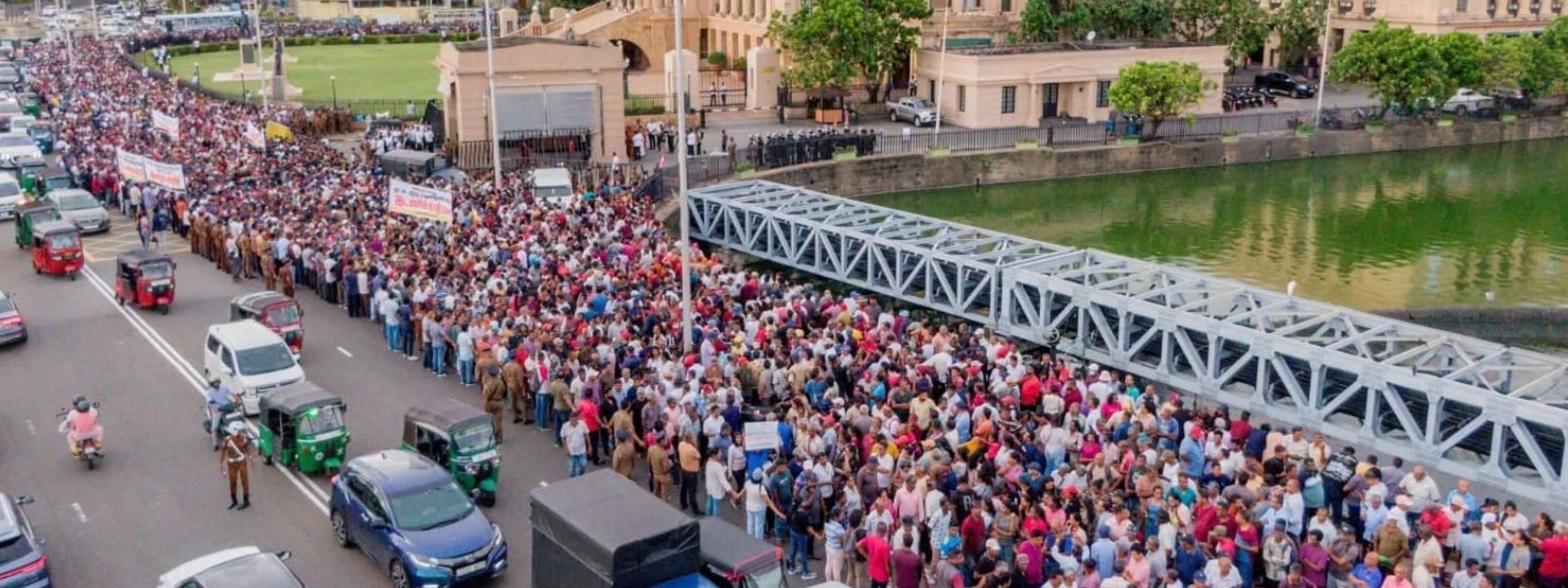
A protest march organized by the Janavarame Purawasiyo Organization (Citizen’s Of The Mandate) was held in Colombo today in what organizers described as a response to ongoing demonstrations seeking the release of Venerable Galagoda Aththe Gnanasara Thero, with participants calling on the Government to ensure that the law is applied equally to all citizens and to resist what they alleged were attempts by corrupt elements to undermine the country’s justice system.
The demonstration, led by members of the Maha Sangha and joined by religious leaders from other faiths as well as representatives of civil society organizations, began near the Colombo Fort Railway Station this afternoon.
Participants stressed that conspiracies aimed at preventing legal action against thieves, corrupt individuals and drug traffickers should be defeated. They also called for the law to be enforced fairly and equally, without privilege or special treatment, and urged authorities not to allow what they described as efforts by those responsible for damaging the country to derail ongoing legal processes.
Following the march, the protesters proceeded to the Presidential Secretariat.
During the demonstration, Police appealed to those gathered to remain peaceful and avoid causing inconvenience to the public.
A Police officer was heard saying, “Please do not inconvenience the public. Please remain peaceful and do not block the road. Allow people to pass through peacefully.”
Police further informed the group that Additional Secretary to the President Kapila Bandara was present at the Presidential Secretariat.
Subsequently, a delegation comprising several Buddhist monks and representatives of the protest was granted an opportunity to enter the Presidential Secretariat and hold discussions with officials.
Among those participating in the march were members of the public who openly expressed opposition to calls for special treatment or pardons outside the normal legal process.
One participant said, “If Ven. Gnanasara Thero has committed an offence, then the law must be applied to him. Otherwise, I too can shave my head, wear a robe, commit an offence and ask for a Presidential pardon. If that is allowed, it would have to apply to everyone. That cannot happen. The law must be equal for all.”
Another participant questioned the example being set for future generations, stating, “This is not the Dhamma taught by the Buddha. When teachings that are completely contrary to what the Buddha preached are being promoted, what example are we giving to the next generation?”
A third participant argued that the Government had come to power on a promise of equal justice and should not abandon that principle.
“The President came to power saying the law must apply equally to everyone. He cannot reverse that position now. If he does, it is the people who will turn away. The people are united in saying that the law must apply equally to all. In my view, this campaign is being driven by groups trying to protect themselves from legal action and prison sentences.”
After meeting officials at the Presidential Secretariat, members of the Maha Sangha and representatives of the organization addressed the media.
Venerable Meegahajadure Seelananda Thero claimed that certain political groups were attempting to exploit the court ruling involving Ven. Gnanasara Thero to create instability within the country.
“We can see attempts to create confusion in the country by using the court decision involving Ven. Gnanasara Thero as a cover. This Government is making a serious effort to establish the rule of law. Those who oppose that effort are trying to undermine it. A small group of corrupt and politically defeated individuals, many of whom are facing court cases and remain out on bail, are misusing the sacred robe in a deeply unfortunate manner. Our request to the President is to understand the aspirations of the people’s mandate and act accordingly.”
Venerable Embilipitiye Ananda Wansa Thero said the role of the clergy was not to control political leaders but to provide guidance and counsel.
“Our role is not to make rulers act according to our wishes. Our role is to advise and guide. Only a handful of monks are engaged in these activities. That is not the role entrusted to the Sangha. For more than two thousand years we have carried a much greater responsibility. This situation is like an elephant carrying the Sacred Tooth Relic casket losing control. It should not be allowed to continue.”
Meanwhile, Chandrasiri Mallikarachchi, Secretary of the Janavarame Purawasiyo Organization, urged President Anura Kumara Dissanayake not to reverse any legal measures already undertaken.
“We request the President not to roll back any legal action that has already been initiated, even by the smallest degree. Those measures should be implemented in full. We also ask the Government to expedite investigations relating to individuals currently facing allegations. Cases should be filed against those corrupt groups and the country should be governed in a manner that serves the welfare of the people. That is why we participated in this demonstration today.”
Following the discussions and media briefing, the protesters dispersed peacefully, concluding a march that was framed by organizers as a show of support for the equal application of the law and a response to recent protests calling for the release of Ven. Gnanasara Thero.