By seeking to escalate the long-term fishers’ issue at a time the two nations are resuming the forgotten ferry service after four decades, Sri Lanka’s Fisheries Minister Douglas Devananada may be torpedoing the larger connectivity project of his President, Ranil Wickremesinghe.
The minister’s reiteration of an earlier demand for an UN intervention to ‘prevent the large Indian fishing fleet from poaching in Sri Lankan waters’ at a second such meeting in the past months, with the UN Resident Coordinator Marc-André Franche in Colombo has the potential for non-Establishment Indian stake-holders to challenge the 1974 ‘Katchchativu Accord’, at the ICJ or such other fora, whatever their locus standi. Equally important is the potential for Minister Devananda’s initiative to torpedo the multi-nation Colombo Security Conclave (CSC) on Indian Ocean security, starting with non-traditional security in these waters, where the two nations have a lot to share between themselves and with other signatory-nations in the region.
Considering that it is an international initiative, it is unclear if Devananda had Cabinet clearance and/or the President’s approval for approaching the UN directly, over the head of the Foreign Ministry, which alone is known to handle such matters all along. All along the Foreign Ministry has been handling the issue, and at the bilateral level. Yes, the Fisheries Ministry has been the ‘line ministry’ in the matter, but then it had not acted unilaterally. As such, any deviation from the known and/or approved course will have larger bilateral consequences.
Alternatively, it has to be assumed that the Cabinet and/or the President have/has given approval for Minister Devananda to rake up the issue at the ‘international level’. This has an entirely different set of interpretations and consequences at multiple levels. It is again unclear if it is so, and if so, the decision-makers have taken a closer look at issues.
What more the current ministerial initiative seeking extra-stake-holder intervention, even if by the UN, comes at a time when Sri Lanka has named former Foreign Secretary Kshenuka Seveniratne as the next High Commissioner to India at New Delhi. Until recently, Sri Lanka’s Permanent Representative (PR) at the UN Headquarters, Amb Seneviratne is well-versed with the fisheries’ issue, she having headed governmental delegations for talks with India, when she was Additional Secretary in the Foreign Ministry.
Reviving a dream
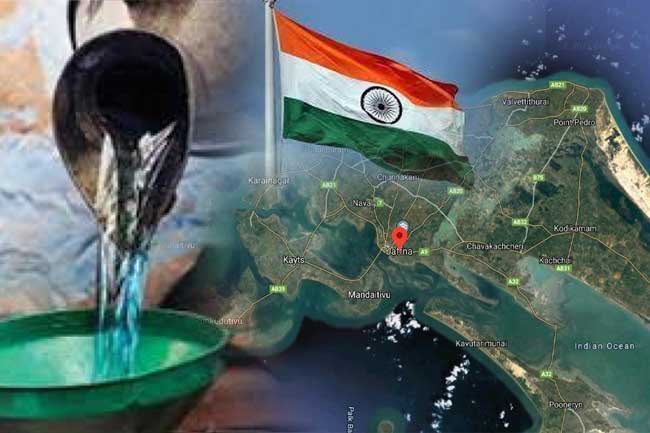
The ferry service – this one, between Nagapattinam in southern coastal Tamil Nadu Kankesanthurai (KKS) in Sri Lanka’s Northern Province — has had a chequered career before being shut down at the commencement of the ethnic war in Sri Lanka. It had begun as the prestigious Boat-Mail train-cum-boat service between the Tamil Nadu capital of Chennai, then Madras and Colombo, the capital of Sri Lanka, then Ceylon. Both nations were then separate colonies of the British Crown, though issues involving the ownership of the tiny Katchchativu Islet had remained.
The boat-link between Danushkodi in Rameswaram further down Nagapattinam, and Talaimannar in northern Ceylon was lost when the 1964 ‘Rameswaram Cyclone’ washed away Danushkodi Island and also the rail assets in the vicinity. Though reviving the ferry service, this time with higher-speed vessels had captured the imagination of leaders in both Colombo and Delhi since the conclusion of the ethnic war in Sri Lanka, it has been an article of faith for President Ranil Wickremesinghe, as a part of his ‘Connectivity Projects’ between the two South Asian neighbours.
Thus, when he mooted the idea of a land-bridge between the two countries when he was Prime Minister in 2004 Wickremesinghe had visualised as an agency for connecting Sri Lanka, its people and businesses not just with the south Indian State of Tamil Nadu, but the southern Indian region as a whole. In a larger perspective, his connectivity dream extended all the way up to the entire Eurasian land-mass, though he did acknowledge that political issues on either land-wings of India would require time to resolve, for the full potential to be achieved.
Not many people in the two countries remember it, but during an official visit to Delhi as Prime Minister, Wickremesinghe had signed an MoU with Indian counterpart Atal Behari Vajpayee, for undertaking technical studies on a land-bridge. If it could not be pursued, it owed to objections from Tamil Nadu’s then AIADMK chief minister Jayalalithaa, who saw the land-bridge as a ‘security risk’ when the LTTE was still around, even if not as active during those years of cease-fire agreement (CFA) with the Sri Lankan Government (2002-06).
Way with waywardness
The larger idea of greater connectivity between the two countries got a new and urgent fillip during President Wickremesinghe’s delayed yet maiden Delhi visit earlier this year, when the two governments signed a series of agreements to increase flight-frequency, resume the ferry service and revive the hopes of a land-bridge. Though academic doubts do exist about the economic viability of such a massive boost to bilateral connectivity on multilateral spheres, the current Sri Lankan dispensation especially is more hopeful than most.
Inside Sri Lanka especially, there has been unconvincing opposition to the land-bridge especially, with some stray voices claiming that it would lead to the nation becoming yet another State of the Indian Union. Such motivated and at times unreasonable critics of the projects seldom look at the prospects of India having to face multi-strata criticism from across present-day Sri Lanka to any such proposal for ‘unification’, which has never ever happened in history, including when the common British colonial power was lording over both countries, as if they were independent nation-States.
These critics are almost always short on facts. They do not want to acknowledge that if India had designs on Sri Lanka, it would not have to ‘give away’ Kachchativu without contesting Colombo’s claims, which were at best contestable. They seldom remember that even the ‘Kachchativu controversy’ has had its origins when the two nations were under the same colonial master but could resolve it, that too in smaller Sri Lanka’s favour, close to a quarter century both had acquired Independence. They often refer to the IPKF operations as a part of the failed Indo-Sri Lanka Accord, aimed at ending Sri Lanka’s ethnic war early on, as New Delhi’s attempt to have Indian boots on the island-nation, but again forget very many facts in the matter.
One, the IPKF came to Sri Lanka at the written request of wily President J R Jayewardene, who made Indian soldiers fight the LTTE as if by proxy, and give up their lives for a cause that was exclusively Sri Lanka’s, if not of the Sinhala majority, better still ‘majoritarians’ in the country. They do not want to remember that the IPKF left the country, bag and baggage, when Ranasinghe Premadasa as JRJ’s elected successor, wanted them out.
Whether or not the IPKF had a premonition that Premadasa would fall prey to the LTTE’s bicycle-bound suicide-bomber, but they most definitely knew that his leadership was diverting previous war-material meant for his own armed forces, yes, to the LTTE, of all. Unfortunately, no successor government or even the leadership of the armed forces has ordered a probe into the murky dealings of those days, which made not just Premadasa the man and leader, but also the nation’s armed forces, sitting-ducks for the LTTE, for a lot more time to come.
And long after the IPKF’s disastrous relations with the Sri Lankan government (but not their own counterparts), India continued to send in its forces, this time exclusively on a humanitarian mission, post-tsunami, end-2005. The alacrity and pace with which India handled what was Sri Lanka’s situation, that too when coastal south India and the Andaman Islands, including the tri-forces command HQ, too, were badly hit by the tsunami, should have spoken volumes even to lesser mortals. Once again, Indian troops left once the immediate rescue and relief operations were over. Yet, the Sinhala-Buddhist majoritarians have a way, even with their waywardness…
Joint vision
Mr. Wickremesinghe said hailed it an important step in improving connectivity between the two nations, and recalled how people of both countries have travelled across the Palk Strait for many years. Indian PM Modi, again in a video-message, reiterated his statement after the meeting with President Wickremesinghe in Delhi, and said that the ferry service will help strengthen cultural, commercial, and civilisational ties between the two nations. Connectivity is the central theme of the ‘joint vision’ of the India-Sri Lanka economic partnership, he said adding that India will take steps to resume the Rameswaram-Talaimannar ferry service as well. In his video message, India’s External Affairs Minister (EAM) S Jaishankar called it a “truly big step for people-to-people contacts between India and Sri Lanka…. And it was so recognised by Prime Minister Modi and President Ranil Wickremesinghe,” Jaishankar said.
Though the initial plan was to revive the original Rameswaram-Talaimannar route, but it would have meant a further delay as civil works needed to be taken up at both ends. Various alternatives were considered in India, like Karaikal and Puducherry, but Nagapattinam was found to be fast and feasible. Because it was all done in a hurry, as the two governments wanted to launch the service before the cyclone-prone north-east monsoon sets in this month (October), there was not much preparation or pre-launch publicity or guarantee for regularity.
The up-and-down daily trips thus have since been reduced to alternate days until 23 October, the last day before monsoon holiday, after which the ferry service would reopen in January in a full-fledged manner. The current run, where there were only a few passengers on board – but included some excited western tourists – would help the authorities to fix operational problems, if any, before the full commercial launch. By the time, there is also the hope of a better, larger vessel being pressed into service, as for what could now be called the ‘trial run’, India had temporarily diverted Hindustan Shipping Corporation’s ‘HSC Cheriyapani’, which was one of the three speed boats doing the inter-island routes in the Lakshadweep group.
Addressing India’s federal Shipping and Ports Minister Sarbananda Sonowal, who was present at the launch-function, Tamil Nadu’s Ports Minister E V Velu wanted the one-way ticket price to be reduced from the current INR 7,670 (LKR 30,000 appx). That way, Sri Lanka’s Transport, Shipping and Ports Minister, Nimal Siripala de Silva was on hand at Kankesanthurai, to receive the first batch of travellers.
Cause for concern
It is in the overall background, ill-advised initiatives like Minister Devananda’s, that too coinciding with the ferry re-launch, becomes a greater cause for concern than meeting the eye. It is to be noted that every Government in New Delhi since the signing of the ‘Katchchativu Accord’ in 1974 and a modified IMBL Accord in 1976, has conceded that Indian fishers, especially from southern Tamil Nadu and Karaikal enclave of the Puducherry Union Territory, were violating the IMBL on occasions.
Despite the continuing all-round opposition in Tamil Nadu, where it is a sensitive political issue, New Delhi has repeatedly proclaimed that Kachchativu remained a part of Sri Lanka, as outlined in the 1974 Accord. It has also been underscoring the fact that the livelihood of fishers in both nations cannot be interfered with.
It is Indian fishers in the case of their Tamil brethren from northern Sri Lanka, and by the Sri Lanka Navy and lately, Sri Lankan Tamil fishers, in the case of the other. In recent weeks and months especially, there have been constant reports of local fishers from Sri Lanka’s North independently raiding the Indian fishers’ vessels and looting their catch and gears, just as they have all along been complaining about bottom-trawlers from across the Palk Strait destroying theirs all along. Then, of course, there are continual reports of the Sri Lanka Navy (SLN), in the name of curbing poaching by Indian fishers, arresting them and their vessels, under relatively new laws in that country, and freeing only the former after governmental intervention but letting the boats and gears to rot under the open sky.
Greater sensitivity
Bilateral cordiality being what it is now, and the national governments’ joint desire is to fast-track all connectivity projects so that Sri Lanka would not have to risk another economic melt-down as happened last year, there is need for greater sensitivity in both nations towards the ferry service on the one hand and the land-bridge and other projects on the other. Yes, the connecting waters of the Palk Strait cannot be made murky where they are not, and murkier where they already are.
This is because the safety of ferry travellers initially and also pleasure and adventure tourists, not to mention Buddhist, Hindu, Muslim and Christian pilgrims using the cheaper ferry service, compared to air travel, would be compromised if the fishing waters are to be troubled more than already – and continues to be so in the weeks and months after resumption in January.
In between, the heightened fishers’ issue in the region, including the frequent harassment and subsequent arrest of fishers from Nagapattinam region especially (but not exclusively so) in Sri Lankan waters could have consequences for the ferry service, which when resumed full-scale. With the ferry service on, and connecting train services too facilitated in due course, it can interest southern Sri Lanka tour-operators to use the route for aged pilgrims visiting Buddhist religious centres like Bodh Gaya and Saranath in north India.
This is not to leave out Hindu, Muslim and Christian pilgrims from both sides to travel to the other – and also small-time traders in Sri Lanka’s North and the East especially to use the ‘free luggage’ quota to buy products in Tamil Nadu, which they have been lugging by flight, paying higher transport costs. The same, of course, goes for normal tourists from one country to the other, who are keen as much on shopping as seeing places and people.
(The writer is a policy analyst & political commentator, based in Chennai, India. Email: sathiyam54@nsathiyamoorthy.com)