Sinhala Buddhist monk blocks Tamils from accessing land subject to encroachment by vihara in Batticaloa

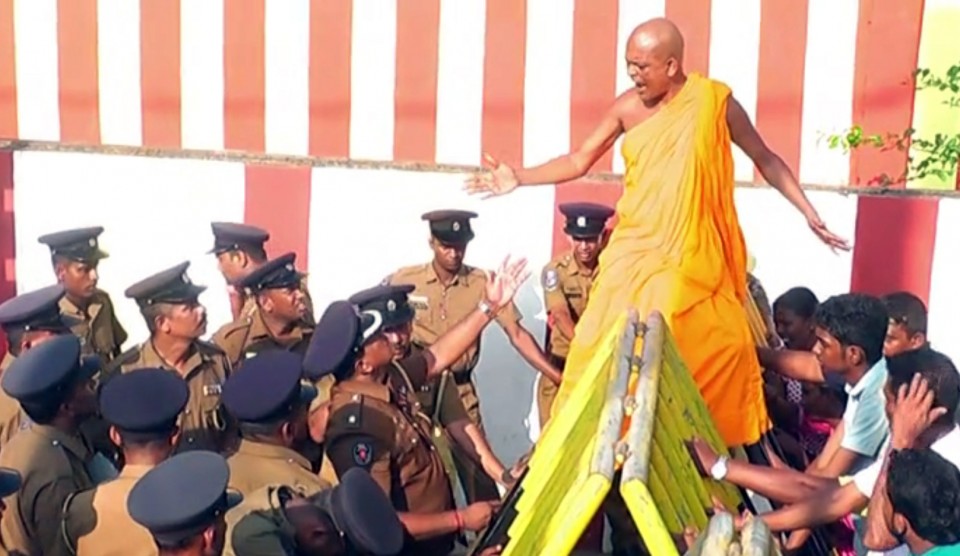
A Sinhala Buddhist monk blocked and threatened a group of Tamils from accessing land which is being encroached upon by a Buddhist vihara in Mayilaththamadu, Batticaloa.

A group of Tamil multi-faith leaders, farmers and journalists went to Mathavanai in Batticaloa today to visit a farmer who’s land is being encroached on by the construction of a vihara. However, upon their arrival a Sinhala Buddhist monk and a group of people associated with him, blocked the Tamils from leaving their vehicles. The group also threatened to set fire to all of the Tamils who were in the vehicle.

Tamil journalists who also went to the area to report on the news, had their cameras and equipment taken off them and their files were destroyed.

This incident follows similar incidents of Sinhalisation across the North-East, where Tamil-owned land has been taken over by Sinhala Buddhists often aided by Sri Lanka’s archeology department and the military.

Posted in Uncategorized

US calls on Sri Lanka Army to build trust with minorities

The United States had talks with the Sri Lanka Army, during which the need to build trust with minority communities to ensure lasting peace was also discussed.

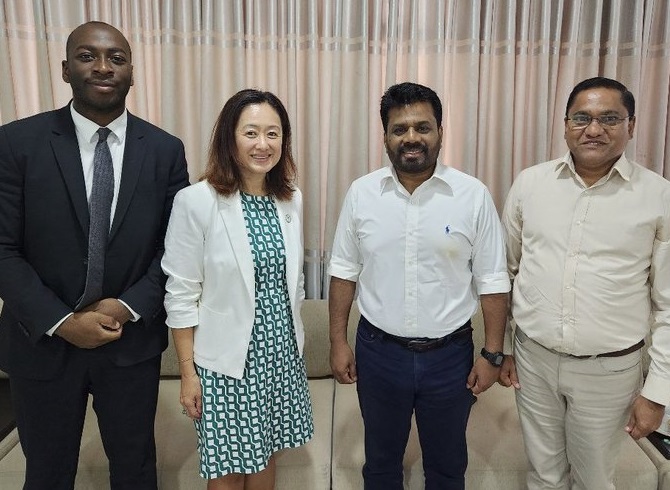
The US Ambassador to Sri Lanka Julie Chung said that she met the Sri Lanka Army 1 Corps Commander Major General S.B. Amunugama and Staff to discuss the shared commitment to defense cooperation, including Sri Lanka’s efforts to modernize the military.

“Discussed the need to build trust with minority communities to ensure lasting peace,” the US Ambassador said.

The Ambassador, who is on a visit to the North, met a wide range of communities, including civil society leaders in Jaffna to hear their concerns and perspectives.

“Such dynamic voices and partners are essential as we work together to support a democratic Sri Lanka,” the Ambassador said.

Posted in Uncategorized

Mahanayakas want Prez to discuss 13A with them

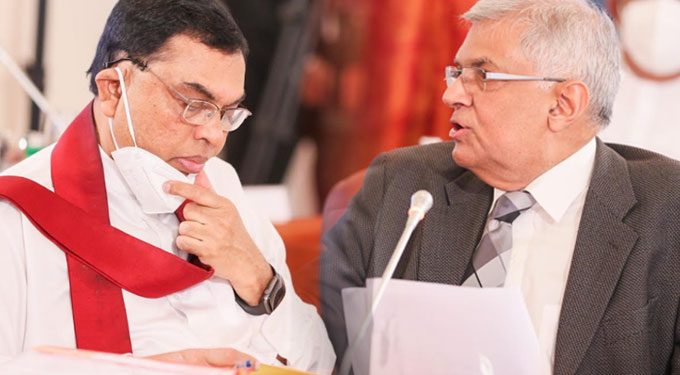
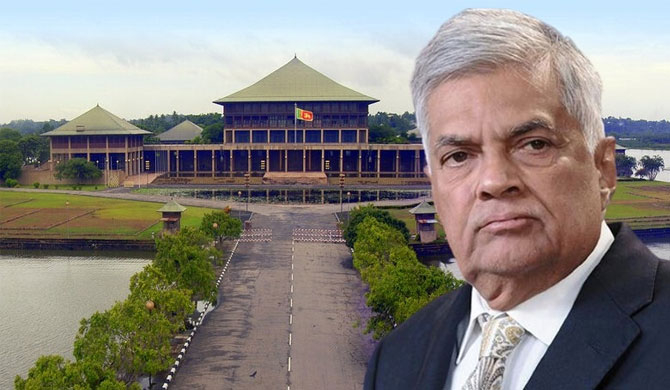
The Asgiri Chapter of the Siam Sect stated that it would be best if President Ranil Wickremesinghe would discuss the full implementation of the 13th Amendment to the Constitution with religious leaders including the Chief Prelates (Mahanayakas) of the main Buddhist sects.

Wickremesinghe, who came to power following the resignation of former President Gotabaya Rajapaksa in July last year (2022), pledged that he would fully implement the 13th Amendment, and work to resolve the issues faced by the people of the Northern and Eastern Provinces.

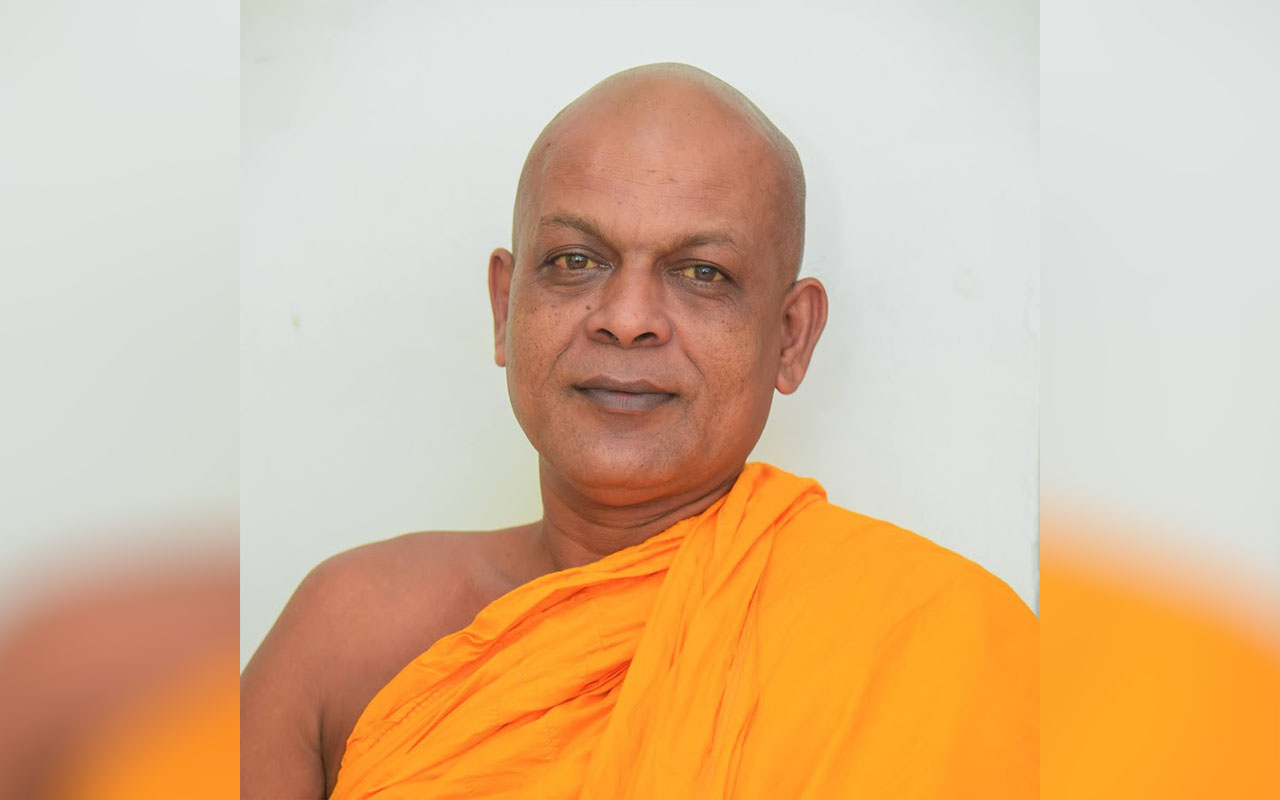
Speaking to The Daily Morning on the matter, Asgiri Maha Viharaya Supreme Sangha Council Secretary Ven. Dr. Medagama Dhammananda Thera said that they were of the view that the 13th Amendment should not be implemented as it may cause various adverse effects, including communal conflicts. “All former Presidents didn’t implement this, and they must have done so for a fair reason. So, we don’t approve of the implementation of the 13th Amendment. However, as the President has expressed his consent to implement it, he should discuss the matter with all religious leaders, including Chief Prelates.”

Wickremesinghe has had several discussions with several parties including Parliamentarians, particularly those representing the Tamil community regarding the 13th Amendment. His preparation has, however, seen opposition from several parties including the ruling Sri Lanka Podujana Peramuna itself, which recently stated that he (Wickremesinghe) did not have a moral right to implement the 13th Amendment, as he is enjoying power based on the mandate given by the people to Rajapaksa.

In February this year, the Chief Prelates of the main Buddhist Sects including Warakagoda Sri Gnanarathana Thera, Thibbatuwawe Sri Siddhartha Sumangala Thera, Makulewe Wimala Thera, and late Dodampahala Chandrasiri Thera had, in a letter addressed to the President, requested him not to implement the 13th Amendment, claiming that the granting of Police and land powers may lead to separatism.

On 29 July 1987, the Indo-Lanka Accord was signed between the then Indian Prime Minister Rajiv Gandhi and then Sri Lankan President J.R. Jayewardene which described the devolution of powers to the Provinces. On 14 November 1987, the Parliament passed the 13th Amendment and the Provincial Councils (PCs) Act, No. 42 of 1987 to establish PCs.

On 18 July 2023, Wickremesinghe assured a group of Tamil MPs that the 13th Amendment would be fully implemented – without Police powers – in the PCs.

Indian Envoy meets Sri Lankan MPs in Parliament; Jaishankar joins via video message

India-Sri Lanka relations are expected to be further enhanced in four main areas of Food security, Energy security, Currency Support and long-term investment, said the High Commissioner of India to Sri Lanka, Gopal Bagley said on Monday (23) in Parliament.

The High Commissioner said this while addressing a meeting of the Sri Lanka India Parliamentary Friendship Association held in Parliament under the patronage of Speaker Mahinda Yapa Abeywardena.

The speaker pointed out the importance of strengthening the relations between the two countries through the implementation of exchange programs through the Sri Lanka India Parliamentary Friendship Association and expressed his gratitude for the continuous support provided by India.

External Affairs Minister of India Dr. S. Jaishankar informed the Members of Parliament through a video message that India will continue to support the development activities of Sri Lanka.

Posted in Uncategorized

Andrew Patrick appointed new British High Commissioner in Sri Lanka

Andrew Patrick presented his credentials to President Ranil Wickremesinghe on August 23, 2023, becoming the new High Commissioner for Great Britain and Northern Ireland in Sri Lanka.

“The last 75 years of our relationship has shown how much our countries can achieve together, and the significant contribution of the Sri Lankan community in the UK,” High Commissioner Patrick said in a statement.

“I look forward to building upon those 75 years through strengthening cooperation to ensure a peaceful and prosperous future for both our countries.”

From 2013 to 2018, Andrew Patrick served as British Ambassador to Myanmar. Previous appointments have included Afghanistan and South Africa.

The High Commissioner is accompanied by his wife, Khin Sandar Win, who comes from Myanmar and is a businesswoman, the British High Commission said.

Posted in Uncategorized

New envoy notes contribution of Sri Lankans in UK

The new British High Commissioner to Sri Lanka, Andrew Patrick, noted the significant contribution of the Sri Lankan community in the UK.

Andrew Patrick made the comment in a statement issued after presenting his credentials to President Ranil Wickremesinghe today.

“I am both honoured and delighted to be accredited as the British High Commissioner to the Democratic Socialist Republic of Sri Lanka. The last 75 years of our relationship has shown how much our countries can achieve together, and the significant contribution of the Sri Lankan community in the UK,” he said.

The new High Commissioner said that he looks forward to building upon those 75 years through strengthening cooperation to ensure a peaceful and prosperous future for both countries.

From 2013 to 2018, Andrew Patrick served as British Ambassador to Myanmar. Previous appointments have included Afghanistan and South Africa.

The High Commissioner is accompanied by his wife, Khin Sandar Win, who comes from Myanmar and is a businesswoman.

India will continue developmental assistance to Sri Lanka in every possible area: Jaishankar

India’s External Affairs Minister S Jaishankar on Wednesday pledged continued development assistance in every possible area to Sri Lanka amid its ongoing economic crisis.

Jaishankar addressed the parliamentarians who are part of the Sri Lanka-India Parliamentary Friendship Association through a video link and emphasised that India was in every aspect working towards strengthening the Indi-Sri Lanka ties.

“India will continue to provide developmental assistance to Sri Lanka in every possible area,” Jaishankar said during his address.

Indian High Commissioner in Colombo Gopal Baglay was also present in Parliament and said that the bilateral relationship is further expected to be enhanced through four main areas: food security, energy security, currency support and long-term investment.

On the occasion, Sri Lankan parliamentary Speaker Mahinda Yapa Abeywardena said that relations could be further enhanced through exchange programmes that could be implemented by using the parliamentary friendship association.

Parliamentarians noted with gratitude India’s economic assistance to Sri Lanka when the island was plunged into its worst economic crisis last year.

India offered Sri Lanka more than USD 4 billion worth of assistance which in the main funded the imports of essentials and fuel.

The economic crisis triggered by forex shortages forced the public into the streets which forced the ouster of former President Gotabaya Rajapaksa.

Source – PTI

Posted in Uncategorized

Sri Lanka’s Security Anchor Is India In Indo-Pacific Context

Sri Lanka believes that due to its strategic location and proximity to the Indian mainland, Colombo’s security interests are aligned with that of New Delhi’s, and that is the reason why the island nation identifies India as the “anchor” when it comes to the Indo-Pacific strategic framework in the Indian Ocean, according to Milinda Moragoda, High Commissioner of Sri Lanka to India.

Speaking to India’s ABP Live, Moragoda said Sri Lanka has “learnt to live” with the fact that due to its geographical location it will always be the theatre where the strategic competition between India and China will be played out. However, he said, Colombo shares a special relationship with New Delhi that cannot be compared with other bilateral ties that the country has, due to historical, civilisational, genetic as well as geographical linkages.

“We are engaging, we are working with India clearly and we have always said that when it comes to security interests, India’s security and our security are the same and that’s logical because of where we are located. Within that context we are engaging with anybody who is interested,” Moragoda said, adding that Japan and the United States have shown interest in engaging with Colombo.

“In the Indo-Pacific context, many people come and talk to us. But the anchor is India for security. That is self-evident. But to maintain that understanding, you have to have a high-quality dialogue (between leaders) because in today’s day and age, what we are talking about today may become irrelevant tomorrow because situations move very fast,” he said, adding: “So unless there is very clear communication between leaders, these things will not work and also both being democracies we are complex, that also we need to understand. It’s not just one person making decisions, one has to understand each other that way as well.”

Earlier this month, New Delhi once again raised the red flag as Colombo plans to allow the entry of the Chinese vessel — Shi Yan 6 — into Sri Lankan waters. The ship is expected to dock at the ports of Colombo and Hambantota in October this year. This comes after India expressed similar objections to the visit of a Chinese satellite tracking vessel Yuan Wang 5 to the Hambantota Port in August 2022.

“Sri Lanka has learnt to live with this (India-China strategic concerns over the Indian Ocean island). From Ramayana to today, we have had to deal with different aspects of this… We had people coming from Portugal, Netherlands and the UK. So external factors are par for the course I guess,” the Sri Lanka envoy highlighted.

“We have to deal with that. When it comes to India, you cannot compare the relationship with any other relationship. We are linked genetically and also through civilisation and geographically we are linked,” he added.

According to Moragoda, having a sustained bilateral relationship depends on the “quality of dialogue” between the leaders of the two neighbouring countries.

He said when Sri Lankan President Ranil Wickremesinghe visited India in July, Prime Minister Narendra Modi had a private lunch meeting with him while the National Security Advisor had a breakfast and External Affairs Minister S. Jaishankar held a private dinner interaction with him. This, Moragoda said, shows how much importance India attaches to the relationship.

“The objective is to have a clear dialogue. Crisis do occur, especially in today’s geopolitics it can happen, but it is also important that leaders have high quality dialogue and engagement,” he stressed.

India, Sri Lanka and Maldives jointly operate a minilateral security dialogue, Colombo Security Conclave, aimed at maritime security, countering terrorism, and cybersecurity. This is run by the National Security Advisors. The group’s secretariat has been established in Colombo and soon an office will be set up there with expanded membership, he said.

‘Adani Came In When Nobody Would Invest in Sri Lanka’

Moragoda said when Sri Lanka was reeling under the severe economic crisis and heading towards bankruptcy, it was the Adani Group that came to its rescue, injecting confidence among other investors.

He was referring to Adani’s nearly $700 million investment into building the West Container Terminal of the strategically located Colombo Port, which also has a terminal running parallel to it that is operated by the Chinese.

“When nobody would invest in Sri Lanka last year, he (Gautam Adani) came and they invested. Despite all challenges they have been able to stick to their plan. They are a professional group, they understand ports and know the business very well,” Moragoda said, adding: “From Adani’s perspective it’s a very logical investment but he took the risk at a time when Sri Lanka was basically a bankrupt economy. When nobody was lending, he put his money. That has given others the confidence to come and look at Sri Lanka.”

He said nearly 80 per cent of Sri Lanka’s port business comes from transhipment, out of which 70 per cent goes to India. Thus, for Adani, the investment in building the terminal will prove to be significantly profitable.

Apart from this, he said, ITC is building one of their main hotels outside India in Sri Lanka, which is likely to become operational by the end of this year.

“It’s an iconic building and property and they have invested hundreds of millions of dollars in that. Similarly, many leading Indian companies are interested. The CEO of Tata Group was there recently in Colombo, the airport and oil companies are there. Indian Oil is distributing oil in Sri Lanka. It is looking at laying a pipeline in Sri Lanka as well,” said the envoy.

He denied allegations that Indian investors have faced issues in Sri Lanka previously owing to protests by labour unions and workers. “There is no discrimination. I wouldn’t say that … The way India and China take decisions are different. India is private sector led so the decision making process is different,” Moragoda said.

‘Now We Don’t Need Fish To Eat, We Need Fishing Rod To Catch Fish’

According to the Sri Lanka high commissioner, for his country to achieve economic stability as well as sustained growth, it is imperative that it goes for economic integration with neighbouring India.

“What we require now is not fish to eat, but a fishing rod to catch fish and that’s where India can help us and that’s what India is trying to do. We need a good fishing rod now with which we can catch the fish ourselves and for that investment and economic integration are key,” he said. “We can do economic integration quickly. What we need now is to get the economy to grow. There are going to be many external challenges. While broadening our income stream, we need foreign investment, we need to get into the global supply chains as they have changed also since Covid.”

In an effort to achieve economic stability and widen its sources of income, Colombo is now seeking private sector investments from other countries in order to ramp up growth after the 2022 crisis led to massive protests there by the local population. The country witnessed unprecedented food, fuel and fertiliser shortages in 2022 owing to the policies of the former Gotabaya Rajapaksa government.

Moragoda said India was the first country to step in when the country’s economy was sinking. “We are a democracy, we are a polarised society there is no doubt about it … Given the support India gave last year every Sri Lankan appreciates that. India was not obliged to that and I think all Sri Lankans know that. India anticipated the crisis before the others did. The speed with which India moved was important.”

He explained: “India played a key role with a funding of nearly $4 billion. A lot of support that India had provided was balance of payments support. That means when we were not able to meet the payments of the Asian Clearing Union, you stepped in and paid that money so that was like hard cash and $2 billion was paid there itself. Then there was a currency swap of $400 million and $500 million for oil, so that all has been given. Then $1 billion was given as a credit line, which is a mixed credit line and the rest is left and is being used for medicines.”

Without India’s support, Moragoda said, “there would have been a serious crisis” in Sri Lanka

“India then took the lead in talking to the IMF, talking to the World Bank and even countries like Japan suggesting that Sri Lanka should be given the opportunity to come into an IMF (International Monetary Fund) programme. Then when the debt restructuring had to be done because the IMF would not move unless there is debt sustainability, India presented a letter of financial assurance and they were the first to do it. India said they would support the debt sustainability model that the IMF put forward,” he said.

“Now we have to look at the growth because our economy has shrunk. We are stabilising but the economy is not growing. So obviously people are getting poorer. We need to have growth, for which we need investments. That is why when President (Wickremesinghe) was here he talked of connectivity, economic integration and investment. This is to benefit from India’s growth and for us to be able to latch on to that,” he explained.

Moragoda said this is also one of the reasons why Sri Lanka wants to enhance the existing free trade agreement (FTA) with India, which will give them more market access while enabling them to gradually open up their economy.

“It’s not that we are starting from zero. Idea is to now enhance it in both ways. We have to now open up our economy. Our economy was closed right after the crisis. We don’t import any motor vehicles at the moment but at some stage we would have to do that. We have an understanding with the IMF that we would quietly open up the economy and that’s what we are doing. Basically the idea is how we can broaden the agreement,” he said.

According to the high commissioner, while Sri Lanka has been able to obtain a $3 billion bailout package, the country is also making efforts to increase its sources of income.

“Over 80 percent of the revenue the government earns is spent on government salaries and pensions. It is a huge government service where over 1.5 million is employed and another 500,00 pensioners. So nearly 2 million people out of a population of 22 million relying totally on government salaries,” he said.

He added: “So for everything else we only have around 20 percent to spend on sectors such as education, health and defence among others. Before the crisis, over 70 percent of our revenue was going on the interest we borrowed for the next year. So this had a cumulative effect. Then we had a long period of war which damaged not just the society but also the economy.”

Tamil Leaders Need To Show ‘Flexibility’ on 13th Amendment Issue: Moragoda

On the contentious issue of implementing the 13th Amendment of the Sri Lankan Constitution, which seeks to grant equal rights to the minority Tamil community in that country, Moragoda said the Tamilian political leaders need to show some “flexibility” now that the Wickremesinghe government is working towards resolving it.

For the past couple of months, President Wickremesinghe had been meeting Tamilian leaders in his country to arrive at a solution and get a Parliamentary consensus on the issue.

“In a democracy, it is a challenge. Different groups have different views. Everything is too much at a conceptual level. President is also talking about the development of the east and northeast. When you look at Trincomalee, it is going to be key for the development of the East. The oil pipeline will help them,” he said.

The high commissioner added: “Then the power grid (plan), a major chunk of the power production that is going to come will be from the north-western coast of Sri Lanka which is going to be for the northern province. So unless we think like that no big development can take place. We have to have development there.”

Return Of Rajapaksas Can’t be Ruled Out

Despite the massive unpopularity of the previous Gotabaya Rajapaksa government, which was overthrown in the wake of people’s protests owing to the economic crisis of 2022, the Rajapaksas will be allowed to contest the next Sri Lankan Presidential elections in 2024, said Moragoda.

“We are democracy… The current government has a Rajapaksa representation in it… There are several family members of the Rajapaksa in it. We are a democracy and the outcome is up to the people finally. Demonising individuals, I think, is fashionable these days but I don’t think that is going to answer the question. End of the day it is for the people to decide and that’s how Sri Lanka has functioned all along,” he said.

Last year, Sri Lanka witnessed some unprecedented violence against the Rajapaksa regime, which was headed by the then President Gotabaya Rajapaksa. The 73-year-old had to flee Sri Lanka in July 2022. After hiding in Maldives, Singapore and Thailand, he came back to the country in September that year. In the meantime, Wickremesinghe was made the President of Sri Lanka.

“Next year we will have elections. Presidential elections are due after August next year. For the moment, the focus is on stabilising the economy and at every step President Wickremesignhe is getting the backing of the Parliament in whatever he is doing, including the 13th Amendment. In a democracy, elections will have to take place and it is expected to take place in the second half of next year. Of course, in a democracy you cannot say anything for sure. But this is what is the decision as of now,” Moragoda said.

As the country witnessed its worst ever political violence, protesters went on a rampage in capital Colombo and areas around it in May 2022, demanding changes in the government’s disastrous economic policies. The protesters even burnt down the ancestral home of the Rajapaksas in Hambantota while properties of other ministers were also destroyed.

“Basically, our society is a society full of grievances. It’s polarised, fractured, fragmented around grievances. It’s a small country but that’s what it is about. And these grievances keep exploding from time to time. This was one such explosion,” said Moragoda.

“Our democratic model has to be able to absorb this. This is a challenge. And everybody thinks they are right. Burning down somebody’s house or killing someone is not right. Leaders have to know how to manage that. But in a small country, one would think we can find a solution, but it has eluded us,” he said, adding: “We’ve had a very violent history. In the last 75 years, we have been fighting wars, we have had insurgencies, so we need to find solutions but they have to be incremental and not through a revolution. We do not support revolutions.”

Shi Yan 6: China research ship requests Sri Lanka port call

China has requested permission for a research ship to dock in Sri Lanka, Colombo said Tuesday, following a visit by a spacecraft-tracking vessel last year that sparked security concerns from neighbouring India.

Sri Lankan foreign ministry spokeswoman Priyanga Wickramasinghe said Beijing had sought permission for the Shi Yan 6 to dock, but that no date had been set and the request was being processed.

Chinese state broadcaster CGTN calls the Shi Yan 6 a “scientific research vessel” crewed by 60 that carries out oceanography, marine geology and marine ecology tests.

Last year, India raised concerns over a Sri Lanka port call in Hambantota by Chinese research vessel Yuan Wang 5, which specialises in spacecraft tracking and which New Delhi described as a spy ship.

India is suspicious of China’s increasing presence in the Indian Ocean and its influence in Sri Lanka, seeing both as firmly within its sphere of influence.

Sri Lanka is strategically placed halfway along key east-west international shipping routes.

Last year, Colombo attempted to address New Delhi’s concerns by asking China not to engage in any research activities while in Sri Lankan waters.

The Hambantota port has been run by the Chinese since 2017, when they took on a 99-year lease for $1.12 billion, less than the $1.4 billion Sri Lanka paid a Chinese firm to build it.

China last year said it was “completely unjustified for certain countries” to cite “security concerns” to pressure Sri Lanka.

China owns 52 percent of cash-strapped Sri Lanka’s bilateral debt, and Beijing’s support is crucial for Colombo’s efforts to restructure its foreign loans.

Colombo defaulted on its $46 billion external debt in April 2022, and must restructure its finances as part of an International Monetary Fund bailout.

Source: AFP

13-acre land given to China undervalued – Jayasekara

State Minister for Ports and Aviation Premalal Jayasekara yesterday (23) alleged that the Ministry of Ports and Shipping, under Minister Nimal Siripala de Silva, had leased 13 acres within the Colombo Port to China’s CM Port to construct South Asia’s biggest logistic centre, without calling for tenders, procurement or government evaluation of the land.

The CM Port also runs the Colombo International Container Terminal (CICT) and the State Minster alleged that the transaction was facilitated by a Chinese business figure, who secured the land at a seemingly low cost to construct the mega logistic centre.

Expressing concerns over the leasing of the land, the State Minister warned that this development poses a potential threat to national security and expressed worries that the revenue generated from the Port’s operations over the next 35 years would be diverted to the Chinese operators of the facility.

The construction work on the logistic centre has not commenced as yet according to sources.

He claimed that the land was undervalued, because land evaluation was not carried out by the State, but by a private party who undervalued the 13-acre plot at a time when there is a high demand for land inside the Port.

He said he would expose the matter at the next press conference and that he, as the State Minister who is aware of corruption, was in the process of gathering inside information to bring it to the notice of the authorities. He claimed that he has been sidelined without any job given to him and he merely signs documents of requests for jobs and opportunities which are then forwarded to Minister de Silva.

He said the 13 acres, located between the East Container Terminal and the West Container Terminal, has been given to the Chinese for a song.

Further, he alleged that certain senior officials were reportedly involved in rampant corruption at the Ports ministry. Notably, the land that was leased for 35 years sans a tender process, proper procurement procedures, or a thorough evaluation was a serious matter of concern.

The State Minister said however, the striking paradox is where some trade unions, typically vocal about corruption and the sale of national assets, have remained silent regarding this issue.

Further, Jayasekara alleged that there had been proposals concerning the usage of this land since 2016. However, the leasing took place without transparent processes before it was given to China, he claimed.