Two petitions challenging legality of Sri Lanka-India MoUs dismissed by SC

Two Fundamental Rights petitions filed seeking an order to invalidate the Memorandum of Understanding (MoU) recently signed between Sri Lanka and India, were today dismissed by the Supreme Court.

The Supreme Court two-judge-bench comprising Justice Achala Wengappuli and Justice Priyantha Fernando decided to dismiss the two petitions citing that there is no prima facie case to proceed with the applications.

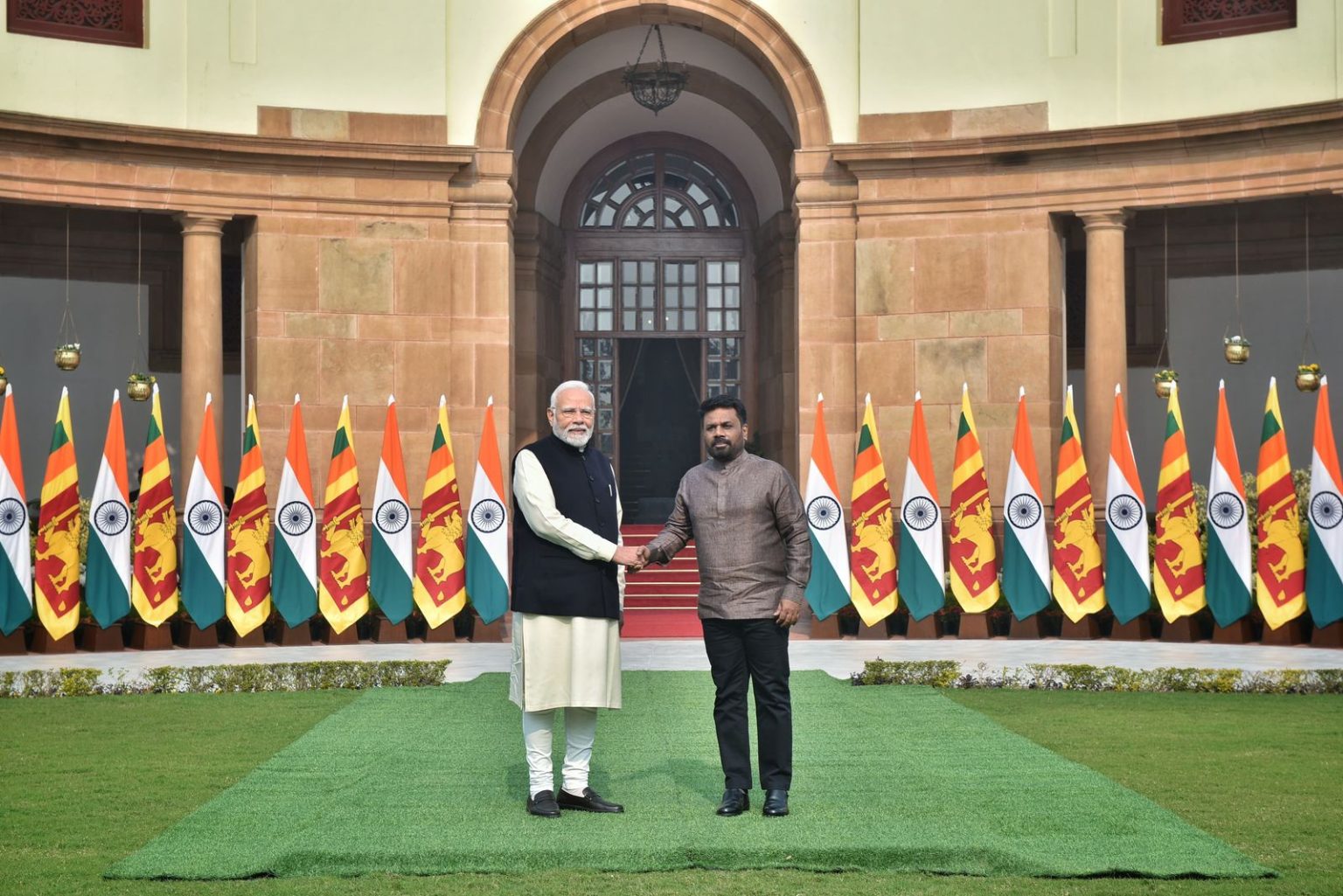
Seven MoUs between India and Sri Lanka, including defence cooperation, sharing successful digital solutions and MoU on Multi-sectoral Grant Assistance to the Eastern Province, were exchanged on April 5 at the Presidential Secretariat in the presence of President Anura Kumara Dissanayake and Indian Prime Minister Narendra Modi.

President’s Counsel Manohara de Silva and Senior Counsel Canishka Witharana appeared for the petitioners. Deputy Solicitor General Nirmalan Wignashwaran appeared for the Attorney General.

Posted in Uncategorized

Wife of Convicted Soldier Demands International Probe into Chemmani Mass Graves

In a significant development related to the Chemmani mass graves case in Jaffna, the wife of Lance Corporal Somaratna Rajapakse—who was convicted as the main accused in the Krishanti Kumaraswamy rape and murder case—has written to President Anura Kumara Dissanayake, expressing her husband’s willingness to testify if an international investigation is launched, Virakesari newspaper exclusively reported on Sunday (3).

In her letter, S.C. Wijewikrama stated that her husband has no involvement in the rape and murder of Krishanti Kumaraswamy and her family. She claimed that the orders to bury the bodies at the Chemmani checkpoint came from senior military officers, particularly Captain Lalith Hewage. She insists her husband only carried out those orders and was wrongfully convicted.

She further alleges that successive governments have protected high-ranking military officials while punishing lower-level soldiers to create a false image of accountability before the international community.

Wijewikrama claims that over 300 individuals suspected of having links with the LTTE were detained, tortured, and killed over time, and their bodies were secretly buried in the Chemmani area, often at night. The only reason Krishanti Kumaraswamy’s case came to light, she says, is because her family was related to Kumar Rupasinghe, a known international human rights activist and brother-in-law of then-President Chandrika Kumaratunga.

In her detailed account, she describes how suspected individuals were identified and arrested at the Chemmani checkpoint, taken to the 7th Battalion military base, tortured, and later buried near the checkpoint by her husband and other soldiers, allegedly under direct orders from higher-ranking officers.

She also claimed that her husband’s conviction was based solely on his disclosure of the location of the graves and not on any direct involvement in the murders. She alleges that Captain Hewage and other officers were briefly arrested in 1999 after her husband gave testimony, but were later released on bail, and no further legal proceedings followed.

Wijewikrama mentioned that her husband shared these details with lawyer Kumar Ponnambalam, who was later assassinated. She believes political pressure led to the rejection of their appeal in the Supreme Court and insists that the real perpetrators were never held accountable.

She expressed her frustration that despite sending appeals to every President since 1998, no relief has been provided, while several LTTE suspects with far more serious charges have been released in recent years.

Calling for justice, Wijewikrama urged President Dissanayake to appoint a presidential commission to investigate the Chemmani mass graves and the associated crimes. She reiterated that her husband is willing to testify and expose senior officers involved in war-time atrocities committed in Jaffna.

She concluded by stating that international complaint proceedings would soon be filed with the United Nations Human Rights Council and expressed hope that her husband and the other convicted soldiers would finally receive justice after 29 years of imprisonment.

(Courtesy: Virakesari. This news is a translation of the original article, and all credit goes to the newspaper’s editorial team and the reporter.)

Indo-Sri Lanka Accord: 38 Years Since We Missed The Bus By A. Jathindra

Even after thirty-eight years, the Indo-Lanka Accord, signed on July 29, 1987, stands out as a remarkable event in Sri Lanka’s history. After much struggle, the accord led to the 13th Amendment to the constitution, which introduced a provincial council structure in an attempt to resolve the island’s protracted ethnic conflict. From the outset, hardliners on both sides rejected the 13th Amendment as a comprehensive solution: Tamil hardliners argued it was insufficient, while some Sinhalese hardliners believed it gave too much to the Tamils.

To this day, Sri Lanka’s ethnic question remains unresolved, stubbornly echoing those same old arguments—even though the bloody civil war ended with the loss of thousands of lives. History remains our only teacher, reminding us of what we failed to understand in the past. Despite India’s hard-footed Cold War approach, she put her best efforts into helping Sri Lanka move forward, but both factions failed to engage constructively.

If we examine the post-Indo-Lanka Accord era, it is clear that successive governments of Sri Lanka have failed to show even a little progress. Sixteen years after the end of the war, the nation still struggles to move an inch toward resolving the national question beyond the 13th Amendment.

Throughout my political journey as an opinion maker, I have often observed—especially on the Tamil side—a tendency to blame India, a sentiment that persists even today. Whenever I hear such statements, I am reminded of the African proverb: “He who spits against the sky, it falls on his face.” Blaming powerful countries will not affect them; it always rebounds on those who blame.

Amidst a world entangled in Cold War tensions, India inevitably took a tough stand on Sri Lanka after President JR Jayewardene shifted away from the non-aligned orbit. Had Jayewardene acted in accordance with India’s concerns, India would never have decided to train Tamil militants. At that time, as a nation within the Soviet sphere of influence, India faced difficult choices to maintain its regional power status.

In Sri Lanka, many still cling to old hatreds, missing the reality: if India had truly wanted to break up Sri Lanka, it could have done so through Tamil militants, just as it did in East Pakistan. However, from the beginning, India had a firm policy not to support a separate Tamil state. Gopalaswami Parthasarathi, then special envoy of Prime Minister Indira Gandhi to Sri Lanka, made it clear to all militant leaders that India would not support a separate state—and would never allow it.

When I interviewed the late R Sampanthan, leader of the Tamil National Alliance, in 2010 about the Vattukottai Declaration of 1976—why SJV Chelvanayakam made that decision and whether it was wise to call for a separate state without knowing how to achieve it—Sampanthan replied boldly, “If it was needed by India, it would have happened.” Even today, some manipulate the same narrative, suggesting India supports Tamil separatists or controls the north and east when it comes to investments in those provinces. But the reality is far from that.

India devoted maximum effort to move the nation forward, but both the LTTE and the Premadasa-led UNP missed the bus. Both Premadasa and Prabhakaran wanted India out for their own political survival. Later, LTTE ideologue Anton Balasingham admitted the truth: the LTTE compromised with Premadasa because, as he stated, “We were on the brink of destruction; the IPKF had taken the entire north and east—so we entered into an understanding with Premadasa to escape total annihilation.”

If we are truly committed to learning from history, a crucial question arises: who was ultimately responsible for empowering the LTTE as a powerful non-state actor—Premadasa’s UNP or India?

Premadasa and Prabhakaran invested in each other against India. As a consequence of this dangerous game, Premadasa lost his life within a few years, and Prabhakaran and his entire force were destroyed at Mullivaikkal. What was achieved by antagonizing the Indo-Sri Lanka Accord? Nothing.

The reality is that the ethnic question remains unresolved. If we truly saw it as a domestic issue, why have we not found a solution better than the 13th Amendment? If it is not the optimal solution, successive Sri Lankan governments could have proposed another—but this has not happened. What does this teach us? The answer is that the provincial councils introduced by the Indo-Lanka Accord remain the best option for Sri Lanka to close its internal ethnic gap and move forward.

Looking through the lens of history, India’s involvement in Sri Lanka has been that of a “bridge, not a battering ram”—from the infamous “Parippu Drop” of June 1987 to providing $4 billion in aid during Sri Lanka’s recent economic crisis. In this context, this essay argues that we all missed the bus—and, worryingly, we are still in danger of missing it again. There were historic opportunities during the so-called government of good governance led by Maithripala Sirisena, but they missed the bus. Now, with the National People’s Power government holding a rare majority in parliament, the opportunity is here again.

*A. Jathindra is a Sri Lankan-based independent political analyst and head of a think tank, Centre for Strategic Studies -Trincomalee (CSST).

Repealing PTA: Anti-Terror Bill nears completion

The review committee for the proposed Anti-Terror Bill is on track to complete its work in the next two weeks, paving the way for the bill to be released for public consultations.

This timeline was confirmed by Committee Chairman Rienzie Arsecularatne, PC, who stated that the team was currently reviewing the final two chapters of the legislation.

“We are down to the last two chapters, so we plan to invest the next two weeks into completing the necessary work,” Arsecularatne said.

“We will be making any necessary additions, and thereafter we will also be making the bill available for public consultations.”

The new bill is intended to replace the country’s longstanding Prevention of Terrorism Act (PTA), a controversial piece of legislation that has faced widespread criticism from human rights organisations for its broad provisions that have been used to arbitrarily detain and prosecute critics, journalists, and members of minority communities. The new legislation incorporates amendments based on recommendations from the Supreme Court.

Arsecularatne noted that there had been considerable interest from various stakeholders, including the European Union and the British High Commission, as well as civil society and religious organisations.

However, the period for public input will be brief. “The public consultations cannot be extended for a long period of time because there is urgency in enacting the bill,” he said.

The committee’s goal is to finalise the entire process by September, a deadline that aligns with previous statements from the Foreign and Justice Ministers.

‘Silumina’ uncovers major Chinese racket to claim Sri Lanka’s gross domestic product

The government is inquiring into a major racket by Chinese nationals to claim a considerable portion of Sri Lanka’s gross domestic product in the same manner they acquired the golden triangle of Cambodia, Laos and Myanmar.

‘Silumina’ reports that they had been aided by top officials of the police, immigration and emigration department and other state institutions.

Chinese nationals, barred from their own country over computer fraud, have been issued with resident permits here.

In Cambodia, they have acquired around 60 percent of that country’s GDP.

Experts on international relations say that country has been unable to take action against the fraudsters.

If the situation persists in Sri Lanka, the immigration and emigration permits as well as the GSP plus concession would be adversely impacted, they said.

China has cracked down on them, and a man who carried a red warrant and entered Sri Lanka on a Guinean permit, but deported home, has been sentenced to death.

Some of the Chinese who had been nabbed with fake resident visas had all permits issued by the state.

The boundary observation unit of the department notified the state intelligence service about them, who had entered the country on tourist visa.

Holders of tourist visa cannot engage in any income-earning activity.

They have invested heavily in the Colombo port city with the intention of claiming a majority stake, state intelligence believes.

IT firms set up by them recruit Sri Lankans at high salaries and are given specific targets to fulfil.

Questions have been raised over their telephone numbers and email addresses.

A detailed report about them is to be handed over to the president and other government authorities in the coming week.

Posted in Uncategorized

Clothing, other items found from Chemmani mass grave to go on public display for identification

Clothing and other items that have been unearthed along with human skeletal remains from the mass grave site at Sittupatti in Chemmani, Jaffna will go on public display for identification to facilitate the investigation.

Such a display happens for the very first time, on 05 August from 1.30 pm to 5.00 pm at the site, and Jaffna magistrate A.A. Anandaraja has issued an order for the public to inform courts or the CID if they identify the items.

Among the around 50 items retrieved are infant feeding bottles, toys, children’s footwear and schoolbags, correspondents report.

By the end of the 27th day of second stage excavations at Chemmani, skeletal remains of 112 persons, including children, were retrieved, with another 10 having surfaced, said lawyer for the victims V.S. Niranjan.

Ranitha Gnanaraja, another lawyer, said that since no Defence Ministry permission had come by 29 July, the Sri Jayewardenepura University will carry out a scanning of the area for any more human remains buried at the site.

Excavations began on 15 May under the supervision of forensic archaeologist Prof. Raj Somadeva and Jaffna JMO Selliah Pranawan.

Posted in Uncategorized

Court of Appeal Grants Time to File Objections in Petition Against MP Ramanathan Archchuna

The Court of Appeal today granted time to file objections in the case filed seeking to revoke the parliamentary membership of MP Ramanathan Archchuna.

The petition was taken up before the Court of Appeal bench comprising Justices Mayadunne Corea and Mahen Gopallawa.

Attorney-at-Law Senani Dayaratne, appearing on behalf of MP Ramanathan Archchuna, requested time to submit objections to the petition.

Accordingly, the court granted four weeks for the respondent to file objections and directed the petitioner to respond within two weeks thereafter.

The petition is scheduled to be taken up again on September 26.

The case was filed by social activist Oshala Herath.

The petitioner alleges that MP Ramanathan Archchuna was serving as a government medical officer at the time of his election to Parliament.

It is claimed that, under the Constitution, a person holding government office is not legally eligible to be elected to Parliament, making the respondent ineligible at the time of his election.

Therefore, the petitioner has requested the court to declare the MP disqualified from holding office, voting in Parliament, and to nullify his seat as a Member of Parliament.

Posted in Uncategorized

SL awards Kerawalapitiya LNG project to China

The Sri Lankan Government has decided to award the Kerawalapitiya Liquefied Natural Gas (LNG) project to China Harbour Engineering Company (CHEC), effectively moving forward without India’s Petronet LNG Ltd. Officials stated that CHEC had submitted its proposal through a proper tender process, while Petronet’s bid was unsolicited and submitted under a government-to-government arrangement, which had only received Cabinet approval under the previous administration.

CHEC’s original project partner, Pakistan’s Engro Corporation, has withdrawn from the joint venture. According to the Secretary to the Ministry of Energy, Prof. K.T.M. Udayanga Hemapala, CHEC has already informed the Government that it will replace Engro with another company to fulfil the same role in the project.

“We are currently awaiting the signing of the agreement, which has already been negotiated and submitted to the Attorney General for clearance,” Prof. Hemapala said. “Once we receive clearance, we can sign the agreement, and then they will begin constructing the Floating Storage Regasification Unit (FSRU) and the pipeline at Kerawalapitiya.”

He added that several attempts had been made by previous Governments to launch the project. “Initially, tenders were called. The American company New Fortress and India’s Petronet showed interest, but for various reasons, those projects were not completed.”

“When we came into power, we evaluated all the proposals and found that the most feasible option—aligned with our Government’s commitment to transparent procurement was the one that had gone through the formal tender process. That was CHEC’s proposal. We proceeded accordingly, and the project has now been awarded to CHEC,” he said.

Prof. Hemapala also clarified that the Petronet proposal has not been formally cancelled. “To cancel a project, we must follow the proper procedures, including consultations with the respective Government and other necessary steps. We will do that in due course. There was a committee report which recommended against proceeding with Petronet’s proposal. It was unsolicited and not part of the formal tender process,” he explained.

He noted that an expert committee had reviewed both proposals and found that Petronet’s solution was a short-term one, while CHEC’s offered a long-term strategy. Based on this, the committee recommended moving forward with CHEC.

Regarding future engagement with Petronet, the Secretary said, “We are still open to discussion. Initially, when they applied, the FSRU was to be handled by another party—not solely by CHEC. Now that we are proceeding with CHEC, we have asked them who will be supplying the FSRU. They simply need to inform us of the replacement company, since Engro has withdrawn.”

The tender for the project was officially issued by the Ceylon Electricity Board (CEB) on 18 February 2021. It was finalised with Cabinet Appointed Negotiating Committee (CANC) approval received on 5 August 2022 for the FSRU, and on 13 September 2022 for the pipeline. The new Cabinet granted approval to proceed with the project on 19 December 2024.

CHEC had initially formed a consortium with Engro Corporation. However, following Engro’s withdrawal, CHEC has identified another supplier to take over its role. Prof. Hemapala noted that such changes are common in large-scale procurement processes.

“As a procurement entity, the Ministry of Energy reviewed the changes and found no negative impact on the Government. On the contrary, these were positive developments, and therefore we approved them,” he said.

Indo-Lanka Chamber urges Sri Lanka to fast-track India trade pact

Sri Lanka must urgently draw lessons from the recently concluded UK–India Free Trade Agreement (FTA) to revitalise its trade and investment ties with India, the Indo-Lanka Chamber of Commerce and Industry said, calling for the swift implementation of a similar bilateral pact.

Citing the UK–India FTA, which is projected to add £4.8 billion annually to the British economy while opening doors for deeper market access and investments between the two countries, the chamber said Sri Lanka stands to gain even more due to its geographic proximity and existing ties with India.

“This is a powerful example of what can be achieved through a well-structured bilateral agreement. Sri Lanka is far better positioned geographically than the UK to engage with India. We share close cultural, historical, and economic ties, and India remains our largest trading partner,” the chamber said.

The chamber stressed that the long-pending Economic and Technology Cooperation Agreement (ETCA) with India could unlock similar benefits for Sri Lanka, including preferential access to Indian markets, investment inflows, enhanced regional value chain participation, and much-needed job creation, elements that would directly aid the island’s post-crisis economic recovery.

“India is not just a strategic partner – it is our immediate neighbour and one of the world’s fastest-growing economies. As nations like the UK begin to see tangible benefits from deeper engagement with India through instruments such as FTAs, the Indo-Lanka Chamber of Commerce & Industry firmly encourages Sri Lanka to chart a similar course,” the Chamber noted.

The chamber’s call comes at a time when progress on the ETCA has been stalled for years amid domestic political sensitivities. Despite resistance, the agreement has long been viewed by trade experts and sections of the private sector as a strategic extension of the existing Indo-Sri Lanka Free Trade Agreement (ISFTA), with the potential to reposition Sri Lanka more firmly within regional economic frameworks.

Posted in Uncategorized

Three years after Aragalaya: bring on the next revolution By Wijith DeChivkera

I wouldn’t punch 119 quite yet. Or seek to frogmarch me to the local constabulary’s complaints desk. This piece is not about armed revolt or aggressive rebellion. The thought I’d leave with you today is rather one of peaceful easy feelings prompted by some quiet introspection.

Of course, the early springs of the erstwhile Aragalaya were peaceful and easy also, rising as they did – at least in its suburban incarnation – as a domesticated people’s movement. Tame but not lame. Passionate yet law-abiding.

But to focus on bustling women and their kitchen-utensil-aided “spontaneous overflow of strong emotion” is to forget the fountainhead of farmers’ and (to a lesser degree perhaps) fishers’ woes that set the spark to the faggots of government’s effigies being burnt.

I wouldn’t forget the anguish of families whose loved ones died lamentably in those labyrinthine fuel queues. Or discount the dilettantes who swanned around iconic Colombo landmarks of an afternoon out. Mouthing rehearsed slogans and brandishing placards whose demands would have been alien to them only a few months before the vote-with-your-feet street movement captivated the imaginations of sundry generations across Sri Lanka.

That it was the boys of the red brigade and men to whom Marx was on nodding terms who actually stormed the barricades, which converted the push to secure justice into a putsch, shouldn’t detract from the roots and original intentions of the unprecedented people’s movement.

Nor devalue the holistic assertions and demands of popular sovereignty. Which sprang to the fore in the face of that strange mix of governmental arrogance, incompetence and lack of empathy for the long-suffering masses: battling Easter wounds, economic downturns and pandemic depredations without so-called saviours but self. Who only three short years before the populist ouster had given a certain gubernatorial ethic their resounding mandate!

There was to be, as expected however, no system change as such despite resignations. And because of the then incumbent regime’s appeals to parliamentary procedure over widespread popular sentiment. Just an entrenchment of the old guard under a new ace of spades after the joker in the pack had been cut out of the deal.

The knaves in a rump parliament saw to it. That took over two years and a brace of elections after the long silence following the stifling of the people’s struggle for republican democracy. To see a new deck led by a putative king of hearts being ensconced in the House! To reflect a truer mandate of a larger electorate!

So all is well, and all’s well that ends well? Well, no: not quite, not yet; not quite yet.

Fuelling a perpetual revolution

Not to gainsay the good intentions of the government of the day or undermine the achievement of the greatly inspiring struggle of an aspirant people.

But the Aragalaya accomplished, albeit belatedly, only a bit more of the political agenda than even its strongest critics hoped for and wished would eventuate in a Sri Lanka they and we all claim to love.

The part that those who are still inimical to true popular sovereignty are going to hate is that if a people’s movement such as the Aragalaya is to actualise ALL of its ambitions, it must be a perpetual revolution.

Peaceful. Introspective. Reflective. Empathetic. J’adore.

For there is much to be accomplished in the sociopolitical realm before the JVP-NPP combine may conscionably be allowed to retire gracefully or contest a putative second term in good faith.

For one, the abolition of an Olympian executive system that has presided over the people’s ruin for too long under the guise of safeguarding unity and shielding the interests of state sovereignty and supposed territorial integrity.

For more, dismantling of those draconian millstones like albatrosses around the masses’ necks – such as the odious Prevention of Terrorism Act (PTA) and the insidious Online Safety Act (OSA) – and ensuring no Trojan horses are smuggled into the citadel under the stratagem of ‘repeal & replace’ with the same in all but name.

Then again, there must be the significant alleviation of poverty in a milieu where present levels of indigence are unacceptable – whether you’re a card-carrying member of a Marxist, Socialist, Communist, left-leaning party or a devotee of the pagan cult born in Bretton Woods.

Also, lest the IMF has misplaced it somewhere on their long list of to-dos, we must find meaningful employment for a lost generation of youth. Or prepare to beat our ploughshares into swords again. To quell a future war for want of turning our swords into ploughshares to make a still-wounded post-war state a properly healed post-conflict society.

Last but by no means least, we could spur on the development of a new national identity not shackled to atavistic notions of race, creed, cultural and ethno-linguistic markers; or civilisational glories of bygone ages being shanghaied into a modern era bereft of sympathy for superstition: a need of the hour.

This, through the inclusive drafting of a pluralistic new social contract that aims to position a Sri Lanka for all Sri Lankans in our hearts and minds, rather than some document idolising a particularist point of view or an exceptionalist expectation of a majority with a minority complex.

Also, we could build and cement an ethos in which we can celebrate differences, diversity and deviating perspectives – as perhaps best enshrined in the recent judgment that women may finally be permitted to buy or sell alcohol. Or better still, a friendly neighbourhood environment in which even a belated appreciation of past presidencies that now seem stalwart won’t be condemned out of hand because we’re onboard a bandwagon now.

For as much as one might be loathe to admit it, the closing of ranks by a widely despised regime in the aftermath of July 2022 served Sri Lanka in at least one sterling sense. In that those who stepped up to the plate, or into the breach caused by the ignominious exit of a discredited president, steadied the ship of state through the direst of the straits we have sailed to date.

One can but hope that in similar vein, even the ranks of Tuscany, who despise the incumbent administration – in city, chamber, council, cabal, coffee-morning and cocktail circuits – would come to see and lever the power of the people made manifest to effect what is best for nation, state, country, the spirit of governance and the soul of Sri Lanka.

That would be a revolution in itself: a consummation devoutly to be wished!

Fostering a pluralistic identity

With that being said, there is one more thing to do. And that is to sound a caution in the shell-like ears of the naive and sentimental lovers of the zeitgeist. There is an equal and opposite danger that the voter could fall off the dark horse on the other side as well. It is the attendant hazard of putting too much stock in people rather than principles; in men and women, and not in meaningful movements; in governments, and not in persons of goodwill in boardrooms and in the bureaucracy.

After all, even our leaders of today have feet of clay: as they have amply demonstrated time and again in these few brief months in power; or, if you take them at face value, in service. Thus suffice it to say that a proud and independent-minded people would do well not to be swayed by the propaganda of any regime. No matter how innocent of corruption they may seem or stand indicted in the court of public opinion of alleged past crimes against the state.

But rather be wise as the serpent and keen as the dove in bending and shaping the powers that be to do the people’s will. As best represented by the commonwealth’s national interest, and not their own agenda…

(Editor-at-large of LMD | Fanning a productive iconoclasm)