Hill-country Tamils continue march to press for demands

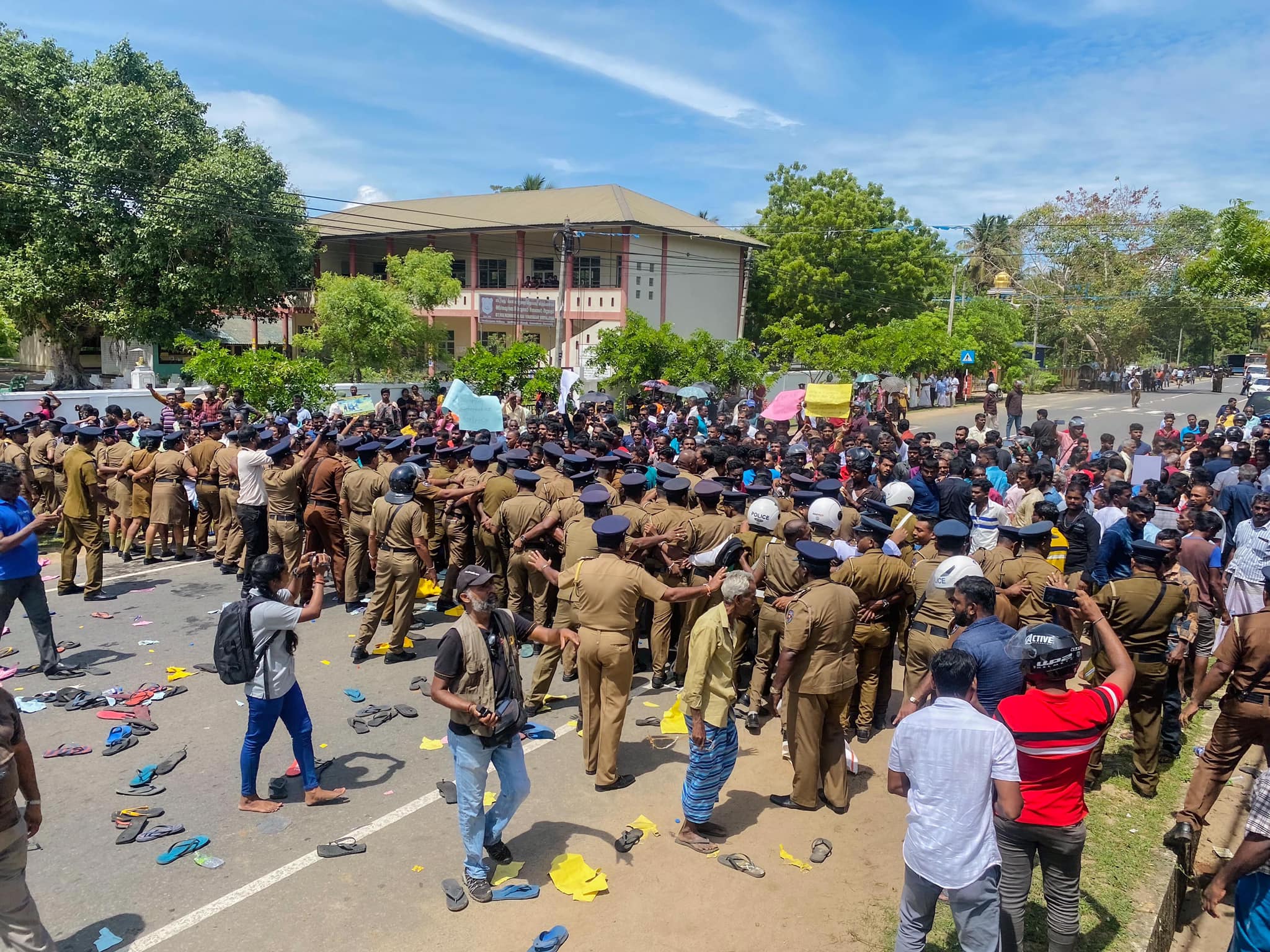
A march by plantation Tamils to mainly demand citizenship rights has reached Madhu on the fourth day as it makes it way from Thalaimannar to Matale.

The agitation that started on 28 July when a set of 11 demands were made to the government, ends on 12 August.

Malaiyaha Tamils are taking the same route their ancestors took 200 years ago to reach the hill-country, where they have since been working mainly as tea estate labourers.

They are seeking the support of other communities to win their demands.

Among these demands are the recognition of their history, struggle and economic contributions, a separate identity but with equal rights and access to education, health and social security.

A reasonable payment for their work, workplace dignity, protection and equal salaries for men and women, land, livelihood and housing rights and the protection and promotion of their culture are also included.

Posted in Uncategorized

Central Bank of Sri Lanka clarifies speculations on authorizing INR as a designated currency

The media release read that the CBSL from time to time, authorizes selected foreign currencies as designated foreign currencies with a view to facilitating international trade and cross-border banking transactions.

Commencing May 1979, the CBSL has occasionally recognized designated foreign currencies.

According to the CBSL, at present, 16 currencies – Australian Dollar, Canadian Dollar, Chinese Renminbi, Danish Kroner, Euro, Hong Kong Dollar, Indian Rupee, Japanese Yen, New Zealand Dollar, Norwegian Kroner, Pound Sterling, Singapore Dollar, Swedish Kroner, Swiss Franc, Thai Bhat and US Dollar – have been authorized as designated foreign currencies under the provisions of the Banking Act and the Foreign Exchange Act, with the latest inclusion being the INR in August 2022.

Posted in Uncategorized

Wimal slams Prez, warns of dire consequences

INR as currency for trade settlements:
National Freedom Front (NFF) leader Wimal Weerawansa has accused President Ranil Wickremesinghe of trying to make Sri Lanka an Indian state ‘economically’ by allowing the Indian rupee (INR) to be used as a currency for trade settlements between the two countries. If Indian and Sri Lankan Customs sign an agreement in this regard, Sri Lanka will become an Indian state, Weerawansa has warned.

Following Wickremesinghe’s visit to New Delhi, the two countries declared the move had forged stronger and mutually-beneficial commercial linkages, and agreed to operationalise India’s Unified Payment Interface or UPI based digital payments for further enhancing trade and transactions between businesses and common people.

Addressing a public rally at Bokundara, Piliyandala on Sunday (30), MP Weerawansa pointed out that President

Wickremesinghe had finalised four agreements including the one on INR ascurrency for trade settlements between the two countries without at least discussing them in Parliament.

The former Minister asked what is the purpose of having sectoral oversight committees when such far reaching decisions were taken without proper consultations.

MP Weerawansa alleged that the UNP leader was exploiting the current economic-political-social crisis to advance his personal agenda.

Japan, China Lock Horns Over Aid Diplomacy

Japan and China have locked horns over aid diplomacy to emerging and developing countries in key maritime locations. The Japanese government has condemned China’s so-called debt trap financing in which developing countries are saddled with debts and China obtains the rights to use ports and other local infrastructure.

The Japanese government aims to help such emerging and developing countries move away from their dependence on China.

Foreign Minister Yoshimasa Hayashi, who is currently on a tour of southwestern Asia, was invited to the private residence of Sri Lankan President Ranil Wickremesinghe on Saturday morning and had a meeting with him over breakfast.

Hayashi expressed his hope for further progress in Sri Lanka’s debt restructuring process and underscored the importance of transparent, fair restructuring that involves all creditor countries. Wickremesinghe replied that he would exercise utmost care regarding transparency and fairness.

The foreign minister stressed the involvement of “all creditor countries” because China does not participate in the creditor committee, in which creditor nations discuss Sri Lanka’s debt payment plans following the country’s default on its debt last year.

Japan is co-chairing the committee with France and India, and is closely watching Chinese moves so that China will not steal a march on other creditors by presenting repayment conditions favorable to itself.

Sri Lanka has a significant amount of infrastructure built with loans from China.

One such facility is the 350-meter-tall Lotus Tower, a landmark in Colombo. About 80% of its total construction costs of $88 million, or about ¥12.3 billion, was financed by Chinese loans.

The number of visitors has topped 1 million since its opening to the public in September last year, but the local Daily Mirror newspaper reported that foreign visitors to the tower accounted for only 2% of the total. The plan was for its construction costs to be recovered through the admission fees paid by foreign visitors, which were set at 13 times the rate paid by local residents.

The Port of Hambantota in southern Sri Lanka is a prime example of a debt trap. The port was built with a huge amount of Chinese loans as one of key programs in the Belt and Road Initiative, a massive China-led infrastructure project.

But the Sri Lankan government was unable to repay the loans and handed over the rights to operate the port to a Chinese state firm on a 99-year lease.

According to Japan’s Finance Ministry, Sri Lanka had bilateral external public debts totaling $10.1 billion, or about ¥1.4 trillion, as of December. Of that figure, $4.1 billion dollars (about ¥570 billion) was owed to China, while $2.7 billion (about ¥380 billion) was owed to Japan.

Sri Lanka is geopolitically important for both Japan and China. The country is located on a sea-lane that 90% of Japan-bound oil tankers pass through. It is essential for Japan to strengthen its relations with Sri Lanka to realize a free and open Indo-Pacific, which is advocated by the Japanese government.

Sri Lanka is also considered one of the bases of China’s String of Pearls strategy, which positions the Indian Ocean as a key strategic position in the marine traffic.

Maldives, which is also part of Hayashi’s current tour, is in a similar situation. The country started its infrastructure development under China’s Belt and Road Initiative. However, its tourism industry was seriously hit by the coronavirus pandemic, leading to fears that Maldives may find it difficult to make debt payments to China.

Maldives is trying to reduce its dependence on China, and it aims to strengthen ties with Japan through Hayashi’s visit.

But Japan’s budget for official development assistance has been declining since its peak of ¥1.1687 trillion in fiscal 1997. Its ODA budget for fiscal 2023 stands at ¥570.9 billion.

“In terms of economic clout, Japan can’t beat China. It’s important for Japan to show its partners that it’s willing to get involved on a long-term basis,” said Etsuyo Arai, director of the South Asian Studies Group, Area Studies Center, at the Institute of Developing Economies, Japan External Trade Organization.

Source:japannews.yomiuri.co.jp

Posted in Uncategorized

Sri Lankan envoy bats for land connectivity By Suhasini Haidar/The Hindu

Land connectivity is essential for the growth of ties between India and its neighbouring island, said the Sri Lankan envoy in India, pitching for connectivity projects resembling the “Channel tunnel” from the U.K. to Europe as a possible future initiative if environmental concerns are cleared.

Speaking about Sri Lankan President Ranil Wickremesinghe’s visit to India in July, where the two countries unveiled an “Economic Partnership Vision” statement that includes maritime, air, energy, trade and people-to-people connectivity, High Commissioner Milinda Moragoda said Sri Lanka’s hopes of benefiting from India’s economic growth and coming out of its current economic crisis hinged on being able to build causeways, bridges, pipelines, electricity transmission lines and landing infrastructure so as to increase travel to and from India.

“Building any causeway or highway across the streets will require environmental impact assessments, and there is a process for that”, Mr. Moragoda told The Hindu in an interview. “If Sri Lanka is looking at this idea of piggybacking on India’s growth story we have to have [land] connectivity,” he added.

13th Amendment

When asked why concerns expressed by India over implementation of the 13th amendment for devolution of power to Tamil majority areas was not, however, included in the joint statements made during the visit, the Sri Lankan envoy said President Wickremesinghe had discussed his latest proposals with Prime Minister Narendra Modi.

“Prime Minister [Mr. Modi] expressed his views and President [Mr. Wickremesinghe] expressed Sri Lanka’s position. So that conversation will continue,” said Mr. Moragoda, pointing out that eventually the resolution of the Tamils’ issue would have to be found “within Sri Lanka”.

The vision statement released after President Wickremesinghe met Mr. Modi in Delhi on July 21 refers to plans for a feasibility study on land connectivity “at an early date”.

“Both leaders have decided to establish land connectivity between Sri Lanka and India for developing land access to the ports of Trincomalee and Colombo, propelling economic growth and prosperity in both Sri Lanka and India, and further consolidating millennia-old relationship between the two countries,” it said. However, the envoy declined to comment on whether this would involve using the Ram Sethu, or the Adam’s Bridge that connects Tamil Nadu to Mannar Island, which has been the focus of protests by religious and environmental groups, in any way.

Private Investments

In addition, the envoy said that as Sri Lanka doesn’t have refining capabilities, an oil pipeline could help the island’s needs, especially if connected to the oil tank farms in Trincomalee which are also part of the MoUs signed during President Wickremesinghe’s visit. The projects agreed to during the visit most closely mirror a number of MoUs signed during Mr. Wickremesinghe’s previous visit in 2017, when he was Prime Minister under then Sri Lankan President Maithripala Sirisena. Those MoUs, including the plan for India to refurbish energy and port facilities in the eastern city of Trincomalee eventually did not make headway and were delayed due to internal political turmoil in Sri Lanka. When asked about timelines for the execution of the projects agreed to during this visit, Mr. Moragoda said the emphasis now is on encouraging private investments.

“When you talk of timelines for initiatives like this in democracies, it’s more complicated. One understanding between the two leaders is to try to encourage the private sector to be more engaged on both sides, which could be more time-sensitive and successful,” he explained. He added that the purpose of the Sri Lankan President’s visit, the first to India since he took over in June 2022, to “chart the way forward” for Sri Lanka’s economic recovery, as the economic vision statement had done, and to thank Mr. Modi and India for the support to Sri Lanka during its debt crisis.

In the past week, Colombo has received visits from French President Emmanuel Macron, Japanese Foreign Minister Yoshimasa Hayashi and an official from the Communist Party of China (CPC) Central Committee, all of whom also offered to help Sri Lanka as it works out a debt restructuring programme with the International Monetary Fund by the end of the year. Mr. Moragoda said economic revenue streams would have to be upgraded for a recovery, and hoped particularly for Indian investment and Indian tourists to contribute to that.

Posted in Uncategorized

TNA MPs meet with Indian envoy in Sri Lanka

A group of parliamentarians representing the Tamil National Alliance (TNA) has called on the Indian High Commissioner to Sri Lanka, Gopal Baglay this morning (Aug 01).

The discussion has reportedly taken place at the official residence of the Indian envoy, with ITAK leader R. Sampanthan and TELO Leader Selvam Adikalanathan in attendance.

At the invitation of High Commissioner Baglay, the TNA parliamentarians joined the meeting during which the implementation of the 13th Amendment to the Constitution, division of police powers several other issues were discussed at length.

The meeting comes days after President Ranil Wickremesinghe’s India visit and the all-party conference in late July.

During Wickremesinghe’s two-day official visit to New Delhi, Indian Prime Minister Narendra Modi urged him to implement the 13th Amendment to the Constitution and ensure a ‘life of dignity and respect’ for the Sri Lankan Tamil community.

Meanwhile, at the all-party conference convened on July 26, the Head of State had s tressed the significance of discussing the 13th constitutional amendment with all parties, as it is a matter that affects the entire country.

Late Vijaya Kumaratunga’s statue in Dehiwala damaged

The statue of late actor-turned-politician Vijaya Kumaratunga, which is established in front of Dehiwala Public Market, has reportedly been damaged.

Police said that part of the left side of the statue’s face has been damaged.

When inquired by Ada Derana in this regard, the OIC of Dehiwala Police stated that although information was received about some unidentified person who had pelted stones at the statue, the alleged act of vandalism has not been confirmed yet.

Furthermore, he added that the part of the statue may have collapsed naturally.

He also expressed that the police have not yet inspected the CCTV footage since no complaint was received so far regarding the incident.

Posted in Uncategorized

Japan seeks Lanka’s backing for its Indo-Pacific strategy

Japan has sought Sri Lanka’s backing for its Free and Open Indo-Pacific (FOIP) strategy. Japanese Foreign Minister Hayashi Yoshimasa has taken up this issue with his Sri Lankan counterpart Ali Sabry, PC, when they met on 29th July.

According to a statement issued by the Japanese Embassy, in Colombo, Minister Yoshimasa has also briefed Minister Sabry regarding Russia terminating an international agreement that allowed grain exports from Ukraine through the Black Sea to various parts of the world.

The following is the text of the Embassy statement: “At the outset, Minister Hayashi welcomed the increasing exchanges of dignitaries between Japan and Sri Lanka since the 70th anniversary of the establishment of diplomatic relations last year, including President Wickremesinghe’s two visits to Japan, and expressed his desire to continue to actively cooperate with Sri Lanka, which is located at a strategic juncture along the sea lanes of the Indian Ocean and is an important partner in realizing a “Free and Open Indo-Pacific (FOIP)”.

Minister Hayashi explained the outcomes of the G7 Hiroshima Summit, including the maintenance and strengthening of a free and open international order, based on the rule of law, and the new plan for a “Free and Open Indo-Pacific (FOIP)”. He also stated Japan would place importance on cooperation with the Indian Ocean Rim Association (IORA) that Sri Lanka will chair from October. Foreign Minister Sabry as the IORA chair conveyed his hope for Japan’s active involvement.

Minister Hayashi expressed his expectations for further progress in the debt restructuring process and the importance of a transparent and comparable debt restructuring that involves all creditor countries. Foreign Minister Sabry stated that Sri Lanka is committed to a transparent and comparable debt restructuring process, and again expressed his gratitude for Japan’s contribution to the discussions on debt restructuring.

Minister Hayashi commended Sri Lanka’s efforts in promoting anti-corruption measures and transparency in the policy making process in accordance with the agreement with the IMF, and expressed his hope that Sri Lanka will bring itself back on track for development as soon as possible. Regarding national reconciliation, he commended Sri Lanka’s efforts in amending the Prevention of Terrorism Act and in establishing the Truth and Reconciliation Commission, and conveyed to Foreign Minister Sabry that Sri Lanka has Japan’s support in this endeavor. Foreign Minister Sabry expressed his appreciation for Japan’s cooperation.

The two ministers exchanged views on international issues including nuclear disarmament and non-proliferation. Minister Hayashi highly commended and welcomed Sri Lanka’s ratification of the CTBT.

Minister Hayashi presented Japan’s position on ALPS treated water, to which Minister Sabry responded that Sri Lanka is a member of the IAEA and trusts the IAEA process.

The two ministers also had a frank exchange of views on the regional situation, including the situation in Ukraine and East Asia. In this context, Minister Hayashi reaffirmed the importance of the efforts of the Black Sea Grain Initiative (BSGI), which has enabled grain exports from Ukraine through the Black Sea to various parts of the world, and then confirmed that Russia’s termination of the initiative completely runs counter to the international community’s efforts in addressing food insecurity and is deeply regrettable and that the international community must be united and strongly urge Russia.”

China Funds Sri Lanka Supreme Court Renovation Project

The comprehensive refurbishment project of the Sri Lankan Supreme Court complex was launched on Monday (31).

The project will see the refurbishment of the Supreme Court and Justice Complex, Power Center, Guard Room, and External Work covering a total construction area of 23,602 square meters.

The Supreme Court Complex, built in 1989 with China Aid, has been playing a central role in the island’s judiciary.

The program to commence the refurbishment of the Supreme Court Complex, at a cost of 240 Million Yuan, funded by the Chinese Government got underway on Monday (31) at an event grated by the Chief Justice, Justice Minister, and the Chinese Ambassador to Sri Lanka.

The refurbishment of the Supreme Court will take place across 32 months, in two phases, and all work is expected to be completed in October 2025.

Sri Lanka and India land connectivity has distinct advantages By P.K.Balachandran/Ceylon Today

During Sri Lankan President Ranil Wickremesinghe’s July 20-21 State Visit to India, Wickremesinghe and the Indian Prime Minister Narendra Modi agreed to explore the feasibility of building a bridge across the Palk Strait to give India “land access” to the ports of Colombo and Trincomalee.

India and Sri Lanka already have air and sea connectivity and the two leaders decided to improve and expand them. But there is no “land connectivity”. Both Wickremesinghe and Modi are now keen establishing a land link also in order to bring the two countries closer for the common good and for the larger purpose of integrating the South Asian region.

The Vision Statement issued at the end of Wickremesinghe’s visit said that the two leaders agreed to “establish land connectivity between Sri Lanka and India for developing land access to the ports of Trincomalee and Colombo, propelling economic growth and prosperity in both Sri Lanka and India, and further consolidating the millennia-old relationship between the two countries. A feasibility study for such connectivity will be conducted at an early date.”

Explaining the concept to the media, Indian Foreign Secretary Vinay Kwatra said that the idea was proposed by the Sri Lankan President and was backed by the Indian Prime Minister.

Land connectivity will help India’s Southern States, which are now India’s growth centres, to increase their trade with Sri Lanka and vice versa. Ships from ports on India’s Eastern seaboard like Vishakhapatnam, Kolkata and Chennai, now have to go around Sri Lanka to reach Colombo. But if a land link is established with a bridge across the Palk Strait, traders can use road/and rail transport which are cheaper and less time consuming.

Long History

In 1913-14, the British rulers of India and Ceylon planned to use the rail link to bring Indians to work in the island’s tea and rubber plantations. Rail tracks were laid on the Indian side up to Dhanushkodi, and on the Ceylon side, up to Talaimannar. But the track across the Palk Strait was not laid because World War I intervened.

The idea had to wait until Wickremesinghe became Prime Minister in 2002-2004 to be revived. His “Hanuman bridge” was part of his larger project to build a strong economic cum strategic relationship with India to contain the Tamil Tiger insurgency in North and East Sri Lanka. He granted India the 99 unused giant oil tanks in Trincomalee and a part of the Ceylon Petroleum Corporation’s distribution network to the Indian Oil Corporation and proposed a land link.

Sri Lanka envisaged a four-lane highway with a parallel single rail track that would cost of LKR 88 billion. Many papers were presented at a seminar held in Colombo in August 2002 under the aegis of the Sri Lanka Institution of Engineers and the Indian Institution of Engineers (Tamil Nadu Centre). A Concept Paper was presented to the Tamil Nadu Chief Minister J.Jayalalitha.

But the project did not take off, partly because Jayalalitha was against the land link that could facilitate LTTE infiltration into Tamil Nadu, and partly because Wickremesinghe was facing a backlash from the Sinhala nationalists, who feared infiltration from India. At any rate, he lost the 2005 Presidential election to Mahinda Rajapaksa, a Sinhala nationalist.

A decade later, in June 2015, the Indian Road Transport Minister Nitin Gadkari proposed the building the 23 km bridge with ADB assistance of US$ 3.5 billion as part of the Asian highways project. But he made this announcement without consulting the Sri Lankan leadership, perhaps imagining that Wickremesinghe, who was Prime Minister then, would automatically give it a nod. But Wickremesinghe was non-committal having been a victim of Sinhala nationalism earlier.

Indeed, Gadkaris persistence drew a hostile response in Sri Lanka. In 2016, Vasudeva Nanayakkara said that if the bridge was built the 60 million Tamils from Tamil Nadu would swamp Lanka. Another nationalist, Udaya Gammanpila, said that if the bridge was built he would demolish it.

Wickremesinghe Revives Proposal

However, Wickremesinghe now feels that the political climate in Sri Lanka is conducive to closer ties with India, given the significant role India has played in rescuing Sri Lanka from an economic abyss. Significantly, till now, no Sinhala nationalist leader has opposed the “land link” proposal made in New Delhi.

Wickremesinghe has support from two Lankan economists: Gayasha Samarakoon and Muttukrishna Sarvananthan. They said in a paper published by Routledge, that a land bridge would bring down the transport cost in India-Sri Lanka trade by 50%.

The 23 km bridge could be traversed in less than an hour. And from the arrival point at Talaimannar, it would take another 7–8 hours to reach Colombo by road (roughly 367 km). The total travel time between India and Colombo would be 9 hours with a few more hours to accommodate customs requirements.

But the total time taken to transport goods from Tuticorin in Tamil Nadu to Colombo is between 116 and 122 hours (about five days) for non-container ships, and between 40 and 46 hours (i.e., nearly two days) for container ships. This is “excessive” the economists said.

They further said that the waiting time for customs clearance and other formalities could also be significantly reduced if the land route was used because the land route would involve only exports/imports to/from India, whereas the Colombo Harbour would be handling trade to and from all over the world.

Lower transport costs would bring down prices of goods in Sri Lanka. An uptick in trade would create thousands of direct and indirect jobs. The road link would also contribute to the economic development of backward provinces like the Northern Province and the North Central Province.

“Districts in these provinces have been the lowest contributors to the national economy for a very long period. The poverty and unemployment rates of these provinces are the highest in the country and the human development index of these provinces is the lowest in the country,’’ the economists pointed out.

“Furthermore, the business communities in the Northern and North Central Provinces have long complained about their inability to directly engage in international trade. Presently, businesspersons in the Northern and North Central Provinces can engage in export/ import trade only through exporters/importers in Colombo. The proposed bridge would boost direct international trade between the northern, north-central, and eastern regions of Sri Lanka and India (particularly Southern India).”

Currently, only a small fraction of Indian tourists visits the Northern, North Central, and Eastern Provinces of Sri Lanka due to the long distance from Colombo, where the main international airport is located. The proposed bridge would boost tourist traffic to these marginalized provinces.

Unlike in 2002, 2015, 2016 and 2017, Sinhala nationalists have made no comment on the bridge proposal as on date. This is probably because it will be churlish to oppose closer links with India when India is helping Sri Lanka overcome a grave economic crisis.

But suspicions about India’s moves run deep in the minds of the Sri Lankan ruling class, based on an atavistic fear of Indian hegemony. An imagined prospect of being flooded by businessmen, professionals and workers from over-populated India frightens Sri Lankan businessmen and professionals. Hence the opposition to the Comprehensive Economic Partnership Agreement (CEPA) and the Economic and Technical Partnership Agreement (ETCA) proposed by India.

Sri Lanka is also thought to be too weak vis-à-vis India. Sunday Times said so in an editorial on Wickremesinghe’s visit: “The problem for Sri Lanka is that it has no muscle, no clout to bargain as equal partners for win-win solutions when in Delhi. It is a lopsided balance sheet.”