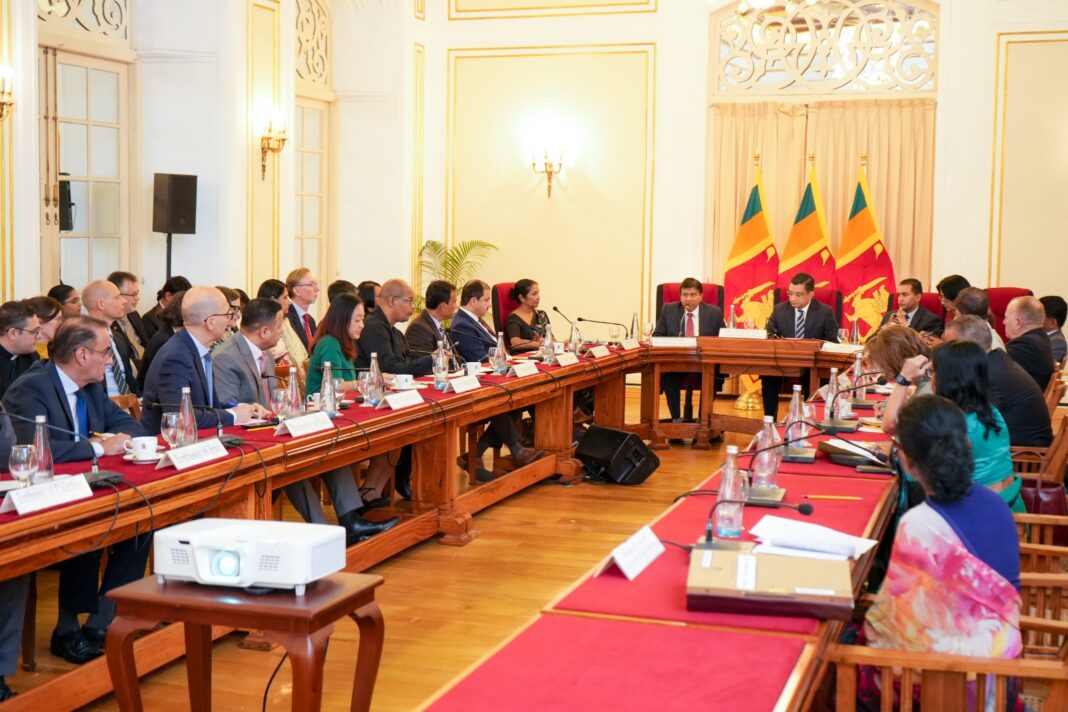
A ‘mini war’ has broken out between Cabinet Ministers and State Ministers in the execution of their duties.
The State Ministers have complained to President Ranil Wickremesinghe that they have no functions to discharge allegedly due to their ministerial colleagues usurping them. In addition, they have also complained that they have not been issued with good vehicles or other facilities they are entitled to.
The issue has reached serious proportions prompting President Wickremesinghe to summon a meeting tomorrow afternoon (4 p.m.) at the Presidential Secretariat. He will call upon State Ministers to identify their problems.
There are a multitude of reasons confronting the State Ministers. The main one appears to be the absence of any select government institutions under their control, a practice that was previously followed. This was after such bodies were gazetted under the state minister. Consequently, there is also no State Secretary for their ministries. There is only one Secretary for each ministry. State Ministers complain that no minister had been good enough to voluntarily cede any institution under him or her.
Ministers concede that at present, state ministers are not bound by a directive to divest any of their functions as in the past. One angry minister, who did not wish to be named for obvious reasons, said there have been instances where state ministers have shown interest in tenders for projects and other matters involving finances. However, he said, they could not get involved officially. A state minister, who also spoke anonymously, said even ministers resorted to such practices and cited a deal where state land, amounting to 80 acres, had been given by a minister through an irregular practice. True the process has involved Cabinet approval, but irregularities existed, he claimed.
Besides their monthly salaries, both ministers and state ministers are entitled to several perks. Ministers are entitled to two vehicles for their use with the option of picking their own drivers. Both categories are entitled to five different secretaries (a private secretary, a Public Relations Officer, Two Co-ordinating Secretaries, and a Media Officer). Each minister is entitled to 12 security guards, a vehicle for his or her use and a bungalow in Colombo.
There is added significance to tomorrow’s meeting. The Sunday Times learns that President Wickremesinghe is to affect a minor cabinet re-shuffle anytime in the coming weeks. The idea, a government source said, is to replace or shift ministers who have been found wanting in their ministries. This is particularly after reports that their non-performance had caused the public great hardships and led to an unprecedented deterioration of work carried out by their ministries.
Already a vote of no confidence is being moved by the opposition parties against Health Minister Keheliya Rambukwella. Among other matters, they have accused him of “not duly appointing the Board of Directors to the National Medicines Regulatory Authority, importing low quality drugs, importing drugs deviating from the tender procedure, importing drugs at exorbitant prices, being responsible for the scarcity of essential drugs and shortage of laboratory equipment in the hospital system and purchasing of unregistered drugs on the pretext of emergency purchases thereby resulting in deaths and impairments due to their use”. The motion will be debated in Parliament on September 6,7 and 8. There has been widespread criticism about the shortage of medicinal drugs, exodus of specialist doctors and the deteriorating service at public hospitals amidst allegations of mounting bribery and corruption.
With a majority in its favour, the ruling SLPP government led by President Wickremesinghe is sure to have the motion defeated. Its parliamentarians have been told not to undertake overseas visits until the debate is over. Nevertheless, there are a considerable number of SLPP parliamentarians, not to mention their opposition colleagues, who are disenchanted.
How patients are harassed and undergo severe hardships in public hospitals is illustrated by a recent incident. A cancer patient warded at the Teldeniya government hospital required an urgent CT scan before surgery. Hospital staff learnt that the machine at the Kandy General Hospital was not working. So, the staff at Teldeniya arranged an ambulance to take him to the Matale government hospital. When the patient arrived there, it was found that the machine there too was not working. The patient returned to Teldeniya and was discharged with the advice that he should return in a week. A week later, he admitted himself again. He was discharged the next day with the news that there was no CT scan available. Teldeniya Hospital staff telephoned him later and asked that he admit himself again. He was admitted for one day and discharge with the same reason – the CT scans are not working.
Rising gun violence
Another area of public concern, besides the deteriorating health services, has been the worrying law and order situation. Hardly a day passes without a murder being reported to Police Headquarters. In almost all instances, such murders have been carried out with the use of automatic weapons. Other than making pronouncements about persons being arrested, the Police as a whole have not been able to either prevent these incidents or nab those using illegal firearms. To make matters worse, some police top brasses have linked some of the murders to internecine battles between drug cartels. That only confirms that there has been a marked increase in drug abuse. Other than small quantities, there have not been major find of any drug hoards. This has led to allegations, yet to be proved, that drug warlords were in cahoots with some police personnel. Another cause is said to be the tug of war at higher levels where some senior officers are vying with each other to be the head of the Police.
According to a retired senior Police officer, territorial policing which is an essential part of maintaining law and order has come to a virtual standstill. “Particularly during nights, other than traffic policemen, crime prevention activity is much less or literally non-existent,” he pointed out. He said matters took a turn for the worse after last years’ protests (aragalaya) where the vast volume of Police personnel was deployed for static duty guarding fuel stations and other establishments. With that over, the old practices slowed down.
The Presidential Media Division arranged for Public Security Minister Tiran Alles to speak at a news conference. He claimed that the “Police Department is working on a non-political agenda” and argued that “there is no room for underworld activities inside the country.” A PMD statement said: “Minister of Public Security Tiran Alles emphasised that necessary measures have been taken as a responsible government to stop hindrances to the lives of the people. He further stated that the programme to suppress the underworld has already been implemented under the instructions given by President Ranil Wickremesinghe.
The Minister also pointed out that the police department is working on a non-political agenda and is always committed to protecting the law and order of the country at the highest level….
“He added, currently, the Police Department is working on a non-political agenda. All the necessary facilities have been provided. It has been about a year since the current government took office, so not everything can be accomplished within a year. However, the Police Department has undertaken a significant amount of work. The Police Department currently comprises around 85,000 officers. The ministry has developed a special programme to eradicate narcotic drugs from the country. Underworld activities in the South have been on the rise consistently.
Due to this, the Special Task Force, the police, and other security forces jointly started special operations in such areas. As a result, it has been possible to eliminate to some extent the underworld activities in the Southern Province. At present, there are several reports of shootings between groups of underworld gangs. They murder each other. Necessary measures have already been taken to stop such activities of the underworld gangs. Security forces have also been instructed to shoot if necessary. As a responsible government, no activity that harms the lives of the people will be tolerated….”
Minister Alles’ remarks raise more questions than answers. If, as he claims, underworld gangs are shooting each other, how did they obtain their weapons? Just a few years ago, there were fewer than the present, over 600 Police stations. They maintained law and order without the help of the security forces. Despite a so-called special programme to curb drug abuse, there has been a marked proliferation. Another malaise, it has come to light, is the increasing use of political influence and even financial inducements on the police to use their influence to punish people. There has been many instances where courts had to issue orders to arrest police personnel when matters came to light. The latest incident is the alleged killing of a domestic who worked in a Colombo seven household. She died in custody of the Borella Police. The Magistrate’s Court ordered the arrest of those allegedly involved. A Sub Inspector of Police was first arrested. Later, two police constables and a sergeant were arrested, again on the orders of the Magistrate.
There were shocks as living costs showed signs of a further increase. This is the result of this week’s fuel price rise and increase in bus fares. This, no doubt, is an issue that the government would have to address before an election.
OHCHR report on Lanka
On the external front, a matter of importance is next week’s 54th sessions of the United Nations Human Rights Council in Geneva. The report of the Office of the High Commissioner for Human Rights (OHCHR) will come up for interactive dialogue in the forenoon and afternoon of September 11 when the sessions begin. Diplomatic sources said that a copy of the draft OHCHR report has already been forwarded to the government (Foreign Ministry). A formal response from it is due at the OHCHR in Geneva on Tuesday (September 5) with its inputs. That is expected to outline a string of measures that have been adopted, including the ethnic reconciliation process, the implementation of the 13th Amendment to the Constitution, the setting up of the Truth and Reconciliation Commission and the strengthening of the Provincial Councils, land reforms, PTA reforms, prisoner releases, and the introduction of the anti-corruption law.
One of the key areas the OHCHR report will deal with, the same sources said, was its “serious concern” over the shrinking of “democratic space” in Sri Lanka. Reference is being made to curbs on meetings and restrictions on freedom of assembly. It is not immediately clear whether there would be references to the Sri Lanka Accountability Project (SLAP) which is now fully funded and staffed. However, it will be inevitable for the High Commissioner not to report on progress of this most controversial of projects.
Former High Commissioner Michele Bachelet in September 2022 in her written report made several observations and highlighted concerns. Some of the salient points were;
The High Commissioner hopes that the new administration will respond to the popular demand for accountability for economic crimes, including corruption, and abuse of power with a renewed commitment to end impunity. As noted above, the report of the national Consultation Task Force appointed by President Wickremesinghe (when he was Prime Minister in 2016) provides important recommendations for advancing accountability at the national level which remain an equally relevant starting point to this day.
The Human Rights Council should continue to monitor developments closely, and in the absence of tangible results at the national level that ensure justice for Sri Lankan people, Member States should continue to pursue complementary international strategies for justice and accountability for human rights violations, corruption, and abuse of power. The Office of the High Commissioner for Human Rights will continue to accompany the people of Sri Lanka in this vital journey.
Support Sri Lanka in the investigation of economic crimes that impact on human rights and the tracing and recovery of stolen assets.
Of the 42 paragraphs in that resolution, 14 were new inclusions and have been inserted for the first time. Highlighted in the resolution are four new preambular paragraphs introduced for the first time. Among them:
(PP6) Recognising the severe economic crisis which deteriorated in Sri Lanka since late 2021 and the profound impact that this has had on the people of Sri Lanka.
(PP7) Underscoring the importance of addressing underlying governance factors and root causes which have contributed to this crisis including deepening militarisation, lack of accountability in governance and impunity for serious human rights violations and abuses.
(PP8) Recognising the recent efforts of the Government of Sri Lanka to address the ongoing economic crisis and welcoming the staff-level agreement reached between the Government of Sri Lanka and the International Monetary Fund.
Last year’s resolution also drew attention to the protests that culminated with then President Gotabaya Rajapaksa fleeing the country. He later returned. The resolution added five new operative clauses. They are:
Expresses concern at the human rights impacts of the economic crisis, including as result of increased food insecurity, severe shortages in fuel, shortages in essential medicines and reductions in household incomes, whilst stressing the need to promote and protect the rights of the most marginalized and disadvantaged individuals, including daily wage earners, children, older persons, and persons with disabilities.
Remains concerned at continued militarisation of civilian government functions; the erosion of the independence of the judiciary and key institutions responsible for the promotion and protection of human rights; lack of progress in addressing longstanding grievances and demands of Tamil and Muslim populations, surveillance, intimidation, and harassment of journalists, human rights defenders, families of the disappeared and persons involved in memorialisation initiatives, and sexual and gender based violence.
Notes the persistent lack of independence, impartiality and transparency of domestic mechanisms, and that emblematic human rights cases have been undermined through delays and the granting of Presidential pardon to those accused or convicted of crimes relating to grave violations of human rights.
Calls upon the Government of Sri Lanka to address the ongoing economic crisis and help ensure it does not happen again, including by investigating and, where warranted, prosecuting corruption, including by public and former public officials, and stands ready to assist and support independent, impartial, and transparent efforts in this regard
The most controversial provision in resolution 51/L.1/Rev.1 (Operative Paragraph 6), relates to the evidence gathering mechanism under the Human Rights High Commissioner, tasked to a separate secretariat with special funding (now listed as OP8), has been revised to make it stronger. It now says: “Recognises the importance of preserving and analysing evidence relating to violations and abuses of human rights and related crimes in Sri Lanka with a view to advancing accountability, and decides to extend and reinforce the capacity of the Office of the High Commissioner to collect, consolidate, analyse and preserve information and evidence and to develop possible strategies for future accountability processes for gross violations of human rights or serious violations of international humanitarian law in Sri Lanka, to advocate for victims and survivors, and to support relevant judicial and other proceedings, including in Member States, with competent jurisdiction.”
In essence, the 54th UNHRC sessions in Geneva will be a review of last year’s resolution and how the country has performed. Despite apprehensions in some quarters, the outcome is not likely to be of alarming proportions. However, the strength of the High Commissioner’s written report and the seriousness of concerns raised will have significant impact on how and what the UNHRC will do in Sept 2024. Will Sri Lanka remain in the agenda or not will be decided then.