Bill to amend the Provincial Councils Elections Act in Parliament on Tuesday

The bill to amend the Provincial Councils Elections Act, No. 2 of 1988 is scheduled to be tabled in Parliament on the 25th of April.

The Private Member Bill by Parliamentarian MA Sumanthiran was published in government gazette in 2019 as the Provincial Councils Elections (Amendment) Bill.

According to MP Sumanthiran, the first reading of the bill will take place on Tuesday.

If Parliament adopts the bill, the delayed Provincial Council elections can be held under the previous voting system.

The Provincial Councils Elections Amendment Bill was passed by Parliament on the 20th of September 2017 with the support of more than two-thirds of the Members of Parliament.

However, it led to the delay of the Provincial Councils elections for more than five years.

Posted in Uncategorized

China Merchants, Sri Lanka’s Access to build US$392mn logistics hub

China Merchants Port Holdings said it is teaming up with Sri Lanka’s Access Engineering and Colombo port to set up a 392 million dollar logistics centre as a build operate transfer project.

outh Asia Commercial and Logistics Hub, will be a 50-year build operated transfer project with CM Port holding a 70 percent stake and Access Engineering and Sri Lanka Ports Authority holding 15 percent each.

The statement said the project will “result in an infusion of US$ 126 million in addition to an upfront payment of US$ 26 million after the agreement is signed.”

An 8 storey building with a 530,000 cubic metre capacity will be built in the centre of Colombo port. Construction will begin in the second half of 2023 and is expected to be completed by end 2025.

It will be linked to the Katunayake airport via a port access elevated highway.

If will offer services including multi-country consolidation. Container freight station, general warehousing and value added services.

Colombo port has been declared as a ‘freeport’ by the Government of Sri Lanka.

The “will enjoy the associated Freeport advantages in its operations, such as no customs clearance for transshipment and MCC cargo, resulting in reduced paperwork and associated costs,” the statement said.

“The project also provides an ideal platform for the registration of hub companies – which will enjoy tax concessions in CIT, WHT, VAT, etc.”

Posted in Uncategorized

Govt turned Sri Lanka into ‘land of auctions’ – Sajith

Leader of the Opposition Sajith Premadasa alleges that, although the loss-making state institutions need to be reformed, the government is planning to sell off the profit-making state institutions as well.

Making a special statement regarding the IMF’s Extended Fund Facility (EFF), the Opposition Leader claimed that the government failed to secure the best IMF agreement for the country and its people, by reaching out for the global lender at the last moment.

“It is very much clear that loss-making state institutions should be reformed. A bankrupted country cannot maintain the unprofitable state institutions”, he said.

Premadasa further stressed that as a result of the weak policies of the government, plans are afoot to sell off the state institutions to deceitful capitalists for dirt cheap.

“The country has become a ‘land of auctions’ for capitalists across the world”, he alleged.

Sajith Premadasa also claimed that the government should act to create a suitable model for the country by following the models such as Temasek in Singapore and Kazanah in Malaysia, in order to convert the loss-making state institutions into profit-making institutions and the profit-making ones to make more profit.

The Smell of Terror -GroundViews

“On land a tiger, in the water a crocodile.” A Bengali proverb

In Sri Lanka terror means Tamil or Muslim. When the J.R. Jayewardene government responded to the ethnic problem not with the promised political reforms but with repression and the PTA was born, the concept of terror (and its prevention) invoked an image. Not of the Tiger chief, for his face was yet to be seared into the collective memory of the Sinhala South, but of the Tamil. Every Tamil symbolised terror, from the politician defending the Eelam demand in parliament to the old woman sweeping the street who knew nothing of a separate state. They were the descendents of South Indian invaders of yore, political heirs of the timeless project of occupying and unmaking this land of Sinhala-Buddhism.

The PTA was thus born and lived most of its 44 year existence as an anti-Tamil law. It was first enacted as a temporary measure when the armed Eelam movement was in its infancy, hardly a movement, just a ragtag band of dreamers and malcontents. Within four years of the PTA’s birth, the fledgling insurgency had turned into a raging war, fed by innumerable political crimes and mistakes, ranging from the burning of the Jaffna library to Black July. Had those atrocities not happened, had a political solution to the ethnic problem been enacted, the Eelam War could have been prevented, with or without the PTA.

So the PTA was a colossal failure. It failed not only to nip the Tamil insurgency in the bud, or to do the same with the JVP insurgency of 1987-89. It also failed to stop the Easter Sunday massacre. The anatomy of that final failure is extensively documented through a number of investigations and inquiries. Revisiting their findings is timely since that tragedy is being used by the administration to push through the potentially more draconian ATA.

The Easter Sunday massacre was preventable. It wasn’t prevented not because the PTA had loopholes but because of “the deplorable want of oversight and inaction…in the conduct of affairs pertaining to security, law and order and intelligence.” That was the Supreme Court in its January 2023 judgement. Information about an impending attack first became available on April 4, 2019, yet the men in charge of ensuring national security and public safety did nothing. That failure happened not because the PTA didn’t confer enough powers on the security establishment but because of their “lack of strategic co-ordination, expertise and preparedness,” as the Supreme Court put it succinctly.

If any one man symbolises this failure, it is Nilantha Jayawardana, the then head of the SIS. He was the first top official to receive concrete information about an impending attack. By April 21, he had in his possession the names of several potential attackers: Mohamed Zaharan, Mohamed Milhan, and Mohamedu Rilwan. If even one of these was arrested, the massacre might not have happened. As the Supreme Court pointed out, “All this shows that there was so much information that was available before Nilantha Jayawardena…but it cannot be said that Nilantha Jayawardena acted with alacrity and promptitude.” The court ruled that disciplinary action must be taken against him within six months, as part of a broader revamping of “security systems and intelligence structures.”

The same point was made by the parliamentary select committee in October 2019. In its final report the committee said that the SIS chief, MOD secretary, IGP, CNI, DMI “failed in their responsibilities. All were informed of the intelligence information prior to the Easter Sunday attacks but failed to take the necessary steps to mitigate or prevent it.” But doing anything about these structural or personnel problems was impossible. Within hours of the attack, the Rajapaksas had blamed the government for permitting it by weakening and demoralising the intelligence agencies. This cry was later taken up by Cardinal Malcolm Ranjith who accused the government of dismantling “The intelligence agencies that were once very strong. This was done to fulfil the needs of international organisations and NGOs.”

Innocents like Hejaaz Hisbullah and Ahnaf Jazim were arrested. The man the Supreme Court singled out for negligence, Nilantha Jayawardana, was made a senior DIG on January 3, 2023. Three and a half months later, he remains in that august position. And the security systems and intelligence structures remain as they were, moving to a beat that has very little to do with national security and public safety. The government is busy pushing the ATA. The opposition and the Cardinal are busy chasing the elusive mastermind. And the Rajapaksas are poised to benefit from both preoccupations.

The Mastermind Syndrome

The idea of a hidden hand, a mysterious mastermind behind the Easter Sunday massacre was birthed and popularised by the Rajapaksa camp. Two days after the massacre, Mahinda Rajapaksa mentioned the possible presence of a foreign hand behind the attack. In the next several weeks, this amorphous foreign hand was given shape and form by his acolytes. Wimal Weerawansa said that the American Ambassador could be behind the attack, with Prime Minister Wickremesinghe’s complicity, to turn us into a Libya or Syria. Udaya Gammanpila informed the parliament that the IS was an American cat’s paw. Americans had Muslims ready, complete with Sinhala names, to attack other Muslims thereby igniting another Black July. Muslim countries would protest and the West would invade in the guise of peacekeeping, he claimed.

These ravings were rendered respectable when Cardinal Malcolm Ranjith joined the bandwagon. In June, at a ceremony to re-consecrate the Katuwapitiya church, he said, “The youth who carried out the bomb attacks were used by the international conspirators…I have seen a report that ISIS leader Abu Bakr al-Bagdhadi is in a military camp which is run by the most powerful country in the world. I won’t mention the name of this country but clearly the ISIS leader is in a military camp which is run by this powerful nation… We question whether this nation knew about the bomb attacks.” The paper was Divina, which was less coy than the cardinal and mentioned the name of the country supposedly hosting the IS chief, the US.

The possible identity of the mastermind changed according to the political climate. At first it was the foreign hand. Later parliamentarian Rishard Bathiudeen became the top contender for the role. Athuraliye Rathana thero began a fast against him. The Catholic Church backed a no-confidence motion by the pro-Rajapaksa opposition against him. He was even arrested during the Gotabaya presidency. Today, for many, the Rajapaksas are the mastermind. Cardinal Malcolm Ranjith even quoted from the parliamentary select committee report to this effect. (The report wondered “whether those with vested interests did not act on intelligence so as to create chaos and instil fear and uncertainty in the country in the lead up to the presidential election.” At that time, the Cardinal didn’t heed the warning.)

The mindless preoccupation with a mastermind is a convenient scapegoat for political and security establishments, as well as for the people. Politicians promise to find the mastermind when in opposition and use the mastermind to evade the difficult task of revamping the security establishment once in power. The security establishment depend on the mastermind to deflect attention from their own culpability. We, the people, need not face how we failed to take a public stand against extremists in our own communities.

When the police came to the Dematagoda house of Ilham Ibrahim, the Shangri La bomber, his pregnant wife detonated a bomb, killing herself, her three children, and unborn baby. What would make a father consent to such a horrendous plan or a mother carry it out? The question, if asked, would compel us to face the dark side of religion, how extreme belief and piety can result in inconceivable horror (this is true of ideological extremisms of the secular variety too). But if we busy ourselves with the forever search for the mastermind, we need not face the role played by Sinhala-Buddhist supremacism and Islamism in preparing the ground for the massacre. We are not guilty for the mastermind did it.

The mastermind obsession also served to discredit the only serious investigation into the massacre carried out by the CID under DIG Ravi Seneviratne and SSP Shani Abeysekara. When President Gotabaya Rajapaksa transferred 700 CID personnel including the members of the investigative teams, hardly anyone protested. The Rajapaksa opposition also boycotted the parliamentary select committee. Both the investigation and the select committee pinpointed how the Rajapaksas’ anti-Muslim campaign played into the hands of Mohamed Zharan and other extremists. As the then acting head of the TID Jagath Vishantha informed the parliamentary select committee, “After the Digana incident they published a lot of posts against Sinhala-Buddhist extremism. And from our Research and Analysis units we could see that they got many comments and likes.” “Zahran started a campaign to radicalise Muslim youth and motivate them to use violence to achieve their ends post March 2018 attacks on Muslims in Digana…” the select committee concluded. “He was able to recruit many by using that incident and the Aluthgama incidents of 2014 to embrace the Islamic State of Syria and Iraq ideology.” The report also highlighted increasing levels of Wahabism and Arabisation in parts of Sri Lanka or rather Saudi-Arabisation.

So without the Rajapaksa’s anti-Muslim campaign, without Aluthgama and Digana, the Easter Sunday massacre could have been prevented just as the long Eelam War could have been avoided if Black July didn’t happen. The key is political, a state and a society that enable moderates of all religions while marginalising extremists of every religion. But those necessary political changes need not even be discussed so long as we can cling to the never ending search for the mastermind. For there will never be a mastermind that can satisfy all the diverse elements who need him.

The problem with the ATA

Shakthika Sathkumara was an award-winning writer and a Sinhala-Buddhist father of three. Fathima Nushara Zarook was a Muslim mother of one who had worked in the Middle East as a housemaid. Mr. Sathkumara was arrested in early April and Ms. Zarook in early May 2019. Both had fallen foul of ICCPR, an international covenant created to protect fundamental rights and was being used to violate them in Sri Lanka.

ICCPR is being wielded against minorities and dissenting Sinhalese via Section 3: “No person shall propagate war or advocate national, racial or religious hatred that contributes incitement to discrimination, hostility or violence.” The proposed ATA includes in its definition of terrorism, “causing destruction or damage to religious or cultural property or heritage.” This clause is ripe for abuse by Sinhala supremacists within and outside the state. For instance, a Muslim woman believed to be wearing a kaftan featuring a dhamma chakka or a Sinhala man writing a story about predation within the Sangha can be deemed guilty of damaging our heritage. Tamils protesting the implanting of a bo sapling in an area without a single Buddhist inhabitant can be accused of damaging cultural property. “Causing serious risk to health and safety of the public or a section thereof’ would be terrorism under ATA. This in a country where Muslims were accused of spreading Covid-19! If passed sans amendments, ATA could create an abusive system like pre-revolutionary Frances’s lettre de cachet. This may not happen under President Wickremesinghe. What about his successors?

The normally fractious opposition is united against the ATA. The Rajapaksas are hedging their bets, waiting to cut the best deal either way. To get the law through the parliament, President Wickremesinghe will need the votes of all SLPPers and not just those backing him. To get that support, he will have to concede whatever pound of flesh the Rajapaksas demand. This is likely to be ministerial posts to Namal Rajapaksa and hardcore acolytes like Johnston Fernando and Rohitha Abeygunawardana, perhaps even premiership for Mahinda Rajapaksa. If the president concedes, that would tarnish his recovering reputation beyond redemption and give a new life to the outdated myth of Ranil Rajapaksa.

The Rajapaksas retain the backing of their devotees, but most of the 6.9 million have long deserted them. Angry at being deceived by the family, burdened by indirect taxes and high rates, they will react with unappeasable anger at any attempt to give cabinet portfolios to men they blame for their condition. This anger may well work against President Wickremesinghe at any future election, especially a presidential poll.

The government’s determination to push the ATA is creating new political fault lines the economy could ill afford. Sri Lanka has avoided Lebanon’s fate and achieved a modicum of stability thanks to President Wickremesinghe’s economic policies. The steady increase in foreign remittances is the latest indication of a country that is on the path to recovery. The focus should be on justice, good governance, and rule of law, specifically preventing incidents like the recent attack on a foreign-owned garment factory by supporters of a Gampaha district state minister. ATA is a diversion from that sensible path. If repressive laws and armed power suffice to maintain status quos, Bastille would still be standing.


Posted in Uncategorized

US Court orders SL, Hamilton Reserve Bank to submit joint status letter by 12 May

The United States District Court, Southern District of New York last week ordered the Sri Lankan Government and its sovereign bondholder Hamilton Reserve Bank (HRB) to submit a joint status letter by 12 May 2023.

The decision by US District Judge Denise Cote follows a conference held involving the two parties on 20 April.

The Government in early April in its answers to HRB’s Amended Complaint, denied almost all the allegations.

Via its attorneys Clifford Chance US LLP, the Government said the Plaintiff HRB’s claim is barred, in whole or in part, by reason of Sri Lanka’s sovereign immunity. Furthermore the Plaintiff’s claim is barred, in whole or in part, because Plaintiff lacks standing to sue and Plaintiff’s claim is barred, in whole or in part, and/or should be stayed, on the grounds of international comity.

Therefore, Sri Lankan Government respectfully requested the US Court to dismiss HRB’s Amended Complaint with prejudice or, in the alternative, staying proceedings; as well as award Defendant its costs, attorneys’ fees, and such other and further legal and equitable relief as the Court may deem just and proper.

The Daily FT on 10 April exclusively reported (https://www.ft.lk/top-story/SL-s-external-debt-restructuring-bid-suffers-blow/26-747259) United States District Court, Southern District of New York decision to deny Sri Lanka Government’s motion to dismiss the case filed by HRB.

HRB owns over $ 250 million in principal amount of the $ 1 billion worth International Sovereign Bonds (ISBs) issued in 2012. The Bonds matured on 25 July 2022. Hamilton alleged that as a result of Sri Lanka’s default, it is owed $ 250.19 million in principle and $ 7.349 million in accrued interest (before accounting for pre-and post-judgement interest).

HRB, represented by Bleichmar Fonti and Auld LLP and Jenner and Block LLP, initiated this action on 21 June 2022 after which on 21 September Sri Lanka filed a motion to dismiss the complaint.

Sri Lanka in mid-April announced a moratorium on foreign debt repayments including the Bonds and since then has made no payments on the Bonds.

Posted in Uncategorized

Why did Thowheed Jamath endorse Gotabaya Rajapaksa?

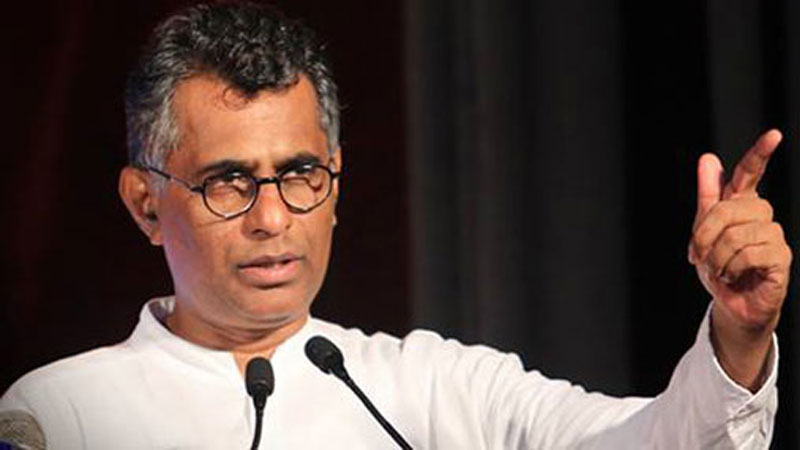
Despite several commissions of inquiry to probe the Easter Sunday attacks of 2019, four unresolved questions remain, MP Patali Champika Ranawaka said.

“There is still no response to the allegations that the Sri Lankan military intelligence fed the Thowheed Jamath organzation.

Why did this organization endorse the election of Gotabaya Rajapaksa?” Ranawaka questioned, adding that he has no confidence that justice will be meted out to the victims of these attacks.

Monk appointed as the new SLPP Chairman

The Sri Lanka Podujana Peramuna (SLPP) has appointed a monk as its new Chairman, to replace rebel SLPP MP G.L Peiris.

The Venerable, Professor Uthurawala Dhammarathana Thera was appointed as the SLPP Chairman at the SLPP General Meeting today.

The SLPP had in March sacked party Chairman Prof. G. L. Peiris from his post.

SLPP General Secretary Sagara Kariyawasam said the Executive Committee of the SLPP took a unanimous decision to remove Prof. G. L. Peiris from the post of Chairman.

Kariyawasam said that Prof. G. L. Peiris was invited to attend the meeting but he did not attend.

Prof. G. L. Peiris was Chairman of the SLPP from the day the party was formed.

However, last year Prof. G. L. Peiris and a group of SLPP members crossed over to the opposition benches and sat as Independent MPs in Parliament.

Posted in Uncategorized

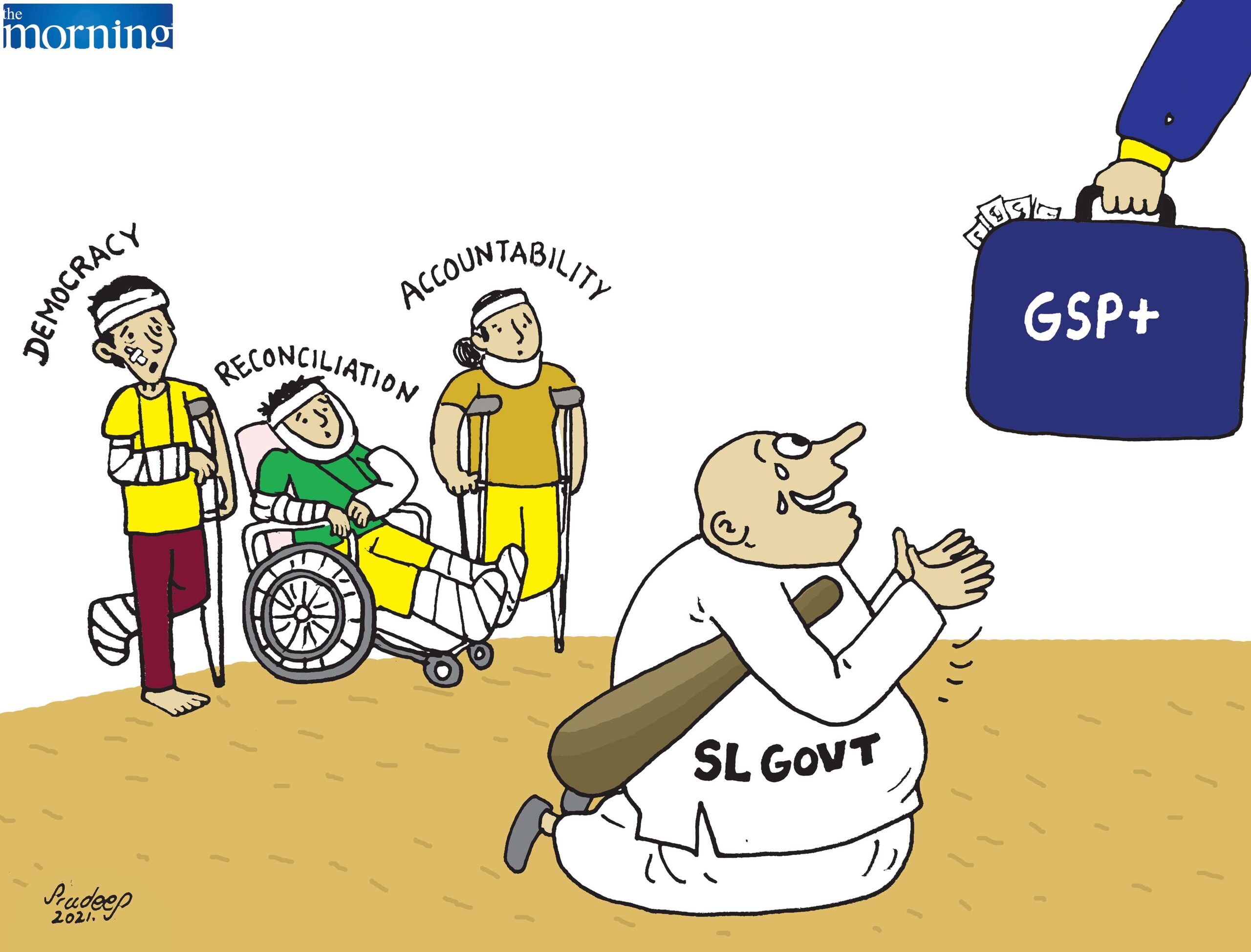
Sri Lanka risks loss of GSP+ unless Anti-terrorism Bill changed

Sri Lanka risks the loss of GSP + trade concessions due to the provisions of the proposed Anti-terrorism Bill as the European Union (EU), the United States (U.S.) and the United Kingdom (UK) have expressed their concerns over it through multiple diplomatic channels, Daily Mirror learns.

Paola Pampaloni, the European External Action Service Deputy Managing Director of Asia and Pacific, wrote to the Foreign Ministry here expressing concerns on the new bill, according to an informed source.

The US has communicated its displeasure over the content of the new bill through Sri Lankan Ambassador in Washington DC Mahinda Samarasinghe. Also, the UK authorities informed Sri Lankan Foreign Secretary Aruni Wijewardane who is there, that this bill, unless changed, will have an impact on trade relations through preferential trading.

Besides, some representatives of the EU member states raised concerns in this regard when they were called for high tea with President Ranil Wickremesinghe and his Chief of Staff Sagala Ratnayake on April 17, 2023. During the brief discussion, they said that the spirit of the bill would have a bearing on decisions regarding GSP + concessions.

According to informed sources, these envoys noted that it will have a particular bearing when Sri Lanka re-applies for the same concession after upcoming reforms of the EU’S GSP + framework next year.

The repeal of the current Prevention of Terrorism Act (PTA) is a commitment made by Sri Lanka to qualify for US $ 500 million Gsp( generalized Scheme of Preferences) + trade concessions in exporting to the markets in the EU region. The European Commission’s report on Sri Lanka is expected to be presented at the end of next month or early June.

However, there is criticism from various quarters like some civil society organizations, political parties in the opposition and trade unions on the new Anti-terrorism Bill introduced to be enacted in place of the PTA. They even call it far more draconian than the PTA.

The government has now delayed the presentation of the bill for discussion with the concerned parties.

From the frying pan into the fire of the Anti-Terrorism Law BY Dr. Jehan Perera

In a recent media interview, Archbishop of Colombo Malcolm Cardinal Ranjith stated that so far, the Government investigations into the Easter Sunday terror attacks on 21 April 2019, had been unsatisfactory and unacceptable. He said: “The official channels of justice have not been fair to us all along. There has never been a serious, committed investigation into the Easter attacks, its’ causes, players, and authors and any other forces.”

He warned that a related application would also be filed in the future in the courts against the current President (Ranil Wickremesinghe) once he leaves office as he currently enjoys immunity. He pointed out that the President would not hold that position for all time but that the Catholic Church would continue and those who came after him (Cardinal Ranjith) would also take up the cause.

The investigations by governments under three successive Presidents (incumbent Opposition Parliamentarian Maithripala Sirisena, Gotabaya Rajapaksa, and Wickremesinghe) even though they were armed with the Prevention of Terrorism (Temporary Provisions) Act as amended (PTA), have not disclosed the truth of who was behind the attacks. The best that has been done so far has been by the Supreme Court. This followed Fundamental Rights cases filed by the Catholic Church and other citizens as no proper investigations were initiated by the Government to provide legal redress. Having perused the investigation reports, it found Sirisena and four senior security officials (then Defence Secretary Hemasiri Fernando, then-Inspector General of Police Pujith Jayasundara, then-State Intelligence Service Director and incumbent Senior Deputy Inspector General of Police [SDIG] Nilantha Jayawardena and then-Chief of National Intelligence and retired DIG Sisira Mendis) guilty of negligence in having failed to act on intelligence information that they had received.

They all were subjected to fines (Sirisena – Rs. 100 million, Fernando – Rs. 50 million, Jayasundara – Rs. 75 million, Jayawardena – Rs. 75 million, and Mendis – Rs. 10 million), running into millions of rupees (Rs. 310 million) which the officials in particular would be hard pressed to pay. But, the Court did not identify who was the mastermind behind the bombings. So, the search for the truth must continue.

In the absence of truth, there is no closure and suspicions only grow deeper. In his most recent statements, Cardinal Ranjith has got more and more outspoken. The Cardinal said during the Easter midnight mass in Colombo: “Now, the Easter attacks. How many years? Four years. Still no justice. Still, no one knows what happened. All kinds of things are being said by people. It is important that we struggle for justice, for truth. That is Christianity.” In addition to demonstrating the unwavering resolve of the Church to obtain justice, this was a clear example of how the PTA that that was in place since 1979 (No. 48 of 1979) failed to prevent the Easter bombings despite its draconian provisions that have led to a very large number of abuses. It is tragic that the present Government seems to have lost sight of this lesson and is now proposing a worse alternative in the form of the draft Anti-Terrorism Act.

Truth Commission

The Government’s announcement that it will be setting up a Truth Commission to look into what happened in the three-decade-long civil war and bring about national reconciliation, will not deal with the Easter bombings. Instead, the Truth Commission will be looking at “the conflict that took place on or after 24 July 1983, and prior to 18 May 2009”. Though not elaborated upon, this is the period of the separatist insurgency by the Liberation Tigers of Tamil Eelam (LTTE) and other armed separatist groups who waged a guerrilla war. The mandate of the Commission will be, among others, the promotion of national unity, peace, the rule of law, coexistence, equality with tolerance and respect for diversity, and reconciliation among the people of Sri Lanka, by establishing a truthful, accurate, impartial, and complete record of the alleged damage and/or harm caused to persons or property in the conflict.“

The period of investigation being limited to 24 July 1983, to 18 May 2009, is an indication that the Truth Commission’s mandate will be a limited one. It will only look at that time period in which the LTTE was the dominant Tamil militant organisation. However, massive human rights violations continued to take place after the war’s end. Busloads of LTTE personnel and their families disappeared days after the war. Over 300,000 civilians were incarcerated in barbed wire camps for over six months in which many of them went missing, some who bribed themselves out and others who were taken away by the security forces. The ethnic conflict preceded the start date and continues after the end date, making the mandate of the Truth Commission an inadequate one.

The specificity of the dates also raises a question as to whether only the ethnic war will be looked at by the Truth Commission or whether the Janatha Vimukthi Peramuna insurrection, which took place during that time frame (between 1987 and 1989) will also be investigated. A very large number of people lost their lives in that conflict which was separate from that of the ethnic conflict. The doubt arises because the formulation of the terms of reference of the Truth Commission has not been a public process and very much a secret one, quite unlike what happened in South Africa, which is the country that the Government is seeking assistance from. In the coming days, the Government may indicate what its intentions are, now that it seems to have decided to go ahead with the process.

The President’s pledge

It is clear that the Easter bombings and its fallout will not be a part of the mandate of the proposed Truth Commission. The mandate of the Truth Commission will only extend up to 18 May 2009, the last day of the war. The exclusion of the Easter bombings from the mandate of the Truth Commission may be justified on the basis that it took place a decade after the war had ended. It was also only a single event, unlike the war which continued over a very long period. But, the need for a Truth Commission to investigate the Easter bombings cannot be ignored as the truth of what happened continues to be veiled and hidden. The puzzle then, and which remains to this day, was the motivation for the attacks and who was behind them.

Cardinal Ranjith’s determination to ensure that the truth will be found may have its origins in the belief that the Christian worshipers were made scapegoats for a deviant political agenda. The dead have no voice to demand justice, so it is the duty of the living to seek the truth. This is one of the reasons for the importance given worldwide to Truth Commissions to investigate controversial events of the past. Instead of working together for accountability and justice, Government leaders have so far shown little or no interest in ensuring the accountability of those who were responsible for the Easter attacks taking place. Unfortunately, it is no different in relation to the present economic crisis. There seems to be no action to explore the making of the crisis and the failure of the Government to address the issue of accountability for those who wrecked the economy and continue to be in seats of power.

In his Easter message, President Wickremesinghe appeared to be aware and sensitive to Cardinal Ranjith’s sentiments which he sought to assuage when he said, “I am very much aware of the extreme pain caused by the Easter Sunday attacks being still fresh in your minds, and I share that pain. I wish to reassure you that the legal proceedings related to this tragic incident are being processed independently and impartially, without any influence. The necessary groundwork towards this end has been laid, to ensure justice for all the victims. I pledge my unwavering commitment to ensuring the security of our country, by preventing any recurrence of such heinous acts.” In addition to restating his commitment, the President can strengthen his credibility by also going back to the past to ensure that those who committed crimes, whether criminal or financial, are soon removed from positions of high office that they do not merit.

(The writer is the Executive Director of the National Peace Council)

Easter Attacks: Cardinal says cannot trust current leadership to deliver justice

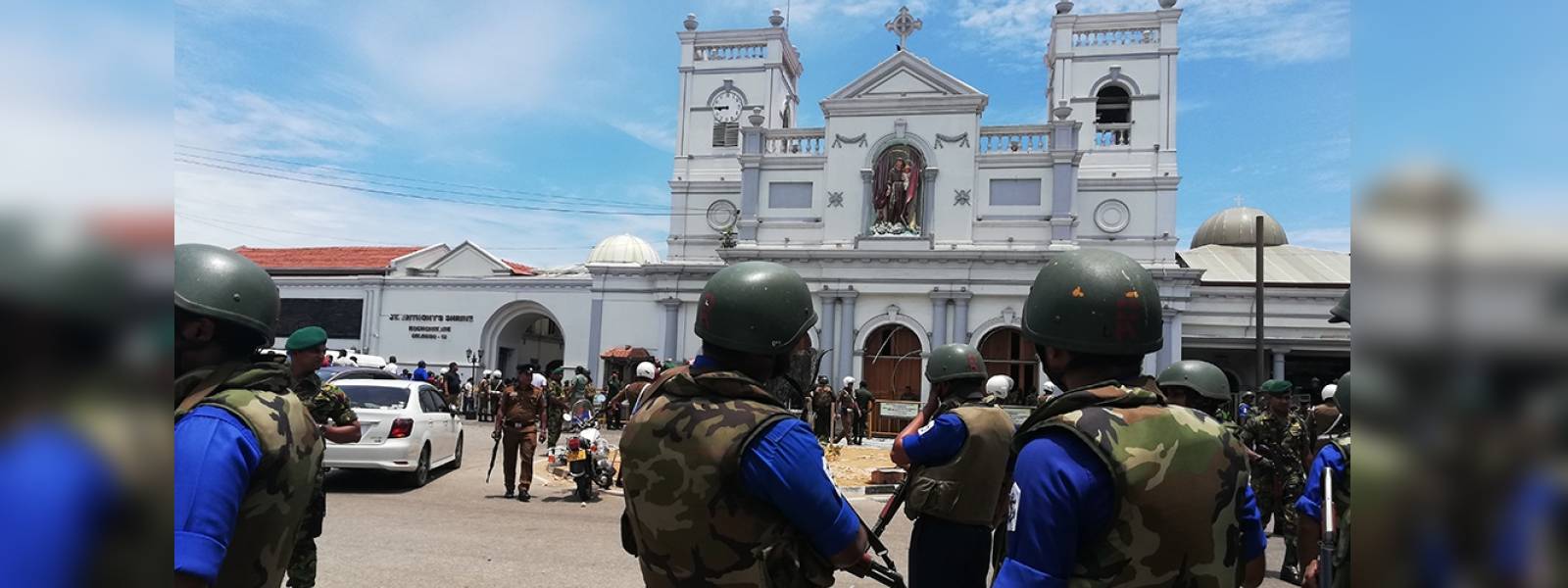
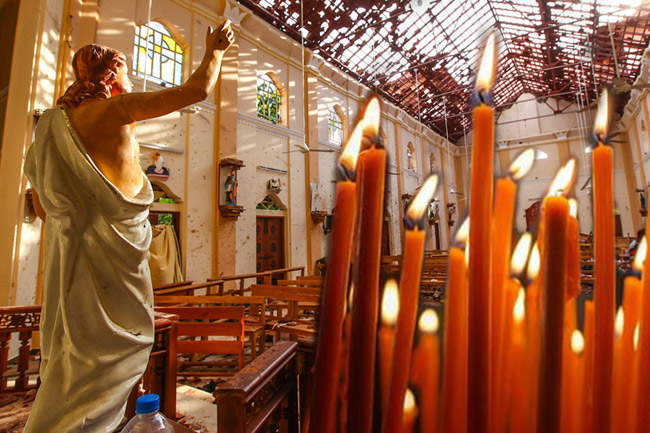
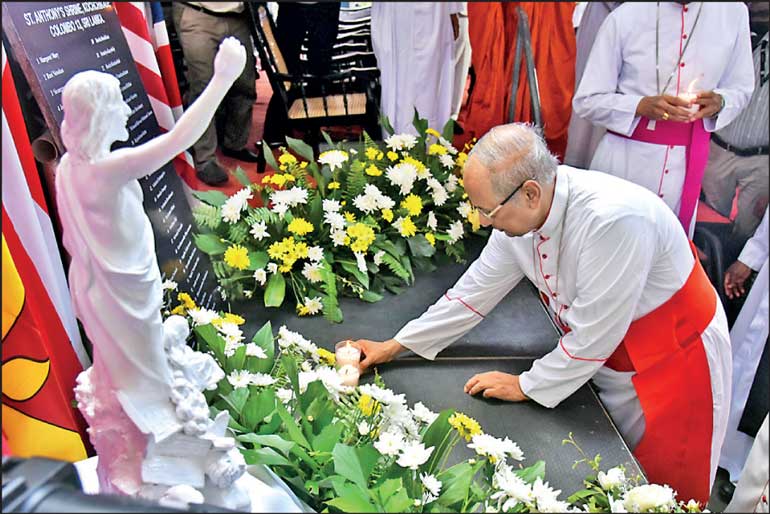
The Archbishop of Colombo, Malcolm Cardinal Ranjith says he along with the victims of the Easter Sunday attack cannot place their trust in the current leadership to deliver justice. He said while President Ranil Wickremesinghe and the Minister of Public Security have expressed their willingness to hold an honest dialogue on the matter, it is questionable if they intend to continue their duplicitous policies during the discussions. “Today dictatorship reigns in the country. We cannot place our trust in the current leadership that has taken steps to dismantle the people’s sovereignty,” he said. The Cardinal made these comments while addressing those gathered at the St. Anthony’s Shrine in Kochchikade to mark the fourth anniversary of the devastating Easter Sunday bombings that took over 260 lives and injured scores more.

A large number of people from all faiths gathered at the Church yesterday to remember the victims of the attacks and call for justice. Many commemoration events were organised by the Church and other groups across the country yesterday. A march of prayer commenced on 20 April from St. Sebastian’s Church in Katuwapitiya to St. Anthony’s Shrine in Kochchikade where the main commemoration event was held with the attendance of religious leaders, diplomats and other dignitaries as well as families of the victims.

Masses were also held in Churches and people were seen forming human chains on the sides of main roads as requested by the Cardinal. Many carried photographs of the victims and held placards demanding justice for the attack and calling the Government to bring the perpetrators to book.

However, the Cardinal, while expressing his doubts about the leaders, called on God to hear the voices of those suffering and reveal the truth behind the attacks. He called on God to safeguard the unity achieved in Sri Lanka. “We alert everyone that we will remain watchful till justice is delivered,” he said. The Cardinal also expressed his displeasure at the Attorney General’s Department and the Police for failing to take action based on the recommendations of the Presidential Commission of Inquiry into the attacks and at the Government for being reluctant to take genuine steps to probe into the incident.

Also addressing those gathered, the Chief Sangha Nayake of Dakshina Lanka Omalpe Sobhitha Thera urged the Cardinal to seek justice through an international mechanism if the domestic mechanism is faltering. “Though we call ourselves a Buddhist country, if there is no justice and fairness here, let us take this to the international community,” he said.

The Thera accused politicians of fuelling terrorism and extremism to achieve their selfish and power-hungry political aims. “But today there is no one answerable for the results of their actions. Providing security is one of the main responsibilities of the ruler. This tragedy took place as they did not fulfil it. This is the only country that has this many rulers who have corrupted the country and failed to fulfil their responsibilities. If the country that declares itself as Buddhist fails to deliver justice and fairness, if there is no Dhamma to be seen in the country declared as the land of the Dhamma, I invite you to take this to the international community. Let us ask them for justice,” Thera said.