Lanka Delimitation Commission proposes cutting oversized Local Government bodies by half

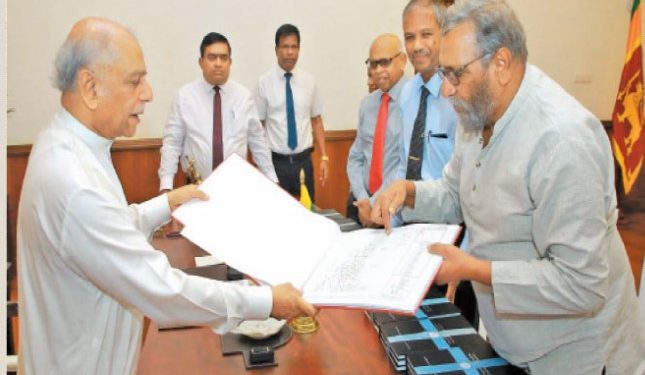
The preliminary draft of the report of the National Committee on Delimitation of Divisions for Local Government bodies was handed over to Prime Minister Dinesh Gunawardena on April 11.

The preliminary draft of the report of the National Committee on Delimitation of Divisions for Local Government bodies was handed over to Prime Minister Dinesh Gunawardena on April 11.

The Delimitation Commission (DC) headed by Mahinda Deshapriya, former Chairman of the Election Commission has made substantial progress in its given task of delimitation of electoral wards of the Local Authorities- Municipal Councils, Urban Councils and Pradeshiya Sabhas.

It is an unenviable and painstaking task as redrawing of constituency boundaries had to be done while taking into consideration many factors such as the number of voters, their ethnicity and the geographical size of the constituency to ensure proper representation of different communities, without marginalising or ignoring any minority groups or minor parties.

Chairman Deshapriya and other members of the Commission managed to complete the first draft report, which was handed over to Prime Minister Dinesh Gunawardena earlier this month. As Deshapriya explained the draft will be dispatched to Distract Secretariats across the country and the Local Authorities and the public will be able to make further recommendations for consideration before the Delimitation Report is finalized by the given date, i.e. April 30, 2023.

The Commission received a considerable number of proposals, suggestions and recommendations from the public, political parties, religious leaders and non-governmental organisations and most of them were incorporated into the draft report. The members of the Commission took extreme care to ensure proper representation of the people in the councils. Their main difficulty was how to accommodate the religious communities scattered in different areas in a district. It was not easy to ensure the representation of some minority communities –Tamil, Muslim and Malay – in some constituencies. Similarly Sinhalese are a minority in some constituencies in the Colombo district. All these factors were taken into consideration while drawing the constituencies. Furthermore, the proportional representation quota as well as bonus seats based on district percentage of votes will also take care of proper representation of minority communities and minor parties unable to get 50% of the cast votes in a constituency to get elected under the first past the post system.

The Delimitation Commission was appointed as there was an outcry over the current enormous size of the Local Government bodies and was a heavy burden on the Treasury. The Local Authorities are divided into three different groups: Municipal Councils, Urban Councils and Divisional Councils (Pradeshiya Sabha). Currently, there are 341 Local Authorities (24 Municipal Councils, 41 Urban Councils and 276 Divisional Councils). The Commission said the number of representatives to be elected will be reduced to 4,714 from 8,400. The number of elected members has been reduced to 2,882 from 5,092 and the number of members from the list has also been reduced to 1,832.

Considering the demand for reforms of the electoral system as well as for re-demarcation of constituencies, Prime Minister Dinesh Gunawardena, in his capacity as Minister of Provincial Councils and Local Government, issued an extraordinary gazette appointing a five-member National Delimitation Committee for the demarcation of wards for Local Authorities. While former Commissioner of Elections, Mahinda Deshapriya Chairs the Committee, Jayalath Dissanayake, W.M.M.R. Adikari, Dr. K. Thavalingam, and I. A. Hameed serve as members. The National Delimitation Committee is effective from November 1, 2022 to February 28, 2023, as per the gazette notification and the term was later extended up to April 30, 2023.

Deshapriya acknowledged that the Commission received some requests for caste-based demarcations of electoral wards of the Local Authorities but they were not entertained. “In the reduction of the current number of wards in the delimitation process, the Commission received requests to retain some such wards directly identified with certain caste groups. We declined to entertain such requests.” Although the issue of caste is more visible in the North and the East, it is seen all across the country. “We find it everywhere, more or less,” he said.

Referring to the large number of representations received from different institutions and the public, he however lamented about the lack of enthusiasm even among the political parties to send proposals to be considered in carving outwards with new boundaries.

Deshapriya said the Commission considered ensuring the representation of numerical minorities, as far as possible. They also proposed 25% representation for women.

According to the Commission sources, the Colombo Municipal Council composition is proposed to be reduced to 67 from the current membership of 110, which includes 66 elected directly and 36 according to PR and 8 members as an overhang. The Commission proposes to eliminate the overhang member quota.

Meanwhile, Opposition MP, S. M. Marikkar proposed to appoint a committee comprising MPs from all parties in Parliament to review the recommendations made by the Delimitation Committee. “This would also set the Sinhala candidate against the Muslim candidate and vice versa. The report also contained recommendations which would create errors and imbalances in representation in the Local Councils. When they were told to bring down the number of 8,400 Local Councillors to 4,800, they slashed the number by half without giving due consideration to practical problems arising thereby. For example, in Kolonnawa there are 20 Local Councillors – 12 of them are elected while there are eight bonus seats. The total number is proposed to be down to 10. The way it is proposed to be done is by electing only six members and allocating four bonus seats,” Marikkar said.

However, Deshapriya said the Committee recommendations are open to amendments. Once the final report is handed over to the Prime Minister on April 30, he, as Minister of Home Affairs and Local Government will appoint a Review Committee to examine the report and propose its recommendations for the required Gazette notification.

Commission Chairman clarified that the Delimitation Report has nothing to do with the scheduled Local Government elections, for which nominations have already been received. “The Government has to pass the bill in Parliament to annul the current nomination papers and that is the only way this delimitation report can have an impact on the current Local Government polls,” he said and pointed out that on three previous occasions, Parliament has passed such bills.


Posted in Uncategorized

Chief Prelates urge President to remove unsuitable clauses in Anti-Terrorism Bill

The chief prelates of all three Buddhist Chapters have called for the removal of ‘unsuitable clauses’ in the much-disputed Anti-Terrorism Bill after an extensive dialogue with society and through a panel of experts.

It is observed that the controversial and broad definition of ‘terrorism’ in the proposed Anti-Terrorism Bill deem peaceful protests and speaking up about the shortcomings of the incumbent government an act of terror, the chief prelates pointed out in a letter to President Ranil Wickremesinghe.

Passing this Bill will be nationally and internationally adverse for Sri Lanka, as the move can make way for some serious doubts about the democracy in the country, they warned in their communiqué.

Posted in Uncategorized

Agriculture Ministry insists China requested for 100,000 monkeys

The Ministry of Agriculture today confirmed that China had made a request to import 100,000 endangered monkeys from Sri Lanka, amidst protests from environmental groups.

Gunadasa Samarasinghe, the top bureaucrat in Sri Lanka’s Ministry of Agriculture said that a privately-owned Chinese company connected to Zoological Gardens which are animal breeders had made the request to his ministry.

“We will not send the whole 100,000 in one lot. But we considered the request due to crop damages caused by the monkeys in several parts of the country. They will not be taken from conserved areas. The focus will be only in the cultivation areas,” Samarasinghe told reporters.

The toque macaque monkey is endemic to Sri Lanka and classified as endangered on the International Union for Conservation of Nature (IUCN) red list.

Last week, Sri Lanka’s Agriculture Minister Mahinda Amaraweera said that China’s request for 1,00,000 monkeys to be exhibited at over 1,000 Chinese zoos could be considered.

“They want these monkeys for their zoos,” the Minister was quoted as saying.

Sri Lanka bans almost all live animal exports but the proposed sale comes at a time when the country is facing its worst-ever economic crisis.

The cash-strapped island nation has removed several species from its protected list this year, including all three of its monkey species as well as peacocks and wild boars, allowing farmers to kill them.

The toque macaque is known to destroy crops in several parts of Sri Lanka, and even sometimes attacks people.

Authorities in Sri Lanka have pegged the monkey population in the country between two to three million.

Meanwhile, China’s embassy in Colombo said that it is unaware of Sri Lanka exporting “100 thousand” of “endangered” toque macaque monkeys to a Chinese private company for “experimental purposes”.

The mission’s statement said the Chinese National Forestry and Grassland Administration, the regulator handling the import and export of wild animals and plants had not received any such requests to allow the monkey imports from Sri Lanka.

Citing China as one of the top countries in the world in terms of wildlife protection legislation and law enforcement, the embassy said that the country has already adopted its Wildlife Protection Law in 1988 with several amendments afterwards and is a contracting party of the Convention on International Trade in Endangered Species of Wild Fauna and Flora (CITES).

“The Chinese government always attaches great importance to wildlife protection and actively fulfills international obligations,” the embassy said in a statement on Tuesday.

(PTI)

Catholic Church continues quest for truth as Sri Lanka marks four years since ghastly Easter attacks

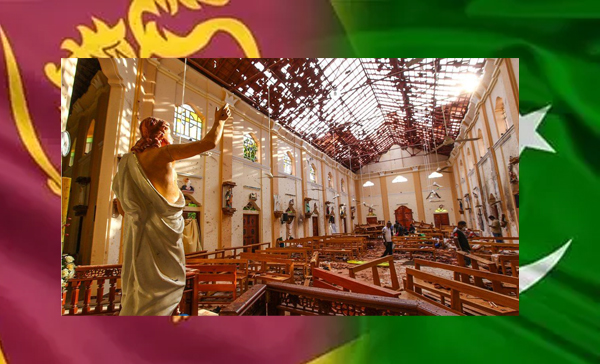
The Catholic Church in Sri Lanka has decided to form a ‘human chain’ (‘Jana Pavura’) as today (April 21) marks the fourth commemoration of the ghastly bombings on Easter Sunday 2019 which claimed the lives of hundreds and left a long-lasting void in the families and friends of terror attack victims.

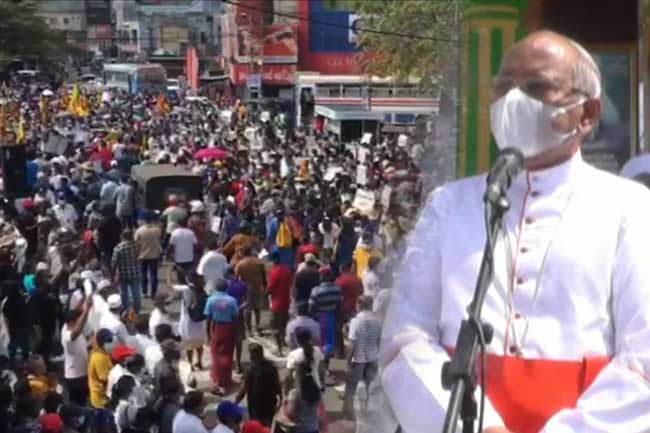
The ‘human chain’ is organized in support of the Catholic Church’s quest to seek the long overdue truth behind the brutal carnage on April 21, 2019, and justice for the victims.

The Archbishop of Colombo, His Eminence Cardinal Malcolm Ranjith has invited all Sri Lankans to join the campaign today.

The ‘human chain’, themed “We are Watching until Justice is Meted Out”, was initiated at 8.00 a.m. this morning and it will be formed from St. Anthony’s Church in Kochchikade to St. Sebastian’s Church in Katuwapitiya on the Colombo-Negombo main road.

Meanwhile, a march was organized from St. Sebastian’s Church in Katuwapitiya to St. Anthony’s Church in Kochchikade last night and a special church service was also held in parallel with the march.

A special commemoration event and a Mass, led by Cardinal Ranjith and Apostolic Nuncio Archbishop Biran Udaigwe, will be held at the St. Anthony’s Church in Kochchikade from 8.00 a.m.

It is be attended by the ambassadors and high commissioners of several countries including China, the United States and the United Kingdom.

A two-minute silence will also be observed at 8.45 a.m. in memory of the victims of the brutal terror attack.

The country was left devastated on April 21, 2019 after a group of suicide attackers of the now-outlawed local Islamic extremist organization National Thowheed Jamaat (NTJ) carried out a series of coordinated bomb blasts at St. Anthony’s Church in Kochchikade, St. Sebastian’s Church in Katuwapitiya, Zion Church in Batticaloa, Cinnamon Grand, Kingsbury and Shangri-La hotels in Colombo and a guest house in Dehiwala, leaving more than 260 people including foreigners dead and at least 500 people injured.

Sri Lanka declared a state of emergency immediately after the bombings and the probes launched into the incident led to the arrest of many who have had links to the suicide bombers.

The Sri Lankan Catholic Church led by Cardinal Ranjith and the families of the victims have continuously raised concerns and doubts about slow progress of the investigations into the attacks, accusing the government of sweeping the truth under the rug for political gains.

Posted in Uncategorized

Cardinal calls for fresh, transparent probe into Easter Sunday attacks

Archbishop of Colombo His Eminence Cardinal Malcolm Ranjith today called for a fresh and transparent probe into Easter Sunday attacks and said justice cannot be expected from the incumbent President or the government.

“We need a fresh and transparent probe which is directed towards finding out as to why the repeated prior warnings on the Easter Sunday attacks were not taken seriously, to determine as to why the suicide bomber who blew himself up at Dehiwala was allowed to do so, why wasn’t he arrested, to determine who was ‘zonic zonic’ who called ISIS in Indonesia and requested them to claim responsibility for the Easter Sunday attacks. We need a fresh probe to find out answers to these questions, ” he said.

“It looks that justice cannot be expected from the incumbent President and the government, ” he added.

The Apostolic Nuncio Archbishop Brian Udaigwe said Sri Lanka had full blessings of Pope Francis in its efforts to mete out justice for those who were affected by the attacks.” justice cannot be meted out through anger,” he while quoting former President of USA Barack Obama.

He said the Catholic Church does not believe in insulting Buddhist monks and other members of clergy and will not associate with people who insult them.

“We don’t condone insulting clergy and particully the Buddhist monks. Some say catholics are behind the repeated insulting of monks over social media but I would like to say that church is not behind such campaigns,” Cardinal Ranjith said while speaking during a religious service held at St.Anthony’s Church Kochchikade.

“We will not condone insulting monks and will not associate with people who do such things. One should remember that Sri Lanka’s culture is associated with Buddhism.

Posted in Uncategorized

Anti Terrorism Bill: US expresses concerns over aspects that fall outside of international standards

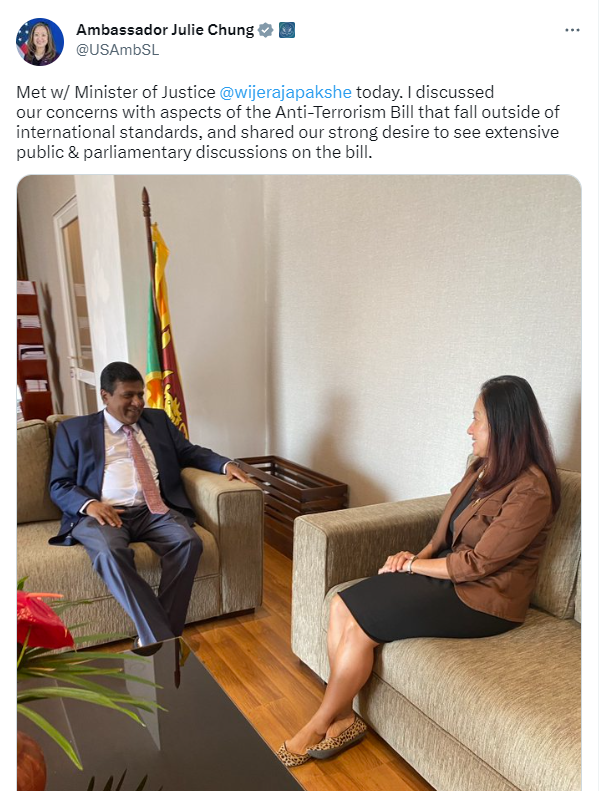
US Ambassador to Sri Lanka Julie Chung has expressed concerns with aspects of the Anti-Terrorism Bill that fall outside of international standards.

She met with Justice Minister Dr. Wijeyadasa Rajapakshe, PC and the US desire to see extensive public & parliamentary discussions on the bill.

The Ambassador tweeted that it is important that all voices – including civil society, academia, and lawmakers – are considered to ensure the legislation serves as an effective tool for combatting terrorism without restricting freedom of expression or assembly.

Amid geopolitical concerns, 15 Sri Lanka’s ruling coalition members visit China on CPC’s invitation

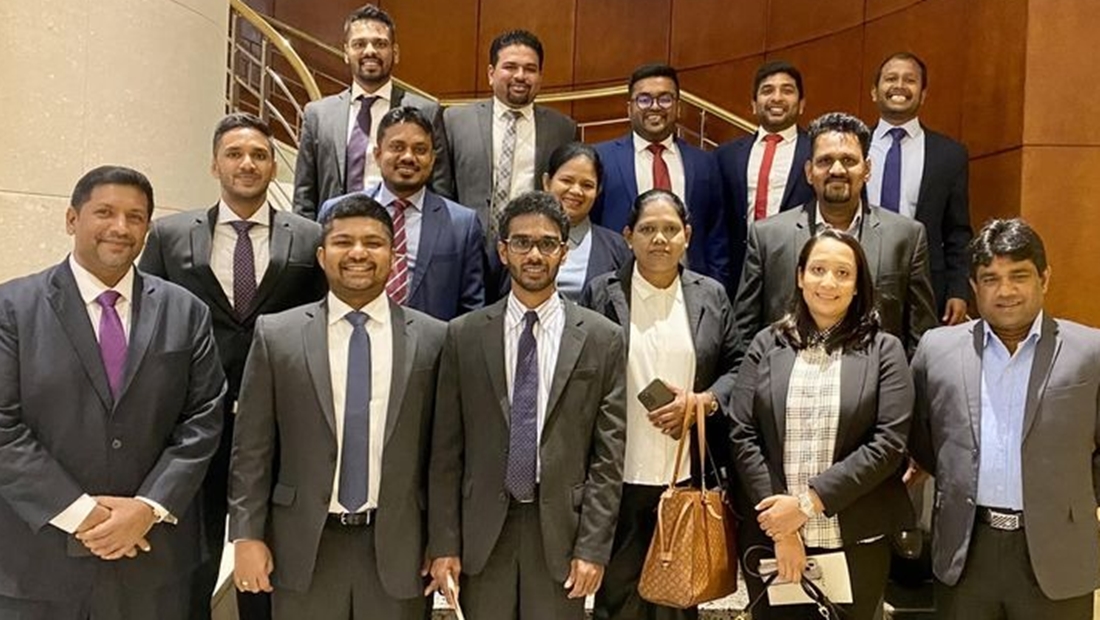
Amid rising geopolitical concerns, fifteen young Sri Lanka’s ruling coalition members including parliamentarians have left for China on a familiarization tour on the invitation of the ruling Communist Party of China (CPC), the island nation’s participants said.

Five members from President Ranil Wickremesinghe-led United National Party (UNP) and 10 from former president Mahinda Rajapaksa-led Sri Lanka Podujana Peramuna (SLPP) have left the country for a 9-day tour which includes visiting two Chinese provinces.

The move is likely to raise more concerns as both India and the United States are keenly watching the moves by China to keep their influence in Sri Lanka, political analysts say. China is one of the biggest lenders to Sri Lanka after the end of a 26-year war ended in 2009 amid criticism that Beijing’s loans have led the island nation to the current unprecedented economic crisis and sovereign debt default.

India and the US have raised concerns over increasing influence of China in Sri Lanka and raised questions over Beijing’s possible intention of establishing military base in the island nation where they own a port in the deep southern district of Hambantota and a Port City in a reclaimed land next to main port in Colombo.

Beijing’s familiarization tours are not unusual as China has offered the same for influential people, professionals, and journalists in the past. The participants in the current tour are some of the young politicians who are aspiring to become legislators in the future.

The group will be in Kunming in the Yunnan province for three days until Saturday where the visitors will meet provincial CPC officials, participate in a seminar on “experience of targeted poverty alleviation and rural revitalization based on local characteristics”, and visit some model villages and modern agricultural base.

BRI Cooperation, Opportunities

During the rest of the tour, the Sri Lankan politicians will visit Fujian province and the capital Beijing. They are scheduled to participate in a seminar in Fujian on high quality Belt Road Initiative (BRI) cooperation and opportunities of development for regional countries.

Sri Lanka is one of the strategic Chinese partners in the BRI and most of the island nation’s Beijing-funded infrastructure comes under the BRI, Sri Lankan government officials have said.

In Beijing, the Sri Lankans will meet experts of the CPC Central Committee.

Sri Lankan legislators D V Chanaka and Nipuna Ranawaka, a nephew of former president Rajapaksa have represented the SLPP.

Following are the other members in the SLPP delegation which has left to China according to the official document signed by the party secretary: Milinda Rajapaksa (former local councilor/ Director at Media Center for National Development), Ravindra Samarawickrama (senior lecturer), Udara Wijesinghe (Chairman – Cashew Corporation), Kanishka Bandara (LLB, London), Sudarma Kulathunga (journalist), Sudima Chandani (Secretary, federation of Local Government Authorities), Thambirajah Thajeevaran, and Gorakapitiyage Chaminda Aruna Shantha.

From the UNP, former state minister Ruwan Wijewardena, Eranthi Ranga Bandara, Jeyaraj Vishnuraj, Sajana Sooriyaarachchi, and Duminda Attygala have joined the delegation.

The delegation will return to Sri Lanka on April 28.

Posted in Uncategorized

Coimbatore blast bomber inspired by Sri Lanka bombings mastermind

India’s National Investigation Agency (NIA) has claimed that a bomber involved in a 2022 blast in a car in Coimbatore was inspired by Zahran Hashim, the mastermind of the 21 April 2019 Sri Lanka bombings.

The NIA today (Thursday) filed a chargesheet against six persons for their involvement in the 2022 blast in a car in Coimbatore, in which the alleged bomber Jameesha Mubeen was killed.

As first reported by HT, NIA has claimed in its chargesheet that Mubeen was inspired by Maulvi Zahran bin Hashim, mastermind of April 21, 2019, Sri Lanka bombings, in which over 260 people were killed, and was planning to carry out similar strikes in India, particularly Kerala and Tamil Nadu.

An explosion had taken place at an ancient Temple Arulmigu Kottai Sangameshwarar Thirukovil at Eswaran Kovil Street, Ukkadam, Coimbatore on October 23.

The vehicle-borne Improvised Explosives Device (V-IED) driven by Jamesha Mubeen had blown up in front of the temple. Mubeen was killed in the blast.

“Investigations had revealed Mubeen was inspired by ISIS ideology to carry out this attack. He had also taken ‘bayath’ or oath of allegiance to its self-proclaimed Caliph Abu-al-Hasan al-Hashimi al-Qurashi,” said NIA in its chargesheet.

A pen drive recovered from his associate – Mohammed Asarutheen, arrested by NIA, contained videos recordings of Jamesha Mubeen, where he had identified himself as a member of Daulat-e-Islamia (or Islamic State).

“Mubeen had spoken extensively on his intention to commit a suicide terror attack against the ‘kafirs’ (non-believers) and to become a martyr. Mubeen was inspired by the bayans (sermons) of Zahran Hashim, a radical Islamic cleric of Sri Lanka, who masterminded the easter serial suicide bomb attacks in 2019 killing around 260 people. Mubeen wanted to orchestrate a similar kind of attack against the ‘kafirs’ in India,” NIA statement said.

The agency said it recovered handwritten notes from Mubeen’s residence wherein criticism of the existing democratic system, which are not in tandem with Islamic laws, has been mentioned.

“There is also a mention of ‘targets’, including government office buildings, district court, public gathering places like parks, railway stations and few other local temples,” NIA said.

Islamic State of Khorasan Province’s online magazine called ‘Voice of Khorasan’ corroborated this in an article titled, ‘A Message to the Inhabitants in the Land Occupied by Cow and Mice Worshipping Filths’ where ISKP took responsibility for the attack held at Coimbatore, Tamil Nadu, agency said.

“The article goes on to state that the attack was revenge to uphold the honour of their religion and to establish Allah’s deen and his law upon his land and to terrorize the ‘Kufr’ and its followers with the threat that it was just the beginning,” it said.

Mubeen was aided by associates Mohammed Asarutheen, Mohammed Thalha, Firose Khan, Mohammed Riyas, Navas and Afsar Khan in arranging logistics.

NIA said Thalha had sourced the Maruti 800 blue colour car bearing which was used in the explosion of vehicle-borne IED while Firos, Riyas and Navas had loaded the explosives and gas cylinders in the car making it the potent weapon.

“Asarutheen and Afsar, both cousins of Mubeen had procured, weighed, mixed and packed the chemical constituents used to manufacture the VBIED used in the attack,” agency added.

Earlier, the NIA probed a module of ISIS in Coimbatore, headed by Mohammad Azharuddin in 2018-19 and found that he, along with another associate Sheikh Hidayatullah, was in touch with April 21, 2019, Sri Lanka bombings mastermind – Maulvi Zahran bin Hashim.

Mubeen too used to follow Hashim’s videos and was inspired by him.

Hashim and another Sri Lanka bomber – Mohammad Azaan had even travelled to India in 2017 and 2018 to discuss the plans of Islamic State.

Indian agencies, based on NIA probe into Coimbatore module, had sent three alerts to Sri Lanka security agencies about a plan to carry out a major strike there.

(Hindustan Times)

Sri Lanka parliament to debate government’s agreement with IMF on three days next week

Sri Lanka parliament will debate the government’s agreement with the International Monetary Fund for the USD 2.9 billion Extended Fund Facility on three consecutive days next week.

The Committee on Parliamentary Business has decided that the Resolution for the implementation of the arrangement under the Extended Fund Facility (EFF) of the International Monetary Fund (IMF) for Sri Lanka will be debated on the three consecutive days on the 26th 27th and 28th of April.

The Acting Secretary General of Parliament Mrs. Kushani Rohanadeera announced that the decision was taken at the meeting of the Committee on Parliamentary Business held today (20) under the Chairmanship of Ajith Rajapakse, Deputy Speaker of Parliament.

The Government of Sri Lanka and the International Monetary Fund have entered into an agreement for the rapid progress in the economy of Sri Lanka and for sustainable economic growth that will benefit the present and future generations.

The arrangement for the 48-month Extended Fund Facility of about 3 billion USD was tabled on March 22nd, 2023.

Whilst the proposal submits that the Ministry of Finance, Economic Stabilization and National Policies should provide all necessary approvals for the implementation of the said setup, a vote is to be followed post the three-day debate if necessary.

Parliament is scheduled to convene from the 25th to the 28th and 9.30 am to 10.30 am has been allocated for Questions for Oral Answers.

Accordingly, on Tuesday, April 25th, Order under the Code of Criminal Procedure (Special Provisions) Act published in the Gazette Notification 2317/28 dated January 30th, 2023 is scheduled to be taken up for debate from 10.30 am to 5.00 pm.

Thereafter, the Motion at the Adjournment Time by the Government will be taken up from 5.00 pm to 5.30 pm.

Following Questions for Oral Answers, on April 26th, it has been agreed to approve without debate the Resolution under the Essential Public Services Act published in the Gazette Notification 2328/02 dated April 17th, 2023 by the President.

Thereafter, the Resolution for the implementation of the arrangement under the Extended Fund Facility (EFF) of the IMF for Sri Lanka will be taken up for debate until 5.00 pm.

It was also decided to present for approval 13 motions regarding the Annual Reports of various Statutory Institutions.

Furthermore, it was also agreed to present the Private Member Bills, Kelaniya Buddhist Women’s Charitable Society (Incorporation) Bill and Sri Lanka Institute of Taxation (Incorporation) (Amendment) Bill for its second reading.

Thereafter, time has been allotted from. 5.00 pm to 5.30 pm for Questions at the Adjournment Time.

On the 27th and 28th the Resolution for the implementation of the arrangement under the Extended Fund Facility (EFF) of the IMF for Sri Lanka is scheduled be debated for the second and third consecutive days from 10.30 am to 5.00 pm.

On the 27th of April the Motion at the Adjournment Time by the Opposition will be held from 5.00 pm to 5.30 pm.

Following the debate on April 28th, it has been agreed to approve the Inland Revenue (Amendment) Bill without debate.

Thereafter, time has been allotted from. 5.00 pm to 5.30 pm for Questions at the Adjournment Time.

Sri Lanka GDP outlook slashed as economy struggles to recover – Bloomberg

Economists sharply cut Sri Lanka’s growth outlook for the rest of the year as curbs on imports and still-limited reserves persist, even as the International Monetary Fund (IMF) releases bailout loans and the authorities work towards debt-restructuring efforts, the latest Bloomberg survey of economists showed.

According to Bloomberg News, the economic contraction is predicted to more than double from 4.4 per cent to 9.9 per cent in the first quarter. Growth is likely to bounce back from the second quarter, though at a slower pace of 1 per cent from an estimated 2.9 per cent previously.

For the full year, Sri Lanka’s gross domestic product estimate was revised to 0.7 per cent from 2.7 per cent, the survey showed.

Last year, the South Asian nation grappled with its worst economic crisis since independence as US dollar shortages and shrinking reserves, together with an infamous organic fertiliser policy, led to crop failures and severe shortages of food and fuel. People took to the streets to protest, eventually forcing a change in leadership as the economy nearly came to a halt and inflation surged.

While there are signs of stability with food and fuel imports coming in and the IMF approving a US$3 billion loan, some economists say the current economic situation is nowhere close to pre-pandemic normalcy.

“Conditions are still weak, but are tilted to the upside,” said Andrew Vogel, an economist at S&P Global.

He added that Sri Lanka has very few usable foreign reserves and significant restrictions on imports. Moreover, a still-ongoing moratorium on external debt payments pending restructuring agreements is keeping conditions uncertain.

The island nation’s double-digit inflation, which is Asia’s fastest, is expected to persist this year, the Bloomberg survey showed. Economists foresaw consumer prices surging to around 28.8 per cent in the second quarter and averaging around 25 per cent for the year.

They also forecast a cumulative 100-basis-point hike in the benchmark rates in the second quarter. They expected this to hold at least until the end of the third quarter before the easing cycle begins.

The Central Bank of Sri Lanka has kept its key rate at the highest level since August 2001 to support growth, despite price gains remaining stubbornly high at 50.3 per cent in March. The monetary authority predicts that headline inflation will slow to single-digit levels by end-2023.