Petition seeking to postpone LG polls to be taken up on Feb. 23

Retired Colonel W.M. Wijesundera’s lawyers have informed the Supreme Court that it is not necessary to support motion requesting to expedite the petition to postpone the upcoming Local Government elections, Ada Derana reporter said.

Accordingly, the Supreme Court has ordered to take up the matter as scheduled on 23 February, according to the reporter.

The relevant motion was called before the two-member Supreme Court bench consisting of Justices S. Turairaja and Shiran Gunaratne today (Feb. 20).

There, Attorney-at-Law Faisz Musthapha, who appeared on behalf of the petitioning party, mentioned that the Supreme Court had earlier ordered the petition to be called for consideration on February 23.

The attorney further pointed out that they took steps to file a motion requesting the case to be called before February 23, since the postal voting was scheduled to be held on March 22.

The writ petition had been filed by the retired Army Colonel, seeking an order postponing the upcoming LG elections in view of the current economic crisis in the country.

Sri Lanka’s Chinese-built port city stirs white elephant fears

As far as many residents of Sri Lanka’s capital are concerned, the last thing their island nation needs in the midst of its worst-ever economic crisis is another beach – the island nation’s 1,340km coastline is blessed with some of the most beautiful beaches in the world.

Yet, Port City Colombo (PCC), a vast new Chinese-built reclaimed commercial zone in Colombo, recently unveiled an artificial beach facing the Laccadive Sea.

“The artificial beach is just greenwashing to attract international investors – sustainability is a convenient buzzword,” Priyangi Jayasinghe, a researcher at Colombo’s Munasinghe Institute for Development, told Al Jazeera.

Jayasinghe is one of many local critics who fear that PCC is another Beijing-funded white elephant in the mould of controversial projects. They include the loss-making Hambantota International Port, which was leased to Chinese state-owned China Merchants Port Holdings Company Limited in 2017 as Sri Lanka struggled to repay its foreign creditors, which include China, India and Japan as well as private lenders.

Critics say PCC, which is being developed on 269 hectares (665 acres) of reclaimed land, is unsustainable and will have negligible benefits for the nation’s ailing economy.

“PCC will make a very minor impact on the Sri Lankan economy. It will be a separate tax-free dreamland when the rest of the country is facing higher taxes to deal with the economic crisis,” Jayasinghe said.

CHEC Port City Colombo, which is developing PCC, rejects the criticism and insists the ambitious development project, funded under China’s Belt and Road Initiative (BRI) to the tune of $1.4bn, will establish a world-class city for South Asia.

CHEC Port City Colombo (Pvt) Ltd is a wholly owned subsidiary of China Harbour Engineering Company (CHEC), which in turn is a subsidiary of China Communications Construction Company Limited (CCCC), a majority state-owned enterprise with headquarters in Beijing.

An aerial view shows the ocean on the left with Colombo city on the right, a road separating the two.

Though scheduled for completion in 2041, construction has finished at parts of the site, including a pedestrian bridge and the artificial beach, which was scheduled to open in December but remains sealed off to visitors.

The project’s credibility received a boost in January from a high-profile visit by the United Kingdom’s former Prime Minister David Cameron. However, many locals, struggling with rampant inflation and food shortages, remain sceptical of more Chinese involvement in Sri Lanka’s economic affairs.

“And that over there is China,” a driver of a tuk-tuk motorised trishaw told Al Jazeera, pointing at the huge construction site for PCC while weaving through the congested midday traffic.

“Every time I return to Colombo, the government has sold a bit more of the nation to China,” Prem Velautham, a Sri Lankan living in the UK who recently visited the site, told Al Jazeera.

In reality, fears of Chinese ownership are based, at least in part, on misconceptions about the facts on the ground.

Much like the Hambantota Port, PCC is not owned by China or a Chinese company but 65 percent of the 178-hectare (440-acre) area of saleable reclaimed land will be held on a 99-year lease by a Chinese majority state-owned company.

“Given Sri Lanka’s role at the epicentre of the ‘debt trap diplomacy’ narrative and the well-documented troubles of the Hambantota seaport, it is not surprising that residents in Colombo or elsewhere are sceptical of flashy projects like this one – they have good reason to be,” Austin Strange, the co-author of Banking on Beijing and an assistant professor of international relations at the University of Hong Kong, told Al Jazeera.

CHEC Port City Colombo has said the project will create 143,375 new jobs and additional economic value of $13.8bn per annum.

“PwC has carried out an economic impact assessment of the Colombo Port City which highlights the significance of this project across multiple economic levers,” a spokesperson for the company said.

Critics question whether those calculations include the full environmental costs.

Vidhura Ralapanawe, a sustainability expert who advised the PCC Commission, the government body tasked with overseeing the development, said the project is car-centric and has not properly taken into account expected increases in demand for energy, water and waste and sewage services.

Ralapanawe also pointed out that a $1.5bn Japanese-funded light rail project that would have served as the main public transport link between PCC and Colombo was cancelled in 2020.

“In 2021, I told the (PCC) commission that the existing sustainability plan was just not good enough – there was no serious focus on sustainability, it was just treated as the icing on the cake,” Ralapanawe, who is executive vice president for sustainability and innovation at the sustainable apparel manufacturer Epic Group, told Al Jazeera.

“What we have now is ‘not much’ in the way of sustainability – this was designed as a city on the cheap.”

A PCC Commission spokesperson rejected these claims as “incorrect” and referred Al Jazeera to the commission’s website, which states: “Port City Colombo follows an integrated approach, for the management of energy, water, and waste, with its sustainability initiatives focused on protecting and preserving the environment.”

When asked by Al Jazeera for more specific details, the commission referred questions to CHEC Port City Colombo, despite the Chinese company stating that the government is to provide the infrastructure for sewage treatment under the Public Private Partnership that covers the development.

The same PPP agreement also makes the government responsible for water supply, energy supply, waste removal and public transport.

Some environmental activists and citizens question whether authorities have the plan or budget for the significant investment required to accommodate PCC, given Colombo’s over-stressed public infrastructure and the abject state of Sri Lanka’s public finances.

CHEC Port City Colombo has estimated the project will increase demand for water by 39,000 cubic metres per day, equivalent to more than 15 Olympic-sized swimming pools, in a country that experienced severe droughts in 1992 and 2001. The developer has said the increased demand will be met by the state water authority and that it is encouraging its private partners to recycle wastewater.

CHEC Port City Colombo has also argued it is “not feasible” to establish a large-scale renewable plant for the project but it is “exploring all avenues to see which specific form of renewable or combination of renewable energy is most feasible”.

The company said a new multi-lane motorway known as the “Outer Circular Highway (OCH)” will meet the development’s transport needs and it will seek to “promote a more pedestrian form of commuting with many sheltered walkways and green canopies”.

While CHEC Port City Colombo has argued that PCC has already generated “significant interest in the international community”, Ralapanawe said foreign firms may be deterred from investing in the project if it does not allow them to meet internal sustainability targets for reducing carbon emissions, waste and water use, and protecting the marine environment.

Many residents in Colombo also express concerns that Chinese investors could take a bigger stake in PCC if the project fails, although there has been no suggestion of such a possibility by either the government or the developer.

“PCC is a case of not thinking things through, on a macro scale,” Ralapanawe said.

SOURCE: AL JAZEERA

Japan’s Mitsubishi, Taisei scale back in crisis-stricken Sri Lanka

Japanese companies like Mitsubishi Corp. and Taisei Corp. are closing offices and canceling contracts in Sri Lanka as its devastating economic crisis makes doing business difficult.

Trading house Mitsubishi says it will close its Colombo office at the end of March, citing “changes in the economic environment.” The office was set up to gather information and to serve as a liaison with the headquarters in Japan.

The company handles engineering, procurement and construction for power plants and trades in steel and chemical products in Sri Lanka. Projects already in progress will continue and be managed by staff in neighbouring countries.

In March 2020, engineering group Taisei won a contract worth 62 billion yen ($462 million at current rates) for the construction of a four-story passenger terminal building, an elevated bridge and more for the second phase of the expansion of Bandaranaike International Airport near Colombo.

As the economic turmoil deepened, the Japan International Cooperation Agency stopped lending to state airport operator Airport and Aviation Services (Sri Lanka), drying up funds for the project. The engineering company is negotiating with the airport operator to cancel the project and is in the process of liquidating the project. It has apparently booked losses on the project.

“We will refrain from commenting on individual projects,” the company said.

JICA is not expected to withdraw funding for the airport construction itself and will likely look for another company to take over. Sri Lankan media have reported that a Chinese company was interested in the project, but the JICA loan is conditioned on participation by Japanese companies.

In addition to the country’s current-account deficit, Sri Lanka’s tourism industry, its main source of foreign currency, has been devastated by the prolonged effects of the coronavirus pandemic. The country went into default in May 2022. After Russia’s invasion of Ukraine, the cost of living increased, especially in prices of imported goods.

Mass protests triggered by the crisis forced President Gotabaya Rajapaksa, who had handed key government positions to relatives, to resign in July. Ranil Wickremesinghe, a former prime minister, replaced him and worked out a deal for a $2.9 billion loan from the International Monetary Fund, but its fiscal woes continue.

Posted in Uncategorized

Right to franchise: ‘IGP and Govt. Printer have broken the law’

The Election Commission (EC) is to file a motion with the Supreme Court to find judicial recourse to remove obstacles blocking the Local Government Polls from being held on time.

A cloud of uncertainty hangs over the first election to be held after last year’s public protest and civil disobedience campaign – the Aragalaya – succeeded in forcing President Gotabaya Rajapaksa to abandon his presidency, with several State institutions continuing to create bottlenecks, choking ballot progress.

The first election following the political instability is seen as a litmus test for the current administration.

When asked about what measures the Election Commission will take given the ongoing stalemate, Commissioner General of Elections Saman Sri Ratnayake said: “We expect that the Supreme Court will deal with the obstructions that have emerged to block the election from being held according to the schedule. We, as the Election Commission, have no reason to delay elections.”

He said the commission would file a motion regarding the obstructions and leave it to the court to decide on the next step.

“We gave an undertaking to the courts that we would conduct the Local Government Elections. Now we have filed a motion reporting to court on how we are being obstructed from carrying out our duty of holding polls.”

He charged that the Treasury’s claim of lack of funds was suspect as there had been a Cabinet circular revealing a surplus of Government revenue for February.

“A Cabinet circular was issued to the Ministry of Finance stating that there would be a marginal surplus in Government revenue at the end of February, so it is up to the Finance Minister to allocate some of that surplus for the Local Government Elections. That responsibility and power lies with the Minister of Finance, President Ranil Wickremesinghe.”

Ratnayake also said action would be taken against officials who had obstructed the election process.

“Both the Inspector General of Police (IGP) and the Government Printer have broken election law and the commission will decide on what action to take against those two officials.”

Meanwhile, the Bar Association of Sri Lanka (BASL) in a statement charged that there was a concerted attempt to delay the Local Government Polls.

“The Bar Association of Sri Lanka expresses its deep concern over recent attempts by State authorities to disrupt the Local Authorities Elections, which are mandated by law to be held prior to 19 March 2023. The BASL emphasises that all elections are a vital part of Sri Lanka’s democratic process and must not be hindered.

“The BASL notes several decisions by the Government in recent weeks, purportedly aimed at managing public funds, have had the effect of preventing the Election Commission from conducting the elections. These include a demand by the Government Printer for the release of funds prior to the printing of ballot papers and the Secretary to the Treasury claiming that there are no funds available for the elections. This is despite a budget allocation of Rs. 10 billion for the purpose of elections,” the statement read.

Further, the BASL said that any efforts to delay elections must be “defeated” and those responsible held accountable.

“It is the sacred duty of the Government to ensure that funds are provided for the conduct of the elections which are an essential function in the country. The BASL calls on the Government and all State officials to respect the Constitution and the law and ensure that the Local Authorities Elections are held as scheduled, without any further attempts to disrupt or interfere with the process.

“The BASL is of the view that all attempts to interfere with the electoral process must not only be defeated, but all those responsible for such interference must be dealt with in accordance with the law.”

Germany seeks Sri Lanka’s support for resolution against Russian invasion

Germany has sought Sri Lanka’s support for a resolution at the United Nations against Russia, a visiting German MP said.

Speaking to a group of journalists after wrapping up a visit to Sri Lanka, German MP Dr. Peter Ramsauer said that he raised the issue with President Ranil Wickremesinghe.
The European Union had this week circulated the resolution to be voted on by the UN General Assembly on the eve of next week’s first anniversary of Russia’s invasion of Ukraine.

The resolution calls for a cessation of hostilities and a peace that ensures Ukraine’s “sovereignty, independence, unity and territorial integrity.”

Last year Sri Lanka abstained from voting on a resolution against Russia

Sri Lanka maintains a close relationship with Russia and follows a “friends with all” foreign policy.

Dr. Ramsauer is Rapporteur for Sri Lanka and the Maldives in the Foreign Affairs Committee of the German Bundestag (Parliament).

His visit falls in line with the 70th anniversary of diplomatic relations between Sri Lanka and Germany established in 1953.

Dr. Peter Ramsauer, together with German Ambassador Holger Seubert, held several high-level meetings in Colombo with senior members from the Government as well as with opposition representatives, civil society representatives, members of the press and other stakeholders.

Posted in Uncategorized

Asian polls monitors condemn attempts to postpone LG elections

Asia’s leading polls monitoring outfit, Asian Network for Free Elections (ANFREL), yesterday said it was deeply concerned by the numerous attempts to disrupt the long overdue local elections, in Sri Lanka.

ANFREL said the local elections were supposed to be held on 20th March, 2022, and have been postponed, for almost a year, by the Minister of Provincial Council and Local Government. The elections are currently scheduled for 9th March, 2023.

“However, we regret the recent developments, aimed at disrupting the elections, including through legal means, and the instruction to stop accepting deposits, from candidates, issued by a Ministry Secretary, to returning officers. Furthermore, the Department of Government Printing refused to submit the printed postal ballot papers, to the Election Commission (EC), until the printing cost is paid, resulted in the indefinite postponement of the postal voting, which was originally slated for 22-24 February,” it said.

Given below is the ANFREL statement in full: “We are also alarmed by reports of death threats against three EC commissioners, who were reportedly pressured to resign from their positions. We call on the Sri Lankan government to investigate these reports and ensure that the perpetrators are brought to justice.

“The right to free and fair elections is a fundamental human right, and any attempts to interfere with this right must be denounced in the strongest possible terms. Therefore, the Sri Lankan government must ensure that the elections are conducted, on the scheduled dates, without any further delay, and that the electoral process is transparent and fair.

We stand with the people of Sri Lanka in their pursuit of a free and fair electoral process, and urge the Sri Lankan government to take all necessary steps to ensure that the will of the people is reflected through genuine periodic elections, in accordance with Article 25 of the International Covenant on Civil and Political Rights (ICCPR).”

Posted in Uncategorized

SJB to hold protest on Monday against bid to put off polls

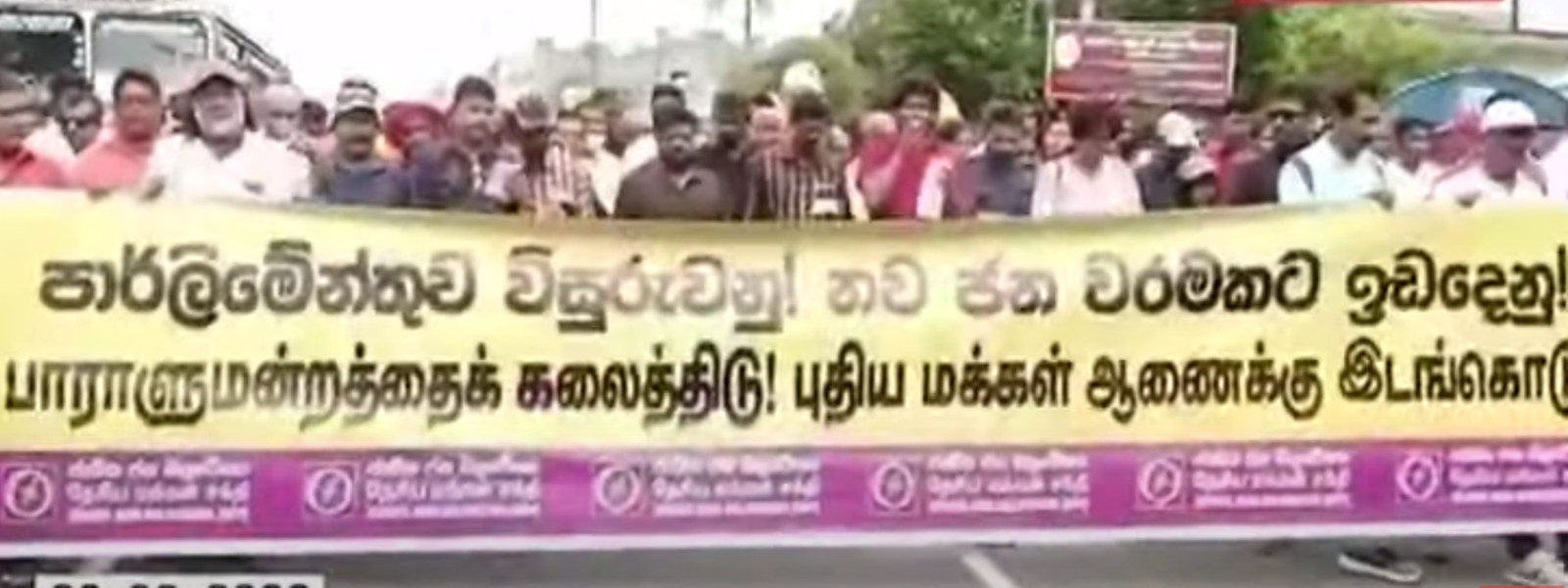
The Samagi Jana Balawegaya (SJB) will on Monday (20) hold a demonstration against the Government’s attempts to delay Local Government elections which are scheduled to be held on 9 March.

The demonstration will be held opposite the Presidential Secretariat and the Ministry of Finance.

SJB General Secretary Ranjith Madduma Bandara invited the public to participate in the demonstration. “We ask the people to fight for their rights. The President might next claim there are no funds for a Presidential election. Therefore, we ask the people to join us on 20 February to protest against this,” he said.

He assured the party will fight alongside the people. “The Government is attempting to curtail the people’s right to franchise. The Government is now trying to bankrupt democracy in a bankrupt country,” he said, adding that the Government is acting in this manner as it is aware the SJB will emerge victorious at the polls.

Posted in Uncategorized

BASL charges: Concerted effort to prevent elections and endanger sovereignty of the people

The Bar Assocation of Sri Lanka has charged that there is a concerted effort to prevent elections, to undermine the franchise of the people, and endanger the sovereignty of the people of Sri Lanka.

FULL STATEMENT:

“The Bar Association of Sri Lanka (BASL) expresses its deep concern over recent attempts by state authorities to disrupt the Local Authorities Elections, which are mandated by law to be held prior to March 19th, 2023. The BASL emphasizes that all elections are a vital part of Sri Lanka’s democratic process and must not be hindered.

The BASL notes several decisions by the government in recent weeks, purportedly aimed at managing public funds, have had the effect of preventing the Elections Commission from conducting the elections. These include a demand by the Government Printer for the release of funds prior to the printing of ballot papers and the Secretary to the Treasury claiming that there are no funds available for the elections. This is despite a budget allocation of Rupees Ten Billion for the purpose of elections

The BASL states that the conduct of the Secretary to the Treasury, the Government Printer, and other government officials and institutions over the last few weeks clearly demonstrates a concerted effort to bring the elections to a halt, thus undermining the franchise of the people and endangering the sovereignty of the people of Sri Lanka. Such attempts to prevent elections mandated by law represent an unprecedented attack on democracy and the rule of law and pose a grave threat to the electoral process in the future.

The BASL warns that such actions could set a dangerous precedent for an unpopular executive or legislature to obstruct the allocation of resources for an election and prevent the people of Sri Lanka from choosing their representatives and leaders.

The BASL also points out that Article 104 B (2) and 104 GG (1) of the Constitution make it clear that all state authorities are duty bound to cooperate with the Elections Commission and that refusing or failing to do so is a criminal offense punishable with imprisonment. In terms of Article 33 (c) of the Constitution the President too is empowered to ensure the creation of proper conditions for the conduct of free and fair elections, at the request of the Election Commission.

On the 15th December 2017 the Supreme Court in SCFR 35/2016 on 15th December 2017 has clearly explained the importance of conducting timely elections for local authorities and the importance of the franchise as follows:

“Franchise is a fundamental right enjoyed by people. According to Article 3 of the Constitution “In the Republic of Sri Lanka sovereignty is in the people and is inalienable. Sovereignty includes the powers of the government, fundamental rights, and the franchise”. Franchise is a fundamental right recognized under Article 10 and 14(1) of the Constitution. The failure to hold elections on the due date or postponing is a violation of a fundamental rights of the people . Under Article 4(d) of the Constitution the fundamental rights which are by Constitution declared and recognized shall be respected, secured and advanced by all organs of the Government and shall not be abridged, restricted or denied save in the manner and to the extent hereinafter provided. In the present case the legislature as well as the executive had violated this Article.”

On 11th January 2023, the BASL warned that any move to interfere with the franchise will have far reaching consequences. Previous attempts by different administrations over the years to interfere with the franchise of the people have resulted in disastrous consequences for the country and its people.

It is the sacred duty of the Government to ensure that funds are provided for the conduct of the elections which are an essential function in the country. The BASL calls on the government and all State Officials to respect the Constitution and the law and ensure that the Local Authorities Elections are held as scheduled, without any further attempts to disrupt or interfere with the process.

The BASL is of the view that all attempts to interfere with the electoral process must not only be defeated but all those responsible for such interference must be dealt with in accordance with the law.”

Posted in Uncategorized

SL cannot afford to plunge into another crisis over LG polls

The upcoming Local Government (LG) is deemed to be one of the most decisive elections in the history of Sri Lanka, which could result in a massive breakthrough. However, the possibility of holding the election is getting uncertain day by day with the recent statement made by the Secretary to the Ministry of Finance that it is difficult to release funds for holding the LG polls given the current economic challenges.

In addition, the Supreme Court has also given green light for the Election Commission (EC) of Sri Lanka to hold the election as scheduled. In this context, it is imperative that the political hierarchy and citizens set the tone for the smooth conduct of the election without causing any sort of hindrances resulting in putting off the polls and creating chaos in the country.

The EC in struggle

Finance Ministry officials have informed the Chairman of the Election Commission, Nimal Punchihewa that due to a circular issued recently, it is possible to allocate money only for essential services, adding that election activities have not been designated as an essential service under the said circular.

Accordingly, Finance Ministry officials have pointed out that if funds are to be issued to institutions that do not come under the category of essential services, the approval of President Ranil Wickramasinghe as the Minister of Finance must be obtained.

At the same time, an estimated sum of Rs. 770 million is reportedly required for the month of February, in order to meet the basic expenses incurred for the upcoming election due to be held on March 09. The Commission has requested the Ministry of Finance in writing to allocate
However, the EC is in a struggle to carry out its essential and urgent election duties as the Treasury has given only Rs. 100 million to the EC in spite of demanding Rs. 770 million for its day-to-day tasks.
According to the EC Chairman, if the Treasury continues to delay the provision of required funds for the EC, the Commission has no option other than reporting to the Supreme Court.

“The budget 2023 has allocated Rs. 10 billion for the EC in a special vote in Parliament as the EC is an independent Commission. We are hopeful that the EC could successfully conclude the Local Government (LG) polls with a budget of Rs. 3 or 4 billion by March 9. The Commission last week requested only Rs. 770 million out of Rs. 10 billion for the month of February to carry out immediate tasks related to the March 9 LG polls. The underfunding has put the EC in a severe financial constraint,” the Chairman of the Commission, told reporters recently.

Moreover, the EC will have to extend another request to the Treasury for election expenses for the month of March after calculating the cost to complete the election on March 9. The EC requires a minimum of Rs. 3 billion to conclude the LG polls on March 9 as most of the expenses are borne by other state establishments like the Police Department, and Government Printer, and payments to public officials for election duties are made after the conclusion of the election.

More confusion popping up

Meanwhile, Government Printer Gangani Kalpana Liyanage has said that initial printing activities in preparation for the 2023 Local Government Election have been completed adding that, the Government is yet to provide security for the smooth conduct of the ballot paper printing activities.

According to Liyanage, the Police have deployed only three police officers despite the request made to the police chief to deploy 60 police officers to oversee the security measures during ballot paper printing.
In this context, the Election Commission stated that if the ballot papers are received on time, the postal voting of the LG polls can be held on February 22, 23, 24, and 28 as scheduled. However, if the ballot papers are not provided on time, the Commission has to decide on new dates for the postal voting of the LG election, which could delay the entire proceedings.

For a free and fair election

In a backdrop where the Supreme Court has given the green light to the EC to go ahead with the LG election, a free and fair election is very much on the cards. However, the EC is yet to make an official statement with regard to the election in the wake of the statement of the Secretary to the Ministry of Finance. Nevertheless, the Treasury and the Finance Ministry have a constitutional and official obligation to transfer sufficient funds to the EC in time to ensure democracy and a free and fair elections.

In addition, as it is evident, the policies implemented by incumbent President Ranil Wickremesinghe do not reflect the mandate of the people as he was not elected by the people. In addition, the present composition in Parliament is also in a mess. In this context, the political analysts are of the viewpoint there an election is the need of the hour and in the event of no election, there is a tendency and possibility that people would rally around and come to the streets to show their agitation.

However, in spite of whether the election being held or not, the country cannot afford to go for another uprising, which would definitely aggravate the current crisis in the country. Therefore, the people of Sri Lanka should be mindful of the fact that the country needs to move on and stick to its priorities while ensuring democracy.

Local Govt polls: EC to file special motion before Supreme Court

The Election Commission has decided to file a special motion before the Supreme Court citing difficulties it is facing while preparing to hold the 2023 Local Government Election on March 09.

The election body has cited inadequate funds, inadequate supply of fuel for transportation, the inability to print the ballot papers by the Government Printer and several other issues as obstacles to going ahead with LG election preparations.