Not in favour of 13A; could lead to separatism, EP Governor says

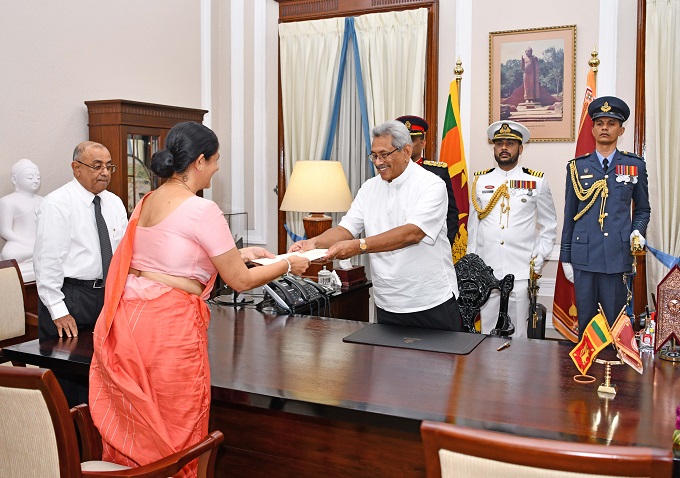
Eastern Province Governor Anuradha Yahampath today expressed her displeasure over the implementation of the 13th Amendment because it could lead to separatism in the country.

Addressing an event today, she said that she was totally against separatism.

“The separatism will cause no peace in the island and leads to war. If separatism is implemented in any small island, it will create issues. Similar practice has created enough of issues everywhere in the world. There has been war wherever there is separatism, particularly in island nations. “There is no peace in those countries, but raging war,” she said.

Therefore, I’m very much against separatism, she added.

Sri Lanka: Surviving the 75th year of independence by Col. R Hariharan

Sri Lanka will be celebrating its 75th Independence Day on February 4, 2023. As a republic the country has come a long way from the dominion it was at the time of independence. The shaky step with which President Ranil Wickremesinghe steps into the 75th year of independence, tells that his job to mend the fractured country left in disarray by President Gotabaya Rajapaksa is far from over. His government has to survive at least one more year to ensure the economic recovery process is started as per IMF norms.

The former president Gotabaya’s flight to safety from the country to escape from the wrath of the people has a lesson for all political leaders. They cannot afford to take popular support for granted. That includes President Wickremesinghe, though he is not elected President by popular mandate. Embers of Aragalaya struggle are still smouldering; a small number of vested interests, nihilists and ultra-left wingers are trying hard to keep alive the protest movement. They have been indirectly helped by the government’s continued lack of accountability. People cannot afford the resurgence of another Aragalaya upsurge as it would shift the national focus from economic recovery. It is the government responsibility to get its act together to ensure the popular discontent is handled with sympathy, sensitivity and fair play.

Apparently, the government has shown signs of getting its act together. It has just released Wasantha Mudalige, Convenor of the Inter-University Students Federation and one of the leaders of the Aragalaya protests, after holding him in custody under the infamous Prevention of Terrorism Act (PTA) for nearly nine months. But much more needs to be done by the government to gain public confidence. It is in this backdrop that events in the month need to be understood.

Economic recovery

The seamless connectivity between external relations and the economic recovery of the country came into full play during the month. Early in the month, President Wickremesinghe addressing businessmen in Colombo, briefed them on the state of economic recovery. He had said Japan and the Paris Club, two of Sri Lanka’s major creditors, had expressed their willingness to assist. Talks had begun with India and China. “We discussed with China’s EXIM Bank and are currently debating on how to restructure our debt. The Chinese side has agreed to move quickly” he added. Japan’s State Minister of the Cabinet office Satoshi Fujimaru, China’s Vice Minister of the International Department of the CCP’s Central Committee Chen Zhou and India’s External Affairs Minister S Jaishankar visited Colombo in that order. The US Under Secretary of State for Political Affairs is currently visiting Sri Lanka to “offer continued support for Sri Lanka’s efforts to stabilize the economy, protect human rights and promise reconciliation” according to the State Department.

The Paris Club is said to have proposed a 10-year debt moratorium and a 15-year debt restructuring programme. Japan’s minister Fujimaru came with a delegation of Japanese businessmen and his discussions with the President focused on investment opportunities available in Sri Lanka in hospitality and tourism, mining and training of Sri Lanka’s workforce. Chinese Vice Minister Chen led a delegation with the avowed aim to meet leaders of the government and political parties to brief them “on the CPC National Congress decisions and enhance cooperation with friendly developing countries under President Xi Jinping’s policies.” On debt restructuring, he assured PM Dinesh Gunawardena that “several ministries and financial institutes of China are working closely on this issue for quite a long period. I’m confident that Sri Lanka will have good news very soon.” But “the good news” that China’s EXIM Bank agreeing to a two-year moratorium on Sri Lanka’s debts may not satisfy the IMF programme.

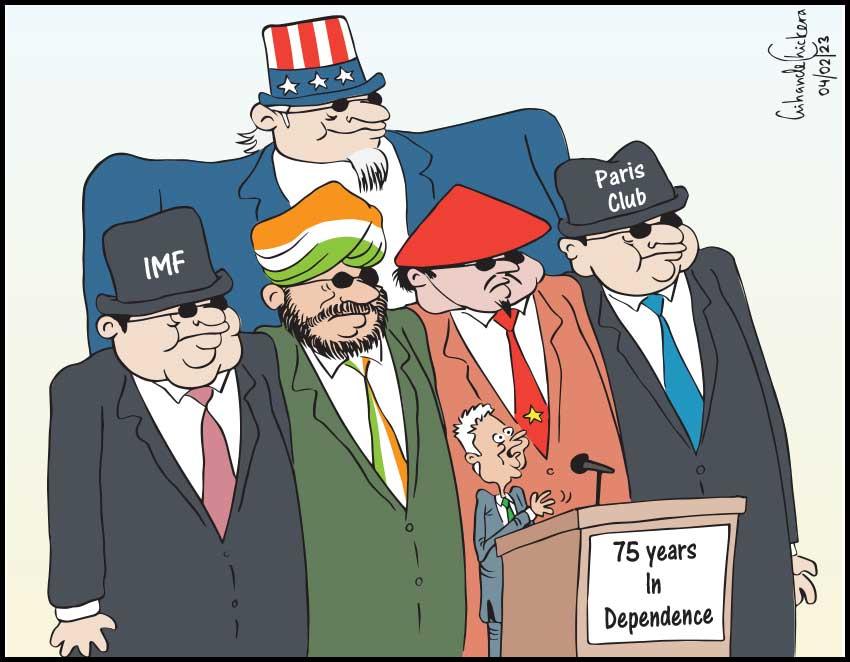
In contrast to China, India – the third largest creditor – validated its “neighbourhood first policy” by writing to the IMF Chief of its support to restructuring of Sri Lanka’s debts on the eve of EAM Jaishankar’s visit to Colombo. In its letter to IMF, India has said it will support medium to long term treatment of debts through maturity extension and interest rate reduction or any other financial operations that would deliver similar relief. India also said that it expects Sri Lanka to seek equitable debt treatments from all commercial creditors and other official bilateral creditors.

After bilateral talks, EAM Jaishankar addressed a joint press conference at the Presidential Secretariat along with President Wickremesinghe and Foreign Affairs Minister Ali Sabry. He said in Colombo that India will stand by Sri Lanka in its hour of need and expressed confidence in overcoming challenges. His words that India “felt strongly that Sri Lanka’s creditors must take proactive steps to facilitate its recovery” and extended financial assurances to the IMF to clear the way for Sri Lanka to move forward. Our expectation is that this will not only strengthen Sri Lanka’s position but ensure that all bilateral creditors are dealt with equally,” must be heart-warming to the beleaguered President.

He also said India will encourage greater investments in the Sri Lankan economy, especially in the core areas like energy, tourism and infrastructure. Apart from the use of rupee settlement for trade, he also suggested strengthening connectivity, encouraging Indian tourists to make RuPay payments and the use of UPI payment as helpful to Sri Lanka.

Implementing 13th Amendment

The Indian EAM’s talks with Sri Lankan leaders in Colombo seem to have nudged President Wickremesinghe to walk the talk on unfulfilled promises on ethnic reconciliation and implementing 13th Amendment (13A) to the Constitution in full.

The President informed an all-party leaders conference on reconciliation that the Cabinet was agreeable to fully implement 13A. In a statement issued by his secretariat, he said “The 13th Amendment has been in existence for over 30 years. I must implement it. If anyone is opposed, they can bring in a constitutional amendment to change it, or abolish it.” Explaining his stand, he said he was working according to a supreme court decision on 13A. “We are still in the bounds of a unitary state. I am against a Federal state but I support the devolution of power to provinces. The provincial councils don’t even have the powers enjoyed by the City of London. So, we can’t call this a federal state,” he said.

It is clear that the President has left the decision to implement or scrap the 13A on political leaders from all parties. it might be a political ploy to tide over a tricky political issue for a short time. But, his credibility as President is likely to be tested when he attempts to implement 13A. His statement has already received negative reaction from Tamil National Alliance as well as Sinhala right. And we can expect more political flak on this issue across parties.

This adds yet another rider to the political stability of the government, which does appear to be clear about conducting the local government elections(LG) in March. Already, the uneasy ruling coalition of Sri Lanka Podujana Peramuna (SLPP) and the Sri Lanka Freedom Party (SLFP) is divided over the conduct of LG elections in March. Lack of clarity on the issue is already causing scepticism about the government’s intentions among the public . In the face of a brewing political turbulence, it will be a tough call on the President to take decisive action even at the best of times. Now, when the country is trying to save itself, it is going to be tougher.

Tailpiece: Sri Lanka’s annual bilateral naval exercise ‘CARAT’ (Cooperation Afloat Readiness and Training) was held on land and at sea in Colombo, Trincomalee and Mullikulam for a week from January 19. The exercise aims to promote regional cooperation, maritime partnerships, enhance maritime interoperability and maintain a free and open Indo-Pacific. These aims coincide with that of the four-nation Quadrilateral framework. The Japan Self Defence Force (SLDF) and the Maldives National Defence Force joined the Sri Lanka armed forces in the last leg of the exercise. These details reflect the changes taking place in the strategic narrative of Indo-Pacific theatre after the Quad. China is sure to take not of the strong strategic message CARAT is sending.

Col. R Hariharan is a retired military intelligence specialist on South Asia associated with the Chennai Centre for China Studies

Much ado about nothing – 5th Column -Sunday Times SL

My dear Mother Lanka,

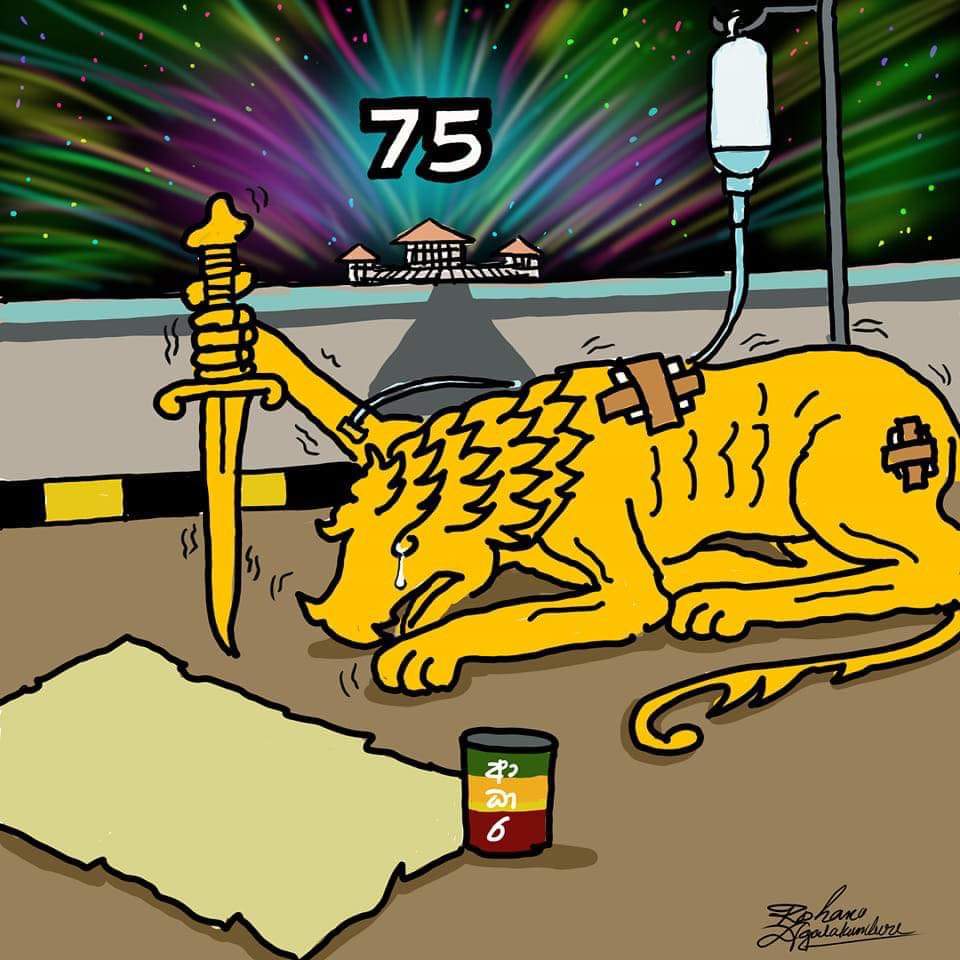
I am writing to you with mixed feelings as we mark the 75th anniversary of gaining independence from British colonial masters. I think it is more accurate to say that we ‘marked’ independence instead of saying we ‘celebrated’, because there has been precious little to celebrate as a nation lately.

We did ‘celebrate’ yesterday with a ceremony at Galle Face. There is nothing wrong with an event to mark the occasion, but the fact that there was opposition to even that suggests that all is not well. Critics complained yesterday’s event demonstrated our ‘neva gilunath, band choon’ mentality.

People ask why millions were spent on parades when our hospitals lack medicines, our fuel is rationed and we can’t afford uninterrupted electricity. These are valid questions. The powers that be didn’t get it right in striking a balance between ‘celebrating’ and being sensitive to the hardships of the people.

That is why some even query as to whether we are worse off gaining independence and whether it would have been better if we were still under the ‘suddas’. We manage our own affairs and make our own decisions now, but, judging by recent events, we have made a right royal mess of it, haven’t we?

It is great that we could break free from the shackles of foreign rule, first by the Portuguese, then by the Dutch and finally by the British, and be in charge of our own destiny once again. However, the question is whether we have made life better for our people since then. The answer, of course, is ‘no’.

We struggled for decades to gain independence from the British so we could be free from their rule, though it was not a bloody battle like it was in India or Pakistan. Yet, 75 years later we are queuing up outside their high commissions, trying to migrate and be under their rule once again!

Just how much we have fallen is shown by Prince Charles who is now King attending our 50th anniversary celebrations – sweating profusely and being ignored by Mrs B seated next to him. 25 years later, those attending our event are two-bit ministers from a few neighbouring countries!

Our national anthem says ‘dhaanya, dhanaya neka mal palathuru piri jaya

bhumiya ramya’ but there is no grain due to the fertiliser fiasco, no riches as we are bankrupt, fruits and flowers are expensive due to inflation, our land is being sold to foreigners and all the Ramyas are trying to leave the country!

You-know-who said recently that we should aim to be a modern and prosperous nation by 2048 when we reach a century of ‘independence’, but this is as good a time as any to reflect on what went wrong. Or else, we will be in a worse plight by 2048 and still harking back to our glorious past of 2,500 years.

The ‘suddas’ who governed us didn’t do so because they loved us. They repressed our people, imposed taxes on us and stole our natural resources. It is also true that these same people lecture us even now on how we should conduct our affairs. They controlled us then. They try to control us now.

While the ‘suddas’ didn’t do us any great favours, we still rely on the roads and railways they built, the schools they set up, the laws they introduced, the plantations they cultivated and the language they spoke. What have we done for ourselves since they left us 75 years ago? Sadly, very little.

Whose fault is that? It has become the fashion these days to blame it all on the politicians or the few families that have ruled us for three-quarters of a century – and they do have to accept a significant share of that responsibility, especially those who led the country after the first 20 years or so.

Still, we as a nation are also responsible not only for electing our rulers but also for falling victim to their strategy of pitting one community against the other, repeatedly. Then, when they passed laws to suit them, others helped them, be it in the House by the Diyawanna Oya or in the halls of Hulftsdorp.

Slowly, the rule of law collapsed, rulers became a law unto themselves and our leaders acted as if they were Kings or Queens. Instead of rebelling against them, most people took the easy way out, voting them in, again and again for various rewards – a job, free rice, ‘samurdhi’ or the promise of a bracelet.

Also emerging were a new set of ‘yes men’ – ministry secretaries, corporation bosses, other high officials, even Police and military officers, and those who sit on benches – who did the bidding of their political masters in return for a commission, promotion, extension of service or a diplomatic posting.

Most top posts where key decisions are made were filled by these ‘yes men’ instead of being given on merit to the most deserving. Naturally, decisions were made for political reasons and not for the nation’s good. Now, our ‘democratic socialist’ Republic has become a ‘dictatorial corrupt’ Republic.

I am sorry to sound so negative, Mother Lanka, but if this 75th anniversary is to serve some purpose, it is time for all of us, your sons and daughters, to look in the mirror. What you see will not be pretty. Yet, if we can see our flaws, we can correct them. Then, maybe we can really celebrate, at least by 2048!

Yours truly,

Punchi Putha

PS: At the very site where our ‘independence’ was marked yesterday, the Galle Face Green, there were signs last year that your conscience was finally awakening. If that process can be seen through to its end, then we can claim true ‘independence’ instead of being in dependence forever, Mother Lanka.

Posted in Uncategorized

EC shocked by police mini-poll estimate

The Election Commission is to raise objections with the Treasury over the estimates submitted by the Police Department to assist in the conduct of the upcoming local council polls, after the figures showed a three-fold increase compared to the 2018 local polls expenses.

The Police Department has sent in an estimate of Rs 2.8 billion as the required amount for services to be provided for the March 9 local council elections in contrast to the claim for the local polls five years ago.

A senior EC official said the estimated expenses covering allowances, fuel costs, hiring of vehicles, use of telephones and communication, stationery and incidental expenses showed large increases with some as much as six-fold.

Among the increases is the vehicle-hiring cost which has increased from Rs 138 million to Rs 745 million. The fuel bill estimates have increased from Rs 108 million to Rs 675 million.

He said the Commission had made its own estimates and found that the figures sent by the Police Department were heavily overestimated.

He said the EC had decided it would make payments only upon the submission of bills by the Police Department.

A senior Police officer said their estimates were based on current prices.The EC also would be taking up the matter in the Supreme Court where three petitions related to the polls are pending. In a related development, the EC also plans to take up in court the delay in the release of Treasury funds for the polls.

The EC had received only Rs 35 million from the required Rs 100 million to prepare for the polls. The official said they had estimated the amounts needed for the elections, but were concerned that the funds would not be received in time.

According to the estimates Rs 800 million would be needed before the end of February; Rs 1,600 million by the end of March; Rs 1,400 million by the end of April, Rs 600 million by the end of May; Rs 120 million by the end of June and Rs 80 million by the end of July.

Apart from the financial issue, the EC has not received a satisfactory response from the Power and Energy Ministry to increase the fuel quota for the Commission and the candidates.

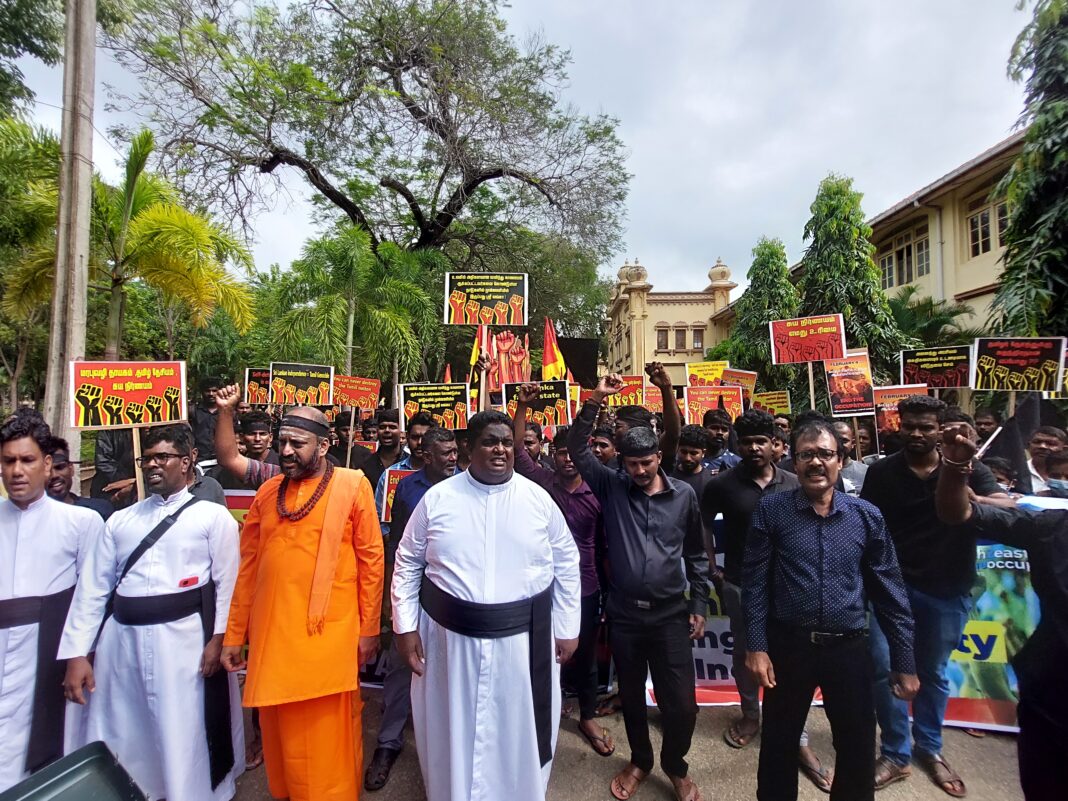
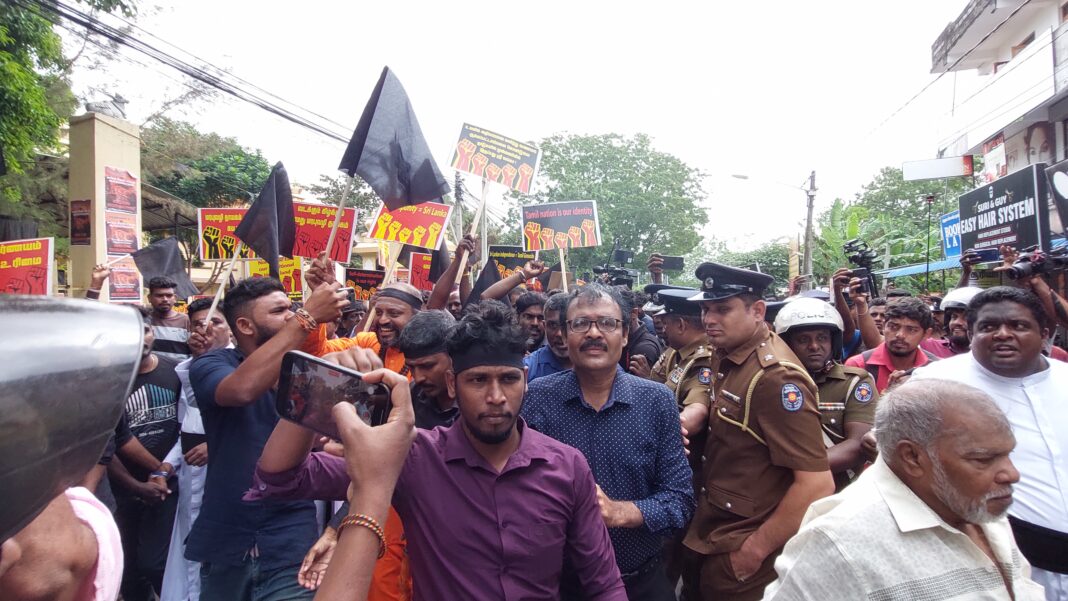
‘Black day for Tamil homeland!’ – Tamils in Jaffna protest Sri Lanka’s Independence Day celebrations

Tamils in Jaffna are rallying through the town today in protest of Sri Lanka’s 75th Independence Day, which is regarded as a ‘black day’ for Tamils.

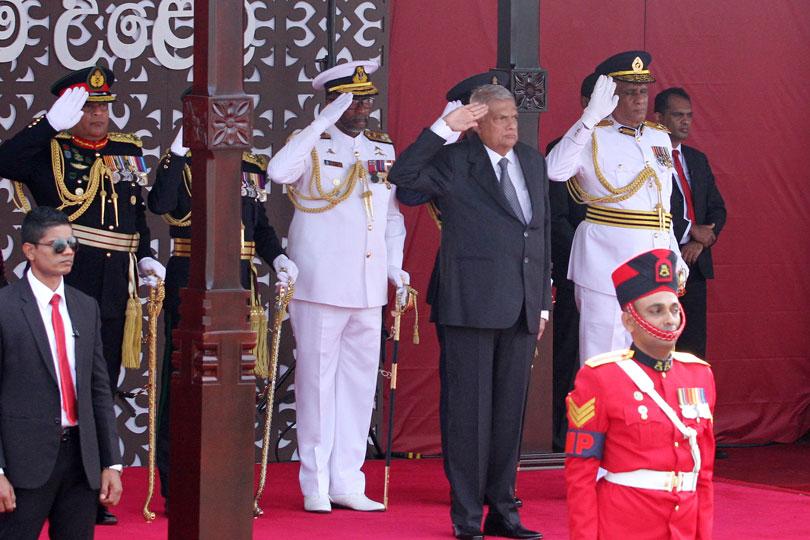
Sri Lanka’s 75th Independence Day was celebrated at Galle Face under tight security today.

A heavy military presence was seen on the streets in some parts of Colombo during the celebrations.

President Ranil Wickremesinghe and Prime Minister Dinesh Gunawardena attended the celebrations together with members of Parliament, mostly from the Government.

The main opposition Samagi Jana Balawegaya boycotted the celebrations at Galle Face together with a number of other political parties.

The protest began outside the University of Jaffna, where black flags have been hoisted at the campus to mark the occassion.

Businesses in Jaffna expressed their solidarity with the protesters by carrying out a hartal – a day long shutdown- across Jaffna.

Sri Lanka’s Independence Day is deemed a ‘black day’ for the Tamil nation as it continues to be occupied by the Sri Lankan military and lacks basic rights as well as the right to self-determination.

Posted in Uncategorized

Sri Lanka President’s address to the nation- Full text

Sri Lanka President Ranil Wickremesinghe in an address to the nation on the 75th independence day, calling for an end of divisive politics, minority discrimination and politics of deceit.

He promised maximum devolution within a unitary state.

After independence the country was divided on race, religion and region, he said.

“We were divided to a point of developing suspicion and animosity against each other,” he said.

“Various groups exploited this division to gain power and created further rifts among the people. Instead of rejecting such groups, we accorded power to these very same groups.”

“In politics, lies were spread instead of the truth. Politicians who spoke the truth were rejected by the people.

“Those who pointed out the real situation of the country and sought related remedies were hardly given a place. Yet, those who satisfied people with their lies gained greater acceptance.

The full statement is reproduced below:

Most Venerable Maha Sangha and the clergy, my fellow citizens, all Sri Lankans abroad, dear children,

Today, I will not be delivering a traditional Independence Day statement. I am not going to dwell on the freedom we gained. While honouring those who were dedicated and worked hard for the country’s freedom, including the late Mr. D.S. Senanayake, I will focus on regaining the freedom that we have lost today.
Around 75 years ago, the esteemed ‘London Times’ newspaper carried an editorial stating that “It is our desire to see Sri Lanka become a Switzerland in the East, very soon.”

They had not expressed a similar vision for any other country in the East.

However, what has happened to us today?

Today, we are facing an unprecedented economic crisis, hitherto never experienced.

Why have we to face such a situation? Who is responsible for such?

Let’s be truthful. All of us are more or less responsible for this situation. None of us can point fingers and blame each other.

We made mistakes from the beginning. Efforts were made to rectify those mistakes, though it was not possible to correct them completely.

The policy followed by the late Mr. D.S. Senanayake in securing the country’s freedom was to unite all Sri Lankans. He believed that everyone, be it Sinhala, Tamil, Muslim or Burgher, should forge ahead as Sri Lankans.

However, after independence we divided in terms of race, religion and region. We were divided to a point of developing suspicion and animosity against each other. Various groups exploited this division to gain power and created further rifts among the people. Instead of rejecting such groups, we accorded power to these very same groups.

In politics, lies were spread instead of the truth. Politicians who spoke the truth were rejected by the people. Those who pointed out the real situation of the country and sought related remedies were hardly given a place. Yet, those who satisfied people with their lies gained greater acceptance.

We got trapped in a consensual political culture. Our characteristic was to be depended on borrowed resources and we borrowed even more.

We adopted the notion that, “The government is a spring of resources”. Many were of the view that the duty of the rulers was to distribute the various resources obtained from that spring, among the people. Accordingly, job opportunities were provided and various goods and equipment were also distributed. Cash was also made available.

In most instances, we did not vote on behalf of the country. Instead we voted for a candidate in order to receive a job, to gain admission to a school for our children and to have a tender passed etc. We worked for political candidates expecting personal favours in return.

Most of us contested not for the country, but for personal power, for greater perks and to earn a little more.

We were trapped in promises and endured slogans which finally resulted in the gradual collapse of the country’s economy. We borrowed increasingly to fulfil election pledges and proved the slogans shouted at the protests were correct.

We borrowed more for consumption rather than for investment. However, according to the Buddhist Philosophy one should take loans for investment purposes and not consumption. While we are talking of Buddhism, our action is not in keeping with the Buddha’s teachings.

Lee Kuan Yew, who visited Sri Lanka to study and formulate a strategy to rebuild Singapore, said after many years, that . “This situation has arisen in Sri Lanka due to unnecessarily prioritising politics. If Sri Lanka was followed as a role model, even Singapore by today would have perished.

In fact, we have reached the point of destruction. There are those who want to keep perpetuating this wound forever, though I don’t wish. Let’s seek to heal this wound though it’s difficult and painful. If we endure the suffering and pain for a short period of time, we can get the wound healed completely.

We have no way out of this crisis with short cuts as that some political parties are pointing out.

We have only one way to get rid of this situation, if we want to overcome this crisis and achieve real economic and social freedom. Remember, if we miss this path due to misplaced political agendas, we would neither have a future nor a country.

On several occasions, I pointed out the seriousness and danger of the looming economic crisis we are facing today. I have already said that the first six months of this year will be extremely difficult. We have to face this difficult situation in our stride, although unwillingly, for the sake of the country.

Although a large number of people in this country got out of poverty with the free education and expanded the middle class, today the country has turned into a land where it is impossible to fulfil their aspirations. I see the youth who should be working hard in different fields in this country are creating long queues to obtain passports. We need to change this situation too.

To achieve this end we should modernize the economy and open it to the world. The corrupt political factionalism that deceives the people making them dependants and poor for ever should also be changed. This is the “system change” that the youth of this country have been demanding for over a long period of time.

My government therefore has embarked on new path of reform to fulfil the needs of the youth. Even though those decisions that have to be taken for it are painful, it has to be done in order to overcome.

We have to move away from narrow politics in order to be rid of this crisis situation. We must face this challenge together as children of one mother and make our fullest contribution to strengthen the path towards the successful development of this country. We must all move forward as Sri Lankan nationals leaving aside all differences.

Hence the basis and foundation for a strong new economy has already been formulated. We are successfully completing the difficult stage required to get support from the International Monetary Fund (IMF). We expect to get their consent without delay.

We cannot be satisfied just by strengthening the economy. The entire system needs to be changed. All areas of this political system, the legislature, parliament, Executive, state machinery, etc. should be modified to suit the modern era. The nation, and we should benefit from this change. More space should be created in the new system, for representation and opinions of young people and women in particular.
For this system modification, we are proposing a number of orders to the Parliament.

Additionally, immediate action needs to be taken in relation to the unique issues that the people in the North and East face. A cabinet subcommittee for this purpose has already been established.

All political parties are informed of its decisions and their implementation dates. Thereby those tasks are carried forward. We have given priority to activities such as release of land and prisoners.

Furthermore, measures are being taken for the maximum division of power in a unitary state. However, we’ll never consent to the division of this nation.

I’m not attempting to treat the superficial condition with painkillers. But to treat the root cause of the malaise. It is challenging and difficult, but it’s our only option.

I know that many of the decisions I have been compelled to take since assuming the presidency have been unpopular.

However, because of those decisions, today no citizen of this country will die of dehydration in oil queues. You won’t starve without gas. Not curse without fertilizer.

Therefore, regardless of the obstacles the anarchist political forces seek to create, I will continue this new reform program with the majority of people who love this country.

We can become a developed country by 2048 if we work and move forward in a united and planned manner envisioning peace and reconciliation. There is the potential to become a developed country which is not begging from any other nation in the world. True freedom can be achieved and it is possible.

It is our collective responsibility to build a new country in which our children can compete with the rest of the world. Therefore, I urge all parties to come together to overcome this difficult period.
Let’s unite! Let’s join hands!

With joined hands let’s embark on a united journey over the next 25 years, as we have planned. Let’s further nurture those plans in accordance with the views of all parties. Let’s get stronger. Let’s make them more systematic and streamlined.

Not only should all of us who live in Sri Lanka join this effort. But the Sri Lankans living in the different countries around the world should also shoulder this journey. Everyone should be united. Everyone should contribute to the achievement of these goals as much as possible.

Let us devote ourselves, unite as children of one mother. Let us make our country one of the most developed in the world by 2048, when we will celebrate 100 years of independence.

Thank you all.

Posted in Uncategorized

How Can We Celebrate The 75th Independence Day? – Global Tamil Civil Society

Dear Sinhala Brethren,

“We must learn to live together as brothers or perish together as fools” – Martin Luther King jr

We wish to live in a conflict-free Sri Lanka where we can join in to celebrate Island’s 75th Independence day as much as you do. Both communities lost thousands of lives and limbs and caused enormous pain and unimaginable suffering. We became poorer and beg the international community. Brothers and sisters, let us address our grievances and aspirations to end all conflicts. Let us rebuild our beautiful island where all feel equal and dignified.

Sri Lanka is our island too. How it has alienated the Tamils since Independence is a clear indication of that deliberate policy of discrimination that became constitutionalised and institutionalised. For us to celebrate independence as much as you do, we need our Sinhala brethren to address sincerely our longstanding grievances and aspirations now. Such acts of justice will not cause any harm to any other people. It will neither uproot anyone, restrict their freedom of movement nor deprive them of their rights in whatever form of devolution.

It is not at all about the separation of our beautiful island, but it is to ensure that the island celebrates undivided patriotism, powersharing is inevitable and reassuring the individual rights and collective rights of all the people through a plurinational democracy. Let us explore tried and tested models in the world that will be suitable for power sharing in Sri Lanka.

The conflicts were man-made in Sri Lanka. Worse when murder and mayhem took place in the name of peace & religion. Instead of addressing the underlying issues, the conflicts were allowed to deteriorate and then suppressed. Then it becomes a way of living and political culture. Let us be the ambassadors of goodwill. The pogroms and war have destroyed the country beyond repair. The effects of violence have not only bankrupted the country but brought the system to its knees. The state culture of violence permeated even those against violence. The mutual killings and destruction must end, apologies for the past atrocities endorsed and true acts of reconciliation shall prevail among all people. The politicians et al who robbed the people of their future are still at large, protected by the system.

The anger of future generations called for System Change and disposed of the most powerful despots from their positions. It could be regarded as the most peaceful revolution ever witnessed to dispose of the heads of government. It is the responsible conduct of those activists who stood by the people with lived experience at the forefront and pitched on peace and harmony that remains an admiration. In the same belief, we appeal to the peaceful, invigorating and generous communities to effect the necessary change peacefully on the Island.

The war-ravaged political doctrine has exposed the hegemony and lost its purpose. The same countries that supported the war efforts are calling for UN action because of the excesses that were carried out beyond International Humanitarian Law. Some countries the Sri Lankan called on to protect the sovereignty of Sri Lanka are violating our sovereignty and exploiting the economic situation. Let’s seek bilaterally acceptable universal solutions that can end unaccountability, violence, hunger and corruption with a new Social Contract that will address all past commissions and omissions. End the fear of persecution, undemocratic governance and unacceptable expenditures. Whilst we starve we cannot allocate funds for a defence force that fights no enemy or a bloated government service sector that swallows all resources that are meant for people.

The remedies cannot be brought by the statutes alone. Devolution has been absorbed into the constitution but never implemented by the legislature or judiciary. Even agreements have been made since 1957 but all agreements and negotiations have been reneged or aborted and resulted in confrontations. The real change has to come from the hearts and minds of the people. History has documented the magnanimity of the Sinhalese people who stood firm risking their own lives to defend the people and their properties in 1958, 1977 and 1983 anti-Tamil pogroms though many hundreds and thousands were sadly maimed & massacred. The survivors and injured who were robbed of their dignity were sent by ships to Tamil Homeland from refugee camps in Colombo as the final solution for those victims. Their independence and identities are to be protected wherever they are and in the territory that has protected them. It is the essential element of the realisation of human rights, non-discrimination and equality. We believe in the new generation that Sri Lanka has produced beyond the ethnic divide to end ethnic injustice.

Many of you have been visiting war-ravaged areas in the North-East and have seen for yourself the extent of the destruction the Tamil civilians were subjected to the brunt of the war. Mothers and fathers are still looking for their children. Children are still looking for their parents. Their lives have been destroyed but the Transitional justice and psychosocial support had been delayed for them. It’s a humanitarian crisis which needs an urgent and lasting solution addressing guarantees of non-recurrence. The delayed justice has taken the responsibility of justice to international fora as Sri Lanka remains the party to the crime.

It’s beyond any doubt that Sri Lanka is at a crossroad and need to be salvaged from its foundation i.e. politically and economically. We are ready, willing and able to work shoulder to shoulder with you all to salvage the country and it is high time we do away with the bloody past and overcome mistrust and hegemonic behaviour. Let’s come together to salvage this country, which was once a role model for many democracies around the world.

The injustice perpetrated over the years must be addressed to end the ongoing atrocity crimes, to embark on constitutional reforms to end the hegemony & unaccountability. The powersharing structure in the multi-ethnic and multi-national plural society of Sri Lanka is anticipated to address all ethnic conflicts. However, the power-sharing arrangement also demands a culture of impunity eradicated not only among the government but also among the people too. Sri Lanka also has to establish an independent judiciary and end state persecution by repealing the Prevention of Terrorist Act. The structure must be based on reparative justice that guarantees

the non-recurrence of atrocity crimes and cannot be denied out of any absurd claims. The conflict resolution encompasses security sector reforms including vetting all defence forces that may have contributed to the mass atrocities of 1988-1990 among Sinhala and 2009 Mullivaikal massacre.

The People’s Struggle has created an opportunity for all the people to come together. The young generation has stood steadfastly for ethnic justice, accountability and reconciliation. The outside world demands inclusive democracy and constitutional and institutional formalities. This is an unmissable opportunity for the new agents of peace and democracy to accommodate the system change envisaged that can bring peace, prosperity and democracy. Their rights are guaranteed constitutionally through structural reforms, tax reforms, food security and most importantly physical security. Their independence and identities are to be protected wherever they have been flourishing historically and the territory that has protected them.

Let there be powersharing and collective sovereignty to unify the country!

Posted in Uncategorized

Pledge on 13A is a ploy to hoodwink people: Tilvin

The pledge given by President Ranil Wickremesinghe to fully implement the 13th Amendment to the Constitution was a ploy to hoodwink the people, JVP General Secretary Tilvin Silva said today.

He told a news conference that President Ranil Wickremesinghe was trying to divert the people’s attention from burning issues and mounting protests against them.

“It is Ranil Wickremesinghe who initiated this dialogue on 13A again. No one was talking about it. People across the country were talking about rising cost of living and economic crisis. We ask people not to get caught to these racial ploys,” he said.

He said President Ranil Wickremesinghe is continuously obstructing the Local Government election process not due to financial constraints but due to lack of votes from the people. Silva said the latest move to obstruct the election was to ban state officials from obtaining goods and services on credit basis.

“This order was given to prevent the election commission from carrying out the election activities on credit basis. This is an anti-democratic move. Ranil Wickremesinghe as the President has no right to intervene in this manner to obstruct the election,” he said.

He said the election process was almost completed by now and that if the election was stopped it would be a waste of money.

Posted in Uncategorized

Seven million Lankans in need of humanitarian assistance:UNICEF

UNICEF has said seven million people in Sri Lanka are in need of humanitarian assistance due to the economic crisis.In its Sri Lanka Humanitarian Situation Report, issued on 02 February, the UN agency said essential services for children such as health, nutrition, and education have been severely impacted by shortages of medicine, food insecurity, lack of fuel and long power cuts.

In 2022, UNICEF reached over 1.3 million people, including 750,000 children with humanitarian assistance through humanitarian interventions.Over 800,000 people in urban areas have access to safe drinking water, 285,403 children in rural and estate areas were provided with educational materials, and 205,000 adolescents benefited from mental health and psychosocial support services in communities and in schools through UNICEF initiatives, the report said.

UNICEF also piloted a humanitarian cash transfers program which reached 3,010 mothers with young children for three months in the Colombo municipal area in 2022.

This is to be further scaled up to reach 110,000 mothers and caregivers in 2023, the report said.It said that in 2022, UNICEF appealed for 25 million U.S. dollars to provide life-saving humanitarian services to nearly 2.8 million Sri Lankans, including 1.7 million children affected by the economic crisis in Sri Lanka.

UNICEF received USD 34 million, however there is uneven distribution of funding received, it said.

UNICEF said: “Some sectors (Education, WASH and Child Protection) remain significantly underfunded, while others (Nutrition and Social Protection) have received almost triple the asked amount. This situation highlights the need for fresh funding into 2023 particularly for the underfunded sectors. In addition, the generous contribution to the cash-based programming was only made available in the fall.

UNICEF Sri Lanka Country Office launched its Humanitarian Action for Children (HAC) on 10 June 2022 aligned with the UN inter-agency Humanitarian Needs and Priorities (HNP) appeal for Sri Lanka. The HAC has been funded thanks to the generous contributions of bilateral, public, and private donors. UNICEF expresses its sincere gratitude to Japan, Australia, New Zealand, Norway, Canada, Switzerland, USAID, the Central Emergency Response Fund, UNICEF USA, Foreign Commonwealth and Development Office (UK) and Global Thematic Humanitarian Funds and many others for their generous contributions, without which UNICEF could not meet the most pressing needs of woman, children, and most vulnerable populations affected by the worst economic crisis the country has experienced since independence. While the HNP expired in December 2022, the need for continued funding to sustain prevailing humanitarian needs post-HNP is critical.”

Indian State Foreign Minister to visit Sri Lanka for 75th Independence Day

The Indian Minister of State for External Affairs and Parliamentary Affairs, Shri V. Muraleedharan will be visiting Colombo to participate in the celebrations connected with the 75th Independence Day of Sri Lanka on 4 February 2023.

The Indian Ministry of External Affairs said that his visit will take place at the invitation of the Government of Sri Lanka.

During the visit, the Minister of State will also have separate bilateral interactions with President Ranil Wickremesinghe and the Sri Lankan Foreign Minister, Mr. M.U.M. Ali Sabry on matters of mutual interest.

He will also have an interactive session with prominent members of the Indian Diaspora.

This year also marks the 75th anniversary of the establishment of diplomatic relations between India and Sri Lanka.

Sri Lanka is India’s close neighbhour and friend and occupies a central place in India’s ‘Neighbourhood First’ policy. India, as always is committed to stand with the people of Sri Lanka for their economic recovery, growth and prosperity, said the Indian External Affairs Ministry.

The Sri Lankan government has decided to celebrate the 75th National Independence Day with pride together with the new reformist program for the next 25 years.

During this celebration held with pride under the theme “Namo Namo Matha – A Step towards a Century”, the government will announce its new reformist course for the next 25 years for the implementation of a stable government policy right until the 100th Independence Day celebrations in 2048.

The main ceremony of the National Independence Day Celebrations will be held on the 04th of February at 8.30 am at Galle Face Green under the patronage of President Ranil Wickremesinghe and Prime Minister Dinesh Gunawardena.

The festivities are scheduled to begin after the offering of floral tributes at the statue of Mahamanya D.S. Senanayake at Independence Square and the statue of the war heroes at the Presidential Secretariat.

A Sri Dalada exhibition is to be held at the historic Temple of the Tooth Relic premises in March, an exhibition of Kapila Vastu Buddhist Relics to be held in Colombo in May, the sacred Buddhist relics from China exposition and exhibition to be held in Anuradhapura in June, exhibition of the sacred Buddhist relics from Pakistan is scheduled to be held in the Southern Province in July.

In addition, the special cultural arts festival “LankaraLanka” organized in conjunction with the 75th Independence Day will be held on February 03 at 7.30 pm at Independence Square in Colombo with the participation of 750 artists from the public and private sectors.

The Jaffna Cultural Center will be opened on February 11th morning under the patronage of the President, and the cultural procession will commence opposite the Jaffna Cultural Center and will travel through the streets of Jaffna culminating near the Jaffna Fort (the old bus station site).

On the 19th of February, the Republican Rally is scheduled to parade the streets of Kandy under the full sponsorship of the Sri Dalada Maligawa (Temple of the Tooth Relic) representing all dance traditions of the country.

The Independence Day activities also include a project of 75 urban forests and a project of 1996 houses for low-income families in Colombo and many projects and programs on the National Youth Platform.

In addition, the ‘75th Independence Anniversary Commemoration Medal’ was introduced to the Sri Lankan Tri-Forces recently.