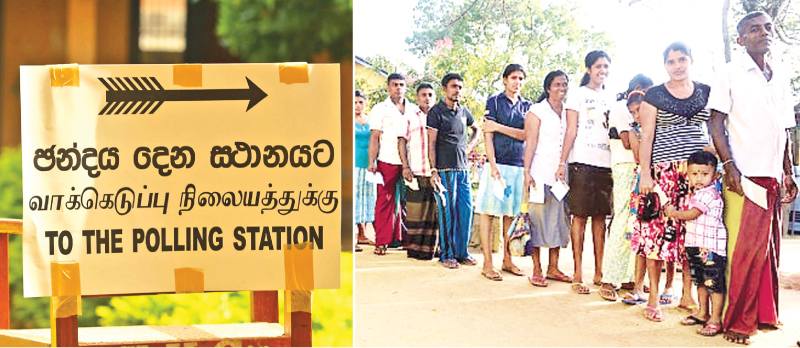
An element of uncertainty still shrouds the prospects of local council elections next year, though paradoxical enough, legal requirements strongly weigh in favour of its conduct.
The Election Commission would have hoped that a final ruling on the matter would come from the Supreme Court, the country’s highest judicial institution. This was based on two petitions filed by opposition political groups seeking an order on the Election Commission to issue a declaration to conduct local elections before March 20. Petitioners in one application were Samagi Jana Balavegaya (SJB) General Secretary Ranjith Madduma Bandara, and Prof. G.L. Peiris, who now heads the Sri Lanka Podujana Peramuna (SLPP) faction Nidhas Janatha Sabhawa. The other is from Sri Lanka Freedom Party (SLFP) General Secretary Dayasiri Jayasekera, Lakshman Kiriella (SJB), Abraham Sumanthiran (Tamil National Alliance), and Anura Priyadarshana Yapa, who heads another faction of the SLPP. Among those cited as respondents are Prime Minister Dinesh Gunawardena and Election Commission Chairman Nimal G. Punchihewa. The SC took up the matter last Friday and put off till January 18 the hearing of the petitions.
This is amidst a deadline of December last week set by the Election Commission for an official announcement on the date of the local council elections. Instead of waiting for an SC determination, there is no barrier now for the Commission to go ahead.
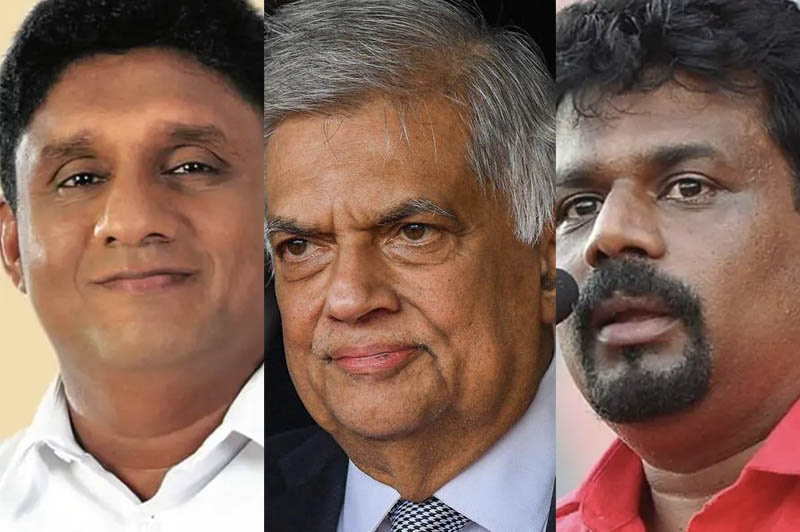
There are two key aspects that make the impending local government elections significant. It would be the first litmus test for President Ranil Wickremesinghe-led SLPP government. Its popularity hit a new low after ex-President Gotabaya Rajapaksa’s mismanagement spawned an unprecedented economic crisis. The ripples caused by it are still being felt with the people being burdened by mounting living costs and thrust into a multitude of other difficulties. Two: It would also be a test of strength for the SLPP which has splintered into at least three different groups so far. A desperate move is being made now to resurrect the party for a future presidential election.
First to the challenge before President Wickremesinghe. He declared earlier that the government plans to set up Jana Sabhas or People’s Councils. Two prime movers of this project are former Speaker Karu Jayasuriya, now head of the National Movement for Social Justice (NMSJ), and Victor Ivan, a onetime Janatha Vimukthi Peramuna (JVP) activist and later Editor of the Ravaya newspaper. They were invited to address the Cabinet of Ministers at a regular weekly meeting on the merits of these new bodies which were meant to replace local councils. Legislation to set up the proposed new councils was to be modelled taking into consideration the Sabhas existent in India. Since then, however, the move has not gained much traction.
Later, President Wickremesinghe saw to the appointment of a Delimitation Commission headed by former Election Commission Chief Mahinda Deshapriya. The appointment was to prune down the number of wards in local councils and halve the number of members from some 8,000. Though the move was originally believed to delay the conduct of local polls, the task of the Commission is now over and will not conflict with it, Deshapriya told the Sunday Times. More on his comments in later paragraphs.
In this backdrop, SLPP parliamentarian Premnath C. Dolawatte, who has been strongly supportive of President Wickremesinghe’s actions, proposed the introduction of a youth quota of representation. This was like the present 25 percent quota that is allotted for women representation. Such a move would have meant new legislation being introduced in Parliament. This gave rise to speculation that the move, if pursued, would also further delay the local polls. This, however, did not become a reality.
President Wickremesinghe is said to be not in favour of early local council elections. This is based on his view that the ongoing economic crisis would have to be overcome before such a task is undertaken. He is said to fear there would be deep divisions that could be caused within the ruling party by early local polls. This is whilst some senior SLPP members say that President Wickremesinghe’s thrust would be to embark on an aggressive economic recovery programme and seek a mandate at a presidential election. “He has hinted at this on occasions,” one of them said.
Of course, such a move hinges on the all-important task of having the International Monetary Fund (IMF) release the Extended Fund Facility of US $ 2.9 billion over a period of 48 months. The past many months and weeks have seen government officials and politicians waxing eloquent on instalments from the EFF being available by December. They have now put off their forecast to January next year and will continue their guessing game thereafter too. However, the fact remains that the matter could be delayed till the first quarter of next year, according to well-informed sources.
Despite the existence of two schools of thought over the local elections, it is highly unlikely the SLPP leaders will make the issue a confrontational one with President Wickremesinghe. Besides the absence of a robust leader in their ranks, the President’s assertiveness and tough positions on some issues have been the main cause. As a UNPer who is closely watching the scene observes, “he (the President) has not been giving in every time there is a demand. He has so far struck what seems a balance. Don’t forget he holds the key on many issues.”
In marked contrast, the SLPP, particularly its prime mover and strategist, Basil Rajapaksa, though wielding less clout now, wants the conduct of the local polls. He is now busy formulating the party’s propaganda campaign and lining up candidates. With the prospect of a defeat in many areas, he believes his party has a distinct advantage over would-be rivals. The United National Party (UNP), though it picked some candidates, is not likely to return a substantial number of winners. Hence, the SLPP’s challenge, is to be ahead of the Janatha Vimukthi Peramuna (JVP)-led National People’s Power.
A government parliamentarian declared last week that the SLPP would contest the local polls together with 15 other parties. According to the Chairman of the Committee on Public Enterprises (COPE), Prof. Ranjith Bandarara, this would include a broad coalition with the UNP. The remarks were made on December 14 when he spoke to the media from the Kandy District Secretary’s Office. The MP’s claims were flatly denied by the General Secretaries of both the SLPP and the UNP. It is ironic that the professor himself should make such an erroneous remark on a matter that is not within his purview. It also reflects badly on his COPE leadership where his predecessor Prof. Charitha Herath avoided such controversial remarks. Here is what they said:
SLPP General Secretary Sagara Kariyawaam: “We have not had any discussion with the UNP regarding contesting the local council election together with them. Lots of people are asking me about this after media reports made claims to that effect. Of course, we are willing to join with anyone to create a better future for the country. That comment does not mean that we are contesting the election together with the UNP or any other party.” Though Kariyawasam made no comment on it, SLPP strategist Basil Rajapaksa has initiated a dialogue with one breakaway group of the SLPP that is led by a onetime left leader. The idea is to settle differences and get together.
UNP General Secretary Palitha Range Bandara said: “We have not officially held any discussions about contesting local elections with the SLPP. What we say is that we will work with any party to develop the country. The President, the party Chairman and the General Secretary have not declared officially anywhere that we would contest the local election with the SLPP. We will always keep the people informed when there is any change. No such change has come about, and those reports are wrong.”
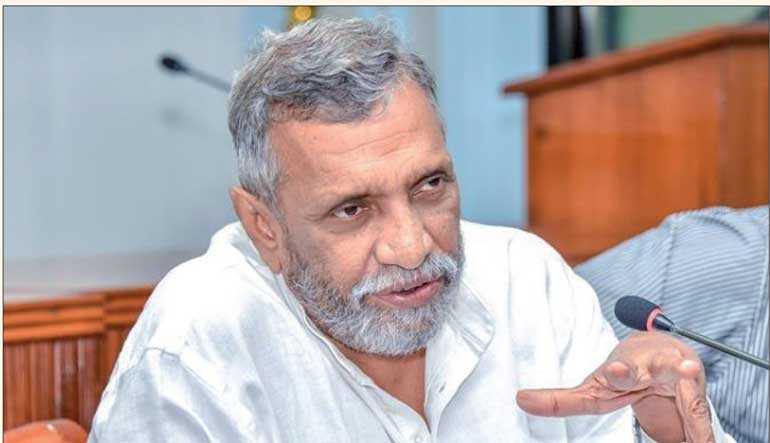
The work to downsize the number of wards in local councils and prune down the composition of members has been completed. “Please do not identify us as a Delimitation Commission. Our real designation should be Amalgamation Commission,” its Chairman, Mahinda Deshapriya told the Sunday Times. He said that some 8,800 seats in all local councils would have to be pruned down to a little more than 4,000. This was one of the mandates given to the Commission after a decision on the matter had been made by the Cabinet of Ministers.
Deshapriya said: “We had to retain the 60:40 ratio. That way, the reduced number would come to 5092. We must leave out 2400 slots. This is now being finalized. As far as I know, nothing will happen to impending local elections. It can only be delayed by Parliament or the Courts. We proposed to conclude our work by February 28. Thus, there are prospects for local elections in May or June. We will sell ice cream including sugar-free ones. Therefore, our services will have to be seen as sweet and not intended to delay or stymie anything.”
The demand to conduct early local polls formed one of four resolutions at the annual sessions of the main opposition Samagi Jana Balavegaya on December 11. It said the people’s sovereignty would be challenged by not holding elections on time. The elections to the local councils should be held before March 20, 2023. Since the People’s Mandate obtained by the Podujana Peramuna from the Presidential Election and the Parliamentary General Election is not in force now, the President and the parties of the Podujana Peramuna to consolidate their power in the executive and legislature are preparing for a repressive regime that suppresses the basic rights of the people of the country, suppressing the mass struggles, suppressing the media. This conference suggests that we should immediately work together with all the progressive democratic forces to force the government to hold the local government elections on time, against all kinds of state repression.”
Formally re-elected leader, Sajith Premadasa calling for the conduct of local elections, declared, “At this moment groups that say that “Unuth ekai, Munuth ekai” (both government and the opposition are the same), are engaged in a big conspiracy to destroy the SJB. At this moment where cowardly regressive forces are engaging in conspiracies against the SJB, I would like to tell one thing — as the son of Ranasinghe Premadasa, Sajith Premadasa would not allow anyone to lay a hand on the party. That is a pledge I would make.”
Another event of political significance was the conference of party leaders held last Tuesday to discuss issues relating to the formulation of a national ethnic reconciliation programme. It has become increasingly clear that a programme will not be able to be finalised in time for February 4, next year, when Sri Lanka marks the 75th anniversary of independence. Last Tuesday’s meeting saw contributions being made by several stakeholders. Some of the significant aspects are reflected in a statement issued by the Presidential Media Division. Here are edited highlights which give one an idea about the vast landscape participants covered and the objectives of those who expressed those views:
“President Ranil Wickremesinghe emphasised that all political parties should come to a common agreement to provide a solution to the ethnic problem by the upcoming 75th Independence Celebration. President Ranil Wickremesinghe revealed this while attending the All-Party Conference held at the Presidential Secretariat yesterday (13) afternoon.
“The President convened this conference with the aim of finding a solution to the ethnic problem through national reconciliation.
“The President addressing the all-party conference, said, “We must all come together to solve the problem in this country. Whether it is called an ethnic problem or something else is not important. We want to provide solutions to these problems. All the political parties came together to find a solution to this and reach an agreement in parliament. Today this party leaders’ meeting was called for that purpose.
“The northern parliamentarians have raised the national issue of the country today. This question can be discussed in two parts. The first is the process of compensation for the missing and investigations. There are many problems that need to be solved regarding the Prevention of Terrorism Act, as well as land. The second is the arrangement required to do legal work related to power devolution. In this regard, the Minister of Foreign Affairs and the Minister of Justice are jointly implementing a special programme. Accordingly, we hope to provide a report on the missing persons and political prisoners. After that, we can talk about devolution.
“The report of the committee headed by Supreme Court Justice Nawaz will be printed in a week. The report includes several proposals. We are also considering the suggestions of the previous reports.
“The discussions at the Human Rights Commission held in Geneva and the international discussions about Sri Lanka are mainly carried out under two factors. We have taken into consideration the reports of the Lessons Learned and Reconciliation Commission, the Udulagama Commission, and the Paranagama Commission.
“All those reports indicated that solutions could be provided for the incidents that happened in the country, but these solutions could not be provided under the mechanism of a foreign country. Accordingly, we had promised to provide solutions to this under a local mechanism, but it has not been implemented.” According to the President, former President Gotabaya Rajapaksa appointed the Nawaz Commission. What was done by that commission was to prepare the necessary programme to provide solutions for this by incorporating the suggestions of the previous commissions. Accordingly, we have a responsibility to implement this mechanism.
“Even the security forces have expressed their interest in implementing this mechanism. The security forces say that some units have been branded differently. A situation has arisen where some divisions cannot even go to UN operations. They expect to prove their innocence, and if something suspicious has happened, they expect the law to be enforced. However, we have not been able to follow such a procedure until now. We think that these can be solved through a local mechanism. You can get solutions for this through the Truth Commission. We have discussed this with South Africa as well.
“It is very good for the North and South to solve this problem. We present a cabinet paper for this. A former ambassador has been appointed as the director general of this committee. This is expected to bring many good proposals by uniting all the Sinhala, Tamil and Muslims living abroad. We hope to provide facilities for that as the government.
“The Ministry of Justice is entrusted with the task of reconciliation in Sri Lanka. Even now, the Office of the Missing Persons is maintained under the Ministry of Justice. We hope to complete all the files here by December 31 of next year. An amount of Rs.100,000 was offered for each missing person as compensation. We are currently considering the property compensation.
There were nearly 11,000 people who lost their birth certificates and identity cards due to the war in the north. We worked to reorganise them. Several mediation programmes in the Northern Province were conducted under the Ministry of Justice. We believe that when these issues are resolved, Sri Lankans abroad will be encouraged to invest in Sri Lanka. The truth-seeking commission is currently underway. The South African government is supporting us in this regard.
“President Ranil Wickremesinghe: “Several issues have been raised about the land in the North. The advisor, the secretary of the Ministry of Lands, and the Chief of Defence Staff, together with the representatives of the people in those areas hope to find a solution to these issues. Currently, there has been progress made. As the discussions progress, ideas can be obtained. That is why this conference was called to seek the views of all the parties. I suggest that we agree on a solution to this issue.”
MP C.V. Vigneswaran: “Looking at this problem from the Tamil people’s perspective, we have three issues. The lands, the missing persons and the presence of so many troops in these areas. People have problems regarding the acquisition of land to various departments. It should be looked into. That is the first thing that needs to be done. This is the first thing and the most immediate thing that needs to be done, as far as our people are concerned.
Then secondly, there are legal provisions, which give us certain rights as it is, especially the Provincial Councils. Not having elections about provincial councils in relation to other provinces, is not going to help consequences in those areas, except for the perks the office-bearers will be wanting to have for themselves. But, as far as we are concerned, we need to have the Provincial Councils looking after our interests is very great. The North and East Provincial Council elections should be held as quickly as possible. Already, lots of lands are being taken over and it’s all being done quite against the law actually and there are various cases pending. So, we need to investigate the question of land grabbing and all that.
“Therefore, we need to be clothed with the rights that we already have and those must be accommodated and those must be brought into effect.
“So, the first one was with regard to the ground situations or the problems, second one is with regard to the rights we already have which needs to be put into effect and the third one of course with regard to the Constitution. As rightly pointed out by Your Excellency, that part of it comes third but they have to be simultaneously attended to if we are to keep to the time limit that your excellency has given as 4th of February next year. But it is not impossible because we already have sufficient documents, sufficient commission reports that have gone into various matters and in fact there are various drafts which have been prepared. So we have to only sit down and work out a final outcome in order to see how we could grant rights of those who have been affected by the constitution so far brought in this country.
“Lastly let me point out, as far as northern and eastern Tamils are concerned, we have a history of over 3,000 years and we have a land of our own, we have the language, culture and even probably the land area is different from the rest of the country. We need to be given that right because it was only in 1833 the British has brought this country together administratively and thereafter, it has been granted, during the time of independence on a platter, more or less, to the majority community. Today people of the northern and eastern provinces are under the boot of the army as well as the majority community in the northern and eastern provinces. All these have to be brought to an end and we need to have a constitution which gives us respect, equality, and the desire to go together as one country in the future.
MP Patali Champika Ranawaka: “In the matter of solving the ethnic problem, there is the ability to make decisions as the executive as well as to make decisions according to both parts of the constitution. The necessary solutions to provide a political solution are decided by the executive. But in matters related to environment and archeology, the relevant law should be applied.”
MP Rauf Hakeem: “Mr. President, while welcoming your initiative to call this meeting, we feel that we could address this issue in a very simplified manner, initiatively at least by taking a resolve to implement the 13th amendment in full as an initial stage before affectivities to be done before the 75th independence. We can then work on other constitutional reforms through a structure that can be created by the all-party conference and to involve the civil society if it is possible. Already people like civil society activist Victor Ivan and others have met us with a structure to look at the issue involving some elements of civil society as well. While saying that I will also just add briefly about the grievances of entire Tamil-speaking population in the North and the East. The day-to-day livelihood issues have been impacted heavily by land grabs not by the army alone but through other departments of the state. Particularly, Wildlife, Forest, and the Archaeology Departments.
“There are a variety of issues which simply doesn’t affect only the Muslim community but also the Sinhalese community and some other parts of the island as well. So particularly when you address the issues, these issues have to be brought up and coming back to some other issues pertaining to the Easter Sunday attacks. There have been attempts to confiscate some of the religious institutions and properties to the state. Local communities are letting it happen because of the presence of the Police. We appeal to you to look at a way of resolving it with the local religious leaders in these areas we know that this aberration with the society has been taking place. All of us are willing to work with the state to resolve these issues. To hand back some of the lands, not just the properties owned by Saharan and his group, but there are other places of worship too that are confiscated. Please look at those issues as well.”
Speaking on behalf of the SJB, parliamentarian S.M. Marikkar said that the talks by party leaders, though they took part, were a distraction to put off local council elections. “They can buy time with this prolonged exercise,” he told the Sunday Times.
However, the main interlocutor with President Wickremesinghe, the Tamil National Alliance (TNA) is serious. It is having two separate meetings with him ahead of the formal talks to discuss core issues, according to Abraham Sumanthiran.
We will be discussing the possibilities of securing the release of political prisoners. Fifteen of them are convicted prisoners and cases against 16 others are those who are detained under PTA,” he said. Another issue which will be discussed, he said, is the land issue where “we are calling on the government to release privately owned land held by the security forces and state agencies.” Also listed is the issue of poaching by Indian fishermen in the Palk Strait as it affects the livelihood of northern fishermen. He added: “However we have our doubts whether solutions to the ethnic issue could be presented and discussed before February 4 as expected by President Wickremesinghe.”