Details emerge on how the 7 Lankans were tortured in Ukraine

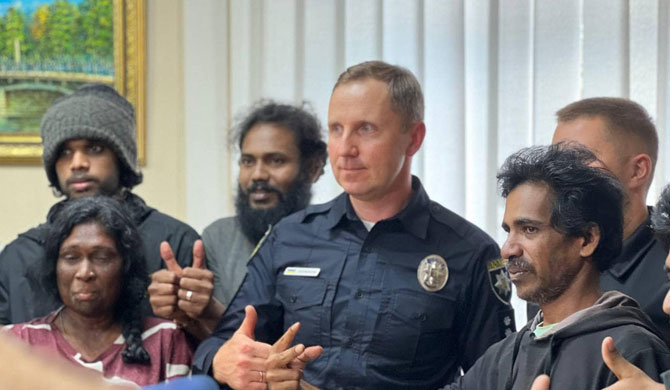
Details have emerged of how the 07 Sri Lankans were tortured at the hands of the Russian Army.

In a Facebook post, Serhiy Bolvinov, head of the Investigative Department of the National Police in Kharkiv Oblast has said that the seven Sri Lankans, which included a woman and 6 men, were in Kupyansk at the start of a full-scale invasion.

They tried to reach Kharkiv on foot but were detained by Russian troops at the first checkpoint. They were bound, and taken to aa makeshift prison in Vovchansk with bags covering their heads.

The post notes that the Sri Lankans were kept in inhumane conditions, and forced to work as cleaners.

The female Sri Lankan had been held in a prison for two months with two of them having their nails ripped off while one was hit by a door on the head.
‘Since the Russians do not communicate in English, so foreigners never understood what actually the Russians wanted from them, and for what they were tortured. The only thing they understood was the Russians said “money” during torture. According to this, the second world army demanded money from detained foreigners from Sri Lanka,’ the translated post states.

After the de-occupation of Vovchansk, foreigners again decided to go to Kharkiv on foot – and on the way they were met by a hotel guard who took shelter and reported it to Ukrainian police.

The Investigative Management is currently conducting investigative actions, interrogating them as victims, and establishing all details. There is already a connection with the Sri Lankan embassy and all the foreigners police have been provided with security and proper residence conditions, the post further states.

Posted in Uncategorized

Sri Lanka’s JVP gen secy makes dubious claim on IMF deal, says loan “pittance”

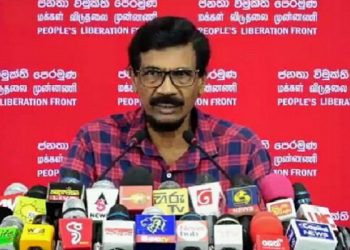
The general secretary of Sri Lanka’s Janatha Vimukthi Peramuna (JVP) appeared to be stoking doubts about the island nation’s deal with the International Monetary Fund (IMF), when he made a questionable claim on Sunday that the multilateral lender’s proposed 2.9 billion US dollar bailout package will amount to pittance.

Tilvin Silva, general secretary of the twice-revolutionary Marxist-Leninist party which now leads a small but popular opposition coalition, said speaking at a rally on Sunday September 18 that Sri Lanka cannot resolve its ongoing debt crisis with more debt.

“The government of [President Ranil] Wickremesinghe and the Rajapaksas has decided to rely on the IMF. The plan is to overcome this crisis by obtaining a loan from the IMF.

“Our country’s crisis is debt. Can a crisis caused by debt be solved by a loan? If the crisis is debt, can the solution be debt? No, it cannot,” he said.

Silva was commenting on the IMF’s recently announced staff-level agreement on a 48-month Extended Fund Facility (EFF) for the crisis-hit Sri Lanka amounting to roughly 2.9 billion dollars, pending IMF board approval.

“A 2.9 billion dollar loan has been proposed — yet to be approved by the IMF board — for four years. That’s 725 million a year, or about 360 million per six months. It costs us 400 million dollars a month to import fuel,” said Silva.

Sri Lanka’s ailing economy cannot be revived with such a “small amount,” he said.

“It’s sochchamak (pittance),” said Silva.

“We cannot resolve this by going to the IMF. We have a crisis of 10, 15 billion dollars,” he claimed.

Sri Lanka, going through the worst currency crisis in the history of the country’s central bank, defaulted on its external debt, around half of which is held by private bondholders, in April 2022. One of the prerequisites for securing the IMF’s bailout package is to successfully restructure this debt.

Analysts say that the IMF staff-level agreement is an important first step in gaining the credibility needed for restructure negotiations with Sri Lanka’s lenders.

More than the loan, experts say, IMF programmes guide countries not to live on borrowings by raising taxes, market pricing goods and sequencing reforms to allow the economy to grow faster. IMF programmes also bring temporary controls on central banks’ ability to print money.

Masahiro Nozaki, a member of the IMF delegation that was recently in Colombo said on September 01 that the IMF progamme, if approved by the board, would also help unlock additional financial support from other multilateral lenders.

Sri Lanka’s main opposition, the Samagi Jana Balawegaya (SJB), has asked that the government table the IMF agreement in parliament, but has not expressed opposition to the programme. The SJB was, in fact, was at the forefront of a campaign demanding the previous government of former President Gotabaya Rajapaksa to go to the IMF before Sri Lanka sank deeper into its crisis.

The country’s leftist parties including the J0VP which have traditionally opposed the IMF and the World Bank have been somewhat vague about their stance on what will be Sri Lanka’s 17th programme with the international lender.

Political analysts say the National People’s Power (NPP), the opposition coalition led by the JVP, has been cautious in its criticism of the latest IMF programme as the demand to go to the IMF has been a largely popular one.

Critics of the party have expressed suspicion that the party is trying to quietly sow public scepticism about the deal before it could succeed.

Sri Lanka to present debt restructuring, IMF bailout plans to creditors – Reuters

Crisis-hit Sri Lanka will make a presentation to its international creditors on Friday, laying out the full extent of its economic troubles and plans for a debt restructuring and multi-billion dollar International Monetary Fund bailout.

Years of economic mismanagement combined with the COVID-19 pandemic have left Sri Lanka in its worst economic crisis since independence from Britain in 1948, causing it to default on its sovereign debt.

The country’s Ministry of Finance said in a statement via legal firm Clifford Chance that an online call on Sept. 23 would be open to all its external creditors and be “an interactive session” in which participants can ask questions.

Sri Lanka’s woes came to a head in July when then-President Gotabaya Rajapaksa fled the country and resigned after violent public protests.

His replacement Ranil Wickremesinghe has managed to reach a preliminary deal with the IMF that if formalised would provide the country $2.9 billion in loans over four years.

“Authorities intend to update their external creditors on the most recent macroeconomic developments, the main objectives of the reform package agreed with the IMF … and the next steps of the debt restructuring process,” the statement dated Sept. 17 said.

Debt crisis veterans cite uniquely difficult elements in Sri Lanka.

The impoverished population that forced Rajapaksa to flee still needs to accept Wickremesinghe, seen by many as of the same political ilk, and who faces a bristling opposition.

The country’s borrowings are so complex that estimates of the total range from $85 billion to well over $100 billion. Perhaps most challenging of all, competing regional powers China, India and Japan must also find common ground on how to reduce debt they are owed by Colombo.

Sabry terms UNHRC resolution ‘divisive’

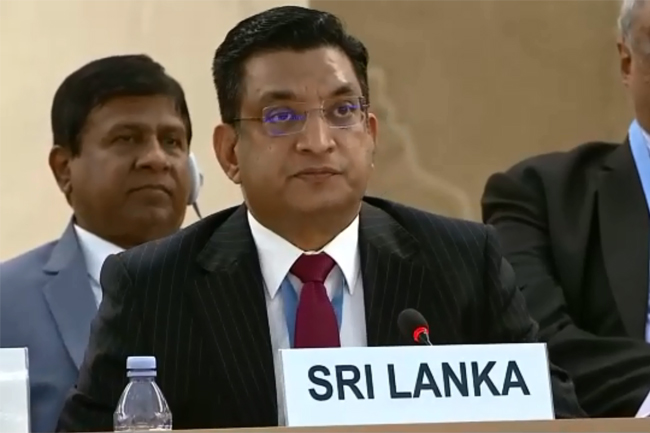
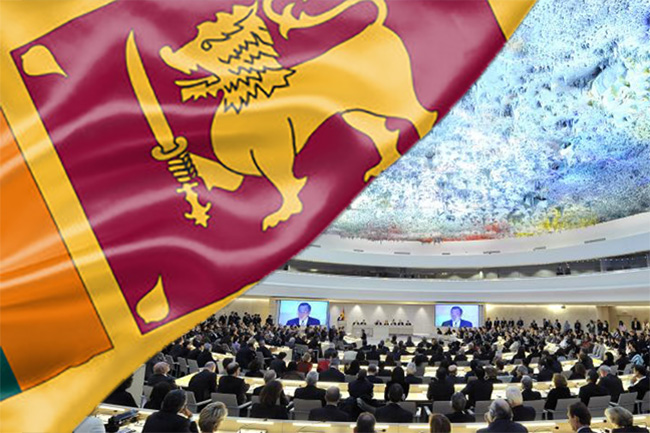
Minister of Foreign Affairs M.U.M. Ali Sabry PC told The Morning yesterday (18) that the draft resolution on Sri Lanka, co-sponsored by the Core Group of countries on Sri Lanka at the ongoing 51st United Nations Human Rights Council (UNHRC) session, is “unnecessary” and “divisive”, and that it will be resisted by the Government of Sri Lanka (GoSL) whether or not it has the votes to defeat it.

When queried by The Morning regarding the Government’s stand on the draft resolution by the Core Group, Minister Sabry said: “We have clearly told them that at this point in time it is unnecessary, and that we don’t want any divisive mechanism. We need the support and blessings of the international community,”

Minister Sabry went on to stress that whether they have the resolution or not, it is the duty of the Government to ensure accountability and reconciliation through the domestic mechanism.

“It is our duty as Sri Lankans to find accountability and reconciliation through the domestic mechanism. This will be continued, but if there is anything beyond that, and any external mechanism that will violate our Constitution, whether we get the numbers or not, we will continue to resist, because we cannot agree on that,” he said.

The fresh draft resolution on Sri Lanka noted the need for power devolution, the conduct of polls, addressing the plight of missing persons, replacing the Prevention of Terrorism (Temporary Provisions) Act, and accountability for protest-related violence, whilst recognising the efforts of the Government of Sri Lanka (GoSL) to address the economic crisis, including the staff-level agreement with the International Monetary Fund (IMF). This newly drafted resolution on Sri Lanka, co-sponsored by the Core Group of countries on Sri Lanka, namely, the UK, Canada, Germany, Malawi, Montenegro, North Macedonia, and the US, was made public early last week.

Meanwhile, commenting on the resolution put forward by four US senators calling for a comprehensive international approach to address the current political and economic crisis in Sri Lanka, Minister Sabry said: “Let us see how that goes, different people are working in this regard.”

This US senate resolution would be brought before the United Nations General Assembly (UNGA), which is to convene in New York this week. US Senate Foreign Relations Committee Chairman Senator Bob Menendez (D-N.J.), with Senators Dick Durbin (D-Ill.), Patrick Leahy (D-Vt.), and Cory Booker (D-N.J.), would submit this resolution.

Minister Sabry also said that he had not held any discussions with the Sri Lankan diaspora organisations while at the ongoing United Nations Human Rights Council (UNHRC) sessions in Geneva, Switzerland.

The delegation representing the Sri Lankan Government, headed by Minister of Foreign Affairs M.U.M. Ali Sabry PC, assured the UNHRC on 12 September that the Sri Lankan Government endeavours to establish a credible truth-seeking mechanism within the framework of its Constitution. The contours of a model that would suit the particular conditions of Sri Lanka are under discussion.

Minister Sabry addressing the 51st UNHRC sessions on 12 September in Geneva, Switzerland noted the recommendations of the Presidential Commission of Inquiry have resulted in progressive amendments to the Prevention of Terrorism Act (PTA), and the release of detainees.

Geneva air turns frostier for Sri Lanka at UNHRC session

Commissioner warns: Fundamental changes vital to meet challenges

When Foreign Minister Ali Sabry strode on Monday morn into Geneva’s UNHRC headquarters at the Palais Wilson to give formal reply to the perennial charges levelled against Lanka, it was blatantly clear that the alpine air would turn frostier toward his Government, even before he ended his uncompromising speech.

Throwing away the olive branch the Yahapalana Government had offered in 2015 to consider its willingness to accept a hybrid tribunal of independent foreign and local judges to inquire into alleged war crimes and other human rights violations, Ali Sabry remained stuck in the same old groove as the previous Rajapaksa Foreign Ministers had been, playing the same scratched record of intransigence at the behest of their master’s voice.

But that had been before the bubble burst.

During the years 2011 to 2014, Lanka was an upward mobile nation, on a spending spree with Chinese finances that freely flowed to wreak the ‘miracle of Asia’ mirage and build the grandiose dreams of its war crowned President Mahinda Rajapaksa who had received a fresh mandate from his adoring people in 2010 and a two-thirds majority in Parliament. China had been the banker to the nation and money was no object. Lanka was on a high and suffered no blushes in showing off her prized baubles of unearned wealth.

So confident did Mahinda Rajapaksa appear to be that the miracle bubble would not burst that he even told the European Union where to get off the bus when it warned him that Lanka risked losing the GSP on its EU exports if it continued to ignore its international human rights obligations.

Rajapaksa responded by stating that the shield of sovereignty — the amulet that protected governments from international censure even if they did their worst to its own citizens — was worth far more than the millions of foreign exchange that would flow from its EU exports to the nation’s coffers.

The Lankan people, draped in the patriotic Lion flag, stood in unison to give a euphoric roar of approval for the President’s brave stance to take on the might of the western world and protect the nation’s sovereignty. Stout hearts that did not wince when it was pimped to China or India in return for dollar loans, now brimmed with pride when it was hailed as inviolate lair.

The bubble would burst and the crash would come ten years later; and leave the same Lankan people beggared beyond belief. China would no longer be the sole bankroller and lender of the last resort but chief debt collector, refusing to accept a yuan less in settlement but determined to recover to the last yuan.

Furthermore, on the political front, the mood in the country has changed dramatically. Human rights and the dignity of citizens have taken deep root in the fertile Lankan soil. The popularity the Rajapaksas and their party, the SLPP, enjoyed barely three years ago has now turned to hate and disgust, the mandate granted now gone with the wind.

Amidst all this, the economic bankruptcy of the nation has driven the present government to seek the succour of the west-dominated IMF for a bailout.

But undaunted by these considerations, Lanka remained defiant in the face of her accusers, led by Britain, in Geneva. The new Foreign Minister Sabry toed the same old Rajapaksa line, against the line his present President Ranil Wickremesinghe had taken as Prime Minister in 2015, when his Government co-sponsored Resolution 30/1 with the US, agreeing to a joint investigation of alleged abuses with participation by Commonwealth and other foreign judges, defence lawyers, authorised prosecutors and investigators.

In 2015, the then Yahapalana Prime Minister Ranil Wickremesinghe had seen no constitutional bar to Resolution 30/1. As reported in the Sunday Times of 27 September that year, he had opined that any perceived barrier could be overcome through reference to Article 13(6) which holds: ‘Nothing in this article should prejudice the trial and punishment of any person for any act or omission which, at the time when it was committed, was criminal according to the general principles of law recognized by the community of nations’.

This article remains intact even after the 20th Amendment. In May 2019, the Government had also co-sponsored a new resolution with Britain, which called for its commitment to implement Resolution 30/1 in its entirety. This was adopted by the session as Resolution 40/1.

When Gotabaya Rajapaksa came into power in November 2019, his Government had formally withdrawn from both resolutions at the very next UNHRC session in March 2020. Announcing that his government was withdrawing from it, then Prime Minister Mahinda Rajapaksa jubilantly declared on February 19, 2022:

“It is because of the historic betrayal committed by the Yahapalana government formed by the UNP, TNA and JVP in co-sponsoring UNHRC Resolution 30/1 in 2015.” Since then Lanka had been on the same Rajapaksa track, followed faithfully this year too.

In her latest report issued last week, the outgoing UN High Commissioner for Human Rights Michelle Bachelet highlighted that Sri Lanka has “consistently failed to pursue an effective transitional justice process to hold perpetrators of gross human rights violations and abuses accountable.”

She also added for good measure that “impunity remains a central obstacle to the rule of law’ and warned: ‘Fundamental changes will be required to address the current challenges’.

Ignoring this call to brush up its act, Lanka’s Foreign Minister Sabry on Monday told the UNHRC, in terse diplomatic jargon, that, “Notwithstanding the severe constraints and challenges, Sri Lanka remains firmly committed to pursuing tangible progress in the protection of human rights and reconciliation through independent domestic institutions.”

What he was saying was, in other words, no hybrid court comprising foreign and local judges, but one filled exclusively by Lankans.

When Government appointed commissions, whether manned by retired judges or public servants or Police DIGs, have lost all credibility, integrity and impartiality even in the Lankan people’s own eyes, it is hard to fathom how such discredited domestic ‘Lankans Only’ tribunals can pass muster in the international domain.

Successive governments have not only made bankrupt the economy through corruption but have also debased and corrupted the body politic by crude political interference that, to insist on ‘domestic mechanism’ will be scornfully held as another shabby attempt to pull the wool over international eyes. To loosely translate an old Sinhala proverb, it will be akin to ‘asking the thief’s mother to read her crystal ball and name who stole the goods’.

Especially in the light of the charge made against Lanka at the start of the session by UNHRC’s Acting High Commissioner when she declared: ‘Successive governments had created political obstacles to accountability, and actively promoted some officials credibly implicated in alleged war crimes, into the highest levels of government’. The fact that the man holding the brief for Lanka at the present session, Foreign Minister Ali Sabry, was the personal lawyer of the former Defence Secretary Gotabaya Rajapaksa, during whose tenure the human rights violations are alleged to have been committed, would not have been lost on the UNHRC Commissioner either.

On Wednesday, the Core Group, led by Britain, made public the draft resolution on Lanka which called for, among others, a new PTA drafted in accord with acceptable international norms and greater accountability. Lanka is on the thin edge of the wedge, having tested the world’s patience to the end of its long tether. Can we afford to let it snap when our economic recovery depends on the world’s goodwill and largess now more than at any time in the past?

Last month Lanka faced a gruelling ordeal to secure an IMF staff agreement. Though hailed as a great victory, it was merely the first in a series of bridges to cross before reaching the final decisive bridge of the IMF Board. But even to cross this initial bridge, there was a heavy toll to pay for its dismal economic record. The Lankan Government was forced to enforce severe economic reforms and warn, ‘many more are on the way’.

Though already flattened by the heavy burdens they bore, the people were summarily told to like it or lump it. The nation’s halcyon days of living it up on borrowed money were over. The day of reckoning had dawned. The hour had struck when the people had to face the stark economic truth.

This month Lanka was forced to run the human rights gauntlet at the UNHRC’s 51st session in Geneva, a bi-annual marathon event in which she had to run for over a decade. By the artful use of delaying tactics and vacillations, helped by three different postures following three changes of governments, Lanka has, so far, been able to successfully ward off the day of the world’s judgment but failed miserably to cleanse her blackened track record on human rights.

The past Rajapaksa regimes — the most to blame of all past governments — had unashamedly played the racial card to the gallery; and, holding it as their primary duty whatever the constitution otherwise decreed, given foremost place to the majority race and promoted and fostered it as the chosen seed in the land. Minority interests were ignored and trampled upon if it collided with the ‘inherent rights’ of the majority.

But it’s a luxury the chosen seed may not be able to enjoy for long. An extravagance, governments will be denied enjoying as an easy sure-fire vote-catcher to win elections and covet cheap glory. Even as it did with the IMF on the economic front, the world, through UNHRC, may impose severe political reforms which the Government will have to accept whether it likes it or lumps it.

Sovereignty is not the freedom of the wild ass. It is not a shield of protection that grants exemption from prosecution, a licence to act with impunity against universally accepted laws in the name of dubious patriotism. The thunder of universal justice transcends the din of national chauvinism.

If the beleaguered Lankan Government with its begging bowl at the IMF table, and heavily dependent on the world’s largess, does not kowtow with UNHRC demands for severe political reforms, then the day of reckoning will soon dawn and the hour will soon strike when it has to face the stark political truth on the value the world places on human rights.

Already the threat has been sounded. On Monday, UNHRC’s Acting High Commissioner, also called on States to pursue alternate strategies to compel Lanka to advance accountability at the international level, including prosecutions based on extraterritorial jurisdiction against leaders and imposing targeted sanctions.

Alas, the much-feared sanctions will not be necessary now. They have been made redundant with Lanka forced to endure self-imposed sanctions in the wake of her economic bankruptcy.

Nemesis always finds a way of visiting even if formally stopped at the gates. Unfortunately, divine retribution has fallen on the people who, having knowingly voted the unworthy to power, must pay for their leaders’ sins.


Posted in Uncategorized

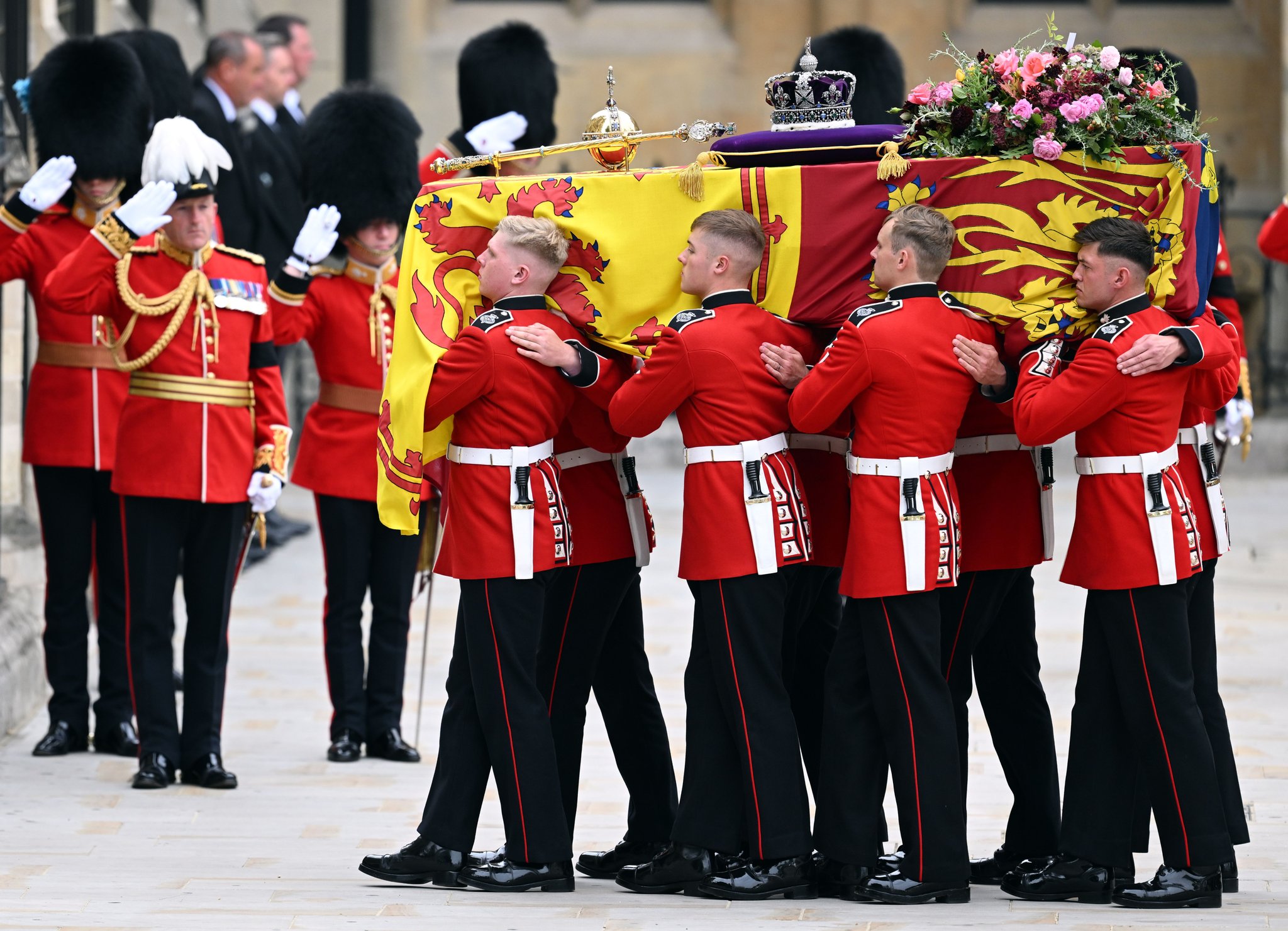
Queen’s funeral: Elizabeth II’s final journey begins

The Queen’s final journey is under way as her coffin is carried by gun carriage to her funeral service at Westminster Abbey.

The King is leading the Royal Family in procession behind the carriage.

Tens of thousands of people have travelled to London and Windsor for the funeral and burial service, which are being watched on television by millions around the world.

Posted in Uncategorized

Journalist alleges van raided by police 24hrs after interview with Prez

A van transporting a journalist and the crew were raided by Sri Lanka police less than 24 hours after an interview with President Ranil Wickremesinghe, foreign correspondent Avani Dias has claimed today (16).

In a twitter post by Dias, she claimed that the crew and herself were covering the ongoing protests in Sri Lanka since the beginning of the year and had interviewed President Wickremesinghe yesterday and in less than 24 hours police stopped their vehicle twice with claims that the crew was concealing someone.

Posted in Uncategorized

Government repression against students performative: IUSF

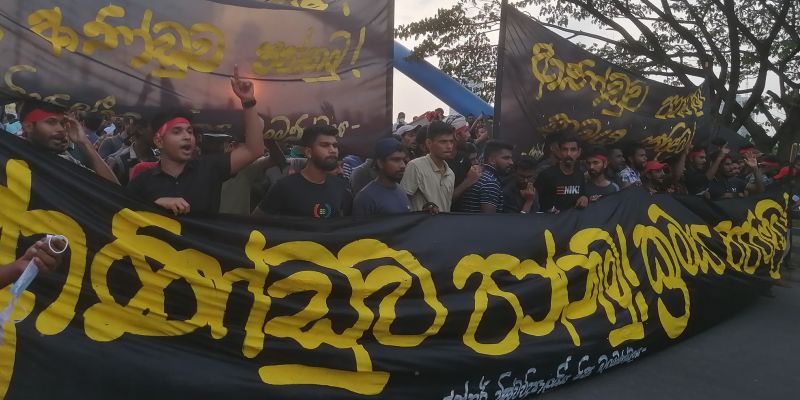
The Acting Convenor of the Inter University Students Federation, Terence Rodrigo alleged that the Government’s acts of repression are performative, and further stated that despite harking about neoliberal values, none of the arrested activists have been presented before Court.

Commenting on why the government was trying to make an example of protesters, Rodrigo rationalized that it is was because the government was unable to provide solutions to the economic and political problems faced by the people of Sri Lanka.

‘Ranil Rajapaksa’s economic reforms are not the answers the people are looking for’, he said, adding that the national resources of the country have been sold by them.

Seven Sri Lankans detained by Russian troops in Ukraine rescued

Seven Sri Lankans detained by Russian troops in Ukraine have been rescued.

Ukraine President Volodymyr Zelenskyy said that the Sri Lankans were rescued after the Kharkiv region was recaptured from Russia.

Russian troops had detained the Sri Lankan students in March.

“Torture chambers where civilians of occupied cities and towns were bullied and premises where people, even foreigners, were kept have been found, the Russian President was quoted as saying.

He said that the Sri Lankans were students of the Kupyansk Medical College.

They had been captured by Russian soldiers in march and were kept in a basement.

Volodymyr Zelenskyy said that the Sri Lankans are being provided with proper medical attention.

Posted in Uncategorized

Sri Lanka considering joining Russia’s payment system Mir – minister

The Sri Lankan authorities are discussing with Moscow the possibility of joining Russian payment system MIR, the discussion is underway between the Central Banks, Sri Lankan Minister of Transport and Highways and Minister of Mass Media Bandula Gunawardena has told Sputnik.

“Yes, yes, our embassy tried to do that because you want to [have] easy payment system… We will try to do that, we can get Central Bank’s approval. After that it will be a success,” Gunawardena said when asked whether the Mir payment system would be launched in Sri Lanka.

The minister added that the discussion is underway between the Central Banks of the two countries, adding that “we must get Central Bank’s approval. After that, we will announce that.”

He noted that the Sri Lankan authorities would like Russian tourists to be able to pay by card while visiting the country.

Visa and Mastercard suspended operations in Russia on March 6 against the backdrop of Moscow’s special military operation in Ukraine. Since then, the holders of Visa and Mastercard bank cards issued in Russia can no longer pay for goods and services outside Russia.

Source: Sputnik