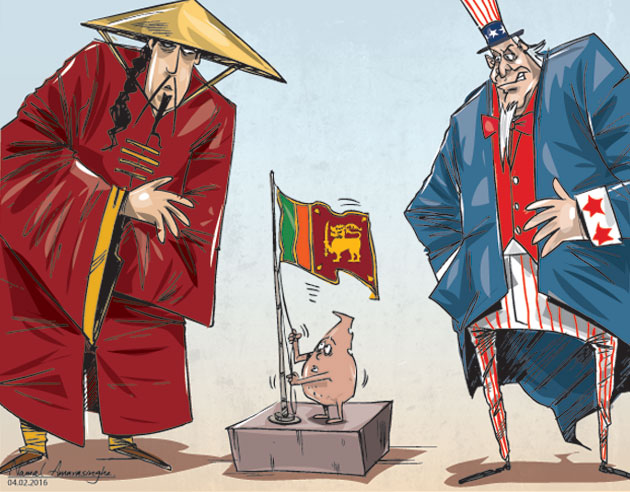
Weerasekera alone refuses to abandon China ship

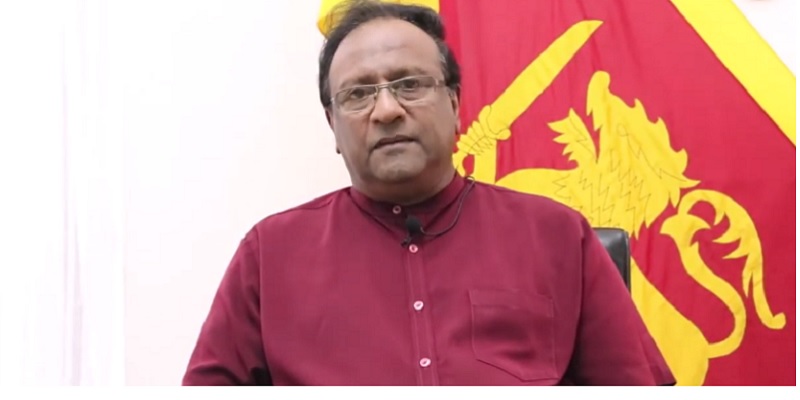
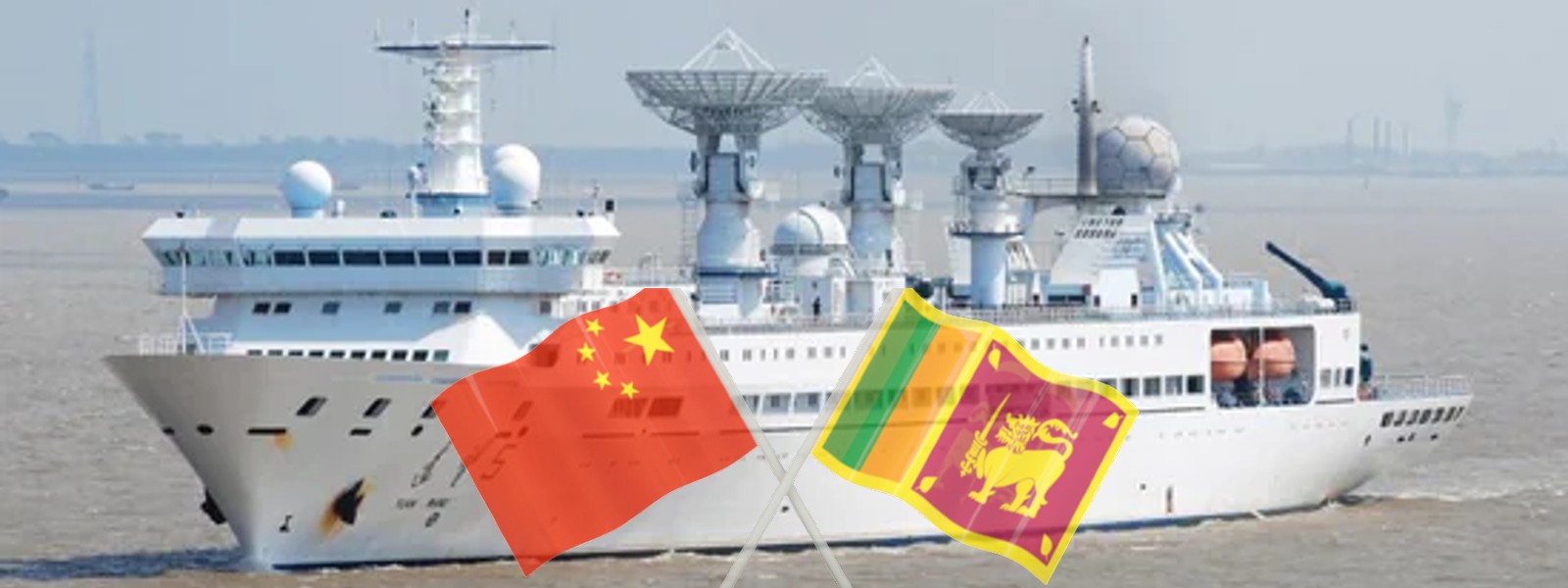
Former Public Security Minister, Rear Admiral (ret.) Sarath Weerasekera, has taken exception to the withdrawal of permission granted to Chinese research vessel Yuang Wang 5 to visit Hambantota port for refueling.

Sri Lanka, in 2017, leased Hambantota harbour to China for 99 years.

The ex-Navy Chief of Staff has raised the issue at hand at the government group meeting, chaired by President Ranil Wickremesinghe, on Monday (08) at the Presidential Secretariat.

Among those present at the group meeting were Prime Minister Dinesh Gunawardena and former PM and MP Mahinda Rajapaksa.

Lawmaker Weerasekera has explained that it wouldn’t be fair to rescind approval at the behest of India after having given the Chinese go ahead on July 12.

Prof. G.L. Peiris had served as the Foreign Affairs Minister at the time the Foreign Ministry granted approval for the vessel to visit Hambantota port.

Since then new President Ranil Wickremesinghe has sworn in Ali Sabry, PC, as the foreign affairs minister after Prof. Peiris chose to join the SLPP rebel group.

Sabry, who held justice and finance portfolios under the then President Gotabaya Rajapaksa, has explained the developments relating to the Chinese ship visit scheduled for Aug 11.

Declaring that the proposed visit was a routine one and posed no threat at all, Colombo District lawmaker Weerasekera alleged that President Gotabaya Rajapaksa had to pay a very heavy price by depending on the US and India.

Except for SLFP MP Dr. Suren Raghavan, who asked for deferment of the visit, other members of the government group had been silent, sources said.

MP Weerasekera has warned that China would be furious with Sri Lanka not with India over the ship controversy.

The naval veteran has also referred to joint military exercises conducted with the US and India over a period of time.

Rebel SLPP members hadn’t participated at the group meeting. However, the National Freedom Front (NFF) has issued a statement strongly condemning the government over its response to Indian pressure.

The MP has queried the Indian intervention in the wake of Chinese Ambassador in Colombo Qi Zhenhong taking it up with President Wickremesinghe.

China throughout the war backed Sri Lanka regardless of change of governments. After the successful conclusion of the war in May 2009, Sri Lanka received Chinese support at the Geneva-based United Nations Human Rights Council (UNHRC) where Western powers continuously undermined war winning Sri Lanka.

Yuan Wang 5 will not enter Hambantota today (11), says Harbour Master; Vessel already in Sea of Sri Lanka

The Harbour Master for the Hambantota Port says that the Yuan Wang 5, a ballistic missile and satellite tracking ship in China’s research vessel fleet, will not reach port today.

He said that no vessel can enter the Hambantota Port without his permission.

The Sri Lankan Foreign Ministry already requested China to defer the arrival of the Yuan Wang 5, a ballistic missile and satellite tracking ship in China’s research vessel fleet.

However, there is no announcement on whether or not this vessel will be allowed to enter the Hambantota Port.

The Yuan Wang 5 left its Chinese Port of Origin on the 14th of July, and until now it has not entered a single port along its route.

The vessel has been sailing for approximately 28 days with zero replenishment.

On the 28th of June 2022, China announced that the Yuan Wang 5 would reach the Hambantota Port and the Foreign Ministry granted approval on the 12th of July.

However, on the 8th of August 2022, Sri Lanka’s Foreign Ministry in a letter to the Chinese Embassy requested for the ship to be delayed, however, the Yuan Wang 5 had already entered the Indian Ocean by that time.

However, the statement from the Foreign Ministry did not specify the reason for such a request.

In recent days, Indian media reports suggested that Indian authorities had voiced their protest against the arrival of the Yuan Wang 5, citing security concerns.

When News 1st made an inquiry from the Indian High Commission in Sri Lanka on Wednesday (10) on this matter, the High Commission said NO COMMENT.

On Wednesday (10) vessel trackers showed that the Yuan Wang 5 was moving away from its course to Sri Lanka, however, on Thursday (11) the vessel was back on its course to Sri Lanka.

The Yuan Wang 5 was approximately 600 nautical miles away from the southern port of Hambantota in the Sea of Sri Lanka as of Thursday (11) evening.

The vessel is now facing the Bay of Bengal from the east of Sri Lanka.

An observation of the course of the Yuan Wang 5 revealed that it was passing over the Ninety East Ridge, a mid-ocean ridge on the Indian Ocean floor named for its near-parallel strike along the 90th meridian at the center of the Eastern Hemisphere.

On Tuesday (9) the Yuan Wang 5 made a slight change to its course and proceeded over the Ninety East Ridge, at low speed.

In 2021, a Chinese government survey ship, the Xiang Yang Hong 03, was operating in the same region in the Indian Ocean and carrying out a search pattern west of Sumatra.

A Pakistan warship is on its maiden voyage to Pakistan while exercising en route with Cambodian and Malaysian navies. The ship is expected to be at Colombo port from August 12-15, 2022.

Chinese built Pakistani-guided missile frigate PNS Taimur to make a port call at Colombo while on its way to join the Pakistan Navy in Karachi, and India too had focused its attention on this vessel as well.

While Sri Lanka permitted the Pakistani guided missile frigate to make a port call at Colombo, it is understood that the ship was denied permission to make a port call at Chattogram port by the Sheikh Hasina government from August 7-10 after making a port call at Lumut port in Malaysia.

Posted in Uncategorized

Occupy Galle Face ‘aragalaya’ no more

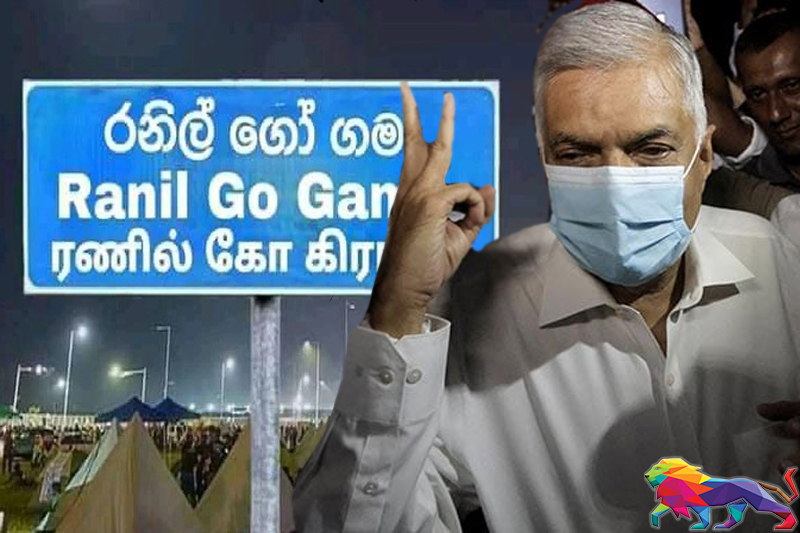
Protestors of the “aragalaya” (struggle) attached to the “RanilGoGama”, formerly “GotaGoGama”, at the Galle Face – whose protest site at the Galle Face Green was vandalised on multiple occasions, and whose activism led to the resignation of former President Gotabaya Rajapaksa and former Prime Minister Mahinda Rajapaksa – have vacated the site which was in operation since early April.

Speaking at a recent press conference, a key and active member of the “aragayala”, Ven. Koswatte Mahanama Thera, said that even though the Occupy Galle Face movement came to an end yesterday (10), the “aragalaya” would however continue in different forms.

“During these four months of the ‘aragalaya’ against the State leadership and politics in the country, we brought every ethnicity together, and had a lot of victories. I think that it’s a considerable achievement. The ‘aragalaya’ that started on 9 April has made many achievements, but now we have to fight against President Ranil Wickremesinghe, his Emergency Law, and the Prevention of Terrorism (Temporary Provisions) Act as amended (PTA), which have to be taken away, and also fight towards abolishing the Executive Presidency, which is of the utmost need at the moment in order for democracy to prevail in Sri Lanka. The political unrest and economic crisis will worsen in this undemocratic system of Wickremesinghe and therefore, we will continue our fight against it “

Further, speaking to The Morning, activist Lahiru Fernando said that more than 43 tents were established at the site, and charged, however, that the majority of the tents had since been stolen by third parties.

“We received tents from donors and we have to give them back, but at the moment, we have only 10 tents left, as the others were stolen.”

The library at the “GotaGoGama/RanilGoGama” has been relocated to a temple in Panadura under the same name.

“We were able to donate around 4,000 books to school libraries previously, and the other books will be stored in a temple in Panadura,” Fernando stated.

The protests focused on the resignation of former President Gotabaya Rajapaksa, and his Government, and the organisers felt it apt to name their site “GotaGoGama” for which they then coined an equally fitting tagline for their entire campaign – “Gota Go Home”. Within a week or two, in April, hundreds of thousands of anti-Government protestors gathered at the Galle Face Green. Maintaining a veneer of unity in a protest zone that continued to host people of almost all ages, from wizened elders to newborn babies, their ability to come together has been their biggest strength. That has reinforced support for their cause from across the country, and the world, making it possible for the organisers to maintain supplies of water, food, and electricity. The “GotaGoGama” site also had a cinema hall, kitchen, press room, facilities for emergency medical treatments, etc.

Meanwhile, four writ applications filed before the Court of Appeal pertaining to an order by the Police regarding anti-Government protestors have been withdrawn. The petitions had been filed calling on the court to suspend the order by the Police for the protestors to vacate the Galle Face protest site. The applicants have withdrawn the four writ applications filed before the court, and have also informed the authorities that they will vacate the Galle Face protest site. Leading protestors similarly announced that they would be leaving the protest site yesterday (10).

Earlier, Colombo Fort Chief Magistrate Thilina Gamage on Tuesday (9) granted bail to eight protestors charged with unlawful assembly, and the obstruction of duties of Police officers at the entry road to the Colombo Fort Magistrate’s Court on 25 May. The suspects appeared before the court in compliance with a notice issued to them previously. Among the suspects were actress Damitha Abeyratne, YouTuber and social activist Rathidu Senarathna popularly known as “Ratta”, actor Jagath Manuwarna, and Ceylon Teachers’ Union (CTU) General Secretary Joseph Stalin.

Posted in Uncategorized

EU tells President to pay special attention to GSP, IMF, & UNHRC

The European Union in Sri Lanka said that it encouraged Sri Lankan President Ranil Wickremesinghe to pay special attention to the GSP+, IMF, and the Human Rights Council.

The EU hopes that concrete steps will be taken by the government to make these processes a success.

They met with the President on Wednesday (10) in Colombo and stressed that the protection of Civil & Human Rights, Freedom of Expression, and Right to Dissent is of utmost importance.

“We agree bringing Sri Lanka back on track requires joint & inclusive action,” tweeted the EU in Sri Lanka.

Posted in Uncategorized

Ex-Sri Lanka President Gotabaya arrives in Thailand for temporary stay: reports

Former Sri Lankan president Gotabaya Rajapaksa arrived in Bangkok on Thursday (Aug 11) for what Thai authorities said would be a temporary stay, after weeks of seeking shelter in Singapore following his ouster since mid-July.

He is believed to have arrived in Bangkok’s Don Mueang Airport around 8pm Bangkok time, via charter plane from Singapore’s Seletar Airport earlier in the evening.

Mr Rajapaksa’s arrival in Bangkok comes as his visa in Singapore expires on the same day.

The 73-year-old former president fled his island nation last month amid months-long protests over Sri Lanka’s worst economic crisis in decades, which has left many Sri Lankans in dire shortage of fuel, food and medicine.

He arrived in Singapore on July 14 and was granted a 14-day short-term visit pass. This was later extended until Aug 11, The Straits Times earlier reported.

His arrival in Bangkok marks the second South-east Asian stop that Mr Rajapaksa has made to seek refuge from the political turmoil in his homeland and the massive protests largely targeted at him.

Thailand received a request from the current Sri Lankan government to allow the former president entry into the kingdom, said Mr Tanee Sangrat, director-general of Thailand’s Department of Information and foreign ministry spokesman on Wednesday.

The consideration was based on long-standing and cordial ties between Thailand and Sri Lanka, he added.

As a holder of a Sri Lankan diplomatic passport, Mr Rajapaksa can enter Thailand without a visa for 90 days, according to the 2013 Agreement on Visa Exemption between the two countries.

“The stay is temporary in nature with the aim of onward travel. No political asylum has been sought,” Mr Tanee said.

The two countries have no extradition treaty.

On Wednesday, Thailand’s Prime Minister Prayut Chan-o-cha said Mr Rajapaksa’s stay was for “humanitarian reasons” and that the former president had promised not to conduct political activities during his stay while seeking political asylum in a third country.

“This is a humanitarian issue. We have made a promise that it’s a temporary stay. No (political) activities are allowed, and this will help him find a country to take refuge in,” Mr Prayut was quoted as saying in The Bangkok Post.

On July 14, Mr Rajapaksa fled to Singapore via the Maldives, and then tendered his resignation soon after landing in Changi Airport.

Singapore authorities had said that the former president was allowed entry to the country on a private visit, and had not asked for, nor was he granted asylum.

His successor, Mr Ranil Wickremesinghe, was sworn in as acting president of Sri Lanka on July 15, with the support of lawmakers from Mr Rajapaksa’s party.

Mr Wickremesinghe has since promised to pass laws to limit the powers of the president – which is one of the protesters’ key demands.

He has also declared a state of emergency that has resulted in the crackdown of protesters and key organisers in the country.

Source: The Strait Times

Posted in Uncategorized

Ranil’s three-stage return and rise to the top

There were many in Sri Lanka and abroad who thought the political life of Ranil Wickremesinghe had been laid to rest after the August 2020 parliamentary elections. The United National Party (UNP) that had Wickremesinghe at the helm for more than 25 years was routed at the polls. For the first time since its inception, the UNP failed to get even one MP elected. The UNP was able to garner only 249,435 (2.15%) votes throughout the Island.

In Colombo district where Ranil Wickremesinghe contested the UNP got only 30,875 (2.61%). Ranil’s share of the preference votes is not known but it is surmised that it would have been less than 15,000. It was a terrible downfall for the UNP leader and five times prime minister whose personal tally at the previous 2015 parliamentary election had been a record breaking 500,566. Also Ranil had never suffered defeat in an election from the time he first entered Parliament as an MP in July 1977.

Viewed against this dismal backdrop, there was much merit in the opinion articulated by political observers and analysts that the 2020 electoral verdict had written the political obituary of the UNP in general and Ranil Wickremesinghe in particular. This may very well have been the case but for two factors. The first was the remarkable resilience, tenacity and political courage of Ranil Wickremesinghe. The second was the consolation prize received by the UNP in the form of a national list MP. The silver lining for the UNP, in the dark cloud of electoral defeat, was that the overall votes gained by the party at the polls, entitled it to a solitary national list MP post.

What has been happening thereafter amounts to an unbelievable exhibition of political wizardry, Wickremesinghe utilised the national list MP slot to engineer a political renaissance. Ten months after the disastrous 2020 election, Ranil Wickremesinghe re-entered Parliament on 23 June 2021 as the UNP national list MP. On 12 May 2022, the lone UNP parliamentarian was appointed Prime Minister by President Gotabaya Rajapaksa. Ten weeks later on 21 July 2022, Ranil Wickremesinghe was sworn in by Chief Justice Jayantha Jayasuriya as the eighth executive president of Sri Lanka. Ranil had been elected president by 134 of 225 MPs in Parliament on 20 July. The poll had been necessitated by the resignation of Gotabaya Rajapaksa.

Thus Ranil Wickremesinghe – for whose political life the death knell had been seemingly rung after the 2020 poll – demonstrated to the world at large that reports of his political demise have been greatly exaggerated as stated once by Mark Twain. In the words of the bard of Avon quoted at the beginning, Ranil has “taken the tide in the affairs of men, at the flood, on to fortune.” In a deft display of strategic calculation and tactical manoeuvring, Ranil Wickremesinghe has reached the pinnacle of power from the depths of defeat.

Ranil’s return and rise to the top in three stages as Parliamentarian, Premier and President will be related in detail in this two-part article. This does not mean that this column necessarily approves or disapproves of what Ranil has done or is doing. This narrative merely places the contours of Ranil’s three-stage political renaissance in perspective. Some of these matters have been related to some extent in my articles in our sister paper “Daily Mirror”. I shall be drawing from those for this article if and when necessary.


August 2020 Parliamentary Election

Politically resilient Ranil Wickremesighe’s return to power has indeed been remarkable. The advent of the August 2020 parliamentary election saw Ranil’s erstwhile deputy leader Sajith Premadasa staging a “coup” and forming the “Samagiya Jana Balawegaya” (SJB). The SJB contested elections under the telephone symbol. Most MP’UNP hitched their wagon to the Premadasa star. Political party allies of the UNP such as the Sri Lanka Muslim Congress (SLMC) Tamil Progressive Alliance (TPA) and the All Ceylon Makkal Congress (ACMC) also switched sides.

The grand old party tasted ignominious defeat at the 2020 Parliamentary poll. The UNP led front obtained 106 seats at the 2015 elections but in 2020 the party failed to get even one MP elected. The UNP polled only 249,435 (2.15%) votes. No MP was elected. Adding insult to injury was Ranil Wickremesinghe’s personal debacle. The UNP leader who had not lost an election from the time he entered Parliament in 1977 was trounced in Colombo district.

Under the proportional representation electoral system the votes it garnered enabled the UNP to nominate a single MP on the national list. Ranil declined nomination and left it to the party to decide upon another nominee. There was keen competition among the UNP stalwarts – who had stood by Ranil through thick and thin – to be appointed as MP on the national list. So much so that the party was in danger of fragmenting again. Finally there emerged a consensus that the UNP leader should be appointed national list MP. Ranil relented and took his oaths as the sole UNP parliamentarian on 23 June 2021.

Sole UNP national list MP

The UNP national list MP episode was illustrative of Ranil’s astute political skills in two aspects. Ranil may very well have desired the national list MP seat though outwardly posturing as not being interested. This led to an intricate situation where the party could not agree upon a nominee and instead opting for Ranil unanimously. The protracted wrangling within party folds to agree upon an alternative to Ranil in the form of a national list MP and the broad consensus reached in appointing him as MP strongly indicated the indispensability of Wickremesinghe to the UNP at this juncture. There would be no potential aspirant to party leadership as is usual after massive electoral loss.

The second aspect was the timing of his re-entry to Parliament. The 2020 Parliamentary election was a terrible defeat for the UNP in general and Wickremesinghe in particular. In 1956 the party got 8 seats in a Parliament of 101 MPs. In 1970 the UNP got 17 seats in a Parliament of 157 MPs. But in 2020 the UNP had only one seat in a Parliament of 225 MPs. It was a crushing defeat.

It may have indeed been very humiliating for Ranil to enter Parliament in such a situation. He may have been harangued mercilessly by both sides in Parliament and the media. The delay in making his re-entry to Parliament made a huge difference. By that time the sheen had worn off both the Government and opposition in Parliament. The lacklustre performance of Sajith Premadasa as leader of the opposition disappointed many. Ranil was sorely missed. He had been a fixture in Parliament since 1977.

Ranil’s re-entry to Parliament

So when Ranil made his Parliamentary re-entry there was no major hullabaloo. Of course there were some jibes and taunts but nothing significant. Soon Ranil began making his presence felt in Parliament. He made many positive contributions. Sadly the country was plunged into an unprecedented economic crisis but those in power kept dilly-dallying.

Wickremesinghe offered valuable suggestions to cope with the economic crisis. These ranged from going to the International Monetary Fund (IMF) to setting up a consortium of countries to help garner more financial aid for Sri Lanka. He also kept warning of acute food shortages and an imminent collapse of the economy. These were not heeded and Ranil was ignored like a voice in the wilderness by the powers that be.

Wickremesinghe made a tremendous impression by participating in the all-party conference convened by former President Gotabaya Rajapaksa to discuss ways and means of dealing with the economic crisis. The chief opposition SJB with 54 MPs boycotted it but the sole MP of the UNP was at the conference. Ranil Wickremesinghe’s exchanges with Ajith Nivard Cabraal exposed the shallow economic policies of the then Central Bank Governor and demonstrated the UNP leader’s better grasp of the economic malady afflicting the nation. When Cabraal resorted to personal attacks, Gotabaya himself apologised publicly to Ranil.

“Gota Go Home” protests

Even as the economic crisis worsened there were widespread shortages of essentials like fuel, gas, food and medicine and enhanced power cuts. People began protesting. The “Gota Go Home” protests at Galle Face Green and its impact transformed the political environment. President Rajapaksa resorted to multiple measures to tackle the situation. While refusing to quit on the basis that he had a mandate given by 69 lakhs of people at the 2019 presidential poll, Gotabaya effected several changes in the government. He replaced the older cabinet of senior ministers with a new one of younger ministers. He fired many officials including Cabraal and appointed a new Central Bank Governor. A team of eminent economists was appointed as advisers. Colombo began interacting with the IMF and World Bank.

Gota also invited opposition parties to help form a new multi-party Government. But the SJB and JVP rebuffed Gota. They insisted that Gotabaya Rajapaksa must resign first and emphasised they would not serve in any Government under President Gotabaya Rajapaksa. In a controversial move Gotabaya began pressuring his brother and former President Mahinda Rajapaksa to resign as Prime Minister to pave the way for a new premier being appointed. The other members of the Rajapaksa clan in Government had all resigned earlier. Mahinda resisted the call to resign. There was a stalemate while a cold war ensued between both brothers.

Events however began overtaking. A meeting was held on 9 May at “Temple Trees” where SLPP members assembled in large numbers and urged Mahinda not to resign. Subsequently some of these “supporters” went on the rampage against the protesters opposite “Temple Trees” and at Galle Face. The protesters were viciously assaulted by the armed SLPP mob which also demolished the structures constructed by protesters. Some SLPP MPs were involved in the attacks. The anti-protest violence itself had been allegedly planned and encouraged by key SLPP personalities.

Counter violence by anti-SLPP mobs

After the initial shock, there was a huge backlash. While the attacks on the protests were universally condemned there erupted counter violence. Anti-SLPP mobs began unleashing violence. The SLPP supporters suspected of being involved in the attack were in turn attacked by organised groups. Some were manhandled and dumped in the Beira Lake. Some of the vehicles in which the supporters were transported to Colombo were identified and destroyed. SLPP Polonnaruwa MP Amarakeerthi Athukorala was set upon by a mob at Nittambuwa and beaten to death along with his personal security officer. Nightfall saw further terror. The residences and businesses owned by many SLPP ministers, state ministers, MPs and prominent party supporters were besieged by mobs. The buildings were looted and set on fire. The Police, STF and military seemed unable or unwilling to curb the violence. Some attacks continued on the next day too. Houses, buildings, businesses and vehicles belonging to over 70 SLPP parliamentarians including present and past ministers were totally demolished or extensively damaged.

Beleaguered premier Mahinda Rajapaksa

Mahinda Rajapaksa had earlier been reluctant to step down as Prime Minister. When news of the attacks on protesters by SLPP mobs was known, Mahinda submitted his resignation. This was immediately accepted by Gotabaya. It was a terrible night for Mahinda and his family. Large crowds gathered outside “Temple Trees” and surrounded the premises on all sides. The beleaguered Mahinda Rajapaksa family was marooned within the “Araliya” abode.

Worse still were the sustained efforts by sections of the mob to enter the premises and attack Mahinda. The gates were breached and mobs stormed in. An arson attack was launched. Around 20 Molotov Cocktails or Petrol bombs were thrown at the building. The fire was doused. Tear gas was fired repeatedly to disperse the mobs. Shots were fired in the air. Finally Mahinda and Namal Rajapaksa with their families were evacuated by helicopter to the Trincomalee naval base. In a further development the ancestral house of the Rajapaksas at Medamulna was attacked and destroyed. So too was the memorial dedicated to the parents of Chamal, Mahinda, Gotabaya and Basil.

There seemed to be no government in existence. Political instability was at its lowest point. All this while the country was in the grip of a debilitating economic crisis. Political stability was essential in negotiations seeking financial assistance from the IMF and World Bank. The newly appointed Central Bank Governor Dr. Nandalal Weerasinghe held a media conference where he warned that unless political stability was urgently restored there was no hope for Sri Lanka to get out of the economic morass. Dr. Weerasinghe threatened to quit as Central Bank governor and return to Australia if the situation was not rectified within a few days.

New Prime Minister needed

President Gotabaya Rajapaksa was in a terrible quandary. Although he was refusing to resign as president, Gota’s credibility and effectiveness was practically nil. He was legally the President but seemed to lack legitimacy in the fast changing political environment. Furthermore Sri Lanka was in dire economic straits. Something had to be done urgently to salvage the economy. For all this a new and efficient prime minister was needed.

When Gota conferred with a few advisers and aides he was told that the most suitable person available among the 225 MPs in Parliament was Ranil Wickremesinghe. Moreover Ranil was acceptable to the international community as well as the global financial institutions. But there was a problem. Gota had had a conversation with Ranil prior to Mahinda’s resignation. In that exchange Ranil had reportedly asked Gota to resign as President. This was not to Gota’s liking.

So President Gotabaya Rajapaksa turned to other alternatives. A choice Gota was very much in favour of was former speaker Karu Jayasuriya but unfortunately he was not an MP. There had been news reports that SJB national list MP Mayantha Dissanayake was going to resign his post so that Karu could be nominated. Mayantha’s brother and former minister Navin Dissanayake is the son in law of Karu Jayasuriya. This resignation however did not take place and there have been reports that SJB leader Sajith Premadasa had vetoed the move.

Gota approached former friend and ex-comrade at arms Field Marshall Sarath Fonseka. The former Army commander turned MP was now a political foe. Nevertheless Gota felt a strong man like Fonseka was needed to handle the violence and collapse of law and order. There was a meeting where Sarath Fonseka reportedly accompanied by Parliamentarian Diana Gamage engaged in talks with Gota. Fonseka however declined to accept Gota’s offer and told the President that he should resign first as a prerequisite. Friend turned foe Sarath Fonseka was unwilling to work as Premier with Gota in the saddle as President.

Gotabaya in sheer desperation turned once again to the Leader of the Opposition. Sajith Premadasa once again refused to be Prime Minister with Gotabaya as President. “Resign first” said Sajith. He was encouraged in this uncompromising intransigence by the cabal of multi-party MPs surrounding him.

With Sajith Premadasa spurning his offer again President Rajapaksa was compelled to turn to Ranil Wickremesinghe. There were lengthy conversations between Gota and Ranil. The chief facilitators were a key official at the presidential secretariat and a high-ranking office-bearer of the UNP.

Tactical shift in Ranil’s stance

Earlier when Mahinda was yet the premier, Wickremesinghe had been asked by the media whether he was planning to join the SLPP led Government; Ranil had retorted, “Why should I get aboard a sinking ship? He had also opined to Gota before that the President should resign. But now Ranil Wickremesinghe made a tactical shift in his stance. He was aware that his political bete noire Sajith Premadasa had declined Gota’s offer twice. Ranil recognised an “opening” here and seized the opportunity.

Ranil revised his earlier position that Gota should quit. Instead of asking Gota to resign, Ranil secured an assurance from the President that the “Gota Go Home” protests should be allowed to continue and not be suppressed. The President reportedly agreed. Obviously the logical conclusion of the “Gota Go Home” protest could only result in Gotabaya going home. What Ranil seemed to have calculated then, was that the “Gota Go Home” protest would ultimately result in Gota resigning. Where Wickremesinghe differed from Premadasa and Fonseka and others was that he did not insist upon Gota quitting as a pre-condition. His shrewd assessment of the situation was that the continuing protests would ultimately succeed in forcing Gota’s resignation.

The second assurance Ranil obtained from Gota was a reduction in Presidential powers. The 21st Amendment would be introduced to bring back the 19 A to replace 20 A. However there would be no Presidential or Parliamentary election until political and economic stability was restored. An agreement was arrived at between Gota and Ranil. Upon hearing that Ranil could become premier, Sajith Premadasa contacted Gota and informed the President that he would re-consider the offer under certain amended conditions. Gota informed Sajith politely that he had already decided to appoint Ranil Wickremesinghe as Prime Minister.

Prime Minister for the sixth time

Ranil Wickremesinghe the lone UNP parliamentarian was sworn in as Prime Minister for the sixth time on 12 May 2022. The appointment caused much controversy. What happened thereafter including the resignation of Gota, burning of Ranil’s residence by protesters, the ascension of Ranil as President and the positive and negative acts of omission and commission by the eighth executive president of Sri Lanka will be delved into in greater detail in the second part of this article.

(The writer can be reached at dbsjeyaraj@yahoo.com.)

Posted in Uncategorized

Estate owners’ challenge to Rs. 1,000 wage dismissed

The Court of Appeal yesterday (9) dismissed the petition filed by the Employers’ Federation of Ceylon (EFC) to revoke the decision taken by the Wages Board of the Department of Labour to increase the minimum daily wage of estate workers to Rs. 1,000.

Accordingly, the written application filed by the EFC in March 2021, requesting the court to quash the daily wage of Rs. 1,000 has been dismissed on the grounds that the Ministry of Labour has followed the proper procedures in instating the rule through the summoning of the Wages Board, said Commissioner General (CG) of Labour Prabath Chandrakeerthi, while speaking to The Morning yesterday.

“The appeal by the regional plantation companies (RPCs) to revoke the decision to pay plantation workers a minimum wage of Rs. 1,000 has been dismissed by the Court owing to the fact that the Department has followed the proper procedure in establishing the rule despite what the RPCs claimed,” said Chandrakeerthi.

Furthermore, he stated that this is applicable to only tea and rubber plantation workers, as determined before.

“This can be considered as a victory for the plantation workers in the country, in which the Department is delighted to have been of assistance,” he stated further.

Additionally, MP Jeevan Thondaman, who is attached to the Ceylon Workers’ Congress, also made a post on Twitter regarding the favourable verdict of the case, thanking the attorneys who appeared on behalf of the plantation workers.

“This is not a permanent solution. The RPCs must come to the table and discuss a collective agreement or an alternative wage model; if not we will be forced to go to the wages board demanding a fair daily wage for the workers. When we were criticised for the Rs. 1,000 not being given to the workers, the unions took the brunt of it. We remained silent as we did not want to comment on an ongoing case. After 17 long months, we have received a favourable verdict (sic),” he said.

Posted in Uncategorized

Vicissitudes of India-Sri Lanka strategic relations By P.K.Balachandran

The current disturbance in India-Sri Lanka relations caused by the proposed docking of the sophisticated Chinese military survey vessel Yuan Wang 5 at Hambantota port is but the latest in a long series of hiccups in Indo-Lankan strategic relations.

The relationship has been seeing ups and downs since the two countries became independent in the 1940s. A factor characterizing the relationship is the difference in the strategic vision of the two countries. India has consistently believed that Sri Lanka is vital for its security in the Indian Ocean Region (IOR), and that the island must be within its political and defense perimeter. In contrast, Sri Lanka has consistently labored under fear of Indian domination or even absorption due to the asymmetry in power, physical proximity, historical links, and ethnic and religious commonalities.

While India has attempted to block the influence of powers thought to be inimical to it, Sri Lanka has cultivated India’s rivals to use them as a check on India’s dominance. The India-Sri Lanka spat over the proposed visit of Yuan Wang 5 to Hambantota stems from the contradiction between these two tendencies.

According to Punsara Amarasinghe, author of a paper entitled “Small State Dilemma” (Open Military Studies 2020), a Lankan leader had said that “the day Ceylon (Sri Lanka) dispensed with Englishmen completely, the island would go under India.” Lankans were disconcerted by Indian scholar-diplomat K.M Panikkar’s 1945 thesis that cooperation between India, Burma and Sri Lanka would be “a pre-requisite for a realistic policy of Indian defense.” He wrote: “The first and primary consideration is that both Burma and Ceylon must form with India a basic federation for mutual defense whether they will it or not. It is necessary for their own security.”

Additionally, according to Amarasinghe: “ Many Indian policymakers and strategists believed that the departure of British power from the Indian Ocean region had enthroned newly independent India as the natural successor to Britain as the guardian of the Indian Ocean.”

In the 1950s, Sri Lanka had declared “neutrality” as its foreign policy. But this was not adequate to appease New Delhi, Amarasinghe avers. An Indian Navy officer Ravi Kaul wrote in 1974: “Sri Lanka is as important strategically to India as Eire is to the United Kingdom or Taiwan to China. As long as Sri Lanka is friendly or neutral, India has nothing to worry about, but if there is any danger of this island falling under the domination of a power hostile to India, India cannot tolerate such a situation endangering her territorial integrity.” More recently, retired Indian National Security Advisor, Shivshankar Menon, described Sri Lanka as a “permanently-stationed aircraft carrier” off the Indian southern coast.

In 1963, Lankan Prime Minister Sirimavo Bandaranaike, touched raised the hackles in India when she signed a Maritime Agreement with China. This was a year after China invaded India. India feared that the Sino-Lankan agreement could acquire a military dimension at a time when India’s navy was still a Cinderella. In 1962-63 India expected Sirimavo to support India in its territorial dispute and war with China, but it was not forthcoming. Her only effort was to make them talk.

In 1971, when Sirimavo faced an attempt by the Janatha Vimukthi Peramuna (JVP) to seize power, India sent choppers to help the Lankan forces. But come December 1971, when India needed her support for the liberation war in Bangladesh, she gave refuelling facilities to Pakistan’s military aircraft. India was rubbed on the wrong side.

After Sri Lanka liberalized its economy in 1977-78, President J.R. Jayewardene joined the Western camp, while India’s relations with the US had soured because of the latter’s support for Pakistan in the Bangladesh liberation war in 1971. After the 1983 anti-Tamil riots in Colombo and the influx of Tamil refugees into Tamil Nadu, India began to back the Tamil militants.

But there was an Indian security/geopolitical dimension to the intervention also. Ex-Indian envoy in Colombo J.N.Dixit wrote: “It would be relevant to analyze India’s motivations and actions vis-à-vis Sri Lanka in the larger perspective of the international and regional strategic environment obtained between 1980 and 1984”. Amarasinghe quotes the then Minister of National Security, Lalith Athulathmudali, as saying: “India wanted to control her surroundings. They had an obsession that Trincomalee was being given as a base to the US.”

In mid-1987, India stopped the advance of the Sri Lankan army against the Tamil Tiger militants. It pressured Jayewardene to sign the India-Sri Lanka Accord in July 1987 and accept an Indian Peace Keeping Force (IPKF). The Accord made Sri Lanka bar forces inimical to India from using its ports and other facilities.

To get even with India, President R.Premadasa armed the Tamil Tigers to help them take on the IPKF. Later, he gave the IPKF an ultimatum to leave. A miffed India refused to give military aid to Colombo when it resumed fighting with the Tigers in June 1990. However, in the final stages of the war in 2007-2009, India helped Colombo defeat the LTTE. A “troika” of top security officials from Delhi and a “troika” from Colombo, facilitated the process.

But there was a change in the Delhi-Colombo security equation with China entering Sri Lanka as a big builder of infrastructure. Among the projects, the deep-water port in Hambantota raised the hackles in New Delhi. In 2010, Alok Kumar and Ishwaraya Balakrishnan said in a paper in the Indian Journal of Political Science: “The construction of this port will bring China within breathing distance of India’s southern coast where sensitive installations, including power plants, are present. It could also help China in keeping a track of India’s nuclear, space and naval establishments in South India and also serving as a listening post”.

India’s apprehensions onIy increased when, in 2017, the port was leased to China for 99 years.

In 2014, a Chinese nuclear submarine “Changzheng 2 had docked in Colombo almost coinciding with the visit of President Xi Jinping. New Delhi saw this as a case of Beijing cocking a snook at New Delhi with Colombo’s connivance. In Indian eyes, the docking violated the Indo-Sri Lanka Accord which stipulated that no port in Sri Lanka will be made available for military use by any country in a manner prejudicial to India’s interests.

But China also has security interests in the Indian Ocean, points out Amarasinghe. Zhao Nanqui, the director of the General Logistics Department of the People’s Liberation Army had said: “We can no longer accept the Indian Ocean as an ocean only for the Indians”. Zhang Ming, a Chinese naval analyst had warned that approximately 244 islands from Indian Nicobar and the Andaman archipelago could be used by India as a metal chain to hinder Chinese ships entering the Strait of Malacca.

When Gotabaya Rajapaksa came to power in 2019, Foreign Secretary Adm. Jayanath Colombage said: “We have to understand the importance of India in the region and we have to understand that Sri Lanka is very much in the maritime and the air security umbrellas of India. We need to benefit from that”.

Indian and Sri Lankan navies have conducted joint exercises nine times under the SLINEX series. Recently, India and Sri Lanka agreed to set up a joint Maritime Rescue Coordination Center (MRCC) with a US$ 6 million grant from India. Sri Lanka would also get a donation of a US$ 19.81 million worth 4,000-ton floating dock, a Dornier surveillance aircraft and a ship repair dock from India.

Sri Lanka became part of India’s Security and Growth for all in the Region (SAGAR) scheme. Maritime Domain Awareness (MDA) is part of SAGAR. But in the case of Yuan Wang 5, Sri Lanka had not shared with India, information about its coming. Hence India’s displeasure.

China ship heading to H’tota reduces speed, course remains unchanged

The Yuan Wang 5, a Chinese vessel used for tracking satellites and intercontinental ballistic missiles, remains in the Indian Ocean.

This is despite the Sri Lankan Ministry of Foreign Affairs confirming that it made a request to defer the visit of the Chinese vessel to Hambantota.

India had repeatedly voiced protest against the vessels arrival citing security concerns, and yesterday the Sri Lankan Ministry of Foreign Affairs said it requested China to defer the visit of the Yuan Wang 5. India also termed the vessel as a Chinese Spy Ship.

It is in this backdrop that Sri Lanka made a request from China to defer the visit of the vessel.

However, on Tuesday the vessel increased its speed and reached a point some 600 nautical miles away from the southern Sri Lankan port of Hambantota.

It is now reported that the vessel abruptly reduced its speed to 5 knots late last night, changing direction towards the Andaman Islands.

However, again this morning the Yuan Wang 5 changed back to its original course.

The vessel that can travel at speeds above any other standard vessel had reduced its speed to 4 Knots.

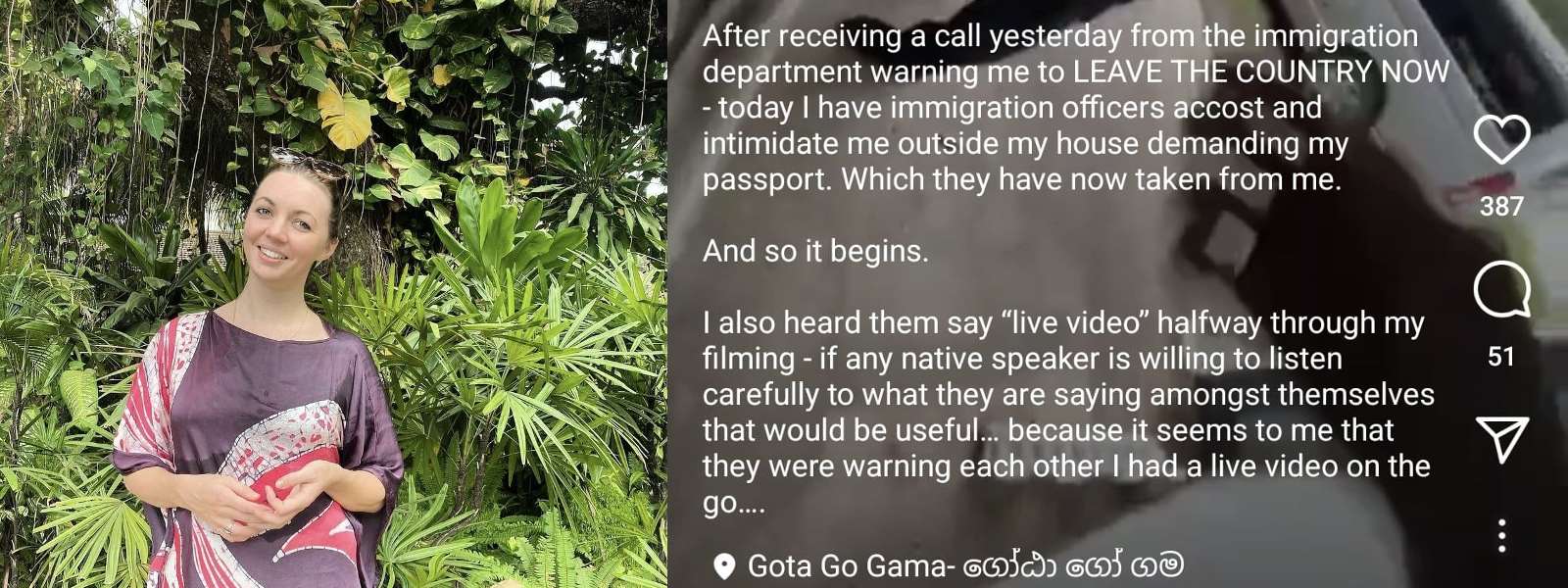
British woman asked to leave Sri Lanka before 15th August for posting Aragalaya Content

The Department of Immigration and Emigration has decided to terminate the VISA issue to British National Kayleigh Fraser, who posted Aragalaya protest content on Social Media.

In a letter, the Department of Immigration and Emigration had informed her to leave Sri Lanka before the 15th of August.

Earlier, The Department of Immigration and Emigration said that the passport of British National Kayleigh Fraser was seized because she had violated her visa conditions.

Kayleigh Fraser was informed to visit to the Immigration and Emigration Department within 07 days for an investigation.

Posted in Uncategorized