Last week’s article was about the guerilla war fought by the Janatha Vimukthi Peramuna (JVP) against the Indian Army in the Trincomalee district. The JVP campaign in Trinco was then led by Kumar Gunaratnam alias “Gemunu”. Gunaratnam later split from the JVP and co-founded the Frontline Socialist Party (FSP). Kumar Gunaratnam alias Kumar/Kumara is currently the leader and general secretary of the FSP.
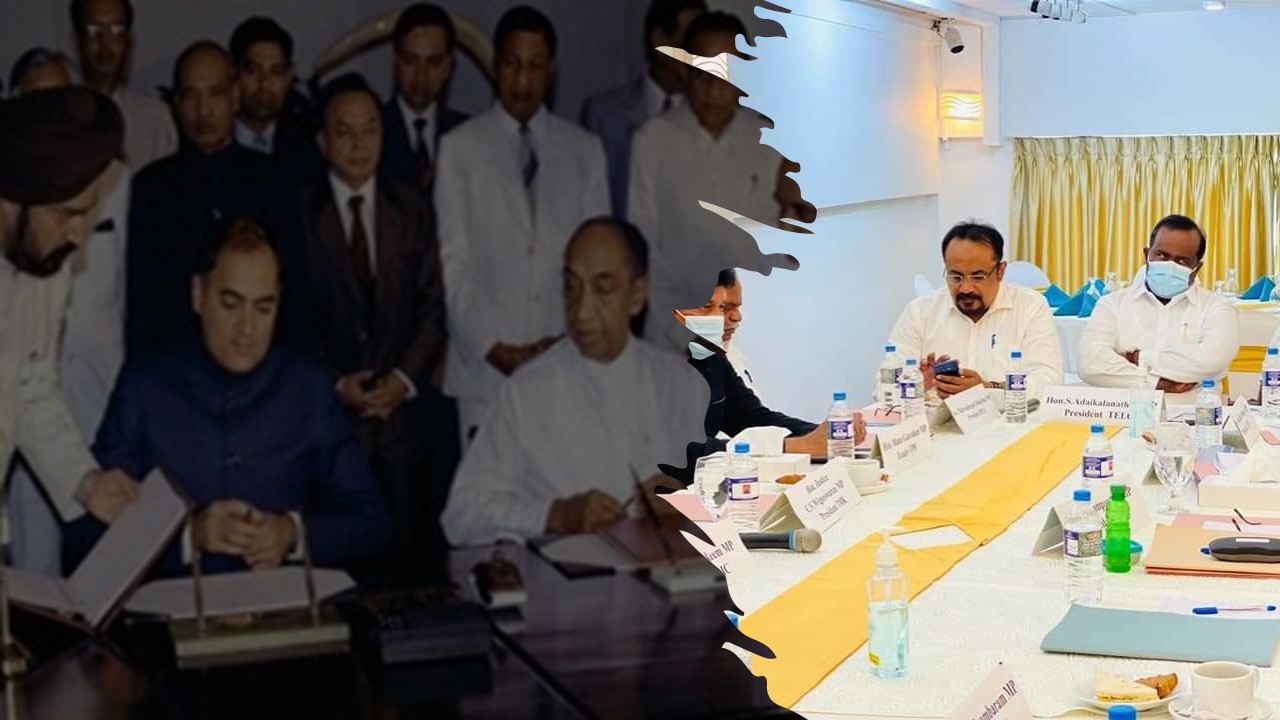
This week’s article focuses on the Indo-Lanka accord. It was in the aftermath of the accord that the Indian Army was deployed in North – eastern Sri Lanka. Yesterday (July 29) was the 35th anniversary of the Indo-Lanka Accord. It was on July 29, 1987 that former Indian Prime Minister Rajiv Gandhi and then Sri Lankan President Junius Richard Jayewardene signed in Colombo the agreement between India and Sri Lanka known as the Indo-Lanka Accord. There was also an exchange of two letters described as annexures.
The accord among other things bestowed upon India the responsibility (shared with Sri Lanka) of ensuring and protecting the security and safety of all communities living in the Northern and Eastern Provinces of Sri Lanka. Clause 2.16(e) says: “The Governments of Sri Lanka and India will cooperate in ensuring the physical security and safety of all communities inhabiting the Northern and Eastern Provinces.”
While the Sri Lankan Government agreed to implement the proposals outlined in the accord, clause 2.14 stated: “The Government of India will underwrite and guarantee the resolutions, and co-operate in the implementation of these proposals.”
The Indo-Lanka Accord provided India a permanent “say” in the affairs of Sri Lanka as it had to underwrite the resolutions and guarantee their implementation. Also, it was – in theory at least – responsible for the safety and security of all people living in the north and east.
The Indo-Lanka treaty has been “forgotten” for many years but nevertheless it remains valid. Provisions of the accord could be activated if and when necessary. Until and unless both countries jointly repudiate it, the Indo-Lanka Agreement will continue to be there. It cannot be unilaterally abrogated by one country.
Even after decades of interaction with our giant neighbour, Sri Lanka is yet to comprehend the nature of relations vis-à-vis India and understand the basics of Indian policy towards it. Sections of opinion within both the Sinhalese and Tamil communities share alike this inability or unwillingness to recognise the reality of what actually prevails at ground level, namely the 13th Amendment (13A) to the Sri Lankan Constitution facilitated by India through the Indo-Lanka Accord.
Interestingly both Sinhalese and Tamil hardliners are united in their opposition to 13A for different reasons. Sinhalese hardliners think the full implementation of 13A provisions would lead to secession while Tamil hardliners opine that implementing 13A would kill the idea of “Tamil Eelam” forever.
If the Tamils were politically astute, they could have accepted the accord as a starting point and then gradually enhanced devolution to the point of quasi-federalism. In this exercise, India would have been on the side of the Tamils
Contours of Indian Policy
It may be appropriate at this 35th anniversary juncture to briefly examine the situation that prevailed in 1987 when the Indo-Lanka Accord was enacted and the events that led to it. It would also be pertinent to delve into the past and focus on the contours of Indian policy towards Sri Lanka that prevailed at that time. I have in the past written extensively on these matters and would therefore rely on some of my earlier writings in this regard.
Indian involvement in the affairs of its neighbours has been described as “benign intervention” by Indian academics and analysts. Generally countries act in their own self-interest but often attribute lofty motives for such actions.
The undermining of the Rana family and empowerment of the Shah dynasty in Nepal, the dismemberment of Pakistan and creation of Bangladesh, the Indo-Lanka Accord and induction of the Indian Army as a peace-keeping force in Sri Lanka and the quick action in the Maldives to crush a coup d’etat aided by Sri Lankan Tamil militants of the PLOTE (People’s Liberation Organisation of Tamil Eelam) are some instances of Indian benign intervention.
All these instances of benign intervention also served India’s interests in the region. Such is the nature of international relations. All countries have their own interests at heart and smaller entities identifying common interests with larger entities and harmonising accordingly have greater chances of bettering the prospects for themselves. In the case of Sri Lanka, the twin tenets of basic Indian policy were preserving the unity and territorial integrity of Sri Lanka on the one hand and ensuring the rights of the Tamils on the other.
The 1983 July anti-Tamil pogrom saw more than 100,000 Tamils fleeing to Tamil Nadu as refugees. The presence of Tamil refugees on Indian soil was the “locus standi” for India to seek a greater role in Sri Lanka. Instead of reaching out to the affected victims of the July 1983 pogrom and alleviating their hardship, the JR Jayewardene regime was hell-bent on appeasing the majority. Blaming the victim syndrome was at its peak.
Sixth Constitutional Amendment
The Government introduced the sixth amendment to the Constitution disavowing separatism. All MPs were required to take an oath to that effect to retain Parliamentary membership. The Tamil United Liberation Front (TULF) with 16 MPs in Parliament refused to take the oath on a matter of principle. As a result, they forfeited their seats. The Sri Lankan Tamil voice was effectively driven away from Parliament.
Several ex-TULF MPs including Opposition Leader Appapillai Amirthalingam took up residence in Tamil Nadu. With more than 100,000 refugees on its soil providing a ‘locus standi’, New Delhi offered its good offices to mediate and bring about a negotiated political settlement. There was an imperative need for India to intervene at that stage.
The Sri Lankan Tamil issue was a crucial emotional issue for Tamil Nadu at that time. There was a fear that the mood may turn volatile and result in a law-and-order crisis. Also there had been a flourishing secessionist movement in Tamil Nadu at one time. It had been checked and transformed democratically. The former Tamil separatists were well integrated into the Indian fabric. Now there was apprehension that the fabric may be torn and separatist tendencies revived because of the Sri Lankan Tamil crisis impacting on Tamil Nadu.
If secession was encouraged in Sri Lanka that could have a demonstration effect on other states including Tamil Nadu in India. If the Tamils were allowed to be continuously victimised in Sri Lanka that too could radicalise Tamil Nadu in the long term. These parameters necessitated in India fashioning policy ensuring both the unity of Sri Lanka as well as Tamil rights.
Interestingly both Sinhalese and Tamil hardliners are united in their opposition to 13A for different reasons. Sinhalese hardliners think the full implementation of 13A provisions would lead to secession while Tamil hardliners opine that implementing 13A would kill the idea of “Tamil Eelam” forever
Three Reasons for Indian Intervention
The fundamental difference in New Delhi policy towards Pakistan in 1971 and Sri Lanka in 1987 was that in the case of the former it suited Indian interests to fracture Pakistan and create Bangladesh while in the case of the latter, Indian interests were better served by preventing dismemberment of Sri Lanka and unifying the island. In short there were three basic reasons for Indian intervention in Sri Lanka then.
Firstly, the JR Government was spurning “non-alignment” and taking Sri Lanka into the pro-Western camp, therefore it was also seen as a Western puppet and lackey. Under prevailing conditions of the day New Delhi feared an arc of encirclement by a “hostile” Washington-Tel Aviv-Islamabad axis. India needed to bring Sri Lanka to “heel” and keep out undesirable elements out of the region. The Tamil issue provided an opportunity to de-stabilise Sri Lanka and pressure Jayawardena into submitting to Delhi diktat.
Secondly, there was the domestic imperative. There was much concern in Tamil Nadu for the plight of Tamils in Sri Lanka. Tamil Nadu was once home to a flourishing separatist movement. India was concerned about the fallout from Sri Lanka on Tamil Nadu if the conflict escalated here.
The third was the unacknowledged personality factor. It is a fact that basic policy is formulated by the bureaucracy in India and the political executive is guided by it. However individual leaders by force of their personality may effect a change in the style of implementation but cannot effectively change the substance of policy.
What happened here was that Indian Prime Minister Indira Gandhi was not very fond of President JR or Prime Minister Premadasa. The United National Party (UNP) made fun of her defeat. When Indira Gandhi and son Sanjay Gandhi lost the elections in the 1977 March Indian elections, the UNP leaders began saying the “cow and calf” will lose here too alluding to Sirimavo and Anura. On the other hand, Indira enjoyed close rapport with TULF leaders, particularly Amirthalingam. The TULF had loyally stood by her in defeat. This personality factor also played a significant part in the politics of that time.
Confluence of Factors
This confluence of factors deemed it necessary that India:
1) Undertake a “benign” intervention in Sri Lanka to help resolve the ethnic conflict within a united Sri Lanka but in a manner acceptable to Tamils;
2) Force Colombo accept New Delhi’s hegemony over the region and appreciate Indian security concerns;
3) Teach the JR regime a lesson while rewarding the TULF.
It was at this point that the July 1983 anti-Tamil pogrom occurred. This created an opportunity for India to step in and offer its “good offices” to bring about ethnic reconciliation. So Gopalaswamy Parthasarathy became India’s official emissary tasked with evolving political rapprochement. But India followed a two-track policy. Tamil militant groups were trained and armed and housed on Indian soil. They were allowed to run political cum propaganda offices in Tamil Nadu publicly.
Tamil Militants as Cutting Edge
India’s objectives were clear. New Delhi wanted to use the Tamil militants as a cutting edge to de-stabilise the JR regime and also exert pressure on Colombo to deliver a political settlement. Once a viable solution was arrived at, the Tamil armed struggle was expected to end. Tamil Eelam was never ever on the cards.
But the Tamils were not to be abandoned entirely. India would underwrite a political solution and maintain a physical armed presence in north east Sri Lanka to protect the Tamils and help to implement the political solution.
Meanwhile Indira Gandhi was assassinated and her son Rajiv Gandhi succeeded her. Rajiv’s ascendancy saw the veteran Gopalaswamy Parthasarathy being ousted as India’s special envoy to Sri Lanka on the Tamil issue. Foreign Secretary Romesh Bhandari functioned as emissary. Despite these changes the basic continuity in policy remained.
There were many twists and turns but India’s strategy worked to a great extent. After the military operation in Vadamaratchy in May 1987 it appeared that Colombo was on the verge of wiping out the LTTE. At that stage India demonstrated very clearly to Colombo that it would not be allowed to crush Tamil militancy. India violated Sri Lankan air space and dropped food parcels over the Jaffna peninsula on June 4, 1987.
To his credit JR read the writing on the wall correctly. He caved into Indian pressure and bowed. The Indo-Lanka Accord was signed on July 29, 1987. That treaty gave India a right to be involved in the affairs of Sri Lanka.
Indo-Lanka Accord
The Indo-Lanka Accord was not perfect. It did not rectify all problems concerning Tamils. But it provided a good and great beginning to a healing process. The Indo-Lanka Accord recognised Sri Lanka as a multi-ethnic, multi-religious nation. Thus, both the mono-ethnic claims of Sinhala supremacists and the two-nation theory of Tamil separatists were negated.
It recognised the Northern and Eastern Provinces as historic areas of habitation of the Tamil and Muslim people where they lived with other ethnicities. Thus, the Tamils and Muslim right of historic habitation was recognised but there were no exclusive rights. The north-eastern region belonged to all ethnicities.
Moreover the opportunity to create a single Tamil linguistic province was made available at that time. Both provinces were temporarily merged with the proviso that a referendum should be held in the Eastern province to either approve or reject the merger.
A scheme providing devolution of powers on a provincial basis was brought in. Provincial Councils with powers allocated on provincial, concurrent and reserved basis were set up. Tamil was elevated to Official Language status. All those convicted of “terrorist” offences were given official pardon. All militants who took to arms were given a general amnesty.
It appeared then that the basic grievances and legitimate aspirations of the Sri Lankan Tamils could be redressed and accommodated if and when the Indo-Lanka Accord was gradually implemented. Besides India was there to underwrite the accord and guarantee its implementation.
13th Constitutional Amendment
The 13th Constitutional Amendment was drafted in Colombo. An Indian Constitutional lawyer was consulted in an advisory capacity. Given the opposition mounted by the SLFP and JVP then it was feared that any Constitutional amendment requiring an island-wide referendum would not be ratified if the Supreme Court decreed so.
Thus the powers and composition of the envisaged Provincial Councils through the 13th Amendment were somewhat restricted. The Supreme Court allowed it without a referendum because of this. Even then the nine-Judge bench was divided five to four.
New Delhi however extracted a promise in writing from JR on 7 November 1987 that he would devolve more powers to the PCs within a specific timeframe. But events took a different turn and this promise was never adhered to by JR or successive regimes. The LTTE fight against the Indian Army escalated. This transformed the situation.
When the accord was signed and Indian soldiers arrived in the Island as “peacekeepers” the predominantly Sinhala “south” protested vehemently. But the Tamils of the north-east welcomed the “jawans” wholeheartedly. Within months the situation reversed when the Tigers took on the Indian Army.
In the words of JR “the referee was now fighting in the ring”. The image of the IPKF underwent a change from that of “Indian Peace Keeping Force” to “Innocent People Killing Force”. When the Indian Army left Lankan shores in 1990, there were a few to mourn its departure.
Convergence of Interests
Primarily, India was acting in its own interest. There was no “identity” of interests between India and the Tamils but there was certainly a “convergence” of interests between both. But this congruence had its limits.
Using the armed struggle for separatism as a pressuring device or bargaining tool was acceptable. But prolonging the struggle for a separate state in defiance of New Delhi was unacceptable. India was all for autonomy within a united Sri Lanka but opposed to Tamil Eelam.
Pragmatically, the best option was for the Sri Lankan Tamils to hitch their “vandil” to the Indian star and accept the settlement provided through Indian efforts. The Tamils had a large support base in Tamil Nadu among fellow Tamils which could have been utilised to pressure New Delhi.
If the Tamils were politically astute, they could have accepted the accord as a starting point and then gradually enhanced devolution to the point of quasi-federalism. In this exercise, India would have been on the side of the Tamils.
“Special” Status for N-E
In practice, north-east Sri Lanka would have enjoyed a “special” status. The N-E would be part of a “de-Jure” Sri Lanka but virtually a “de-facto” extension of India. Let us remember that Indian “media” and “officials” were simply clambering aboard Indian Air Force planes and travelling to and from Palaly and Trincomalee then.
A delicate tightrope walking act was required of Sri Lankan Tamil leaders. If they maintained correct relations with New Delhi and Colombo, they could have elicited the best of both worlds for their people. If Sinhala hardliners ruled the roost in Colombo and adopted a confrontation course with India, a Turkish-Cyprus type of de-facto partition may have ensued.
But these things did not happen. One reason was the shrewdness of JR Jayewardene who gave no cause for India to turn against him. Given the opposition to him in the Sinhala majority south, New Delhi was constrained to bail him out.
On the other hand there was the colossal political stupidity and self-centred arrogance of the LTTE. Not only did it target the Sri Lankan armed forces but also took on the Indian soldiers. New Delhi had no choice other than to fight the Tigers. The IPKF-LTTE war altered the flow of events. War has a cruel logic and powerful momentum that changes things utterly. And then the Tigers assassinated Rajiv Gandhi in Tamil Nadu. The rest is history.
North -East De-merger
Thirty- five years have passed since the Indo-Lanka Accord was signed. The passage of time has seen the Supreme Court ruling that the North-East merger was not done legally. It did not rule out such a merger being validated through appropriate procedures. But both provinces are now separate with their own provincial councils. Police and land powers granted Constitutionally to the PC’s were never implemented. Also, several powers and functions allocated to the councils have been eroded or taken back by Colombo.
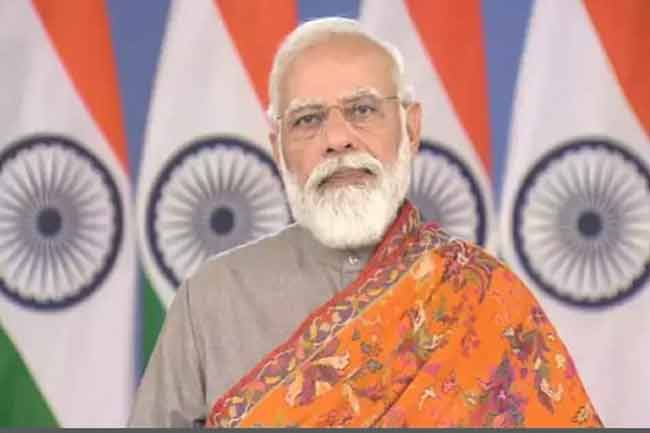
Indian Premier Narendra Modi.
In early January this year, the leaders of seven Tamil parties wrote a joint letter to Indian Prime Minister Narendra Modi. The parties were the TNA, ITAK, TMK, TELO, PLOTE, EPRLF and TNP. In that missive, the Tamil party leaders appealed to the Indian premier to “urge the Government of Sri Lanka to keep its promises to fully implement the provisions of the Thirteenth Amendment to the Constitution”.
Implementing 13A in full
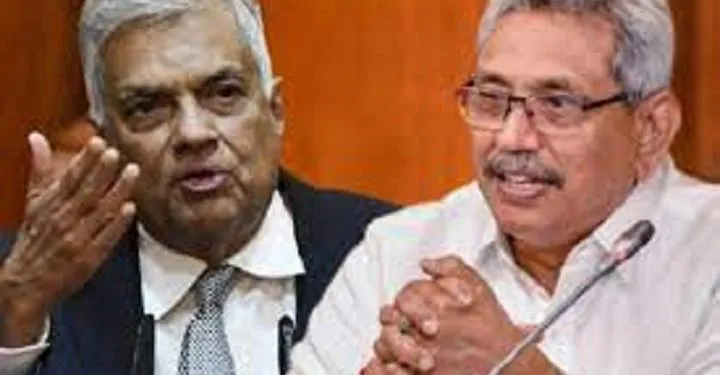
Currently there is a new dispensation in Colombo under President Ranil Wickremesinghe. Relations between India and Sri Lanka have taken a refreshing turn due mainly to India’s economic help to Sri Lanka. The time is opportune for Sri Lankan Tamil political leaders to pursue the goal of implementing the 13th Constitutional amendment in full by interacting with both the Sri Lankan President and Indian Premier.
D.B.S. Jeyaraj can be reached at dbsjeyaraj@yahoo.com