Pakistan High Commissioner visits Kuchchaveli in eastern Sri Lanka

A special welcome was given to the High Commissioner of Pakistan, Major General (R) Farooq Burki HI (M), who visited Kuchaveli Pradeshiya Sabha by Chairman A. Mubarak, Pakistan High Commission in Colombo said.

During this visit, a detailed discussion was held regarding the various developments in the area including Education, Health, Art, and Culture between the High Commissioner and the local hosts.

Kuchchaveli area has been greatly affected by the Tsunami disaster and then the sever impact of Covid-19 greatly affected. Due to this, the livelihood of the people in this area in particular.

Moreover the drinking water problem is considered to be among the huge ones in this area. A public well, constructed with the support of Government of Pakistan as part of public outreach program was also inaugurated in Jaya Nagar, Kuchchaveli.

Sri Lanka become among 10 friendliest countries

Sri Lanka became among the ten friendliest countries in the world at the 2022 Readers’ Choice Awards, the Condé Nast Traveller official website said.

They said the friendliest ten countries were selected while asking the readers to vote for the countries they considered to be home to the friendliest people in our 2022 Readers’ Choice Awards.

From the ever-beaming people of Sri Lanka to the famously open-armed population of New Zealand, our planet is home to some seriously friendly countries, ready to share the love they feel for their country with the world.

French Polynesia has been voted the friendliest country in the world.

The Friendliest Countries in the World:

1. French Polynesia

2. Colombia

3. New Zealand

4. Thailand

5. Costa Rica

6. Botswana

7. Peru

8. Belize

9. Sri Lanka

10. Philippines

Posted in Uncategorized

Truth-seeking mechanism to be based on Gota’s 2021 Prez Commission report

A truth-seeking mechanism is expected to be established before March 2023, based on the final report of the ‘Presidential Commission of Inquiry (CoI) for the Appraisal of the Findings of Previous Commissions and Committees and the Way Forward’ chaired by Supreme Court Judge Justice A.H.M.D. Nawaz, which was appointed by former President Gotabaya Rajapaksa in January 2021.

The final report of the CoI is expected to be released within this month. This CoI was to investigate, inquire into, and report, or take necessary actions, based on the findings of preceding commissions or committees appointed to investigate incidents of human rights violations, serious violations of international humanitarian law, and other such offences. The first report of the commission was submitted to then-President Rajapaksa in July 2021.

Addressing an online forum yesterday (5), Minister of Foreign Affairs M.U.M. Ali Sabry (PC) noted that the final report of the CoI headed by Justice Nawaz is due this month, and that the truth-seeking mechanism will be established based on its outcome.

“Justice Nawaz’s CoI is underway. We are expecting its final report one of these days. Based on that, we would provide some sort of truth-seeking mechanism that is acceptable to the international community. The mechanism will be introduced before March 2023, as we are expecting the commission’s report by this month,” he added.

He also noted that the truth-seeking mechanism will be based on similar mechanisms used in South Africa and South America.

“We cannot state the timeframe of the mechanism. The South African mechanism went on for 20 years. This mechanism should continue to function according to the number of cases. However, establishing the truth-seeking mechanism is vital. We agree that those affected should be able to report their issues. We also understand that if there are any criminal offences connected to these cases, these should be taken to courts,” he added.

Posted in Uncategorized

Paris Club Approaches China, India for Sri Lanka Debt Overhaul -Bloomberg

Paris Club creditors reached out to China and India to coordinate Sri Lanka’s debt-restructuring talks, according to a person familiar with the matter, in an attempt to bring major global creditors together to rework the obligations of emerging economies.

The club, an informal group of mostly rich, western bilateral creditors, is awaiting a response from both countries after it sent an official request in late August to work together, said an official who declined to be identified because talks are continuing.

Coordinating on Sri Lanka may result in the formation of an official creditors committee or simply holding regular meetings to share information on debt treatment, the official said.

Sri Lanka’s presidency said it’s unaware of the efforts by the club. An Asian diplomat in Colombo, Sri Lanka’s capital, confirmed that the Paris Club had been in contact with the country’s non-Paris Club creditors. Chinese and Indian government officials weren’t available for comment on Wednesday due to public holidays.

The formation of an official creditors committee in which China and India agreed to work together with the Paris Club would help Sri Lanka secure a $2.9 billion bailout from the International Monetary Fund.

The Washington-based lender announced a staff-level deal with the government last month and needs assurances from creditors that they’re willing to negotiate a restructuring before its board can give final approval and start disbursing the much-needed funding.

Sri Lanka defaulted for the first time in May and aims to finalize debt-restructuring talks with international creditors by the second quarter of 2023.

The government has said it will ensure transparency and equal treatment among creditors.

The Group of 20 leading economies has so far failed to reach a consensus to include middle-income countries, such as Sri Lanka, in its so-called Common Framework, a plan to reorganize loans owed by the world’s poorest nations that have been plagued by delays since its inception in 2020.

Bringing major creditors China and India to the table would mark a new chapter in global efforts to jointly rework the debt of nations facing soaring financing costs that could trigger a slew of defaults.

Convincing China, the world’s largest official bilateral creditor, to work with the Paris Club would be especially important for developing countries, which have taken tens of billions of dollars of loans from Beijing over the past two decades to build everything from roads and bridges to soccer stadiums and presidential villas.

Sri Lanka has about $50 billion in foreign currency debt, of which about $10 billion is mainly split between China, Japan, and India, according to government data as of December. Japan is part of the Paris Club.

Last month, the Paris Club reiterated its willingness to coordinate with non-Paris Club official bilateral creditors “to provide the necessary financing assurances on time.”

Zambia Model

As a middle-income country, Sri Lanka wasn’t included among nations that could suspend bilateral debt payments that the G-20 agreed to in 2020 to provide relief during the Covid-19 pandemic.

The Common Framework is an extension of that initiative and is being used by Zambia, Chad, and Ethiopia as a mechanism to restructure their loans.

In Zambia’s case, it took about seven months from a staff-level agreement until official bilateral creditors formally communicated their willingness to rework the southern African nation’s debts.

The framework may provide a model for Sri Lanka in its debt overhaul by bringing bilateral creditors around the same negotiating table. That would prevent suspicions often prevalent in sovereign-debt restructurings that one creditor is getting a better deal than others.

“When you moved from a negotiating framework that involved simply Paris Club and commercial creditor representative committees and you added the non-Paris Club bilaterals — China — it became three-dimensional chess,” Lee Buchheit, a veteran of two dozen debt restructurings who’s been consulted by the Sri Lankan government, said in a Sept. 14 webinar. “I can’t see any policy reason why a middle-income country could not attempt on an ad-hoc basis to replicate the common framework approach to negotiation.”


Posted in Uncategorized

Sri Lanka requests Japan to co-chair Sri Lanka debt talks

Sri Lanka has requested Japan to co-chair Sri Lanka’s debt restructuring discussions, President Ranil Wickremesinghe told parliament, while discussions will also be initiated with China.

An earlier version of this story had said, quoting the president, that Japan had agreed to be co-chair of the forurm of creditor nations, but a statement from the president’s office has corrected his speech saying that Sri Lanka had requested Japan to be co-chair.

Sri Lanka has already started preliminary discussions with China.

“After the communist party conference we will start talks with China,” he said.

It is not clear whether China will agree to be the co-chair.

In the case of Zambia, France and China were co-chairs.

Sri Lanka has to first get an agreement with official creditors to get International Monetary Fund approval for an economic reform and bailout plan that is now a staff level agreement.

Sri Lanka has already started discussions with India.

India has given favourable response, President Wickremesighe said.

“We want to get Japan, china and other creditors to agree as soon as possible,” Wickremesinghe said.

“After official creditors we will talk with London Club.”

The London Club is a group of bond holders.

Posted in Uncategorized

President to visit India for key talks with Modi

President Ranil Wickremesinghe is to visit India to have key discussions with Indian Prime Minister Narendra Modi.

The President told Parliament today that he informed Modi of his intention to visit New Delhi for talks.

Wickremesinghe said that he had brief discussions with Modi in Japan recently.

The President said that he had told Modi that he hopes to visit New Delhi for further discussions.

Wickremesinghe did not say when he hopes to undertake his first visit to New Delhi as President.

President Ranil Wickremesinghe said that Sri Lanka has always had the support of the Modi Government.

He said that India has shown interest in helping Sri Lanka recover from the economic crisis.

Posted in Uncategorized

22 A: Amendments accepted at ‘committee stage’ should be subjected to SC approval

Sri Lanka’s former Ambassador to Myanmar, Prof. Nalin de Silva, has said that whatever amendments introduced to a particular Bill at the committee stage should be definitely subjected to the approval by the Supreme Court.

The one-time Mathematics Don has stressed that the Speaker shouldn’t endorse the amended Bill until the Parliament obtained the Supreme Court’s consent.

Prof. De Silva said so commenting on a simmering controversy over Justice Minister Dr. Wijeyadasa Rajapakse, PC, manipulating the committee stage process to introduce new amendments which may not be in line with the Supreme Court ruling on the original Bill on the 22nd Amendment to the Constitution.

Prof. de Silva dealt with the issue at hand as sections of the ruling SLPP, including dissidents, warned against any moves to dilute executive powers to enable the full operationalisation of the 13th Amendment to the Constitution.

The outspoken retired academic has urged the Parliament to introduce an amendment to prevent the Speaker from endorsing an amended Bill, till the Supreme Court approves it.

Prof de Silva last served as Sri Lanka’s top envoy in Myanmar, from 2020 to 2021.

The activist described the absence of provision for the Supreme Court to examine a Bill, following the committee stage, as a major flaw in the Constitution. This loophole should be closed, Prof de Silva said, recalling how successive governments had exploited the committee stage of controversial Bills to pursue their agendas. Prof de Silva cited the passage of the 19th Amendment to the Constitution as a case in point.

Prof de Silva stressed that the Justice Minister’s approval of amendments were certainly not sufficient. Therefore, Supreme Court approval should be a prerequisite for the Speaker’s endorsement, he said.

Having pointed out that the 22nd Amendment had been presented to the public, through Gazette notification, Prof de Silva emphasized that the executive, the legislature and the judiciary were involved in the overall process.

Prof de Silva said that all amendments proposed to the 22 A that would be taken up for vote tomorrow (07) should be defeated. In fact, future attempts to introduce amendments at committee stage of a particular Bill, too, should be thwarted as the Speaker and the Justice Minister whichever party/alliance in power didn’t have the competence to examine the constitutionality of the proposals, Prof de Silva said.

The former diplomat said that the move to dilute executive powers should be examined against the backdrop of President Ranil Wickremesinghe’s failure to secure the required international financial assistance. Declaring that the incumbent government couldn’t obtain at least loans from Western powers let alone grants, Prof de Silva questioned the status of Sri Lanka’s much-touted Staff-Level Agreement with the International Monetary Fund now being contradicted by the government.

Prof de Silva was commenting on Premier Dinesh Gunawardena’s declaration in Parliament on Tuesday (04) that there was only a draft agreement and they were yet to finalize the Staff-Level Agreement with the IMF.

Prof de Silva said that before the finalization of the agreement, the draft agreement should be submitted to the Parliament.

The retired academic said that the government owed an explanation regarding the efforts to introduce constitutional amendments at a time political parties, represented in Parliament, should be concentrating on a tangible economic recovery plan. Prof de Silva asked whether they genuinely expected the introduction of 22 A to the Constitution would really enhance political stability.

Prof de Silva expressed serious concerns about how the powers that be could propose certain amendments at the committee stage of the 22 A with a view to appeasing the Tamil National Alliance (TNA) as well as the Sri Lanka Muslim Congress (SLMC), a constituent party of the main Opposition Samagi Jana Balavegaya (SJB). The retired University Don pointed out the possibility in the government proposing consultations between the appointing authority (the President) and the Chief Ministers in respect of the appointment of Governors of the Provinces. In terms of the Constitution now, the appointment of Governors is the prerogative of the President.

Prof de Silva said that the President couldn’t dilute executive powers enshrined in the Constitution.

Posted in Uncategorized

India’s SpiceJet to fly to Sri Lanka from Nov 15, Aeroflot Oct 09

India’s Spice Jet will begin flying to Sri Lanka from November 15, boosting arrivals from India while Russia’s Aeroflot will also return from October 09, Tourism Minister Harin Fernando said.

Sri Lanka has carried out a promotional campaign in India taking 50 travel industry representatives to key cities to talk to Indian travel industry representatives, he said.

IndiGo Air is already flying to Sri Lanka, he said.

Air India has also doubled frequencies, Fernando said.

The moves are expected to boost arrivals from India.

India became the top generator of tourism after Sri Lanka scrapped visas to the country about 20 years ago. Now visas to Sri Lanka is easily available online.

The European Winter season is also expected to begin from mid-October, he said.

Aeroflot halted flights to Sri Lanka after courts impounded an aircraft taken from an European lessor.

The aircraft was later released.

Sri Lanka Ministers then ‘apologized’ to Russia.

High profile Sri Lankan delegation to visit China

A high profile visit of a Sri Lankan delegation to China was discussed when the Foreign Ministers of the two countries met on the sidelines of the 77th Session of the UN General Assembly.

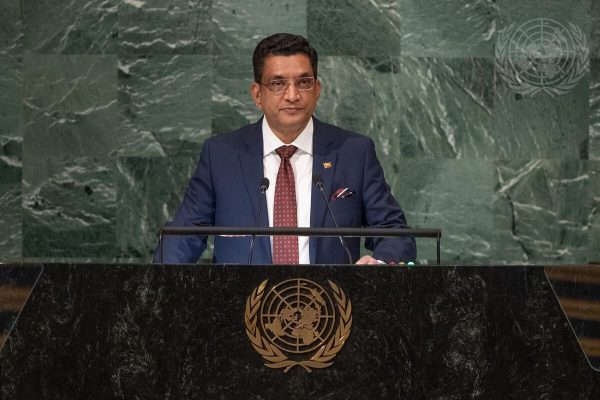
Foreign Minister Ali Sabry had bilateral talks with his Chinese counterpart Wang Yi in New York.

Mr. Sabry told Daily Mirror that a high profile Sri Lankan delegation would undertake an official visit to China possibly in November. However, he did not specify whether it would be at ministerial or presidential levels.

He said the visit would take place once Covid restrictions are eased in Beijing.

“The visit may not take place in October. Possibly it may take place in November,” he said.

China is Sri Lanka’s largest bilateral creditor followed by Japan and India respectively.

Sri Lanka and China have started low level discussions on debt refinancing.

Difficult to compete with powerful nations in UNHRC – Ali Sabry

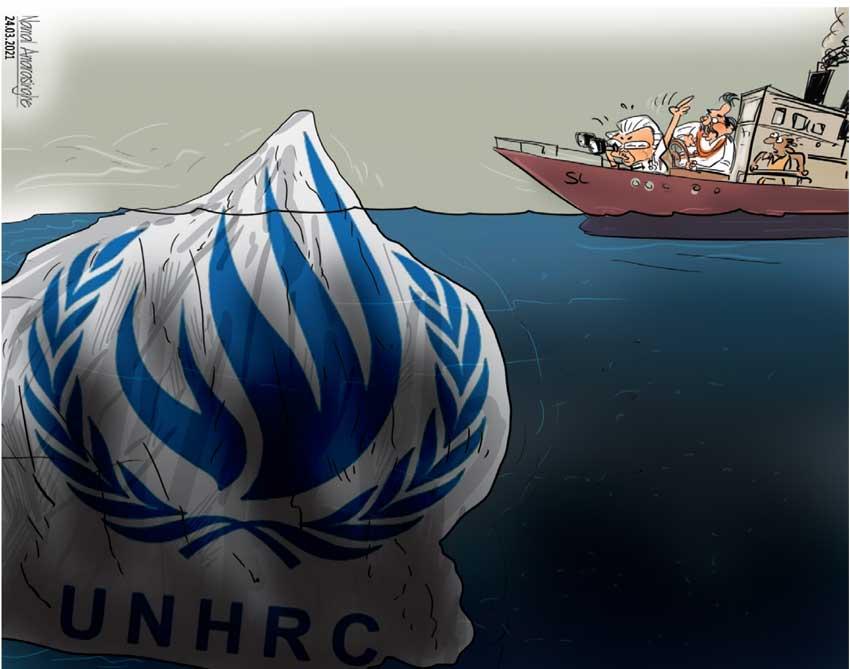
Ahead of the vote on the new UN resolution on Sri Lanka, Foreign Minister Ali Sabry says it is difficult to compete with powerful nations in the UN Human Rights Council (UNHRC).

However, whatever the vote result Sri Lanka will stand firm against the new UNHRC resolution, he said speaking to the media from Geneva.

The final draft of the new resolution on Sri Lanka was submitted to the 51st UNHRC session in Geneva today (05) along with the UN Human Rights High Commissioner’s report on the human rights situation in Sri Lanka.

The draft resolution, titled ‘Promoting reconciliation, accountability and human rights in Sri Lanka’ was initially sponsored by the Core Group on Sri Lanka including the UK, US, Germany, Canada, Malawi, Montenegro and North Macedonia.

It has now been signed also by Albania, Australia, Austria, Belgium, Canada, Czechia, Denmark, Estonia, Finland, France, Germany, Iceland, Ireland, Latvia, Liechtenstein, Lithuania, Luxembourg, Marshall Islands, the Netherlands, New Zealand, Norway, Slovakia and Sweden.

The resolution, Promoting reconciliation, accountability and human rights in Sri Lanka, will be voted this week at the UN Human Rights Council in Geneva.

The draft requests the Office of the High Commissioner for Human Rights to enhance its monitoring and reporting on the situation of human rights in Sri Lanka, including on progress in reconciliation and accountability and on the human rights impact of the economic crisis and corruption.

The office has also been requested to present oral updates to the Human Rights Council at its 53rd session and 55th sessions and a written update at its 54th session and a comprehensive report that includes further options for advancing accountability at its 57th session in 2024.

The new resolution also expresses concern over the human rights developments since April 2022 including violence against and arrests of peaceful protesters as well as violence against government supporters, resulting in deaths, injuries, destruction and damage to houses of MPs.

The resolution has also sought to extend and reinforce the capacity of the Office of the High Commissioner to collect, consolidate, analyse and preserve information and evidence and to develop possible strategies for future accountability processes for gross violations of human rights or serious violations in Sri Lanka.

On October 6, there will be a vote in the UN Human Rights Council (UNHRC) on the resolution on the human rights situation in Sri Lanka. However, Sri Lanka is expected to lose the vote as it did in March 2021.

Posted in Uncategorized