Sri Lanka Seeks to Strengthen Relationship With PACAF and Quad

The tiny Indian Ocean island of Sri Lanka has an outsize geostrategic importance, and its military seeks deeper ties with Pacific Air Forces for maritime security and disaster relief while not roiling China, a senior Sri Lankan Air Force official told Air Force Magazine.

Just 34 miles off the coast of India at its closest point, Sri Lanka aims to further professionalize its Armed Forces and capabilities at a moment when PACAF is seeking to strengthen regional partnerships.

The Sri Lanka Air Force, 30,000 strong, has sought to work more closely with PACAF and is willing to participate in some exercises of the Quadrilateral Security Dialogue, commonly known as “the Quad” grouping, which includes Australia, the United States, Japan, and India.

“We are very concerned about the status quo of the region,” Sri Lankan defense attache Air Vice Marshal Sampath Wickremeratne told Air Force Magazine in a recent meeting at the Embassy of Sri Lanka in Washington, D.C.

“We are very careful, and we do not agitate [any] of the power players in our region,” he said, stressing Sri Lanka’s unaligned status. However, Sri Lanka is worried about shifting security trends in the Indo-Pacific. “There was a status quo, then China coming up with their programs. They are building influence in the region.”

Wickremeratne acknowledged that the United States’ presence in the Indian Ocean traces to the 19th century, and he described China as a “close distant friend,” reflecting its close ties to Sri Lanka while geographically separate.

Sri Lanka’s territorial defense force consists of fewer than 10 fighter jets divided into two small squadrons of Israeli Kfir and Chinese Chengdu F-7G fighters, a licensed version of the Soviet MiG-21 that had been used to contain terrorist groups in the north and east of the island during the insurgency.

The Sri Lanka Air Force’s transport fleet includes two grounded C-130s that lack spare parts due to past U.S. sanctions, the attache said. It relies instead on the Soviet-era Antonov AN-32 and the Chinese-made Xian MA-60. Its helicopter fleet is a mix of Eastern and Western origin, including the Soviet-era Mi-17, Mi-24, and Mi-35 and the American Bell 212, Bell 412, and Bell 206.

For intelligence, surveillance, and reconnaissance, Sri Lanka uses American-supplied Beechcraft turboprop planes.

During the years of internal fighting, many Western countries distanced themselves from defense ties with Sri Lanka, but the country now aspires to reengage globally and strengthen its ability to patrol its territorial waters, which are often used for drug and human trafficking, and illegal fishing.

“We use the satellites and the cloud, and we monitor the dark ships,” Wickremeratne said of illegal vessels.

“For drugs, people recently have used Sri Lanka as a hub for transiting from east to west, from the Afghanistan side to [the Association of Southeast Asian Nations] side,” he said. “The Air Force plays a very big role in that because of the speed, reach, and the height. We are able to react sooner than the other forces.”

Now, Sri Lanka aims to develop its transport and ISR capabilities to better respond to humanitarian and disaster relief and to enhance maritime surveillance, an area where PACAF has shown interest in strengthening collaboration.

One way the attache said Sri Lanka can more closely support PACAF’s goals is by allowing the placement of ISR assets such as the U.S. Department of Transportation application SeaVision or Hawkeye 360, a commercial company that gathers radio frequency data from satellite constellations.

Sri Lanka already partners with India, Australia, and Japan regionally.

“We are getting a lot of support on maritime security,” Wickremeratne said of ties with the United States.

Sri Lanka’s position on participating in Quad activities, and to a lesser extent, those of the newly formed AUKUS group of Australia, the United Kingdom, and United States, is delicate. Sri Lanka agrees with the group’s objectives to maintain the international order, including maritime boundaries, in contrast to China’s numerous, ongoing maritime disputes and aggressive action in the air and the sea.

“Whatever the security structures that are going to be placed in the Indian Ocean region, we would like to play a part of it, but not in a very military angle,” he said, proposing subject matter exchanges, technology, and intelligence sharing. “Anything that we can take and make our territorial security more powerful.”

Inquiries to the PACAF Sri Lanka desk officer were referred to U.S. Indo-Pacific Command, which did not respond to requests for comment by Air Force Magazine.

Command Chief Master Sgt. for Pacific Air Forces David R. Wolfe said PACAF is working on ways to meet Sri Lanka’s defense needs and to respect its neutral status.

“All we’re trying to do is help every country take whatever the next step is for them,” Wolfe told Air Force Magazine at the recent Senior Enlisted Leader International Summit outside Washington, D.C., which did not include the participation of Sri Lankan enlisted officials.

“There’s a very loosely tied, like-minded group of countries that each country for a different reason engages at a different level,” he said. “If they have fears about the geopolitical environment, [we need to] try to allay those fears the best we can, and then find what is the next step for them.”

On the enlisted development side, PACAF aspires to help Sri Lanka grow the education and retention of its enlisted corps with opportunities to reach leadership positions. Wickremeratne admitted that after the country’s conflict period, many former soldiers were released into society without job opportunities.

Sri Lanka’s geographic position is also valuable to PACAF.

“Maritime surveillance is a need,” Wolfe said.

“Interoperability is the main thing that we want with all of the countries, and Sri Lanka is no different,” he said. “Humanitarian assistance and disaster relief is our most likely five-meter target, the most likely need. I mean, that can happen tomorrow, right

Posted in Uncategorized

Sri Lanka’s runaway ex president to return on Aug 24, 25: cousin

Sri Lanka former President Gotabaya Rajapaksa who fled the country in early July following a wave of protests will be returning to Sri Lanka on August 24 or 25, a family member and former diplomat said.

Ex-Ambassador to Russia Udayanga Weeratunga, who is a cousin of the former president, told EconomyNext on Wednesday August 17 that Rajapaksa will return to Sri Lanka next week.

“It is confirmed that the former President will be returning to the island on 24 or 25th of this month. If nothing changes, he will be here.

“According to the constitution, he will receive protection and other facilities. I assume a house will be prepared for him here as well,” said Weeratunga.

Former President Rajapaksa, who fled the country after protestors stormed his official residence in Colombo, is currently in Bangkok, Thailand. He arrived there on August 12 after a brief stay in Singapore.

Rajapaksa resigned from the presidency after mass protests against the worst currency crisis in the history of the island’s intermediate regime central bank.

Research vessel docking at Hambantota Port doesn’t affect any country: China

China on Tuesday said the activities of its high-tech research vessel will not affect the security of any country and should not be “obstructed” by any “third party,” as the ship berthed at Sri Lanka’s strategic southern port of Hambantota amid Indian and US concerns.

Chinese Foreign Ministry spokesman Wang Wenbin said the ship ‘Yuan Wang 5’ has successfully berthed at Hambantota Port with active cooperation from the Sri Lankan side.

Wang parried a question of extending financial support to Sri Lanka, which went bankrupt defaulting on USD 51 billion in foreign debt which included loans from China.

He said that when the ship arrived, the Chinese Ambassador to Sri Lanka Qi Zhenhong hosted the onsite welcoming ceremony at the Hambantota port, which Beijing took over on 99-year-lease as a debt swap in 2017.

Apparently, referring to Indian and US concerns over the ship with military applications berthing at the Hambantota port in the Indian Ocean, Wang said, “I want to stress again that the marine scientific research activities of the Yuan Wang-5 ship are consistent with international law and international customary practice.”

“They do not affect the security and economic interests of any country and should not be obstructed by any third party,” he said.

He said the ceremony was attended by a representative of Sri Lankan President Ranil Wickramasinghe besides more than ten heads of parties and heads of friendly communities.
The atmosphere was warm and welcoming, as Chinese and Sri Lankan national anthems were played, and the Sri Lankan people performed the traditional folk dance on the red carpet, he said.

It will take some time for the Yuan Wang 5 research ship to complete the replenishment of necessary supplies after the docking, hinting that the vessel may be there for a while.

The Sri Lankan government, which earlier asked the Chinese government to delay the arrival of the ship after India and the US reportedly expressed concern over its specialised in satellite and ballistic missile tracking, finally granted the port access to the vessel from August 16 to 22.

On Monday, Wang declined to reveal details of talks with Colombo leading to the bankrupt island’s government reversing its earlier stand to defer the high-tech vessel’s entry. “As for the specific questions that you raised, we have mentioned China’s position quite a few times,” Wang said when asked about what were the consultations that were held.

After Sri Lanka asked China to defer the entry of the ship, Beijing on August 8 reacted angrily saying it was “completely unjustified” for certain countries to cite the so-called security concerns to pressure Colombo and “grossly interfere” in its internal affairs.

The ship with over 2,000 crew has advanced facilities to track satellites and ballistic missiles, according to the Chinese official media accounts.

Sri Lanka said it permitted the ship after extensive consultations. Colombo’s permission has also raised speculation that Beijing could make a positive announcement about Sri Lanka’s previous request to defer the loans it owed to China and its plea for bridge financing to tide over the crisis until it received International Monetary Fund (IMF) support.

Asked, now that the ship has been permitted to dock and whether China will provide the much-needed financial assistance to Sri Lanka considering its economy was in dire straits, Wang on Tuesday said, “as we have stressed many times, as Sri Lanka’s friendly neighbour, China feels deeply for the economic and social difficulties facing Sri Lanka at the moment.”

China has been doing its utmost to support and help Sri Lanka pull through the difficulties. This is what we have been doing and what we will continue to do, he said.

China, which has extensive investments in Sri Lanka running into billions of dollars, has provided USD 73 million in aid and shipments of rice but maintained a steady silence on Colombo’s request for a bailout package as it became bankrupt after running out of foreign exchange reserves in April this year.

China is the main creditor of Sri Lanka with investment in infrastructure. Debt restructuring of Chinese loans would be key to the island’s success in the ongoing talks with the IMF for a bailout.

Wang pointed out that China and Sri Lanka are traditionally friendly neighbours. For years, the two countries have maintained close cooperation in marine scientific research.

“China is ready to work with the Sri Lankan side to consolidate political mutual trust, deepen win-win cooperation and promote the sound and steady development of the bilateral relations,” Wang said.

The southern deep-sea port of Hambantota, which has been developed largely with Chinese loans, is considered strategically important because of its location. India has said that it carefully monitors any development having a bearing on its security and economic interests.

New Delhi is concerned about the possibility of the ship’s tracking systems attempting to snoop on Indian installations while being on its way to the Sri Lankan port. India has traditionally taken a stern view of Chinese military vessels in the Indian Ocean and has protested such visits with Sri Lanka in the past.

The ties between India and Sri Lanka came under strain after Colombo permitted a Chinese nuclear-powered submarine to dock in one of its ports in 2014.

India’s concerns have been focused on Hambantota Port in particular. In 2017, Colombo leased the southern port to China Merchant Port Holdings for 99 years, after Sri Lanka was unable to keep its loan repayment commitments, fanning fears over the potential use of the port for military purposes.

The Chinese Foreign Ministry on Monday said it was “completely unjustified for certain countries to cite the so-called security concerns to pressure Sri Lanka.” India on Friday rejected China’s “insinuations” that New Delhi pressured Colombo against the planned visit by the Chinese research vessel, but asserted that it will take decisions based on its security concerns.

External Affairs Ministry Spokesperson Arindam Bagchi said in New Delhi that Sri Lanka, as a sovereign country, makes its own independent decisions and noted that India would make its judgment on its security concerns based on the prevailing situation in the region, especially in the border areas.

Source: PTI

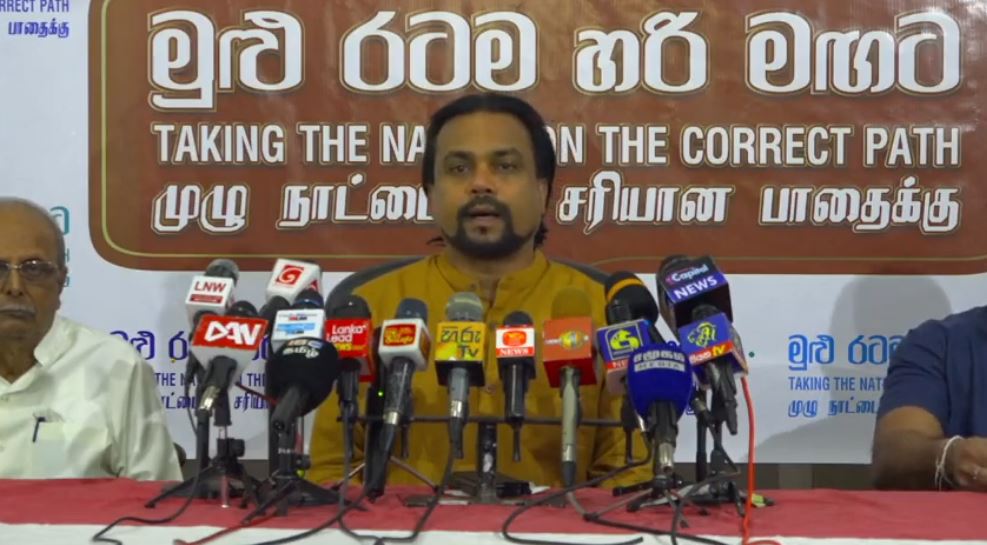
Wimal blames Gota’s naivety, Basil’s arrogance for current situation

It would have been better for the country if former Finance Minister Basil Rajapaksa was allowed to leave Sri Lanka when he attempted to do so in early July, National Freedom Front (NFF) leader, Wimal Weerawansa said.

“Basil tried to go, but officers at the airport didn’t let him go because passengers opposed it. Three officers at the counters left their duties because a passenger took their photos and threatened them. This was a time when the protests were at their zenith. Because of that Basil didn’t go. It would have been better if he had gone,” he said.

Weerawansa said that a person doesn’t need to be in Sri Lanka to investigate whether he had engaged in corruption and that there are UN mechanisms that can be used to punish such individuals and reclaim their assets.

“So there was no reason to keep him. If he had been allowed to go, he wouldn’t still be playing such a big role here,” he said.

The NFF leader said that successive Sri Lankan governments, after 1977, are responsible for the current economic crisis.

“We created this economic mess, and we haven’t really seen the worst of this crisis. Before 1977, Sri Lanka had a positive balance of payment, for the most part. Now it’s the other way around. Especially in the 60s and the 70s, Sri Lanka was trying to manufacture things. A lot of credit must go to then Prime Minister Sirimavo Bandaranaike. I am not saying that things were great, but we were making progress. But this was cut short in 1977. JR Jayawardene opened up Sri Lanka before our industries could mature. Now we are enjoying the ‘benefits’ of the system that JR created,” Weerawansa said.

The NFF leader said that the crisis was exacerbated by the actions of the Rajapaksa family, in the last few years, especially Gotabaya and Basil Rajapaksa.

“The main reason was Basil, but Gota also played a big role in creating this mess. Gota stuck to his family and let them run the show. This is not what the people wanted,” he said.

Weerawansa added that Gotabaya also had no political experience and they had asked him to discuss with trusted Ministers, and expert advisors, before taking serious decisions.

“Because he had no political experience, he needed to talk to people who know how things operated. But he didn’t do that. There was no discussion or consensus building. I don’t think Gotabaya even consulted the other Rajapaksas before deciding on banning agro-chemicals overnight. Therefore, a lot of necessary decisions were not made and a number of errors were made. Things were going down really fast and we tried to warn him, we tried to fix things from within. When we failed, we told the people where the country was heading and Gotabaya responded by firing us,” he said.

The NFF leader said the during party leaders’ meetings, former Finance Minister Basil Rajapaksa would act like a slave owner and treated party leaders like his personal property.

“He used to talk to respected politicians like they were peasants and he was the landlord. He thought their good nature was a sign of weakness. Because of this arrogance, Gotabaya now languishes in a hotel in Thailand and he can’t even come out,” he said.

Adani given approval for Two Wind Projects

Minister of Power and Energy Kanchana Wijesekera said that Adani Green Energy was issued Provisional Approvals for two Wind projects of 286 MW in Mannar & 234 MW in Pooneryn for an Investment of over USD 500 Million.

The Minister met officials of CEB & the Sustainable Development Authority today (16) to discuss the progress of renewable energy projects.

In addition, 21 of 46 Projects that were delayed due to CEB Act amendments will enter into Public-Private agreements next week, he tweeted.

“26 Renewable proposals from EOIs that were given Provisional Approvals to be expedited with Grid clearance & transmission plans,” he added.

Other proposals are to be evaluated within 30 days, Minister Kanchana tweeted.

Posted in Uncategorized

UNDCO Regional Director for Asia-Pacific arrives in Sri Lanka

Regional Director for Asia-Pacific from the United Nations Development Coordination Office (UNDCO) David McLachlan-Karr arrived in Sri Lanka today (16 August).

McLachlan-Karr is scheduled to meet with Government, the Opposition, civil society, the diplomatic community and others. He will also travel to Jaffna to meet with government and civil society groups there.

His discussions with officials in Sri Lanka will focus on the launch of the United Nations Sustainable Development Cooperation Framework (UNSDCF) 2023-2027 which will guide the work of all UN Agencies in Sri Lanka over the next five years.

The Development Coordination Office’s objective is to support the capacity, effectiveness and efficiency of Resident Coordinators and the UN development system as a whole in support of national efforts for sustainable development.

The UN in Sri Lanka said Mr. McLachlan-Karr will meet with government, opposition, civil society and others in Colombo and Jaffna to discuss how the UN can support all Sri Lankans to recover from the Economic Crisis through a joint programme of work over the next 5 years.

Posted in Uncategorized

We footed up the bill for fmr President Gotabaya: Bandula

Cabinet spokesman Minister Bandula Gunawardana today admitted that the Sri Lanka government footed the bill to provide former President Gotabaya Rajapaksa to fly to Thailand from Singapore in a chartered flight last week.

Responding to a journalist at today’s post cabinet news briefing, Minister Gunawardana said the Sri Lanka government paid the bill as it was the responsibility of the government.

“Each and every executive president retired and widows of those passed away enjoy benefits, privileges and special facilities and they are also paid an allowance under the ‘President Entitlement Act No. 4 of 1986’. Therefore, the government is committed to pay former President Rajapaksa’s bills,” he added.

It was under the provisions of this Act, that former Presidents Maithripala Sirisena, Chandrika Kumaratunga and Mrs. Hema Premadasa are provided with a residence, allowance and other facilities, Minister Gunawardana stressed.

If and when former President Rajapaksa returns home in future, the government must provide him with all facilities and privileges entitled to a retired President from the public purse, he added.

Posted in Uncategorized

Sri Lanka briefs diplomats on rights issue ahead of HRC session

Sri Lanka briefed Colombo based diplomats on the human rights issue ahead of the 51st session of the Human Rights Council in Geneva.

Minister of Foreign Affairs Ali Sabry met the Colombo-based Ambassadors and High Commissioners at the Ministry of Foreign Affairs for a briefing on current developments ahead of the 51st session of the Human Rights Council in Geneva, the Foreign Ministry said today.

Attorney General Sanjay Rajaratnam, Foreign Secretary Aruni Wijewardane and Finance Secretary Mahinda Siriwardana also contributed to the briefing.

Minister Sabry outlined the current developments in Sri Lanka, including the democratic transition of office in accordance with the Constitution.

He outlined several areas of progress already visible in addressing some of the immediate challenges which has led to a greater degree of stability for the people. On the political front, the Minister briefed regarding the work underway towards forming an All-Party Government.

He also recalled that the 22nd Amendment to the Constitution which effectively restores the 19th Amendment, has been gazetted and is before the Parliament. This measure will contribute towards strengthening parliamentary democracy, oversight of the executive branches of government and the independence of key institutions. He also explained the progress that has been initiated towards a comprehensive review of the PTA.

The Government is taking focused measures to mitigate the adverse impact of the current economic situation on the vulnerable sectors of the population in order to ensure the economic and social rights of the people and to prevent further disparities. The Minister also noted that despite the unprecedented situation in the country in recent years, including in the aftermath of the COVID pandemic, advancements have been made in the area of human rights and reconciliation through domestic processes.

The Government is in the process of building consensus so that further progress can be made on matters related to human rights, justice and equity. The Foreign Minister emphasized that Sri Lanka will continue its constructive engagement with the Human Rights Council at the upcoming 51st session.

Finance Secretary Siriwardana made a presentation on the current economic situation, focusing on the social safety measures that the Government has adopted for vulnerable groups, with a view to mitigating adverse impacts.

The Attorney General elaborated on the legal framework related to the Government’s response to the recent incidents related to protests and the imposing of the State of Emergency. Foreign Secretary Wijewardane highlighted Sri Lanka’s continuing and extensive engagement with several procedures and processes of the United Nations human rights framework.

During the discussion that followed the presentations, the Resident Coordinator of the United Nations Hanaa Singer-Hamdy expressed appreciation for the consistent efforts of the Government in facing the challenges and expanding the social safety net of vulnerable groups. She also acknowledged the review of the PTA. The UN Resident Coordinator announced that the UN will be partnering with the Government of Sri Lanka on a five-year framework of cooperation which will include areas of social and economic rights and social cohesion amongst others.

Court rejects petition challenging deportation order on UK national

The writ application filed challenging the deportation order on UK national Kayleigh Fraser for participating in the recent protests in Sri Lanka has been dismissed without hearing by the Appeals Court today (16).

The order was issued when the petition was taken up for consideration before Appeals Court Judge Sobitha Rajakaruna.

Appearing on behalf of the petitioner, attorney-at-law Nagananda Kodituwakku stated before the court that although the minister in charge of immigration had the power to deport foreigners staying in the country, the action taken against the petitioner was completely against the law.

He mentioned that she had joined the Galle Face protest movement and expressed her opinion regarding the alleged use of expired tear gas by the security forces to disperse protesters. He also said that it cannot be claimed that she has brought the country into disrepute through this.

Mr. Kodituwakku also alleged that before canceling her visa, no fair investigation was conducted by the Immigration Controller and accused that this was an arbitrary decision taken by the Immigration Controller.

However, the state counsel presenting the facts before the court pointed out that the discretion to issue such a visa cancellation order rests with the Controller General of Immigration and Emigration.

The state counsel also drew the court’s attention to the fact that in a judgment issued by the Supreme Court,it was stated that the full discretionary power regarding the issuance, cancellation and extension of visas to foreigners has been assigned to the Controller General of Immigration and Emigration.

He further said that the Scottish tourist in question had arrived in Sri Lanka on a tourist visa and was issued a residence visa in 2021 and the visa was issued to receive medical treatment and the residence visa will remain valid until March 8 next year.

However, he alleged that the petitioner had not received medical treatment in Sri Lanka and she was engaged in business activities in Sri Lanka in violation of visa regulations.

He also pointed out that although the Controller General of Immigration and Emigration had only canceled the visa issued for the petitioner, no orders had been issued to deport her.

The state counsel also alleged that the petitioner has submitted the petition deliberately concealing these facts.

Therefore, he asked the court to reject the petition without hearing it as there is no reasonable legal basis for maintaining it.

After considering all the facts presented, the appellate court judge decided to reject the petition without taking it up for hearing.

Posted in Uncategorized

TNA, TPA welcome lifting of Tamil groups ban

Two leading Tamil political representations in Parliament, the Tamil National Alliance (TNA) and the Tamil Progressive Alliance (TPA) of the Opposition have welcomed the lifting of the ban imposed on six international Tamil organisations through an amendment to the proscript list of designated persons under Regulation 4(7) of the United Nations Regulations, No.1 of 2012 pertaining to sanctions against terrorism and terrorism financing. However, the National Freedom Front (NFF), led by MP Wimal Weerawansa, has condemned the decision taken by the Sri Lankan Government to lift this ban.

Releasing an official press statement yesterday (15), the TNA welcomed the decision taken by the Government to delist 316 individuals and six entities from the designated list. Furthermore, it stated that some of the entities named in the list have been so named without particular evidence, and that this process of re-evaluation and de-proscribing is encouraged to continue further. “We welcome the delisting of some diaspora organisations and individuals from the terrorism list. However, it must be noted that even others who remain on the list have been so named without any evidence connecting them to terrorism, and by not following the prescribed procedure. We urge the Government to at least continue this process of re-evaluating and de-proscribing all individuals and organisations who ought not to have been listed,” it said.

Speaking to the media yesterday (15), TPA Leader and Samagi Jana Balawegaya (SJB) Opposition MP Mano Ganesan stated that a friendly request based on national unity should be forwarded to the Sri Lankan diaspora abroad, which accounts for 2,500,000 individuals that include Sinhalese, Tamils, and Muslims, to send foreign currency to the island in order to overcome the United States dollar (USD) shortage in Sri Lanka.

“The Government under President Ranil Wickremesinghe has lifted the ban that was earlier imposed on several diaspora organisations. Before this, the Government under former President Gotabaya Rajapaksa lifted the ban imposed on Qatar Charity, which is an organisation that used to send money to Sri Lanka, in an attempt to obtain oil. Now, after the ‘aragalaya’ (struggle), it’s high time to think in the correct perspective and listen, so this decision taken by Wickremesinghe is to be applauded.

“We are currently under a debt of $ 52 billion, and we are in need of $ 500 million monthly for the purchase of food, medicine, and oil. Now, Sri Lanka has the chance to bring in foreign currency from the 2,500,000 diaspora living abroad. The diaspora does not include only Tamils but also Sinhalese and Muslims. On the foundation of national unity, we should request them for their help in this moment of need,” said Ganesan.

However, speaking to the media, NFF MP Mohamed Muzammil relayed a contrary response. He requested an official statement by the Defense Ministry reasoning the lack of threat that these delisted organisations posed to national security. Moreover, he said that the ban on these organisations was placed due to the Liberation Tigers of Tamil Eelam (LTTE) terrorist organisation and questioned whether this threat has ceased with the recent change in the Government.

“At this moment, we should consider the reason behind the ban of the six organisations whose ban has been lifted by the Government. These were banned due to the threat imposed on Sri Lankan national security. Is that threat condition no longer valid? Have these Tamil diaspora organisations given up their ‘Eelam’ dream with the rather recent Government change? Has the collection of money by the Tamil diaspora and the attempt to activate the Tamil ‘Eelam’ through Constitutional provisions ceased? Has the attempt to bring this about through international organisations and countries by claiming that war crimes occurred during the civil war, stopped? We thus expect an official statement from the Defense Ministry stating the reasons for the loss of the threat that these organisations posed earlier.”