India will support democracy, stability in Sri Lanka: PM Modi

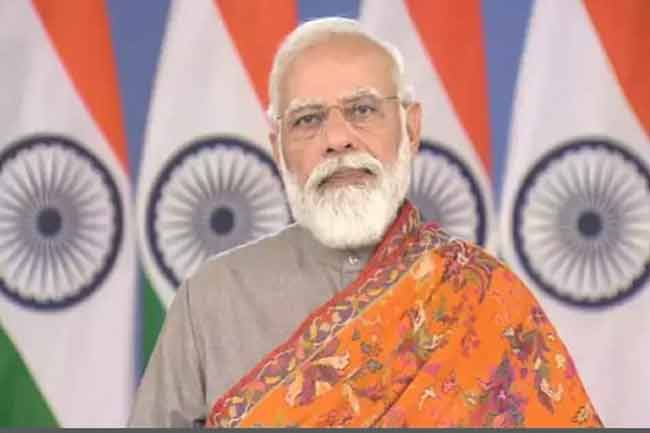
Indian Prime Minister Narendra Modi said on Thursday that India will continue to stand with the people of Sri Lanka and support democracy, stability and economic recovery in the neighbouring country.

Noting Sri Lanka was passing through difficult times, Mr. Modi, who was in Chennai to inaugurate and lay the foundation for several schemes involving an investment of over ₹31,000 crore, said “As a close friend and neighbour, India is providing all possible support to Sri Lanka. This includes financial support, fuel, food, medicine and other essential items.”

India has also spoken strongly in international fora on the cause of giving economic support to Sri Lanka, the Indian Prime Minister said.

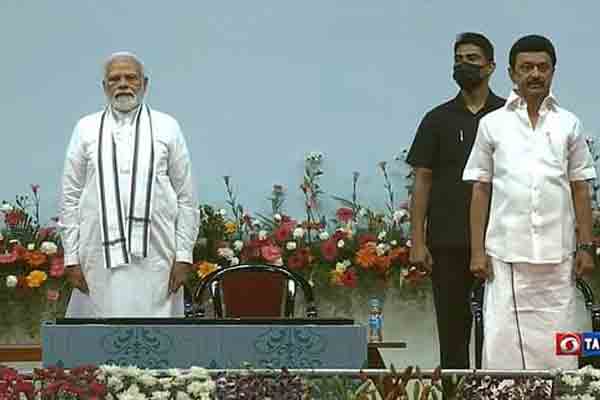
Seeking to connect with the people of Tamil Nadu, who share closed bonds with the ethnic Tamils in the island nation, Mr. Modi recalled his visit to Jaffna some years ago. “I can never forget my visit to Jaffna a few years ago. I was the first Indian PM to visit Jaffna. The Government of India is undertaking numerous projects to assist the Tamil people in Sri Lanka. These projects cover healthcare, transportation, housing and culture,” Mr. Modi said here, in the presence of Chief Minister M.K. Stalin.

While he did not react to Mr. Stalin’s statement (who spoke earlier) that “this was the right time to retrieve Katchatheevu [an island given by India to Sri Lanka decades ago], the Prime Minister said many Indian organisations and individuals have sent assistance for their brothers and sisters in Sri Lanka, including the Tamils in the northern and eastern parts of Sri Lanka. Mr. Modi did not make a mention of the material aid which was sent by the Tamil Nadu government to Sri Lanka through the Ministry of External Affairs recently.

The Prime Minister, who sought to counter the perception that the Centre had not taken adequate steps to give the Tamil language its due devoted a significant part of his speech hailing the Dravidian language.

“The Tamil language is eternal and the Tamil culture is global. From Chennai to Canada, from Madurai to Malaysia, from Namakkal to New York, from Salem to South Africa, the occasions of Pongal and Puthandu are marked with great fervour,” he said and recalled how Union Minister of State L. Murugan, who was on the dais, had recently walked down the red carpet in Cannes in traditional Tamil attire, which made Tamils all over the world very proud.

The government of India was fully committed to further popularising Tamil language and culture, Mr. Modi said and recalled that the new campus of the Central Institute of Classical Tamil inaugurated in Chennai in January had been fully funded by the Union government. A ‘Subramania Bharati Chair’ on Tamil Studies at Banaras Hindu University was recently announced, he said.

“The National Education Policy gives special importance to promoting Indian languages. Due to the National Education Policy, technical and medical courses can be done in local languages. Youngsters from Tamil Nadu will benefit from this,” Mr. Modi contended.

Mr. Modi said in every field, someone or the other from Tamil Nadu was always excelling and recalled how six of the 16 medals the Indian Deaflympics contingent won recently were by athletes from the State.

Elaborating on the projects he unveiled. Mr. Modi said that the government of India was fully focused on building infrastructure that is top quality and sustainable.

His government has also gone beyond what was conventionally called infrastructure, he said, and added that till a few years ago, infrastructure referred to roads, power and water. “Today we are working to expand India’s gas pipeline network. Work is happening on i-ways,” he said.

“A few months back we launched the PM-Gati Shakti programme. This programme will bring together all stakeholders and Ministries with the aim to ensure India has top quality infrastructure in the coming years,” he said.

Recalling his speech from the Red Fort, where he spoke about a National Infrastructure Pipeline, Mr. Modi said: This is a project worth more than ₹100 lakh crore. “Work is under way to turn this vision into reality.”

Tamil Nadu Governor R.N. Ravi participated in the programme. Earlier, the State BJP accorded a rousing reception to Mr. Modi.

The Prime Minister left for New Delhi on Thursday night.

Source: The Hindu

Posted in Uncategorized

Reclaim Kachchatheevu : Stalin tells Modi

The Chief Minister of Tamil Nadu, M.K. Stalin has made a number of important demands from the Indian Prime Minister Narendra Modi, who is currently on a visit to Chennai.

Drawing the attention of the Prime Minister to the issues faced by the Indian fishermen in Tamil Nadu, Stalin requested the Prime Minister to reclaim the Kachchatheevu island from Sri Lanka.

Additionally, he stated that this is an opportune time to save Kachchatheevu Island and ensure the traditional fishing zone and rights of the Tamil Nadu fishing community, so that a solution can be found to the issues of the coastal fishing community in Tamil Nadu.

Posted in Uncategorized

How hubris and Covid transformed Sri Lanka from ‘donor darling’ to default-Financial Times-Benjamin Parkin

The country has opened talks with the IMF over a $4bn bailout with observers waiting to see how China, one of the main creditors, will react

It is 10am and the queue outside a petrol station in one suburb of Sri Lanka’s commercial capital Colombo is already hundreds of people long. At the front is Malar Peter, whose family has taken turns to keep their place for 12 hours already. A few paces behind her is Padmasiri, who arrived at 1am. And right at the back of the queue stands Arumugam Annaletchumi, 50, who expects to be there for the rest of this hot, humid day.

They are all waiting for kerosene, carrying empty plastic canisters for a few litres with which to cook and burn lamps during the long blackouts caused by power shortages. Yet they are there in hope as much as anything else. There is no kerosene at the station and it’s unclear if it will arrive. For Sri Lankans, who until recently enjoyed some of the highest living standards in South Asia, such queues were rare until a few months ago. “People just want to live without problems like this,” Annaletchumi says. “This country has been robbed.”

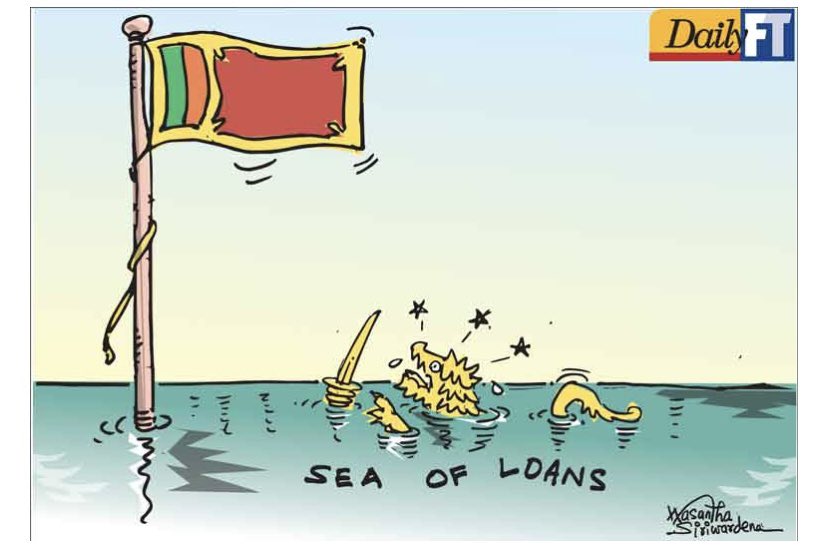
Sri Lanka this month defaulted on its overseas loans after missing interest payments on two $1.25bn sovereign bonds, the first country in Asia-Pacific to do so in more than two decades, according to Moody’s data. The latest estimates put the country’s total foreign debt at more than $50bn, with a $1bn bond maturing in July. President Gotabaya Rajapaksa’s government says it has all but run out of foreign reserves and fuel, relying on ad hoc shipments to top-up supplies in the most visible manifestation of a crisis that, the Eurasia Group consultancy warns, is turning the island into a “failed” state.

After the end of a devastating 26-year civil war in 2009, the island of 22mn had the makings of an Asian economic success story. Under governments run by the powerful Rajapaksa family, annual economic growth peaked at 9 per cent. By 2019, the World Bank had classified the island as an upper-middle income country. Sri Lankans enjoyed a per capita income double that of neighbours such as India, along with longer lifespans thanks to strong social services such as healthcare and education. The country tapped international debt lenders to rebuild, becoming a key private Asian bond issuer and participant in China’s Belt and Road Initiative.

Much of that progress is now in jeopardy. Some observers argue Sri Lanka’s debt crisis is the product of the hubris, mismanagement and alleged venality of political elites including the Rajapaksa family, as well as irresponsible lending on the part of its creditors.

But, on another level, it is an extreme example of the economic and political churn facing developing countries around the world as rising inflation and Russia’s invasion of Ukraine prompt higher interest rates and surging food and fuel prices globally. Within South Asia alone, countries including Nepal have imposed import restrictions in order to protect foreign reserves while Imran Khan was removed as Pakistan’s prime minister in April amid popular anger over inflation.

Sri Lanka’s “economy has been built on unsustainable debt. They were spending more than the money that was coming in,” says Hanaa Singer-Hamdy, the UN’s resident co-ordinator in Colombo. “You don’t have fuel [so] people queue for three or four kilometres waiting in the heat.”

Popular outrage has boiled over in recent weeks after a wave of retaliatory violence following attacks on anti-government protesters and the temporary imposition of a military-enforced curfew. Gotabaya Rajapaksa is fighting for his political survival after the resignation on May 9 of his once-powerful brother Mahinda as prime minister. The president has struggled to form a new cabinet with Ranil Wickremesinghe, the new prime minister, on Wednesday also taking on the role as finance minister after the post was vacant for more than two weeks.

Chinese loans to Sri Lanka, which total about $3.5bn, according to the Advocata Institute think-tank, has proved particularly controversial. While Sri Lanka owes more to private bondholders and countries like Japan, critics argue that China’s BRI loans have been extended at high interest rates for infrastructure projects that have often failed to generate returns.

Sri Lanka has begun talks with the IMF for a bailout of up to $4bn, and is preparing debt restructuring negotiations with creditors. Analysts say the talks will be closely watched to see how China — one of the largest and most important lenders to the developing world in recent years — will respond amid growing signs of financial strain in other Belt and Road participants.

“Sri Lanka is a real canary in the coal mine,” says Gabriel Sterne, head of emerging markets at research group Oxford Economics. “It’s the most interesting case in years. There’s going to be lots of low-income debt crises, and the treatment of China in all that is going to be crucial.”

Postwar economic boom

Sri Lanka has many of the ingredients needed for economic and political success — from rich natural resources to strong social services and a strategic location near many of the world’s busiest shipping lanes.

But in the 1980s tension between the majority Sinhalese Buddhists and Tamils — groups that make up about 70 and 15 per cent of the population respectively — culminated in civil war when the Liberation Tigers of Tamil Eelam launched a brutal separatist campaign amid Tamil resentment over widespread discrimination.

The conflict dragged on for more than two decades before Mahinda Rajapaksa was elected president in 2005. With Gotabaya Rajapaksa serving as defence secretary, the brothers would lead an unrelenting campaign to crush the Tigers. Government forces were accused of war crimes including indiscriminately bombing civilian areas and executing suspected militants. The Tigers were also accused of atrocities and the UN estimates that about 40,000 civilians died in the final years of the conflict, almost half the total. Mahinda and Gotabaya have been subject to sustained scrutiny from civil society groups for the alleged abuses committed under their rule, with Human Rights Watch alleging that Gotabaya is implicated in human rights abuses. He has always denied the allegations.

The end of the war in 2009 was followed by a boom in Sri Lanka’s economy. The government of Mahinda Rajapaksa tapped international bond markets and longtime ally China for debt to fund the construction of everything from roads and airports to “Port City”, an ambitious project to turn reclaimed land in Colombo into a financial hub. Tourists flocked to the island.

Yet this growth masked deep economic and social imbalances. Critics argue that the Rajapaksas shunned efforts at postwar reconciliation and continued to use ethno-nationalism to drum up their Sinhalese Buddhist base. Several debt-backed projects failed to generate a return, most notoriously a Chinese-backed port in the Rajapaksas’ home district that was ultimately handed over to Beijing on a 99-year lease. Critics say that easy money for large infrastructure projects fuelled a culture of kickbacks and corruption that became widespread in politics and business.

“The biggest issue is corruption,” says Harini Amarasuriya, an MP from the leftwing Janatha Vimukthi Peramuna party, one of Sri Lanka’s largest. “For the past 25-30 years, our economic decisions have not been made on any economic analysis but on kickbacks and commissions.”

Some members of the Rajapaksa family have been accused of wrongdoing on various occasions though they have always denied allegations and have not been convicted. Gotabaya Rajapaksa was charged in a corruption case in 2016 though the charges were dropped on grounds of immunity after he was elected president in 2019, according to media reports. He denied the allegations.

Gotabaya Rajapaksa’s 2019 landslide victory came after the Easter Sunday terrorist attacks that killed 269 people. He vowed to right an already struggling economy but instead made a series of idiosyncratic decisions that economists say tipped the island into crisis. He cut taxes sharply — eroding government revenues — and changed the constitution to concentrate power around him and his family, with several relatives also in government. He also imposed a shortlived but destructive ban on chemical fertilisers, designed to promote organic farming and save money on imports, that led to a sharp drop in crop yields.

Anushka Wijesinha, an economist at the Centre for a Smart Future in Colombo, says that Sri Lanka was considered a “donor darling” in the decades after independence, before Mahinda Rajapaksa’s government embarked on its postwar infrastructure boom. “The money [was] coming in easily from bilaterals, multilaterals and commercial loans,” he says. “Financing is not a constraint, doing the policy reforms is not a constraint, and — woohoo, bonus — the room for graft is huge.”

A series of ratings downgrades following the 2019 tax cuts locked Sri Lanka, which had never defaulted before, out of international debt markets, leaving it unable to refinance. The pandemic cut off remittances and tourism, vital sources of dollars. A poll in January by think-tank Verité Research found that only 10 per cent of Sri Lankans approved of the government. Yet Rajapaksa dismissed warnings to begin restructuring or approach the IMF for assistance until March, after protests over the growing economic hardship had spread across the island.

Sri Lanka’s reserves have fallen from $7.5bn in November 2019 to the point where finding $1mn is “a challenge”, Wickremesinghe, the new prime minister, said in an address last week. This has meant shortages of not only fuel but food and medicine, with hospitals forced to postpone surgeries. The country has the worst inflation in Asia at about 30 per cent in April and the currency has almost halved in value since it was floated in March.

The UN Development Programme says that nearly half the population is in danger of falling below the poverty line, and warns of a looming humanitarian crisis as the urban poor and former middle class begin to cut back on meals.

WN Thilini lives with her two-year-old daughter in a low-income Colombo neighbourhood. She says she has stopped giving milk to her child and that they now eat mostly rice, dhal and grated coconut. The 38-year-old says she has enough food and fuel in the house for a couple more meals, before she too will need to join a queue.

“Most people are down to one meal a day”, says her neighbour, Mohammad Akram, “but are embarrassed to admit it.”

A default test case

On top of Rajapaksa’s mismanagement and Covid, observers say the final trigger for Sri Lanka’s default was the war in Ukraine — a worrying example of the aftershocks of the conflict for low- and middle-income countries. Some, including Belize and Zambia, had already defaulted in the wake of the pandemic.

In addition to depending on imported energy and staples such as wheat, the conflict has hit Sri Lanka in unexpected ways. Russia and Ukraine were the country’s first- and third-largest tourist markets in early 2022 respectively. Russia was also the second-largest buyer of Ceylon tea, Sri Lanka’s main goods export.

The island’s default could have significant geopolitical ramifications. Its strategic location in the Indian Ocean has long made it an arena for jockeying between countries such as India and China, arch-rivals who have used combinations of easy credit and diplomatic pressure to secure their interests on the island.

Critics of Chinese activity on the island accuse it of using BRI projects to ensnare the country in a “debt trap”, allegations that it denies. Yet while China has so far rejected Sri Lanka’s requests to restructure its outstanding debts, India has sought to cement its primacy on the island, offering a series of credit lines, debt swaps and other assistance measures that it [India] says total about $3.5bn.

Sri Lanka’s upcoming debt restructuring negotiations are being viewed as a case study for how China works alongside other creditors such as private bondholders, given the rise of Chinese lending in Africa and Asia.

Analysts say that in countries such as Zambia, as well as Sri Lanka, it remains unclear whether Chinese lenders — which includes the government as well as state banks — will be willing to accept losses on their loans or look to enforce claims for full repayment.

Zambia’s restructuring has shown “there’s somehow this expectation that [Chinese lenders] would be senior creditors,” and therefore prioritised for repayment, argues one London-based fund manager, who holds Sri Lankan bonds.

The fund manager argues that had Rajapaksa started the restructuring process earlier, when Sri Lanka had more foreign reserves left, creditors could have recouped larger amounts. “What would have been a fairly mild restructuring process is now a more complicated one.”

The success of any restructuring is likely to be tied to the IMF programme. Any assistance package will take months to negotiate and, while Sri Lanka has already been through 16 IMF programmes in its 74-year history, it has only completed nine. International groups also warn that the reforms the fund is likely to demand, such as reversing Rajapaksa’s 2019 tax cuts and reducing energy subsidies, could exacerbate the suffering without adequate protections for vulnerable populations.

Improvement is “not going to come immediately,” warns Nalaka Godahewa, an MP from Rajapaksa’s ruling Podujana Peramuna party. “It’s going to be difficult because nothing much is going to change [in the short term].”

It is unclear whether Rajapaksa and his government can survive even before implementing a series of potentially unpopular economic reforms, prompting analysts to warn that the island could face prolonged political instability.

“To go into an economic restructuring, you need political stability. This is now challenging,” says the UN’s Singer-Hamdy. “The most important is how you discuss with the creditors now, in terms of agreeing to a haircut. This is [what] will help . . . Everybody is waiting to see how the government will negotiate the restructuring with the creditors.”


Ranil: Return of the Master By Jathindra

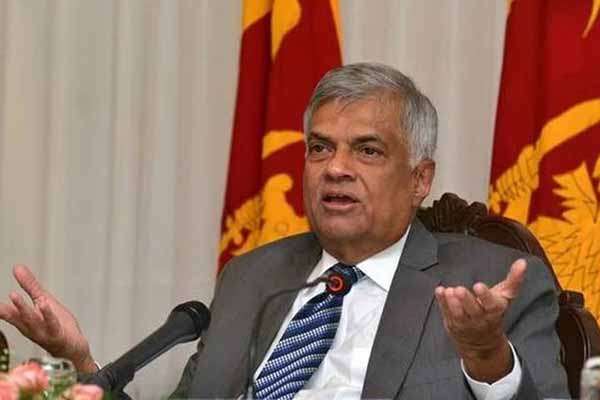
Despite all indications to the contrary, a single seat in parliament has disproved political assumptions that shape our opinion. Just weeks ago, it was unthinkable that Ranil Wickremesinghe’s political future could be resurrected, even resuscitated. The takeover of the premiership when he truly was on his last legs is an opening gambit that may prove to be clever and enshrine him as a sharp-eyed lynx that outfoxed geopolitical apprehensions in the region.

When the Rajapaksa cookie crumbled, the stakes were high. And so was the punditry when the premiership was taken. Harsha de Silva, a member of the opposition in parliament, maintained that the appointment was neither ethical nor moral. M.A. Sumanthiran of the Tamil National Alliance asserted that it was undemocratic.

This is not a moral or democratic issue. It is a strategic move to deal with a crisis that Sri Lanka has not witnessed before. The idealized conception of parliamentary democracy may not be relevant. Was Ranil Wickremesinghe the right choice? This is a vexed question that must be answered using other sensibilities than just idealized parliamentary democracy. One could perhaps begin by asking if it was strategically correct or not. Ranil Wickremesinghe may walk like a proverb and talk like a question but he is the only person who can handle this crisis. Many Tamils are of this opinion. Nevertheless, the relationship between Ranil Wickremesinghe and the Tamil is worthy of note.

The Tamils have often referred to Ranil as the fox. This allusion is derived from Machiavelli’s use of immoral means in politics and the suggestion of a blend between a lion and a fox for political leadership; the fox to recognize the traps and a lion to frighten the wolves. However, there is another important dimension – the Tamil experience with the old fox J.R. Jayewardene. J.R. was Ranil Wickremesinghe’s maternal cousin. This heady mix makes the Tamils view Ranil Wickremesinghe with suspicion.

A section of Tamil political activists and opinion makers are still copying this simulation related to Ranil. It is basically a fear of statecraft. This fear made LTTE leader Vellupillai Prabhakaran to devise a strategy to defeat him through an election boycott in 2005.

In 2005, Ranil would have been elected as president if the Tamils in the North East had voted. Nevertheless, Prabhakaran preferred to confront the war of hardliner Mahinda Rajapaksa rather than confronting Ranil’s clever strategies. Prabhakaran’s choice was doomed for him in the end. The LTTE’s usual approach is bringing down their invincible political opponents with suicide attacks. The case of Ranil was different. He was defeated by Tamil votes, not by suicide bombing. This was unusual in the LTTE’s hunting strategy.

Beyond his capacity, experiences and international reputation, the pro-western outlook of Ranil is the main reason why he seems an apt person for the current situation. Against this background, the defeat of Ranil in the 2005 election was a tragedy both politically and economically. Prabhakaran defeated not only Ranil, but the U.S interest in the peace process and the personal interests of then Deputy Secretary of State Richard Armitage. This is when the West turned entirely against the LTTE.

The former ambassador of the United States to Sri Lanka, Jeffrey Lunstead, described this in his paper United States’ Role in Sri Lanka’s Peace Process (2002-2006) published by the Asia Foundation. Lunstead explained how U.S interests had enhanced due to the peace process:

“The pattern of limited U.S. engagement with the Sri Lankan ethnic conflict changed dramatically with the start of the new peace process in 2001-2002. This was not due to any dramatic change in U.S. strategic interests in Sri Lanka, but rather to a combination of other factors:

The post-Sept. 11, 2001 atmosphere that ushered in a new determination by the U.S. to confront terrorism on a worldwide basis.
The election in Sri Lanka of a UNP/UNF government led by Ranil Wickremesinghe that was markedly more pro-West and pro-free market/globalization.
The personal interest of then-Deputy Secretary of State Richard Armitage.”
In the words of Lunstead, Armitage’s personal interest was bolstered by the politics of the new UNP-led government. The UNP was traditionally a right of centre party. It is a member of the grouping of international conservative political parties, the International Democrat Union (IDU). In an MTV interview in 2003, Armitage pointed out this in different words. “I was very heartened by the comments of Prime Minister Ranil regarding a new infrastructure to provide assistance transparently to all segments of society very openly.”

In light of Ambassador Lunstead’s analysis, Ranil Wickremesinghe’s government came to power with a clear economic reform program based on free market principles in line with U.S. government thinking on economic and international development issues. In Erik Solheim’s words, (Mark Salter’s ‘To End a Civil War: Norway’s Peace Engagement with Sri Lanka) he wanted to reform the economy to make Sri Lanka the Singapore or Taiwan of the Indian Ocean. When Ranil was defeated by the election boycott, the whole programme collapsed. If one looks at this in depth, the foundation for the country’s economic uncertainty today was laid in 2005 when Ranil was defeated.

The mistakes of the Ranil-Maithri government were a significant factor in the Rajapaksas’ resurgence. In 2015, the regime changed by giving space to Ranil again. But Ranil failed to prove his mettle because of the infighting with President Maithripala Sirisena. The question arises now about how Ranil will deal with calamity as it is a different challenge that he has never faced before. As Erik Solheim specified, Ranil Wickremesinghe is a great intellectual, not a street fighter. It has been proved that his intellect failed before the face of the Sinhala street fight-loving masses. Ranil never rose as a populist leader but he always created his own ground for chess. He is now batting on a pitch where the street fighting Rajapaksas fell.

Prime Minister Ranil Wickremesinghe rallied, hoping he would rescue the nation without rescuers. If Ranil succeeds in this challenge, he will be an unforgettable leader among the people. If Ranil fails or others fail him, the country will be plunged into an irreversible crisis. History is a great teacher and hides many surprises. When the Tamils were responsible for defeating Ranil in 2005, it caused a disaster for them. If the Sinhalese defeat Ranil now, it will cause a disaster for the Sinhalese. Ranil may or may not need Tamils now but he needs the Sinhalese.

Posted in Uncategorized

Jet fuel shortage forces Sri Lankan Airlines to refuel in India, UAE, Singapore – sources

Sri Lankan Airlines has started refuelling its aircraft from Chennai, Dubai, and Singapore due to a shortage of jet fuel in Colombo amid a foreign currency scarcity, sources said.

The shortage also has led the Airport and Aviation Services (Sri Lanka) (Private) Limited (AASL) to inform foreign flights to take necessary steps in refuelling.

“There is less jet fuel in Colombo. So we have been using Chennai, Dubai, and Singapore to refuel Sri Lankan Airlines’ flights,” a source from the state-run SriLankan Airlines under anonymity confirmed to Economy Next.

The island’s main Bandaranaike International Airport has a 7.8 million liter capacity fuel tank while Mattala International airport has a 3 million liter fuel tank.

However, Sri Lanka’s economic crisis with a severe shortage of dollars has led to a scarcity of fuel as the Indian Ocean island nation has no dollars to import oil. Sri Lanka has been sourcing fuel from an Indian credit line.

“We informed the (foreign) airlines 10-days ago that the airport is running on limited fuel, so to take necessary measures,” another source from Sri Lanka’s airports said.

“We do have fuel for emergency purposes but this matter is entirely handled by CPC (Ceylon Petroleum Corporation). They are the ones who supply the fuel to the airports.”

Officials from CPC were not immediately available for comments.

Experts say there is a possibility of air carriers cancelling their flights to Sri Lanka as using an alternative route just to refuel is an added cost to the airlines unless the is adequate traffic.

AASL Officials told Economy Next late in April that their daily consumption was around 1.3 million liters amid a drop in air traffic to the country with the onset of the off tourism season and the Ukraine-Russia war.

Posted in Uncategorized

Basil attempting to block 21st Amendment

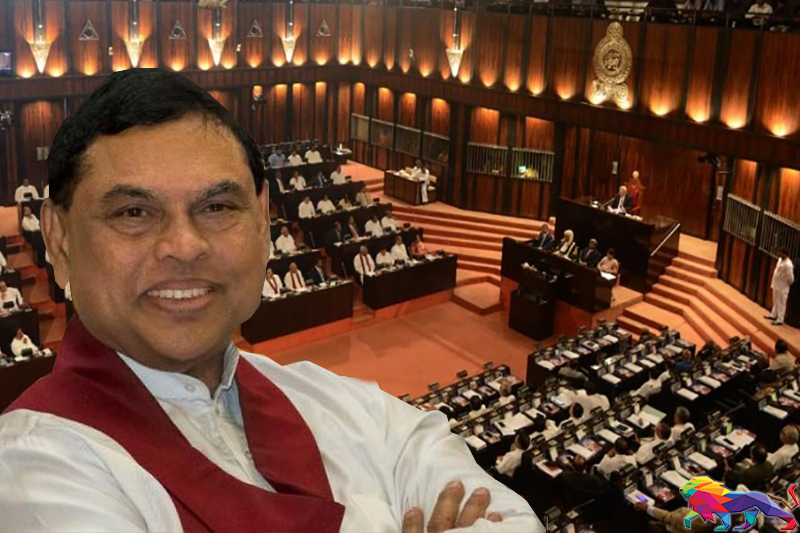
Former Finance Minister and founder of the Sri Lanka Podujana Peramuna (SLPP) Basil Rajapaksa is said to be leading attempts to block the 21st Amendment from being passed by Parliament, Daily Mirror learns.

Government sources told Daily Mirror that Rajapaksa has secured the support of a number of SLPP members to oppose the 21st Amendment.

However, the Government is confident it will be able to convince a majority of the SLPP members to vote in support of the draft proposal when it is tabled in Parliament for a vote.

The 21st Amendment has already been presented to the Cabinet and will be tabled in Parliament after it is discussed with political party leaders.

Government sources told Daily Mirror that the draft is expected to be discussed with political party leaders tomorrow (Friday).

Sources said that the Government is also in talks with the main opposition Samagi Jana Balawegaya ( SJB ) to seek their support for the draft proposal.

Newly appointed Justice Minister Wijeyadasa Rajapakshe was instrumental in drafting the 21st Amendment to the Constitution and is involved in talks with a number of political parties in Parliament and outside to obtain their views.

When contacted by Daily Mirror, Minister Wijeyadasa Rajapakshe said that the draft proposal is not the final document and is open for amendments.

A number of concerns have already been raised over the proposals in its current form.

However, Minister Wijeyadasa Rajapakshe said that the proposed 21st Amendment will go through changes after considering the proposals made by others.

SJB opposes transfer of parliamentary powers to the executive through the government’s 21st amendment

Today the country is in bane with many crises, as a result of concentrating power around the Executive, Samagi Jana Balawegaya (SJB) parliamentarian Eran Wickramaratne says.

He says the proposed 21st Amendment to the Constitution by the government, which appointed Ranil Wickremesinghe as Prime Minister, gives the President the power to keep under his purview subjects of his choice and even the power to dissolve Parliament.

“We are against the transfer of parliamentary power to the executive, which is independent of the executive and the judiciary,” said MP Wickramaratne.

Addressing a media briefing held at the office of the Leader of the Opposition in Colombo today (25), Mr. Wickremaratne further said the Bar Association of Sri Lanka has also expressed concern that the 21st Amendment by the Minister of Justice will not reduce the powers of the President. They had proposed several amendments.

“What are the current powers of the Executive President and the significant change in the powers of Executive President after the proposed 21st Amendment?” The MP questioned.

“When making appointments to senior government posts such as Provincial Governors, Secretaries to Ministries and Ambassadors, the President should consult with the Prime Minister and appoint suitable officials. Since the Prime Minister operates within the framework of the Cabinet, there is ample scope to appoint suitable and experienced persons to such positions if the PM is made the head of the Cabinet. The various crises facing the country today do not arise if the line of separation of powers under the check and balances are well defined with the concept of good governance.”

He said even if the fuel and gas queues were over the country’s economic and administrative crisis would not be resolved, without an internationally recognized stable government.

“The Constituent Assembly, which functioned under the 19th Amendment, was amended by 20A, to increase the number of Parliamentarians and reduce the number of non-Parliamentarians. In the future, while reducing the number of MPs from 7 to 5, the number of non-members should be increased from 3 to 5.”

He said that this should be introduced as a program to bring those who are fighting against corruption and fraud in the regime into the governance.

Mr Wickramaratne referring to the SJB’s position on the taking over of the governance said that the Samagi Jana Balawegaya has a plan to take over the government and solve the problems in the country.

“We mentioned this on several occasions, but we did not get that opportunity. If the SJB to participate in government, we told the President that Executive powers of the President should be abolished or reduced. While this discussion was ongoing Ranil Wickremesinghe who came forward without any conditions was made the Prime Minister. We are ready to support and contribute as a team is needed to resolve the crisis facing the country.”

“The SJB Secretary introduced the 21st Amendment to Parliament. Meanwhile, the government has also now presented with the 21st Amendment. The government’s amendment brings back certain elements of the 19th Amendment, but does not eliminate the executive presidency,” he said.

“The basic tenet of the SJB amendment is that the President should act on the advice of the Prime Minister. The Prime Minister is a member of the Cabinet and the head of the Cabinet of Ministers. According to that theory, the government is governed with the recognition that the Prime Minister is the first among the peers in the Cabinet.”

“But the 21st Amendment proposed by the government does not have such a principle and it does not reduce the power of the President which the people are struggling to demand. Furthermore, the President can take over any subject related to public governance. However, with the 21st amendment proposed by the SJB, the President cannot take over any of the subjects at his whims and fancy. This is the boundary that separates the line of control under the check and balance of governance in developed countries.”

Even when the 19th Amendment was introduced during the period of good governance, President Maithripala Sirisena was granted to carry on the subjects he was pursuing at that time as an interim arrangement until he was in power. However, the constitutional provisions that allowed future presidents to take over subject of ministries were removed.

According to the amendments of the present government, the President can take over any subject. Accordingly, the 21st Amendment to the Constitution proposed by Minister Wijeyadasa Rajapaksa will not make any significant changes that limit the executive presidency as expected by the people.

“One appointment as the Governor of the Central Bank at the will of the Executive caused such an economic crisis in this country. The former Central Bank governor not only printed billions of rupees saying that printing money would not increase inflation, but also wasted millions of rupees to artificially inflate the value of the Sri Lankan rupee.”

Eran Wickramaratne said that by directing the governance structure of the country to the right path, other problems of the country could be solved and the country could be saved from disaster. He stressed that the system of empowering an individual to appoint officials should be changed immediately for the sake of the nation.

Posted in Uncategorized

Russia refutes Energy Minister’s claim

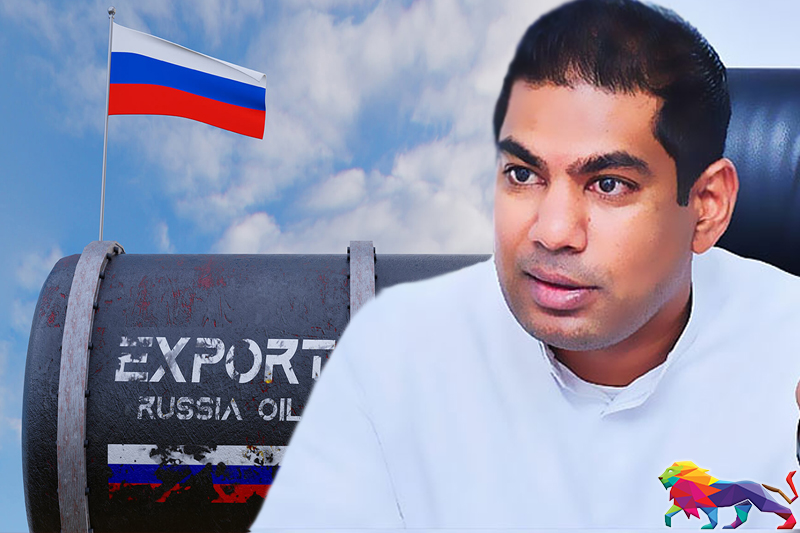
The Russian Embassy in Colombo has categorically denied the statement made by Power and Energy Minister Kanchana Wijesekara that Russia will not supply crude oil to the island nation.

Noting that they have never held any discussions with Minister Wijesekara, the Embassy reaffirmed its full support to Sri Lanka and stressed that Russia will never turn down a request for assistance when the country is battling a crisis on multiple fronts.

The Russian Embassy further stated that a request made by the Sri Lankan government has already been forwarded to the relevant Russian authorities.

UK in talks with Paris Club on Sri Lanka issue

The United Kingdom (UK) is in talks with Paris Club members on potential solutions to Sri Lanka’s unsustainable debt.

The Paris Club is a group of officials from major creditor countries whose role is to find co-ordinated and sustainable solutions to the payment difficulties experienced by debtor countries.

UK Parliamentary Under-secretary at the Foreign, Commonwealth and Development Office, Vicky Ford said the UK Government is closely monitoring the situation in Sri Lanka including food security and livelihoods.

“We encourage a peaceful, democratic, and inclusive approach to resolving the current political and economic challenges,” she told the UK Parliament yesterday (Wednesday).

She said that in April, the World Bank (WB) agreed to provide US Dollars 600 million in financial assistance, and the UK understands there are discussions to extend this support.

“The UK is a major donor to the WB and continues to engages with international financial institutions on Sri Lanka’s economic situation,” she said.

She also said that the UK welcomes the start of in-depth discussions with the International Monetary Fund (IMF) on the reforms needed to bring the economy back to a sustainable path.

“These negotiations are likely to take up to 6 months. Sri Lanka has requested support from the IMF, however, at present no Sri Lanka proposal has been shared with members. When one is made available, we will scrutinise it carefully against the IMF criteria alongside other IMF members.

In the meantime, discussions are underway with several countries to obtain bridge financing in order to maintain flows of essential imported goods.

The UK is also working closely with fellow Paris Club members to discuss potential solutions to Sri Lanka’s unsustainable debt levels in the event that an IMF programme is agreed,” Vicky Ford said.

India allows repayment of US$ 200 million loan in Lankan rupees

Sri Lankan Prime Minister Ranil Wickremesinghe said on Wednesday that the Governments of Sri Lanka and India have agreed that the drugs bought by Sri Lanka with an Indian loan of US$ 200 million, would be repaid in Sri Lankan rupees, given the shortage of dollars in the country.

The Prime Minister instructed the Ministry of Health to immediately submit a document on essential drugs currently in short supply. It was revealed that there is a shortage of 76 essential medicines at present

The Minister of Health Keheliya Rambukwella stated that given the arrival of medicines and anesthetics provided by the French Government on Thursday it will be possible to run emergency operating theatres in the country continuously for 90 days.

Meanwhile, the Drug Regulatory Authority is making prompt purchases of drugs. An Independent Committee headed by the Minister of Health has been appointed to amend the Drugs Regulatory Authority Act.

It was further revealed that local pharmaceutical suppliers have to pay Rs. 33 billion in arrears.