India To Build 3 Wind Farms In Sri Lanka After China Pushed Aside

India has agreed to develop three Sri Lankan wind farms on islets between the countries, officials said Tuesday, in a victory for New Delhi after the project was taken away from a Chinese firm.
New Delhi has long been alarmed about the growing Chinese influence in the region.

A $12 million project to build wind turbines on three small islands in the Palk Strait between southern India and Sri Lanka was awarded to a Chinese firm in 2019, with funding lined up from the Asian Development Bank (ADB).

But after Indian protests about Chinese activity so close to its coast, work never began and the project on the islets of Nainativu, Analaitivu and Delft was later scrapped.

A joint statement issued Tuesday after a visit to Colombo by India’s foreign minister S Jaishankar said a memorandum of understanding had been signed to build the installations.

Sri Lankan officials said India had agreed to provide funding in place of the ADB.

Last week, the Chinese ambassador in Sri Lanka, Qi Zhenhong, expressed Beijing’s displeasure over the scuttling of the project and warned it would send a negative signal to potential foreign investors.

India is known to be suspicious of China’s growing political and economic influence in the South Asian nation, which is strategically located at the southern tip of the vast Indian sub-continent.

China and India have been competing for major infrastructure projects in Sri Lanka, which is currently facing its worst economic crisis since independence from Britain in 1948.

Colombo has asked for more loans from both nations to shore up its foreign reserves and import essentials including food, fuel and pharmaceuticals.

Posted in Uncategorized

What’s behind Sri Lanka’s economic crisis?

Sharine Silva, a hair and makeup artist in Colombo, has been struggling to make ends meet as costs of essential items skyrocket in Sri Lanka, which has been facing one of its worst economic crises in recent decades.

“There’s no fresh milk or milk powder for tea. Prices for baby milk formula are exorbitant,” said Silva, a mother of two.

“It feels like a war where we have to ration our foods now. That sounds so silly given this day and age,” she added.

Skyrocketing inflation, weak government finances, ill-timed tax cuts and the Covid-19 pandemic, which hurt the important revenue-generating tourism industry and foreign remittances, have wreaked havoc on the Sri Lankan economy over the past several months.
Prices of food items, for instance, shot up by as much as 25% in the last month alone.

Shortage of food and fuel

Meanwhile, the nation’s foreign currency reserves plummeted by about 70% since January 2020 to around $2.3 billion (€2.1 billion) by February, even as it faces debt payments of about $4 billion through the rest of the year.

Sri Lanka’s current reserves are only enough to pay for about a month’s worth of goods imports.

A shortage of foreign currency has meant that the country has been struggling to import and pay for essential commodities like fuel, food and medicines.

These challenges has led to cuts in electricity generation, with only four hours of power a day, and long queues outside fuel stations.

Even the newspaper and printing industries have been hit by a severe shortage of printing material, forcing cuts in publications and school examination postponements.

Prasad Welikumbura, a social and political activist in Sri Lanka, said it’s the daily-wage earners who’ve borne the brunt of the crisis.

“It’s really hard for people like taxi drivers and tuk-tuk drivers,” Welikumbura told DW.

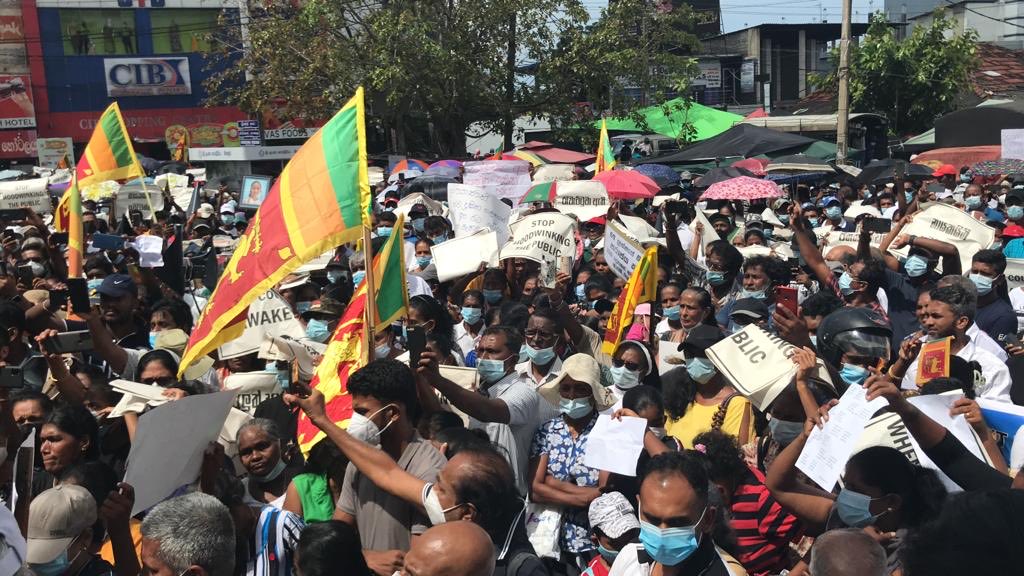
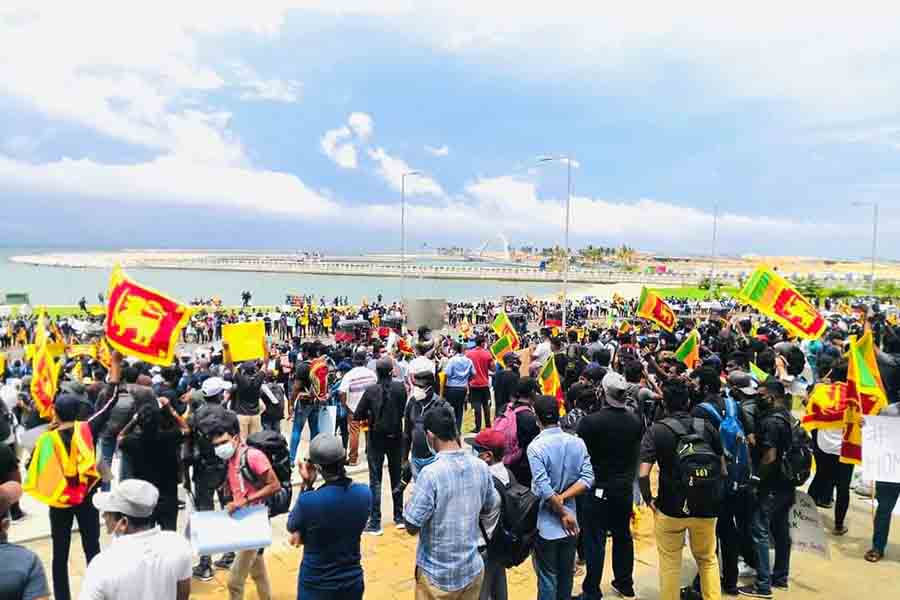
The economic pain has caused growing anxiety and frustration among Sri Lankans, with many of them blaming the government of mismanaging the economy.

Tax cuts and pressure on public finances

The economic emergency poses a significant challenge for President Gotabaya Rajapaksa, who came to power in 2019 promising rapid economic growth.

During his presidential campaign, Rajapaksa promised to cut the 15% value-added tax by nearly half and abolish some other taxes as a way to boost consumption and growth.

The tax cuts led to a loss of billions of rupees in tax revenues, putting further pressure on the public finances of the already heavily indebted economy.

Then came COVID, which dealt a huge blow to the tourism sector, which accounts for over 12% of the nation’s total economic output.

Sri Lanka’s public debt, which was already on an unsustainable path before the pandemic, is estimated to have risen from 94% in 2019 to 119% of GDP in 2021.

“The reduction of taxes and subsequent adding of more money through central bank financing made the inevitable crisis significantly worse,” said Chayu Damsinghe, an economist with Frontier Research group.

India, China and IMF to the rescue?

To address the economic problems, Rajapaksa’s government has restricted imports of several items which have been declared “non-essential.”

It has also approached India and China for assistance.

It’s reported on Monday that Colombo has sought an additional credit line of $1 billion from India to import essential items, after Sri Lankan Finance Minister Basil Rajapaksa signed a $1 billion credit line with New Delhi earlier this month.

In addition to the credit lines, India extended a $400-million currency swap and a $500-million credit line for fuel purchases to Sri Lanka earlier this year.

Meanwhile, Sri Lanka has asked China to restructure its debt repayments to help navigate the financial crisis. The country is also in talks with China for a further $2.5 billion in credit support.

Despite the bilateral deals, economists say Sri Lanka will have to either restructure its debt or approach the International Monetary Fund (IMF) to negotiate a relief package.

After initially refusing to knock on the doors of the IMF, Rajapaksa’s government recently said it would begin talks with the global financial situation to seek a way out of the crisis. Rajapaksa is set to fly to Washington, D.C. next month to start negotiations for a rescue plan.

What is happening in Sri Lanka? Why does it not have money?

A couple of millennia ago, most villages were economically self-sufficient. They produced everything that the residents needed. But modern nation-states are seldom self-sufficient though the globe itself is now a village. They export their surplus. They earn and save foreign reserves. And, they import to cover their deficiencies. Sri Lanka’s current problem is it does not have enough money to buy what it needs from outside world.

RIGHT NOW
Sri Lanka has sought a $1 billion credit line from India to cover the import of essentials, news agency Reuters has reported as the island nation battles through its worst economic crisis in decades.

This is in addition to $1 billion India has already pledged to bail out Sri Lanka, which is struggling to pay for the essential imports including food and fuel.

HOW BAD IS IT?
Its foreign exchange reserve has dipped 70 per cent since January 2020. Sri Lanka’s foreign currency reserves fell to $2.31 billion in February a fall by $779 million from December 2021 through January 2022.

This stalled its imports leading to acute shortage of several essential items. Its currency has undergone substantial devaluation. Its efforts to find generous global lenders have not been very successful.

LANKAN DEBT
Sri Lanka’s debt burden has become unmanageable for the country if a proper bailout package is not given to the country from an international financial agency or group.

Sri Lanka is obligated to repay debt of about $7 billion in 2022. One of the debts is of $1 billion in the form of international sovereign bond that matures in July.

Sri Lanka’s public debt has risen (in projection) from 94 per cent of its gross domestic product (GDP) in 2019 to 119 per cent of the GDP in 2021, the International Monetary Fund (IMF) said in early March.

International ratings agencies have downgraded Sri Lanka’s credit ratings. Market observers fear that Sri Lanka may not be able to service its $51 billion sovereign debt this year.

INDIAN AID
India has reportedly assured Sri Lanka that it would extend the credit line to meet the imports of essential items such as rice, wheat, wheat flour, pulses, sugar and medicines.

Besides the two $1 billion credit lines, India earlier this year extended a $400 million currency swap, and another $500 million credit line for buying fuels.

This is in addition to the Chinese currency swap facility amounting to $1.5 billion in 2021.

LIFE IN LANKA
Lankans are having real tough time. Its banks are unable to secure dollars to finance imports of any kind including food, fuel and medicines. The Covid-19 pandemic only aggravated its economic woes since January 2020, after which the spread of coronavirus shell-shocked the world into separate cocoons.

Prices have sky-rocketed. Each of the past five months has recorded a new high of inflation rate. In February, inflation rate was pegged at 17.5 per cent. Food prices rose by 25 per cent. This increase in prices happened on January’s inflation rate of over 14 per cent.

Stalled imports of the essentials forced the government to resort to stricter rationing. For example, against one kg of milk a day, a Sri Lankan can now buy only 400 grams of milk a day.

Sri Lankan cities are facing daily power cuts of over five hours. Reports say people are forced to stand in kilometer-long queues to get cooking gas cylinders and petrol-diesel.

NOT TODAY’S PROBLEM
If Rome was not built in a day, a crisis does not arrive in a blink. Sri Lanka’s economy has had structural problems for several years. The successive government took short-cuts to address the issues.

For example, every government in the past 15 years issued sovereign bonds without provisioning for repayment. Its foreign exchange reserve increased but not through export of goods and services but from borrowing foreign currencies. This left its forex reserve vulnerable to market shocks.

In 2019, the Sri Lankan government announced substantial tax cuts which ended up lowering its revenue. Its loan arrangements with China too contributed to this crisis. Most of Chinese loan of over $5 billion in the past decade went to low-return projects such as construction of ports, airport and coal power plants.

During the Covid-19 pandemic, its foreign remittances nosedived, and foreign exchange booster tourism sector practically crumbled. Tourism sector is among the top earners for Sri Lanka. But the sector took a hit after Easter bombing in 2017. Before it could recover, the Covid-19 pandemic hit the world hard.

When Covid-related curbs started lifting, tourist inflow was heavy from Russia and Ukraine, amounting to about 25 per cent up to mid-February. The Russia-Ukraine war and consequent sanctions on banking in Russia had a ripple effect on Sri Lanka. Its traditional tourist sources India, China, the UK and Germany have not recovered to pre-Covid levels.

The Covid-19 pandemic exposed the vulnerabilities and put Sri Lanka in a situation where it appears clueless about how to exit from this financial mess.

Surgeries resume at Peradeniya Teaching Hospital

The Peradeniya Teaching Hospital has resumed surgeries after the Medical Supplies Division assured that the required medicines will be delivered.

Indian External Affairs Minister Dr. S. Jaishankar expressed his concern over the Peradeniya Teaching Hospital running short of medicines for surgeries.

“Disturbed to see this news. I am asking High Commissioner Baglay to contact and discuss how India can help,” he tweeted after a News 1st SMS alert was shared on Twitter by a social media user.

All scheduled surgeries at the Peradeniya Teaching Hospital were suspended with effect from Tuesday (29) due to the shortage of medicine.

Sources said that ONLY emergency surgeries will be carried out at the hospital.

Dr. R.M. Saman Kusumsiri Rathnayake, Secretary State Ministry of Production, Supply and Regulation of Pharmaceuticals told News 1st that a delay from the supplier attributed to this situation, adding that one medicine required for surgeries is currently unavailable.

He said that the necessary measures were taken to procure the said medicine.

However, he said that the Peradeniya Teaching Hospital and several other hospitals are in possession of the medication, yet, the dosage is very low.

Following the Indian External Affairs Minister expressing concern, the Indian High Commissioner had spoken to the University of Peradeniya and inquired into the requirement of medicines to continue regular and scheduled surgeries.

Wimal hints at forming new opposition group

Former Minister and Government MP Wimal Weerawansa has hinted at moves to form a new opposition group and sit in the opposition benches in Parliament.

Speaking during a live television program last night, Weerawansa said that he and former Minister Udaya Gammanpila are currently sitting as independent MPs in Parliament.

Asked if he is now a member of the opposition, Weerawansa responded saying “not yet”.

He said that there are several political parties in the opposition, including the Samagi Jana Balawegaya, JVP and Tamil National Alliance.

Weerawansa said that there is a move no form a new group in the opposition and several are expected to join it.

The former Minister said that their intention is to ensure the Government loses its majority in Parliament.

He said that if the Government loses its majority then there will be pressure on Finance Minister Basil Rajapaksa to step down.

Weerawansa said that what is required today is not for the President to step down but for the Finance Minister to be removed.

Posted in Uncategorized

Jaishankar inaugurates India-made Jaffna Cultural Centre in Sri Lanka

External Affairs Minister (EAM) S Jaishankar and Sri Lankan Prime Minister Mahinda Rajapaksa on Monday virtually inaugurated the Jaffna Cultural Centre constructed by Indian grant.
In Colombo, both ministers witnessed the signing of an agreement on supporting Buddhist culture and heritage. They also virtually toured an ongoing camp in Jaffna on fitting ‘Jaipur Foot’.
“Thank Prime Minister @PresRajapaksa for his gracious welcome. Our discussions were followed by some notable events: Witnessed the signing of an agreement on supporting Buddhist culture and heritage. Virtually toured an ongoing camp in Jaffna on fitting ‘Jaipur Foot’. Virtually inaugurated the Jaffna Cultural Centre constructed by India,” Jaishankar tweeted.

The purpose of the Jaffna Cultural Centre is to provide suitable social infrastructure for the people of the Northern Province, especially for the people of Jaffna, to help them to reconnect with their cultural roots as well as to the rest of the country and to rejuvenate and nurture the ancient cultural heritage of Jaffna.

The Centre will enable the people of Jaffna to enjoy various local and international cultural products. It would also serve as a delivery centre for training, instruction and education in a variety of cultural disciplines. The Centre is developed as an iconic building that will emerge as a cultural forum that embodies coexistence and cooperation amongst the various communities on the island.

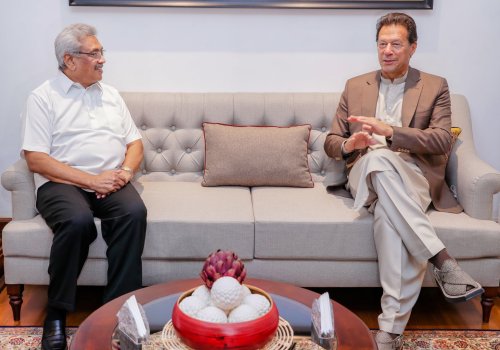
Jaishankar arrived in Colombo on Sunday. He called on Sri Lankan President Gotabaya Rajapaksa as part of his three-day visit.

He reviewed various dimensions of India-Sri Lanka’s close neighbourly relationship and assured Gotabaya of India’s continued cooperation and understanding.

“Pleased to call on President @GotabayaR of Sri Lanka. Reviewed various dimensions of our close neighbourly relationship. Assured him of India’s continued cooperation and understanding,” Jaishankar tweeted.

During the meeting, Sri Lankan President thanked Jaishankar for assistance in form of a USD 1 billion credit line.

“Met with Indian Foreign Minister @DrSJaishankar today, and I expressed my gratitude to the Government of #India for the invaluable assistance provided recently via the line of credit, on behalf of the people of #lka,” wrote the official Twitter account of The President of Sri Lanka.
During his bilateral visit, Jaishankar will also attend the BIMSTEC (Bay of Bengal Initiative for Multi-Sectoral Technical and Economic Cooperation) meeting.

(ANI)

Posted in Uncategorized

SLPP squashes rumours: Ranil Won’t be Appointed PM

Sri Lanka Podujana Peramuna (SLPP), while challenging the recently ousted MPs Wimal Weerawansa and Udaya Gammanpila to make the Government lose its majority in Parliament, as they claimed they would, also squash speculation that UNP Leader, Ranil Wickremesinghe would soon be appointed as Prime Minister of a soon-to-be-formed National Government.

SLPP MP and Minister Rohitha Abeygunawardena addressing a media briefing yesterday (28) when Gammanpila and Weerawansa have time and again said the Government will lose its majority in Parliament but has not done anything to that effect.

Abeygunawardena said, certain people have issues with the Minister of Finance Basil Rajapaksa and are trying to slander him, noting that Rajapaksa was the one who formed the SLPP and has worked relentlessly to make it victorious.

He rejected claims that UNP MP Wickremesinghe would be appointed Prime Minister. Meanwhile, General Secretary of the SLPP Sagara Kariywasam added the most suitable person to be Prime Minister is currently in office and there is no need to make any change.

Kariyawasam said the Government is strong and will overcome the economic crisis and will secure a huge win in the next election.

Weerawansa on 23 March, stressed that they will ensure the Government would lose its majority in Parliament, while visiting Malwathu and Asgiri Maha Nayaka Theras in Kandy to present proposals of 11 constituent parties of the Government.

Posted in Uncategorized

Crisis-hit Sri Lanka seeks further US $ 1bn credit line from India: sources

REUTERS: Sri Lanka has sought an additional credit line of US $ 1 billion from India to import essentials amid its worst economic crisis in decades, two sources said yesterday, as the Indian foreign minister began talks with the government of its neighbour.

The island nation is struggling to pay for essential imports of food and fuel after a 70 percent drop in foreign exchange reserves since January 2020 led to a currency devaluation and efforts to seek help from global lenders.
New Delhi has indicated it would meet the request for the new line, to be used for importing essential items such as rice, wheat flour, pulses, sugar and medicines, said one of the sources briefed on the matter.

“Sri Lanka has requested an additional US $ 1 billion credit line from India for imports of essentials,” the second source said.
“This will be on top of the US $ 1 billion credit line already pledged by India.”
Both sources declined to be identified as the discussions were confidential.
The finance and foreign ministries of Sri Lanka, as well as India’s foreign ministry, did not immediately respond to requests seeking comment.

Sri Lankan Finance Minister Basil Rajapaksa signed the earlier credit line of US $ 1 billion this month in the Indian capital of New Delhi to help pay for critical imports.
Indian Foreign Minister Subrahmanyam Jaishankar met Rajapaksa yesterday after arriving in the Sri Lankan capital of Colombo late the previous day.

“Discussed the economic situation and India’s supportive response,” Jaishankar said on Twitter, with a photograph of the two officials next to each other.

In addition to the credit lines, India extended a US $ 400 million currency swap and a US $ 500-million credit line for fuel purchases to Sri Lanka earlier this year.

Sri Lanka’s imports stalled, causing shortages of many essential items, after foreign currency reserves fell to US $ 2.31 billion by February.

The nation just off India’s southern tip has to repay debt of about US $ 4 billion in the rest of this year, including a US $ 1 billion international sovereign bond that matures in July.
Rajapaksa is set to fly to Washington, D.C. next month to start talks with the International Monetary Fund (IMF) for a rescue plan.

“India is also very supportive of Sri Lanka’s decision to seek an IMF programme and has given their fullest support,” one of the sources added.

Foreign Minister briefs South African Ambassador on reconciliation efforts

Minister of Foreign Affairs Prof. G.L. Peiris discussed the reconciliation efforts underway in Sri Lanka with Ambassador of South Africa Sandile Edwin Schalk, at the Ministry of Foreign Affairs last Friday (25), as per a Foreign Ministry media release.

The ministry stated that the main focus of the discussion was the experience of the Truth and Reconciliation Commission of South Africa. The Foreign Minister explained to the Ambassador that it was the intention of the Government of Sri Lanka to closely study the positive experiences of other countries, while taking care to ensure that these experiences were creatively adopted to suit the circumstances of Sri Lanka.

Ambassador Schalk comprehensively briefed Prof. Peiris on all aspects of the process in South Africa, and on various initiatives by former South African President Nelson Mandela upon his election as President.

Prof. Peiris had said last week, at a media briefing held jointly with US State Department Undersecretary for Political Affairs Victoria Nuland, following the fourth Sri Lanka-US Partnership Dialogue in Colombo, that the Government hopes to develop a truth-seeking mechanism, similar to the one used in South Africa, as part of Sri Lanka’s reconciliation process.

“The Nawaz Commission of Inquiry (CoI) report is very informative. One of its recommendations that we want to develop is the truth-seeking mechanism. Here, we do not wish to reinvent the wheel. There is no purpose in going back. No two situations are exactly alike, when we look at the experiences of other countries such as South Africa in particular. But we are always taking care to adopt the successful experiences of other countries to suit the circumstances in our country,” Prof. Peiris had said.

He added that the assistance of the US is “most welcome” in this endeavour of a truth-seeking mechanism.

Nuland had said that the notion of setting up a truth-seeking mechanism is a “very good step” and that the US looks forward to supporting Sri Lanka in that process.

“Setting up a truth-seeking mechanism, as other countries with difficult histories have done, particularly taking advantage of the South African experience, is a very good step,” she noted.

Posted in Uncategorized

Dissenting parties plan to dissolve Parliament

The 11 parties which unveiled their own manifesto recently, despite being the coalition partners of the incumbent Sri Lanka Podujana Peramuna (SLPP)-led Government, plan to present a motion to Parliament to dissolve Parliament, as soon as nine more SLPP Members of Parliament (MPs) join their group.

Speaking to The Morning yesterday (27), Pivithuru Hela Urumaya (PHU) Leader MP Udaya Gammanpila said that only nine more MPs need to join their group to pass a motion to enable the dissolution of Parliament, as there are two SLPP MPs with them already.

“We need only 11 SLPP MPs to defeat the Government. However, when a motion is submitted to Parliament, there may be last-minute changes in the minds of certain MPs. For instance, MPs are vulnerable to various perks such as ministerial portfolios, vehicles, and cash rewards. There may also be threats to expose certain MPs’ misconduct and corruption. Therefore, we need MPs three times higher than the actual requirement, so we need 33. This is so that we can be 100% confident that a motion is passed in Parliament. Right now, we have 24 and as soon as the remaining nine MPs join us, we plan to submit such a motion,” he said.

The said 11 parties including the National Freedom Front (NFF), the PHU, and the Sri Lanka Freedom Party (SLFP) last week warned that they would soon collectively take away the parliamentary majority of 113 seats enjoyed by the current Government.

Asked if they would be able to get the support of the remaining nine MPs any time soon, Gammanpila said that the support of those MPs would be delayed if the public was to receive some relief thanks to the Indian credit line. However, he claimed, even if so, “things” would worsen again in some time, and that it would be possible to get the MPs’ support at such a time.

When the said 11 political parties’ representatives met the Mahanayakes (chief prelates) of the Malwathu and Asgiri Chapters of the Siam Sect on 24 March, Gammanpila said: “Our 11 parties have 30 MPs. When those 30 are removed, the Government will be left with only 124 seats. As soon as another 12 MPs quit the Government, it will lose its parliamentary majority. Because of the mad things this Government is doing, there are far more than 12 MPs who are extremely disappointed and disillusioned.”

NFF Leader and SLPP Government MP Wimal Weerawansa, during the meeting and speaking to the media afterwards, stated that it would not be difficult to take away the parliamentary majority of the Government.

“An all-party conference was convened for all parties to work together in unity, but Finance Minister Basil Rajapaksa has shown that he is arrogant so much so that he called a former Prime Minister (a reference to incumbent United National Party (UNP) Opposition MP Ranil Wickremesinghe) ‘you’. He wants to create a conflict there as well. This country cannot move forward with such an arrogant, ‘ugly American’. We will soon end this Government’s majority of 113 seats and thereby put an end to this arrogant regime,” he claimed.

Following the said 11 parties of the Coalition Government having unveiled the “Mulu Ratama Hari Magata (the entire country on to the correct path)” document – a set of proposals to overcome the current economic crisis in the country – on 2 March, Weerawansa was removed from the post of Industries Minister. In addition, Gammanpila, who attended the launch of the said proposals, was also removed from the post of Energy Minister.